
With the arrival of spring this week, it is time to clean out and consolidate the stuff in my storage locker(s) at the EA. This is almost as much fun as going to the dentist. Only much more tiring and I am still cursing all of the stuff that I moved here from Denver.
Also, my boy is coming on Friday for 10 day spring break. So lucky he wants to spend it with his mom!

This wonderful and aged camellia is still blooming. It has been blooming its sweet heart out for about 6 weeks now.


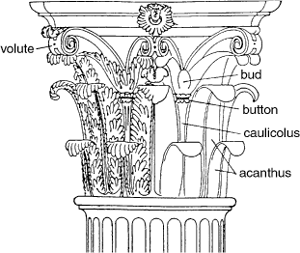
Here is a picture of the acanthus plant that grows with ease here in this temperate, moist climate. I love acanthus because its leaves were the inspiration for the order of ancient Greek capitals known as Corinthian, see above and below. If you remember Art History 101 you will recall Doric, Ionian, and Corinthian capitals. It still amazes me that I am living in a place I can grow acanthus, and I have recently planted three of them in my “experimental gardens” at the EA.
By the way, have you taken an online course with Coursera yet? I just enrolled in four courses on a range of topics from English common law to Greek civilization. The course on Greece was launched yesterday, and I am one of 30,000 online students taking the course taught by a prof from Weslyan University in Connecticut. Some of us are busy introducing ourselves online, and we have students of all adult ages from Manilla, Russia, Australia, Spain, India, just to name a few, and students from all over the U.S. (including, incredibly, at least one mensa student of the ripe age of 11). The lectures are online, as are the readings. I finished the first unit on Minoan and Mycenaean cultures yesterday, and took the quizzes. Eventually, if I pass all the quizzes (ha ha), I will get a certificate of course completion. Obviously I am not working toward another degree, but it is very interesting and a brave new world.
Here’s some dope on the course, and visit here for more info: https://www.coursera.org/
Current Session:
Mar 18th 2013 (7 weeks long) Go to class Enroll in Signature Track
Workload: 2-4 hours/week
About the Course
This course is a survey of ancient Greek history, covering the roughly 13 centuries that extended from the Minoan / Mycenaean Bronze Age (ca. 1800-1200 BCE) down to the death of Socrates in 399 BCE. Along with studying the most important events and personalities, we will consider broader issues such as political and cultural values and methods of historical interpretation.
Some of the topics we will cover include: relations between the Greeks and their neighbors to the East; Homer and the heroic ideal; the development of the type of community called the “polis”; the diffusion of Greek civilization from Southern Italy to the shores of the Black Sea; gods and mortals in myth, religion and ritual; the roles of women; Athenian drama; the treatment of slaves and foreigners; and the birth and evolution of democracy. We will strive to get as full an understanding as we can of this extraordinary, and extraordinarily influential, society.
Almost all the reading assignments are from ancient sources in translation. No previous knowledge of ancient history is assumed.
 get back, lauretta!