Resuming the fashion story from Part 1 and all photographs are from the Giorgini Archivio in Florence or from Google Images:
Once Count Giorgini got the Italian high fashion ball rolling on the heels of the highly successful catwalk shows he initiated in Florence in the early 1950s, buyers from all over the world were knocking on the doors of the new Italian ateliers, placing orders around the clock.
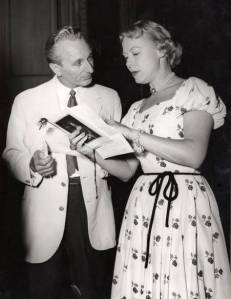
In this photo from the Giorgini Archive in Florence, we have Count Giorgini and the buyer from an American department store, c. 1952. (Is it just me or does everyone wonder how a woman dressed like this could be entrusted as a buyer for a leading American department store? It’s hard to see how her look is one that should be duplicated.)
Simultaneously, Hollywood royalty likewise descended upon Italian fashion houses. Stars such as Audrey Hepburn and Elizabeth Taylor; directors like Alfred Hitchcock; and even politicians including President Harry S. Truman (President of the US from 1945-1951) all found their way to the Italian fashion shows and supported the new ateliers.

The photo above, also in the Giorgini Archivio, Florence, shows Count Giorgini with the American actress Gloria Swanson.

Elizabeth Taylor was seen on and off the set in Rome where she was filming Cleopatra.

Audrey Hepburn filmed Roman Holiday in Rome in 1952 and was a general jetsetter throughout the 1950s and 1960s
The picture below shows Alfred Hitchcock and his wife boarding a plane in Rome in the 1960s.


Above, Hitchcock at a press conference in Rome, mid 60’s.

Above, Hitchcock in Italy. Below he directs Birds, and from the way his actresses are dressed, you know he was highly interested in high fashion from Italy and elsewhere.


Above is President Harry S. Truman and his wife landing with friends in Naples. Below is proof that the President knew how to shop!

Count Giovanni Battista Giorgini played a major role in all the high fashion shows in Italy until 1965. Every year he made sure that new ideas and new talents were showcased in his shows.
The photo below, from Giorgoni Archivio, shows the Count with his models and other principal players in the fashion extravaganzas.

In the 1960s, Giorgini took a gamble on another new challenge, the development of a market for Italian design in Japan. Some of the relationships he began that far back are still important for the Italo-Japanese relationship today. Among the most important Japanese clients is Isetan, one of the largest department stores in that country.

The Isetan flagship store in Shinjuku is considered to be one of the most influential department stores in Japan. The store is often first with showcasing new trends and new products. In particular, the fashion and food floors are thought to be very trendsetting.
Once again, Count Giorgini successfully called the Japanese market place for high western fashion long before any other westerner even thought of the idea. Proof is the fact that Vogue magazine developed a very successful Japanese edition.

The section below attests to the Japanese interest in Italian design:
Dolce and Gabbana Alta Moda for Vogue Japan

This stunningly beautiful editorial, La Canzone Del Mare, showcases the latest Dolce and Gabbana Alta Moda collection for Vogue Japan’s October 2014 issue. Photographed by Boo George, it was shot in Capri, Italy – also where the Italian design duo presented their fall collection in July.
The ultra luxurious fashions were modeled by Dalianah Arekion, Nadja Bender and Kinga Raziak, with styling by Anna Dello Russo and Giovanna Battaglia.
Getting back to what 1960s fashion looked like in Italy, the following section is (taken from this site: http://www.moda.com/fashion-history/60s-italian-fashion-1.shtml) a perfect way to enter the period.
1960s Italian Fashion  Red pants and top with black shoes, from 1966. Red pants and top with black shoes, from 1966. White with green and purple flowers dress and coat, from 1960. White with green and purple flowers dress and coat, from 1960. Morning dress of red fuchsia wool, corded silk hat. By Sarli fashion house in Rome. Inspired by the Russian line. Morning dress of red fuchsia wool, corded silk hat. By Sarli fashion house in Rome. Inspired by the Russian line. Evening dress yellow satin, printed big red and pink flowers. By Eleanora Garnett fashion house in Rome. From 1960. Evening dress yellow satin, printed big red and pink flowers. By Eleanora Garnett fashion house in Rome. From 1960. Hot pink wool ensemble. Collarless, cardigan jacket straight-lined and slashed across the hips with a giant bow of pink velvet. By Fontana Sisters’ fashion house in Rome. From 1960. Hot pink wool ensemble. Collarless, cardigan jacket straight-lined and slashed across the hips with a giant bow of pink velvet. By Fontana Sisters’ fashion house in Rome. From 1960. Black dress with multicolored flowers. By Cesare Guidi. From 1960. Black dress with multicolored flowers. By Cesare Guidi. From 1960. Two-piece sports dress, pants of elastic jersey, loose shirt of laminated silk. By Emilio Schuberth fashion house in Rome. From 1960. Two-piece sports dress, pants of elastic jersey, loose shirt of laminated silk. By Emilio Schuberth fashion house in Rome. From 1960. Evening dress, made of pink silk, embroidered with silver paillettes. By Fabiani fashion house in Rome. From 1960. Evening dress, made of pink silk, embroidered with silver paillettes. By Fabiani fashion house in Rome. From 1960.
Afternoon dress, white silk jersey with blue flowers, blue woolen jersey overcoat. By Mirsa fashion house in Rome. From 1960.
Evening dress, emerald-green, golden and black brocade. By Renato Balestra fashion house in Rome. From 1961.
Golden tan cape, made from shantung organdy. By Renato Balstra fashion house in Rome. From 1962. |
||


 get back, lauretta!
