K is for Kalighat pata. Say what?

About 8 months ago I had the incredible privilege of what I imagine will be a once in a lifetime trip to India. I would go there again in a heartbeat if it weren’t so very costly, but there are just too many other countries I also want to experience.  India hit me really hard.  I felt like I was caught up in a primordial stew of humanity and it has taken me six months, at least, to begin to process what I saw and felt in the overwhelming sub-continent. This is the first time I’ve gone public, so to speak, the first time I even broach the subject of India.  My blood pressure rises just thinking about that place.  It was wonderful and horrible, in about equal measure, about all of the time, in my experience.  I was knocked out by the beauty, elegance, and sophistication of many aspects of the country’s culture.  I was also knocked out by the human and animal rights violations I saw, the misogyny I felt, and the absolute lack of hope for the majority of that vast population.  The suffering and squalor I witnessed in India was overwhelming to me.  I always attempt to be, as Thoreau advised, a transparent eyeball, taking in as much as I can without judgment.  Indeed, in India I felt like a camera set on “panorama,” unable to adjust to the incoming sensory load. The sensitive tissue of my brain was absolutely overexposed.  I came home in a daze that lasted for months; I felt like I’d been hit up the side of the head with a cricket bat, psychologically speaking.  You know the Indians love cricket as much as the Brits, right?  The Brits brought the sport to India, and from what I saw, it took.

Still, India fascinates me and I like to think about it more and figure some things out.  I do that by writing.  So, today I continue my sojourn through the alphabet with art as its signifier.  The letter K is up next.  I think if I can begin with this Sesame Street approach, I should be fine (ha ha).

Lady-with-a-peacock Lady with a Peacock

The following paragraphs are lifted more or less directly from Wikipedia. I have edited them to improve them and make them fit my style of writing.  But, I can take no credit for the facts. I would not be ready to do that, even if I were an expert on the subject!  I am still wobbling from my visit.

Kalighat pata is a style of Indian painting that derives its name from the place known as Kalighat (Bengali: কালীঘাট), a vibrant and densely populated section within Kolkata (Calcutta). One of the oldest neighborhoods in that teeming city, Kalighat has always been densely populated and extremely vibrant, with a rich history of cultural intermingling from the various foreign incursions it has experienced. The art known as Kalighat pata is characterized by generously curving figures of both men and women presented in an earthy, simplified, satirical style. It was developed during the 19th century, in response to the sudden prosperity brought to Calcutta by the East India Company trade, whereby many private businesses became incredibly wealthy.  Many of these nouveau riche  came from not particularly exalted caste backgrounds, so the higher classes tended to look down on them and their often very tasteless conspicuous consumption. The common people, known as babus, thus became subjects of that very noble human characteristic known as ridicule (okay, that is entirely Lauretta’s satirical addition). Thus, the ‘babu culture’ portrayed in Kalighat pata often shows inversions of the standard social order, such as maidservants upsetting norms by wearing shoes; sahibs in undignified postures; and domestic contretemps including depictions of wives beating — or leading about in the guise of pet goats or dogs — their husbands. Kalighat pata would also often show babu making use of European innovations, such as, for example, wearing European clothes, smoking western-styled pipes, or reading at imported desks. In fact, the Kalighat pata was only in part satirical for it also expresses the wonder that ordinary Bengalis felt upon exposure to these new and curious ways and objects of Western life.

courtesan-kalighat-painting-PA02_lCourtesan

Kalighat pata pictures are highly stylized, do not make use of perspective, and are usually pen and ink line drawings filled in with flat bright colors and typically use paper as the support. The practitioners were rarely educated, usually coming from a lineage of artisans. Kalighat patas are still made today, although genuine work is hard to come by. Can you imagine what Picasso would have done in his art had he visited India?  Wow, what a fun line of thought that is (Lauretta speaking).

Picasso  This is a Picasso, achieved without looking at Kalighat pata.  You can see where my idea came from!

The Kalighat pata art form is urban and largely secular, although gods and goddesses are sometimes depicted. When they do appear, they are no more romanticized than the humans in the paintings.

The_demon_ravana_fighting_with_the_ape_hanuman,_1880,_kalighat_school The demon Ravana fighting with the ape Hanuman, 1880

Okay, then, that didn’t hurt too much, did it?  I am still breathing so I know there is hope yet :-)).

L is for Life = Art

get back, laurettadimmick's avatarget back, lauretta!

I think Life with a capital L can be a work of art if it is a Life well-lived.  So, how do you define a well-lived life?  Well, for me it means my days include something that feeds my soul and my hunger for beauty.  This can be looking at a painting by Vermeer, a glass installation by Dale Chihuly, or a natural sight such as Lake Washington.  I can get all of these without going very far from home.

Or, for me, it could also be watching a ballerina rehearse.  I’ve seen a fair number of ballerinas rehearsing lately for the Pacific Northwest Ballet company and I marvel at how beautiful they are to watch.  Their young, gorgeous, attenuated bodies don’t hurt either.

It could as well be reading a great book. Or, eating an incredible meal or drinking a nice wine. Or, walking under a tree in autumn…

View original post 60 more words

Uh, whoops. Almost a year later.

get back, laurettadimmick's avatarget back, lauretta!

It has been almost a year since I was motivated to write here.  Darn.  So much has happened. Some good, some bad; c’est la vie.

So, l wonder if I can recharge this blog.  Let me see, I left off with the alphabet from z to a using art.  I’ll try to get started where I left off.  I’ll think for a few minutes to see what I can dream up for the next letter.

View original post

M is for Masaccio

masaccio_banner

While most people know who Leonardo, Michelangelo, and Raphael were, fewer are aware of Masaccio (1401-1428).  He is a major Renaissance master, who deserves to better known outside of the insiders of art history.

Many of his paintings are in Florence. Here is one of his masterworks, a fresco depicting the Trinity in the church of Santa Maria Novella.  Just about everything you need to know to be a cognoscenti of Italian Renaissance painting is captured in this one work.

Masaccio_003

Let’s start at the outside and work our way in.

1.  First of all, the architectural details that you see in the work are painted, not an actual part of the wall.  So, the architecture we see here, the half-columns with their Ionic capitals and the fluted pilasters with their Corinthian capitals, the architrave, the arch, and the coffered ceiling are all a part of Masaccio’s composition.  The lightness of this beautifully conceived architectural setting drew its inspiration from the actual architecture of another Italian master, Brunelleschi.  Brunelleschi’s masterworks are also to be found in Florence and Masaccio most certainly was a student of the architect.  Not literally his student, but figuratively. Masaccio has depicted what appears to be an actual chapel in a side wall of the nave of Santa Maria Novella.  He gives us a very convincing extension of virtual space.

2.  The ceiling alone, with its coffers that appear to recede into the background by becoming smaller, manifests a hallmark of Renaissance painting.  All previous painters (in the western world) had either ignored how actual vision operates, or attempted to show it but did so unconvincingly.  We are talking Egyptian, Greek, Roman, Byzantine and Gothic art.  But, in Florence, in the 15th century, painters started to study how vision operates and they, along with architects and sculptors of the period, began to codify it.

You can think of perspective in this easy way: picture the way two railroad tracks recede into space as you stand looking at them from head-on.  As the tracks move back into space, they appear to come together on the horizon.  Of course we know that they don’t, actually, come together, but that reveals how our vision operates.

That is how Masaccio’s ceiling works in this painting.  It isn’t an accident.  It is the result of study and awareness of other master’s works.  Here is a detail of the ceiling with an overlay of a system of orthogonals that reveal exactly how Masaccio’s geometric ceiling is composed.  All of the diagonal lines, or othogonals, if carried to the furthest point in space, would converge at a single point.  The system of space in Renaissance art is thus call one-point perspective.  Masaccio gives us a case-book example.  Thank you, M., for making this so clear for us!

vault2

3. In the lower register of the painting, one either side in front of the pilasters, kneel two figures dressed in red and blue; one is male, the other female. Do you know who they are?  Think of your reading of the Bible.  When you picture the Holy Trinity, who do you automatically assume will be involved?  God the Father, God the Son, and the Holy Ghost, of course.

In addition to the two kneeling people, there are two figures standing below the crucifixion.  They are not surprising to find here: they are Mary, the mother of Jesus, and St. John the Evangelist.  I’ll come back to them as well.

So, the two kneeling figures are NOT a part of any passage in ANY Bible.  That is because they are actually portraits of two contemporaries in Florence, perhaps even the man who commissioned this painting for the church.  We assume they are the donor and his wife.

Think about the audacity of that!  If you were a wealthy patron of a local church in the town where you live, and you commissioned the most famous painter in your town for the most important church in your city to paint the Holy Trinity, would you specify that the painting needed to include a portrait of you and your partner?  I’m guessing you wouldn’t!

But in Florence in the quattrocento (the 15th century), this became an acceptable practice.  It has a lot to do with how the 15th century educated mind worked in Florence.  The term “renaissance” refers of course to “rebirth” and what that meant was that the cognoscenti in Florence and Rome and other places around Italy were obsessed with the rediscovery of classical Greek and Roman writings and artworks.  Wealthy men vied against other wealthy men to outbid each other in buying up coins, manuscripts, and other surviving objects from antiquity.  And they studied these objects they bought and began to notice, unlike their Gothic predecessors, that man was the center of the antique world, as opposed to some flight of fancy about a monotheistic god.

Another aspect of this audacious inclusion of the donor and his wife is that the Catholic church, during this period and especially in the not-so-distant future, promoted the expectation that we sinners on earth could “buy” our way out of Purgatory (which was believed to last several thousand years) for any sins of usury etc., by paying for good deeds.  When Julius II was Pope, just a few decades later, he wanted to completely renovate and rebuild St. Peter’s Cathedral in Rome and, to finance it, he sold “indulgences” which meant if you had committed some sin, you could literally buy your way out.  You gave the Church money and the Pope granted you an indulgence, which was believed to be a sort of a golden ticket out of Purgatory and Hell.  Of course this was a huge abuse of the powers of the Papacy and this, along with other profane abuses, led to Martin Luther’s protests and in time brought the Reformation.  But all that is way beyond the scope of this post!

3. Throughout time, once Christianity blossomed, it was relatively rare to depict God the Father.  Artists always felt free to picture Christ, but it seemed and seems almost sacrilegious to depict the Father.  But certain Renaissance painters had no problem experimenting with their picture of Him.  Think of Michelangelo’s famous fresco of God Giving Life to Adam in the Sistine Chapel ceiling.  Masaccio, in the Trinity Fresco, likewise had no difficulty portraying his vision of how God would appear.

sistine1

4. The specific depiction of The Crucifixion is a type known as Christus mortuus, meaning that the death of Jesus has already happened: we see Christ’s body as one that has endured pain but is now past suffering.  Lots of other artists reveled in the opportunity to portray Jesus in the agony and drama of passing into death, but Masaccio has chosen another moment.

Below the cross, stoic Mary does not look at her Son, but raises her hand to somberly recommend Him to us. Her counterpart, St. John the Evangelist, is lost in his own revery of the Crucifixion. He does not involve us in the drama either.  All of these aspects of the scene work together to diminish the terror of Calvary.  The kneeling, quiet Florentines outside the chapel pray to Mary and John to intercede and Christ atones for the sins of all humanity.

5. The Holy Ghost in the picture is represented by a bird-like figure flying between the heads of God and Jesus.  It is really hard to see in this reproduction.  You can do a Google search to find a better picture.

6. In the lower register of the composition, Masaccio painted this scene:

Masaccio_trinity_adams_tomb

That’s right.  You are looking at a skeleton lying atop a grave. Above the skeleton are the these words “Io fu gia quel che voi siete e quel chio son voi anco sarete” (I was once what you are, and what I am, you also will be).  This is a cautionary tale given to us by Masaccio and presumably the donor of the painting.  Yes, the donor seems to state, I am dead.  But, be careful (be devout), for you will be like me sometime in the not too distant future.  In other words, the viewer is warned to be good, for death awaits us all.  Didactic or what?

P is for Jackson Pollock

get back, laurettadimmick's avatarget back, lauretta!

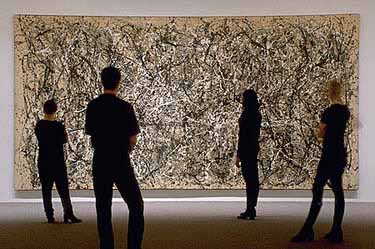
http://upload.wikimedia.org/wikipedia/en/thumb/f/fa/Autumn_Rhythm.jpg/300px-Autumn_Rhythm.jpg

A masterpiece by “Jack the Dripper”

http://upload.wikimedia.org/wikipedia/en/thumb/4/42/Namuth_-_Pollock.jpg/220px-Namuth_-_Pollock.jpg

Many people, when confronted with paintings by Pollock and the New York School, can’t understand what the artist was doing or why.

http://www.beatmuseum.org/pollock/images/pollockgal.jpg

The best way I can explain early modern art is to paraphrase one of the artists working in the style: Traditional painting techniques just didn’t jive with contemporary life.  Realism, perspective, and all of the aims of the western painting tradition from the Renaissance through the mid-19th century, just could not be used any longer to express the developments and atrocities witnessed in the 20th century.  Who wants to look at a perfectly captured painting of an atomic bomb blowing up?  A photograph can capture it.  Leave those subjects for photography and begin to explore other ideas.  Dive into the deep end of your subconscious.

View original post

Q is for Jacopo della Quercia

get back, laurettadimmick's avatarget back, lauretta!

Jacopo della Quercia
031 le vite, jacopo dalla quercia.jpg
Birth nameJacopo di Pietro d’Agnolo di Guarnieri
Born1374
Quercia Grossa (Siena), Italy
DiedOctober 20, 1438
Siena, Italy
NationalityItalian
FieldSculpture
MovementEarly Renaissance
WorksThe Tomb of Ilaria del Carretto

Jacopo della Quercia (c. 1374 – October 20, 1438) was an Italian sculptor of the Italian Renaissance, a contemporary of Brunelleschi, Ghiberti and Donatello. He is considered a precursor of Michelangelo.

The above is all courtesy of Wikipedia.  Thank you Wiki.

Here are multiple views of one of his best-known sculpture, The Fonte Gaia in the Piazza del campo of Siena.

Siena.Campo.Gaia.fountain01.jpgSiena.Campo.Gaia.fountain02.jpgSiena.Campo.Gaia.fountain03.jpg
Left side with Creation of Adam’
Middle section
Right side

Della Querica takes his name from the little town near Siena in which he was born.  During the Black Plague (c. 1350) that killed so many Europeans, people were desperate for an answer as to…

View original post 88 more words

R is for Rialto Bridge in Venezia, Italia!

get back, laurettadimmick's avatarget back, lauretta!

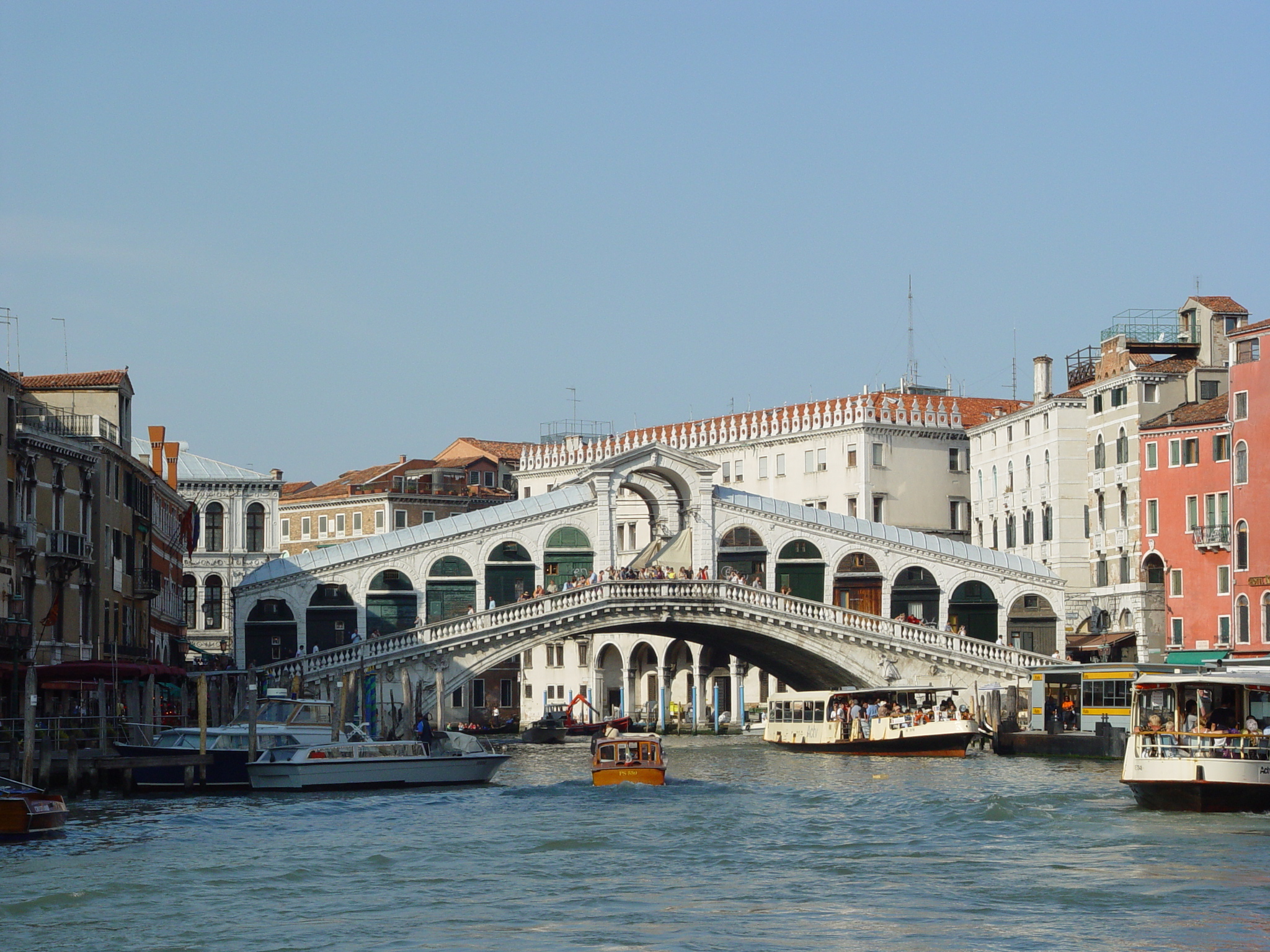
And the winner is:  Erikeno who recommended the Rialto Bridge!  What a great idea!  You can collect your prize in person in September!

http://1photoblog.files.wordpress.com/2009/01/rialto-bridge-grand-canal-venice-italy.jpg

Honorable mention goes to JBragg with the suggestion of Raku ware from Japan.  Thank you JBragg! Here’s a picture for you:

http://www.fukuoka-art-museum.jp/jc/image/jc05/02/kokurakuchawan.jpg

But, back to dreamy thoughts of the Rialto…

http://www.jsu.edu/news/july_dec2004/Rialto%20bridge.JPGIt turns out that early versions of this beloved, gorgeous ponte di rialto were made of wood and it kept collapsing.  About 1585, it was decided to build the bridge in stone and a Swiss-born engineer/architect known as Antonio da Ponte (1512 – 1595) (Anthony of the bridge, are you kidding me?), helped design and build the bridge that has since become the symbol of Venice.

Check out this link for the latest and greatest information.

http://en.structurae.de/structures/data/index.cfm?ID=s0000461


1588 – 1591

View original post

S is for spending the summer with John Singer Sargent

get back, laurettadimmick's avatarget back, lauretta!

Oh my goodness, I have been delinquent!  Sorry, let me get back —pronto— to the reverse alphabet of art. Last post was for the letter T and now I’m ready to move on to the letter S.  Andiamo!

Wouldn’t you love to be passing a summer afternoon with these ladies?  I would!  I bet they are discussing their beaus.

Or, taking a summer afternoon nap to escape the heat in this little outbuilding in Corfu?  I would!

Or, gliding in a gondola over the waterways of Venice?  I would!

Or, observing some exotic ceremony in some Middle Eastern country?  I would!

Or, playing some board game with your friends on some pretty bank of some lovely, cooling stream?  I would!  But I do wonder why all the women have their heads wrapped up in filmy cloth.  Too many insects, I presume.

Mosquito Nets by John Singer Sargent

One activity from which I…

View original post 197 more words