Hey there! You!
The handsome, confident guy in the blue cap!
Ciao bello!
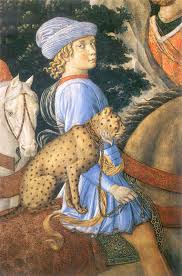
Yes! You! I’m talking to you! The guy with the exotic leopard, riding on a horse. Which is not exactly something you see everyday of the week.
Remember me? I’m your biggest fan.
Where are you going? May I go with you?
Oh! how I love this fresco cycle of which the guy in blue is a part: the Magi Chapel inside the Palazzo Medici in Florence! I think these paintings are my very favorite of all time and that’s a big statement from one who loves art as much as I do. I have very many favorites.
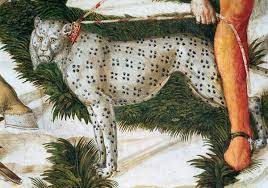
I mean, really, what’s not to love?!
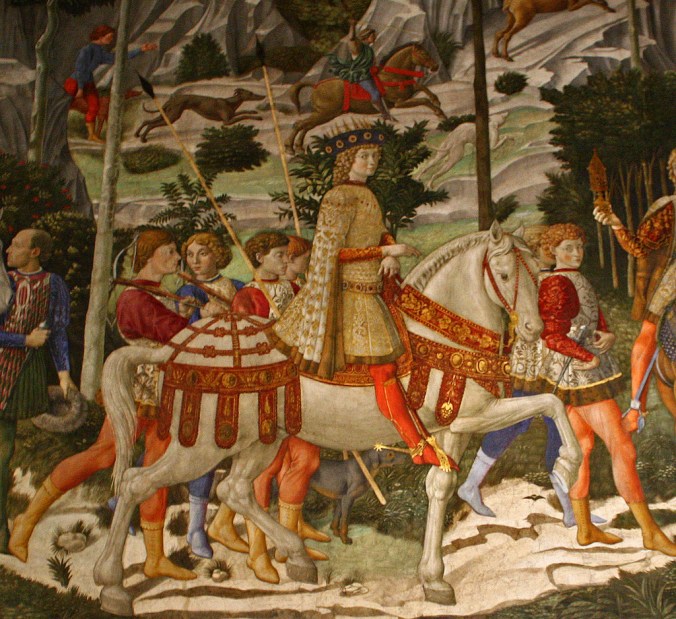
Sumptuous colors, incredible textures, fancy people and exotic animals, who cannot love these paintings? The chapel is a dazzling tour de force, alive with color and movement.
But, before I get completely carried away with the sheer joy of these gorgeous images, let me discuss the celebrated moment depicted in the Magi Chapel.
The scenes take their subject matter from an event that happens every year on January 6. This is the date of the Christian festival celebrating the Epiphany, or the day when the wise men beheld the infant Jesus for the first time.

Also called Three Kings’ Day, this Christian feast day celebrates both the literal visit of the Christ child by the Magi but also the symbolic recognition of the physical manifestation of God the Son as human in Jesus Christ. Put another way, Epiphany proclaims the revelation of Jesus to the Gentiles. It’s a very big deal for Christianity, no doubt about it. Like, the cornerstone.
The visit of the Magi, bringing their precious gifts of gold, frankincense and myrrh to the Holy Family near Bethlehem after the birth of Jesus was a favorite subject for painters of the Renaissance period in Italy. One reason it was so popular, in my opinion, is that like the moment of the Annunciation in the Christian chronicle, the Adoration of the Magi captures one of the most hopeful moments of the story. There is so much pain and suffering in the Christian narrative, heaven knows it is nice to dwell on the occasions for gladness.
Depicting this scene gives any painter the perfect opportunity to use rich colors and scenery, and exotic luxury in general. Since the 12th century, if not before, Florence has been known for its love for and production of luxury goods whether in wool, silk and dyes; hides and leather working; gold; spices; or painted images. It seems a natural for Gozzoli to depict this happy, rich moment of the Christian story for the private chapel of the pre-eminent Florentine family. And, as it turns out, the Medici family had a particular affinity for the Epiphany feast, as discussed below.
The lively frescoes are complimented in the chapel by the precious marble mosaic work flooring, which is divided by elaborate geometric design in extraordinary materials (porphyries, granites, etc.). The chapel is further enhanced with an astonishing ceiling of inlaid wood, painted and generously gilded, attributed to Pagno di Lapo Portigiano. Finally, the elaborate wooden stalls that furnish the chapel were designed by Giuliano da Sangallo. It is clear that no expense was spared in creating this suite of designs.


To begin our tour of this jewel box chapel fresco cycle, let’s have a look at a couple overall photos. The chapel is not huge but it is pretty hard to photograph as a unity. Nevertheless, let’s take a stab at it.
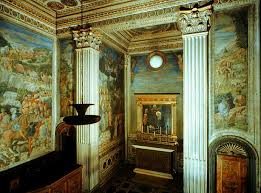
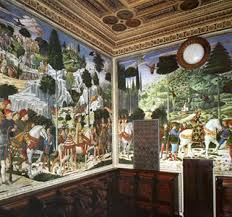
While not perfect, at least the 2 photos above give you a sense of the magnificent room. It is one of the glories of the Renaissance period and one of the surviving in situ masterpieces of Florence.
The Magi Chapel was begun around 1449-50 and probably finished in 1459 as the private family chapel inside the Palazzo Medici-Riccardi in Florence, designed by famed Renaissance architect Michelozzo di Bartolomeo. The exterior of the palazzo looks like this.

Although there were public churches near the palace, and ones for which the Medici family were patrons, it was customary for wealthy families to have private chapels inside their homes. In fact it is not unusual for any religious household to have a space to celebrate their gods inside their home, no matter how humble.
Three of the chapel’s walls are almost completely covered by this famous fresco cycle by Renaissance master Benozzo Gozzoli (1421-97). Gozzoli painted the cycle between 1459 and 1463. The Journey of the Magi to Bethlehem is depicted in three large large sections, each one showing the procession of one of the three Magi.
Let’s begin with the apse wall: An apse contains the centerpiece of any chapel, as it does here as well. The framed altarpiece in the apse is by Fra Filippo Lippi: The Adoration of the Christ Child. Painted specifically for this location, the original is now in Berlin, while a copy by a follower of Lippi hangs in the Magi Chapel. The copy is attributed to Pseudo Pier Francesco Fiorentino, a follower of Lippi, and the painting was restored in 1992.
The image below is the original Lippi painting.

Here’s how the apse looks from front on. It is designed to be the place where one kneels to pray and worship.


The sides walls of the apse as above are painted with saints and angels in adoration. It is possible to see the influence of his master, Fra Angelico, in Gozzoli’s painting style. These personages are arranged so as to be looking at the Lippi altarpiece, the same as we the viewers do.
This host of angels are gorgeously painted in rich colors with a luxurious application of plenty of gold.


The Medici family were, of course, the de facto rulers of the ostensibly republican Florence, and among the greatest art patrons of any era. Books have been written on their influence on the Renaissance, particularly as patrons of all of the arts.
The family had a particular interest in paintings that depicted the Adoration of the Magi, the moment when the Three Kings, led by a miraculous star, discovered the Christ child. As we have said, this event signified the recognition of the holy infant by the secular world and was celebrated in the feast of the Epiphany (from the Greek, meaning “to manifest”).
We know that the city of Florence had mounted an Epiphany festival on January 6 at least since 1390, the date of the earliest surviving record of it. The elaborate pageant, in which men reenacted the journey of the Magi through the streets of the city, must have looked much like the colorful throng that winds through Gozzoli’s fresco cycle.
By 1417, the festival was directed by a lay confraternity, the Compagnia de’ Magi, with funds donated by the Medici. Male members of the Medici family participated in the procession, which passed in front of their famous palace on Via Largo and began and ended at the church of San Marco, headquarters of the confraternity and an important recipient of Medici munificence. Cosimo de Medici even had an image of the Adoration of the Magi in his private room within the monastery of San Marco.
Incidentally, the Procession of the Magi is enacted in Florence today as well. You can read about it here: http://www.theflorentine.net/articles/article-view.asp?issuetocId=9709
So important was the Epiphany to the Medici family, Lorenzo de Medici even changed his birthdate! He was born on January 1, which already seems pretty auspicious, but he decided to change his birthday to January 6 to coincide with the Epiphany feast date. Here’s a portrait of Lorenzo as an adult. I guess when you are a Medici, an earthly prince, you can change your birthdate as desired. Lorenzo did.
It is worth remembering that January 1 didn’t have the significance in the period that it does today. The Florentine calendar treated March 25 as the first day of a new year. March 25 was the feast day of the Annunciation. So, I guess being born on Jan. 1 wasn’t that big of a whoop to begin with. Why not switch to Jan. 6 if you were Lorenzo? Then maybe everybody would remember your birthday? Am I projecting too much?

There’s no doubt about it: the Medici’s identified with the story of the Adoration of the Magi on the feast of the Epiphany.
Let’s begin our tour of the Gozzoli procession.
Caspar, the youngest Magus, leads the entourage on his beautiful white horse. Caspar is surrounded by a group of young Florentine attendants.
 We see Caspar on the left wall here.

Although this figure has sometimes been identified as a portrait of Lorenzo il Magnifico, who was born in 1449 and so was still a boy when the fresco was completed, most scholars believe Lorenzo is more likely included as another figure, as discussed below.
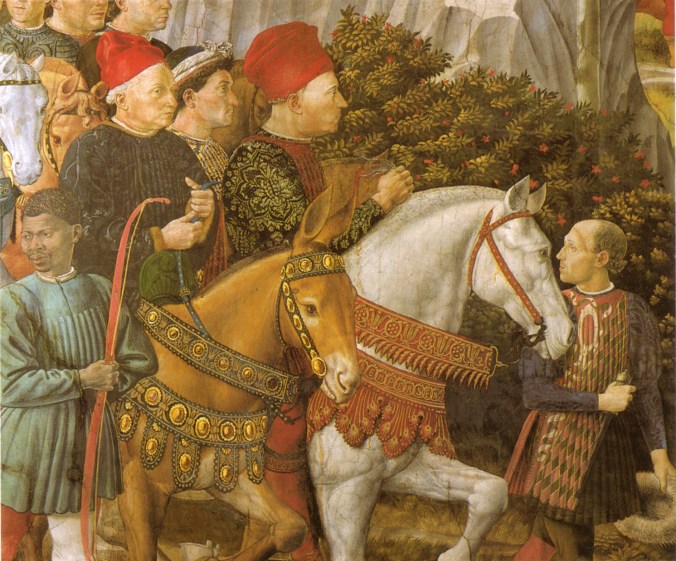
Behind Caspar, to his left, are the contemporary head of the family, Piero the Gouty, wearing a red cap and seated on a white horse and devout family founder Cosimo in a dark blue shirt riding on a humble brown mule.

Here’s a composite photograph of the entire fresco cycle. It is difficult to study the images without being in the chapel itself. We have begun our look at the paintings on the far left and are moving from left to right.

Behind the portraits of Piero and Cosimo, directly to the left of the standing black attendant, are portraits of Sigismondo Pandolfo Malatesta and Galeazzo Maria Sforza, respectively lords of Rimini and Milan, who were often guests of the Medici in Florence. These men are atop the brown and white horses that face the viewer directly.
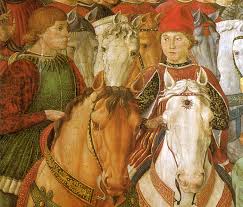
Behind in the middle ground is a crowded procession of illustrious Florentines, including such as the humanists Marsilio Ficino and the Pulci brothers, the members of the Art Guilds and even the artist, Benozzo, himself. The painter looks out at the viewer and can be recognized for the scroll on his red hat, which reads “Opus Benotii.” It is one of the great artist’s signatures on a work of art in the history of the world.

Picture A above.

The self-portrait of the artist himself is marked #14 on the key below Picture B.
Little Lorenzo il Magnifico is the boy marked #7 ; Lorenzo’s elder brother Giuliano is next to him at #8.
The following picture is Picture B, notated with numbers to identify the various illustrious contemporary personages included in Benozzo’s painting. To see the actual faces, consult Picture A above.

Picture B above.
Key to Picture B:
1 – Cosimo il Vecchio de’ Medici
2 – Piero il Gottoso de’ Medici
3 – Carlo di Cosimo de’ Medici
4 – Galeazzo Maria Sforza
5 – Sigismondo Pandolfo Malatesta
6 – Cosimino di Giovanni di Cosimo de’ Medici (?)
7 – Lorenzo di Piero de’ Medici detto il Magnifico
8 – Giuliano di Piero de’ Medici
9 – Gentile Becchi, precettore di Lorenzo e Giuliano
10 – Giuliano di Piero de’ Medici
11 – allora fattore nella filiale del banco Medici a Roma
12 – Giovanni di Cosimo de’ Medici(?)
13 – Benozzo Gozzoli
14 – Pope Pio II Piccolomini

Picture C above
Key to Picture C:
15 – Benozzo Gozzoli (?),2nd self-portrait
16 – Neri di Gino Capponi (?) (1388-1457):
17 – Bernardo Giugni (?) (+1466)
18 – Francesco Sassetti (?) (1420-1490)
19 – Agnolo Tani (?)
20 – Dietisalvi Neroni (?) (1401-1482)
21 – Roberto di Niccolò Martelli (?) (1408-post 1469)
22 – Benozzo Gozzoli (?), 3rd self portrait
23 – Luca Pitti (?) (1398-1472)
Bearded Balthasar, the middle Magus, rides a white horse on the south wall. He is portrayed with the same facial features as Byzantine emperor John VIII Palaiologos.
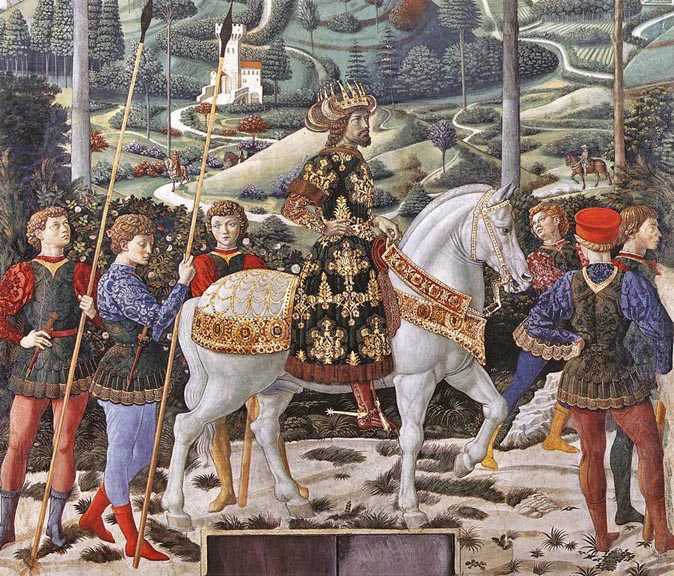

Melchior, the oldest Magus, is depicted riding on the west wall.

Traditionally, his features have been read as those of Joseph, Patriarch of Constantinople, who died in Florence; but they could also be those of Sigismund, Holy Roman Emperor, who helped end the Great Schism by convoking the Council of Constance in 1414. Like Cosimo, he is shown as a peacemaker riding on a humble (this time white) mule.
He is preceded by a page in blue with a leopard on his horse – although he leads the entire procession, no real world identity for this handsome, confident figure has ever been established. Ciao bello! You’re the one that I love!

Rather than depict the topography in and around the actual Bethlehem, Gozzoli instead portrayed rich Tuscan landscapes. As the Three Kings approach Bethelem, they are accompanied by their respective entourages as if they are participating in a noble hunting party with falcons and including exotic felines just for a measure of excess.
What a divine way to celebrate the Epiphany! I think I might change my birthday to January 6 myself. I want to be like Lorenzo.
Nah, I can’t do that, even if Lorenzo and I do share the same root word as the stem of our first (Christian) names.*
I can never be a Medici, as much as I might wish it. Maybe in my next life.
**LAURA f Feminine form of the Late Latin name Laurus, which meant “laurel”. This meaning was favourable, since in ancient Rome the leaves of laurel trees were used to create victors’ garlands. It was also the name of the subject of poems by the 14th-century Italian poet Petrarch. As an English name, Laura has been used since the 13th century. LAURETTA f
Italian diminutive of LAURA http://www.behindthename.com/names/usage/italian/2
LORENZO m Italian, Spanish
Italian and Spanish form of Laurentius (see LAURENCE (1)). Lorenzo de’ Medici, known as the Magnificent, was a ruler of Florence during the Renaissance. He was also a great patron of the arts who employed Leonardo da Vinci, Michelangelo, Botticelli and other famous artists. http://www.behindthename.com/names/usage/italian/2
 get back, lauretta!