Told ya so!

Unfortunately, as I posted here, Starbucks has felt the need to branch into the land of real coffee.  I can hardly believe it.

Let’s hope that Starbuck’s does truly enter Italy with lots and lots of humility!  I can’t help being skeptical about that part too.

http://www.nytimes.com/2016/02/29/world/europe/with-humility-starbucks-to-enter-italian-market.html?emc=edit_tnt_20160229&nlid=53287003&tntemail0=y&_r=0

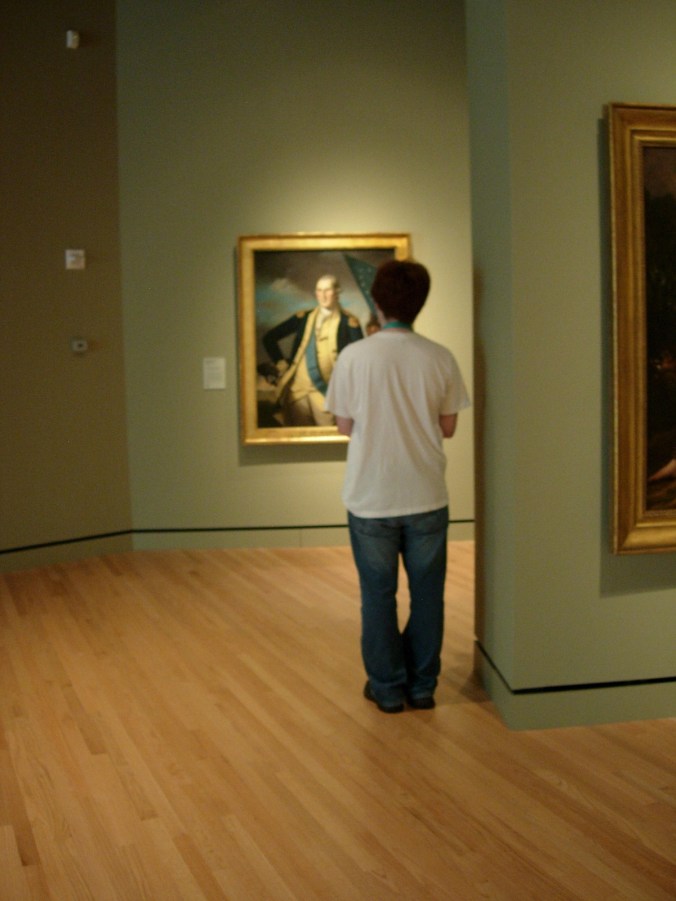
Happy Birthday George Washington! You don’t look a day over 243!


That’s my boy standing in front of Peale’s portrait of GW.  We were visiting the Crystal Bridges American Art Museum in Arkansas, which is a pretty place if you ever get the chance.

DSCN1443Title: George Washington
Artist: Charles Willson Peale, 1741 – 1827
Date: ca. 1780-1782
Medium: Oil on canvas
Dimensions: 50 x 40 in. (127 x 101.6 cm) Framed: 57 3/4 × 48 1/4 × 3 1/4 in.
Credit Line: Crystal Bridges Museum of American Art, Bentonville, Arkansas, 2010.70
Label Text: George Washington posed for Peale an unparalleled seven times. The artist had been an officer in the Continental Army under Washington and crossed the Delaware River with him during the New Jersey campaigns in the winter of 1777-78. Peale portrays Washington as a relaxed yet powerful military leader wearing the blue sash of commander-in-chief of the Continental Army. Although Washington leans against a cannon, at momentary rest, his body fills the foreground and he looks out at the viewer with a commanding gaze. The left background depicts Yorktown, Virginia, where Washington defeated the British in one of the last major battles of the American Revolution. The original owner of this painting, François-Jean de Beauvoir, the Chevalier de Chastellux, was part of the French military force that helped Washington achieve victory in Virginia.


Florence, where the women are all beautiful and the men are noble, chivalrous, agreeable and wise.

biblio

The Florentine writer, Boccaccio, captured the way the populations of Italian city-states viewed one another on a personal level. In his Decameron, Boccacio disparaged citizens of nearly all Italian cities except his own–Florence–and Bologna.

For example, he calls the Sienese credulous and the Venetians untrustworthy, Pisan women are ugly and Perugian men are sodomites, in the Marches the males are uncouth and mean-hearted, like those from Pistoia, who are also rogues.

The south contributes its share of wickedness with assassins from Sicily and thieves and grave-robbers from Naples, but no people rival the ‘rapacious and money-grubbing’ Genoese, who are depicted as pirates, misers and murderers.

Boccaccio’s happy fornicators and shameless adulterers come from all over Italy, but the only consistently good people live in Florence, where the women are all beautiful and the men are noble, chivalrous, agreeable and wise.

Medieval Italians talked of their city as if it were a kind of paradise, its life regulated by sublime statutes framed by lawyers at the new University of Bologna. They were proud of its appearance, especially as culture was then chiefly civic and communal; the great age of individual patronage, both noble and ecclesiastic, came later. Entire populations would turn out with trumpets and pipes to celebrate an artistic event, as the people of Siena did in 1311 when they escorted Duccio’s Maestà from the painter’s workshop outside the city through the gate in the walls and up to the cathedral.

Since things were constructed in their name – and not, as later, in that of the Medici in Florence or the Gonzaga in Mantua – they could take a proprietorial interest in the paving of streets, the laying out of squares, the building of stone bridges.

Nine centuries after their emergence, the city-states remain embedded in Italy’s psyche, the crucial component of its people’s identity and of their social and cultural inheritance. Modern inhabitants of these cities are still proud of their heritage and feel responsibility for its retention. That is why the town centres – though not unfortunately much of the country outside them – are so well preserved today.

Gilmour, David (2011-10-25). The Pursuit of Italy: A History of a Land, Its Regions, and Their Peoples (Kindle Locations 1262-1271) and (Kindle Locations 1250-1256). Farrar, Straus and Giroux. Kindle Edition.

…In the hierarchy of Florentine guilds of the period the most influential were those of judges, bankers, doctors, dealers in silk, traders in wool and furriers, who were much in demand in winter because pelts were cheaper than cloth. Florence’s Arte dei medici e speziali, which included doctors, surgeons, dentists and opticians, had over a thousand members: after passing their exams doctors had to promise to refrain from taverns and brothels and in return they were rewarded by the city with a horse, an attendant and exemption from paying taxes.  Surviving Florentine guildhalls, such as those of the silk makers and the wool merchants, are among the city’s loveliest buildings.

Gilmour, David (2011-10-25). The Pursuit of Italy: A History of a Land, Its Regions, and Their Peoples (Kindle Locations 1313-1319). Farrar, Straus and Giroux. Kindle Edition.


Apropos of the Pope wading into American politics this week…

Pope Francis is a great man from what I can see, and a humble, loyal servant to the god he serves, from all I read.

PopeFrancisIsis-v2

Not all popes have been humble or loyal servants, that’s for sure.  It would seem that popes from the Renaissance period in particular have a bad reputation.

Titian-Paul-III-BR600

The following quote, which is rich beyond measure to me, succinctly captures the general consensus vis a vis that era’s pontifical array:

“No one would have considered a Renaissance pope the servant of anyone, even God.”

Gilmour, David (2011-10-25). The Pursuit of Italy: A History of a Land, Its Regions, and Their Peoples (Kindle Location 1030).

The language of flowers

Did you know that if your great-great grandmother wanted to send a secret message to her beau, she could do so with a bunch of flowers?  For example, if she gave him red carnations…

images


He presumably understood her message would be “my heart aches for you.”


If she  gave him yellow carnations…

images-3

she was telling him “you have disappointed me.”


Now, if she instead sent him a variety of colored carnations, such as this…

images-2

I assume he would know she was just plain schizophrenic.

Just kidding.  I wanted to see if you were paying attention.  I am glad you are!

And it wasn’t just carnations that spoke, believe me.  Savvy Victorians believed that flowers had a code all their own.

There is a language, little known,
Lovers claim it as their own.
Its symbols smile upon the land,
Wrought by nature’s wondrous hand;
And in their silent beauty speak,
Of life and joy, to those who seek
For Love Divine and sunny hours
In the language of the flowers.

The Language of Flowers, London, 1875

I plan to expand this post quite a bit, as it’s a topic I love, so please check back later if you care to read more.  In the short term, check out this link for quick info as to what various flowers meant to the Victorian mind.

http://thelanguageofflowers.com

Let’s go to Marrakech for a minute!

I recently watched the 2015 Nicole Kidman film, Queen of the Desert. The movie chronicles the life of a fascinating Brit, Gertrude Bell. It’s a beautifully produced film and features some interior shots of the world-famous hotel in Marrakech, La Maoumania.  One thing always leads to another, and thanks to the internet, we can make a quick trip to Marrakech.

I highly recommend the film, as well as Morocco.  I was lucky enough to spend a month there a few years ago and I loved it.

QOTD_poster

images-6


Mamounia-Front-Entrance-Final2

http://www.mamounia.com/en/intro.htm

Will you be my Valentine?

Didn’t you love the parties held at school when we were children?  What fun they were.  Trading Valentines with your classmates.  It was an annual celebration I loved.  Plus it enlivened the winter!  I’ve always loved the “conversation” candies of the season.  It has been fun to watch their messages evolve over the decades.

So, here is my Valentine to my readers.  I hope you have a wonderful day filled with chocolate, flowers, and professions of love!

IMG_6609IMG_6600

IMG_6602

IMG_6606IMG_6604IMG_6605IMG_6607IMG_6603IMG_6611