Best aperitivo in Firenze?

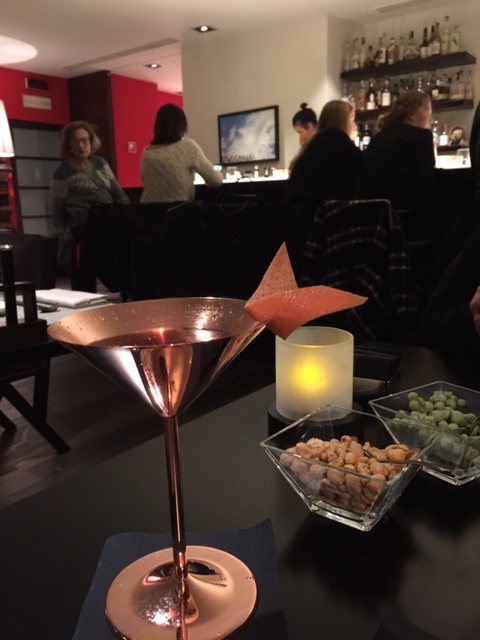
I’m not a huge drinker by any means, but so far the best aperitivo I’ve enjoyed in Florence is at the Fusion Bar at the Gallery Hotel Art.

img_8932

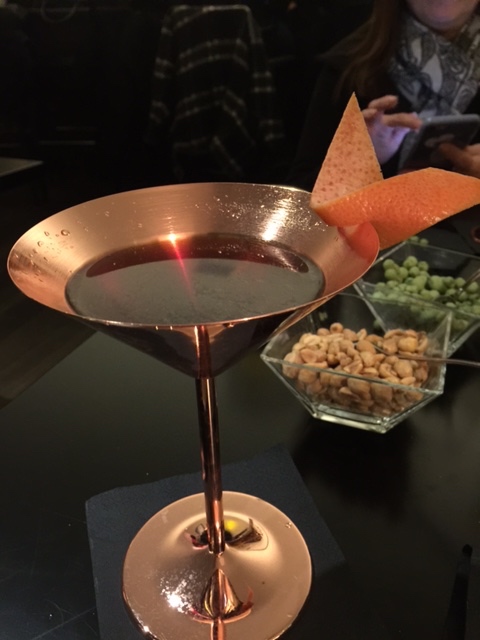
Their craft cocktail menu will amaze you.  I had a “Medley” which is made with bourbon and other spirits.  It was very nice.


img_8935

Of course nice nibbles (as above) are appreciated, but when they brought out the tapas as part of the happy hour, I was gobsmacked.  Great food!  Unfortunately, I didn’t get any pictures.  You’ll just have to take my word for it!

img_8936

My companion ordered a smoked cocktail, and it really was smoked!

img_8937

As you might expect, the art installations at the Gallery Hotel Art Hotel are typically pretty amazing as well.  Currently they have an installation of giant pin wheels gracing the exterior of the hotel.

img_8505img_8506img_8507img_8511

img_8504


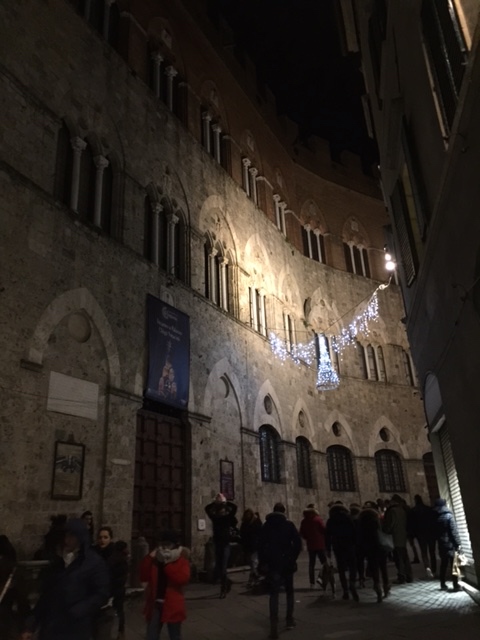
And the very best part of the whole thing, for me, is that I live right across the Viccolo from the bar!

Epiphany part 2.

Who needs words when you have good pictures?  So, andiamo!

OLYMPUS DIGITAL CAMERA

OLYMPUS DIGITAL CAMERA

OLYMPUS DIGITAL CAMERA

OLYMPUS DIGITAL CAMERA

OLYMPUS DIGITAL CAMERA

The Lords & Ladies arrayed in velvets, laces and furs.

OLYMPUS DIGITAL CAMERA

No detail overlooked.  Even the hair is dressed!

OLYMPUS DIGITAL CAMERA

OLYMPUS DIGITAL CAMERA

OLYMPUS DIGITAL CAMERA

OLYMPUS DIGITAL CAMERA

OLYMPUS DIGITAL CAMERA

This Lady stole my heart.  I adore her costume and hair dressing.

OLYMPUS DIGITAL CAMERA

OLYMPUS DIGITAL CAMERA

OLYMPUS DIGITAL CAMERA

OLYMPUS DIGITAL CAMERA


cropped-p1017378.jpg

The procession as it passes the Uffizi.


cropped-p1017376.jpg


cropped-p1017243.jpg


OLYMPUS DIGITAL CAMERA

OLYMPUS DIGITAL CAMERA


OLYMPUS DIGITAL CAMERA

OLYMPUS DIGITAL CAMERA


OLYMPUS DIGITAL CAMERA

OLYMPUS DIGITAL CAMERA


OLYMPUS DIGITAL CAMERA

OLYMPUS DIGITAL CAMERA


OLYMPUS DIGITAL CAMERA

OLYMPUS DIGITAL CAMERA


OLYMPUS DIGITAL CAMERA

OLYMPUS DIGITAL CAMERA


OLYMPUS DIGITAL CAMERA

There was a harlequin adding levity to the proceedings.


OLYMPUS DIGITAL CAMERA

OLYMPUS DIGITAL CAMERA

OLYMPUS DIGITAL CAMERA

OLYMPUS DIGITAL CAMERA


OLYMPUS DIGITAL CAMERA

OLYMPUS DIGITAL CAMERA


OLYMPUS DIGITAL CAMERA

OLYMPUS DIGITAL CAMERA


OLYMPUS DIGITAL CAMERA

OLYMPUS DIGITAL CAMERA


OLYMPUS DIGITAL CAMERA

OLYMPUS DIGITAL CAMERA


OLYMPUS DIGITAL CAMERA

Religious figures were included.


OLYMPUS DIGITAL CAMERA

OLYMPUS DIGITAL CAMERA


OLYMPUS DIGITAL CAMERA

OLYMPUS DIGITAL CAMERA


OLYMPUS DIGITAL CAMERA

OLYMPUS DIGITAL CAMERA


OLYMPUS DIGITAL CAMERA

This Lady carried her falcon.


OLYMPUS DIGITAL CAMERA

OLYMPUS DIGITAL CAMERA


OLYMPUS DIGITAL CAMERA

OLYMPUS DIGITAL CAMERA


OLYMPUS DIGITAL CAMERA

OLYMPUS DIGITAL CAMERA


OLYMPUS DIGITAL CAMERA

OLYMPUS DIGITAL CAMERA


OLYMPUS DIGITAL CAMERA


OLYMPUS DIGITAL CAMERA

OLYMPUS DIGITAL CAMERA


OLYMPUS DIGITAL CAMERA

OLYMPUS DIGITAL CAMERA


OLYMPUS DIGITAL CAMERA

OLYMPUS DIGITAL CAMERA


OLYMPUS DIGITAL CAMERA

OLYMPUS DIGITAL CAMERA


OLYMPUS DIGITAL CAMERA

OLYMPUS DIGITAL CAMERA


OLYMPUS DIGITAL CAMERA

OLYMPUS DIGITAL CAMERA


OLYMPUS DIGITAL CAMERA

OLYMPUS DIGITAL CAMERA


OLYMPUS DIGITAL CAMERA

OLYMPUS DIGITAL CAMERA

Epiphany in Florence!

That headline could mean many different things!

But, today I use it to refer to the national holiday in Italy, which happens every 6 January.  The holiday commemorates both the day the three pagan kings found the infant Jesus and presented him with gold, frankincense and myrrh and, in Florence, the modern holiday also pays homage to the Medici family and their tradition of reenacting the visit of the Magi.

Epiphany is, of course, the Christian feast day celebrating the revelation of God in his Son as human in Jesus Christ. In Western Christianity, the feast commemorates principally (but not solely) the visit of the Magi to the Christ child, and thus the physical manifestation of Jesus to the Gentiles.

Interestingly enough, when we in American refer to the “12 days of Christmas” and start from December 1st, we’ve got it all wrong.  The first day of Christmas is actually 25 December and the 12th day is 5 January.  Just one of many changes we have made!  In other words: the evening of 5 January is 12th night.

In Florence, 6 January is a holiday (as it is throughout Italy).  We didn’t even have school!  Yippee!  Since the 6th fell on a Friday, this weekend is a long one for most Italians.  Benissimo!

OK, since I’m in Florence, let’s start with Florence.  Everything I’m discussing can be found in these references:

https://www.visitflorence.com/florence-events/cavalcade-

magi.htmlhttp://www.theflorentine.net/lifestyle/2014/12/cavalcata-dei-magi/

http://www.duomofirenze.it/feste/epifania_eng.htm
Although it isn’t known precisely when the parade known as “The Cavalcade of the Magi” first began in Florence, documents show it existed by 1390. Every three years (after 1447, every five years), the wealthy powerful lay confraternity of the Magi organized a lavish pageant on Epiphany, which also celebrated the day as the time that John the Baptist, patron saint of the city of Florence, baptised Christ in the Jordan River.

Everything is so complicated.

Back in the Renaissance period, the confraternity met regularly at San Marco, a Medici church.  High-ranking members of that ruling family participated in the pageant, for the Medici’s in particular esteemed the Biblical Magi. The pageant also included influential community leaders and distinguished men of letters.

After 1417, the Cavalcade was financed by the Signoria of the Florentine Republic through a tax it imposed on the Jews; they had obviously never heard of political correctness.

The original procession took a different route than what is done today: three separate groups of participants converged from three different areas of town, meeting in front of the Baptistery (and then, from 1429, in the Piazza della Signoria) and then they all went together to San Marco church.

However, in 1478, the procession was suspended, probably because of the Pazzi conspiracy, and it would seem that Lorenzo the Magnificent, who survived the attack, had no intention of providing other occasions for potentially angry crowds to mill around the city. The procession resumed a decade later. However, when the Medicis were banished from the city in 1494, Savonarola, despite having taken part in the procession in the past, suppressed it, now considering it a perverse “Medici thing.”

One of my favorite Renaissance frescos is in the Chapel in the Medici Palace in Florence. Cosimo de’Medici had  this luxurious fresco painted in 1459 in the chapel of the family mansion in Via Larga by the artist Benozzo Gozzoli. In these frescoes, numerous Medici family members are depicted, including Giuliano and probably also Lorenzo the Magnificent. When Cosimo would withdraw for brief periods to share the friars’ life at San Marco, he was housed in a cell frescoed by Fra Angelico with The Magi Presenting their Gifts to the Christ Child. Some years later, in 1482, Marsilio Ficino, a philosopher and Cathedral Canon closely linked to the Medici, composed a treatise entitled “The Star of the Magi” (De stella Magorum).  There can be no question that the Medici family held a special place in their hearts for the moment from the Scriptures in which the Magi brought gifts to the Christ Child.

Although Savonarola was able to stop the parade in 1494, the celebration was resurrected in 1997 during celebrations of the Seventh Centennial of the Florence Cathedral. Grazie a dio!

Thus, as already stated, every year since 1997, on 6 January or the Feast of the Epiphany, the Cavalcade of the Magi again takes place. It starts at the Pitti Palace, wends its way through Piazza della Signoria and arrives finally in Piazza del Duomo, in the area between the Cathedral and the Baptistery formerly known as ‘Paradise’.
The three Magi on horseback, wearing Renaissance costumes inspired by those in Benozzo Gozzoli’s frescoes, are accompanied by a cortège of hundreds of other costumed personages, among whom the members of Florence’s Historical Football Association and representatives of towns in the Province of Florence, along with horsemen, footmen and standard bearers. The pageant includes Ladies and Lords, Knights, country folk, soldiers, religious figures and more: drummers and the sbandieratori (flag-throwing company of the Uffizi) enchants the public with their skills in throwing and waving their flags along the way and in Piazza della Signoria.
Once the cavalcade reaches il Duomo, the solemn proclamation of the Epiphany passage from the Gospel of Saint Matthew is given by the Archbishop. Then the actors of the Magi, accompanied by the many children whose parents bring them to see the Cavalcade, present their symbolic gifts of gold, frankincense and myrrh to the Christ Child, who is the main ‘actor’ in a real-life crèche erected in the Piazza, with an ox, donkey, and many other farm creatures brought in from the Tuscan countryside.


OK, OK, va bene, enough talk! Let’s look at my pictures!  I’ve got so many, I’ll post them in several posts over the next week or so.

OLYMPUS DIGITAL CAMERA

The Cavalcade begins at Palazzo Pitti.  Here are the Three Wise Men, mounted up and ready to rumble.


OLYMPUS DIGITAL CAMERA

The modern costumes are based upon the gorgeous Benozzo Gozzoil frescoes.


OLYMPUS DIGITAL CAMERA

Many attendants attend the Magi.


OLYMPUS DIGITAL CAMERA

Che bella!


OLYMPUS DIGITAL CAMERA

Distinguished attendant with pheasant feather in his cap


OLYMPUS DIGITAL CAMERA

Mounted attendants (here’s thinking of you dad!)


OLYMPUS DIGITAL CAMERA

More


OLYMPUS DIGITAL CAMERA

This attendant is happy to make his fabulous equine perform


OLYMPUS DIGITAL CAMERA

Fantastico!


OLYMPUS DIGITAL CAMERA

The Magi are preceded by the pages bearing their gifts


OLYMPUS DIGITAL CAMERA

Caskets full of gold, frankincense and myrrh for the new-born king!


OLYMPUS DIGITAL CAMERA

The pages are modern boys and they occasionally act like that!  It’s very cute!


OLYMPUS DIGITAL CAMERA

Men with lances


OLYMPUS DIGITAL CAMERA

Many attendants in fabulous dress


OLYMPUS DIGITAL CAMERA

OLYMPUS DIGITAL CAMERA


OLYMPUS DIGITAL CAMERA

Drummer boys (and girls)


OLYMPUS DIGITAL CAMERA

Drummers


OLYMPUS DIGITAL CAMERA

Let the procession begin, following the Kings


OLYMPUS DIGITAL CAMERA

She carries holly and greens


OLYMPUS DIGITAL CAMERA

Attractive couples of various ages follow
Speaking of artichokes: who was Cynara?

I recently posted about a fabulous raw artichoke salad I enjoyed and, naturally, it got me started thinking about the history of the plant!

images-8

Artichokes, the flowers of the artichoke plant, are commonly found in the Mediterranean area. This flower has been loved since the time of the ancient Greeks and Egyptians. In fact, the ancient Greeks believed that artichokes had a divine origin.

According to legend, Zeus, the father of all the Gods, saw an incredibly beautiful human woman named Cynara.

Zeus fell in love with Cynara’s beautiful ash-blond hair, so naturally he seduced her and brought her up to Mt. Olympus with him. However, the beautiful young girl was homesick and decided to return to her mother’s home on earth.

When Zeus discovered that she had escaped, he was furious for having been betrayed! He punished Cynara by flinging her back to earth and turning her into a plant with a tender heart and spiny exterior. And that is how Cynara became the artichoke.

Today, most artichoke varieties are planted as annuals from seed, and tend to be hybrids of cynara scolymus, whereas in earlier times the principal species were grown as perennials forming massive clumps with deep taproots.  Artichokes were intensely cultivated in Italy in the middle ages, though it seems that roots and the stalks were mostly consumed. In the Renaissance era, hybridization produced the large edible globe we know today.

Back in the day, artichokes were reserved exclusively for consumption by the upper class men only. Apparently, the aphrodisiacal powers ascribed to the artichoke were thought to be too stimulating for women!

Catherine de Medici changed all that when, upon her arrival in Avignon, France, in the 16th century, she informed her husband Henry II, that she would eat artichokes. She observed that the young women of her day were more forward than the pages at court, so perchè no?

And then there is that Italian digestivo created from the artichoke!  What is it called?  Cynar, ovviamente!

images-6

Cynar is a liqueur made from an infusion of 13 herbs and plants, including cynarin which is extracted from the artichoke.  In Italy, the beverage is considered to be a very helpful digestivo.

images-5

Cynar is richly aromatic and has a low alcohol content (16.5 °).  Like all the best things in life (secondo me), it was created in the 1950s! In 1952 to be exact.


images-7


Fresh artichoke and parmesan salad at Cantinetta Antinori.

Last week I had the great pleasure of dining at Cantinetta Antinori, one of my all-time favorite Florentine eateries. As a starter, I enjoyed a raw artichoke and parmesan cheese salad. It was dressed with the finest olive oil and fresh lemon juice, salt and pepper.

I didn’t get the chance to photograph my salad, as sometimes that just seems inappropriate. But, I haven’t forgotten the salad and today I found a nice primer on how to prepare it.

http://www.academiabarilla.com/en/italian-recipes/search-recipes/parmigiano-reggiano-artichoke-salad.aspx

I didn’t take a photo of my lunch, but I did capture the place and time!

img_8678img_8679img_8690img_8682img_8683img_8684img_8685img_8686img_8687img_8681img_8688

Let’s bake a cake!

Facciamo cuocere una torta!  A torta margherita is a traditional Italian cake. One of the most popular cakes in Italy, it was named after the country’s first Italian queen: Margherita di Savoia.

The first recorded  recipe for the torta was in the 19th century, but it probably had been handed down from mother to daughter for centuries earlier.

I recently baked a yummy torta margherita from a box mix in my Florentine kitchen and next I wanted to try one from scratch.  Here’s my guide.


If you want to try one too, here’s the modern recipe:

5 eggs

180 grams sugar

zest of a lemon to taste

150 grams flour

150 grams potato starch

1/2 teaspoon baking powder

vanilla, 1 Tablespoon I’m guessing

salt

80 grams melted butter, cooled

powdered sugar to sprinkle on top of baked cake

Beat eggs, sugar and zest of a lemon on high until you get a light mixture that looks like the example in the Youtube video.  The mixture should be a pale yellow and hold its form enough that you can “write with it” as la signora says.

Next, with mixer on low, add flour and starch, baking powder, salt and vanilla.  The vanilla in the video is a powdered form available in Italy.  La signora reminds us to only mix the flours, etc., in; you don’t want to lose the lift you got by beating the eggs.

Last, slowly mix in the melted butter.

Pour mixture into a round baking tin, buttered, floured and lined with parchment paper.  Bake at 180 degrees C. for 40 – 50 min.  Sprinkle the cooled cake with powdered sugar.

It worked!  My yummy cake looks like this:

img_9086

And I eat it like this:

img_9090


But, you want to make it without potato flour?

Since we, in our American kitchens, don’t typically have potato starch on hand, I believe it is possible to change the recipe slightly, by adding an additional 100 grams of 00 flour.  Here’s another recipe I found on the internet for a Torta Margherita sensa fecola di patate. I haven’t tried it yet, but probably will soon.
Tempo di preparazione: 20 minuti, Tempo di cottura: 40 minuti, Tempo totale: 1 ora
Ingredienti per Torta Margherita senza fecola da 22 cm di diametro
250 g di farina 00)
200 g di zucchero
80 g di burro
4 uova
1 bustina di vanillina
1 bustina di lievito per dolci Paneangeli
120 ml di latte
zucchero a velo vanigliato q.b.

Buona fortuna!

Always on the search for history, I found the following article in the August 2015 issue of BBC History Magazine.

In every issue of BBC History Magazine, picture editor Sam Nott brings you a recipe from the past. In this article, Sam recreates Torta Margherita, a 19th-century cake from Italy that is both gluten and dairy-free.

This recipe comes from Pellegrino Artusi’s 1891 cookbook La Scienza in Cucina e l’Arte di Mangiare Bene (The Science of Cooking and the Art of Fine Dining), and is a cake that has been enjoyed in many Italian households.

Artusi’s introduction to his cookbook gives an insight into the origins of the cake. He originally made it for a friend of his, Antonio Mattei, who took the recipe and, after making a few changes, sold it in his restaurant.

The cake was such a success that it soon became the norm to finish a meal with Torta Margherita. The moral of the story, according to Artusi, is that if you grab opportunities when they arise (as Mattei did) fortune will favour you above someone who merely sits back and waits.

Ingredients
120g of potato starch, sifted
120g of fine white sugar (caster sugar)
4 eggs
Juice or zest of a lemon (optional)
Butter and baking paper (to line the baking tin)

Method
Separate the yolks from the whites and beat the yolks together with the sugar until pale and creamy. Add the lemon (optional) and the potato starch and beat.

In a separate bowl, whisk the egg whites until stiff peaks form, then delicately fold the whites through the batter. Place the mixture into a round cake tin (buttered and lined with baking paper). Bake at a moderate heat for about an hour or until golden on top and firm to the touch.

Time: 60 minutes

Verdict:
When I found this recipe I was intrigued: a gluten and dairy-free cake that tastes nice? And with only three ingredients? But the picture in the recipe book looked very enticing so I gave it a try.

And I’m glad I did! I ended up making several of these as they were so delicious; friends and family devoured them all. The cake is incredibly light, goes well with tea or coffee, and takes just an hour to make.

And, alternatively, there is this: http://www.academiabarilla.com/italian-recipes/desserts-fruit/margherita-cake.aspx