Attenzione! This is an excessively long post. But, how could it not be when it deals with an excessively excessive celebration in Venice?!
Let’s start here:
I recommend starting the video below and letting it play while you look at these photos of an amazing day, 12 February 2017. Coincidentally, my mom’s birthday. Happy Birthday Mom!
Excesses of excessively decorated masks available on every street. Some nice, most mass-produced.


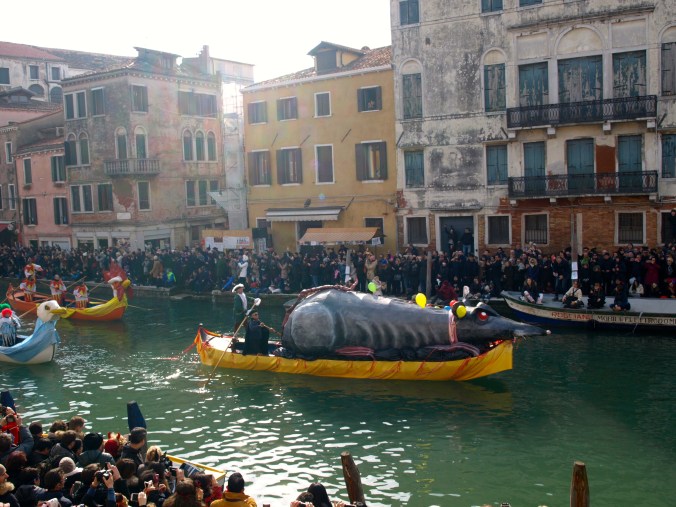
Excessive masses of people, trying to get an excessively good look at the excessively boated water parade.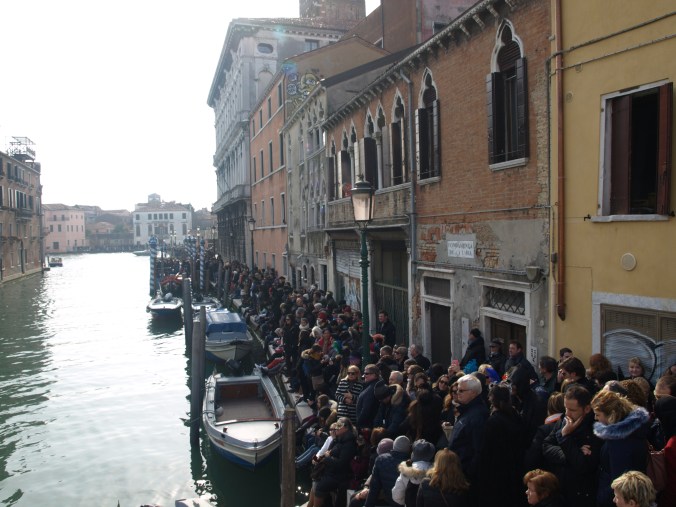
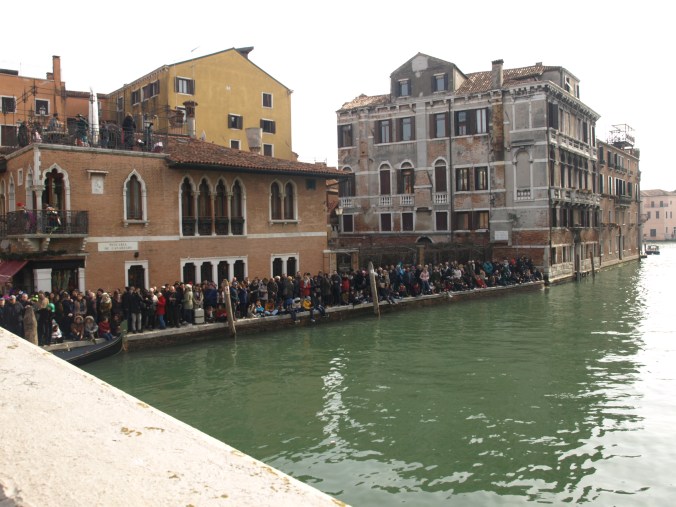
It was impossible to find a place to see the parade. I started looking up. I saw this nice gentleman enjoying the parade from his home. I thought to myself: what can I do to get a view of this parade? What would Trixie Belden do? (boomer reference).

I shouted up to him and waved. He smiled and engaged. This was a big mistake for him! I endeavored to bribe him with offers of excessive money if he would let me and my comrade, Irina the Russian whom I have met at language school, join him at his window. A kindly, older gentleman, he quickly consulted with his kind wife of many years, and together they agreed to let us join them at their windows to look at the parade from above. I gotta say, Lauretta, you still got what it takes! Woo hoo! Let the parade begin!
 The kind signora offered us coffee and apologized for her casual attire. We, who just burst upon her! Lei era molto gentile! The kind gentleman’s head was dizzied with the idea of an American and a Russian together. Especially when I explained to him that we hardly know each other, having only met at language school the week before. He called her Putin and me…Obama, I quickly said!!
The following pictures are from this amazing couple’s home (and, no, they would not allow me to pay them!) What a gift they gave me:
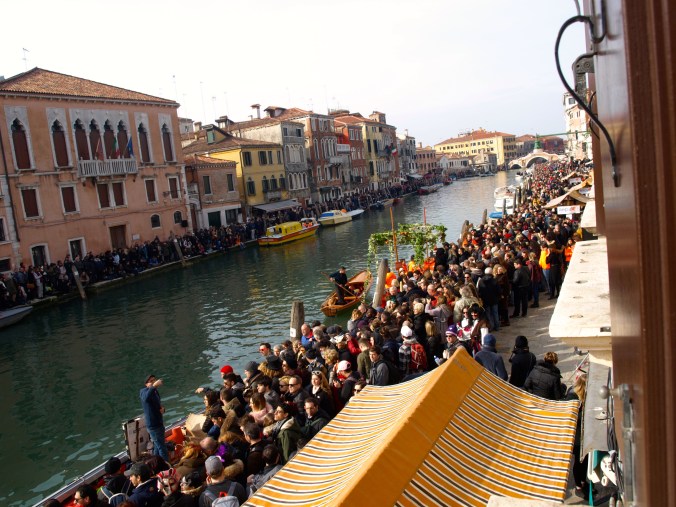
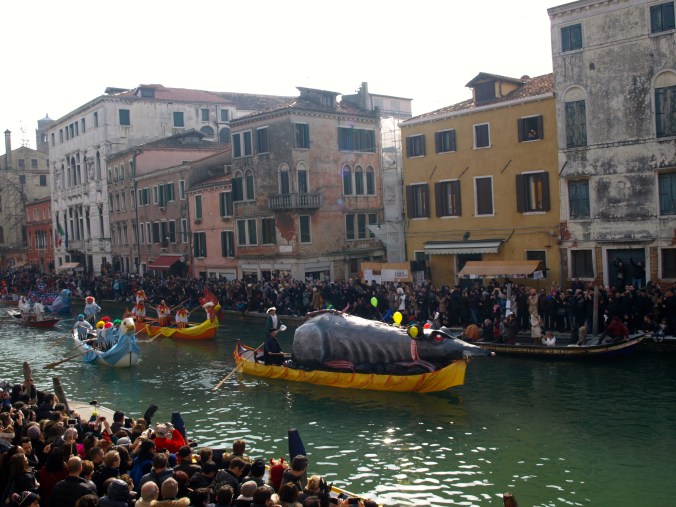
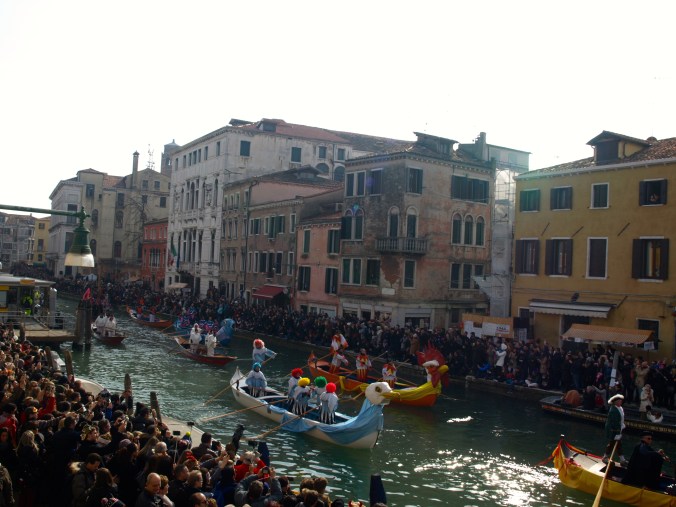
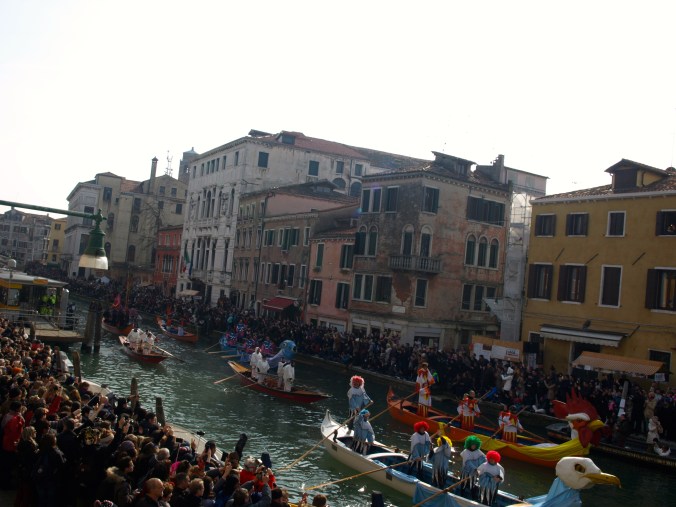
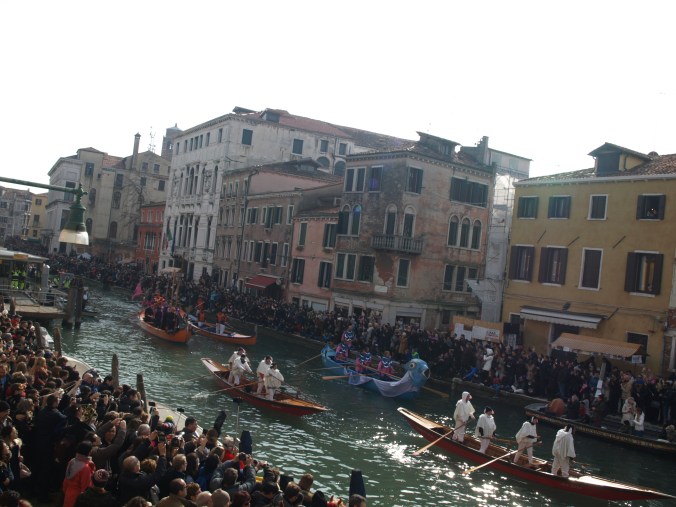
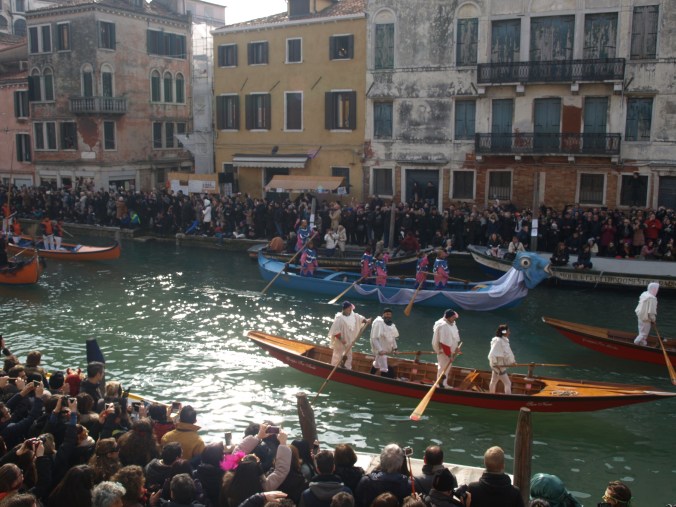
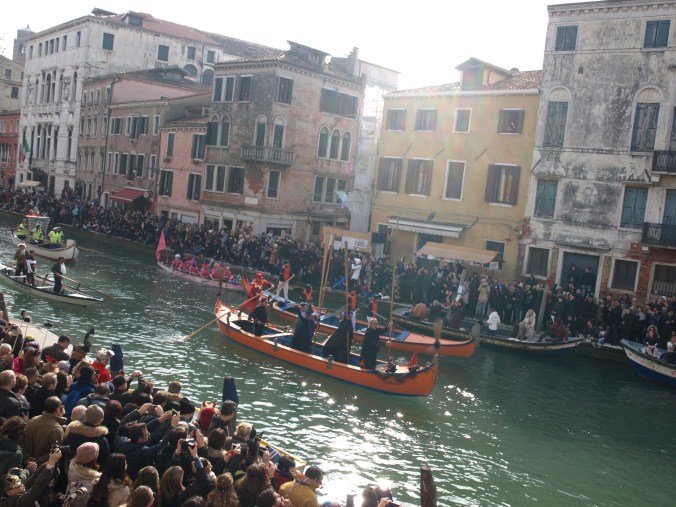
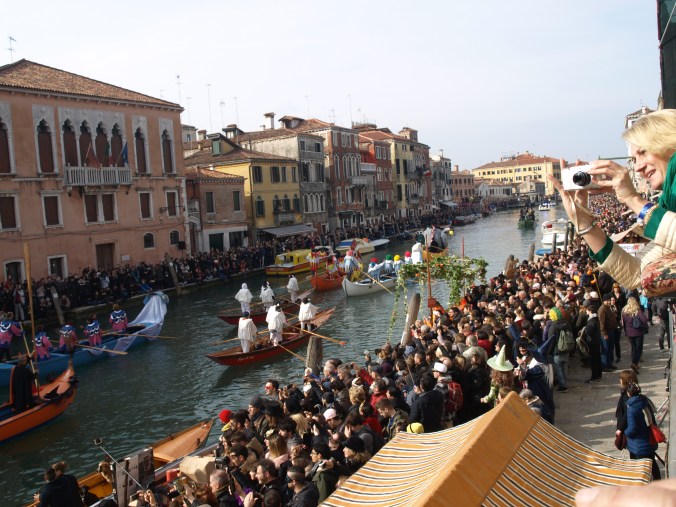
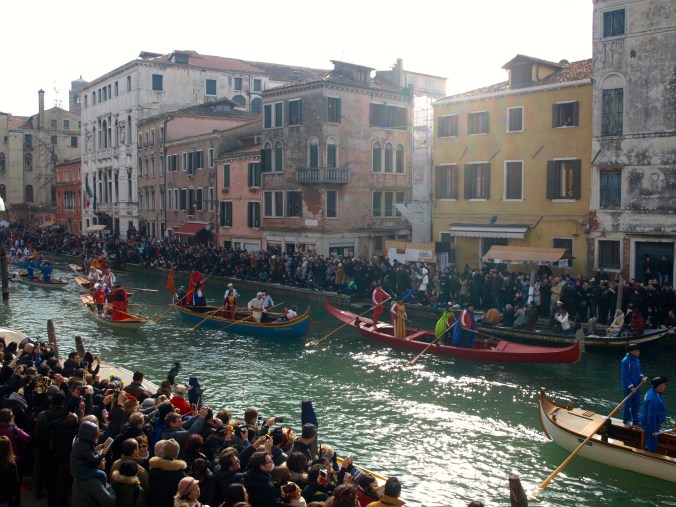
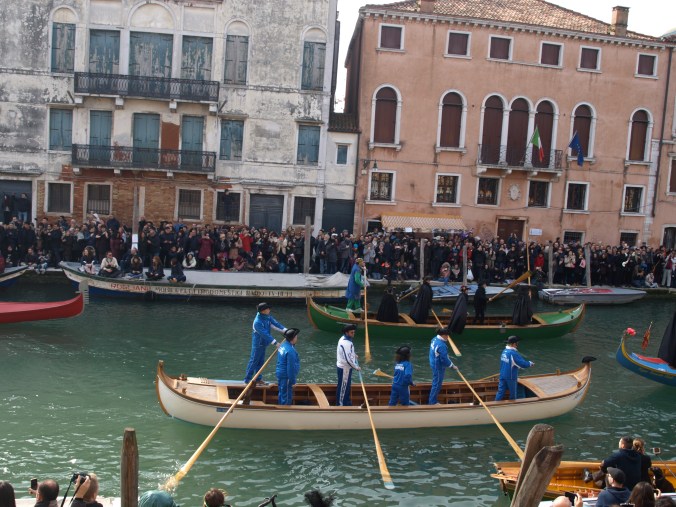

The parade went on and on. The crowds swelled. The sun shone. It was rather magical for a few moments. What more can you ask of life?
As you can see in the photo below, the parade erupts at the end with a canon firing of green smoke and the release of hundreds of balloons.

What a sight!


The costume below won the award for best a year ago.

Crowds swarmed everywhere.

OLYMPUS DIGITAL CAMERA

So let’s learn something, shall we? Perchè no?
The Carnevale di Venezia is an annual festival, ending with the Christian celebration of Lent (Shrove Tuesday or Mardi Gras), forty days before Easter. The festival is world famous for its elaborate masks. In Venice today, the carnevale season runs from late January to early March.

According to tradition, the Carnival of Venice was started in the year 1162, to celebrate a victory of the “Serenissima Repubblica” against the Patriarch of Aquileia. To celebrate this victory, they say, people started gather and dance in Piazza San Marco. By the time of the Renaissance, the festival had become official. By the 17th-c., the baroque carnival presented the world with a very prestigious image of Venice. By the 18th-c, the carnival was famous for its encouragement of licence and pleasure. However, under the rule of the King of Austria, the festival was entirely outlawed in 1797 and the use of masks was strictly forbidden. The carnival reappeared gradually in the 19th-c., but only for short periods and above all for private feasts, where it became an occasion for artistic creations.

After a long absence, the Carnival returned in 1979. The Italian government decided to bring back this historical and cultural feature of Venice. The redevelopment of the masks began as the pursuit of some Venetian college students for the tourist trade. Since then, approximately 3 million visitors come to Venice every year for the Carnival alone. One of the most important events is the contest for la maschera più bella or, the most beautiful mask, which is judged by a panel of international costume and fashion designers.

No one really knows how mask wearing in Venice got started. One scholar argues that covering the face in public was a uniquely Venetian response to one of the most rigid class hierarchies in European history. The first documented sources can be found as far back as the 13th century. The Great Council made it a crime to throw scented eggs and decreed that masked persons were forbidden to gamble.


Masks were an important part of Carnevale, partly because in concealing individual identities they permitted the co-mingling of social classes that otherwise remained distinct and separate. Of course, they also permitted a scandalous level of revelry without any legal consequence.

Another law in 1339 forbade Venetians from wearing vulgar disguises and visiting convents while masked. The law also prohibited painting one’s face, or wearing false beards or wigs.
Near the end of the Republic, the wearing of the masks in daily life was severely restricted. By the 18th century, it was limited only to about three months from December 26. The masks were traditionally worn with decorative beads matching in colour.

Masks have always been an important feature of the Venetian carnival. Traditionally people were allowed to wear them between the festival of Santo Stefano (St. Stephen’s Day, December 26) and the start of the carnival season at midnight of Shrove Tuesday. As masks were also allowed on Ascension and from October 5 to Christmas, people could spend a large portion of the year in disguise. Maskmakers (mascherari) enjoyed a special position in society, with their own laws and their own guild. The mascherari had their own statute dated 10 April 1436. They were a fringe of painters and were helped in their task by sign-painters who drew faces onto plaster in a range of different shapes.

Venetian masks can be made of leather, porcelain or using the original glass technique. The original masks were rather simple in design, decoration, and often had a symbolic and practical function. Nowadays, most Italian masks are made with the application of gesso and gold leaf and are hand-painted using natural feathers and gems to decorate.

Several distinct styles of mask are worn in the Venice Carnival, some with identifying names. People with different occupations traditionally wore different masks.

1. Bauta
The bauta (or baùtta) is a type heavily gilded and cover the entire face; this traditional grotesque was characterized by the inclusion of an over-prominent nose, a thick supraorbital ridge, a projecting “chin line”, and no mouth. The mask’s beak-like chin is designed to enable the wearer to talk, eat, and drink without having to remove it; thereby, preserving the wearer’s anonymity. The bauta was often accompanied by a red or black cape and a tricorn.
In the 18th century, together with a black cape or tabarro, the bauta had become a standardized society mask and disguise regulated by the Venetian government. It was even obligatory to wear it at certain political decision-making events, when all citizens were required to act anonymously as peers. Only citizens (men only, of course) had the right to use the bauta. Its role was similar to the anonymizing processes invented to guarantee general, direct, free, equal and secret ballots in modern democracies.
Given this history and its grotesque design elements, the bauta was usually worn by men, but many paintings done in the 18th century also depict women wearing this mask and tricorn hat. The Ridotto and The Apple Seller by Pietro Longhi are two examples of this from the 1750s.
2. Colombina
The Colombina (also known as Colombino) is a half-mask, only covering the wearer’s eyes, nose, and upper cheeks. It is often highly decorated with gold, silver, crystals, and feathers. It is held up to the face by a baton or is tied with ribbon as with most other Venetian masks. The Colombina mask is named after a stock character in the Commedia dell’arte: Colombina was a maidservant and soubrette who was an adored part of the Italian theatre for generations. Supposedly an actress, who did not wish to have her beautiful face covered completely, had this half-mask designed for her. In fact, the Colombina is an entirely modern creation. There are no historic paintings depicting its use on the stage or in social life.
While both men and women now wear this mask, it began as a woman’s analog to the bauta.
3. Medico della peste (The Plague Doctor)
The Medico della peste, with its long beak, is one of the most bizarre and recognizable of the Venetian masks, though it did not start out as carnival mask at all but as a method of preventing the spread of disease. The striking design originates from 17th-century French physician Charles de Lorme who adopted the mask together with other sanitary precautions while treating plague victims. The mask is often white, consisting of a hollow beak and round eyeholes covered with crystal discs, creating a bespectacled effect. Its use as a carnival mask is entirely a modern convention, and today these masks are often much more decorative.
The plague doctors who followed De Lorme’s example wore the usual black hat and long black cloak as well as the mask, white gloves and a staff (so as to be able to move patients without having to come into physical contact with them). They hoped these precautions would prevent them contracting the disease. The mask was originally beaked with a purpose in congruence with the miasmatic theory of disease practiced at that time: the hollow beak allowed for the containment of flowers and other sweet-smelling substances designed to keep away the foul odors that were thought to spread infection. Those who wear the plague doctor mask often also wear the associated clothing of the plague doctor.
4. Moretta / Servetta muta
The moretta (the dark one) or servetta muta (mute servant woman) was a small strapless black velvet oval mask with wide eyeholes and no lips or mouth worn by patrician women. It derived from the visard mask invented in France in the 16th c., but differed in not having a hole to speak through. The mask was only just large enough to conceal a woman’s identity and was held in place by the wearer biting on a button or bit (the women wearing this mask were unable to speak, hence muta) and was sometimes finished off with a veil. The Rhinoceros by Pietro Longhi, sometimes called Clara the rhinoceros, depicts this mask in use in 1751. It fell into disuse about 1760.
5. Volto (Larva)
The volto (Italian for face) or larva (meaning ghost in Latin) is the iconic modern Venetian mask: it is often stark white though also frequently gilded and decorated, and is commonly worn with a tricorn and cloak. It is secured in the back with a ribbon. Unlike the moretta muta, the volto covers the entire face, including the whole of the chin and extending back to just before the ears and upwards to the top of the forehead; also unlike the moretta muta, it depicts simple facial features like the nose and lips. Unlike the bauta, the volto cannot be worn while eating and drinking because the coverage of the chin and cheeks is too complete.
6. Pantalone
Another classic character from the Italian stage, Pantalone, meaning he who wears the pants or father figure in Italian. This usually depicts as a sad old man with an oversized nose like the beak of a crow with high brows and slanted eyes (meant to signify intelligence on the stage). Like other commedia masks, Pantalone is also a half mask.
7. Arlecchino
Arlecchino’s half-mask is painted black with an ape-like nose and a “bump” to signify a devil’s horn. Arlecchino (harlequin) is a zanni character of the commedia. He is meant to be a kind of “noble savage,” devoid of reason and full of emotion, a peasant, a servant, even a slave. His originally wooden and later leather half-mask painted black depicts him as having a short, blunt, ape-like nose, a set of wide, round, arching eyebrows, a rounded beard, and always a “bump” upon his forehead meant to signify a devil’s horn. He is a theatrical counterpoint to and often servant of Pantalone, and the two characters often appeared together on the stage.
8. Zanni
The Zanni character is another classic of the stage. His mask is a half mask in leather, showing him with low forehead, bulging eyebrows and a long nose with a reverse curve towards the end. It is said that the longer his nose, the more stupid he is. The low forehead is also seen as a sign of stupidity.
Venetian masks feature prominently in contemporary films, including Eyes Wide Shut and Marco Bellocchio’s The Witches’ Sabbath. Stores that supplied the masks include both Ca’ Macana and Il Canovaccio in Venice.
Carnevale is depicted in the 2009 video game Assassin’s Creed II. The main character, Ezio Auditore, is assisted by the artist Leonardo da Vinci in hunting down and assassinating the corrupt Doge of Venice during Carnevale; a golden mask, which Ezio must obtain to enter a private party held by the Doge, plays a significant role in this part of the game. Carnevale is also depicted in the 2005 video game Sly 3: Honor Among Thieves. The first episode of the game is set during the 2001 , and large enemies wear masks.


The pavement was covered with confetti.


My favorite photo of the day:

12 February 2017
and my other favorite of the day:

 get back, lauretta!