The 19th-century aesthete, Walter Pater, once likened Luca della Robbia’s sculptures to “fragments of the milky sky itself, fallen into the cool streets, and breaking into the darkened churches.” These appealing creations, which still brighten the penumbras of Tuscan chapels, are highlighted in an exhibition now on view (through June 4) in D.C.. Della Robbia: Sculpting With Color in Renaissance Florence, at the National Gallery of Art, nga.gov
http://www.nga.gov/content/ngaweb/press/exh/4848.html
Around 1440, Luca della Robbia, the talented Florentine sculptor in marble and bronze, turned his attention to creating in glazed terra cotta. He achieved a result that has been a part of the ambience of Tuscany ever since. This special work was a brand of glazed terra-cotta sculpture that was physically durable, graphically strong and technologically inimitable. (The exact methods for producing it remain a mystery to this day.)
Luca, the art dynasty’s founder, was accustomed to praise. In 1436, when Luca was in his mid-30s, Leon Battista Alberti ranked him one of the five most inventive Florentines, along with Brunelleschi, Donatello, Lorenzo Ghiberti and Masaccio. At the time, Luca was coming off the triumph of his “Cantoria,” a set of carved marble panels of singing children done for the organ loft of the Florence cathedral. What Alberti couldn’t know was that Luca would soon shift from sculpting figures in stone to molding them in clay, and with that to even greater fame. And by using a medium no one else was interested in, Luca could invent an instantly recognizable brand.

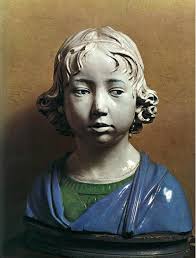
The Della Robbia technique involved firing the clay twice, the second time with glazes that produced a smooth, shiny, opaque and often brilliant palette of white, blue, green, yellow and purple.
Luca the elder, who lived to be over 80 years old, invited his nephew Andrea into the business, and Andrea’s children continued the family tradition, some of them in France, well into the middle of the 16th century. Glazed terra cotta was made into free-standing sculptures in the round relief; relief sculptures that could be hung on a wall; flat plaques sturdy enough to be placed outdoors; and small household objects that were affordable to a wide range of consumers. Production of sculpture using this technique lasted only about a century before its secrets were lost. Some of the most familiar images today of Renaissance Italy, Della Robbia sculptures have retained their original color and shine over the centuries.
Visitors to Tuscany will be familiar with the look of the Della Robbia, especially the rich cerulean blue and fine-porcelain whites of the early pieces by Luca and Andrea. More colors were added as different members of the family expanded the range and ambition of the shop, responding in particular to the styles and expressive language of contemporary painters.
But there is a habit of putting the Della Robbia family production into a neat little box, separating their work from the mainstream of Italian Renaissance art as not quite fully sculpture such as those that Michelangelo would produce, nor as expressive or fine as paintings by Filippo Lippi, Fra Bartolommeo, Andrea del Sarto or Leonardo da Vinci — all of whom may have influenced or inspired Della Robbia designers.
The same thing happens when visiting American museums, where one often encounters a stray Della Robbia piece in the Renaissance galleries. The eye notes its presence with pleasure, but rarely engages with it as deeply as with other works of the period. Part of this, no doubt, has to do with the longer history of glazed ceramics, the tchotchke effect of associating cheap figurines from lesser antique stores with these early and often magisterial essays in the form. Even Michelangelo, who considered sculpture proper to be about the removal of material to find form rather than the building up and modeling characteristic of working with clay, disparaged the medium.
The current exhibition in Washington, D. C. provides a context for the della Robbia style, and provides an excellent opportunity to see the full range of what the Della Robbia artists and their competitors produced.
This exhibition, which opens Sunday and is billed as the first major U.S. show devoted to Della Robbia, began in Boston and features some 40 works, across the full range of what was made.
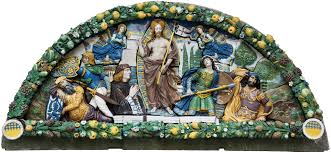
Above a door frame in the main corridor of the National Gallery’s West Building is a spectacular lunette by Giovanni Della Robbia, showing the Resurrection of Christ; outside the entrance to the exhibition, in protective cases, are smaller statuettes that demonstrate how powerfully these works can speak at a more domestic scale, including a touching bust of a boy by Andrea, whose depictions of children are exceptional among artists of the age.
But it’s in the first room of the exhibition proper that you encounter the full continuum of artistic expression and decorative functionality that is one of the most difficult facts to process for modern audiences grappling with the Renaissance. On the walls are two coats of arms, which weren’t exactly mass-produced, but were made in great numbers, with purchasers requesting their institution’s logo or insignia as a custom order, and then adding to it standard moldings or decorative garlands to fancy it up. The use of ceramic molds, the easy workability and the relative cheapness of clay, meant that glazed terra cotta was an accessible, durable, mass-market form. But these two functional works keep company with what is a masterpiece in the medium, a masterpiece by any definition in any age: Luca della Robbia’s “The Visitation,” made around 1445 for a church in Pistoia, not far from Florence.
“The Visitation” was made for the Church of San Giovanni Fuorcivitas in Pistoia, about 30 miles from Florence, it’s a three-dimensional, near-lifesize two-figure tableau illustrating the moment in the Gospel of Luke when Mary, pregnant with Jesus, meets her elderly cousin, Elizabeth, also miraculously pregnant, her child being John the Baptist. In the story, Elizabeth feels the child in her womb stir with joy. In the sculpture, she kneels before Mary to acknowledge her as the mother of God.
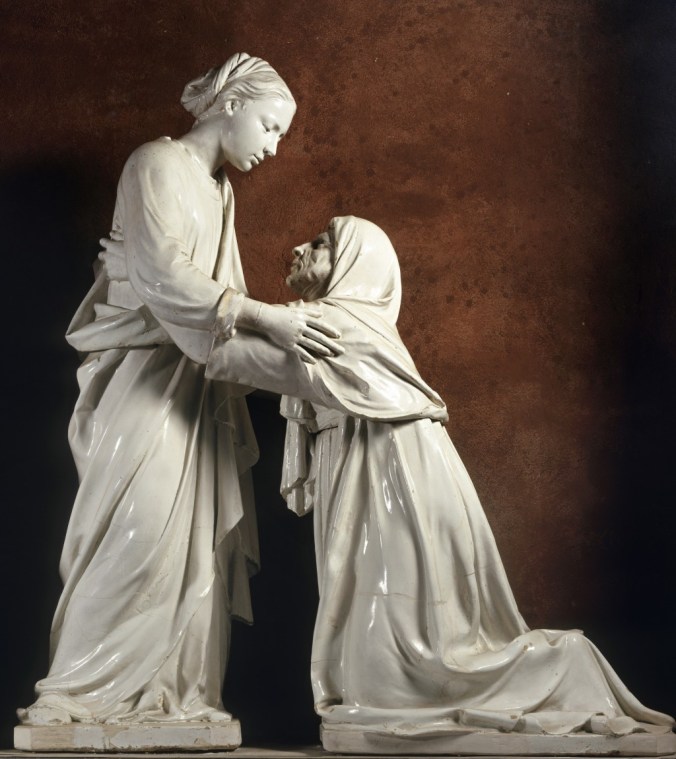
Assembled from four pieces, “The Visitation” depicts a standard scene for artists of the day, the story of the Virgin Mary’s encounter with her older cousin Elizabeth, both miraculously pregnant. The older woman kneels in front of Mary, who looks down tenderly and embraces her kinswoman, who will bear St. John the Baptist.
Luca’s depiction of the women, rendered in white, is deeply touching, and the impact is only heightened by the drama embedded in the construction of the statues. This image of two women, who share a human present (sorority, maternity) and cosmic future that only they — and now we, as witnesses — know, has layered religious and secular implications. But psychological subtly is what makes it moving, conveyed by posture and exchanges of touch, and by the contrast between Mary’s dreamy, half-seeing glance and the older woman’s beseechingly earnest effort to make their eyes meet.
And with this work Luca establishes a formal look that will be his signature: naturalistic figures covered in a creamy-white glaze that glows like moist skin and projects an impression of purity. The flawless coating also helps disguise the fact that this sculpture, which looks so completely of a piece, was too large to be fired whole in a kiln, and was composed in four sections, which can still be disassembled and then seamlessly interlocked.
Fired in four pieces and expertly fitted together, the two forms divide the embracing arms and hands so that Mary’s hands are attached to the sleeves of Elizabeth’s dress, and Elizabeth’s hands encircle the back of Mary’s gown. When they are placed next to each other, you hardly notice the gap between the arms and hands; but even if separated, each woman bears the impress of the other, as if the moment of their greeting has bound them together for eternity, no matter the vicissitudes of the four pieces of terra cotta over the years.
The exhibition also shows how, as the workshop continued to keep up with fashions and changing markets, it took a colorful direction, with unglazed clay standing in for skin, and a profusion of colors and details aiming at the narrative and dramatic power of painting. A set of three saints from around 1550, by Santi Buglioni (who headed a competing shop that also made glazed terra cotta), is presented as the “swan song” of the form, a late tour de force that captures the veins in their hands and the wrinkles around their eyes, creating an ensemble of charismatic and passionate forms. A tabernacle from the 1470s, with a small metal door for the sacramental bread in the center, creates a genuinely illusionist architectural space, with two angels present on both sides.
The exhibition ends with the figure of an adoring angel, reminiscent of Leonardo, made by Luca della Robbia the Younger, around 1510 or 1515. The exhibition emphasizes the Della Robbia connection to other artists, and how far the shop had come since Luca’s early designs in white and blue.
 get back, lauretta!