
Month: June 2017
Palazzo Strozzi: an incredible, historic building now repurposed as a superb exhibition space
The Palazzo Strozzi is a superb example of Renaissance civil noble residential architecture in the historic center of Florence. And it has been repurposed to delightful service of the modern world.
 ‘
‘
Today the palace is used for temporary international expositions, like the one I viewed yesterday, devoted to Bill Viola.

Before looking at the exhibition, let’s discuss the incredible building:
Filippo Strozzi the Elder (1428 – 1491), the banker and statesman, commissioned the structure after his return to Florence in November of 1466.

As a major Medici rival, Strozzi wanted to build the most magnificent home in the city to assert his family’s prominence. The palace may as well have been intended as a political statement of his own status. Based on the wishes of Strozzi himself, the palazzo would be built to look like a small fortress in the heart of the city.
The palace was begun in 1489 and designed by Benedetto da Maiano.

The Strozzi palace was clearly inspired by the Palazzo Medici, with its rusticated stone exterior, but it is much larger and has more harmonious proportions than its predecessor. Whereas the Palazzo Medici was sited on a corner lot and thus has only two main sides, the Stozzi is surrounded on all four sides by streets. The Strozzi palace faces the historical and fashionable Via de’ Tornabuoni, as well as the Piazza Strozzi and on Via Strozzi. The building thus required three imposing entranceways, each flanked by rectangular windows. The Strozzi family’s coat of arms is found in the upper floors.
The siting of the Strozzi in the center major streets provided the challenge of how to integrate a cross-axis in keeping with the Renaissance desire for strict internal symmetry. As a result, the ground plan of Palazzo Strozzi is rigorously symmetrical on its two axes.
The Strozzi family acquired a great number of buildings in this area were acquired during the 70s and demolished them all to to provide enough space for his new home.
The original architect, Benedetto da Maiano, died in 1497; Simone del Pollaiolo (il Cronaca) took over and was responsible for the completion of the palace. Pollaiolo died in Florence in 1508, but is credited with the design and finish of the central courtyard or cortile, surrounded by an arcade inspired by Michelozzo.
The external facade is adnorned with splendid torch holders, flag holders and rings to tie horses made by Niccolò di Nofri, an iron-worker known as il Caparra.
Unfortunately, Filippo Strozzi died in 1491, long before the construction’s completion in 1538. Strozzi’s children were the first to live in the palazzo, moving in around 1505. Ironically, Duke Cosimo I de’ Medici confiscated the palazzo in the same year, not returning it to the Strozzi family until thirty years later.
The palazzo remained the seat of the Strozzi family. Although the family lived in Rome for centuries, the palazzo was returned to its original splendour in the mid-1800s with the Princess Antonietta, and then with Prince Piero, who, from 1886 to 1889, had the building renovated by architect Pietro Berti. In 1937 the family sold the building to the Istituto Nazionale delle Assicurazioni, and many changes were made to the edifice. It was later given to the city of Florence in 1999. It is now home to the Institute of Humanist Studies and to the Fondazione Palazzo Strozzi.
Since July 2006, the Fondazione Palazzo Strozzi has been able to create a rich and innovative calendar of events and exhibits, in these areas of the building: Piano Nobile, la Strozzina and Il Cortile.
The Gabinetto G.P. Viesseux and the Renaissance Studies Institute both have also occupied the building since 1940. Here also is the seat of the Istituto Nazionale del Rinascimento and the noted Gabinetto Vieusseux, with a library and reading room.
Today the palace is used for temporary international expositions like the now-annual antique show, founded as the Biennale dell’Antiquariato in 1959, fashion shows and other cultural and artistic events.
Allora, on to Bill Viola and his video art.
In the exhibition “Electric Renaissance,” Viola seems to have taken certain Renaissance masterpieces and created video dialogues with them. I would say he is tremendously fortunate to have been able to borrow the original Italian artworks and, even if you don’t love Viola’s work, you will be rewarded with a small, select group of historic masterworks. For example:
Here’s his dialogue between his video of 3 contemporary women greeting each other, in relationship to Pontormo’s


Other installations stand on their own. This screen is about 200 feet long by 15 feet high.


People will do anything for a photo of a view!


On my way home.
Today was a perfect Florentine day. We had a refreshing wind that blew through town yesterday and cooled everything off.
I had a super afternoon today, which I’ll post about later. Suffice it to say for now that I went to see an Italian film on Michelangelo at one of the prettiest theaters in the world, a blessed holdover from the golden age of cinema, and then I went to an exhibition of (need I say, modern) video art in a Renaissance palazzo. How could you have a better afternoon than enjoying these contrasts and artworks? Impossible for me to imagine.
So, happily strolling home in the mid-evening, I encountered this great Clet sign.

I walked by the koi made out of luggage materials. I would think it’s a perfect draw for all the Asian tourists who bought too many souvenirs and need a new suitcase to get it all home.


I walked by Moschino boutique and am happy to see fall fashions on display. It assures me that cooler weather will happen again. I am a window shopper only. I could never/would never buy clothes of this price!

I walked by the Dolce and Gabbana children’s shop, and had to admire the way they tell us that they are cleaning, rearranging, tidying up.

I couldn’t help admiring the medieval street I just strolled through, thinking to myself what a perfect specimen of old/new. How lucky I feel to be here.

I turned onto my street, a route which takes me by this cool shoe shop. Cool fall flats on display. Another sign that nicer weather will eventually return!

I ambled by the high-end textile store that always has the most gorgeous bolts of fabric on display. I always stop to admire and it reminds me of happy days with my mother, when I was a bambino. She taught me to appreciate the finer things.

And last, but certainly not least, by my favorite hardware/perfume shop. I mean, really, where else but Florence can you find that particular combination???

I’ll stop in again and get some pictures of the interior. It is a bazaar, filled with things you never knew you needed. But, you do!
Imperfetto.
The Italian word that summarizes my use of the language.
How to do geraniums.
Like the Italians do.
Il geranio. I gerani. Mi piace moltissimo!
Il Geranio
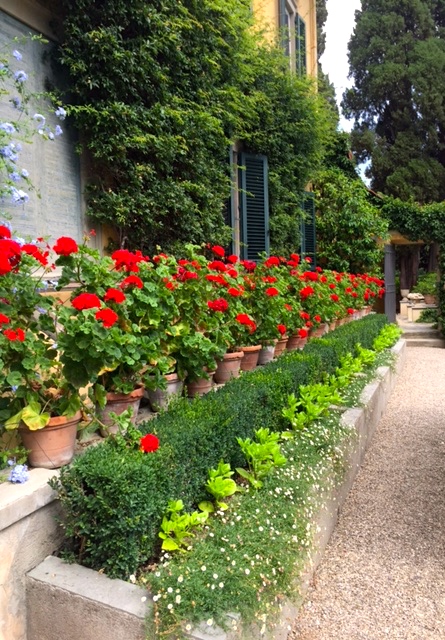
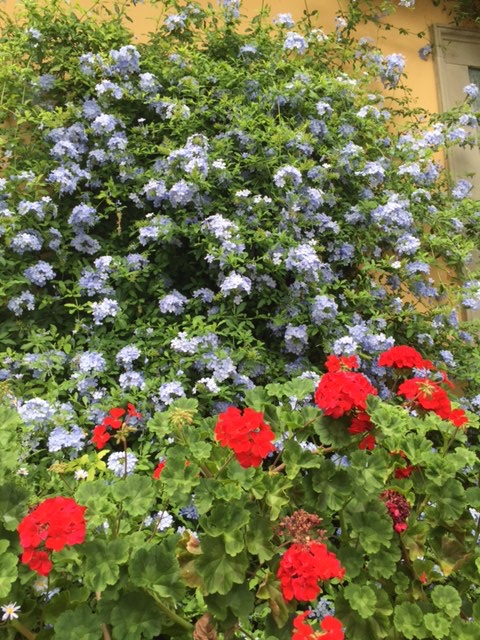
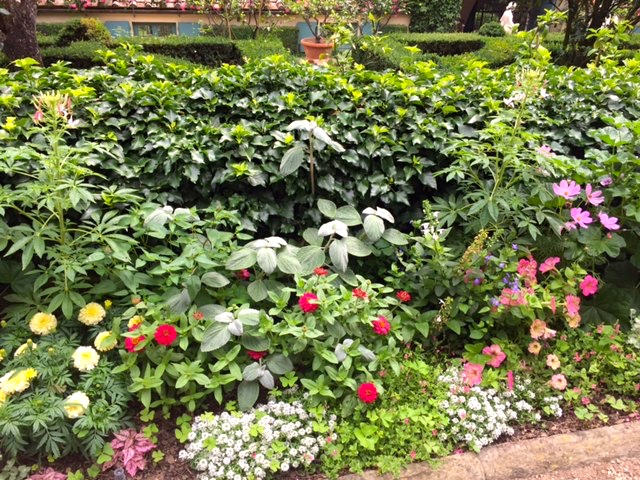
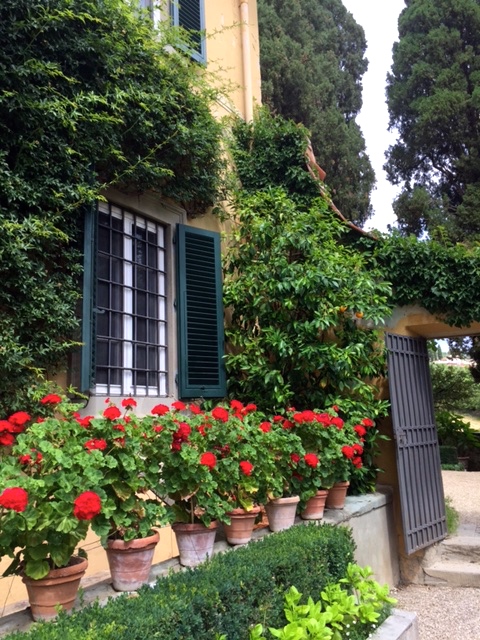
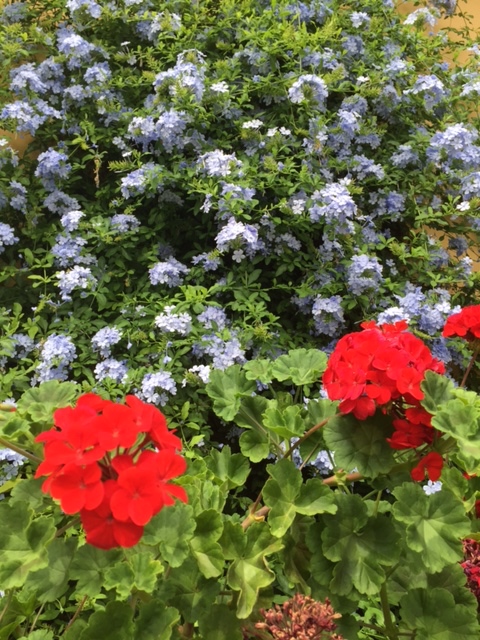
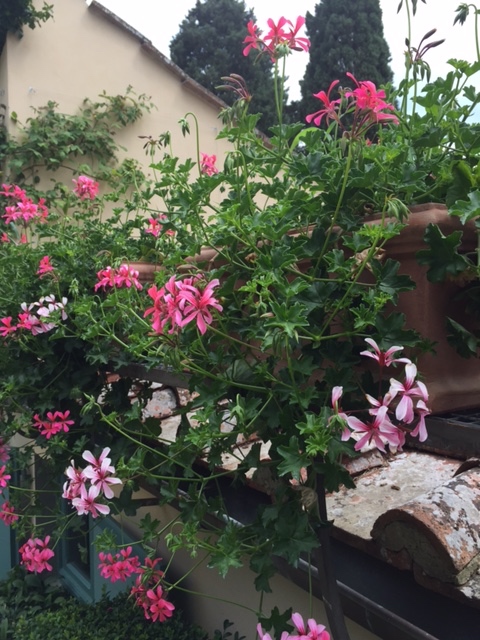
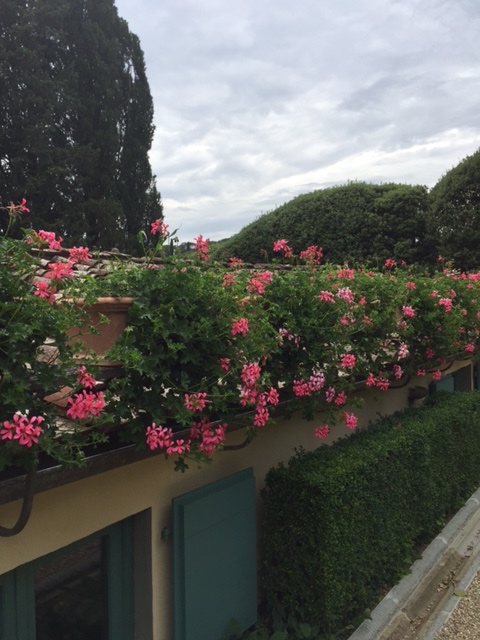
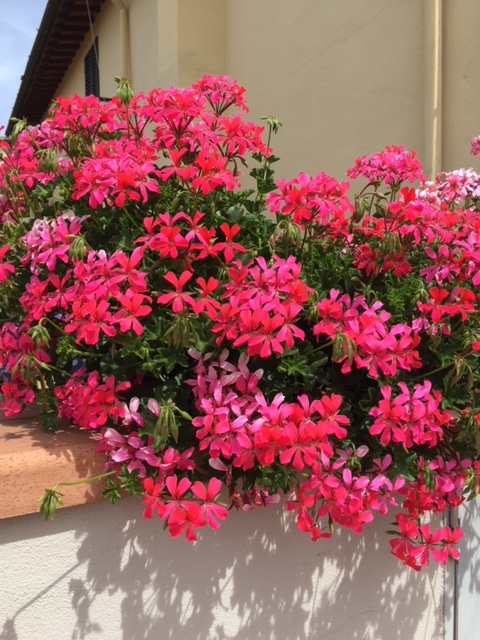


Nobody does geraniums better than the Italians, secondo me.
Firenze

Koi in Florence
K
Sunny sunset
The sun is lowering, tramonto.
But it shines brightly on the Duomo before it sinks.


And I only recently realized I can see the spire of the Badia from my terrace. Sometimes I’m pretty slow!

i colori
Arancia:

Verde:

Rosa:

Certosa e magenta:

 get back, lauretta!
You must be logged in to post a comment.