Month: June 2018
Serendipity
[People who are] super-encounterers not only get excited about encountering information, Erdelez wrote, they may also be more sensitive than others to noticing information in their environment. Think of them as good detectives.
In fact, the origins of the word “serendipity” are tied to the detective story. In 1754, when Horace Walpole, a British politician, was writing to his friend and distant cousin about his tendency to find whatever he wanted “wherever I dip for it,” he called it “Serendipity.”
It was a word he said he coined after a fairy tale called “The Travels and Adventures of Three Princes of Serendip.” “As their Highnesses travelled,” Walpole wrote, “they were always making discoveries, by accidents and sagacity, of things which they were not in quest of.” (This was not really how the fairy tale went, but it was nonetheless Walpole’s recounting of it.)
Thus the origins of the word “serendipity” lie in clues, “keen observations,” and “Sherlock Holmesian insights,” as the sociologist Robert K. Merton and Elinor Barber, a research associate, put it in The Travels and Adventures of Serendipity, a deep dive into the word’s etymology.
Rosenbloom, Stephanie. Alone Time: Four Seasons, Four Cities, and the Pleasures of Solitude, Penguin Publishing Group. Kindle Edition.
Gucci Museum
Watch this video in which Suzy Menkes, the fashion editor of The International Herald Tribune, speaks with the creative director of the Gucci Museum, a fun museum in Florence.
June 24, Florence’s special holiday
Parades, Calcio Storico & Fireworks are part of the celebrations
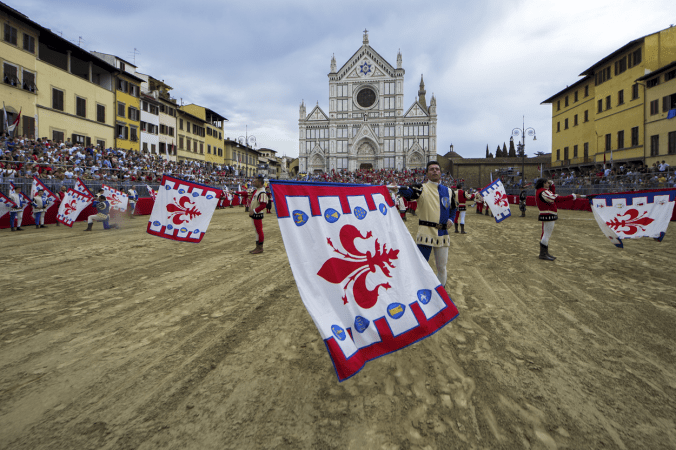
On June 24, Florence celebrates the feast day for its patron saint, St. John the Baptist, considered the “symbol of moral rectitude and political correctness”* on whom medieval Florence aspired to build its economic fortune and good government of the Republic. The image of the saint was even stamped on the city’s currency, the florin.
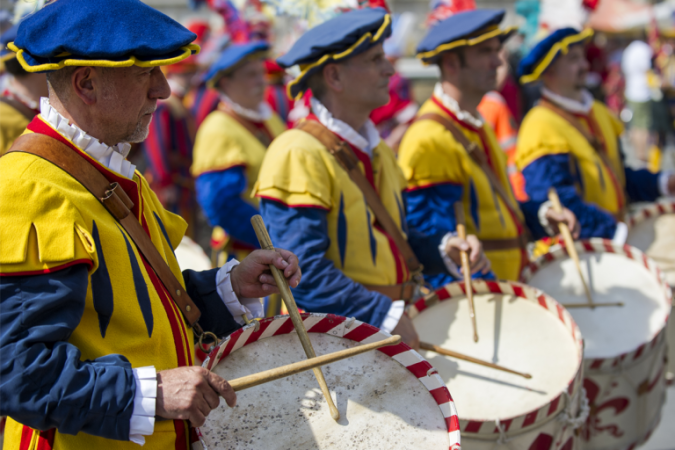
The day has thus been a day of celebration for the city through the centuries. Every year, for St. John, the city organizes several cultural and folkloric events that end with the magnificent fireworks show, called i fochi di San Giovanni by Florentines.
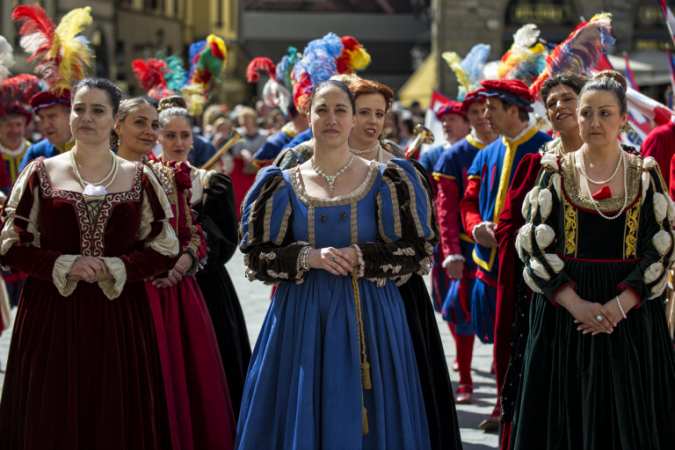
One way Florentines celebrate is by holding the calcio historico on Piazza Santa Croce. in which the 4 quartieri of Florence compete.
For the past 2 weeks the city has been preparing the Piazza. It has been fun to watch the square being prepared for spectators:
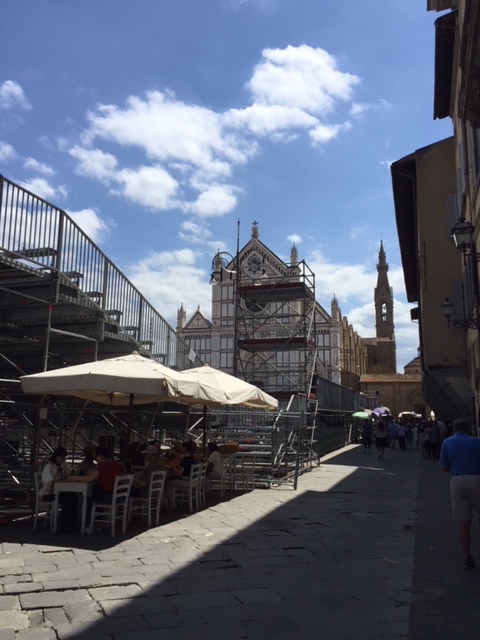
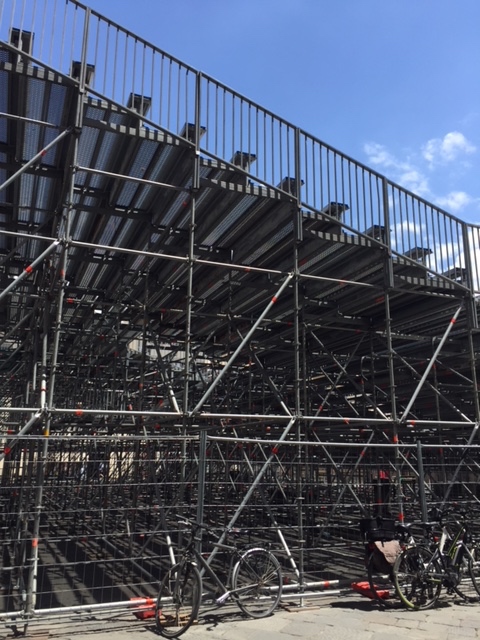
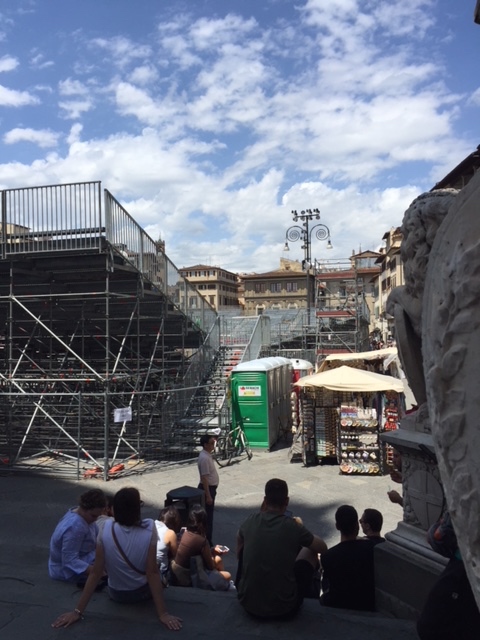
And below, you can watch a bit of a previous game. I will never go to this event because it is very brutal and bloody.
Escapism
I need an escape as from afar I watch my country’s values going down the drain in a way I never saw coming in my lifetime. So, here’s what I’ll post instead. It helps a little.
When were women allowed the right to dine out alone? Pretty recently if you can believe it!
To eat out alone is to partake of such experiences. And if you happen to be a woman dining alone, you also happen to be exercising a hard-won right, one that still doesn’t exist everywhere.
“It was impossible for a woman to go about alone,” Virginia Woolf wrote of Jane Austen in A Room of One’s Own. “She never travelled; she never drove through London in an omnibus or had luncheon in a shop by herself.”
Indeed, generations of women simply weren’t allowed to dine alone in restaurants and bars. As late as the beginning of the twentieth century, New Yorkers were debatinglegislative bills about whether women should be allowed to eat out without a male escort.
And it wasn’t just men who wanted to keep the status quo. “I believe it is a protection to all decent women that women alone should not be allowed to eat in public restaurants,” said a member of the Women’s Republican Club in 1908, according to the New York Times. Despite the objection, the club passed a resolution favoring a bill that would allow women to dine in public places without a male escort.
Doing so, however, continued to be difficult, not for a little while, but for decades. As one restaurateur told the Times in 1964: If a “good-looking lady without a partner asks for a table, you wonder why she is alone and I’ve had my experience with that situation!” It wasn’t uncommon for women alone to be presumed to be like the women in paintings by Van Gogh and Manet—prostitutes.
Things weren’t much better in 1970. A New York magazine article that year began: “In this most liberal of cities, a woman has no legally guaranteed right to enter a restaurant.” When Mother Courage, the country’s first feminist restaurant (according to the Greenwich Village Society for Historic Preservation), opened two years later, it provided a place for solo female diners to tuck in.
“A woman coming to eat here alone knows she won’t feel like a freak and won’t get hassled by men,” Dolores Alexander, who founded the restaurant with her partner, Jill Ward, told People magazine in 1975. Even today women are still reporting the same problems experienced by Alexander’s generation.
Yet despite decades of unwanted attention dining out by herself, could wax poetic about its pleasures. Fellow food writer Marion Cunningham, a champion of family mealtime, also appreciated solo dining: “Sometimes eating supper alone feels private, quiet, and blessedly liberating,” she wrote in her popular Supper Book, where she devoted a page to “Supper Alone.” There she briefly extolls the sorts of unconventional meals that can be enjoyed alone (she liked a baked potato with olive oil and coarse pepper and salt, followed by vanilla ice cream) as well as the opportunity to cook something restorative (for her, it was split pea soup).
In 2017, the New York Times asked the humorist Fran Lebowitz which three writers she would invite to a literary dinner party. “None,” she replied. “My idea of a great literary dinner party is Fran, eating alone, reading a book.”
Rosenbloom, Stephanie. Alone Time: Four Seasons, Four Cities, and the Pleasures of Solitude. Penguin Publishing Group. Kindle Edition.
Italian questions for gli Americani
Urban moonrise

How the French eat
As the writer Alice B. Toklas said, the French bring to the table “the same appreciation, respect, intelligence and lively interest that they have for the other arts, for painting, for literature and for the theatre.” This history of thoughtfully prepared meals and passion for terroir, the combination of earth and climate that distinguishes a wine, has made Paris an ideal place to practice the art of savoring.
Rosenbloom, Stephanie. Alone Time: Four Seasons, Four Cities, and the Pleasures of Solitude (p. 40). Penguin Publishing Group. Kindle Edition.
The good life
There’s only one very good life, and that’s the life that you know you want, and you make it yourself. —Diana Vreeland
 get back, lauretta!
You must be logged in to post a comment.