Do you like alone time?

Audrey Hepburn took to her apartment. “I have to be alone very often,” she told Life magazine in 1953. “I’d be quite happy if I spent from Saturday night until Monday morning alone in my apartment. That’s how I refuel.”

Thinkers, artists, and innovators from Tchaikovsky to Barack Obama, from Delacroix and Marcel Marceau to Chrissie Hynde and Alice Walker, have expressed the need for solitude. It’s what Rodin has in common with Amy Schumer; what Michelangelo shares with Grace Jones.

Philosophers and scientists spent much of their lives in solitude, including Descartes, Nietzsche, and Barbara McClintock, the Nobel Prize–winning geneticist who resisted having a telephone until she was eighty-four.

Countless writers, including Shakespeare, Dickinson, Wharton, Hugo, and Huxley, mined solitude as a theme. Symphonies and songs, poems and plays, and paintings and photos have been created in solitude.

For the creative person, “his most significant moments are those in which he attains some new insight, or makes some new discovery; and these moments are chiefly, if not invariably, those in which he is alone,” Storr wrote in his seminal book, Solitude: A Return to the Self. While other people can be one of our greatest sources of happiness, they can at times nonetheless be a distraction.

Their presence may also inhibit the creative process, “since creation is embarrassing,” as the writer Isaac Asimov said. “For every new good idea you have, there are a hundred, ten thousand foolish ones, which you naturally do not care to display.”

Monet slashed his paintings before the opening of an exhibition in Paris, declaring the canvasses unworthy to pass on to posterity. Robert Rauschenberg flung his early works into the Arno.

Yet just as alone time can be important for creation (and possible subsequent destruction), it can also be necessary for restoration. Some of the latest research has found that even fifteen minutes spent by ourselves, without electronic devices or social interaction, can decrease the intensity of our feelings (be they good or bad), leaving us more easygoing, less angry, and less worried.

Studies led by Thuy-vy Nguyen, published in the Personality and Social Psychology Bulletin, suggest that we can use solitude or alone time as a tool, a way to regulate our emotional states, “becoming quiet after excitement, calm after an angry episode, or centered and peaceful when desired.”

Alone, we can power down. We’re “off stage,” as the sociologist Erving Goffman put it, where we can doff the mask we wear in public and be ourselves. We can be reflective. We have the opportunity for self-evaluation, a chance to consider our actions and take what Westin called a “moral inventory.” We can also take inventory of all the information that has accumulated throughout the day. We can organize our “thoughts, reflect on past actions and future plans, and prepare for future encounters,” as the psychologist Jerry M. Burger wrote in the Journal of Research in Personality.

Even Bill Clinton, exemplar of extraversion, acknowledged that as president he scheduled “a couple of hours a day alone to think, reflect, plan, or do nothing.” “Often,” he said, “I slept less just to get the alone time.”

This notion of reflection harks back to an ancient Greek principle known as epimelesthai sautou. The philosopher Michel Foucault translated it as “to take care of yourself,” and though it was once “one of the main rules for social and personal conduct and for the art of life,” Foucault observed that there is a tendency, particularly in modern Western society, to view caring for oneself as almost immoral. And yet alone time has the potential to leave us more open to others.

And yet alone time has the potential to leave us more open and compassionate toward others. John D. Barbour, a professor of religion at St. Olaf College in Northfield, Minnesota, has written that while solitude involves the self, it’s not necessarily narcissistic. He’s suggested that the solitude sought by biblical prophets helped shape their perspective and may have made them more sensitive to the suffering of people who were less powerful or outsiders. “Solitude at its best,” he wrote, is not about “escaping the world, but toward a different kind of participation in it.”

Unfortunately, there’s a tendency in our own age of scant nuance to conceive of solitude and society as either-or propositions: You’re either alone on your couch or you’re organizing dinner parties.

That’s an unhelpful (and often wrong) distinction. The psychologist Abraham H. Maslow found that self-actualizing people—those who have attained the highest tier of his hierarchy of human needs—are capable of being more than one thing at one time, even if those things are contradictory.  They can besimultaneously individual and social; selfish and unselfish.

Burger wrote that people with a high preference for solitude don’t necessarily dislike social interaction, and aren’t necessarily introverted. They probably spend most of their time around others, and enjoy it; he said it’s simply that, relative to others, they more often chose to be by themselves because they appreciate the reflection, creativity, and renewal that solitude can offer.

Rosenbloom, Stephanie. Alone Time: Four Seasons, Four Cities, and the Pleasures of Solitude. Penguin Publishing Group. Kindle Edition.
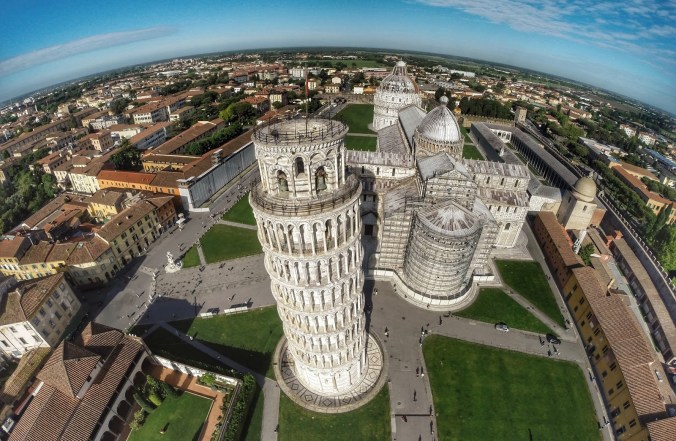
Why doesn’t the Leaning Tower of Pisa fall over?

The Leaning Tower of Pisa has withstood earthquakes for centuries. Now, scientists know why.
image1
Yes, the Leaning Tower of Pisa is still standing. Here’s why it’s earthquake-proof.
The tower and its 5.5 degree lean have vexed engineers for centuries.  

Partially constructed on unexpectedly soft soil, the ancient bell tower began to lean before it was even finished, a historical goof that went on to become one of the world’s historical oddities — and made the tower a UNESCO World Heritage site.

How can something so obviously structurally unsound endure in an earthquake-prone region for hundreds of years? People who assemble an IKEA cabinet and have 18 pieces left over don’t expect to pass a wobbly Hemnes down to their great-grandchildren.

Professor George Mylonakis wanted to know why.

You can read all about it here:

https://www.washingtonpost.com/news/speaking-of-science/wp/2018/06/07/the-leaning-tower-of-pisa-has-withstood-earthquakes-for-centuries-now-scientists-know-why/?utm_term=.f83e68b12400&wpisrc=nl_rainbow&wpmm=1

Show a little courtesy, per favore!

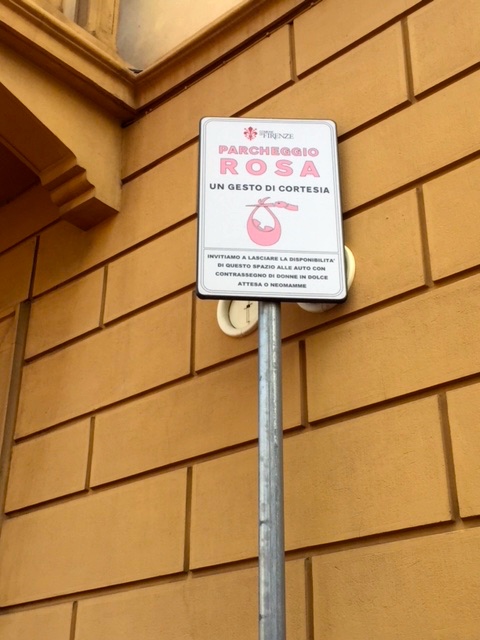
Saw this sign on the street the other day and thought it was interesting and entertaining. It points out that this place on the street, which just happens to be near a major supermarket, is a spot for “Pink Parking,” un gesto di cortesia (a courteous gesture). It’s obviously meant to call on the public’s morality and generosity to save this space for pregnant women.


IMG_9532

I can promise you that in the many times I’ve walked by it, there is never a space saved for a pregnant woman.  Too bad!

Lorenzo de’ Medici’s sculpture garden

Lorenzo de' Medici and His Artists in the Sculpture Garden


Ottavio Vannini – Michelangelo Showing Lorenzo il Magnifico the Head of a Faun, surrounded by the other sculpture students


Young Michelangelo Carving a Faun's Head


Young Michelangelo Carving a Faun’s head by Emilio Zocchi


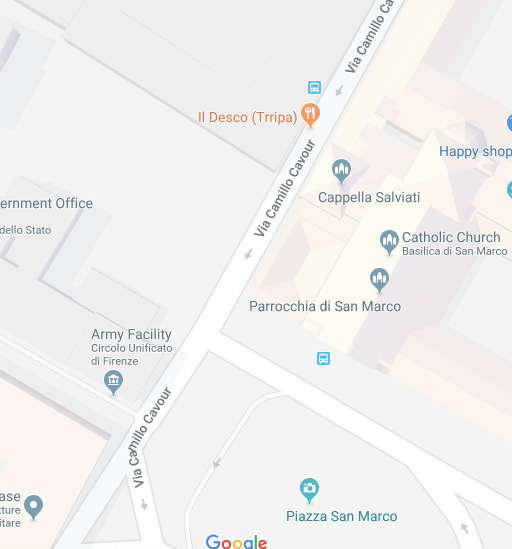
The Piazza San Marco on the former Via Larga, which is now Via Camillo Cavour, was where Lorenzo de’ Medici’s Sculpture Garden was situated in Florence. In the map below, you can get a sense of where the garden was in relationship to Piazza San Marco. The sculpture garden would have been where the words “Army Facility” show below.


Screen Shot 2018-05-29 at 6.34.27 PM


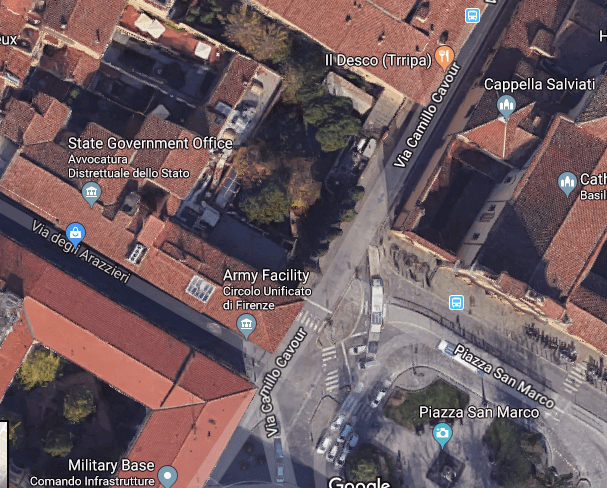
The Google map showing a satellite view, gives an even better sense of this former garden area.  Think away the Army building to the south end of the space, where Via Cavour and Via degli Arazzieri intersect, and you can see that there is still garden area in the site of the former Medici garden.

Screen Shot 2018-05-29 at 6.37.12 PM


Created with the hopes of becoming a great educational institution for studying art, Lorenzo de’ Medici curated a garden full of antique sculptures for artists to come and sketch as part of their artistic practice. Lorenzo also added sleeping and dining quarters so that students could easily live among the work they were studying. Francesco Granacci and Bertoldo di Giovanni are two of the many people to enter through its doors.

The most famous story of Michelangelo’s time in the Garden surrounds Michelangelo’s Faun statue. When Lorenzo saw this statue, he jokingly told Michelangelo that he looked too perfect to be an old faun. Michelangelo than took his drill and knocked out one of the teeth in the mouth of the Faun.

He showed his subtraction to Lorenzo who gained much amusement and pleasure from Michelangelo’s ability to listen and act on his critique.  Although the Faun statue has not been found, the two works of Michelangelo’s attributed to this time period are the Battle of the Centaurs and the Madonna of the Stairs. 


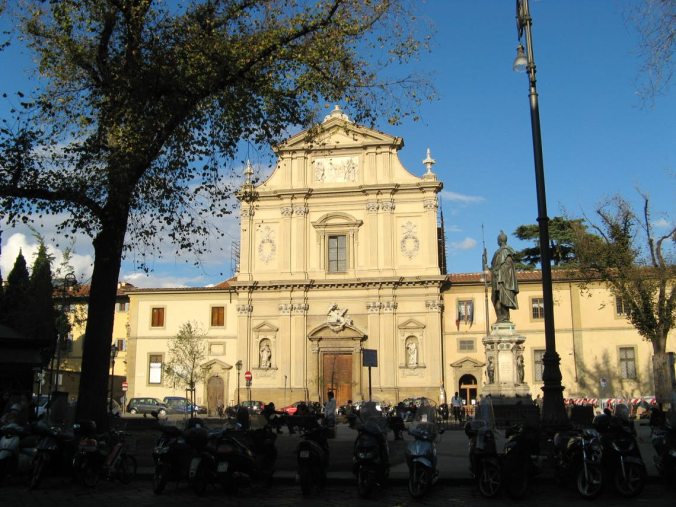
San Marco, Firenze

The monastery of San Marco, which stood just two blocks north of the Palazzo Medici, had been founded in the thirteenth century. However, it had been completely renovated and considerably expanded by Lorenzo the Magnificent’s grandfather, Cosimo de’ Medici in the 1450s.

san-marco

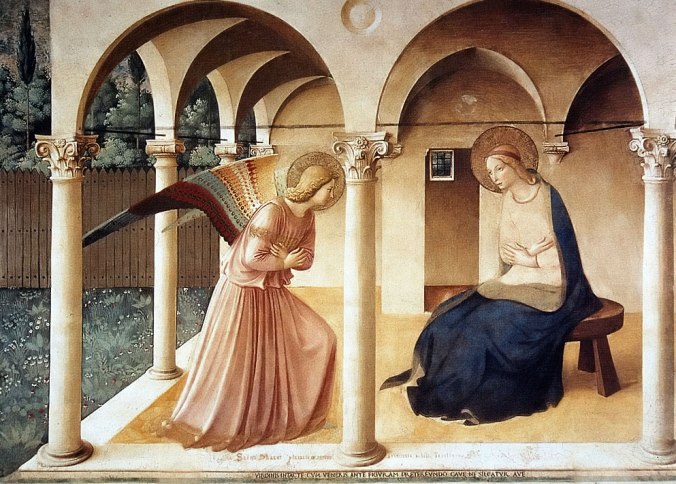
Cosimo had used his favourite architect Michelozzo Michelozzi, and incorporated the work of the resident monk Fra Angelico, one of the great early Renaissance artists.

annunciazione

Michelozzi would be responsible for some of the finest early Renaissance architecture in Florence, including the renovation of the Palazzo della Signoria and the design of the Medici villa at Careggi.

For his part, Fra Angelico’s ethereal paintings would heavily influence Michelangelo, whose depiction of God’s finger passing on life to Adam in the Sistine Chapel was directly inspired by the artist-monk.

The work of Fra Angelico and Michelozzi came together at San Marco in the delightful shaded San Antonio cloister, whose delicate pillars and colourful frescoes enclosed a tranquil green garden in the midst of the monastery.

Cosimo de’ Medici had undertaken the renovation of San Marco late in his life, intending it as absolution for the sin of usury, which had enabled him to accumulate his fortune as a banker. Yet there had also been a less manifest reason for Cosimo’s benevolence, one that explained why in particular he chose to lavish his wealth on San Marco, rather than other similarly prestigious monasteries in the city.

Before the 1433 coup which had removed Cosimo from power in Florence, almost costing him his life, he had managed in the nick of time to transfer secretly to San Marco a large quantity of the funds held in the Medici bank in Florence.

After Cosimo’s banishment into exile, his enemies had raided all Medici premises, as well as those of known supporters, but had been unable to discover the whereabouts of these funds, which had been held on trust, without a word, by the monks at San Marco.

In consequence, Cosimo had spared no expense on the rebuilding of San Marco, which eventually cost 30,000 florins – an unprecedented sum at the time.

The monastery had been furnished with a library, together with many hundreds of religious manuscripts, intended for public use – the first lending library in Europe.

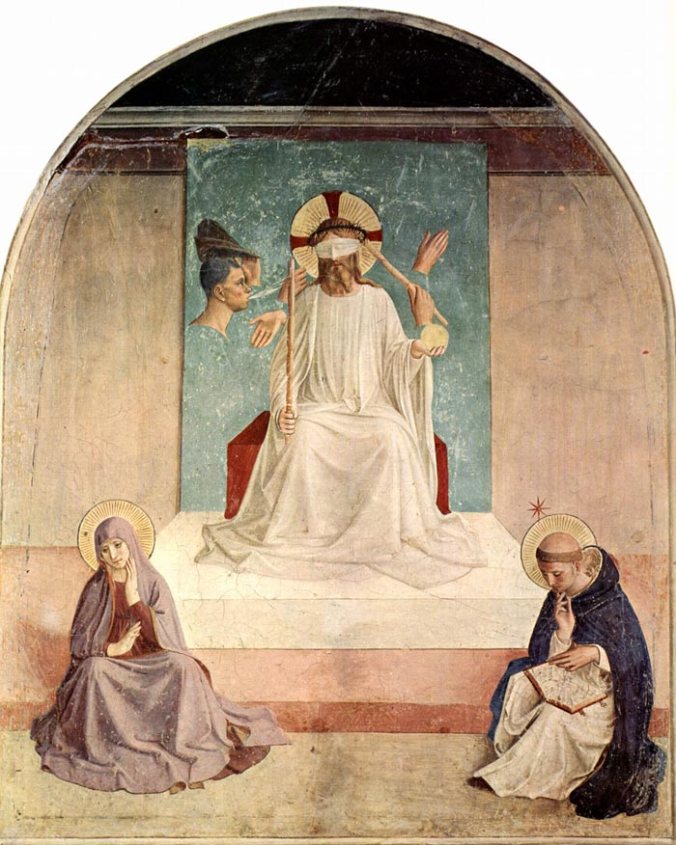
Instead of the usual communal dormitory, each monk was assigned his own cell, many of which contained frescoes painted by Fra Angelico and his assistants. These were mainly portrayals of angels and biblical scenes.

mockingofchrist700

A special double cell, sumptuously frescoed, had been created for Cosimo’s personal use, to which he would often retire for periods of contemplation.

However, he had taken a more active role in the creation of the gardens across the street from San Marco: as a man who delighted in retiring to the countryside, he had done his best to create a pastoral space here within the walls of the city. These gardens would in turn become a favourite spot of Lorenzo the Magnificent, who began decorating the shady spaces with pieces of ancient classical sculpture.

.

Strathern, Paul. Death in Florence: The Medici, Savonarola, and the Battle for the Soul of a Renaissance City, Pegasus. Kindle Edition.

\

Lucrezia de Medici

The major influence on the young Lorenzo (de Medici) would undoubtedly be his mother, Lucrezia, an intelligent and resilient woman in an age when females for the most part had little opportunity to assert themselves beyond the restricted domestic sphere.

Lucrezia came from an old and distinguished Florentine family, the Tornabuoni, and although her arranged marriage to a Medici was undoubtedly contracted for political reasons, she appears from her extant letters to have been genuinely fond of her husband, worrying over his health and betraying her concern that he should not ‘give way to melancholy’.

Yet these letters are not the only evidence of her writing, for Lucrezia de’ Medici was also a talented poet and hymnist. Although the conventional religiosity of her verse is of little modern interest, such piety did not stifle the warmth of her sympathetic personality.

Her verse appears to have been the outlet for a wider creative sensibility, which was used to some effect in guiding her husband’s discriminating patronage of such leading early Renaissance figures as the architect Michelozzi, who had designed the groundbreaking Palazzo Medici; the sculptor Donatello, whose innovative realistic sculptures included the first free-standing nude since classical times; and the troubled artist Fra Filippo Lippi, whose colourful larger-than-life portraits echoed his own larger-than-life personality.

All three of these artists Lucrezia came to regard as personal friends. The Medici were amongst the first patrons to recognise that artists were now becoming something more than mere craftsmen, and the family did their best to accommodate the increasingly difficult temperaments and wayward behaviour of these emergent genius-figures.

Lucrezia was also known to have influenced  would be she who persuaded Piero to allow certain members of the Strozzi family to return from the banishment they had suffered for opposing Cosimo. This would prove a particularly astute move.

Of similar impact was Lucrezia’s formative influence upon the youthful Lorenzo, who quickly began displaying precocious brilliance in a variety of fields, ranging from classical literature to horseback-riding. He was also said to have had an exceptional singing voice, accompanying himself on the lyre.*

Strathern, Paul. Death in Florence: The Medici, Savonarola, and the Battle for the Soul of a Renaissance City, Pegasus. Kindle Edition.


Let’s say you are very sick during the Renaissance…

and you are one of the leading lights of the period.  What would your doctor recommend for you?

images

Well, if you were Lorenzo the Magnificent, this remedy was tried:

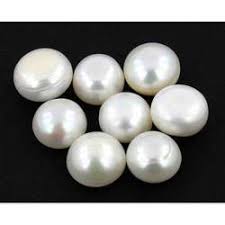
By this stage Lorenzo was being attended by the celebrated Lazaro da Ticino ‘a very creative physician’, who had arrived from Milan. According to Poliziano: ‘in order not to leave any method untested, he tried a highly expensive remedy which involved grinding pearls and precious stones of all sorts’. This was a traditional remedy deriving from classical times, which almost certainly arrived in Europe from China, where such concoctions were thought to be ingredients of the fabled ‘elixir of life’.

Lorenzo_il_Magnifico

Unfortunately, it didn’t work, and Lorenzo died within a week.

Strathern, Paul. Death in Florence: The Medici, Savonarola, and the Battle for the Soul of a Renaissance City  Pegasus. Kindle Edition.