Month: July 2018
An Italian model, 1954

Modella in posa all’angolo di via Strozzi con via de’Tornabuoni nel 1954.
Obsession: a film set against a backdrop of Florence

In 1976 Brian de Palma released Obsession, which was filmed in New Orleans and Florence.


Come for the settings. Stay for the weird, melodramatic story. It’s vale la pena: well worth it.


Leonardo’s Mona Lisa, the mystery
This 2015 video from the BBC is quite interesting, especially for any student of art history. The video is an hour long, not the 1.5 hours the video says it lasts (the last 30 minutes of the video is a repeat). You will come away from watching this video with new questions, and maybe some new answers.
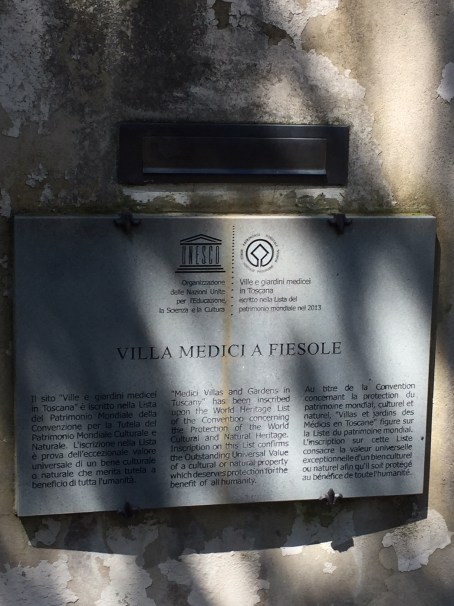
Villa Medici at Fiesole
I was in Fiesole this morning, to catch a breath of fresher, cooler air than at home in Florence and also to see a Medici Villa. I had an appointment to see the grounds of the Villa Medici at Fiesole; the villa itself can’t be visited as it is a private residence.
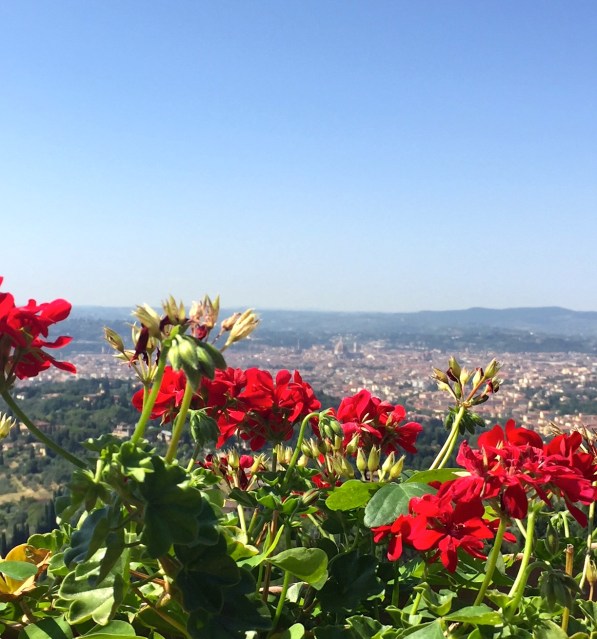
Can you see the tiny Duomo of Florence over the red geraniums, right in the middle?
This is a view you would have of Florence if you were a Medici.

It’s a pretty well-known fact that Florence tends to get a little hot in the summer. That is actually an understatement. Today it was 33 Celsius, with is pretty darn hot.
It is cooler in Fiesole, high above on the hills north of Florence. That is why the Medici had this villa constructed.
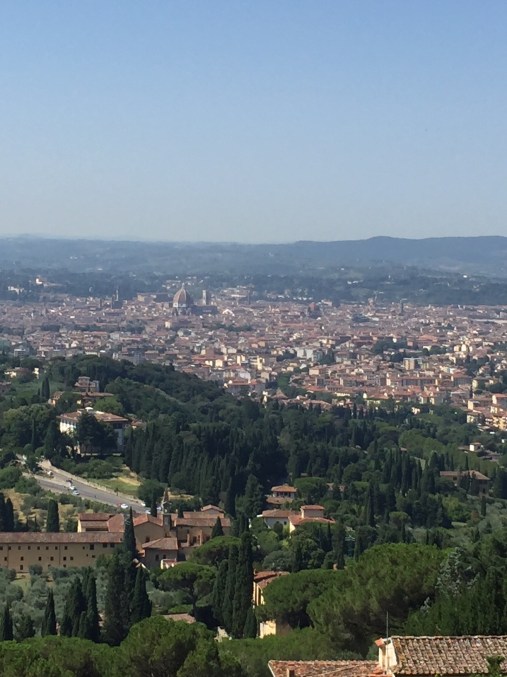
Located on the via Beato Angelico 2 stands one of the oldest villas belonging to the Medici family, the 4th, after the 2 villas in Mugello (Cafaggiolo and Il Trebbio) and the Villa at Careggi. Sometimes called Belcanto or the Palagio di Fiesole, this villa is among the best preserved of the many Medici villas, but at the same time it is also among the less well-known.
Here is a Google earth view of the Villa.
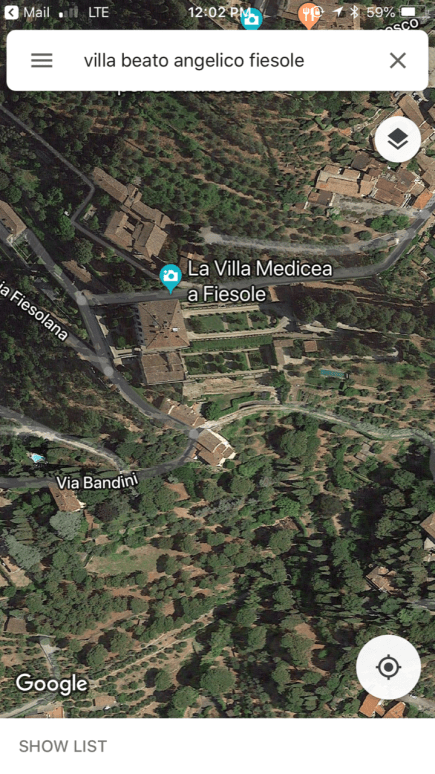
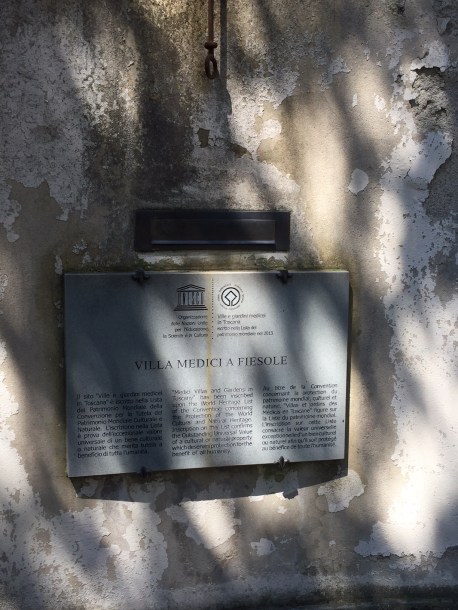
The villa was built between 1451-57. The site was obviously chosen for its panoramic views, despite the fact that the site is on a very steep slope. It was necessary to make a large terrace, to support the palazzo, the out buildings and the vast gardens.
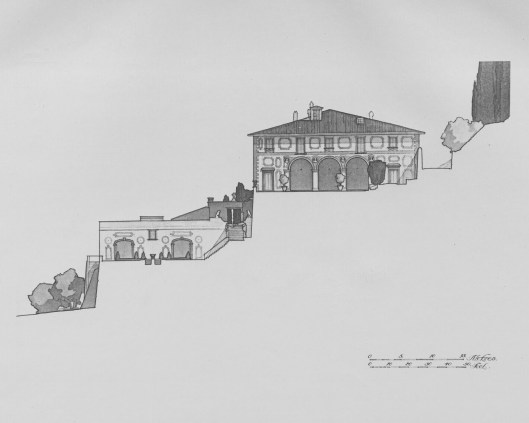
Villa Medici at Fiesole by Michelozzi in 1460
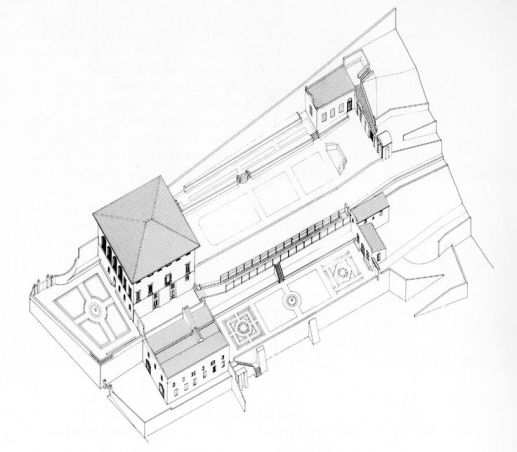
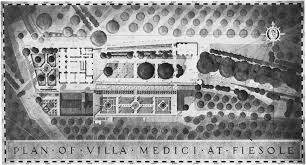
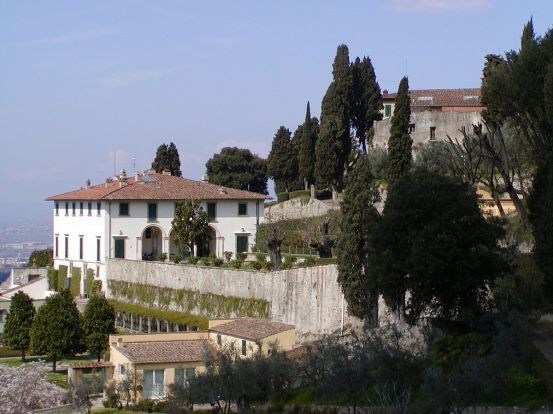
Michelozzo was not bound by pre-existing buildings and built a sober quadrangular palazzo which was whitewashed and had windows framed by stone cornices. Large open galleries, with incredible views of the landscape, were a main feature of the design.
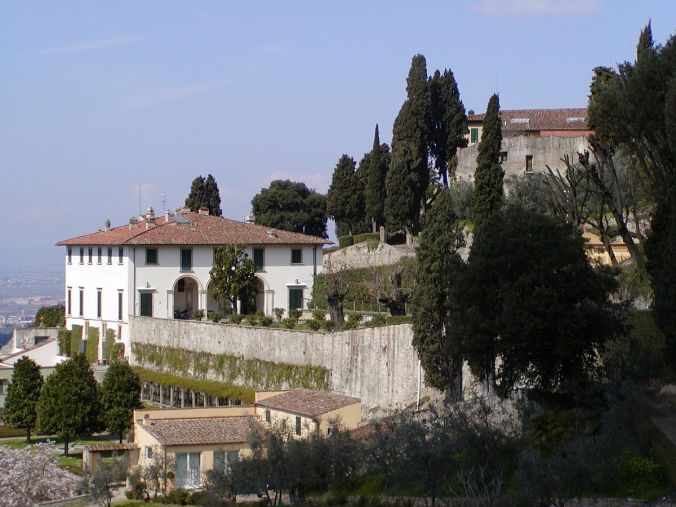
Here are some views of the main loggia at the front of the palazzo.
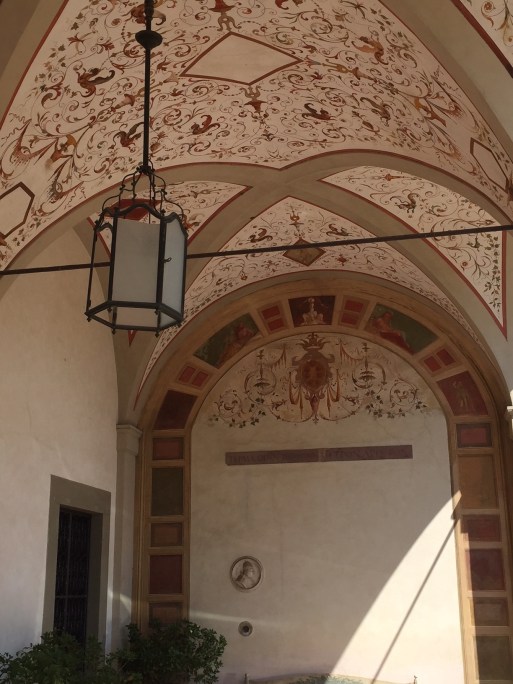

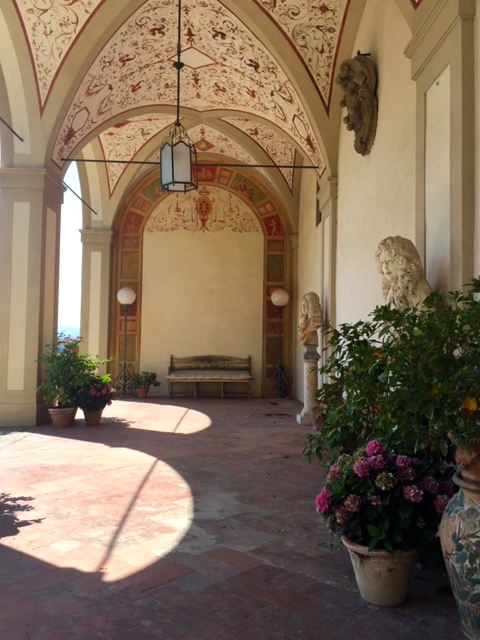
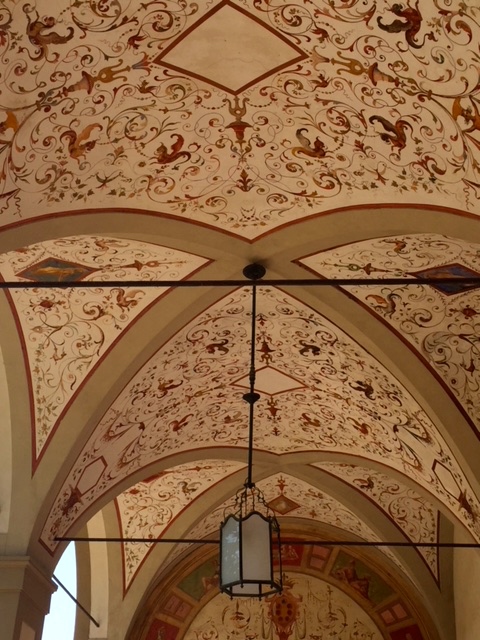
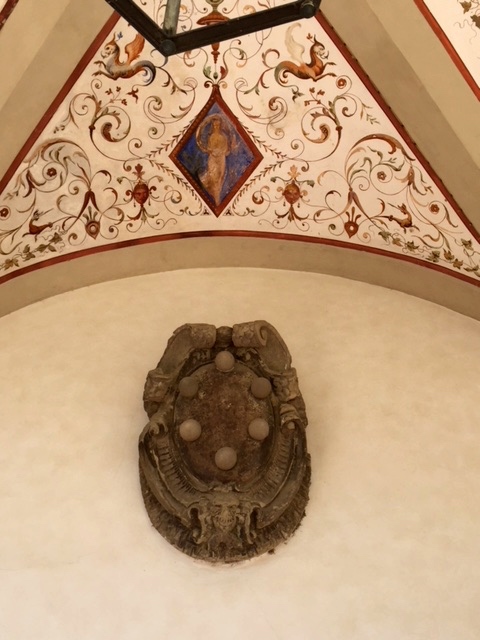
You know you are in Medici country when you see the coat-of-arms with the Medici palle in a prominent position within the loggia.

This villa was very different from previous Medici villas: it is much more open to the outer world than any previous villa, and it has no central courtyard.
There are no defensive-military components, meaning there are no turrets, no elevated walkways supported by corbels, or any moats.
The formal and functional innovations of the villa in Fiesole revealed new aesthetic values; including, above all, a new attention to the landscape and the visual domain.
Likewise, the agricultural and productive components of villa design were essentially elminated, in favor of a total dedication to leisure and physical activity that favored contemplation and intellectual activity.
It was, in fact, the first time that a rural residence had only a garden, instead of being surrounded by an agricultural estate.
These factors, combined with the lack of military structures, are the significant characteristics that make this villa one of the clearest prototypes for later Renaissance villa design.
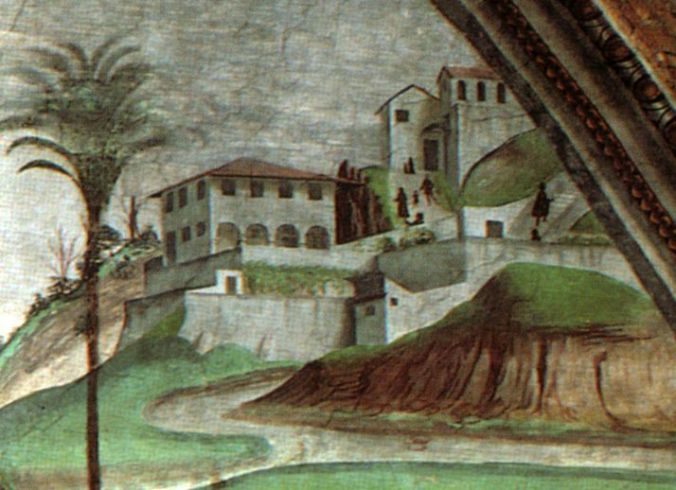
Amazingly, we have a contemporary Renaissance-era view of the villa, as depicted in this fresco by Domenico Ghirlandaio in the Cappella Tornabuoni at the church of Santa Maria Novella, painted between 1485 and 1490. Art historians live for moments like this. It is very rewarding to have a painted picture to give us an idea about how the villa originally looked and it is just plain fun to have such a record of an extant Renaissance building.
The Villa Medici is linked to one of the most dramatic events of the Medici family history: the Pazzi Conspiracy (1478), when some members of the Pazzi family, along with Francesco Salivate and Cardinal Girolamo Riario, and supported by Pope Sixtus IV, designed a plot to get rid of what they considered to be the increasingly oppressive growth of the power of the Medici within the Florentine Republic.
Originally, the plan was to kill the two scions of the Medici family, Lorenzo and Giuliano, during a banquet organized at this Medici Villa at Fiesole on April 25, 1478, through the use of poison that Jacopo de’ Pazzi and Cardinal Riario would surreptitiously place in the drinks meant for the two brothers.
The plot was foiled when Giuliano became suddenly ill. The dinner was canceled and made the enterprise useless. Undiverted from their aim, the murderers were postponed until the following day, during the Mass at the Florence Cathedral. Of course, we know that while Giuliano was killed, Lorenzo was able to save himself by bolting himself into the sacristy.
It is so interesting to walk around the palazzo and out buildings, thinking about the history that happened here, and who was walking these paths 500 years and more ago. That is not to even mention the connected gardens, about which I’ll be writing a separate post soon.
.
Humor on the streets of Florence
The mystery of Il Duomo
You’ll need an hour to watch this, but it is well worth it.
Every day spent in Florence
Is a good day.
Ah, Italia!
“He who hath lived in this country [Italy] can enjoy no distant one. He breathes here another air; he lives more life.”
Walter Savage Landor, Imaginary Conversations
 get back, lauretta!
You must be logged in to post a comment.