
Today everyone uses disposable paper tissues and almost all mothers carry them in their handbags for everyone in the family to use.
But, what preceded the lowly “kleenex?”
Well, according to Professor M. Fanfani, the handkerchief was invented in Italy, just like the fork and the napkin. I tend to think that the napkin and handkerchief both were created in various cultures because humans need these objects and surely someone would have thought of a good product solution.

But readers know I love all things Italian and so of course I am going to go along with the professore and accept the fact that while various cultures no doubt had their own objects for cleaning the face and nose, the first rarified version no doubt was of Italian origin. Most good things were. :-)

So, let’s read and consider his thesis on the handkerchief.

The use of the handkerchief, like that of the fork and napkin, was born in Italy and its use had more to do with the prestige of its possession, than its strictly hygienic reasons.
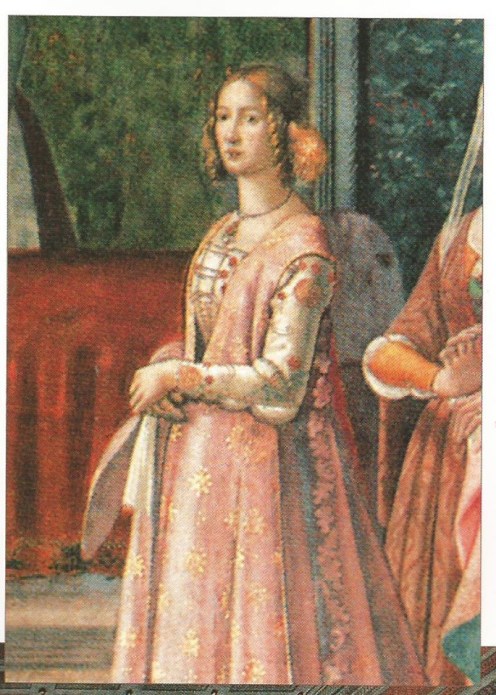
As with so many details about life in Italy, paintings from the period give us a window into the daily life of some Italians.
In the works of Ghirlandaio, an attentive chronicler of the Florentine costume, this delicate accessory is a standout.
Handkerchiefs were rare and expensive; for example, we know that King Henry IV had only five of them in 1594.
We learn that blowing one’s nose with the handkerchief (instead of with your fingers, or with the wide sleeves of a shirt) was a refined sign of nobility or high social standing.

Ghirlandaio often recorded in paint the upper bourgeoisie in Florence. The possession and showing of an embroidered kerchief indicated status.
Who knew?
This text (which I’ve modified in English) appeared on a Facebook post recently
written by Prof. M: Fanfani.
 get back, lauretta!