In all the time I’ve spent in Florence over the years, I have never, ever set foot in the Galileo Museum. So, today I finally went. Science in general is not my cup of tea, but this museum is much more than a science museum.
 Love the “g” made out of stars!
For starters, here’s the view from the museum. Hello up there, San Miniato!


Not bad, right?! I know.
You also can enjoy the tower of the Palazzo Vecchio from the museum:

So, here’s how my visit went today.
For starters, I learned right off the bat that the basis for this incredible collection of scientific instruments and realia is courtesy of the Medici family. No surprise there, I suppose; I had just never thought about it. In the case of this scientific collection, it is one of the later Medici (not the Renaissance era family) who put these amazing things together and bequeathed them to Firenze. Here is Grand Duke Peter Leopold’s very interesting “chemistry cabinet.” I’ve seen a lot of bunsen burners in my school days, but I’ve never seen a cabinet made of the finest woods and high quality finishing. It is quite something.

Neither of the pictures below do the cabinet justice. There were just too many attractions in this room for me to focus on the cabinet itself.


Here’s some interesting information about the collection and Grand Duke.

Now, what I hadn’t known before today is that many scientific discoveries were performed for the European elite at their evening parties. Read the English text in the following slide, which discusses how these soirees would feature chemistry tricks, etc.

I think the following panel tells the story most succinctly: electricity took the place of the quadrille. Who needs to dance when you can be amazed when things light up and other “magical” effects.

The 18th century was truly an age of discovery, as the following quote lays out:

And, of course, if you are going to present scientific parlor tricks to the upper crust, you have to have some impressive and attractive equipment. To wit: this label in English:

Indeed, and here is a sampling of some of them. They are presented in a very effective exhibition manner in this very handsome museum.


Check out this portrait of an Italian scientist named Giovanni Battista Amici. What I immediately noticed was his unusual hairdo. I wonder if he or his portraitist considered maybe combing his hair?


Giovanni Battista Amici (1786-1863) was an Italian astronomer, microscopist, and botanist. He was the director of the observatory at Florence, where he also lectured at the museum of natural history. Amici died in Florence in 1863.
Amici is best known for the improvements he effected in the mirrors of reflecting telescopes and especially in the construction of the microscope. He was also a diligent and skillful observer, and busied himself not only with astronomical subjects, such as the double stars, the satellites of Jupiter and the measurement of the polar and equatorial diameters of the sun, but also with biological studies of the circulation of the sap in plants, the fructification of plants, infusoria etc. He was the first to observe the pollen tube. He invented the dipleidoscope and also the direct vision prism and the “Amici crater” on the Moon is named in his honor.
Back to the exquisite instruments. These glass objects were mind-blowing in that they are hundreds of years old and fragile and some of these delicate vials and decanters are really large.


As the museum exhibition makes clear, there was a boon for the manufacturers of these delicate and finely calibrated pieces of equipment. The high echelon of society that enjoyed watching evening entertainments composed of science demonstrations often wanted to have some of their own objects. Hence: a boom in the manufacturing.


Here’s how you weighed yourself if you were uppercrust:

 ‘
‘

And then there was the advancements in clock-making.


Another genre of objets produced to amaze high society were paintings contrived so that you see one picture (a gentleman) when you look at it straight on, and you see a second picture (the gentleman’s wife?) when you look at the mirror attached to the top of the painting. I’m an art historian and I’ve never seen anything like this. Italy has a way of amazing me, almost daily.


And then there are the armillary spheres and globes! The next set of pix are all of one spectacular Florentine 16th-century armillary sphere:


And then there are the globes, both terrestrial and celestial:


And the maps! The elaborate 15th-century map below shows the known world. Asia is a land mass to the west of Europe here. The New World had not yet been imagined.


And did you know, because I didn’t until today, that the Medici had plans to get involved in the great age of discovery:

And then there are the atlases:


And who might this be?

Amerigo Vespucci, don’t you know. He was a Florentine of course. I’ve seen his tomb in the Chiesa Di San Salvatore di Ognissanti. (FYI: Sandro Botticelli is buried there too.)


More instruments, beautifully displayed:


The cabinet pieces:

I’ve saved my favorite objets for last: the thinest, most beautiful glass vessels:


See those tall, thin extensions of certain glass pieces above? Those are glass and a part of the object. It is absolutely stunning. And they are old! How did they survive?

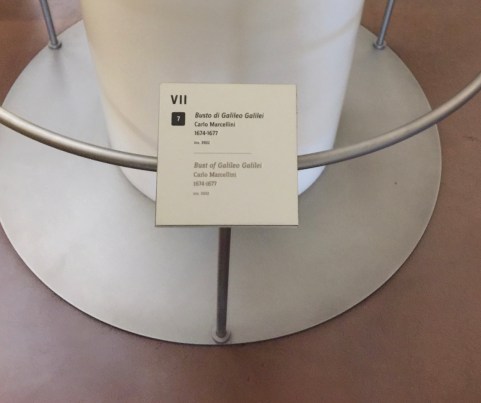
And finally, the important man for whom this collection is named:

 get back, lauretta!