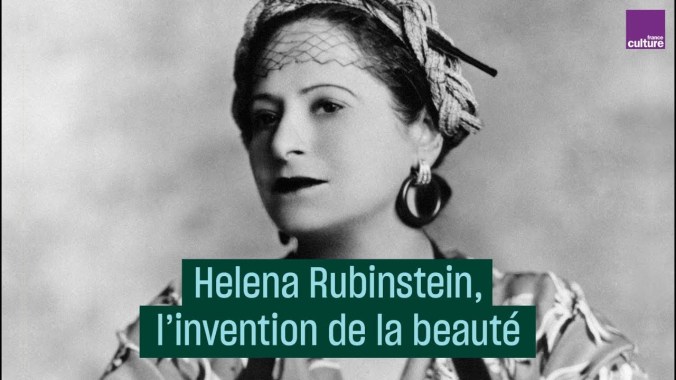
I just arrived in beautiful Paris last night, and on my first stroll down the boulevards, I spotted this poster advertising an exhibition on Helena Rubinstein.
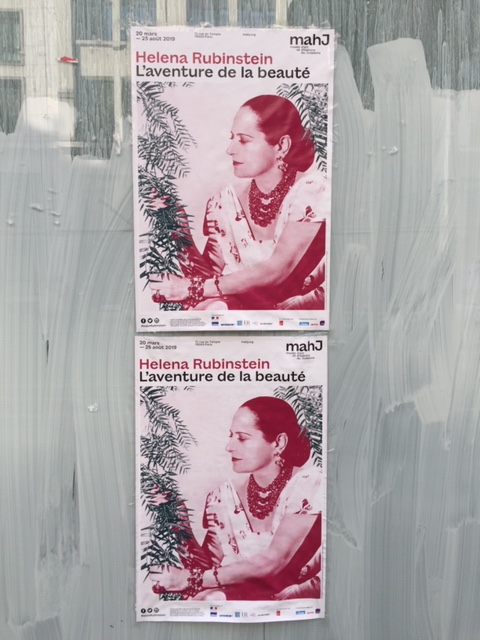
I must admit, I’ve always known her name, but never gave it one second of thought. I reflected quickly in Paris and wondered, “she was American, wasn’t she?” I came to my apartment and quickly looked her up. Now I realize, it’s high time I thought about her!
Helena Rubinstein (born Chaja Rubinstein, 1872 – 1965) was a Polish-American businesswoman, art collector, and philanthropist. A cosmetics entrepreneur, she was the founder of the Helena Rubinstein Incorporated cosmetics company, which made her one of the world’s richest women.
Rubinstein was the eldest of eight daughters born to Polish Jews. Her father was a shopkeeper in the city of Kraków in Lesser Poland. The existentialist philosopher Martin Buber was her cousin and was also the cousin of Ruth Rappaport’s mother.
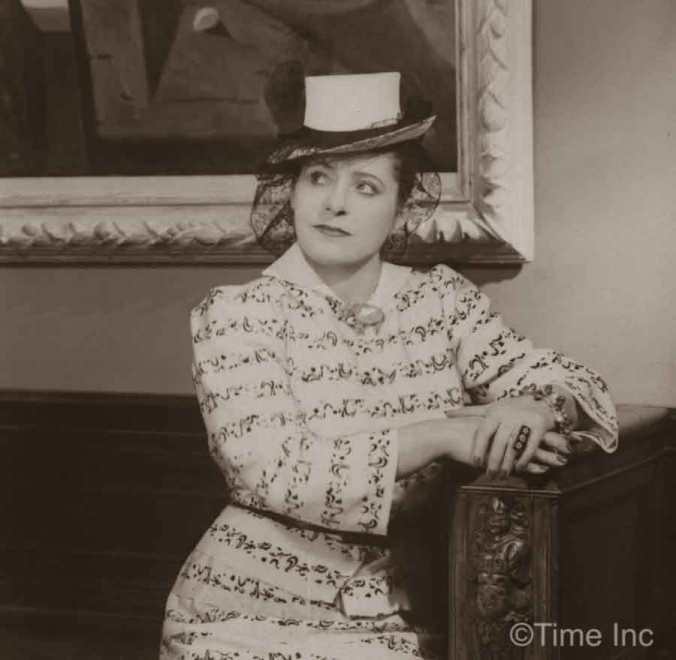
At a diminutive at 4′ 10″, Rubinstein emigrated from Poland to Australia in 1896, with no money and little English. Her stylish clothes and milky complexion were quite noticeable in Australia, and she soon found enthusiastic buyers for the jars of beauty cream she brought in her luggage. She spotted a market and began to make her own. A key ingredient of the cream, lanolin, was readily at hand.
In the town of Coleraine, in the Western Victoria region, Rubinstein’s uncle was a shopkeeper. It was home to some 75 million sheep, and that produced abundant quantities of wool grease or wool wax, chemically known as lanolin. These sheep were the wealth of the nation, and the Western District’s herds of merinos produced the finest wool in the land. To disguise the lanolin’s pungent odour, Rubinstein experimented with lavender, pine bark and water lilies.
Rubinstein found an admirer willing to fund her Crème Valaze, which supposedly included herbs imported “from the Carpathian Mountains.” Costing ten pence and selling for six shillings, it flew off the shelves as fast as she could pack it in pots.
Known to her customers only as Helena, Rubinstein could soon afford to open a salon in fashionable Collins Street, selling glamour as a science to clients whose skin was “diagnosed” for which she “prescribed” a treatment.
Sydney was next, and within five years her Australian operations were profitable enough to send her to London where she opened her Salon de Beauté Valaze.
Rubinstein began what was to become an international enterprise, which is all the more notable beacuse women at this time could not obtain bank loans, so she used her own money to fund her expansion.
Rubinstein thus formed one of the world’s first cosmetic companies. Her business enterprise proved immensely successful and later in life, she used her enormous wealth to support charitable institutions in the fields of education, art and health.
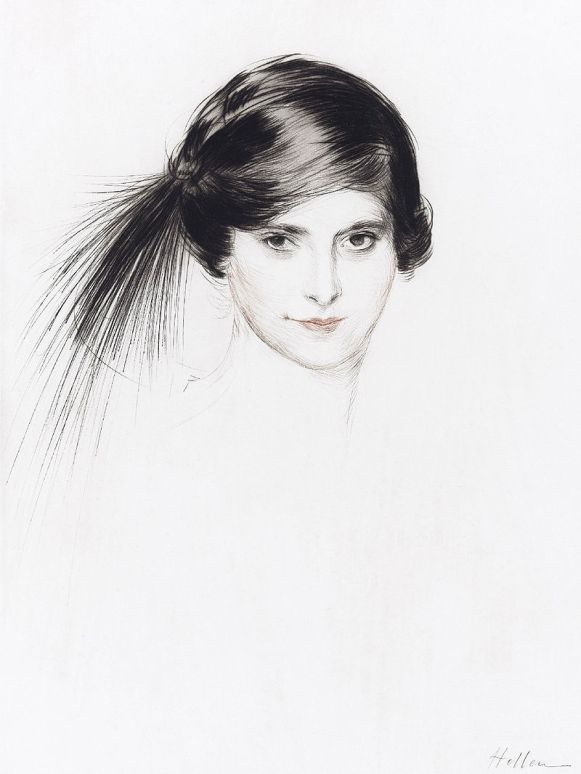
Helena Rubinstein by Paul César Helleu (1908)
In 1908, Helena married the Polish-born American journalist Edward William Titus in London, where they had two sons. They eventually moved to Paris where she opened a salon in 1912. Her husband helped with writing the publicity and set up a small publishing house. He published Lady Chatterley’s Lover and hired Samuel Putnam to translate famous model Kiki’s memoirs.
Rubinstein threw lavish dinner parties and became known for her acid quips, such as when an intoxicated French ambassador expressed vitriol toward Edith Sitwell and her brother Sacheverell: “Vos ancêtres ont brûlé Jeanne d’Arc!” (in English: ‘Your ancestors burned Joan of Arc.’) Rubinstein supposedly replied, “Well, someone had to do it.”
At another fête, Marcel Proust asked her what makeup a duchess might wear. She summarily dismissed him because “he smelt of mothballs.” Rubinstein recollected later, “How was I to know he was going to be famous?”
At the outbreak of WW I, she and Titus moved to New York City, where she opened a cosmetics salon in 1915, the forerunner of a chain that opened throughout the country. Helena opened up the boundless American market, and she skillfully used it, despite the serious competition from Elizabeth Arden and Charles Revson.
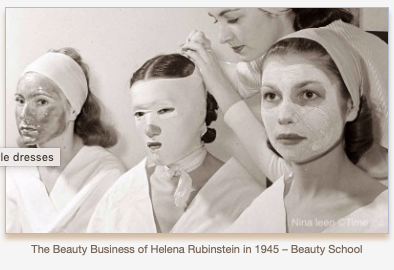
This was the beginning of her vicious rivalry with Elizabeth Arden, the other great lady of the cosmetics industry. Both women were social climbers, and they were both keenly aware of value of effective marketing with luxurious packaging, beauticians in neat uniforms, the value of celebrity endorsements, the perceived value of overpricing and the promotion of the pseudoscience of skincare. The rivalry with Arden lasted all her life. The two were very similar and had the same goals. Rubinstein once said of her rival, “With her packaging and my product, we could have ruled the world.”
From 1917, Rubinstein began the manufacturing and wholesale distribution of her products. The “Day of Beauty” in the various salons became a great success.
In 1928, she sold the American business to Lehman Brothers for $7.3 million (worth roughly $90 million in today’s valuation).
After the Great Depression, she bought back the nearly worthless stock for less than $1 million and eventually turned the shares into values of multimillion dollars, establishing salons and outlets in almost a dozen U.S. cities. She opened a spa at 715 Fifth Avenue which included a restaurant, a gymnasium and rugs by painter Joan Miró. She commissioned artist Salvador Dalí to design a powder compact as well a portrait of herself.
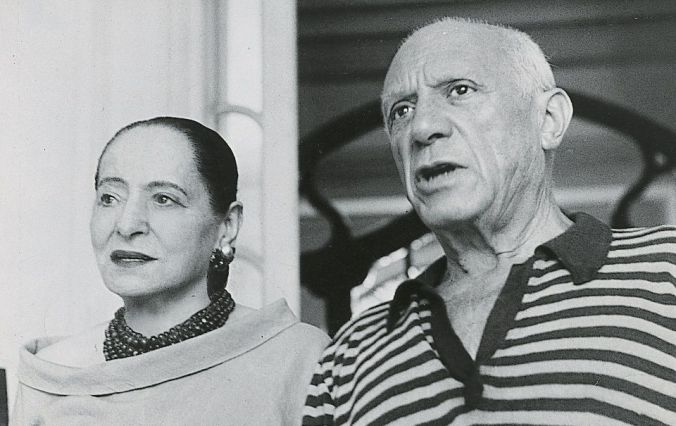
Rubinstein with Pablo Picasso
After her divorce, in 1938 Helena married Prince Artchil Gourielli-Tchkonia (1895–1955).The Self-styled Prince Gourielli-Tchkonia was 23 years younger than Rubinstein. Eager for a regal title to call her own, Rubinstein pursued the handsome youth avidly, and named a male cosmetics line after her youthful catch. Some have claimed that the marriage was simply a marketing ploy, including Rubinstein’s being able to pass herself off as Helena Princess Gourielli.
As a self-made multimillionaire, Rubinstein took a nevertheless took a bag lunch to work and was very frugal in many matters. But she bought top-fashion clothing and valuable fine art and furniture.
She founded the Helena Rubinstein Pavilion of Contemporary Art in Tel Aviv and, in 1957, she established the Helena Rubinstein traveling art scholarship in Australia. In 1953, she established the philanthropic Helena Rubinstein Foundation to fund organizations specializing in health, medical research and rehabilitation. The Foundation also supported the America Israel Cultural Foundation and gave scholarships to Israelis. Beginning in 1958 a £300 annual Rubinstein Prize was awarded for portraits by Australian artists.
In 1959, Rubinstein represented the U.S. cosmetics industry at the American National Exhibition in Moscow.
Rubinstein died April 1, 1965 from natural causes and was buried in Mount Olivet Cemetery in Queens.
Some of her estate, including African and fine art, Lucite furniture, and Victorian furniture, was auctioned in 1966 at the Park-Bernet Galleries in New York City.
One of Rubinstein’s numerous sayings was: “There are no ugly women, only lazy ones.” A scholarly study of her exclusive beauty salons and how they blurred and influenced the conceptual boundaries at the time among fashion, art galleries, the domestic interior and versions of modernism is explored by Marie J. Clifford (Winterthur Portfolio, vol. 38). A feature-length documentary film, The Powder and the Glory (2009) by Ann Carol Grossman and Arnie Reisman, details the rivalry between Rubinstein and Elizabeth Arden.
Her methodology has been described thus:
She was “the first self-made female millionaire, an accomplishment she owed primarily to publicity savvy. She knew how to advertise—using ‘fear copy with a bit of blah-blah’— and introduced the concept of ‘problem’ skin types. She also pioneered the use of pseudo-science in marketing, donning a lab coat in many advertisements, despite the fact that her only training had been a two-month tour of European skin-care facilities. She knew how to manipulate consumers’ status anxiety, as well: If a product faltered initially, she would hike the price to raise the perceived value.”
In 1973, the company Helena Rubinstein, Inc. was sold to Colgate Palmolive, and is now owned by L’Oréal. The L’Oréal-UNESCO Awards for Women in Science are also known as the Helena Rubinstein Women in Science Awards.
The Manhattan Jewish Museum’s exhibition “Helena Rubinstein: Beauty Is Power,” the first museum show devoted to Rubinstein, was held from October 31, 2014 until March 22, 2015.
The musical War Paint dramatizes her rivalry with competitor Elizabeth Arden. After a wildly successful out of town tryout at Chicago’s Goodman Theater, the show opened on Broadway at the Nederlander Theatre on April 6, 2017, earning four Tony Award nominations, including Best Actress in a Leading Role for Patti LuPone’s portrayal of Rubinstein as well as for Christine Ebersole in the same category for her role as rival, Arden.
The comedy Lip Service by the Australian dramatist John Misto chronicles the life and career of Rubinstein and her rivalry with Elizabeth Arden and Revlon. Lip Service premiered on 26 April 2017 at the Park Theatre, London, under the title Madame Rubinstein, before opening at Sydney’s Ensemble Theatre in August of the same year.

















































 get back, lauretta!
You must be logged in to post a comment.