It never ceases to surprise me that along the Arno River, in a very prime area of real estate, sits an unloved small piazza filled with parked cars and motorcycles. In the center, a monument rises, encircled with chains, that seems to be forgotten by the populace. It certainly appears unloved, for it is covered with grit and grime.
Just the kind of thing that attracts my curiosity.
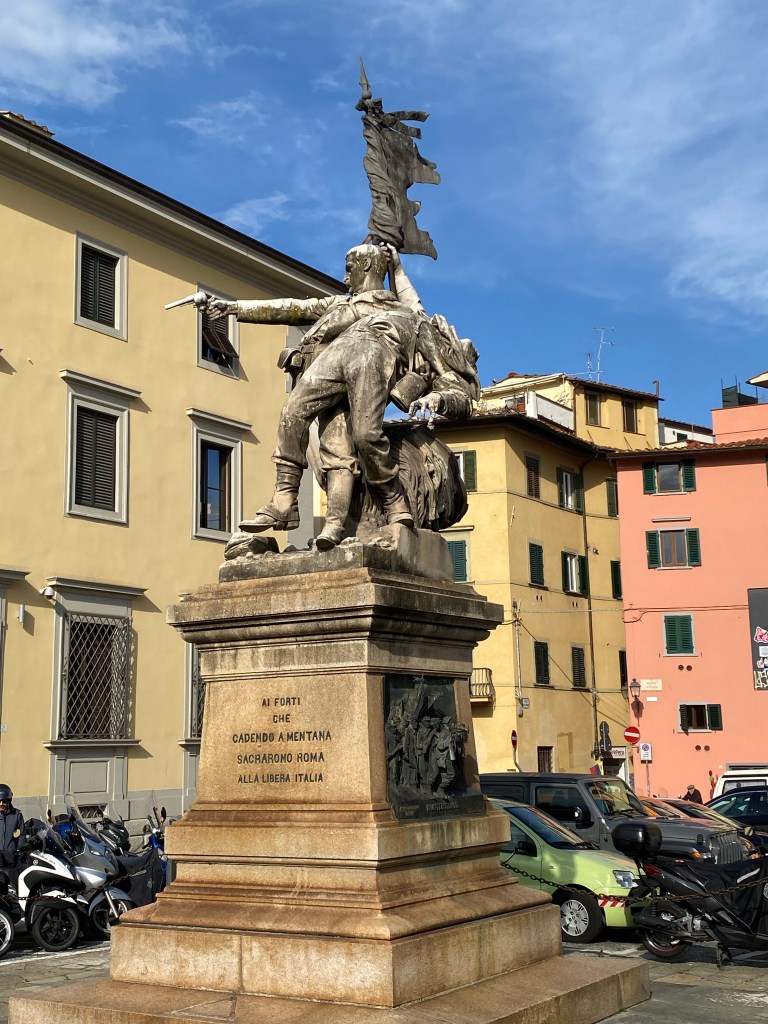
It is the Monument to the fallen of the Battle of Mentana and Monterotondo, by sculptor Oreste Calzolari (1852-1920). It was inaugurated in this piazza in 1902.
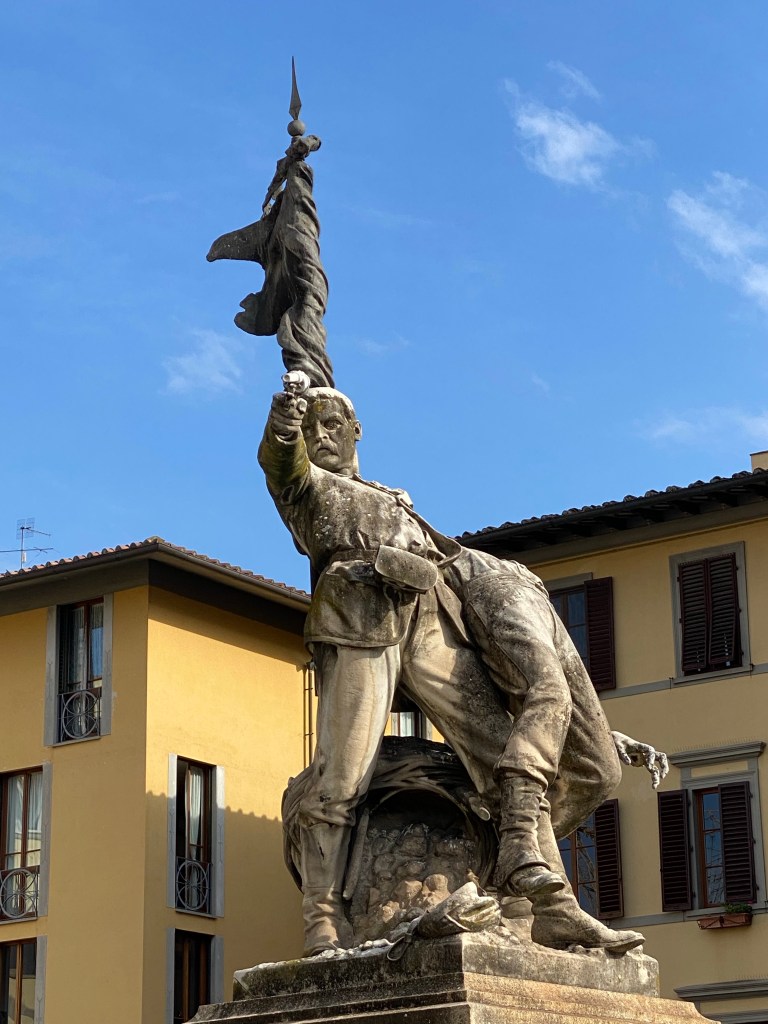
In this medieval looking city filled with Renaissance art, the sculpture looks really out of place, as the front figure aims a revolver at an unseen enemy, reminding me of the American Wild West.
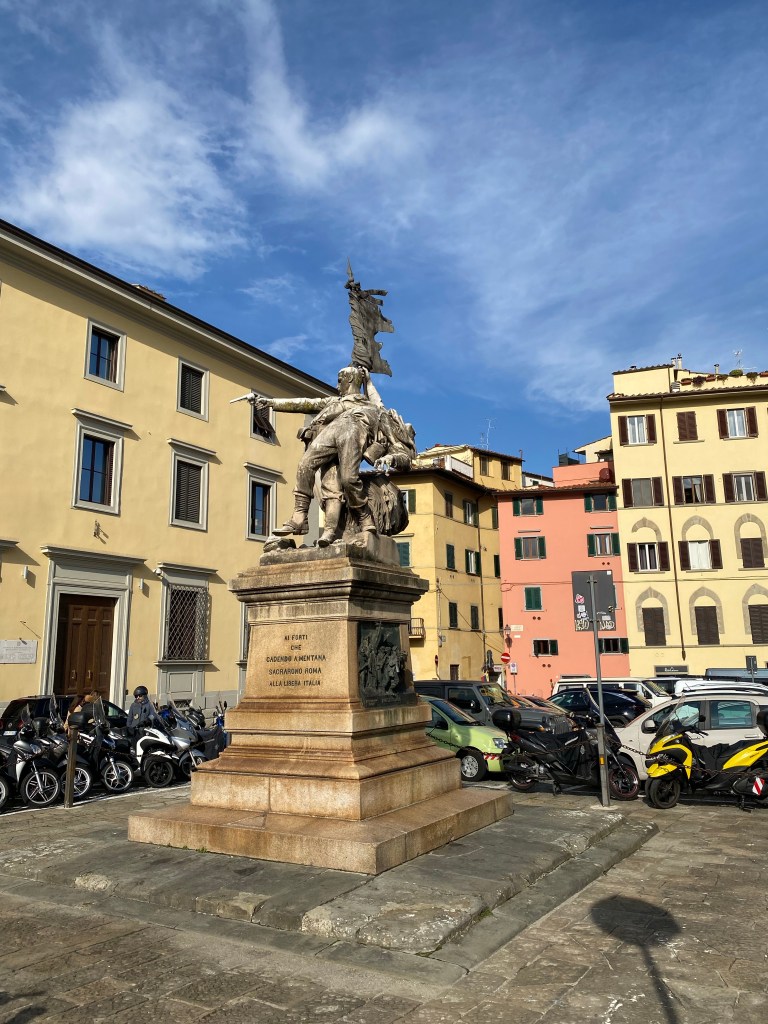
The nearby section of the Lungarno had been undergoing some work for the many months in 2021 and in November, I was happy to see it reopened. As I strolled along the river, this odd monument stopped me as it shown in the late afternoon sunlight. What the heck is it, I wondered?
A little research revealed that the monument was commissioned for Florence by the Society of Garibaldi Veterans in memory of the fallen Garibaldi soldiers on November 3, 1867 when they fought in Mentana and Monterotondo against the papal and French troops. The Garibaldi soldiers were attempting to clear a way to Rome. Garibaldi’s volunteer force was composed of too few and too insufficiently armed men, fighting against imperial forces armed with better weapons. The Garibaldini were severely defeated, and forced to give up the Risorgimento ideal of an Italy united under the same flag.
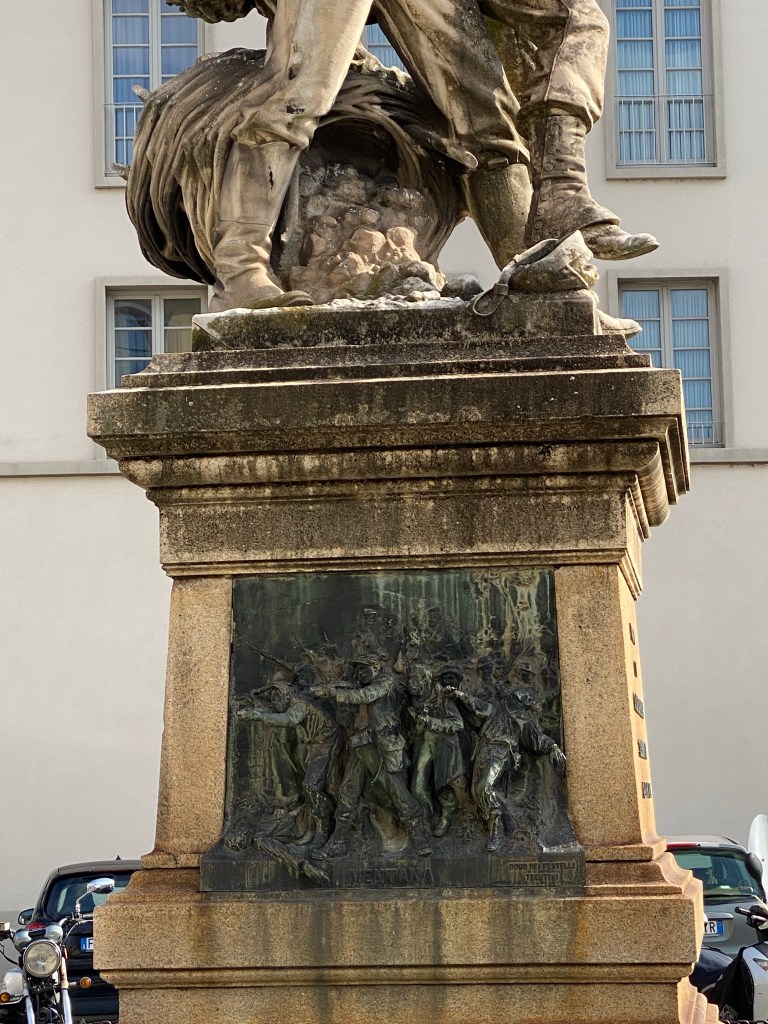
The monument was intended to honor the 150 volunteer soldiers who fought with Garibaldi. The plaque reads: “To the Brave who fell at Mentana, consecrating Rome to Free Italy.” On the 2 sides of the base, bronze reliefs say: “The exit from Monterotondo” and “The clash of Mentana.”
The work was officially inaugurated on April 27, 1902 in the newly renamed piazza, the Piazza Mentana. The square was renamed by a resolution of the municipal council, to prepare it for its new role as the site of the monument. It had previously been called the Piazza delle Travi.
The sculptural group presents the figures of two Garibaldians: the first, standing, stretches his body and his gaze towards the enemy, against whom he extends an arm armed with a revolver, while he supports his dying companion. The dying man falls backwards, still able to hold the flag pole which, incidentally, is made of bronze.

The monument was criticized for the similarity in the composition and in the gestures, with the bronze monument to the Cairoli brothers by Ercole de Rosa inaugurated in Rome in 1883, which had already accused of having being overly dramatic “(Mazzanti).

For those who wonder what happened next in the fight for the unification of Italy, three years later, in September of 1870, Rome was conquered by the army of King Vittorio Emanuele II. The following year Rome was proclaimed the capital of Italy, superseding the city of Florence.






 get back, lauretta!
You must be logged in to post a comment.