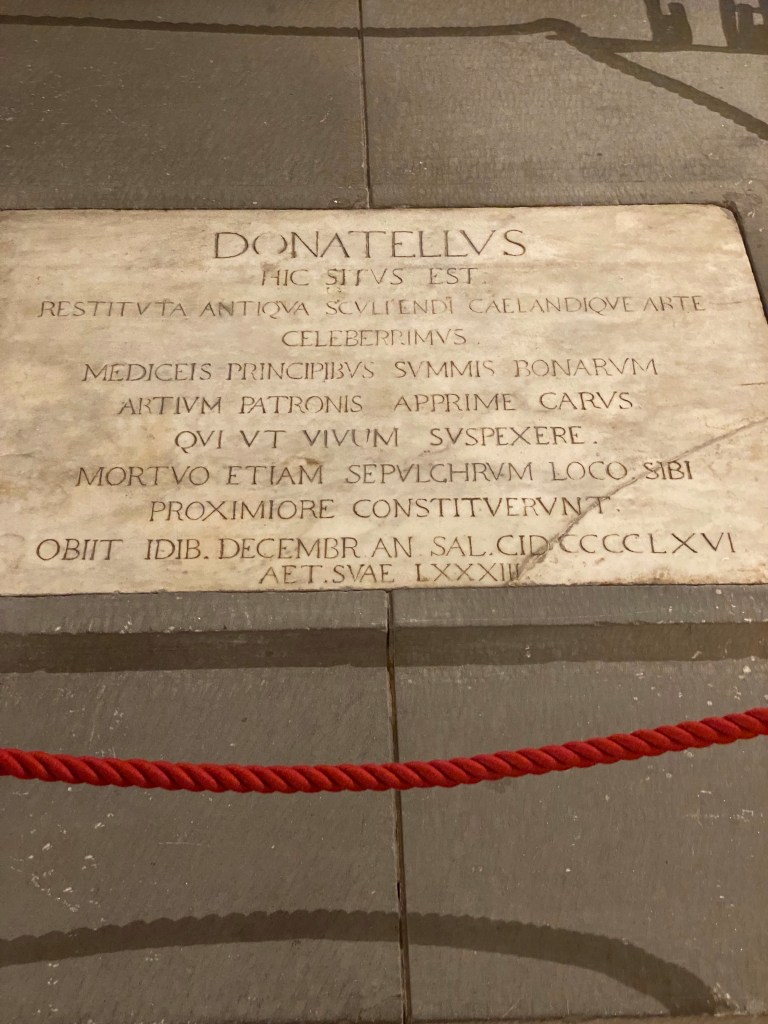
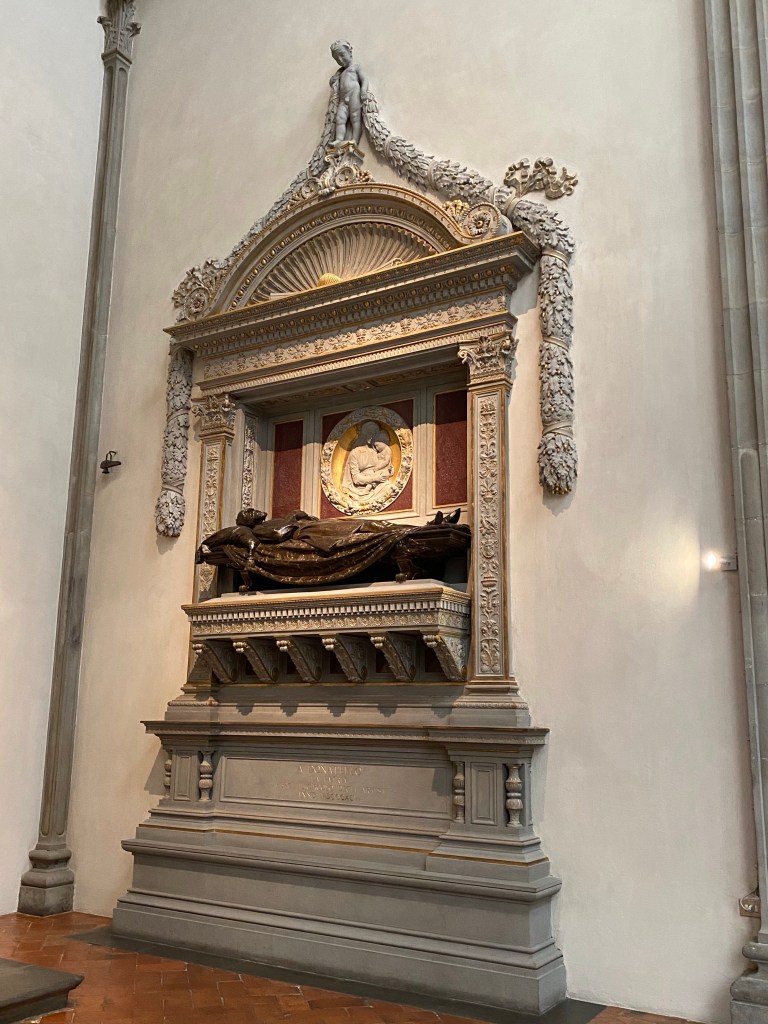
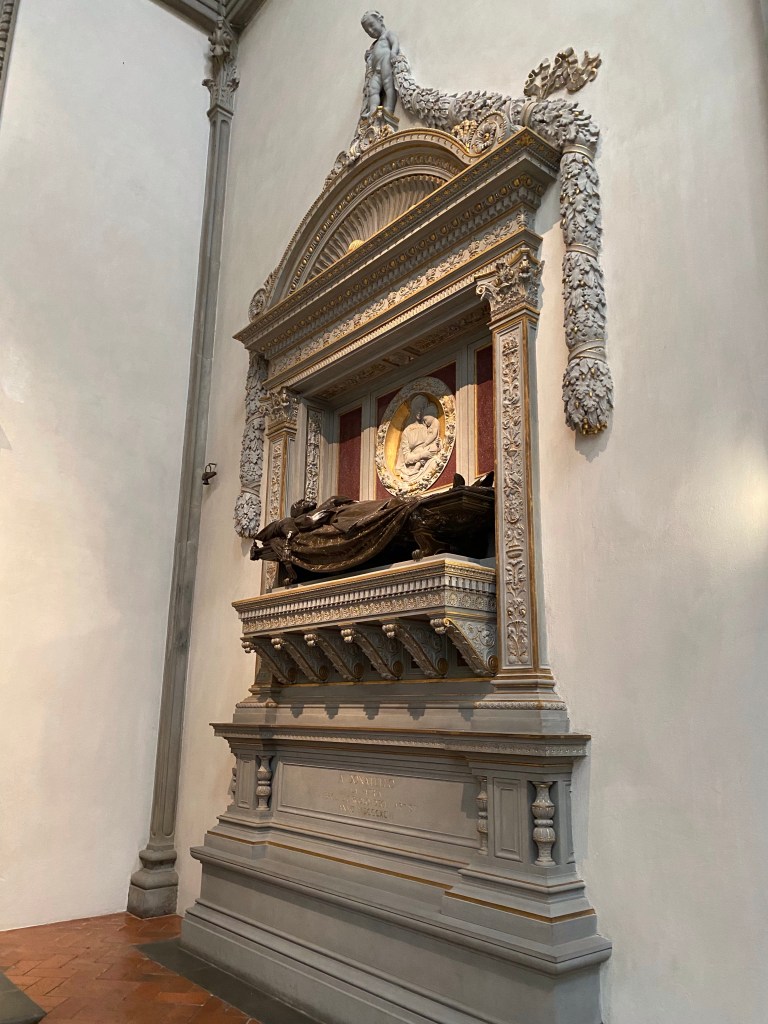
Today I am speaking of the tombs of Gianni di Bicci, Cosimo, Lorenzo the Magnificent and the family’s good friend, Renaissance sculptor Donatello. If you are interested in the ducal tombs in the 16th century chapel, this ain’t that.
Società Canottieri
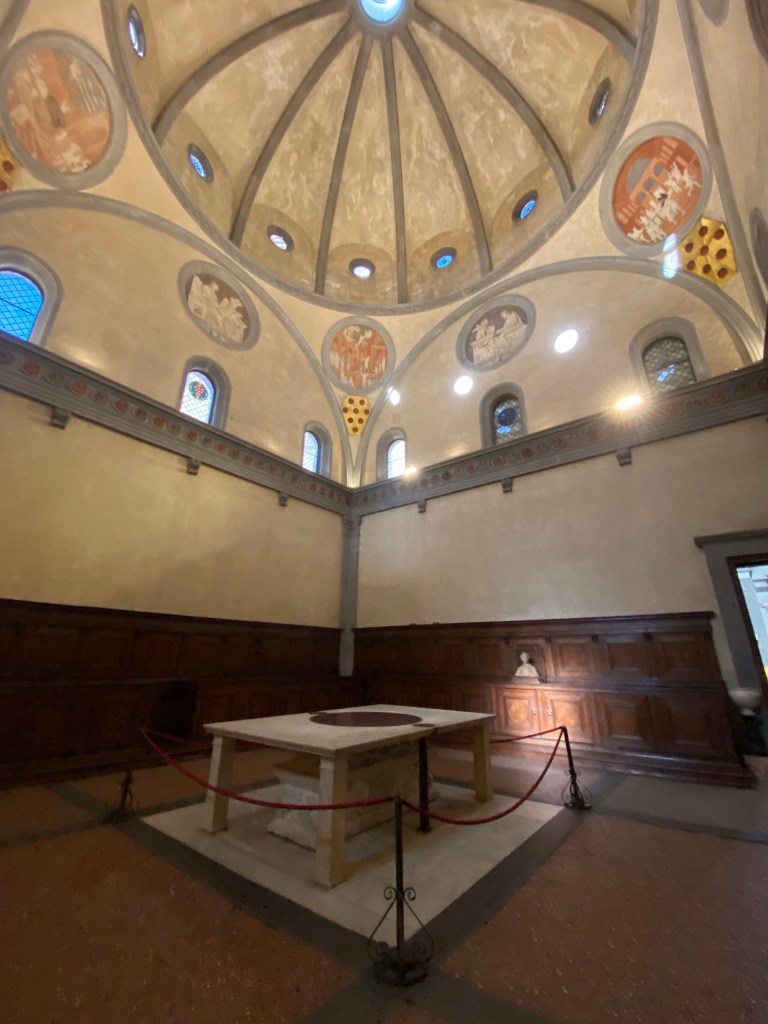
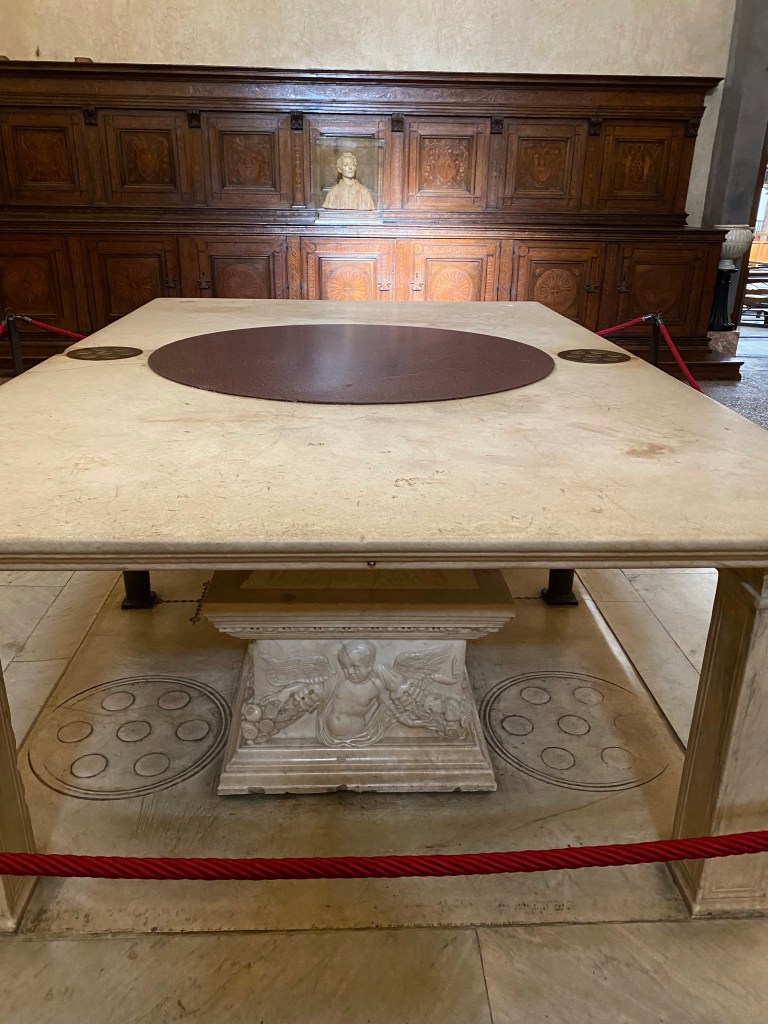
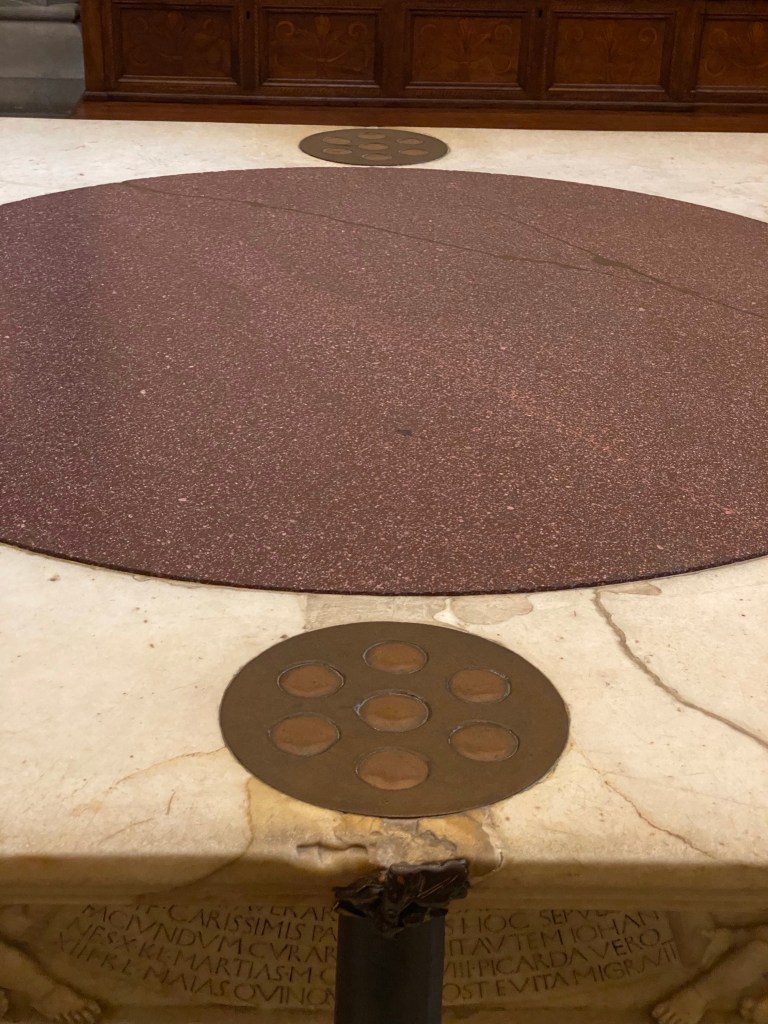
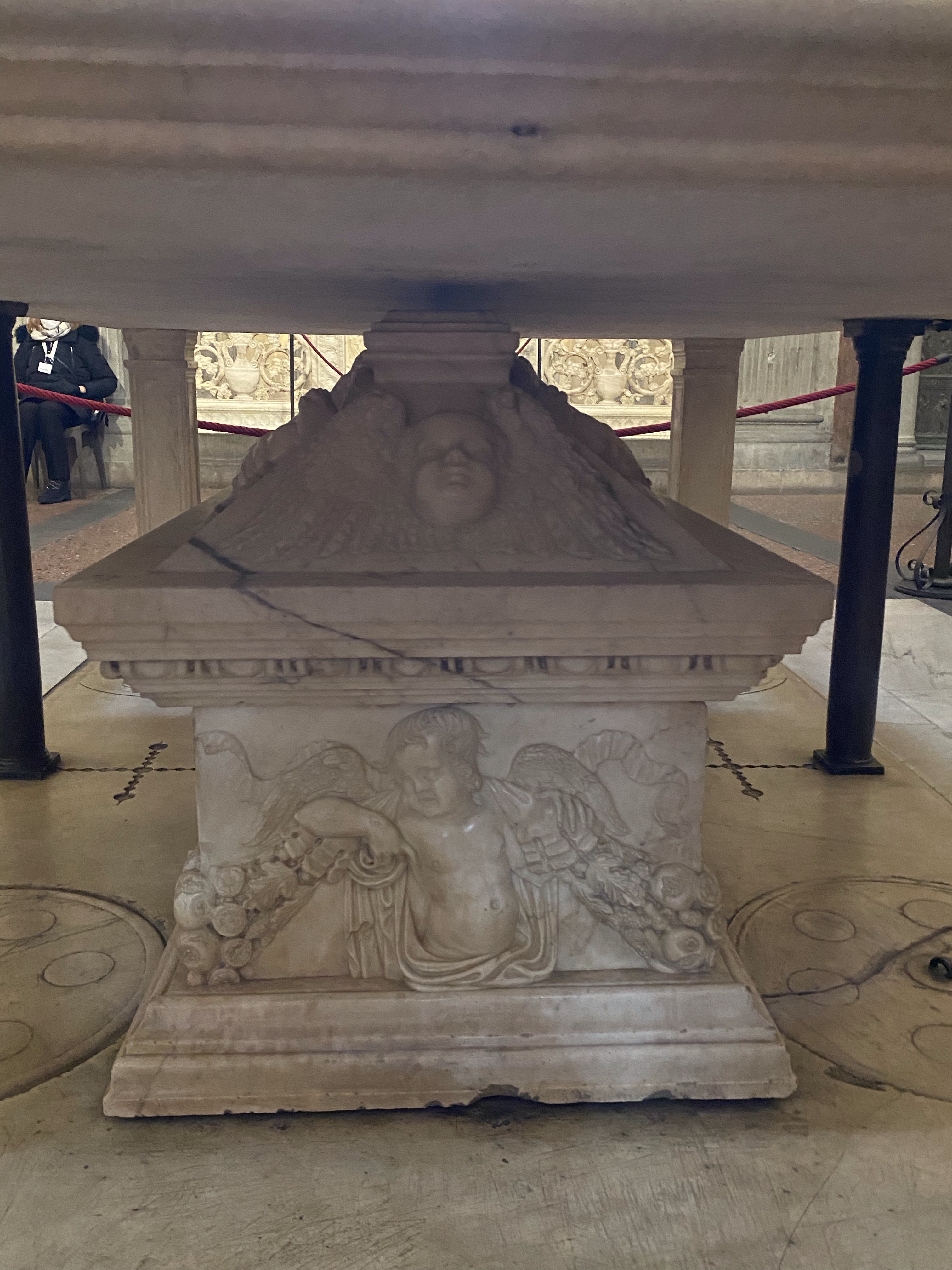
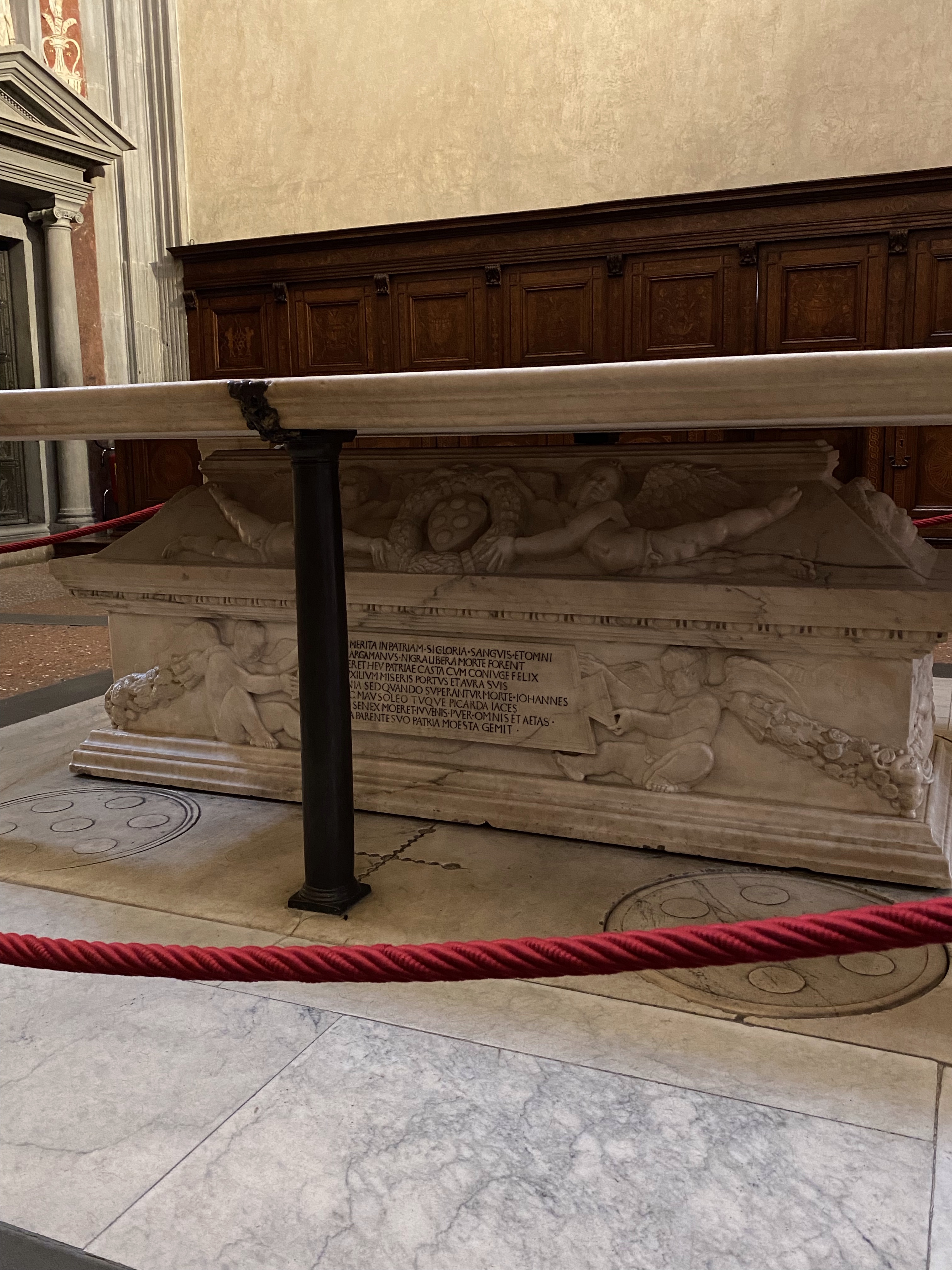
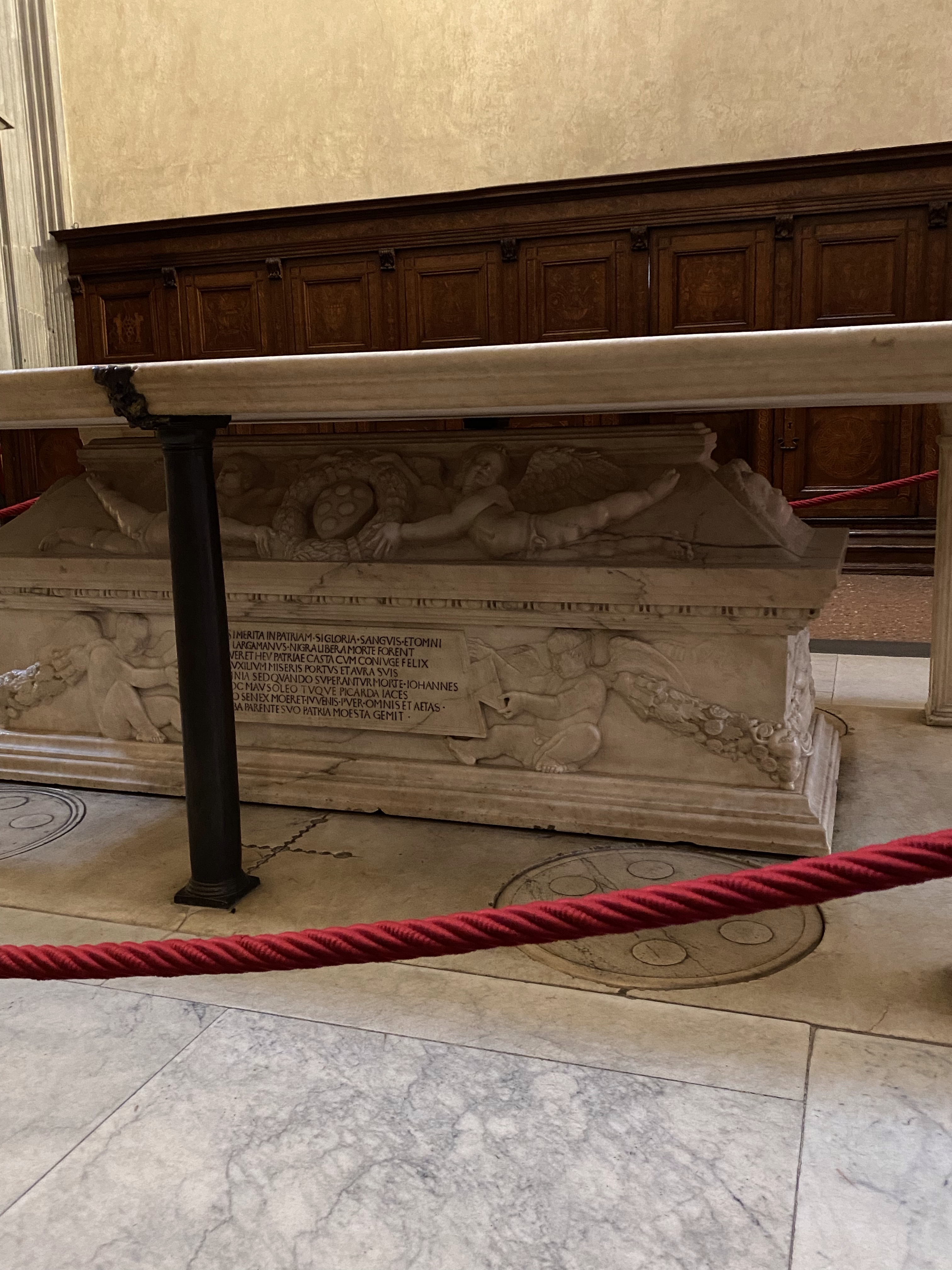
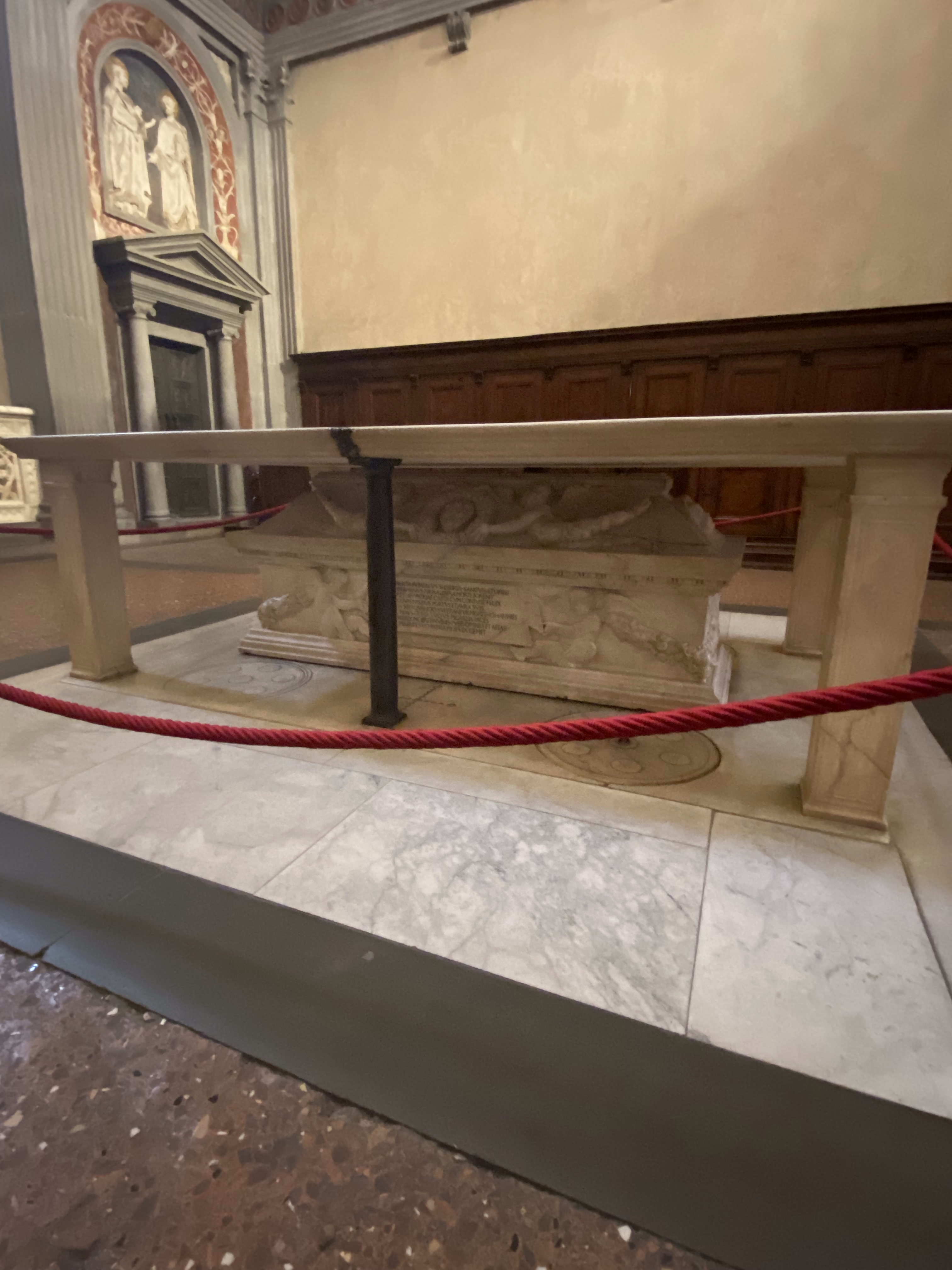
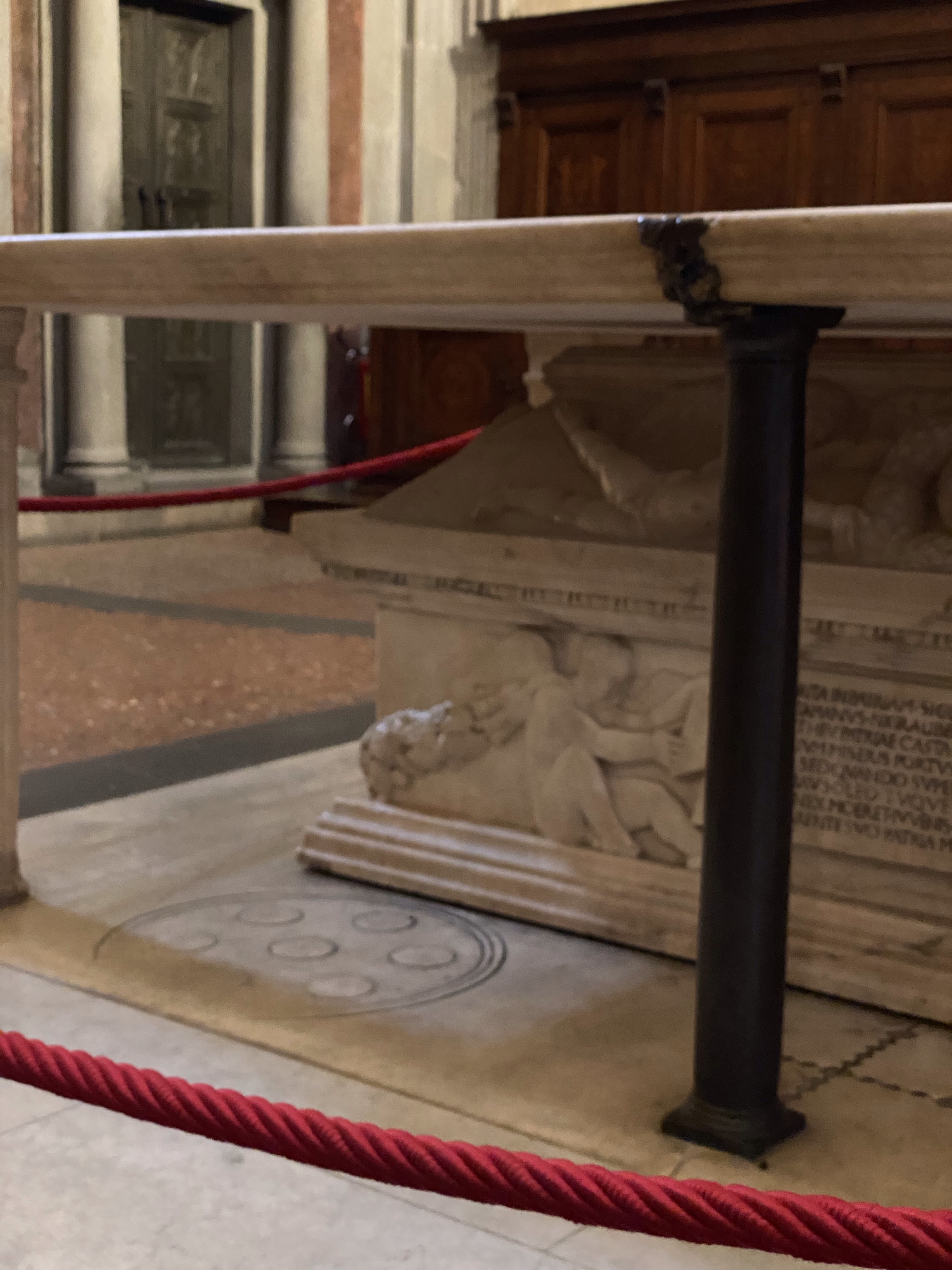
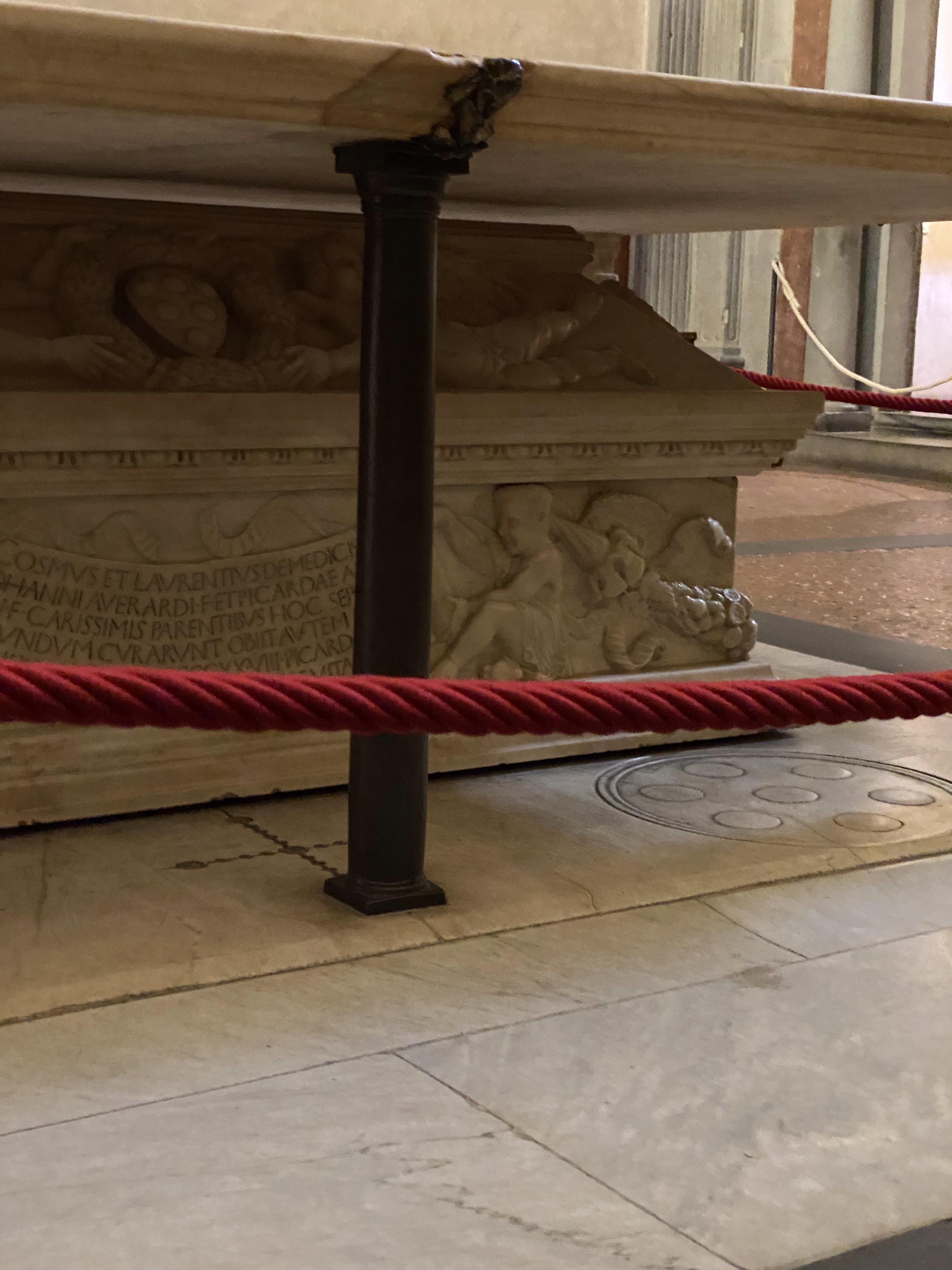
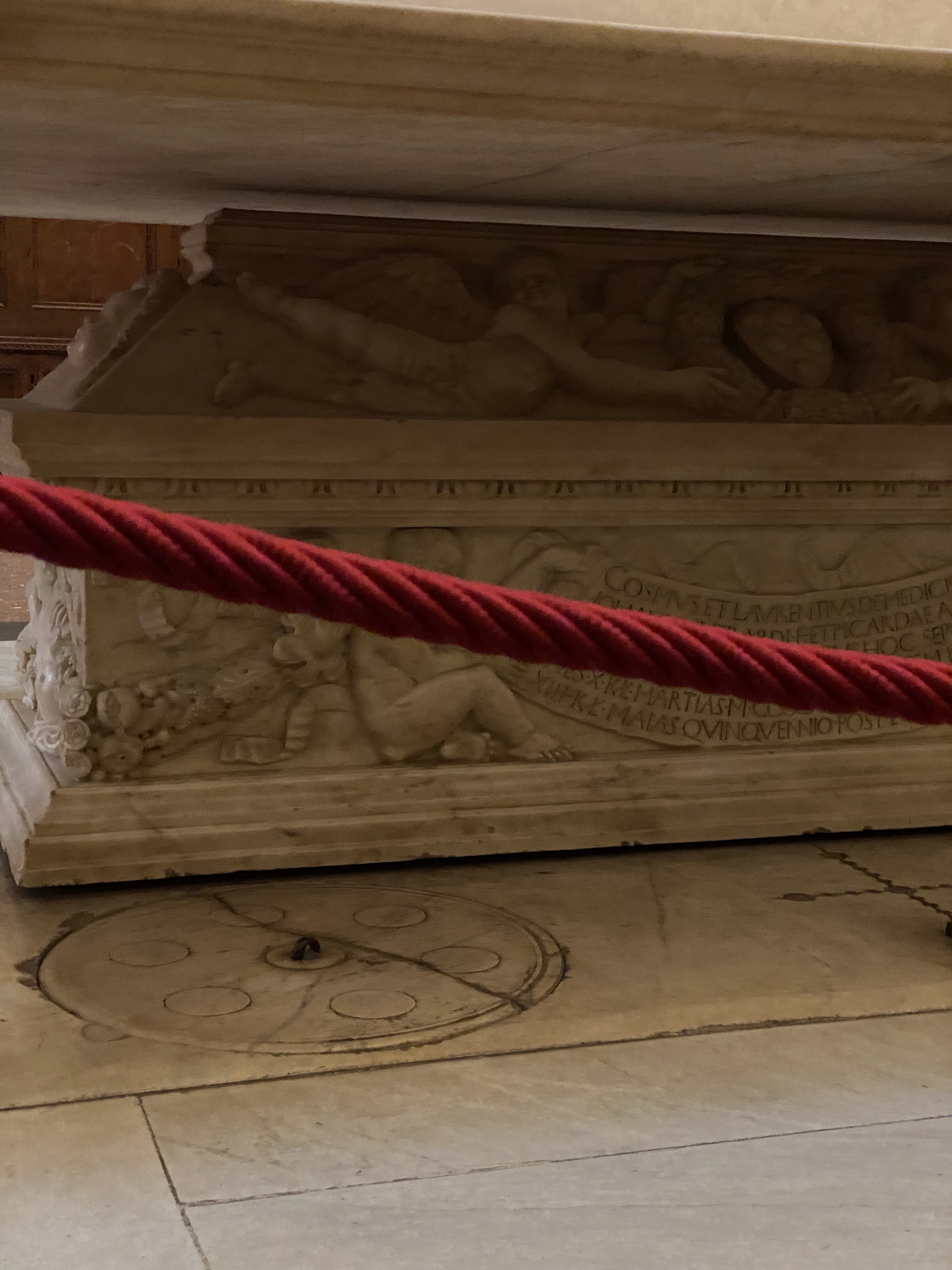
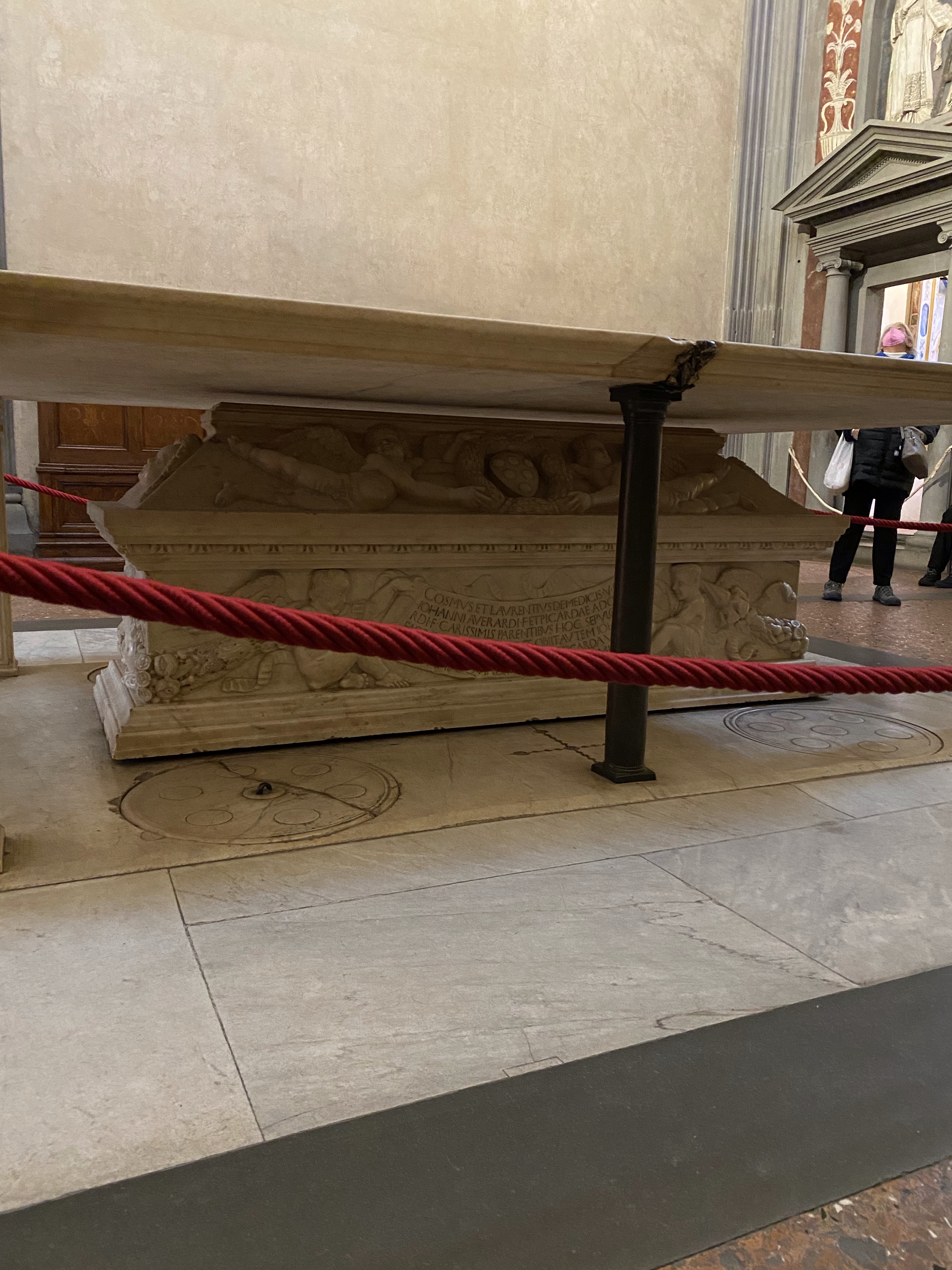
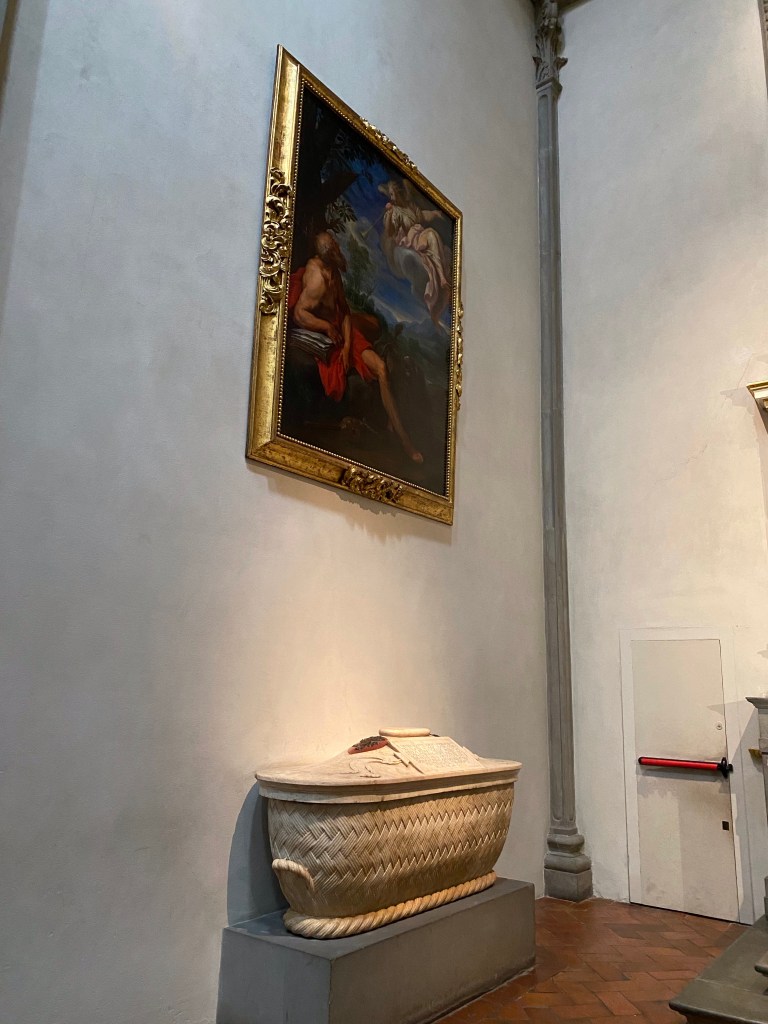
Giovanni di Bicci and his wife Piccarda were buried in the Old Sacristy, on a project designed by Brunelleschi. Their joint tomb is under what looks like a marble table in the Old Sacristy.
The basilica was completed by the Old Sacristy, commissioned by the Medici as their family mausoleum. Giovanni di Bicci de’ Medici entrusted the project to Filippo Brunelleschi, who between 1421 and 1426 built one of the most complex masterpieces of renaissance architecture. Dedicated to St. John the Evangelist, the so-called “Old Sacristy” is a cube covered by a hemispherical umbrella dome divided by ribs. The chromatic interplay of grey stone and white plaster is heightened by the presence of painted stuccoes: the frieze with cherubim and seraphim, the roundels with the Evangelists on the walls and the ones in the spandrels of the dome with Scenes from the life of St. John the Evangelist, by Donatello, who was also responsible for the bronze doors with Saints, Martyrs, Apostles and Doctors of the Church.
The frescoes in the small dome in the apse show the Sun and constellations as they appeared over Florence on the night of 4 July 1442. It is thought that this celestial map was executed by the eclectic painter and decorator Giuliano d’Arrigo, known as Pesello. The funerary monument to Piero and Giovanni de’ Medici, sons of Cosimo il Vecchio, was commissioned from Verrocchio in 1472 by Lorenzo the Magnificent and his brother Giuliano: one of the most sophisticated products of Laurentian artistic culture.
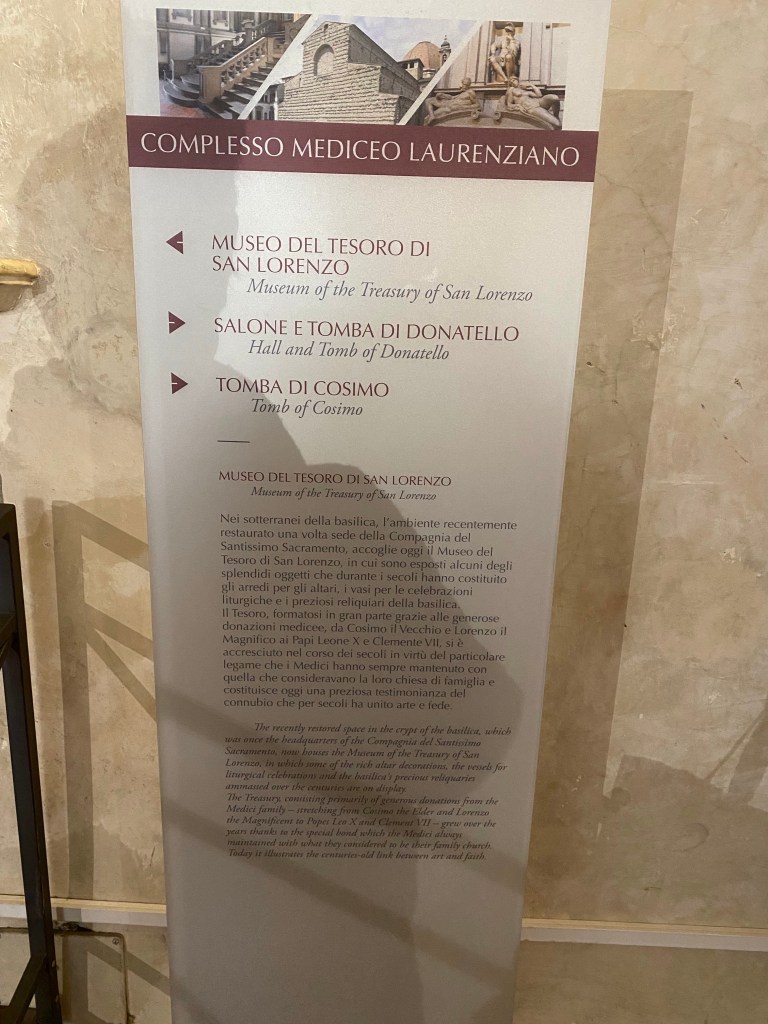
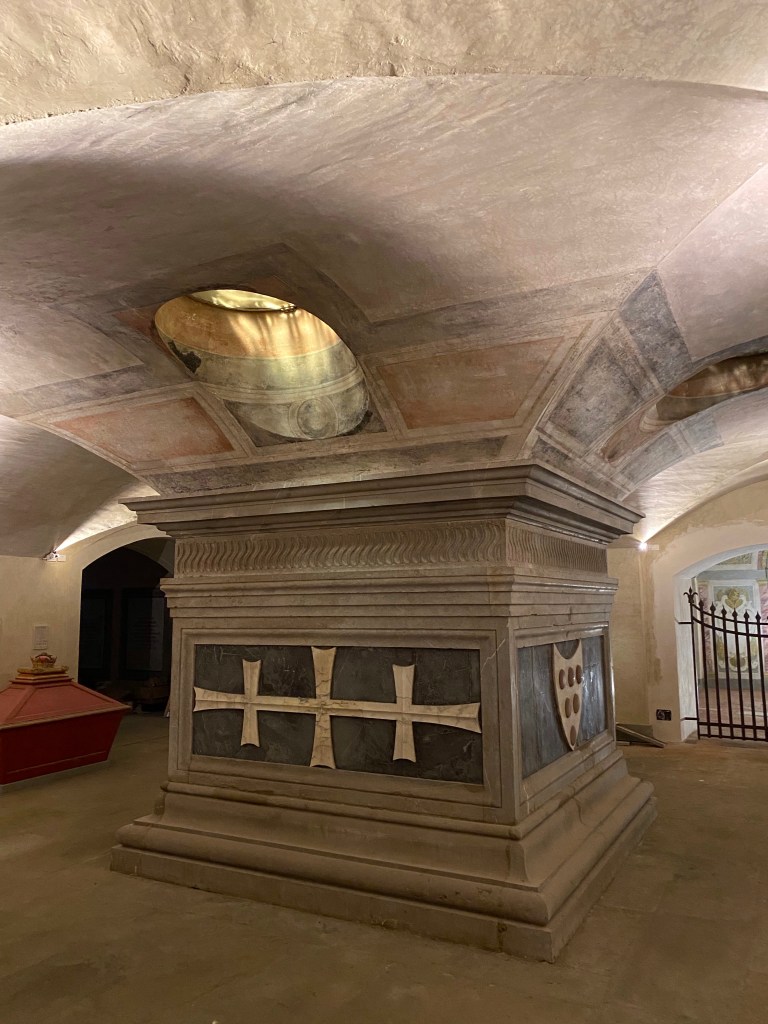
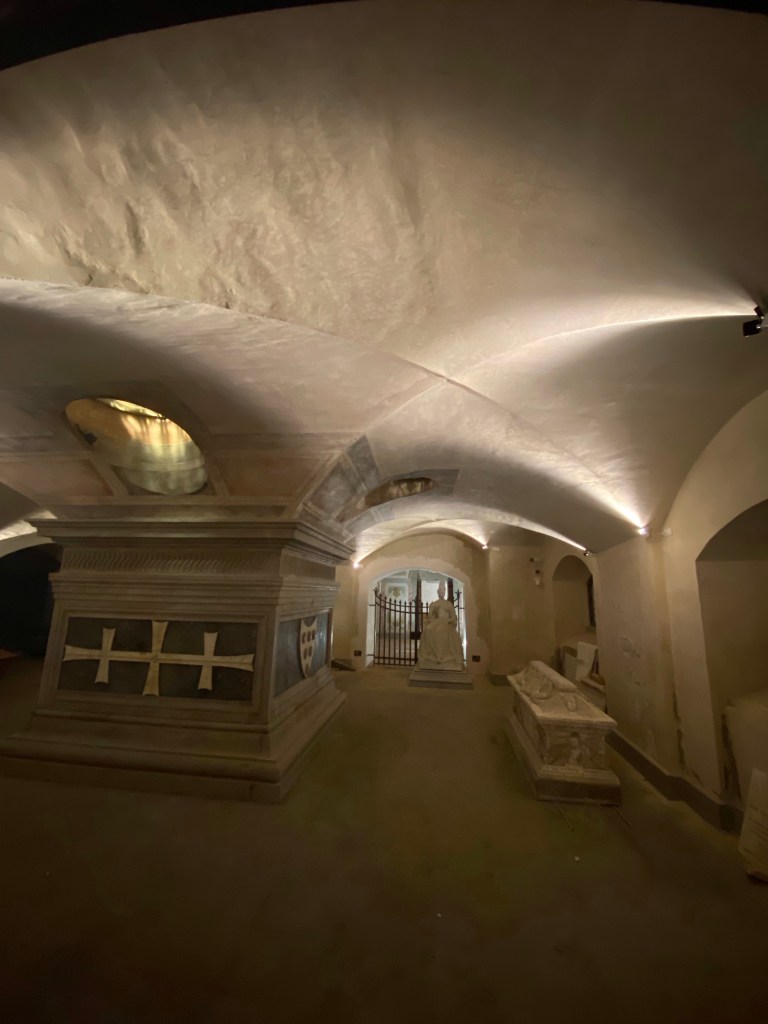
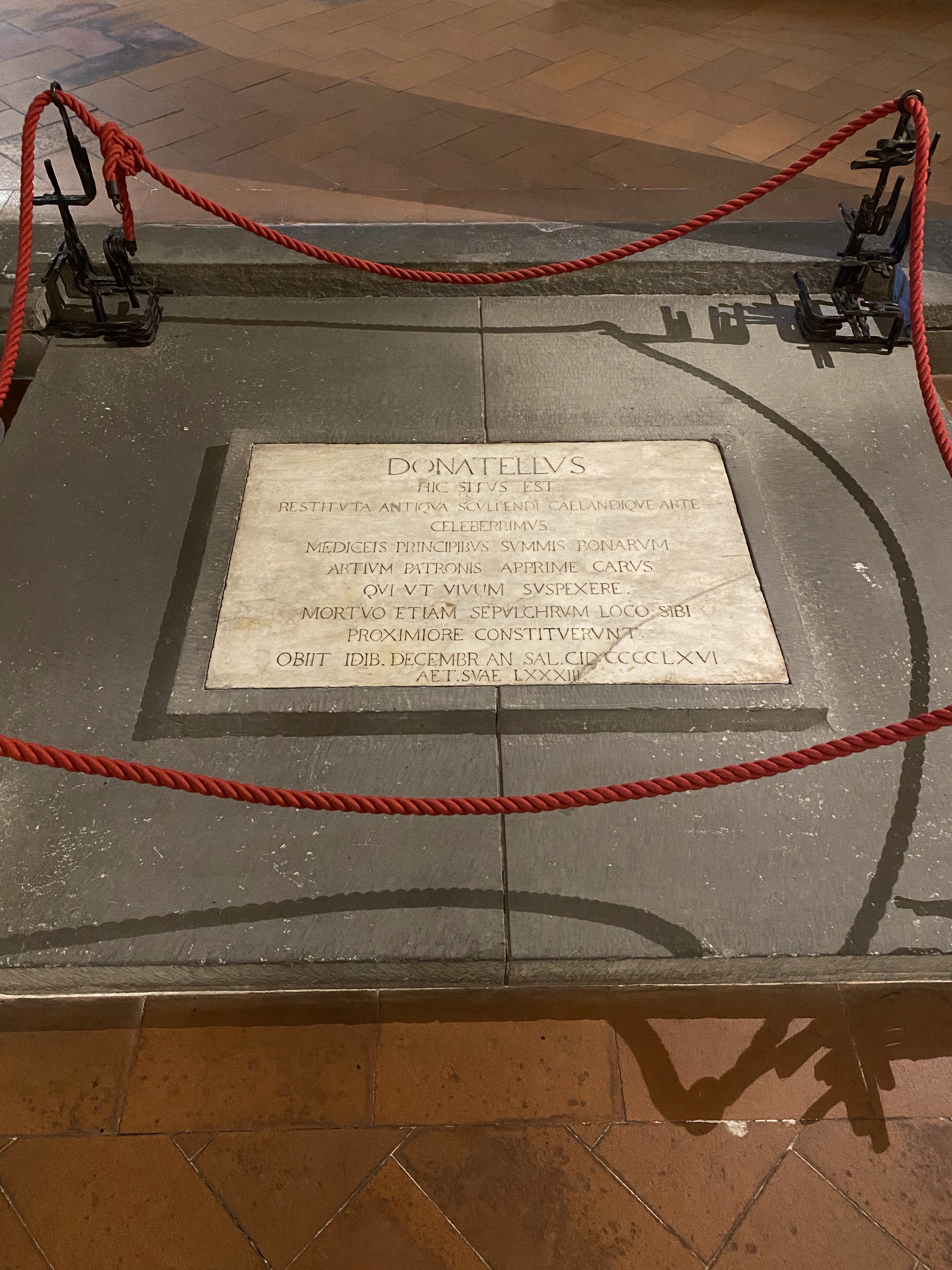
When you enter the crypt of San Lorenzo, you are able to visit the “Treasures of San Lorenzo” museum as well as the underground tomb of Cosimo and the tomb slab of Donatello.
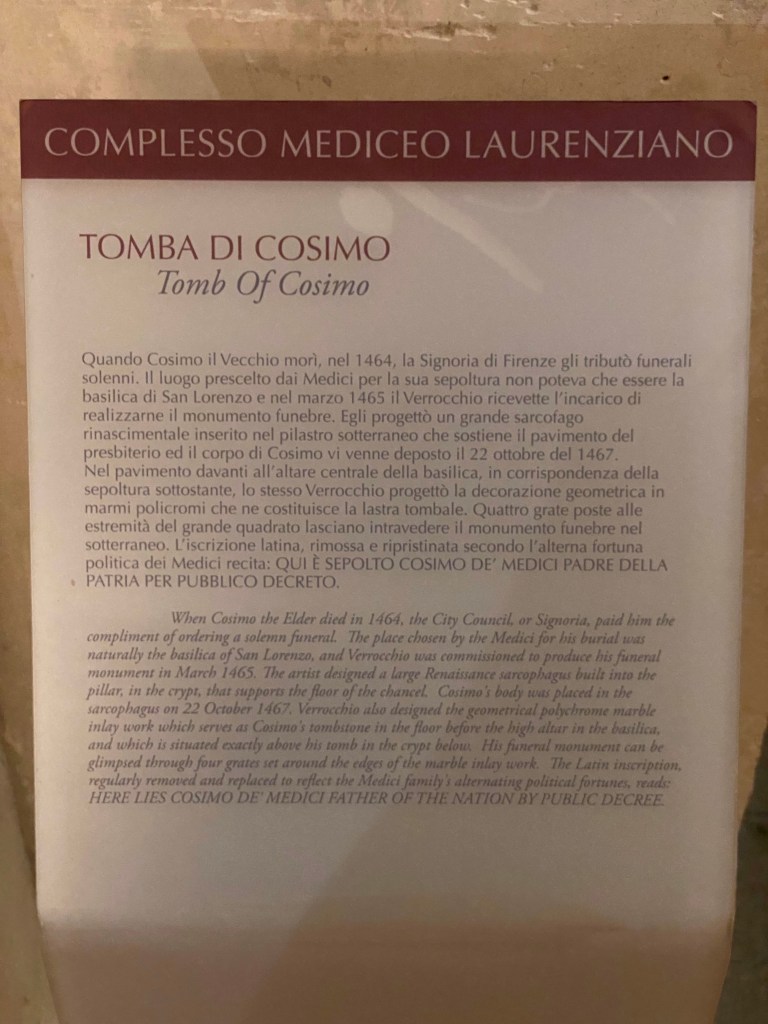
First, I’m focusing on the underground tomb of Cosimo:
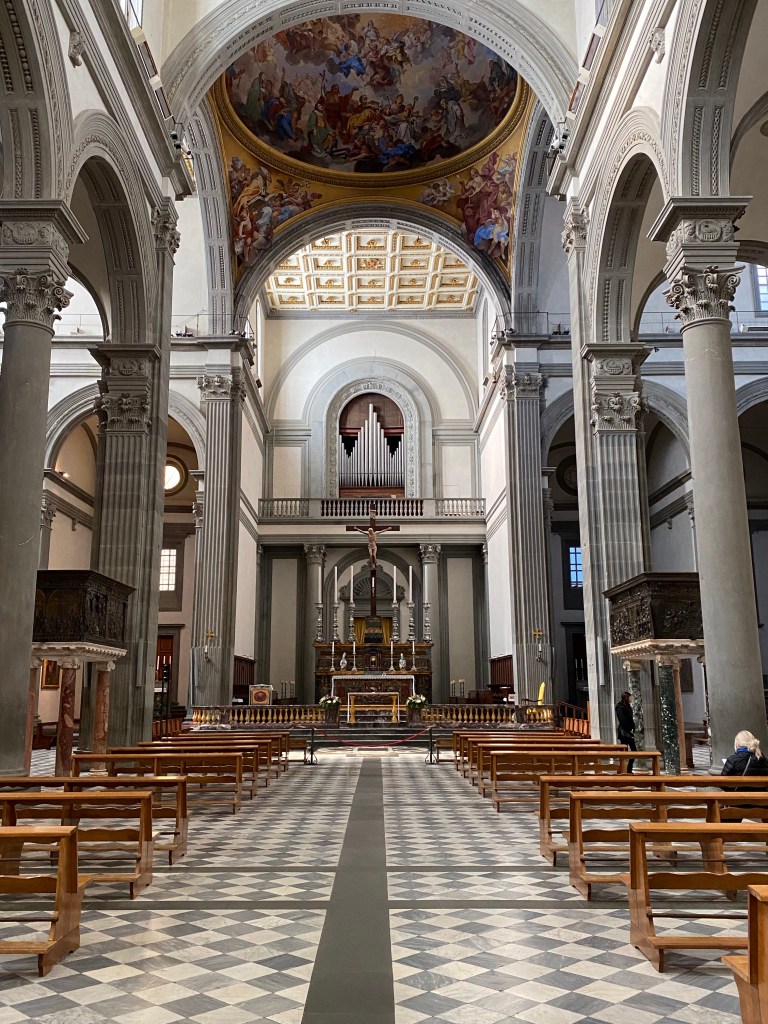
In addition to the underground tomb, the sculptor, Verrocchio, was also commissioned to create a cenotaph in the floor of the main basilica to commemorate Cosimo. This consists of an abstract patterned floor slab in front of the high altar connecting to a burial chamber in the crypt beneath. The artist used valuable materials—bronze, marble, red porphyry and green serpentine stones—to suggest Cosimo’s prestige. Interlocking ellipses within a circle and square evoke medieval diagrams of the universe, associating the name of Cosimo with the cosmos.
was equally skilled in a variety of media and often approached one medium as he would another. His training as a goldsmith reveals itself in his love of polychromy, and the tomb of Cosimo de’ Medici in white marble and red and green porphyry is distinguished by the richness and colour of the materials. This was developed in the tomb of Piero I and Giovanni de’ Medici (San Lorenzo, Florence), where the combination of a variety of coloured stones with bronze decoration is strikingly original.
The picture shows the floor tomb of Cosimo il Vecchio in the nave of Basilica di San Lorenzo, Florence
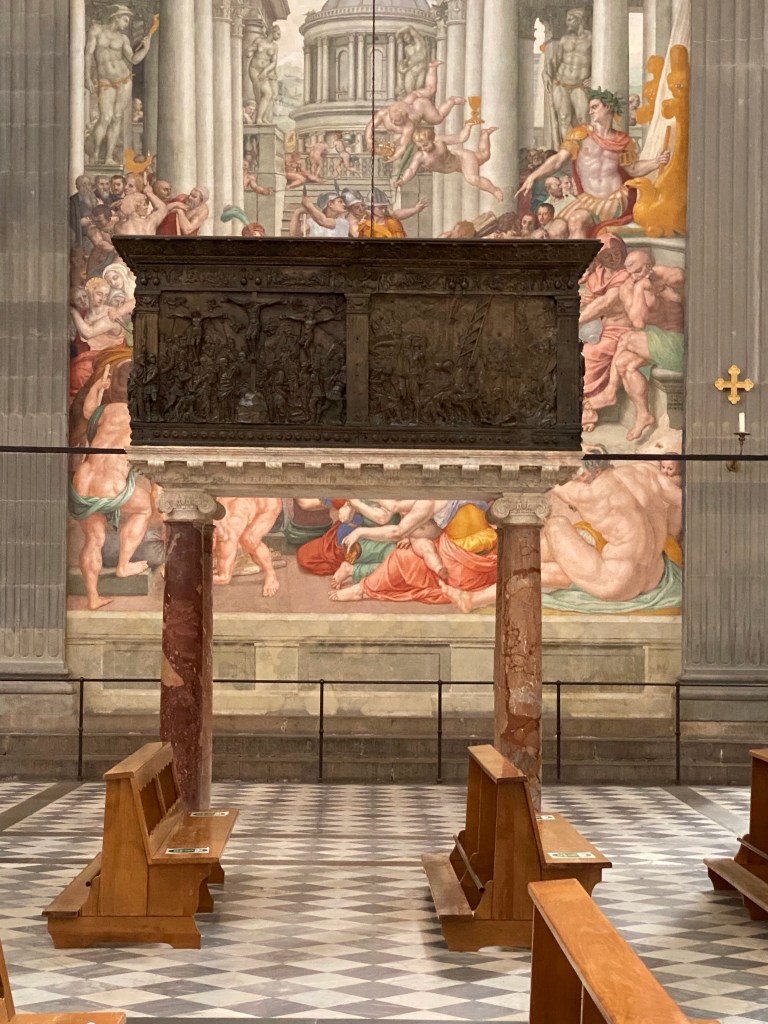
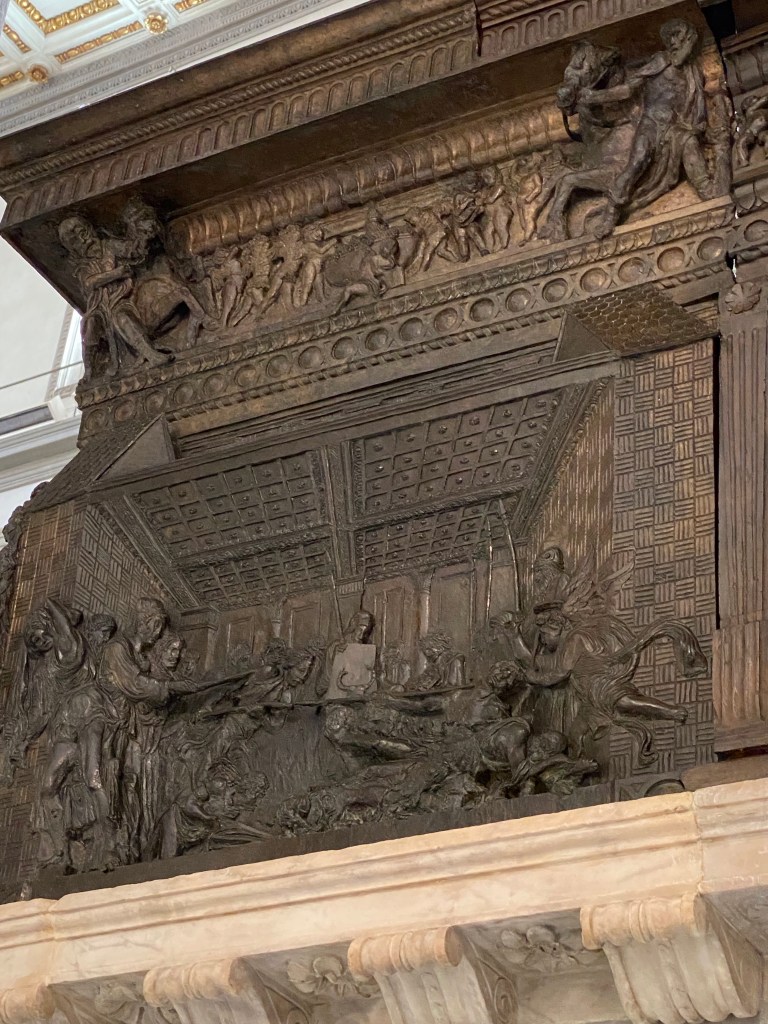
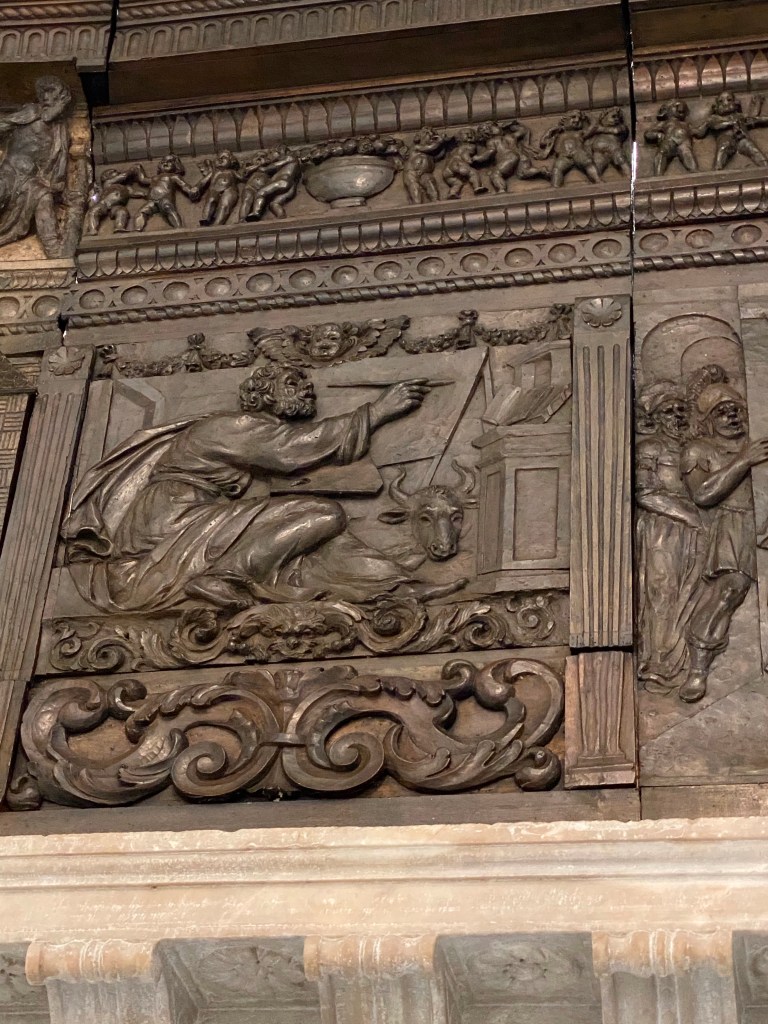
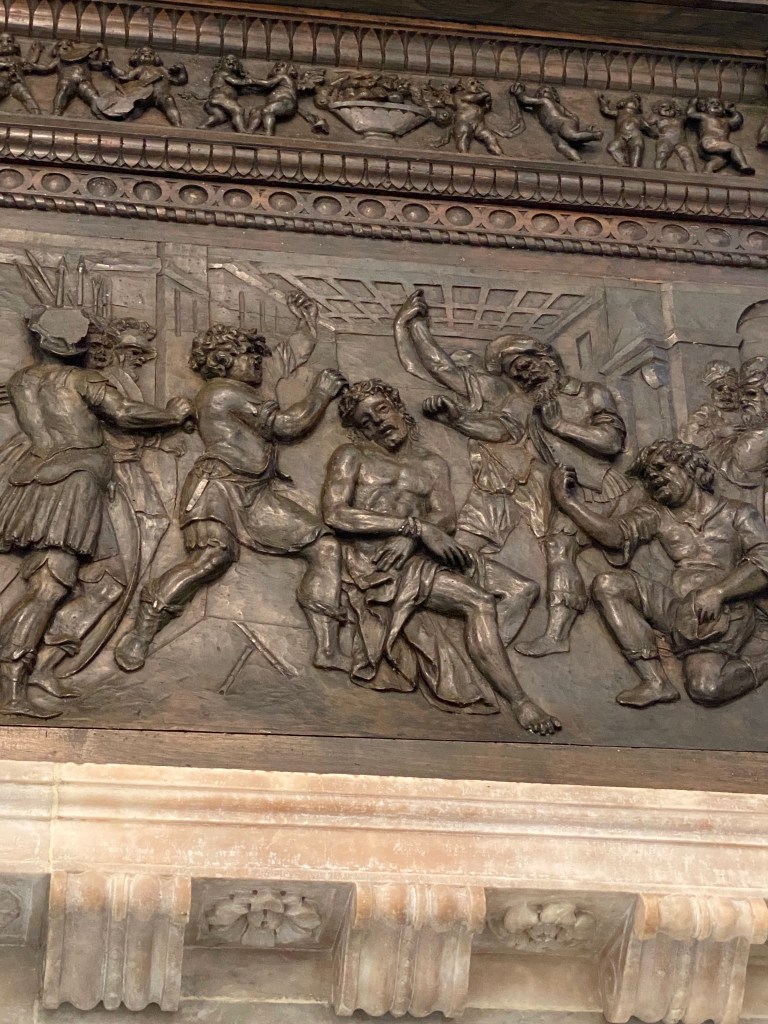
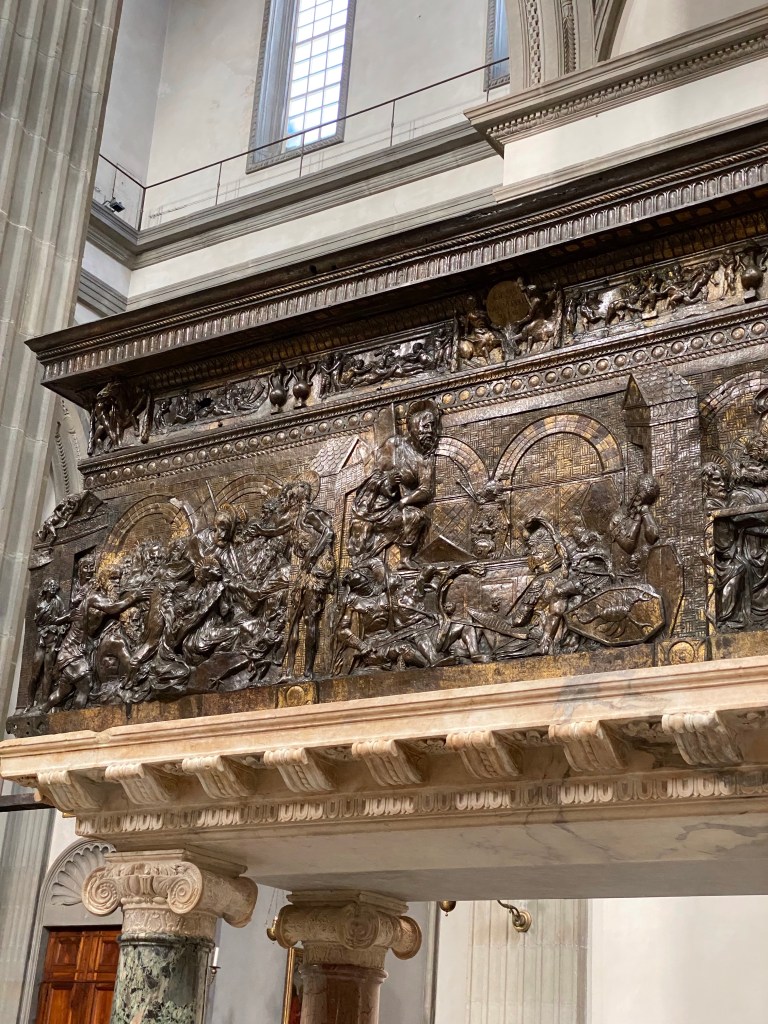
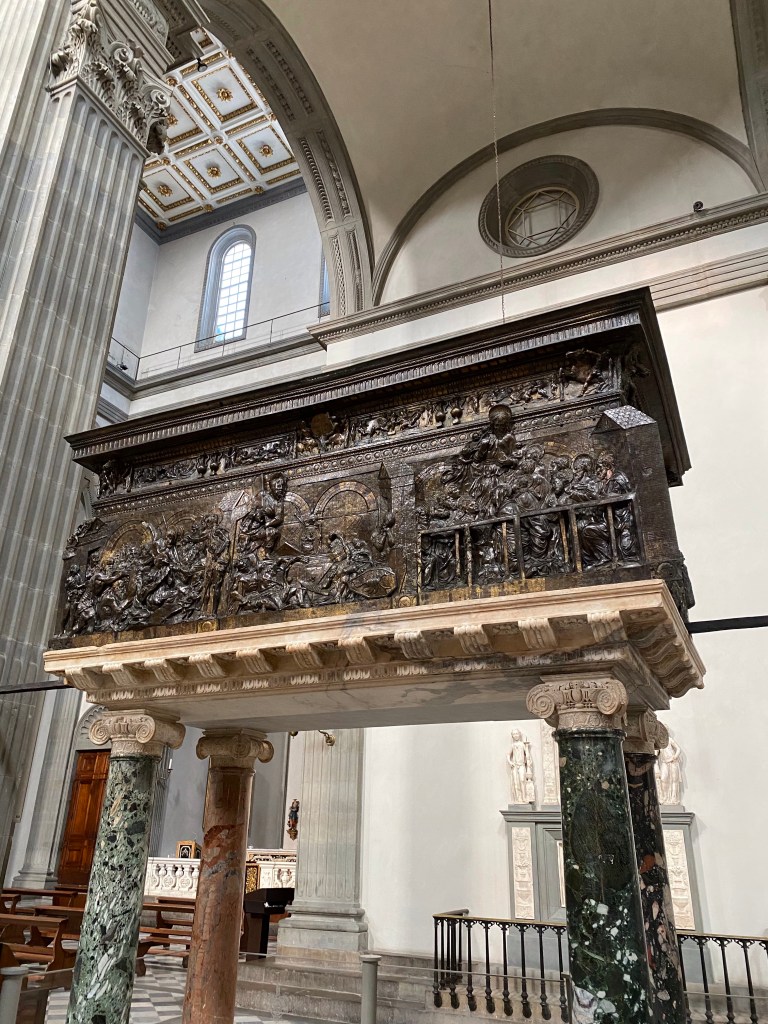
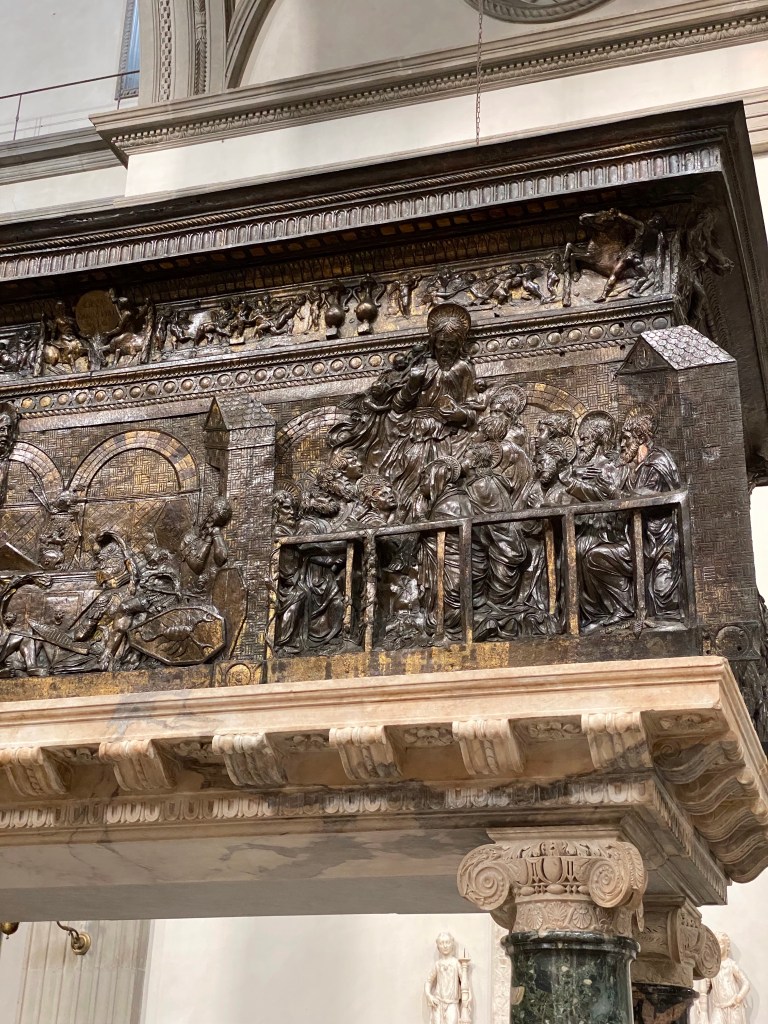
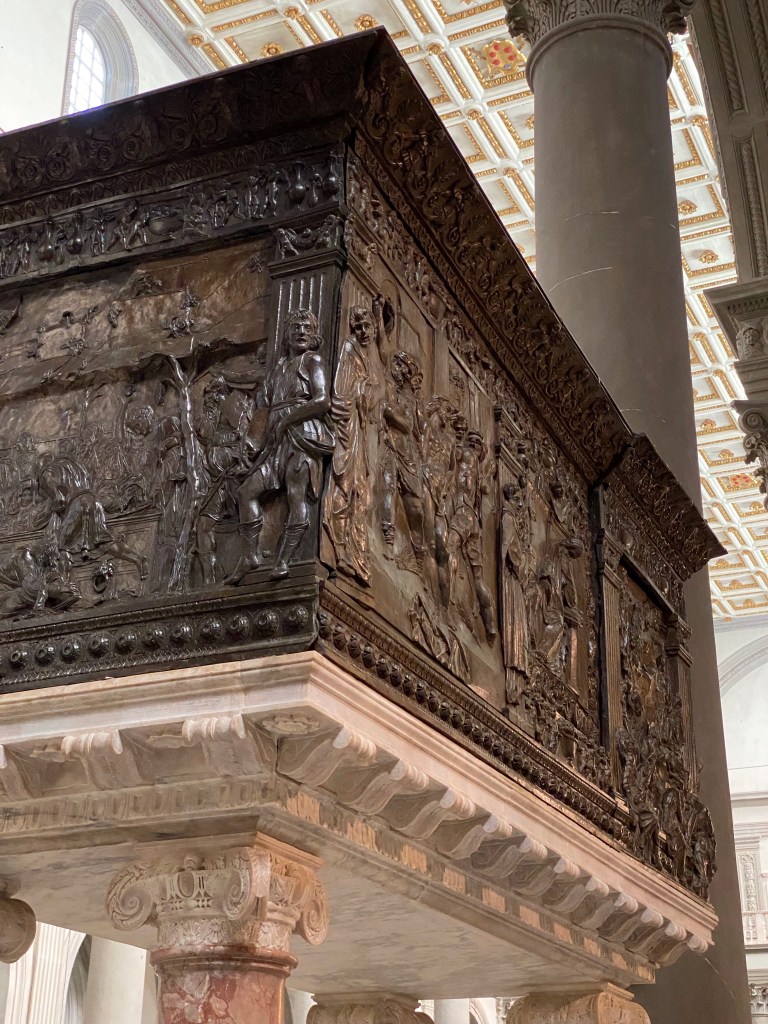
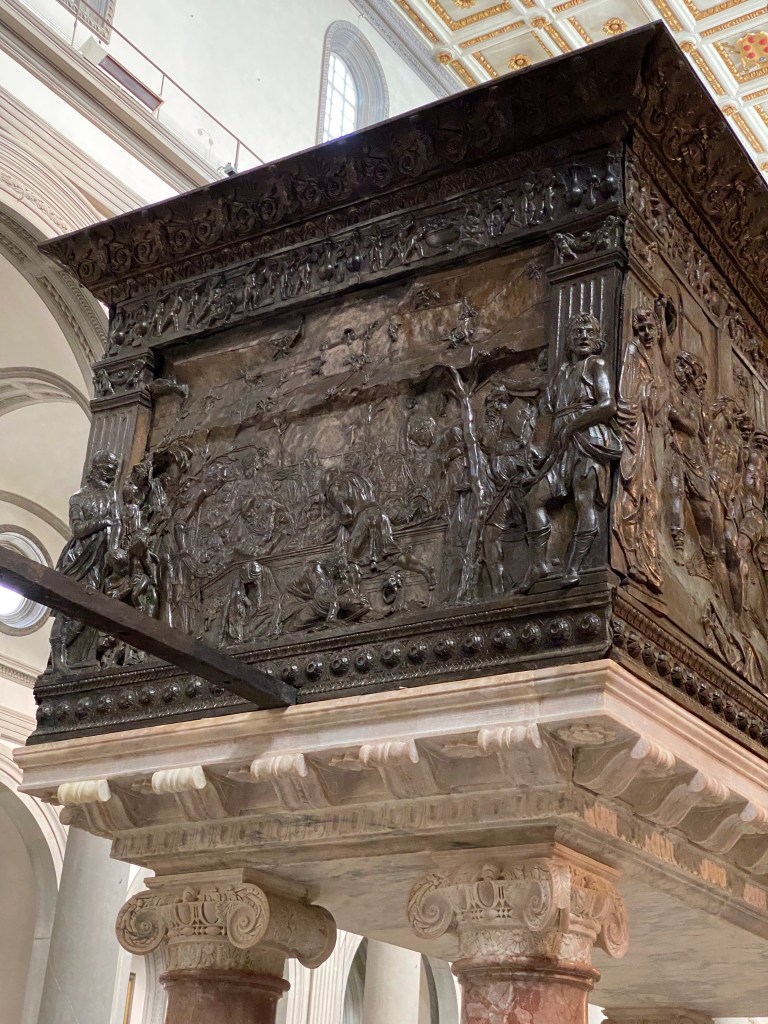
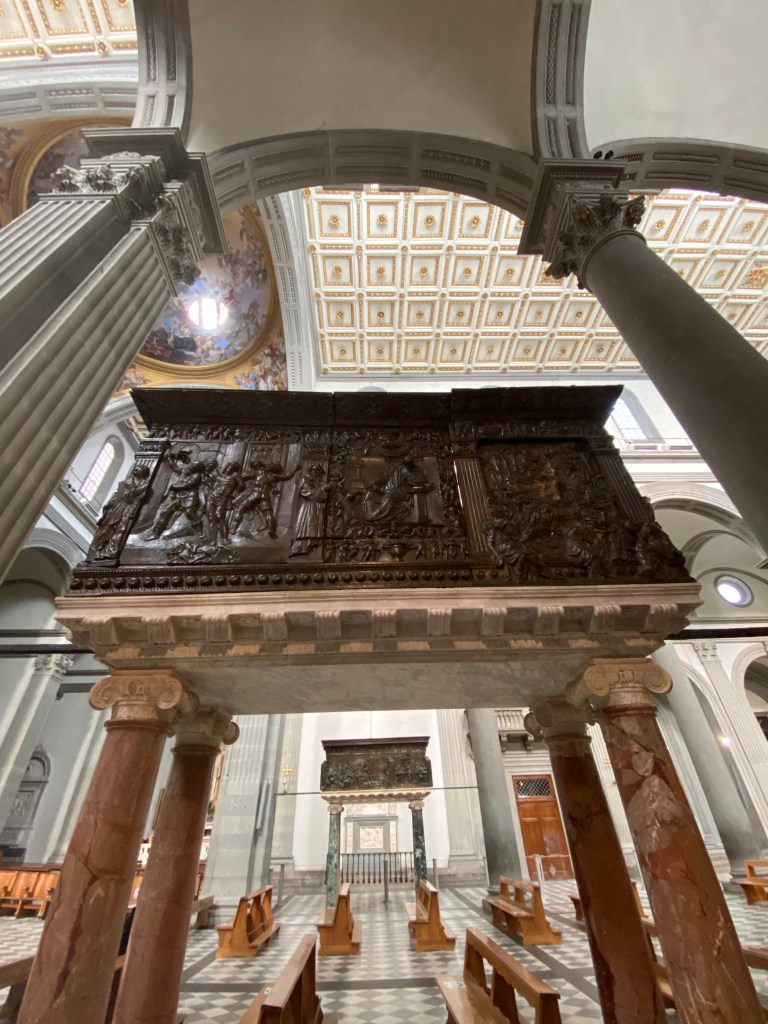
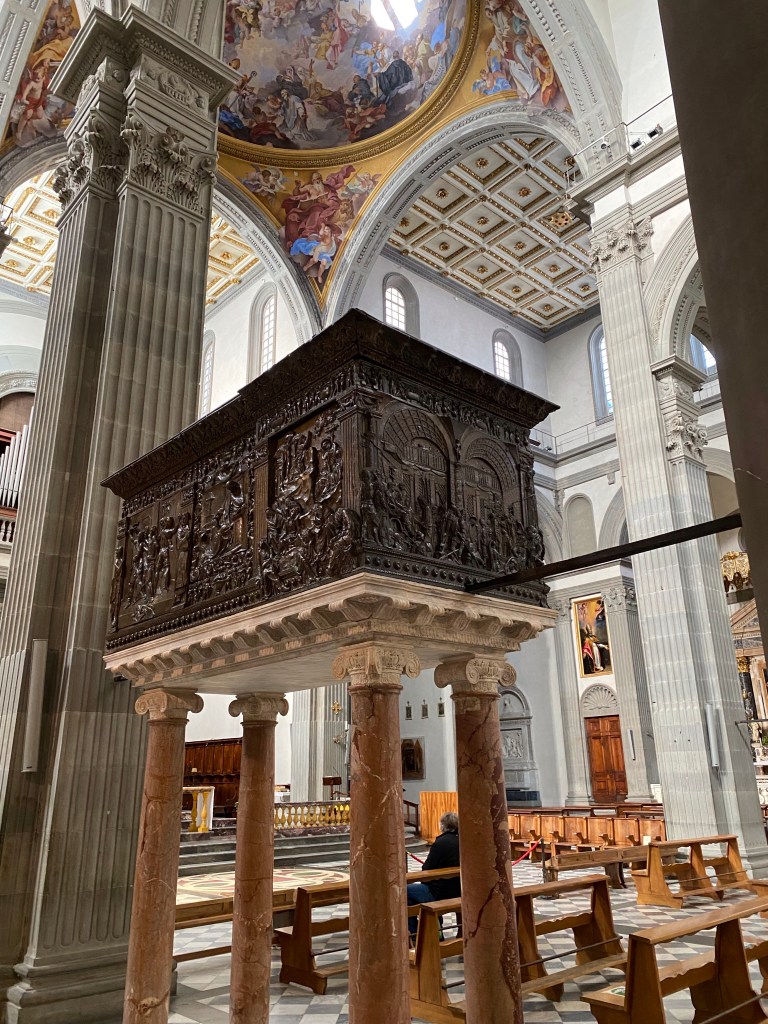
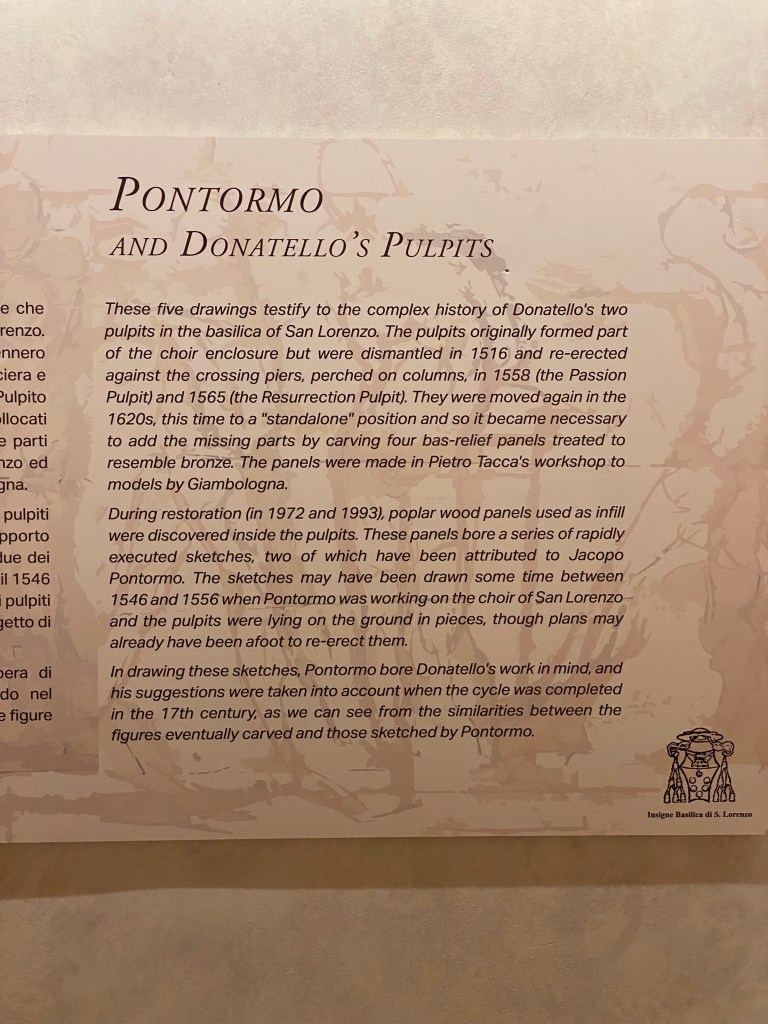
The two bronze pulpits are great works of Donatello’s late manner (c. 1460; finished by his assistants Bertoldo and Bellano), achieving intense dramatic expressivity in the New Testament scenes executed by Donatello himself in ‘stiacciato’ low relief, particularly the Deposition.
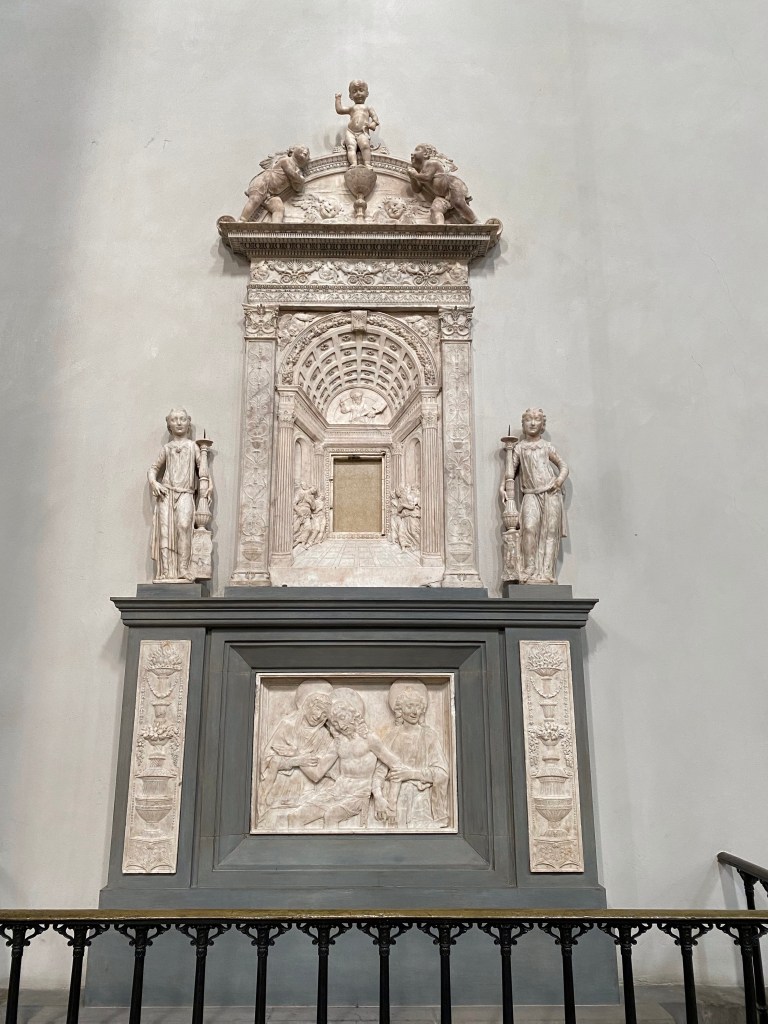
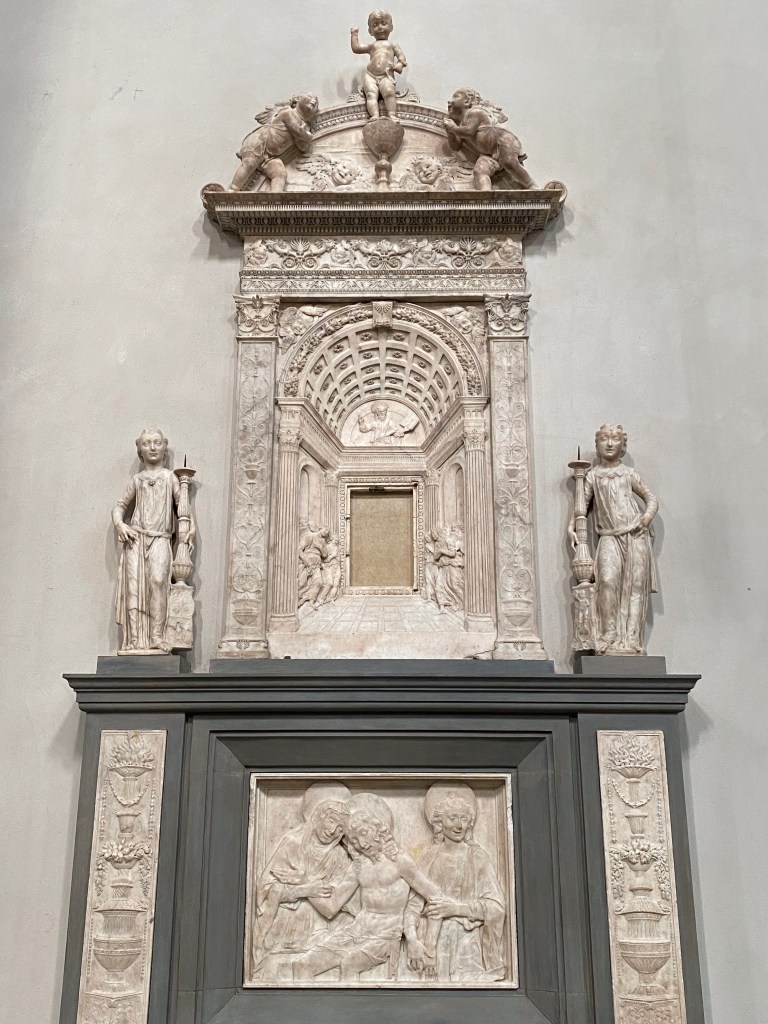
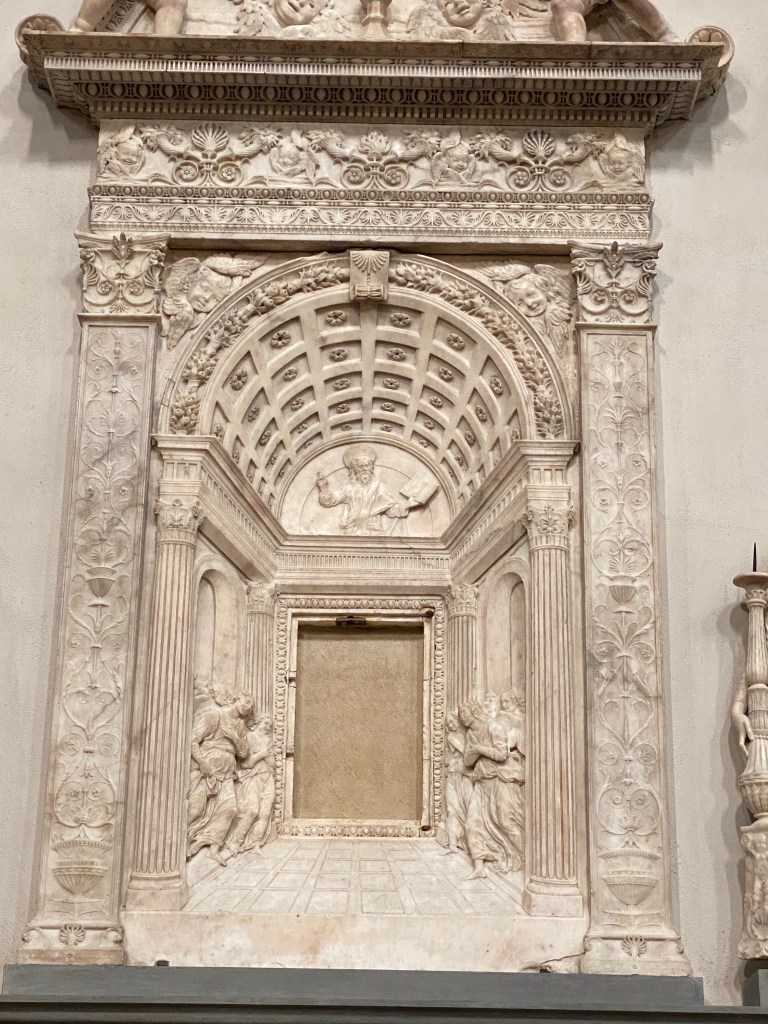
Desiderio da Settignano, Tabernacle of the Sacramento, south aisle
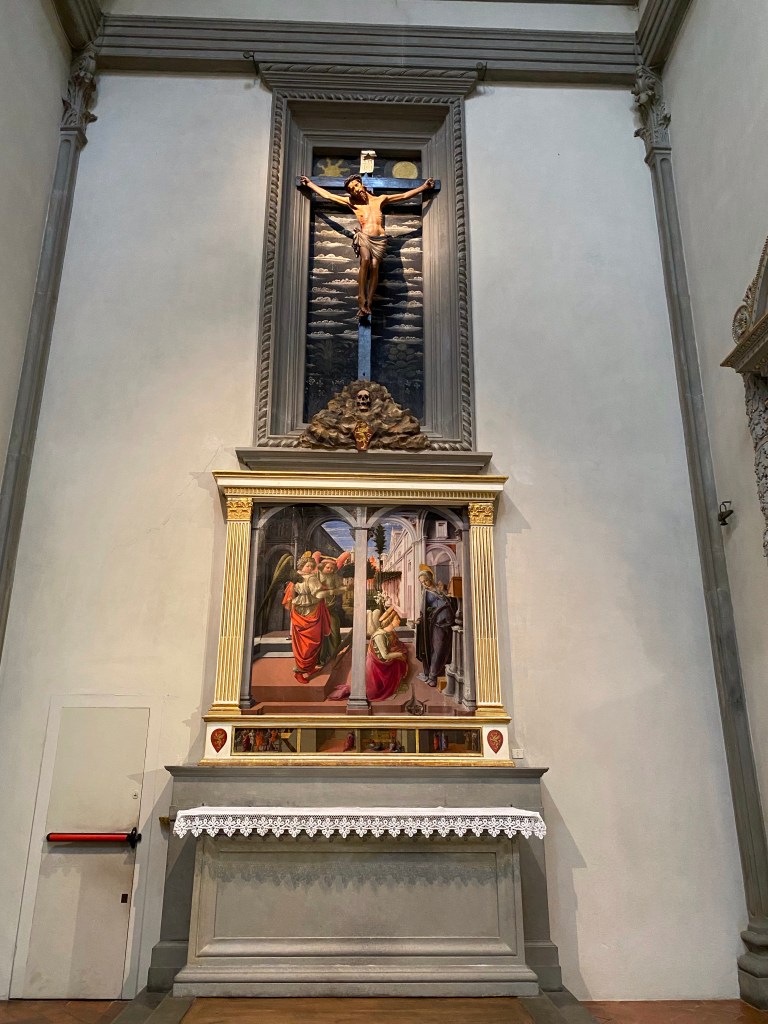
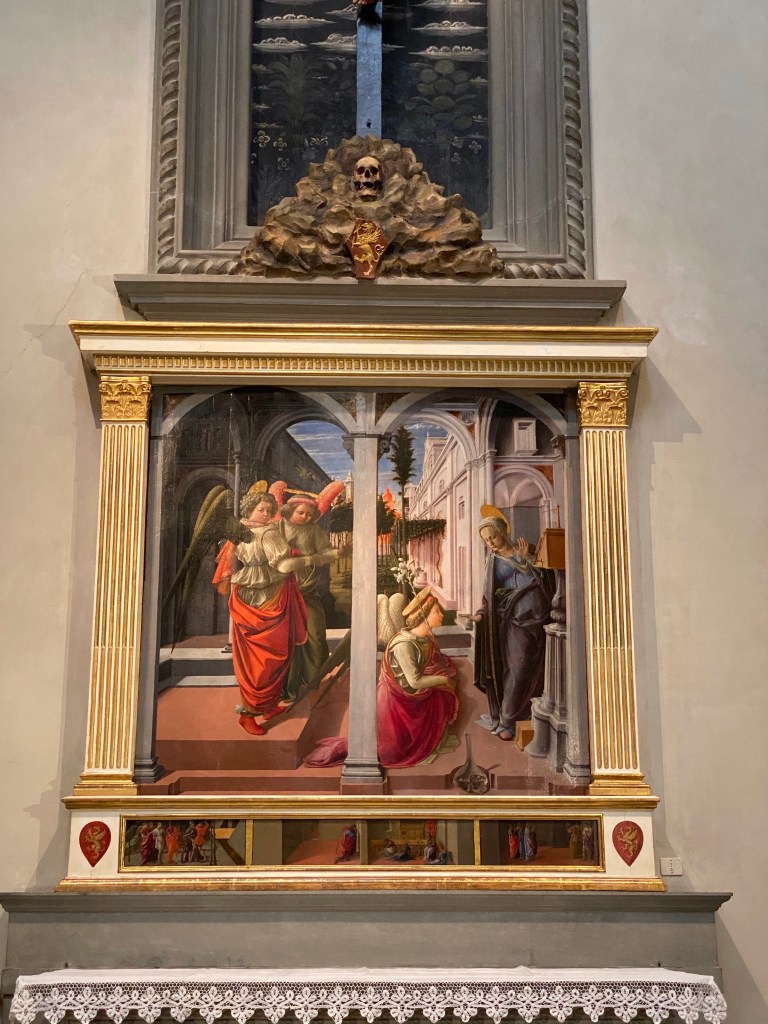
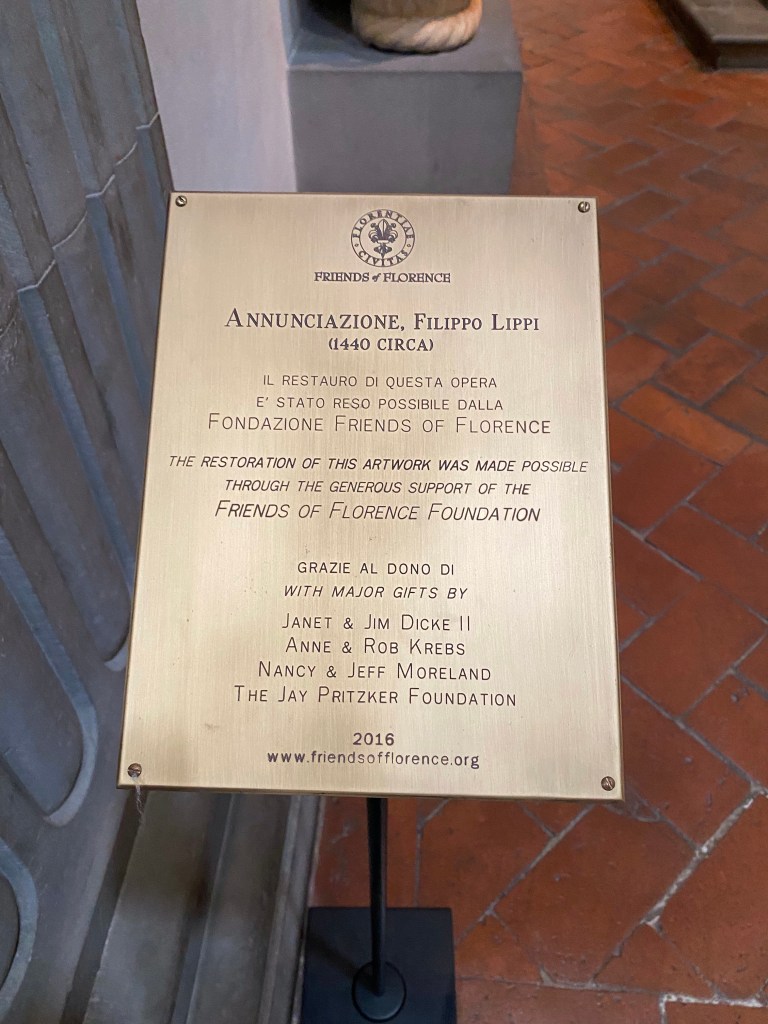
The Annunciation by Fra Filippo Lippi:
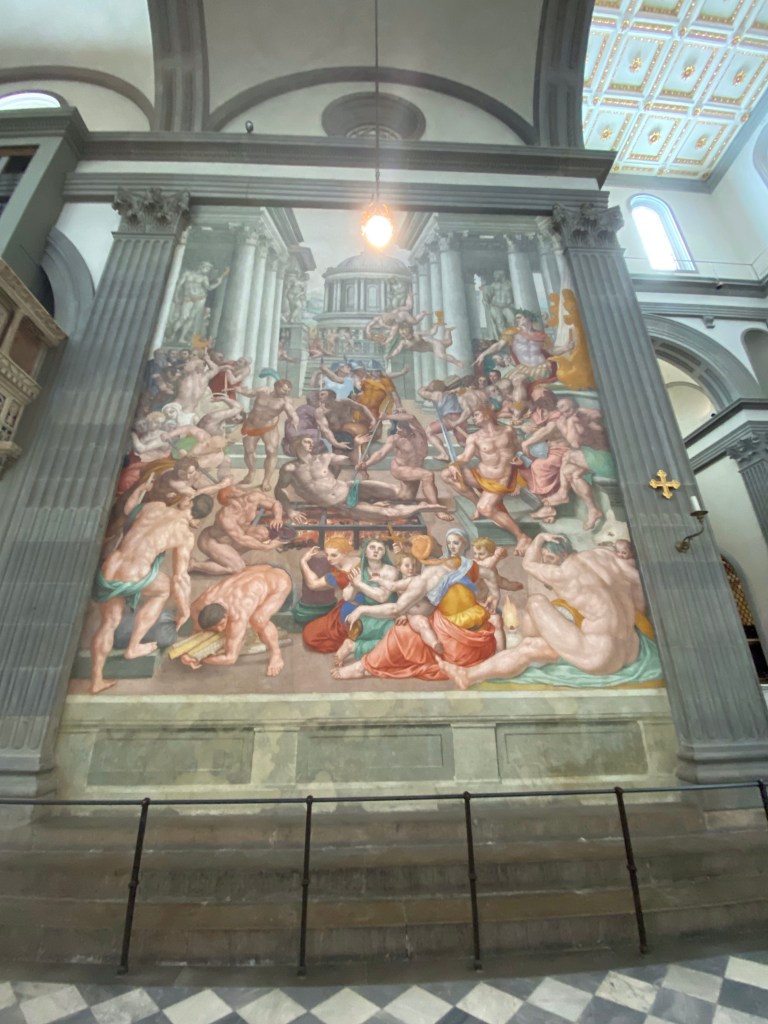
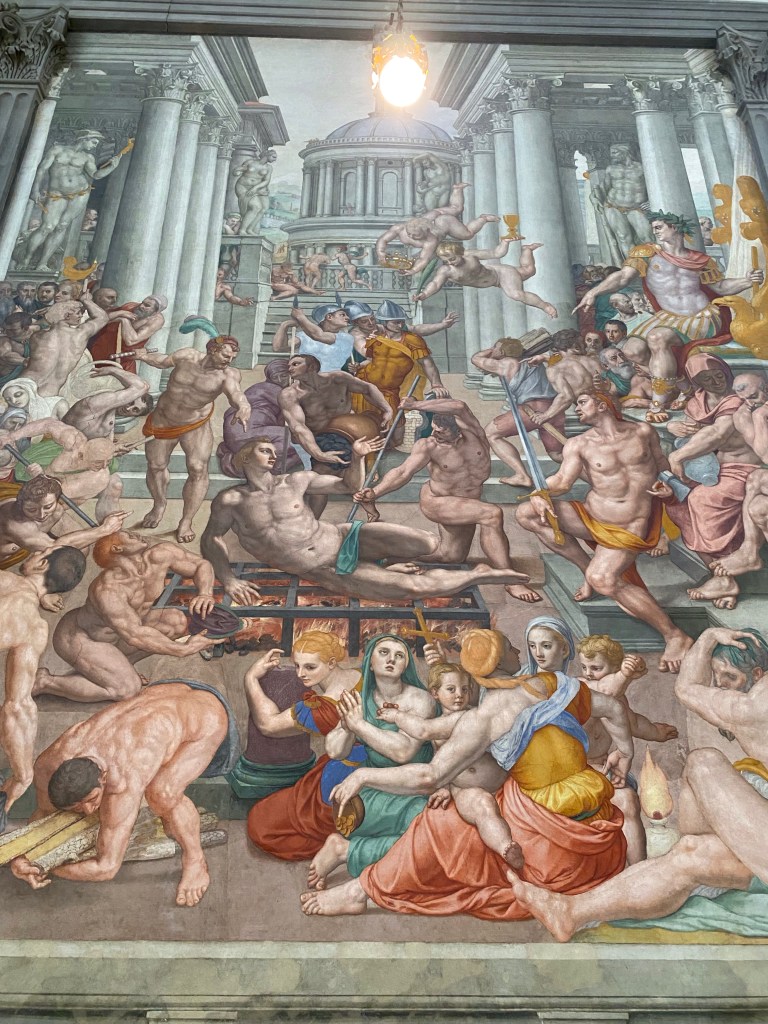
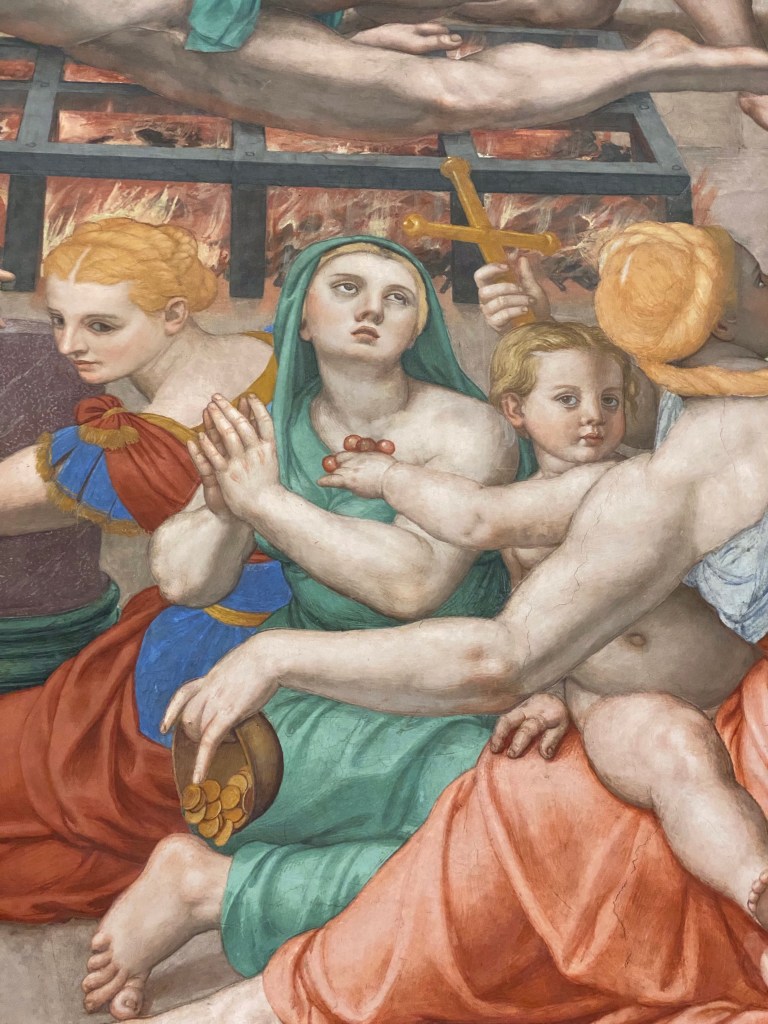
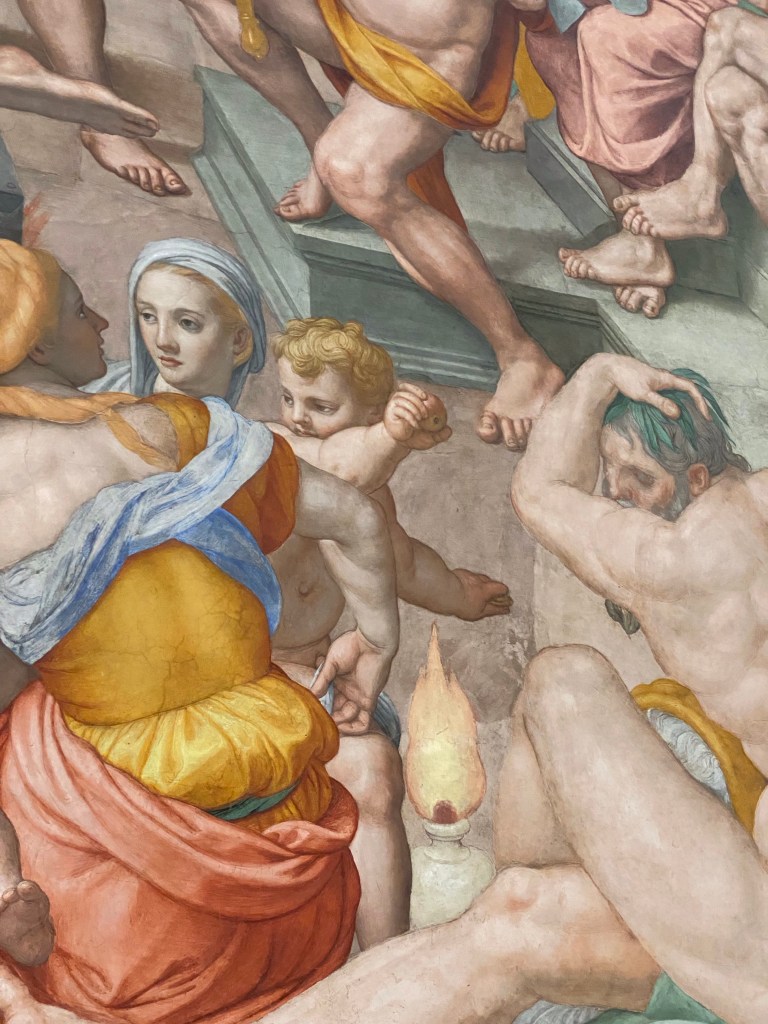
The large mannerist fresco of the Martyrdom of St Lawrence is by Bronzino. According to legend, St Lawrence, who was one of the deacons of Rome, was roasted alive on a gridiron in 258 AD.
Many historians believe a simple spelling mistake led to the belief that St Lawrence (San Lorenzo) was roasted rather than decapitated, as was the normal punishment used against others during the same persecution. However, the legend is well established and the gridiron is generally used as the symbol of St Lawrence.
This is one of the last works of Bronzino. On the left of the fresco, beneath the statue of Mercury, Bronzino painted a self-portrait together with two portraits of his master, Pontormo, and his pupil, Alessandro Allori.
The video below is of the chapel just to the left of the Old Sacristy.
En Francais : Claude Monet a Venise : claude monet venise
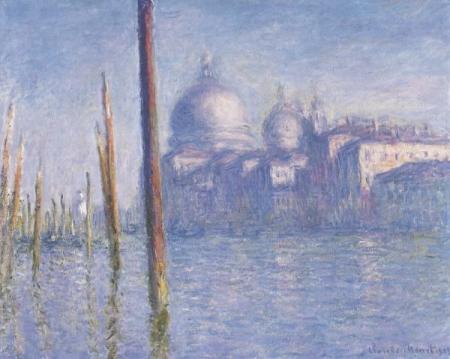
Venice, The Grand Canal Claude MONET 1908 Fine Arts Museum, San Francisco, California, USA
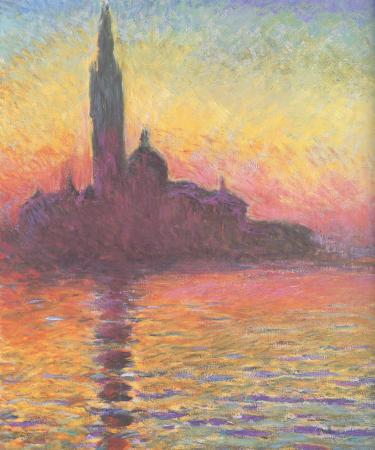
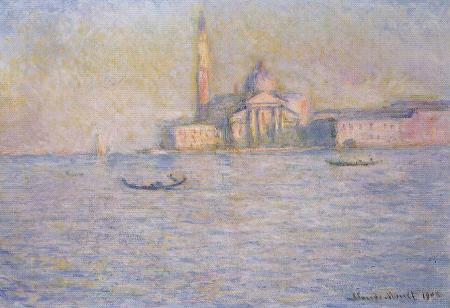
San Giorgio Maggiore at Twilight (or at Dusk) Claude MONET 1908 National Museum of Wales, Cardiff, GB
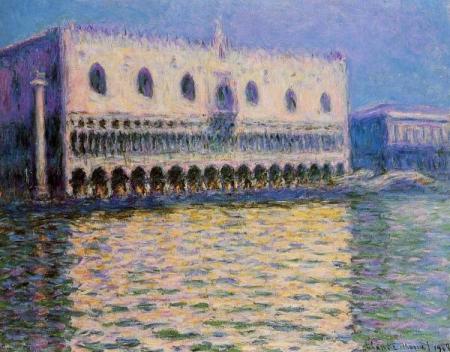
The canvases Monet painted during his one trip to Venice in the fall of 1908 are among the most popular and the best known of his art works. However, their number is relatively small: 37 canvases featuring a dozen different views, taken within short distance of one another.
“Although I am enthusiastic about Venice, and though I’ve started a few canvases, I’m afraid I will only bring back beginnings that will be nothing else but souvenirs for me,” Monet wrote to the art dealer Gaston Bernheim on October 25, 1908.
According to Monet himself, the painter did only “trials and beginnings” in Venice. Although the canvases were finished afterwards in studio, they do not have the same impasto as other works Monet had struggled with, like the Rouen Cathedral series.
When leaving Giverny, Monet did not know if he would feel like painting in Venice. He may have been reluctant to deal with a subject that others had already painted so many times. In order to feel free to work if he chose, he sent his painting materials ahead.
Once he saw the city, Monet was “gripped by Venice.” After several days looking for locations, he felt an urge to paint.
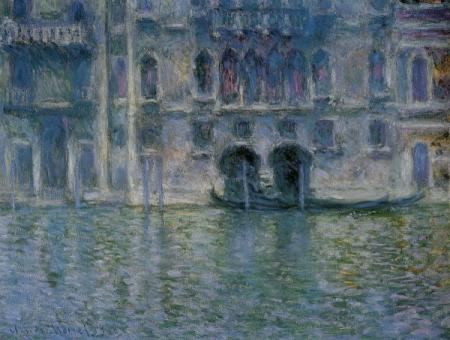
The group of Venetian views he realized can be considered somewhat like the pictures a tourist would like to bring home. He set his heart on the well-known landmarks near the Grand Canal: the Doge’s Palace and church of San Giorgio (which could be viewed from his hotel); Palazzo da Mula; or other typical scenes such as the as Rio della Salute.
Gradually, the sojourn turned into a real painting campaign, just like the many campaigns he had undertaken before. Monet, painter of water and monuments, experienced the shock of encountering a city that unites both.
Monet was 68 when he discovered Venice. He had already been in Italy, but not further than Bordighera on the Riviera. The opportunity was afforded by an invitation from his English friend Mary Hunter, who persuaded him to make the trip. He and his wife would stay in the Barbaro Palace on the Grand Canal.
The trip filled his wife Alice with joy: Usually they would not stray far from Giverny, where Monet had been exploring the secrets of his water lilies for five years.
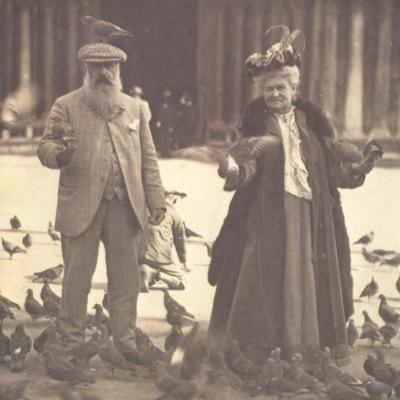
“There were pigeons all over us and I was wincing a bit with fright. But the picture was taken the moment they flew away.” Alice Monet, Venice, October 6, 1908
Venice, The Doge Palace Claude MONET 1908 Brooklyn Museum, New York, USA
Thanks to Alice, we have all the details about their Italian stay, for she wrote daily to her daughter Germaine Salerou. This correspondence was published in 1986 by Germaine Salerou’s grandson (Philippe Piguet, Monet et Venise, published by Herscher).
The Monets arrived in Venice by train on October 1, 1908. “It is too beautiful to be painted! It is untranslatable!” Monet exclaimed, lost in admiration. But of course he took up the challenge. As soon as his painting materials arrived and the weather became acceptable, he put himself on work on October 9.
His timetable was ruled by the passage of the sun: from 8 a.m. he started with his first motif, the San Giorgio Maggiore, facing St Mark’s Square. At ten he turned to St Mark’s Square, facing San Giorgio. After lunch, Monet worked on the steps of the Palazzo Barbaro, painting the Palazzo da Mula. At the end of the day, Monet treated himself and Alice to a sunset gondola ride. They were back at 7 p.m.
After welcoming them for two weeks, Mary Hunter was forced to leave Venice. The Monets then settled in the Grand Hotel Britannia, because Monet had “begun to paint marvelous things” under his wife’s admiring eyes. Full of enthusiasm thanks to the fine weather, he started new canvases every day.
In the morning, the timetable did not change; in the afternoon, Monet painted “on the canal,” and after that through the hotel window. “The view out of our window is marvelous. You couldn’t dream of anything more beautiful and it is all for Monet,” Alice told her daughter. The Monets appreciated the comfort of the hotel and its “electric lighting. It’s magic! Monet can see his canvases – it is delicious and makes you wish you had it at home.” They would have electricity installed in Giverny upon their return.
San Giorgio Maggiore Claude MONET 1908 Indianapolis Museum of Art, Indiana, USA
Palazzo da Mula Venice Monet The Palazzo da Mula Claude MONET 1908 National Gallery of Art, Washington, USA
Several days of rainy, cold, and windy weather enfuriated Monet, relagating him to inactivity. He spoke of leaving and returning the following year; he began to have doubts; he judged his canvases as ugly. But when the sun reappeared, Monet soon took up painting again. These ups and downs in his mood would occur several times during his stay in Venice.
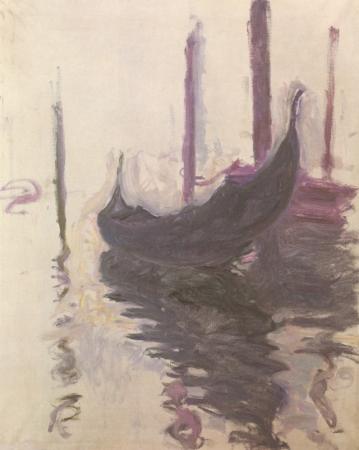
In spite of these breaks, the work went on, Alice being “happy to see Monet so impassioned, doing such beautiful things, and -between you and me- something other than those same old water lilies.” Only cold made Monet give up, in spite of the fur coat kindly lent by Louis Aston Knight, a young American painter living in Rolleboise, near Giverny, whom they happened to meet at the hotel. On December 3, Monet painted a final sketch, featuring a gondola. They left on December 7, ten weeks after their arrival, never to return. Alice’s health began to fail shortly thereafter, and she died in 1911.
Monet would wait a long time before completing the canvases in his studio. In fact, he began to touch them up in November 1910. But he never retouched the last one, the gondola, which he presented his friend Georges Clemenceau. It is now to be seen in the Museum of Fine Arts in Nantes (France). Twenty-nine canvases were put on exhibit at Bernheim-Jeune gallery in Paris, four years after the trip, in 1912. The exhibition was an enormous success, judging by the beautiful tribute paid by Paul Signac, 23 years younger than Monet:
“I had the joy of seeing a large part of your newest works. In front of your “Venice,” in front of the admirable interpretation of these motifs I know so well, I felt an emotion that was as complete and as strong as that which I felt in 1879, before your “Stations,” your “Streets Decked with Flags,” your “Blooming Trees,” which motivated my career… A Monet has always moved me. I always drew a lesson from it, and when I was full of doubt and despondency, a Monet was served me as a friend and a guide. These “Venice” (…) I admire them as the highest expression of your art.”
Gondola in Venice by Monet Gondola in Venice Claude MONET 1908 Musée des Beaux-Arts de Nantes, France





 get back, lauretta!
You must be logged in to post a comment.