I’m going to be showing you the works of art that inspired me to take pictures from many museums in Berlin over the next many posts. Berlin’s art collections took my breath away.

But, in doing so, I also want to talk about the museums themselves. Each is an interesting work of art in its own right.
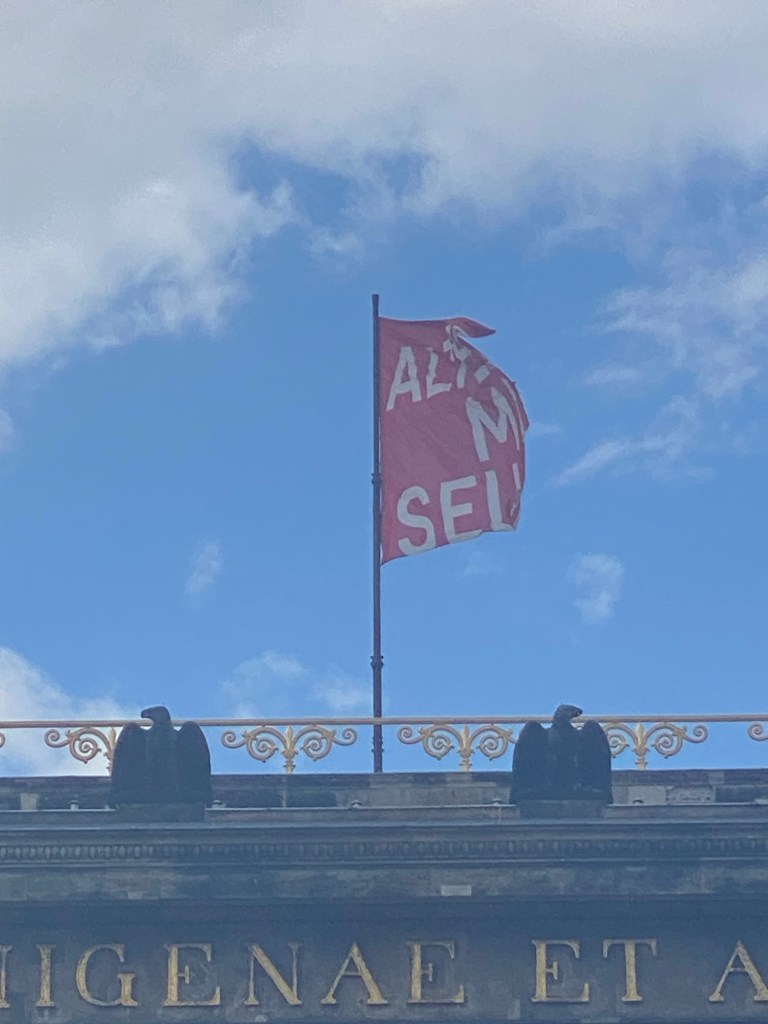
All of the information I’m using in this post that isn’t part of my own pictures or text is based upon the fabulous Wikipedia.
The Museum Island (Museumsinsel) is a museum complex on the northern part of Spree Island in the historic heart of Berlin. It is one of the capital’s most visited sights and one of the most important museum sites in Europe. Originally, built from 1830 to 1930, initially by order of the Prussian Kings, according to plans by five architects, the Museum Island was designated a UNESCO World Heritage Site in 1999 because of its testimony to the architectural and cultural development of museums in the 19th and 20th centuries and the vast collections the island contains. It consists of the Altes Museum, the Neues Museum, the Alte Nationalgalerie, the Bode-Museum and the Pergamonmuseum.
When I had my chance to spend a few weeks in Berlin in the summer of 2024, the Pergamon Museum was closed, as it had been, I gathered, for quite some time. I hope someday it will reopen and I will be lucky enough to come back to see it. It would seem to be something quite astounding.

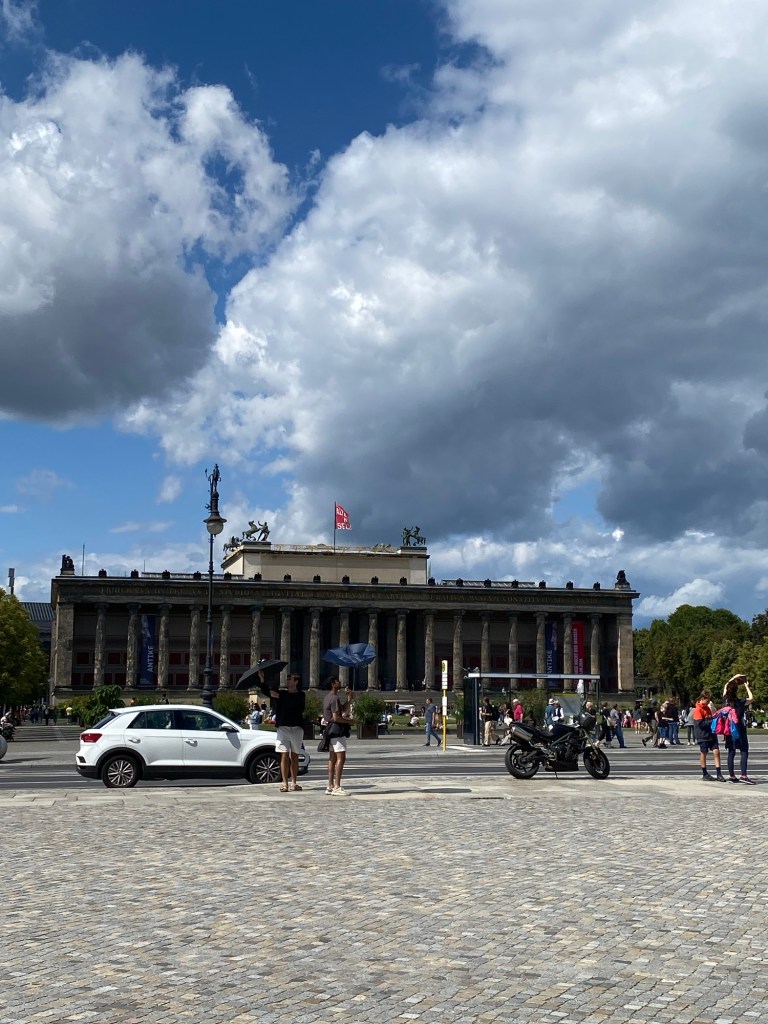
On this, my first visit to Berlin, my first encounter with one of the amazing museums housed on this smallish island was the Altes Museum (the old museum).

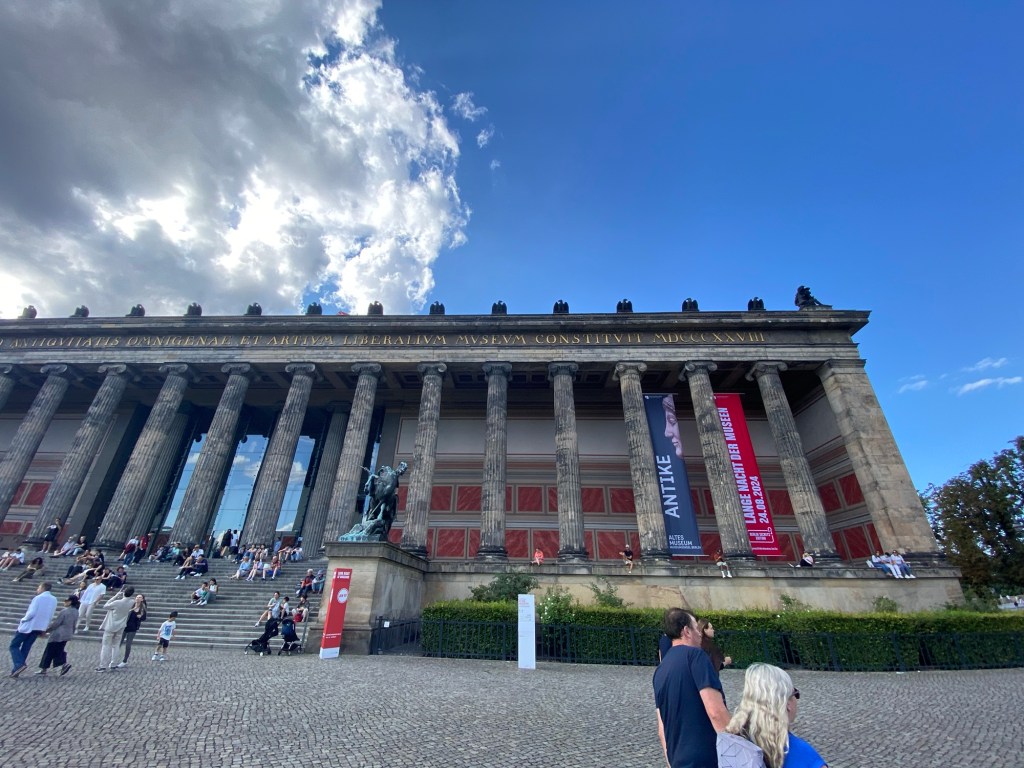
The Altes Museum was built between 1825 and 1830 by order of King Frederick William III of Prussia according to plans by Karl Friedrich Schinkel, it is considered a major work of German Neoclassical architecture. The Altes Museum houses the Antikensammlung and parts of the Münzkabinett. As part of the Museum Island complex, the Altes Museum was listed as a UNESCO World Heritage Site in 1999, in recognition of its testimony to the development of the museum as a social and architectural phenomenon and the superlative collection of Greek, Etruscan, and Roman art it houses.



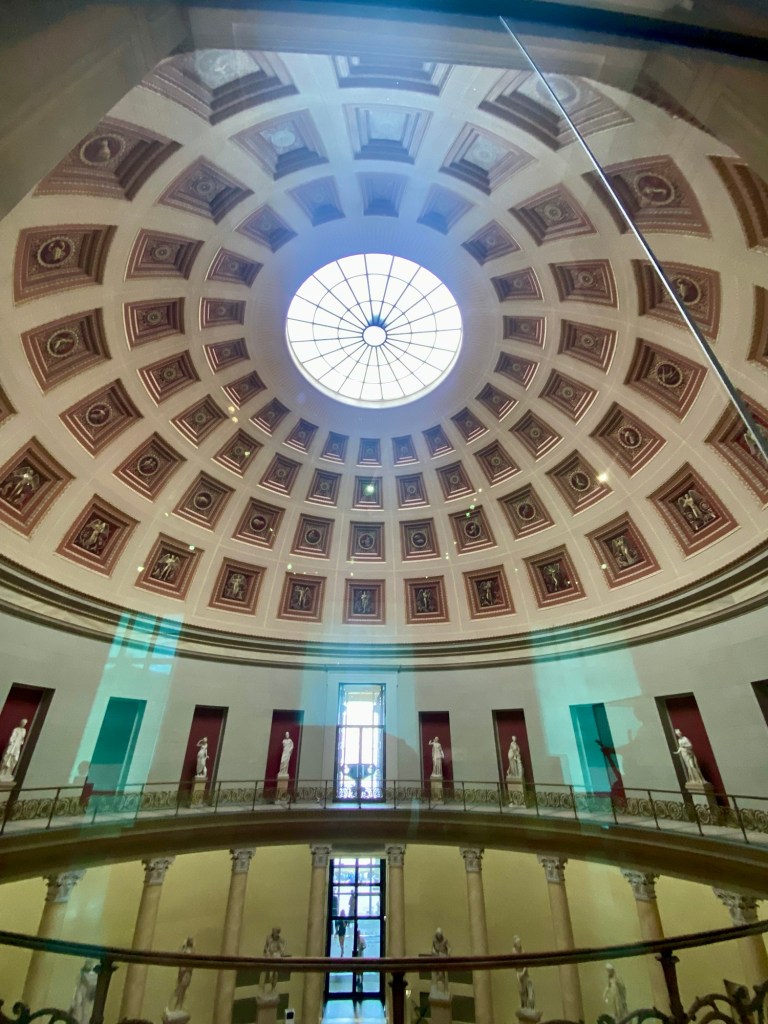
The design dome of the Altes Museum was intentionally made to resemble the Pantheon in Rome.
In the early 19th century, Germany’s bourgeoisie had become increasingly self-aware and self-confident. This growing class began to embrace new ideas regarding the relationship between itself and art, and the concepts that art should be open to the public and that citizens should be able to have access to a comprehensive cultural education began to pervade society. King Friedrich Wilhelm III of Prussia was a strong proponent of this Humboldtian ideal for education and charged Karl Friedrich Schinkel with planning a public museum for the royal art collection.

Above, the museum about 1830.
Schinkel’s plans for the Königliches Museum, as it was then known, were also influenced by drafts of the crown prince, the future King Friedrich Wilhelm IV, who desired a building that was heavily influenced by Classical antiquity. The crown prince even sent Schinkel a pencil sketch of a large hall adorned with a classical portico.
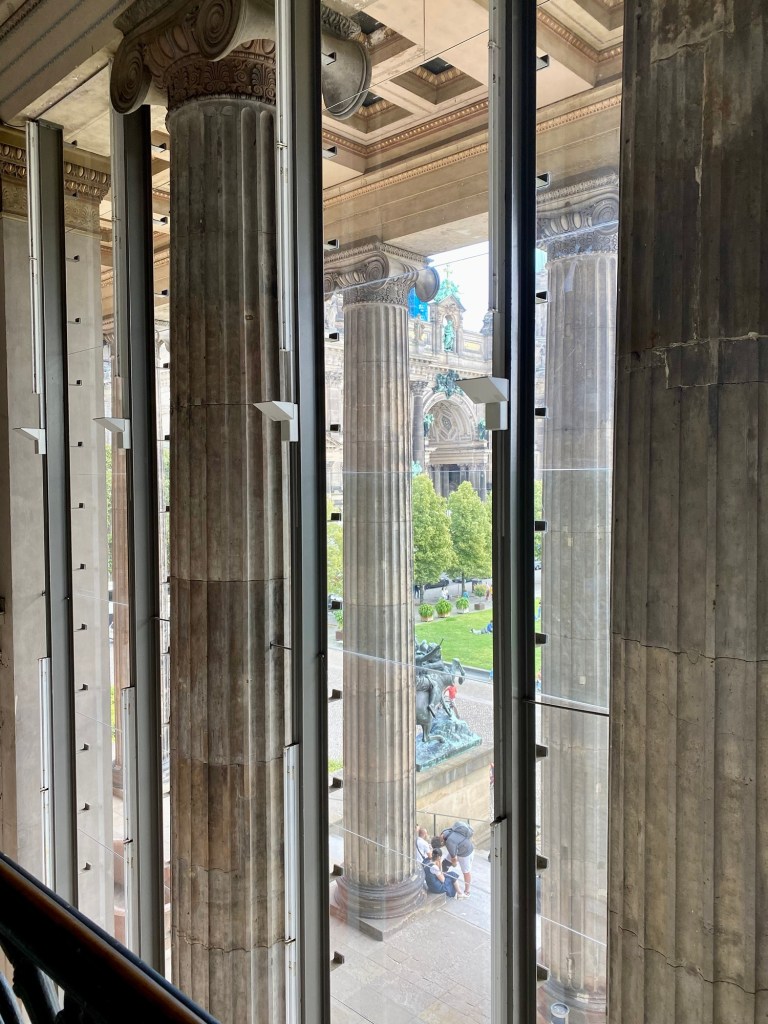
Schinkel’s plans incorporated the Königliches Museum into an ensemble of buildings, which surround the Berliner Lustgarten (pleasure garden). The Stadtschloss in the south was a symbol of worldly power, the Zeughaus in the west represented military might, and the Berliner Dom in the east was the embodiment of divine authority. The museum to the north of the garden, which was to provide for the education of the people, stood as a symbol for science and art—and not least for their torchbearer: the self-aware bourgeoisie. For the front facing the Lustgarten, a simple columned hall in grand style and proportionate to the importance of the location would most certainly give the building character. With the use of 18 Ionic columns, the portico was designed with a function in order to give the museum building an exterior befitting its site.

In 1841, King Friedrich Wilhelm IV announced in a royal decree that the entire northern part of the Spree Island would “be transformed into a sanctuary for art and science.” In 1845, with the completion of the Neues Museum, the Königliches Museum was renamed the Altes Museum (“Old”), a name it holds to this day.
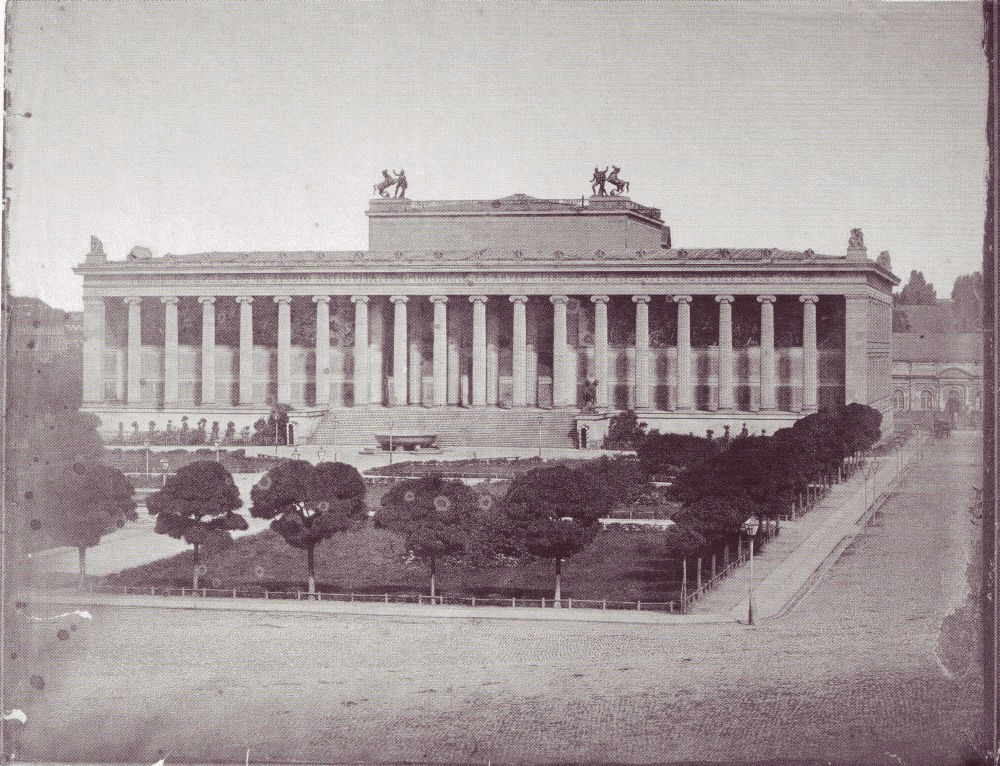
Photo of museum before 1854
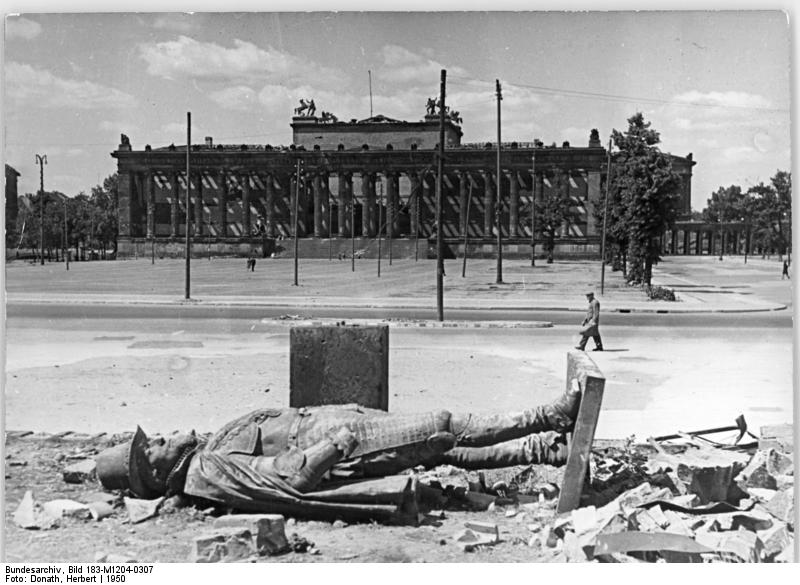

During the Nazi era, the Altes Museum was used as the backdrop for propaganda, both in the museum itself and upon the parade grounds of the redesigned Lustgarten. Close to the end of Second World War, the building was badly damaged when a tank truck exploded in front of it, and the frescoes designed by Schinkel and Peter Cornelius, which adorned the vestibule and the back wall of the portico, were largely lost.
Under General Director Ludwig Justi, the building was the first museum of Museum Island to undergo reconstruction and restoration, which was carried out from 1951 to 1966 by Hans Erich Bogatzky and Theodor Voissen. Following Schinkel’s designs, the murals of the rotunda were restored in 1982. However, neither the ornate ceilings of the ground floor exhibition rooms nor the pairs of columns under the girders were reconstructed.
he Altes Museum was originally constructed to house all of the city’s collections of fine arts, including Old Master paintings, and prints and drawings. However, since 1904, the museum has solely housed the Antikensammlung (Collection of Classical Antiquities). Since 1998, the Collection of Classical Antiquities has displayed its Greek collection, including the treasury, on the ground floor of the Altes Museum.
Because we are so lucky to be living in the internet age, you can access the floor plan of the museum here:
And, even more remarkably, again courtesy of the internet age, you can see great pictures and learn all there is to know about the dome itself here:
I’ll be back soon with more on the collections housed within this fine Berlin institution.
The Altes Museum is fronted by the Lustgarten (pleasure garden), which I’ll be posting about soon as well.
 get back, lauretta!