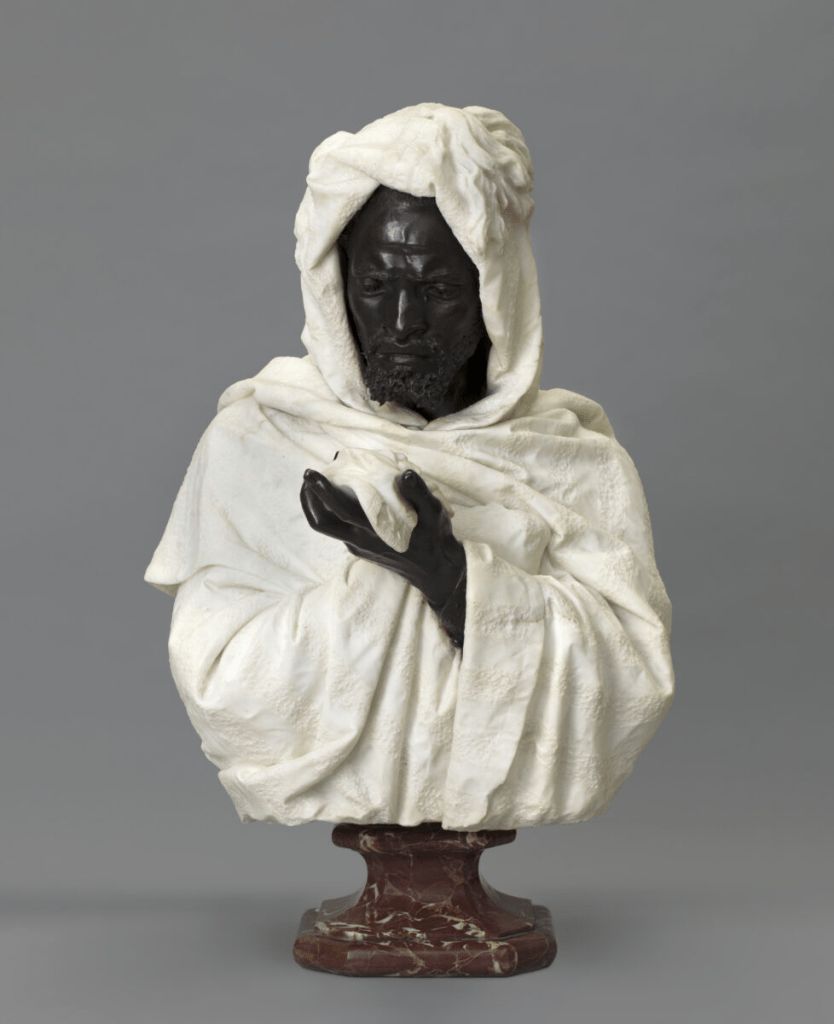
Beginning our tour of the galleries (and avoiding the teenagers there on a school field trip which we heartily applaud!), I was first arrested (truly!) by this magnificent and unusual 19th century sculpture.

Inscribed on back: Calvi fece (Made by Calvi)

Pietro Calvi was widely recognized during his lifetime for his skill and creativity as a sculptor. Born in Milan in 1833, he studied at the Accademia di Brera, learning techniques for working with both marble and bronze. An interest in ethnography led him to explore the creation of sculptures featuring people or popular characters of color—not a common subject for sculpture in this period. The results were dramatic works that combined white marble with the dark patina of cast bronze, an uncommon and even rebellious approach that moves away from the purity of the white marble works that had long dominated. Calvi’s sculptures were widely exhibited, including at the Parma Exhibition of 1870—a noted, pan-Italian exhibition intended to celebrate the newly unified states of Italy—as well as at the Royal Academy in London, the Paris Salon, and in a number of world’s fairs. In fact, Calvi exhibited pendant busts of “Selika” and “Othello” at the Royal Academy in 1872. In addition to his own works, Calvi also contributed to the sculptural programs of the Galleria Vittorio Emanuele and the Duomo cathedral in Milan. Source: https://www.slam.org/press/saint-louis-art-museum-acquires-calvis-bust-of-selika-a-19th-century-work-complementing-museums-othello/

This work is probably modeled on the Black actor Ira Aldridge (1807–67), who was internationally known for his portrayal of Othello, “the Moor,” and used his fame to speak out against slavery. Although Calvi’s sculpture was modeled a year after Aldridge’s death, the actor’s appearance was well known from photographs and prints. Source: https://art.thewalters.org/detail/98789/othello/. The Walters also has a version of this bust.
We are off to a fine start, admiring the holdings of SLAM. Will be posting more soon.
 get back, lauretta!