On my recent visit to SLAM, a gallery talk was being held behind Degas’ ballet dancer and right in front of his pastel of The Milliners. Without knocking someone off their stool, I could not get good photos. What you see below is a result of my best efforts.
Oh, how I do love Degas’ dancer! I’ve seen various editions (all virtually the same) in a variety of art museums and have loved it since the first one I ever saw!

This work is one of many posthumous bronze casts completed after a wax sculpture displayed at the sixth Impressionist exhibition in 1881.The wax figure was the only sculpture that Edgar Degas showed during his lifetime. The artist meticulously created the form of the teenage ballet dancer Marie van Goethem with chin raised and eyes half-closed. The naturalism of the figure was enhanced by the artist’s use of real materials including a muslin dress and satin bow. The stark realism of Degas’ treatment caused the girl’s facial features to be caricatured by critics at the time as “monkey-like.” Art critics: what can you do? An eternal problem.

A. A. Hébrard in Paris had an arrangement with Degas’s heirs to oversee the posthumous casting of Degas’s sculptures, including Little Dancer of Fourteen Years, into bronze. The arrangement involved making casts for Hébrard himself, for the heirs, and another set for sale.

The sculpture stands about 38.5 inches tall.
Below is a photo from SLAM’s website.
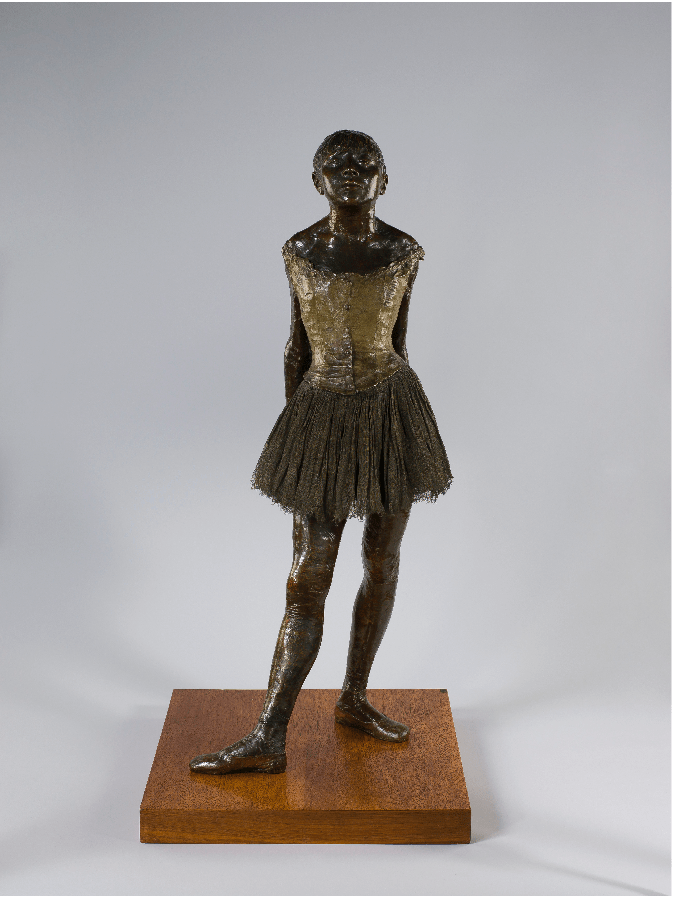
SLAM purchased the sculpture in 1957 from the gallery, M. Knoedler & Co., New York, NY.
The Milliners:

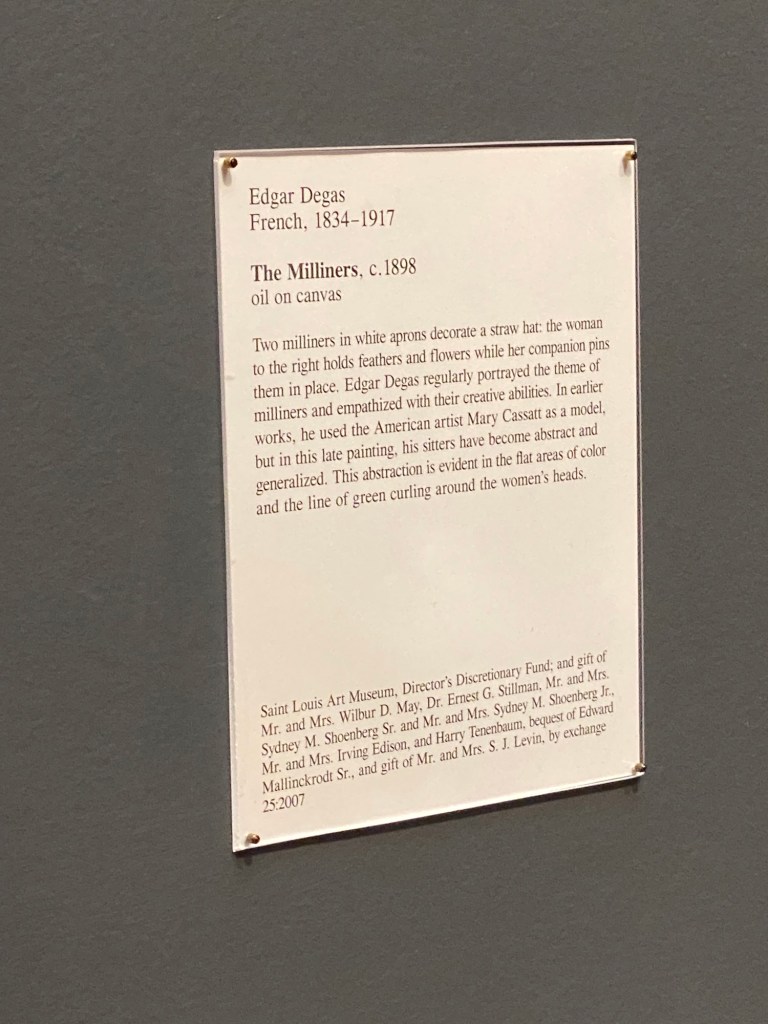
Two milliners in white aprons decorate a straw hat: the woman to the right holds feathers and flowers while her companion pins them in place. Edgar Degas regularly portrayed the theme of milliners and empathized with their creative abilities. In earlier works, he used the American artist Mary Cassatt as a model, but in this late painting, his sitters have become abstract and generalized. This abstraction is evident in the flat areas of color and the line of green curling around the women’s heads.
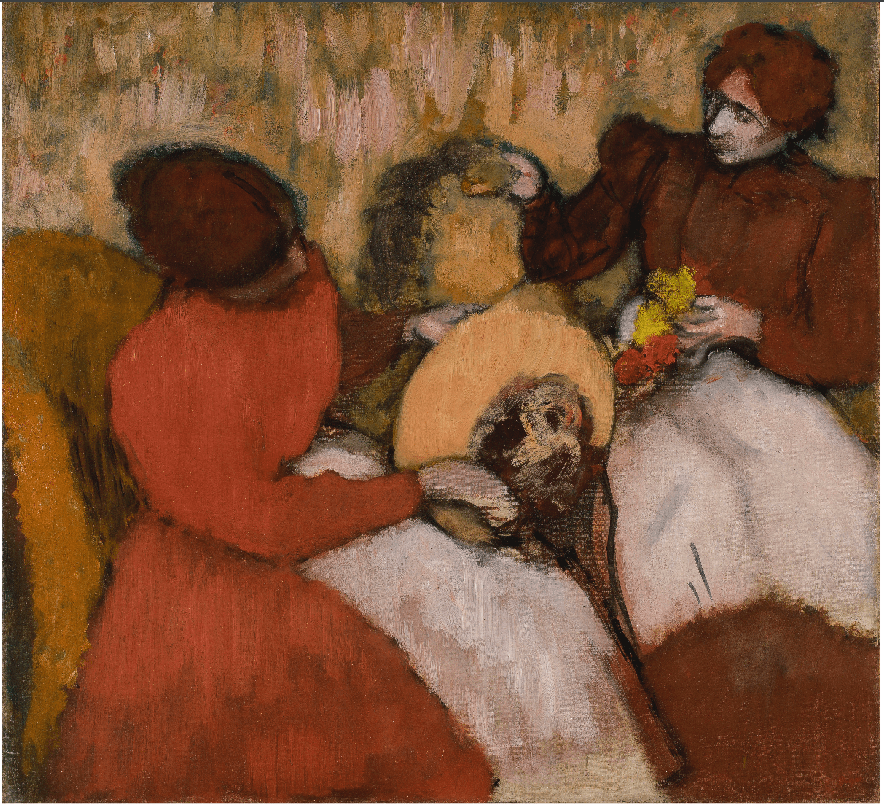
SLAM also owns a Degas bronze entitled Galloping Horse, though I didn’t see it on my recent visit.
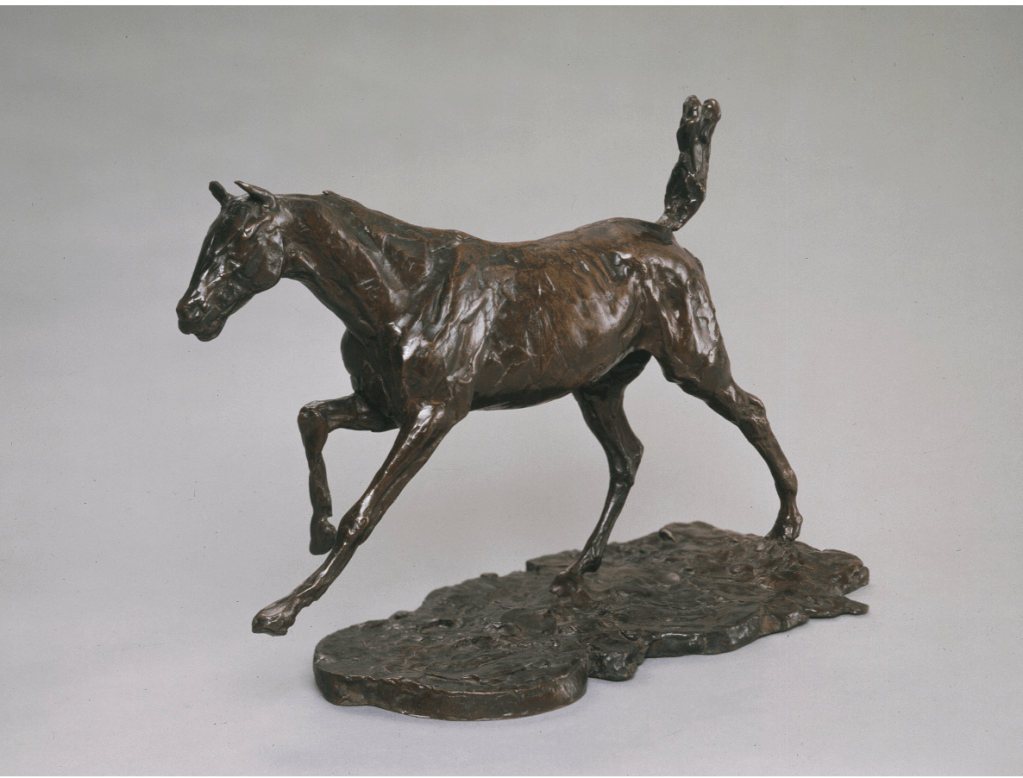
Edgar Degas produced about fifteen sculptures of horses in which he aimed to capture the complexity of horses in motion. A regular visitor to the racetrack, he focused on elegant thoroughbreds rather than workhorses. This sculpture shows a running horse with head intently forward, tail raised, and front legs elevated; Degas succeeds in rendering the energy and tense musculature of the animal. Degas may have been influenced by Eadweard Muybridge’s sequential photographic studies of running horses, published in 1879.
All text above, except my personal observations, is borrowed from SLAM’s website.
 get back, lauretta!