The Bavarian National Museum, Munich, part 2

The Bavarian National Museum (Bayerisches Nationalmuseum) in Munich is one of the most important museums of decorative arts in Europe and one of the largest art museums in Germany. The museum was founded by King Maximilian II of Bavaria in 1855. It houses a large collection of European artifacts from the late antiquity until the early 20th century with particular strengths in the medieval through early modern periods.

The building, designed in the historicism style by Gabriel von Seidl 1894-1900, is one of the most original and significant museum buildings of its time. It is situated in the Prinzregentenstraße, one of the city’s four royal avenues.

The main building of the Bavarian National Museum includes exhibition rooms on 3 floors. The core of the collection dates from the art collection of the Wittelsbach family. This gives the National Museum an importance far beyond the local area. Diversity and breadth of the collections, however, were particularly motivated by the new additions in subsequent periods. The collection is updated continuously not only through acquisitions, but also by significant foundations and bequests. Support experienced by the National Museum, in particular, by the 1960 launched club “Friends of the Bavarian National Museum.”

Of great note: In 2012, the Museum restituted a bronze statue to the heirs of a Jewish collector named August L. Meyer whose art collection was seized by Nazis before he was murdered in the Holocaust. The museum had acquired the bronze in 1937. Efforts have also been made to return some silver objects to the heirs of other Holocaust victims as well.

The National Museum has several branch museums throughout Bavaria. A new building behind the museum houses as addition the Bavarian State Archaeological Collection (Archäologische Staatssammlung) from the first settlement in the Paleolithic Ages through the Celtic civilization and the Roman period right up to the early Middle Ages.

The museum is especially noted for its collections of carved ivory, goldsmith works, textiles, glass painting, tapestries and shrines. The displayed sculptures were created by noted sculptors including Erasmus Grasser, Tilman Riemenschneider, Hans Multscher, Hans Leinberger, Adam Krafft, Giovanni Bologna, Hubert Gerhard, Adriaen de Vries, Massimiliano Soldani Benzi, Johann Baptist Straub, Ferdinand Tietz [de], Ignaz Günther, Matthias Steinl, and Ludwig Schwanthaler.

The museum is famous for its collections of courtly culture, musical instruments, furniture, oil paintings, sketches, clocks, stoneware, majolica, miniatures, porcelain and faience, and its statues. It has probably the world’s best collection of the Nymphenburg porcelain figures of Franz Anton Bustelli (1723–63).

The Romanesque period is astoundingly represented by stone sculptures from the monastery of Wessobrunn and the marble lions from Reichenhall. Important pieces of Romanesque art include wooden figures of crucifixion groups from Bamberg, Schongau and Kaufbeuren, and several works of metal and ivory. The Kasten der Heiligen Kunigunde (jewelry box of Holy Cunegonde), is a unique masterpiece made in the year 1000 in Scandinavia of wood, bronze and narwhal tusk. Reliefs from the Magdeburg Ivories, plaques probably from an antependium of Emperor Otto I and a relief of the West Roman imperial court with one of the oldest representations of the Ascension among the most famous works in the ivory collection.

Key works of ivory art, important stained glass windows, and not least excellent testimonies of textile are found in the Gothic department. On display are also historic Gothic chamber ensembles such as the magnificently painted Zunftstube of Augsburg weavers, one of the finest Gothic cabinets at all.

The Bavarian National Museum displays one of the largest and most important collections of late medieval sculpture from the German-speaking countries. Special attractions are the great knight’s hall with the ceremonial armor of the 15th and 16th Century and the true to scale wooden Renaissance models of the Bavarian ducal capitals.

The portrait art of the Renaissance is represented by medals, miniatures, paintings and full plastic sculptures. Many items come from the art chamber of the Wittelsbach family. From the possession of the Wittelsbach the Bavarian National Museum also presents unique Baroque objects from all areas of craft and artistic production, such as ostentatious furniture, jewelry, weapons, musical instruments, watches, glasses, miniatures, ivories and bronzes. Of importance are especially Florentine bronzes from the collection of the Medici and pastel paintings from Venice including works of Rosalba Carriera. The Bavarian National Museum has the most important collection of the Bavarian Rococo sculpture. A rich collection of architectural models and designs for frescoes and altarpieces documents the new buildings and conversions of churches in the competition of the various monasteries and convents. A unique court ensembles are the silverware of the Prince-Bishop of Hildesheim and the service and figurative centrepieces of Nymphenburg and Meissen porcelain manufacturers. Rare furnitures testify to the high rank of the most famous German cabinetmaker manufactories of the 18th Century.

There is so much to see and think about in this fantastic museum that one post will not suffice. Below are some of the fascinating objets I encountered on my visit. I’ll be posting soon about some other aspects of the collections.

When I happened upon this lovely ceramic figurine, I momentarily thought I had wandered into a Tang China display! Closer inspection revealed it may look Chinese to me, but it is thoroughly Italian. From Ferrara to be specific. It beautifully shows us St. George and his nemesis, the dragon.

The wooden sculpture of the Virgin Mary below is one part of a 2-part sculptural group of The Annunciation, created in Tuscany c. 1410. Lovely in its own right, it would be wonderful to see it with its partner representing the Angel Gabriel.

The next picture shows a gorgeous ceiling. I love its massive simplicity.

Next is a polychromed sculpture from the workshop of Lorenzo Ghiberti. I am feeling right at home.

The works by Luca and Andrea della Robbia are immediately identifiable and always dazzle my eyes. I could spend an eternity in their presence.

The next photo of a relief in bronze and a bronze statue by Giambologna are especially fine.

The German Renaissance! Let’s learn. I know next to nothing about this era.

And, with the next work of art, we are back with an Italian connection. Read the label and you’ll understand that an Italian living in Nuremburg commissioned this unusual lidded drinking vessel. He sought to have his family’s crest, including the head of a Moor from the Pucci family coat-of-arms and the eagle from that of the Strozzi family, rendered here. It is quite something!

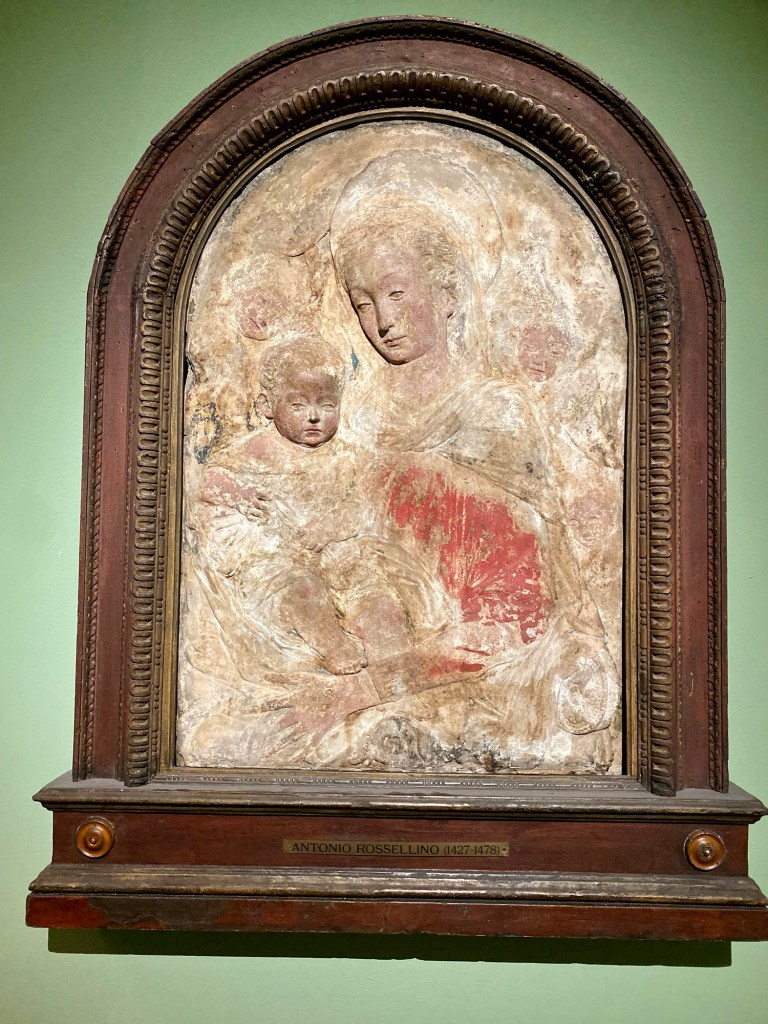
The Bavarian National Museum, Munich & Italian Renaissance Art, Part 1 (Antonio Rossellino)

The day I wandered into the Bavarian National Museum in Munich was an accidental delight! I had no idea what I would encounter in this august museum, but I was sure it would be interesting. The museum did not disappoint.

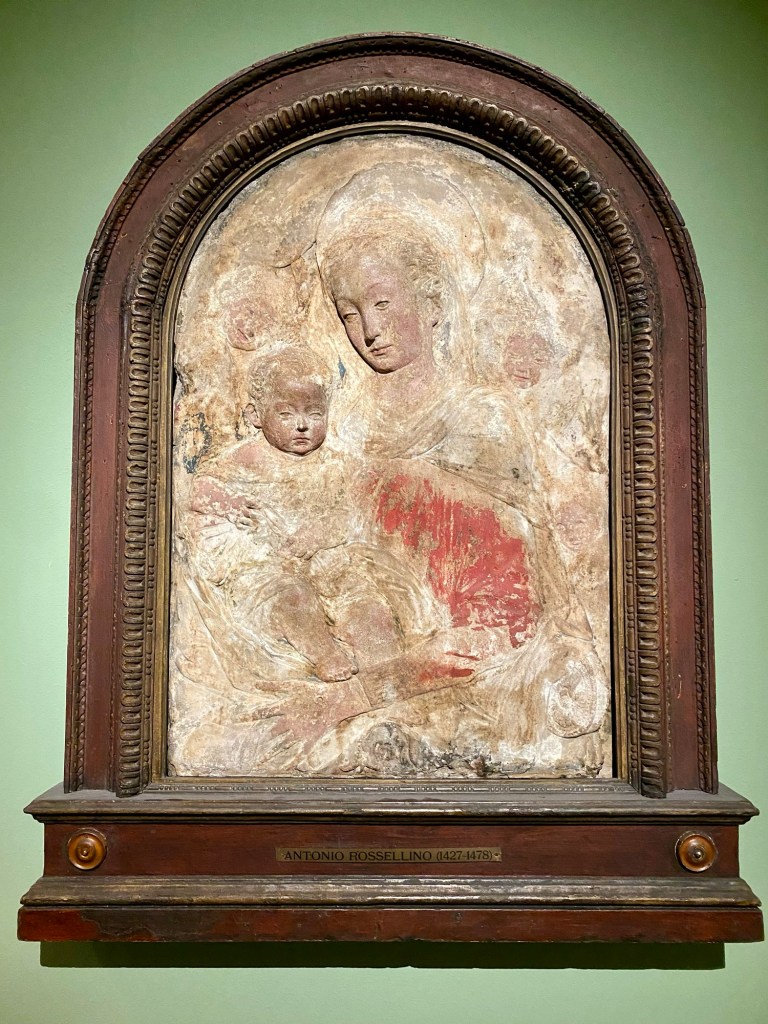
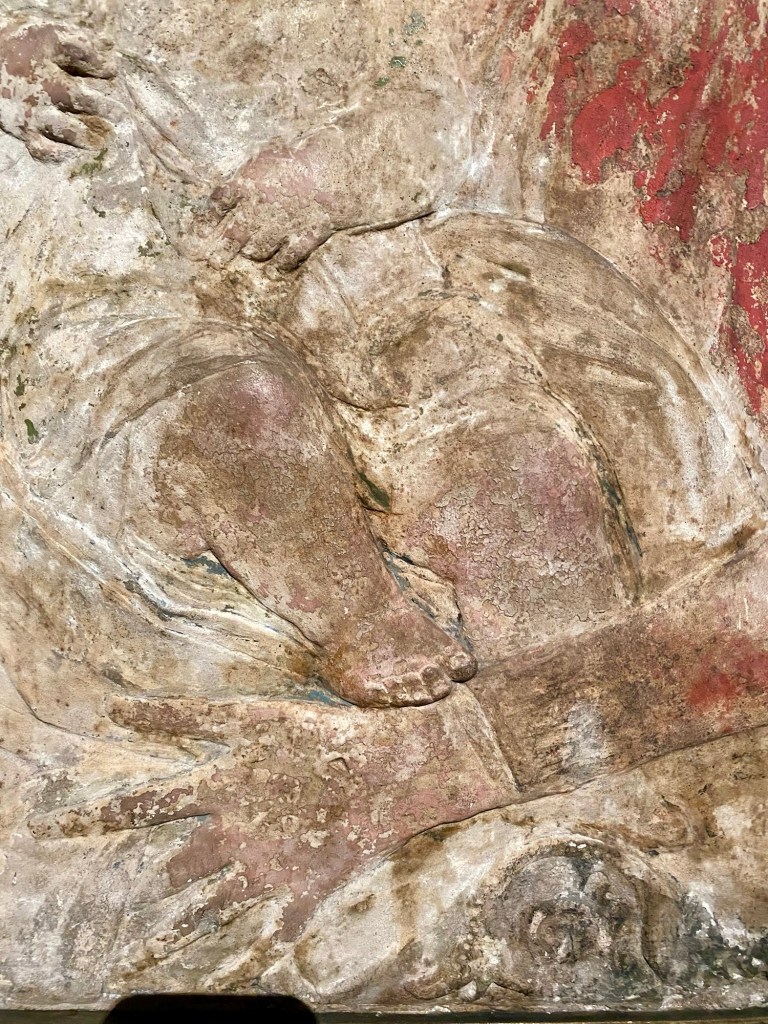
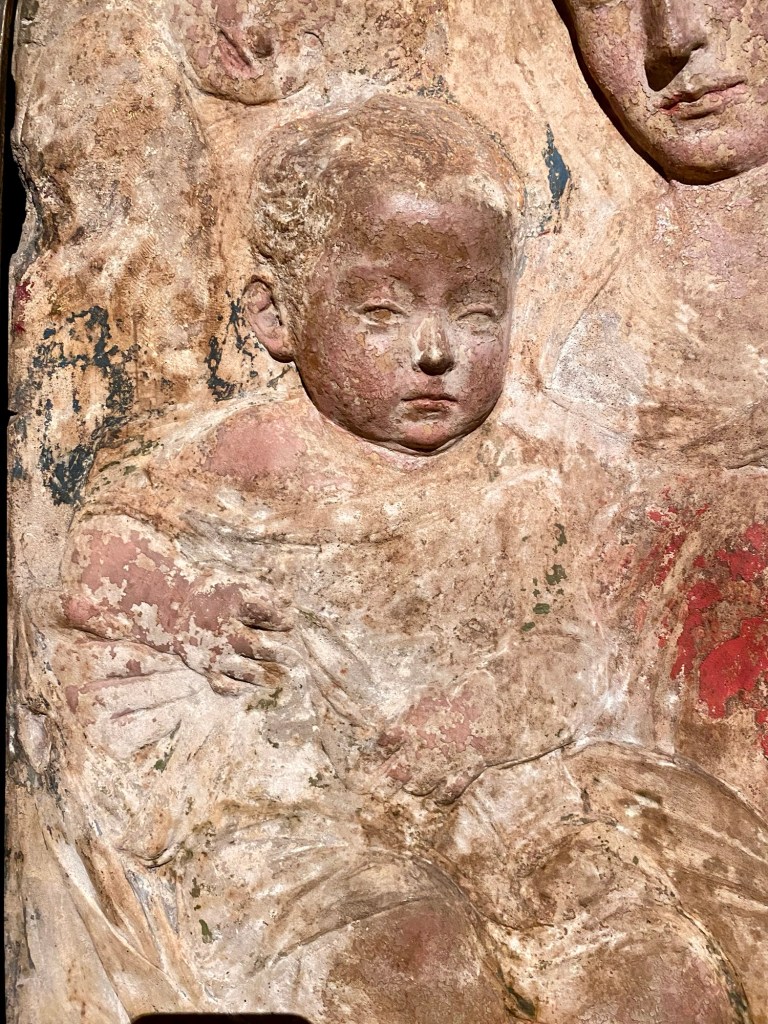
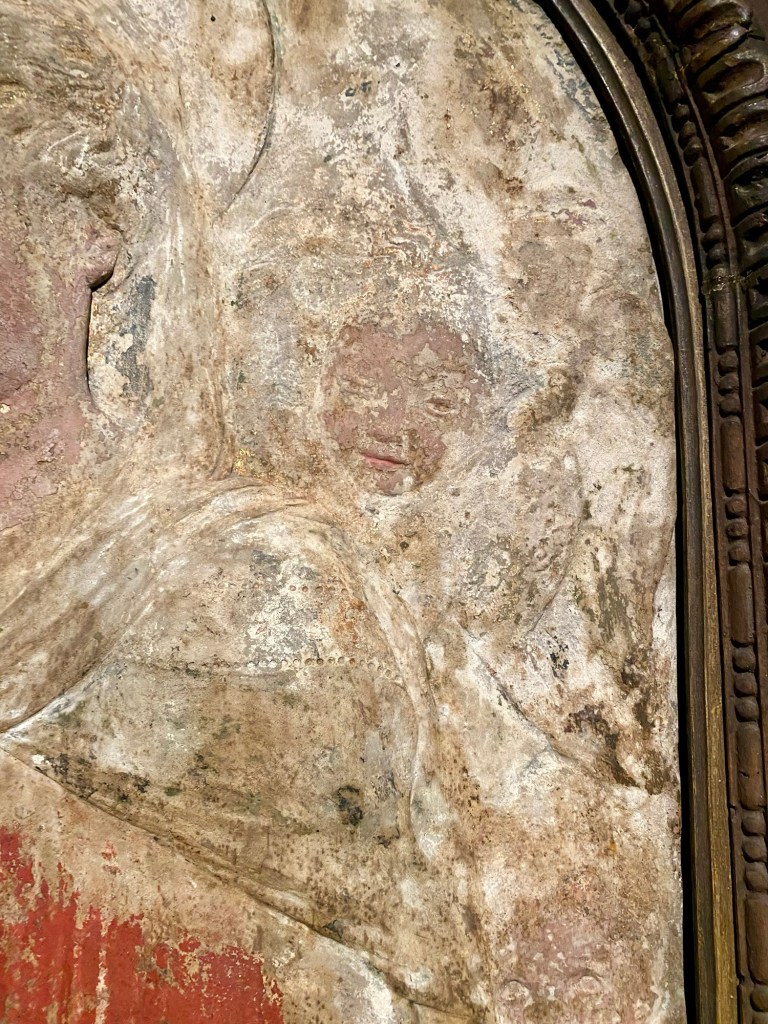
One of the first works that stole my heart that day was this plaster relief sculpture either by Antonio Rossellino or from his workshop. Either way, it moves me.

The Schackgalerie, Munich & a portrait of Bertel Thorvaldsen

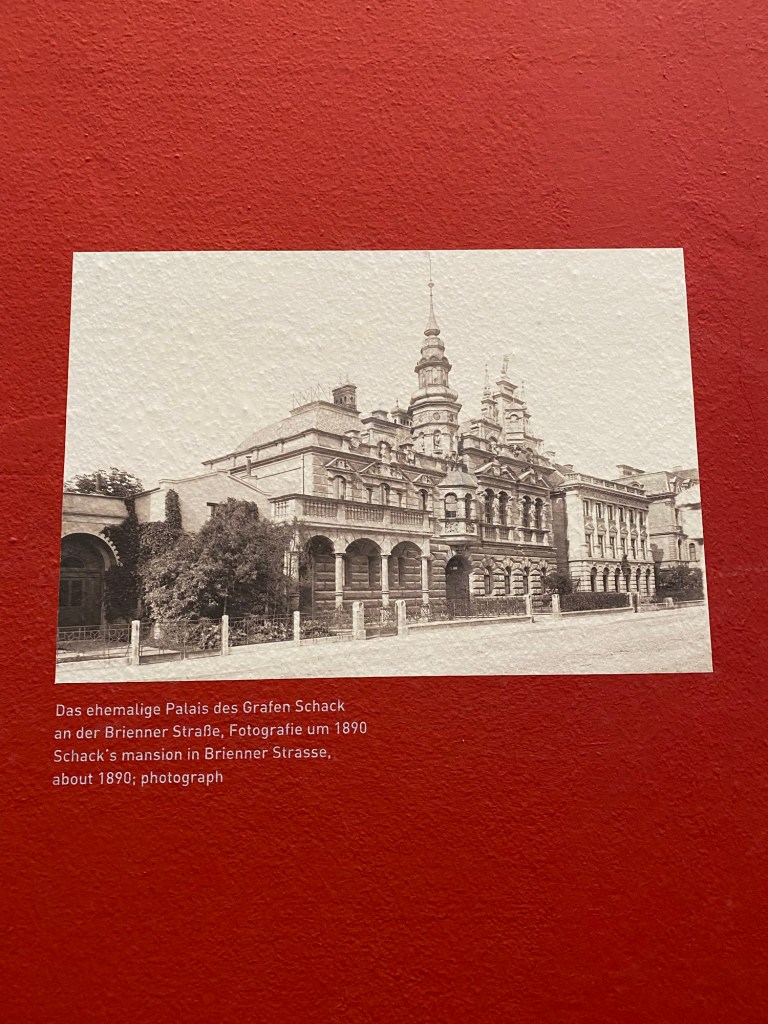
I visited this interesting art museum one day while I was living in Munich last summer. The city’s riches are almost impossible to comprehend. The Schack-galerie is one of the noted galleries in this city and is under supervision of the Bavarian State Picture Collection.

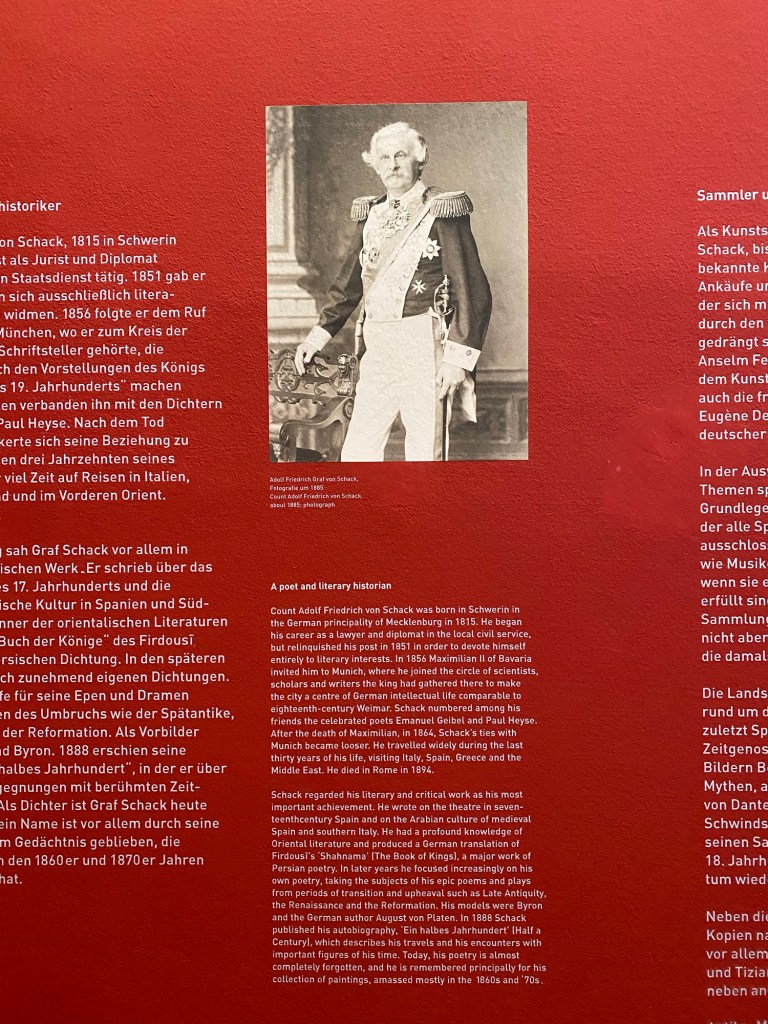
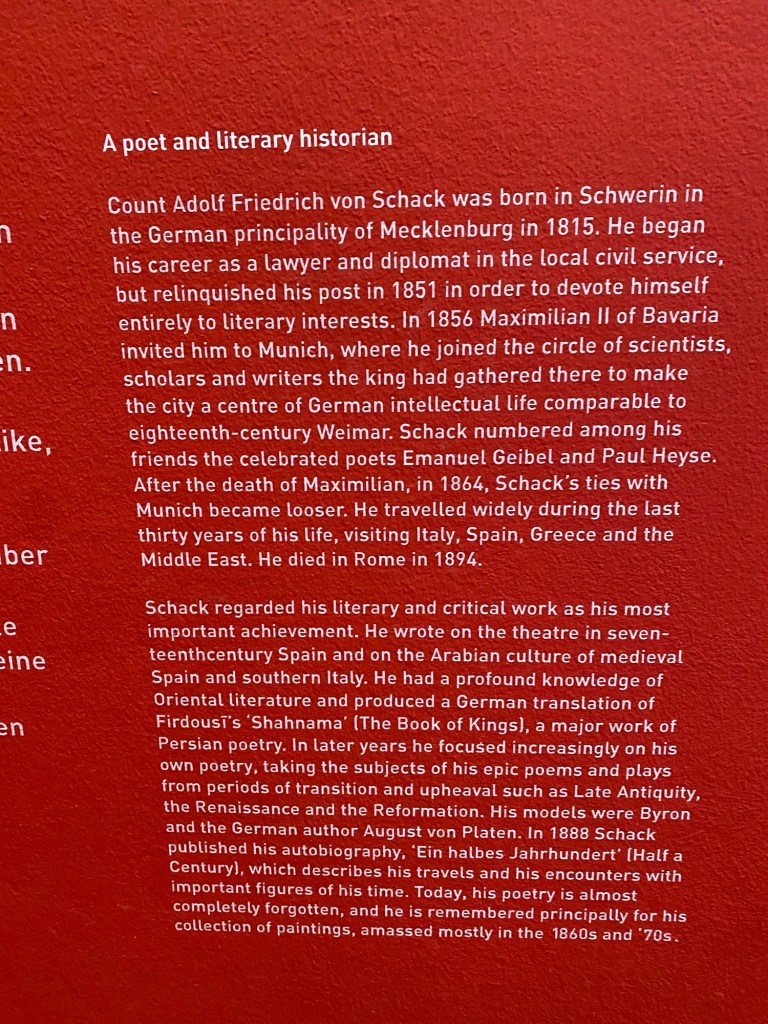
Here’s Schack himself. Adolf Friedrich, Graf von Schack (1815 – 1894) was a German poet, historian of literature, and art collector.

Schack was born at Brüsewitz near Schwerin. Having studied jurisprudence (1834–1838) at the universities of Bonn, Heidelberg and Berlin, he entered the Mecklenburg state service and was subsequently attached to the Kammergericht in Berlin. Tiring of official work, he resigned his appointment, and after travelling in Italy, Egypt, and Spain, was attached to the court of the grand duke of Oldenburg, whom he accompanied on a journey to the East. On his return, he entered the Oldenburg government service, and in 1849 was sent as envoy to Berlin. In 1852, he retired from his diplomatic post, resided for a while on his estates in Mecklenburg and then travelled in Spain, where he studied Moorish history.

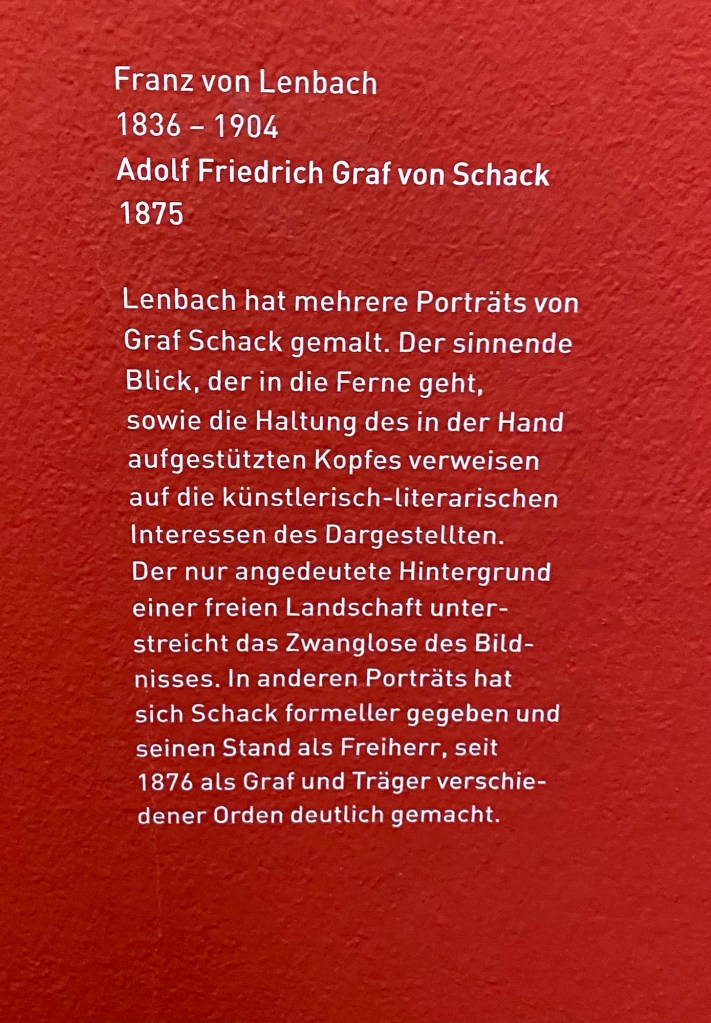
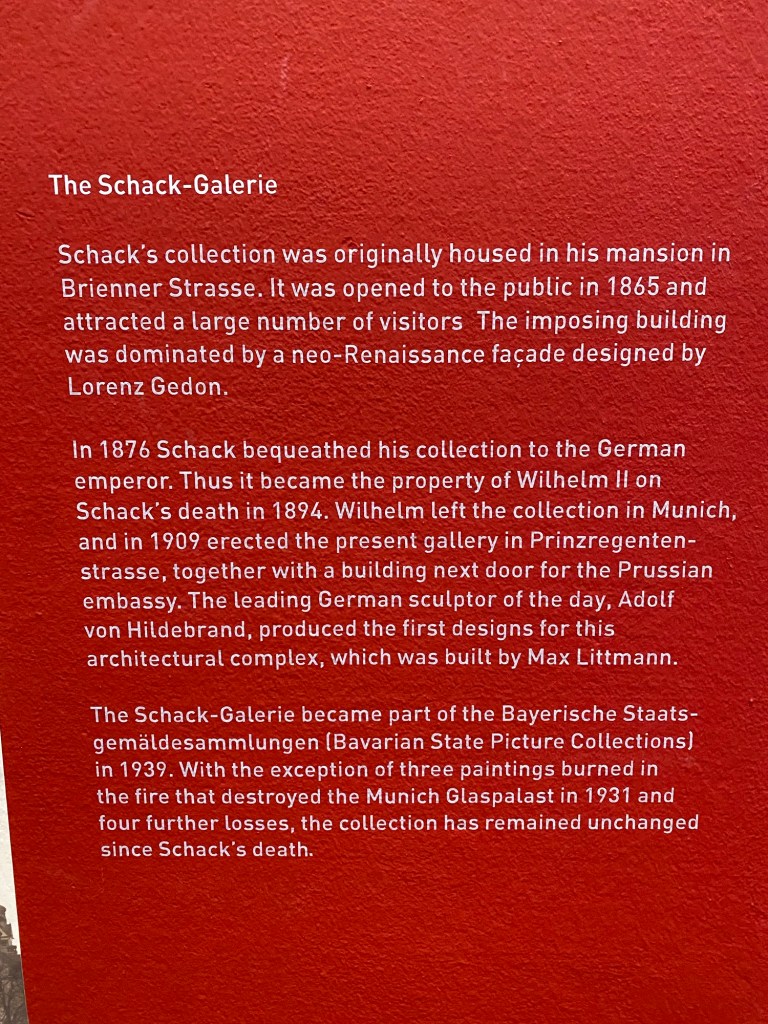
In 1855, he settled at Munich, where he was made member of the academy of sciences, and here collected a splendid gallery of pictures, containing masterpieces of Bonaventura Genelli, Anselm Feuerbach, Moritz von Schwind, Arnold Böcklin, Franz von Lenbach, etc., and which, though bequeathed by him to the Emperor William II, still remains at Munich and is one of the noted galleries in that city. He died at Rome in April 1894, aged 78. Upon his death in 1894, he bequeathed the collection to the Emperor William II, however it remained in Munich.

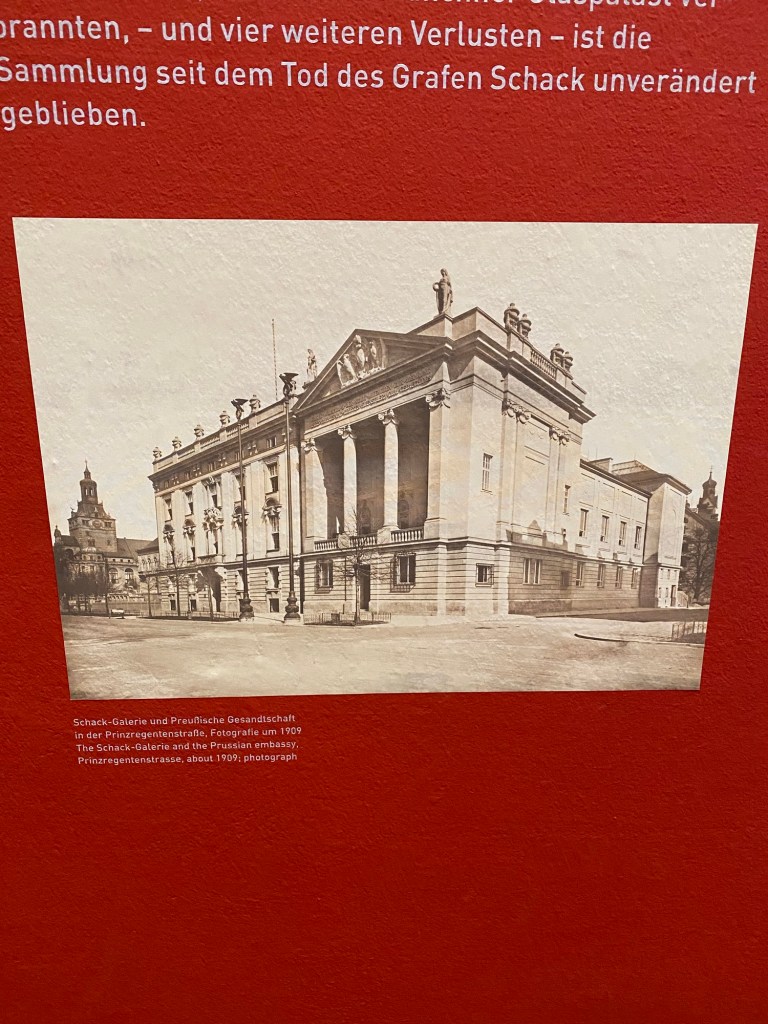
The collection is housed in a building designed by Max Littmann (1907) next to the former diplomatic mission of Prussia in the Prinzregentenstraße as the emperor decided to keep the collection in Munich. The gallery building with its upper-level portico and the adjacent tract of the former Prussian embassy, appear as two independent building complexes, but are unified by a common base and cornice. The façades of the buildings are built with bright sandstone. In the tympanium is an imperial coat of arms and a dedication by William II.

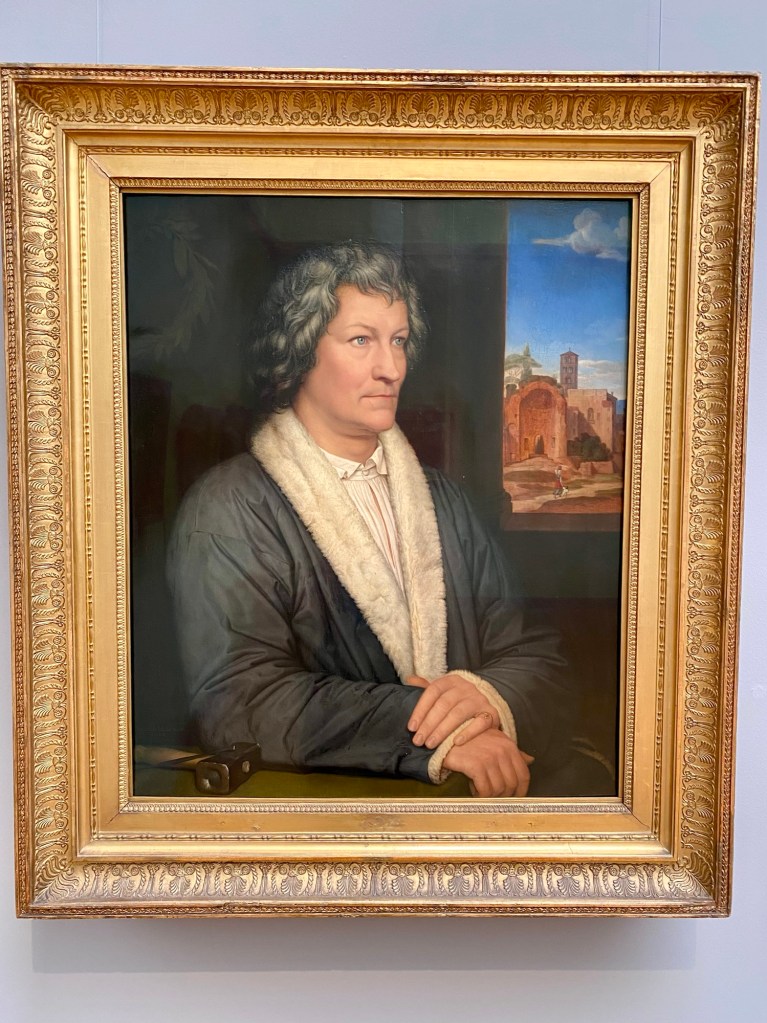
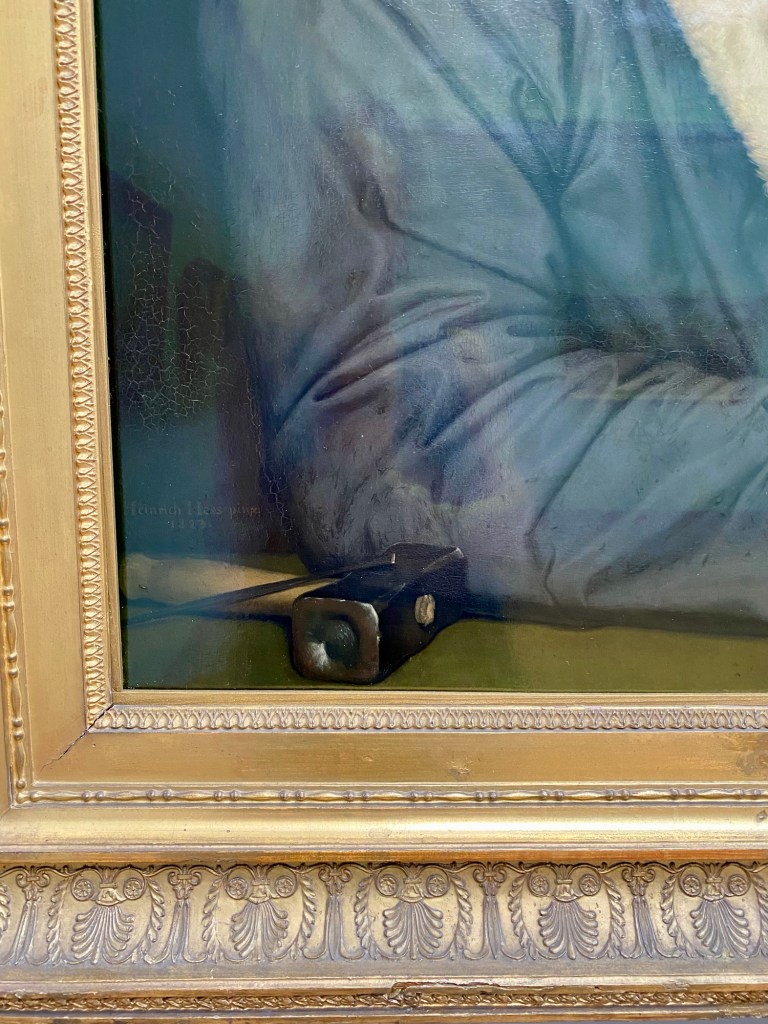
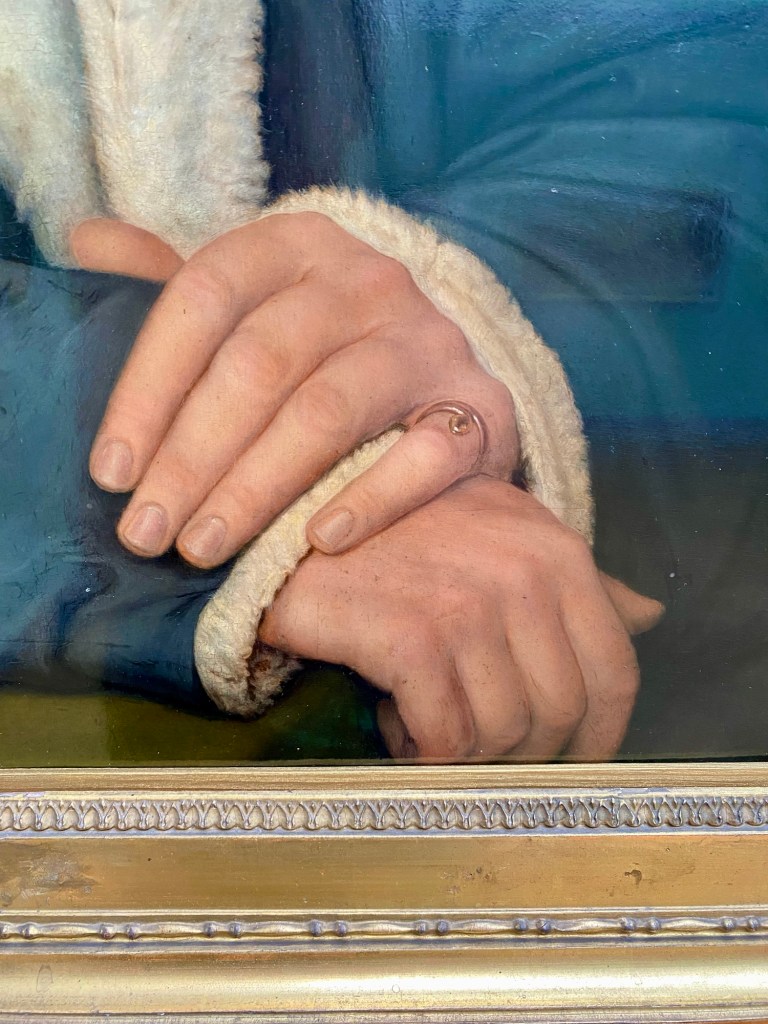
I found the museum interesting if not completely to my taste. But, the highlight of the experience for me was discovering this portrait of the Danish sculptor, Bertel Thorvaldsen. I once studied Thorvaldsen quite extensively and made a trip to Denmark to further those studies. I didn’t expect to see him in Munich!

The Theatinerkirche, Munich

Are you ready to get back into the heart of the cultural life of Munich? I have given you a respite from art, art, art for the past few posts. I’m hankering to get back into it. Andiamo! Let’s go!

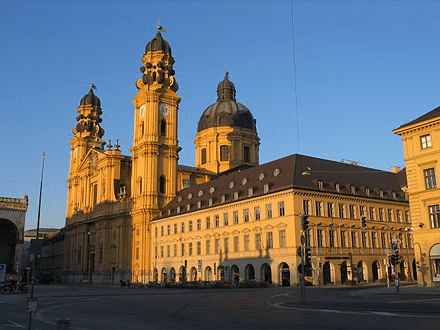
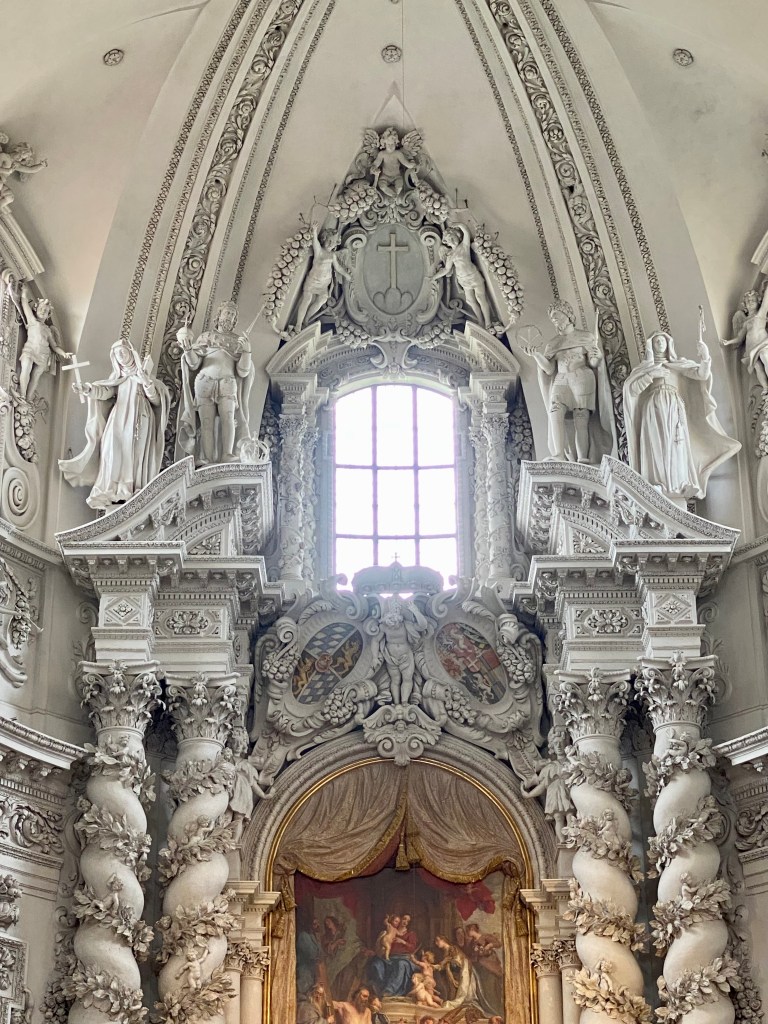
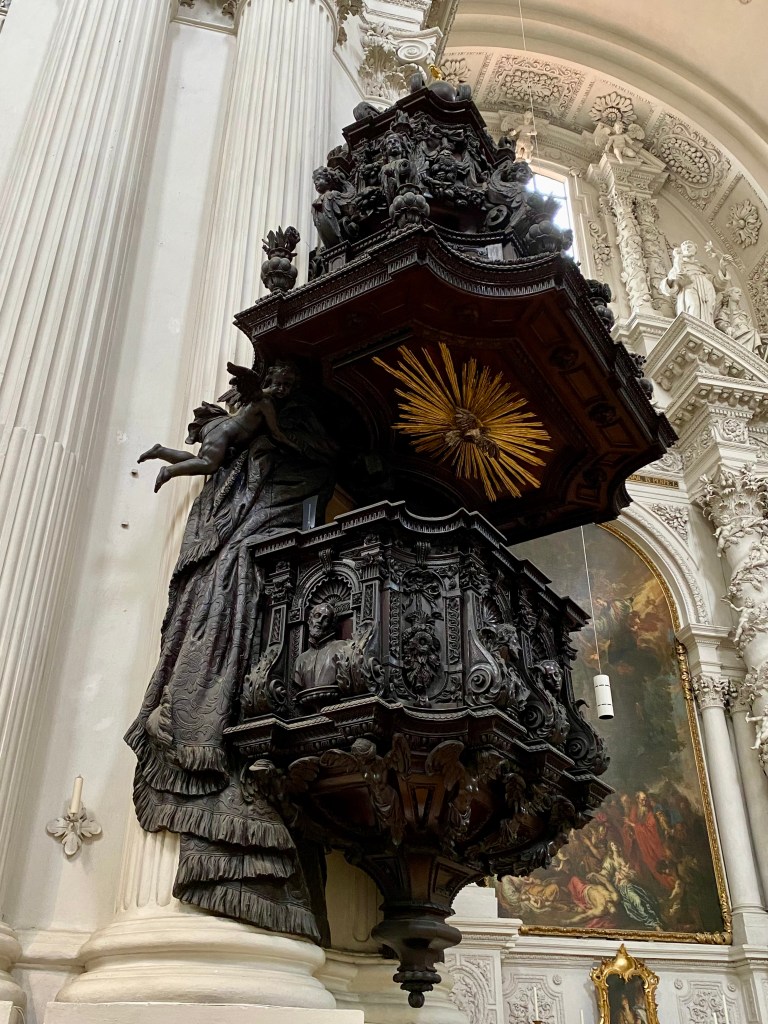
Perhaps the first major impression I had of Munich was this monumental church. And for good reason: With its yellow facade and ornate interior, the Theatinerkirche (Theatine Church) at Odeonsplatz is one of the most beautiful churches in Munich. I emerged from the subway station at Odeonplatz and was blinded by the sunshine and this bright yellow building.

In the mid-17th century, to commemorate the birth of Max Emanuel, the long-awaited heir, Elector Ferdinand Maria and his wife Henriette Adelaide commissioned architects from Italy to build the “most beautiful and precious church.”

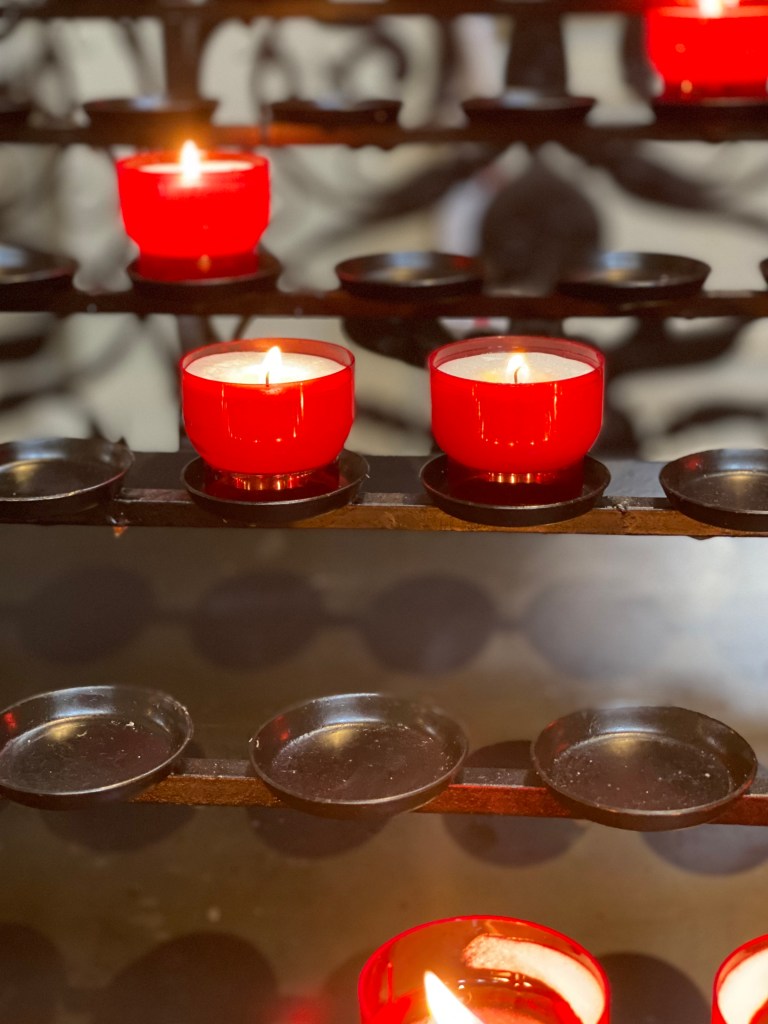
I love the Catholic habit of lighting candles. I try to light a few for lost loved ones every time I’m in a church.

Taking their inspiration from the church of Sant’Andrea della Valle in Rome, Agostino Barelli, Antonio Spinelli built the Theatinerkirche, the first religious building north of the Alps to be designed in the Late Baroque style from Italy.

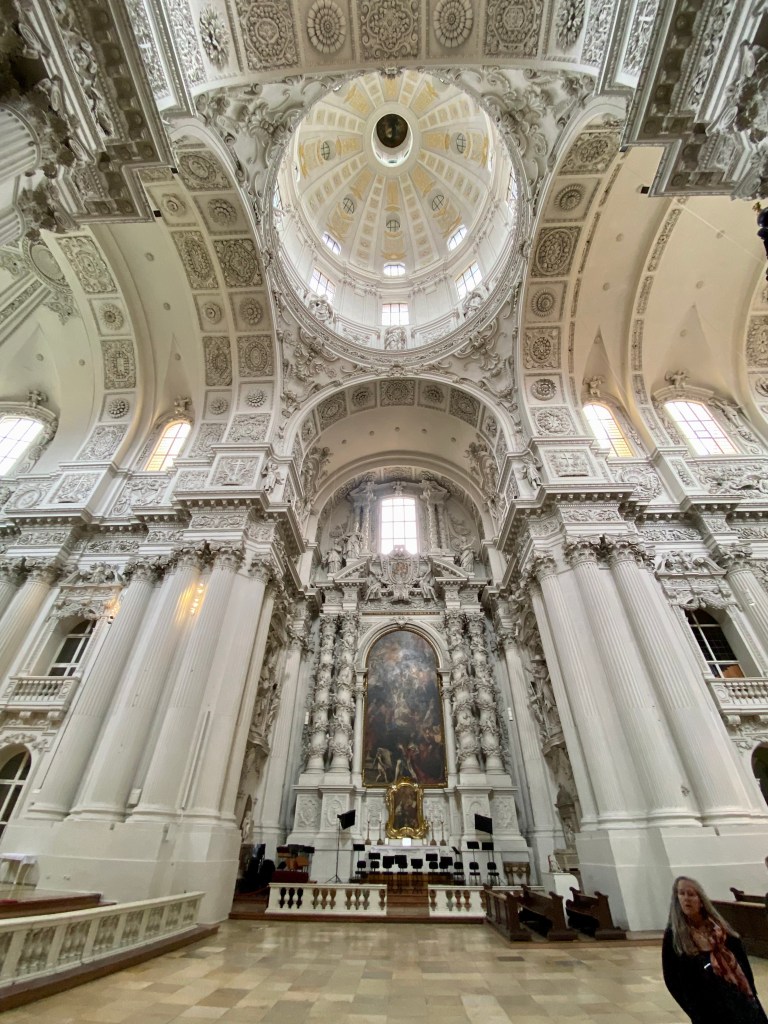
Enrico Zuccalli was subsequently employed to add two 66 meters high towers, and then finished the 71-metre-high (233 ft) dome in 1690. The church is 72 metres (236 ft) long and 15.5 metres (51 ft) wide. The facade in Rococo style was completed only in 1768 by François de Cuvilliés. Its Mediterranean appearance and yellow coloring became a well known symbol for the city and had much influence on Southern German Baroque architecture. The sculptors Roman Anton Boos and Ignaz Günther built the figures and decorative elements on the facade.

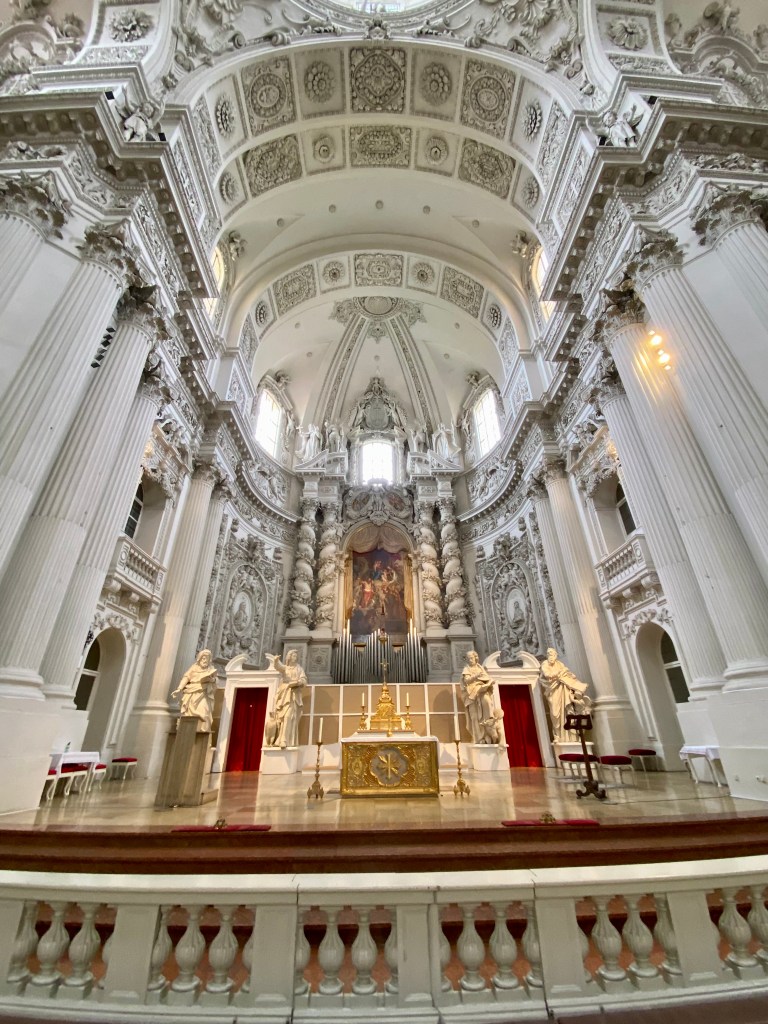
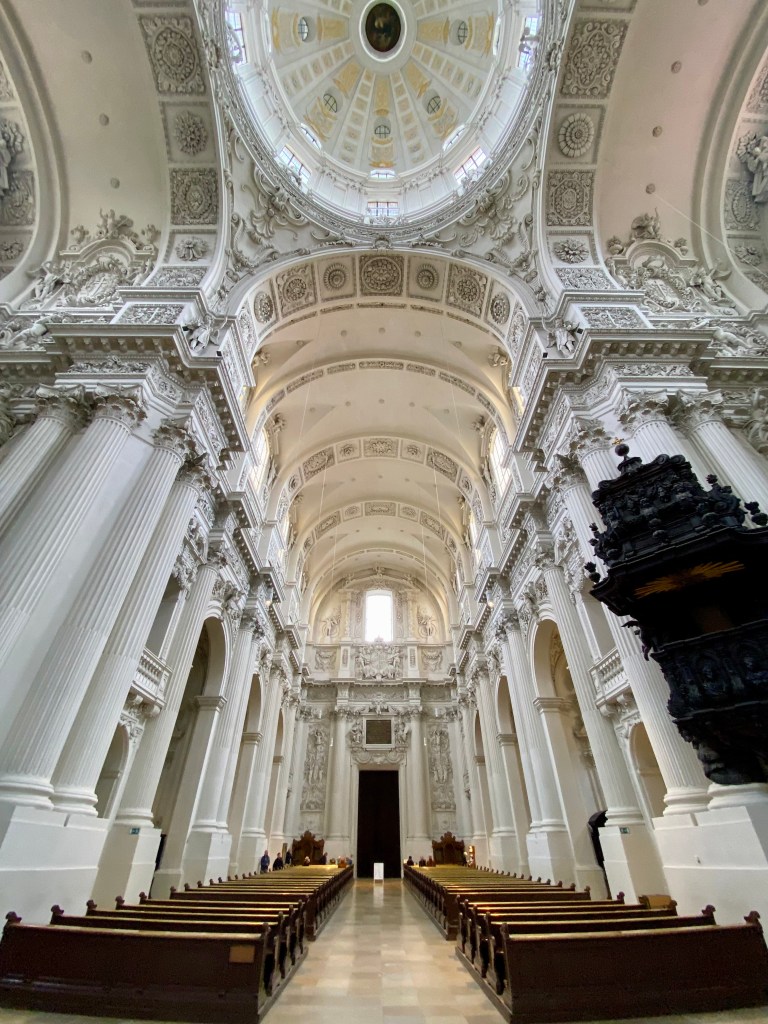
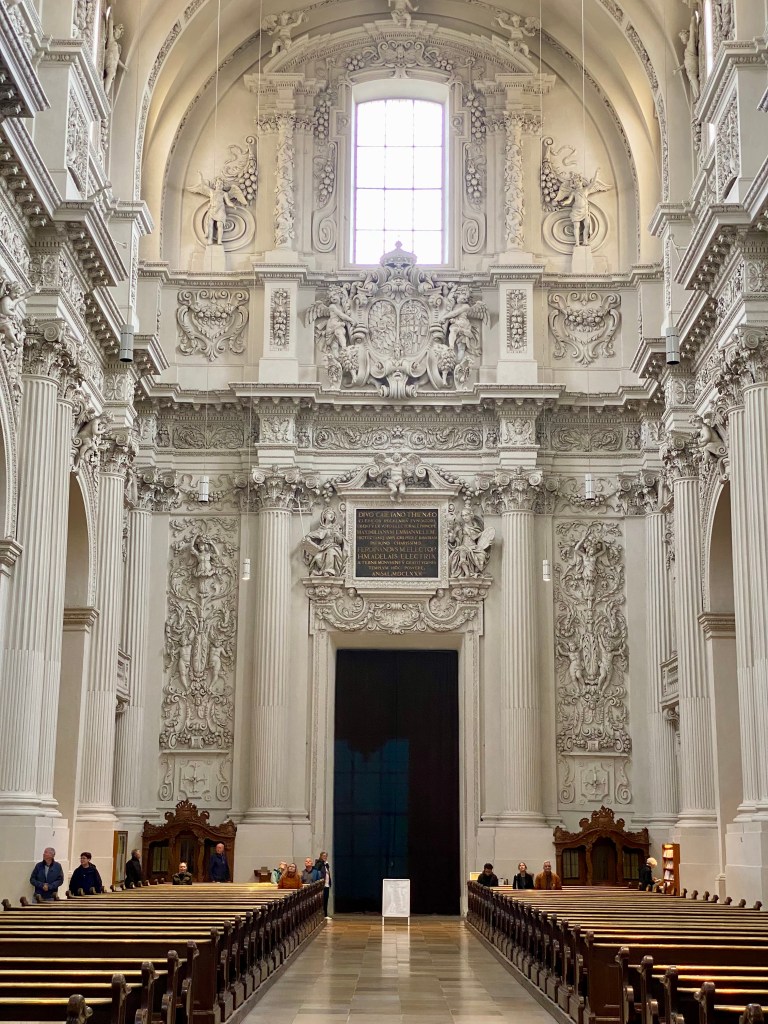
The white interior is as striking in its lightness as the facade is for its saturated color.

The bleached interior is wonderfully cool and forms a striking contrast to the brighter ochre yellow of the facade.

The official name of the church is St. Kajetan: in addition to its function as court church, the church also served as a religious church for the Theatine monks.

Like the Theatinerkiche, the neighbouring Feldherrnhalle was built in the Italian style (emulating the Loggia di Lanzi of Florence). The southern part of the famed Odeonplatz is therefore often referred to as a “piece of Italy in Munich”.

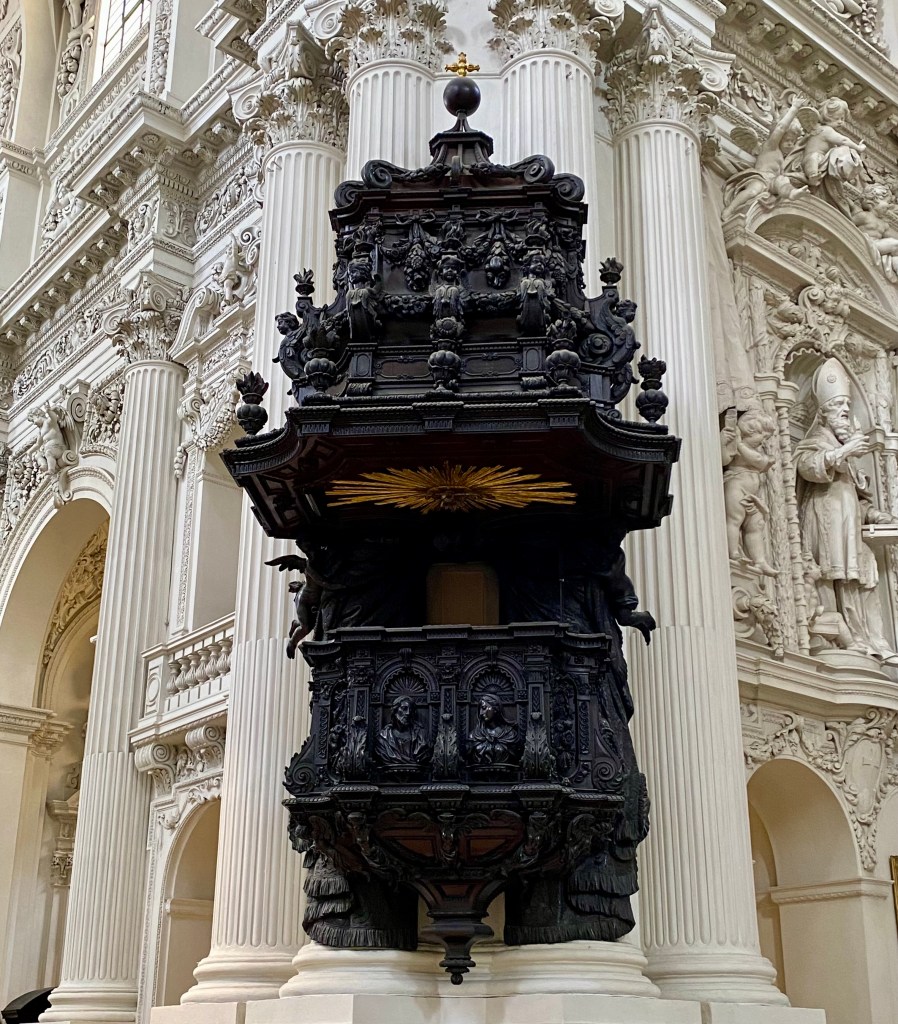
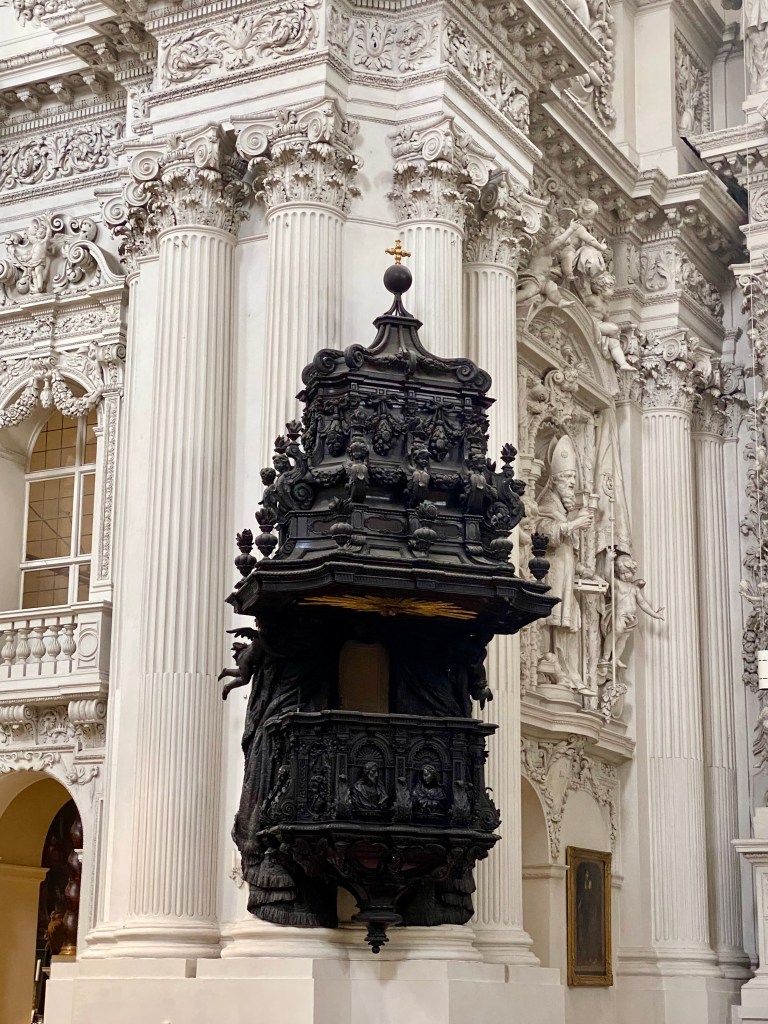
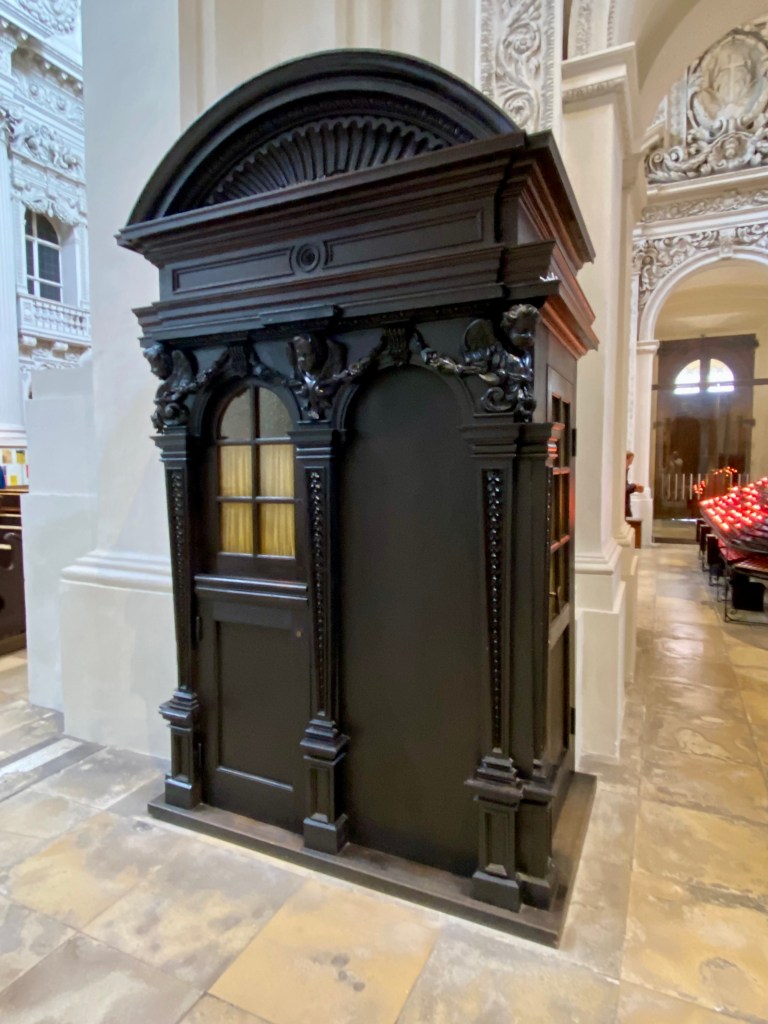
More is more during the Baroque and this church has a degree of decoration that proves the theory.

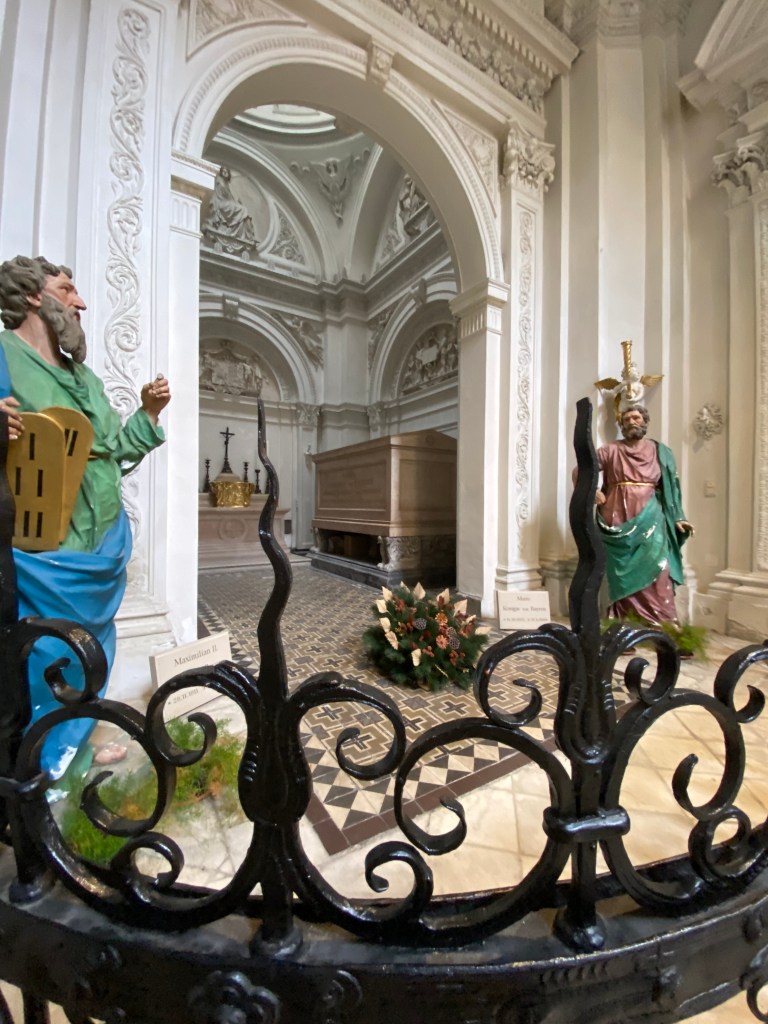
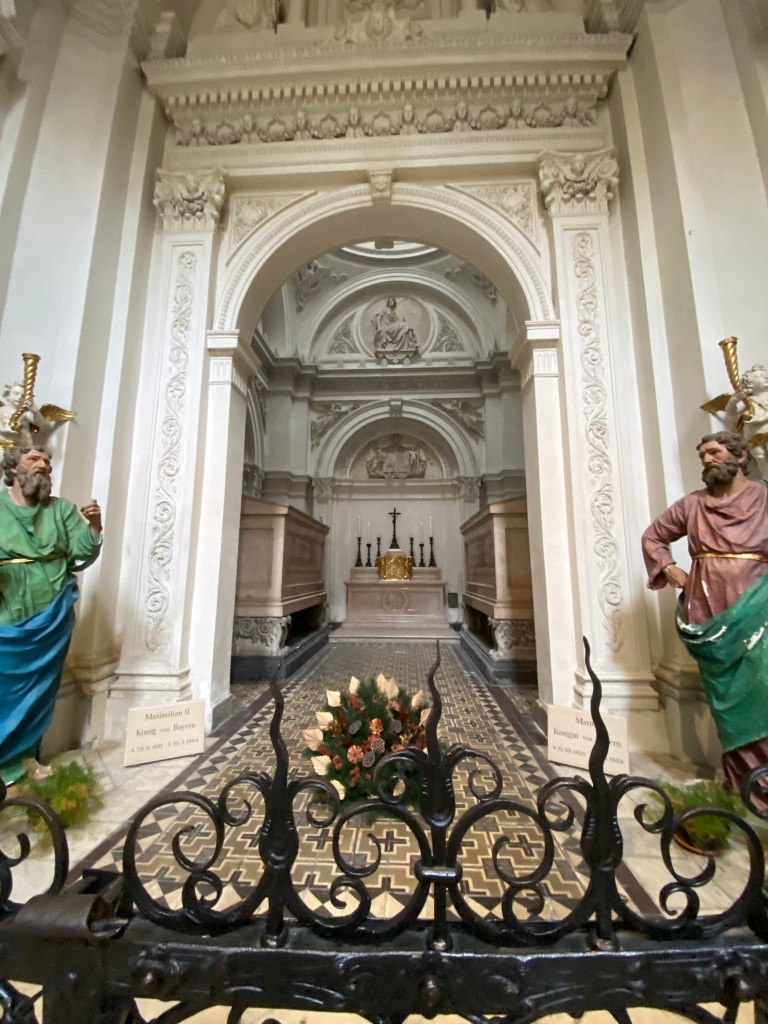
The Electors’ burial chamber is the resting place of members of the House of Wittelsbach, including the two founders Henriette Adelaide and Ferdinand Maria and their son Max Emanuel.

Of course I lit some candles for souls that are departed yet dear to me. This is yet another building that is not to be missed on a trip to Munich.

The Hofgarten, Munich

If you like an elegant formal garden that’s not so big as to be un walkable (and really, who doesn’t?!) you’ll love the Hofgarten by the Royal Residence in Munich.

It’s been a subject for paintings by many eminent artists. For example, Max Stern painted it. Stern was a German painter and graphic artist of Jewish ancestry and this is his Hofgarten in early spring.

After days of cold and rain, yesterday was mild and somewhat sunny in Munich. It went from high summer to fall here overnight. The Hofgarten called to me for one last spin before I leave town later this week.

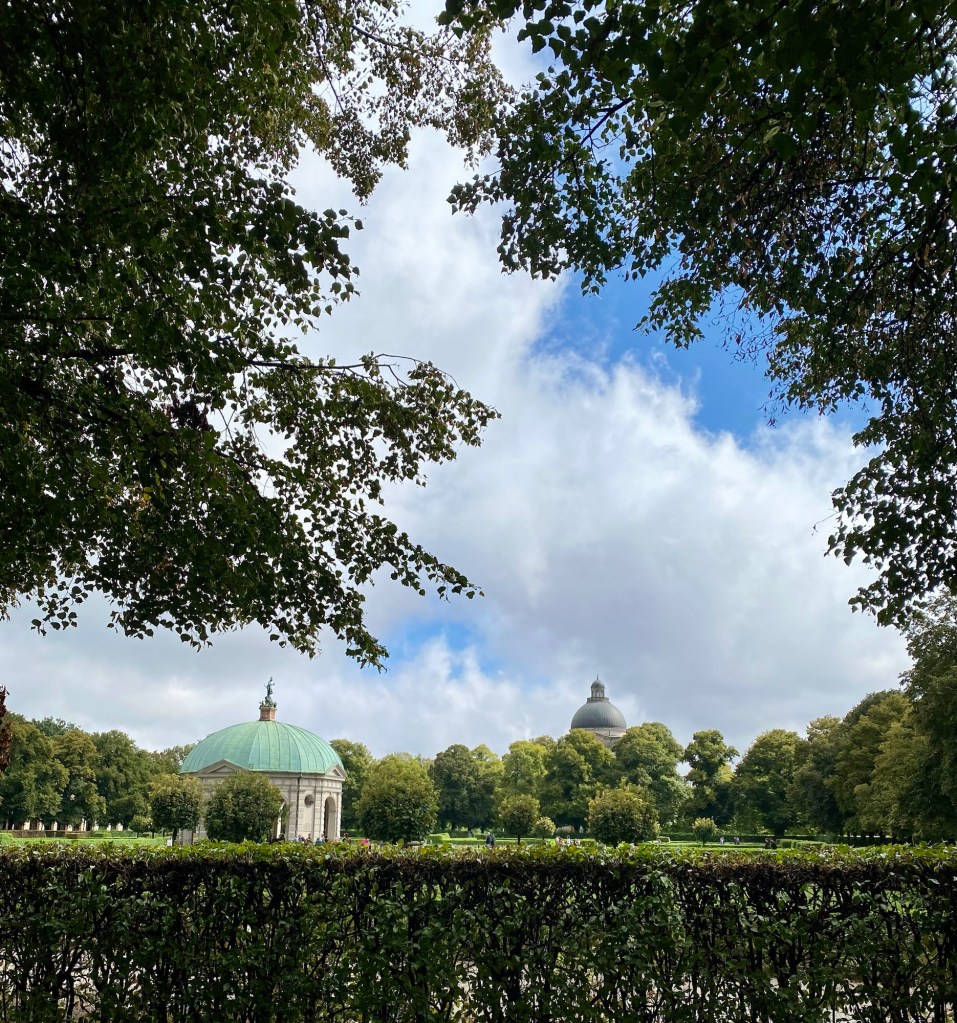
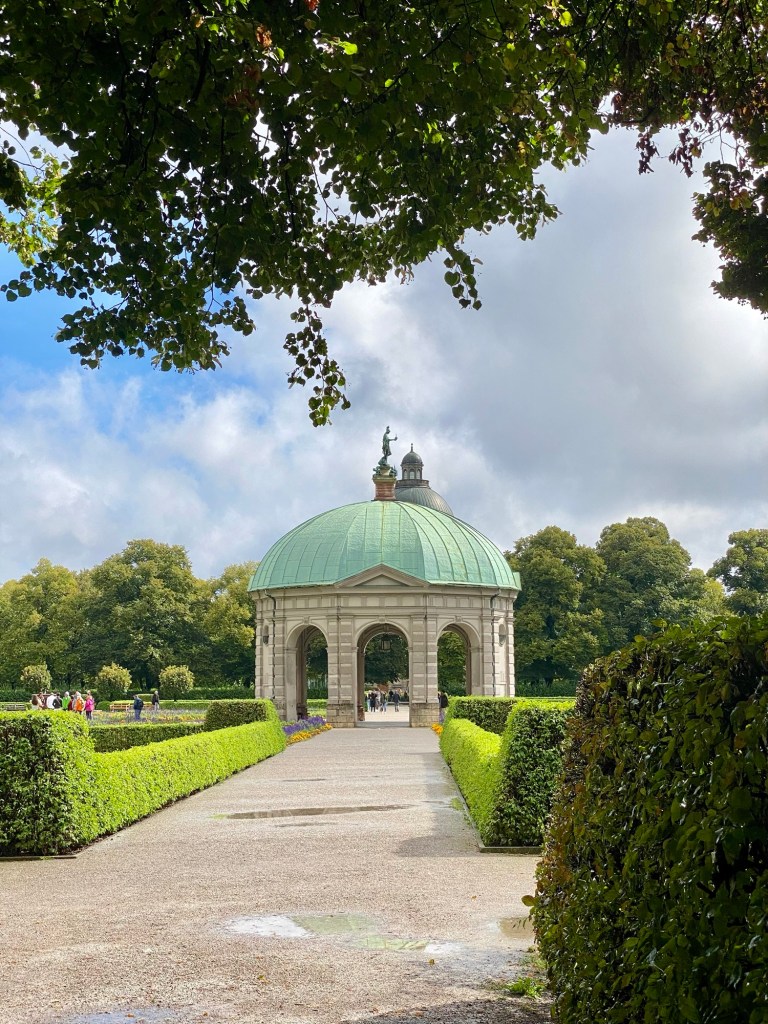
That’s the beautiful little Temple to Diana in the round.

Below is a view of the striking Theatinerkirche with its distinctive black colored domes as seen from inside the Diana Temple.

Bitte MÜNCHEN! I will miss you.

Chicago Botanic Garden and a quinceañera

A gorgeous day in Chicago on November 1 with friends! The recipe for a perfect time.

Two good friends from the days of high school! Last time we were together was in Florence just a few years ago. We like to meet in gorgeous places! Haha!

We’ve spent a lot of time reminiscing about people we enjoyed when we were teenagers and back in South Dakota where we grew up. In particular today I want to mention lovely Laura Karim, whom we both adored. You are missed, dear Laura; rest in peace.

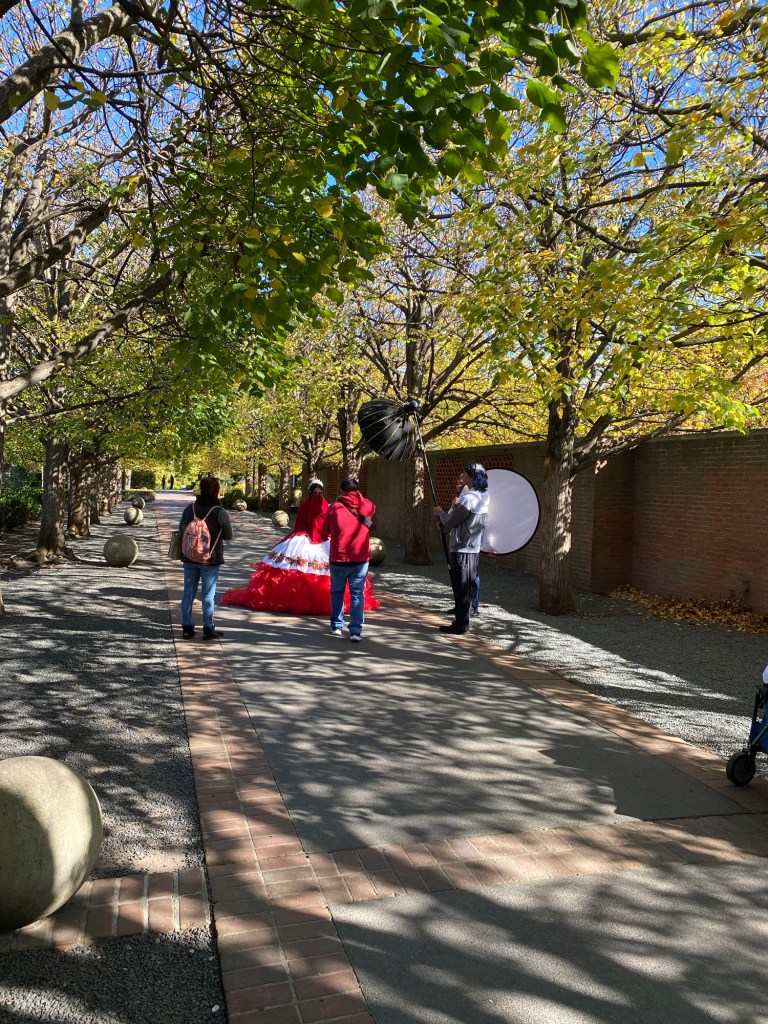
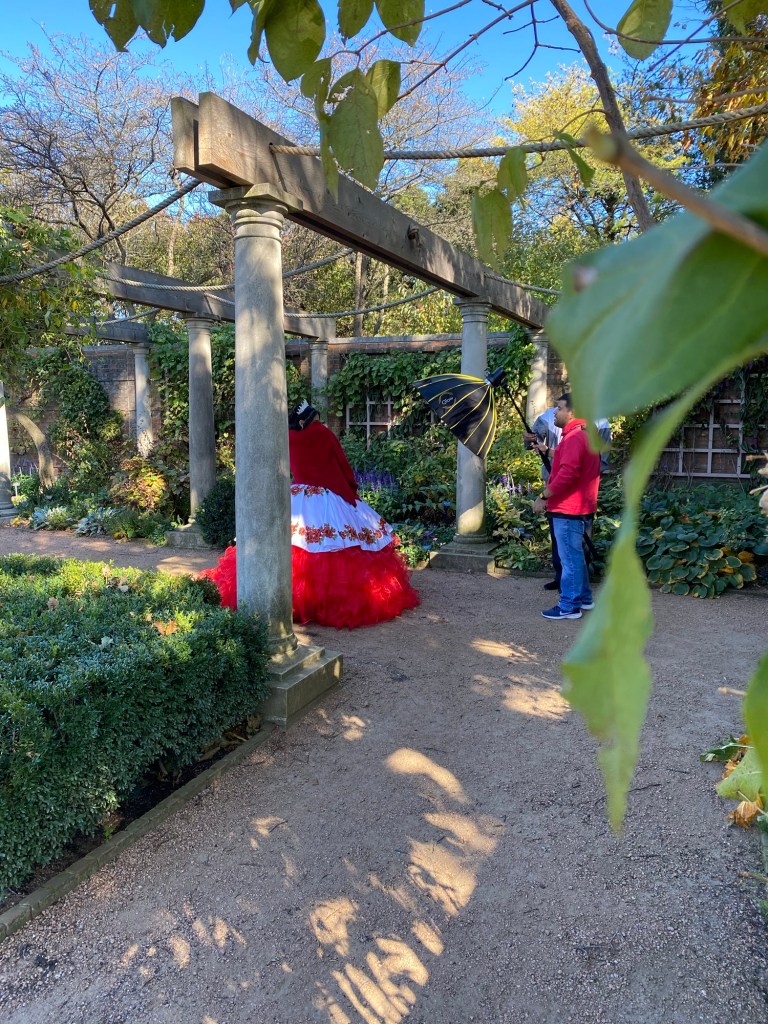
Below, a lovely day for a photo shoot of a quinceañera! Age 15 and spectacular.

What I noticed first of all was the way the trees are cut. I have never seen this outside of Paris. And funnily enough, the last time I was in Paris in the Tuileries, near trees cut like this, I saw a photo shoot of another quinceañera! That young lady was dressed in pink to match the pink blossoms of the flowering fruit trees. It’s always a fun spectacle.

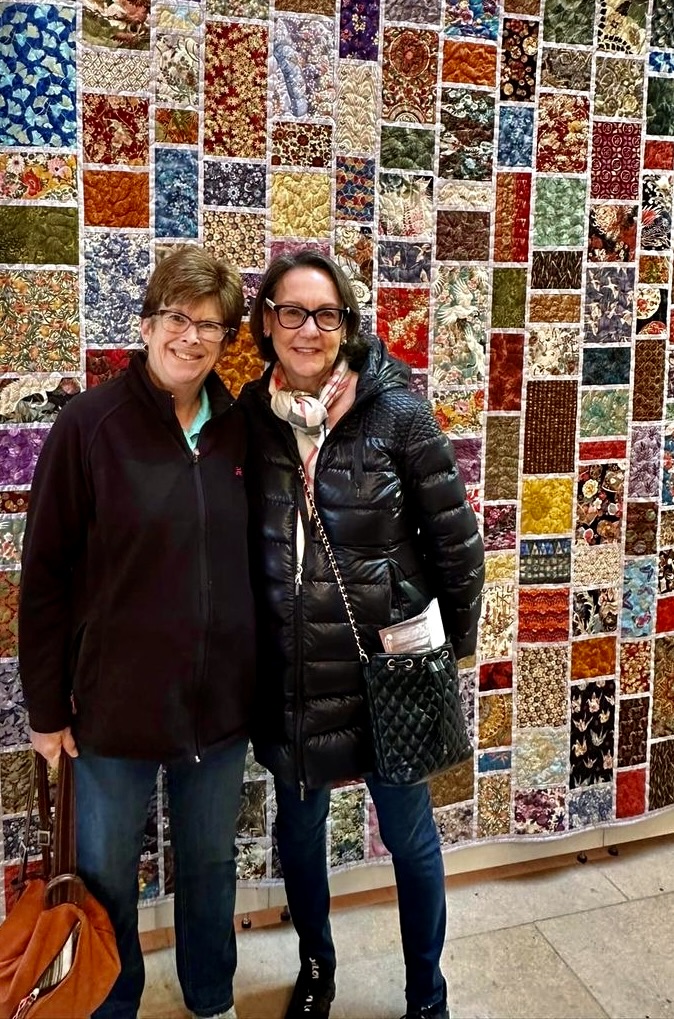
And one shot of Cindy and me inside the fiber exhibit at the garden. Cindy is herself a fiber artist and I really enjoyed viewing the exhibition through her eyes. We saw some fantastic works! Thanks Cindy and Ervin for a fabulous day! I’m so grateful to you for coming to Chicago to see me on this extended layover! Rabbit rabbit!