Warning: before reading this post, please find a comfortable seat in a quiet place and a hot beverage. You are going to need some time and focus to take in all the details! Don’t say I didn’t warn you!
I’m setting up housekeeping in my new apartment in Florence and it takes a lot of trips to the local grocery and hardware stores. I like to go down new streets once in a while as I’m beating my way to a negozio, and I am usually rewarded with something truly interesting.
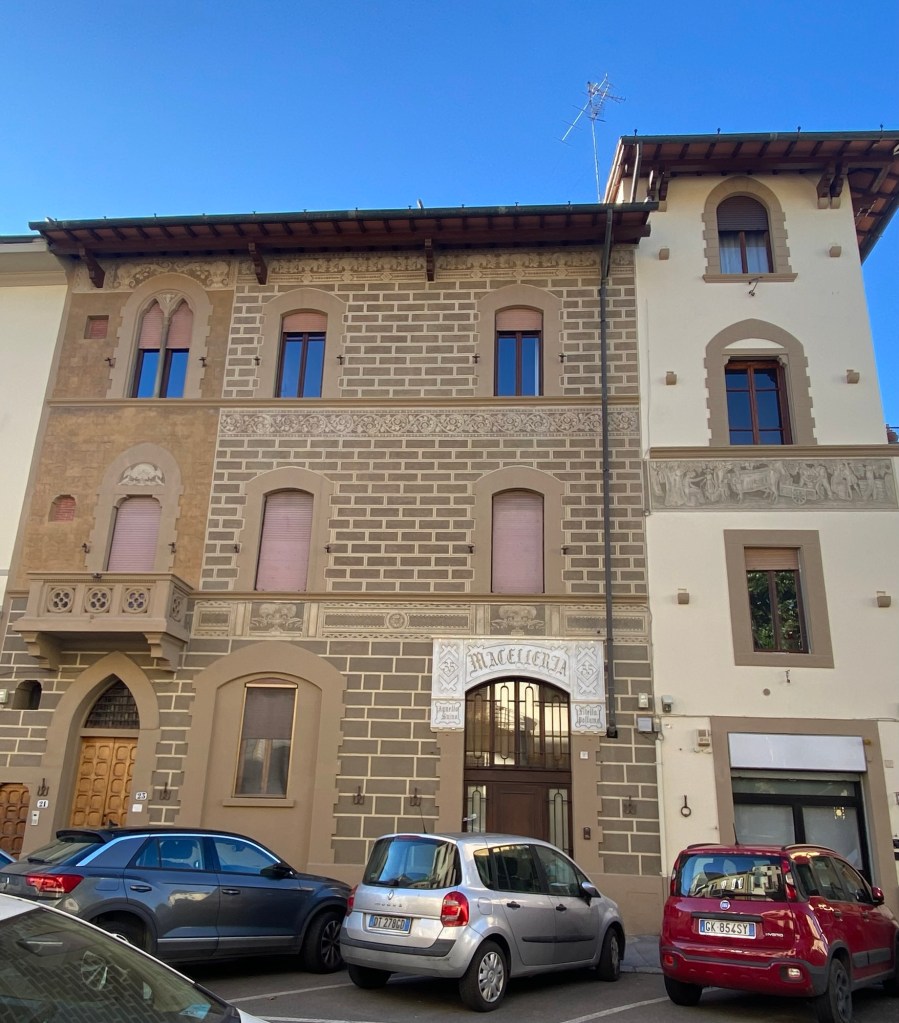
Recently I walked by this palazzo with its very attractive signage over a main door. I recognized it immediately as a former butcher shop and was amazed by the magnificence of the edifice that housed what I think of as a fairly pedestrian business. I stepped across the street to take in the full view and was really impressed. Clearly, this was a very lucrative trade for the person/family that commissioned this building.


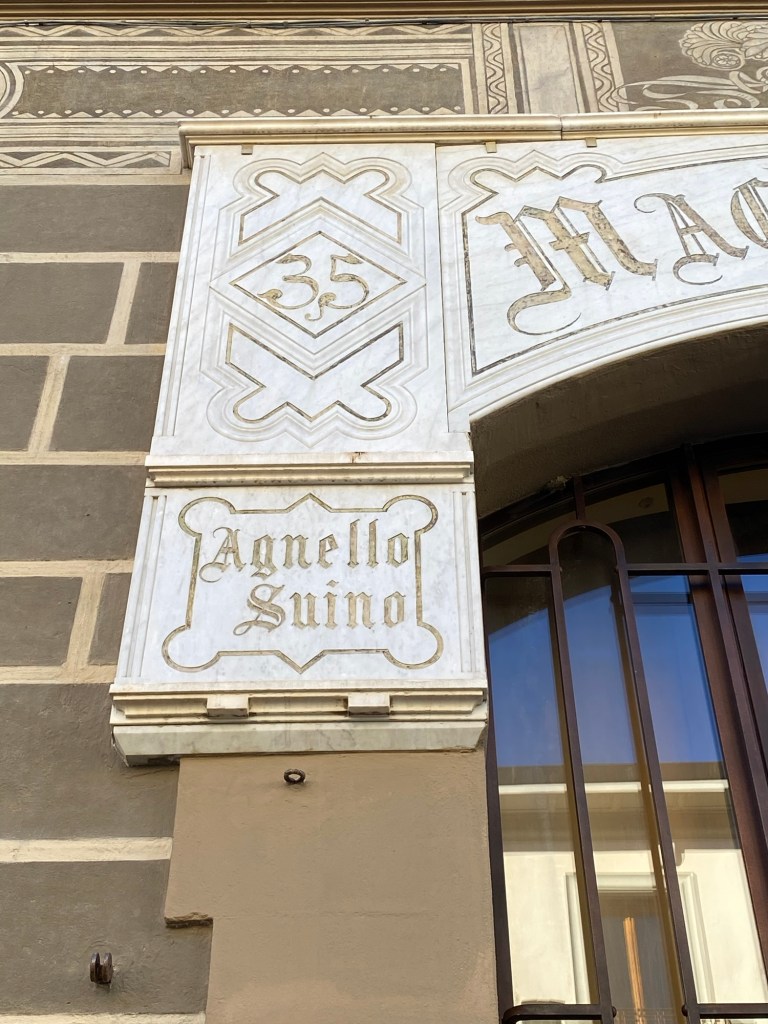
In the photo below we see the elaborate sign that proclaims “butcher shop” and in case there was any question, the products are specifically named on either side of the door. We have agnello (lamb), suino (pork), vitella (veal) and pollame (poultry).
Also, check out the elegant door.

The street number of 35 is given above both groups of meat types in an elaborate art nouveau (in Italy the style is known as Liberty) script. Have you ever seen prettier numbers? I haven’t.


Below, to increase the feeling of antiquity in the building, we see the metal objects attached to traditional Italian palazzi. Some of it was to hold torches. Some of it was to tie horses to. I know that when this building was built, neither use was needed. Still, the metal is created and attached in the traditional way, to give a sense of of antiquity to this actually modern structure.


On the right end of the building, as seen below, is a tower detail, and even though it isn’t much taller than the rest of the palazzo, it makes a reference back to the heyday of Florentine commerce and wealth, which fell in the 11th and 12th centuries. At that time many Florentine towns and cities were filled with tower houses. If you’d like to know more about these tall structures, here’s a great source: https://www.feelflorence.it/en/node/16855. Florence used to be full of really tall towers but most were razed. It’s a quick trip to San Gimignano in Tuscany where you can still see a town filled with Medieval towers if you want to get a sense what a medieval town was like.

Between the first and second windows from the bottom up on the “tower” is a frieze in sgraffito. This refers to an artistic or decorative technique of scratching through a coating on a hard surface to reveal parts of another underlying coating which is in a contrasting color. It is produced on walls by applying layers of plaster tinted in contrasting colors to a moistened surface. Sgraffito on walls has been used in Europe since classical times. It was popularized in Italy in the 15th and 16th centuries (see Wikipedia for more). So, now our “historical” tower makes reference not only to the 12th century, but also the Renaissance era as well! What a mighty tower!
.
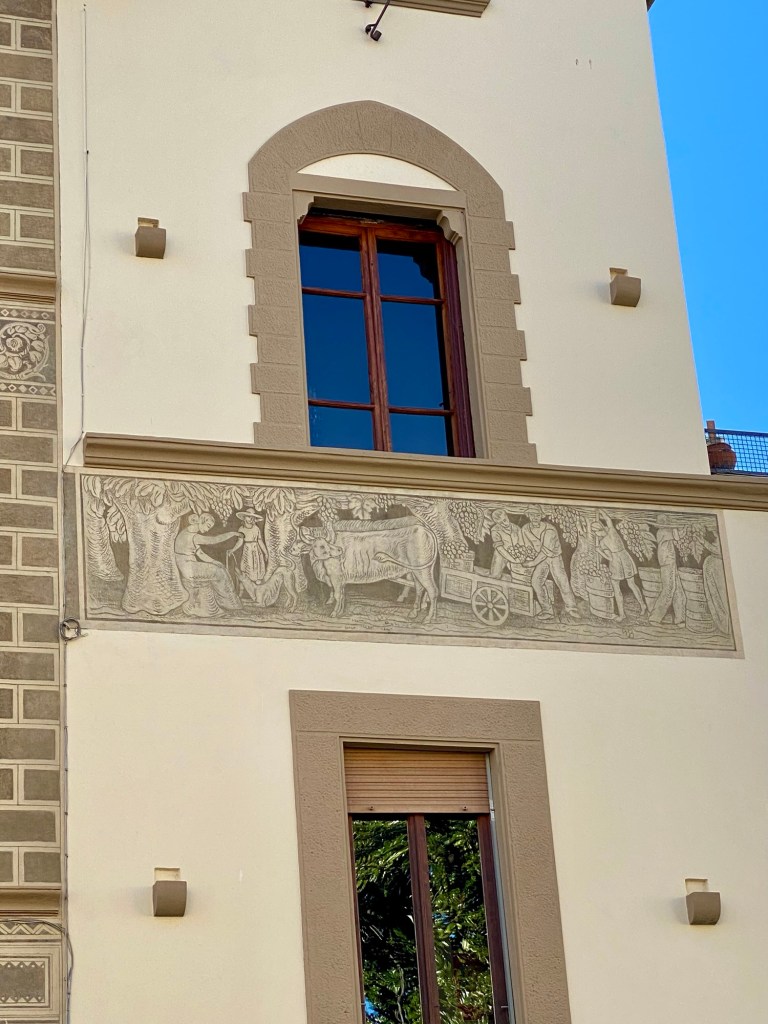
The pastoral scene depicted in the frieze is totally appropriate to a Florentine citizen. With Cosimo de’ Medici the Elder as our reference, wealthy Florentines often/usually had country estates as well as city houses (palazzi), and would go to the country to escape the heat of the Florentine summer as well as the oft-recurring plagues. Likewise, the country provided the harried businessman with farming activities to act as a therapy and ease the mind. Cosimo liked to tend his grape vines for just that reason.
In the frieze we see on the left the matriarch of the family (this is all my supposition) with one of her children. We can only guess that she is as fertile as the farm itself and has many offspring. Sitting in a gladed forest, the wife and her daughter seem to be playing with the family dog. To the right of them stand two healthy Chianina breed steers which are pulling the two wheeled carrozzo, into which workers (could it include the man of the house? I think so because if the two men loading the cart were farmworkers I don’t think the woman and her daughter would be freely sitting near them. It just wouldn’t have happened) are dumping baskets of grapes.
One of the steers seems to look at the mother and daughter and the other looks backwards to the activity behind. Next, an additional worker is cutting the grapes clusters from the overhead vines in the annual rite of passage known as the vendemmia, or grape harvest. The worker to his left seems to have begun the pressing of the grapes with a long paddle. Further to the right and only halfway depicted in the frieze is another lady who reaches to pluck a ripe grape. Who can resist the sweetness of a ripe grape in summertime? I know I can’t and being near the ripe plants loaded with clusters doing the heat of August and September is positively intoxicating. You really don’t even need the wine!
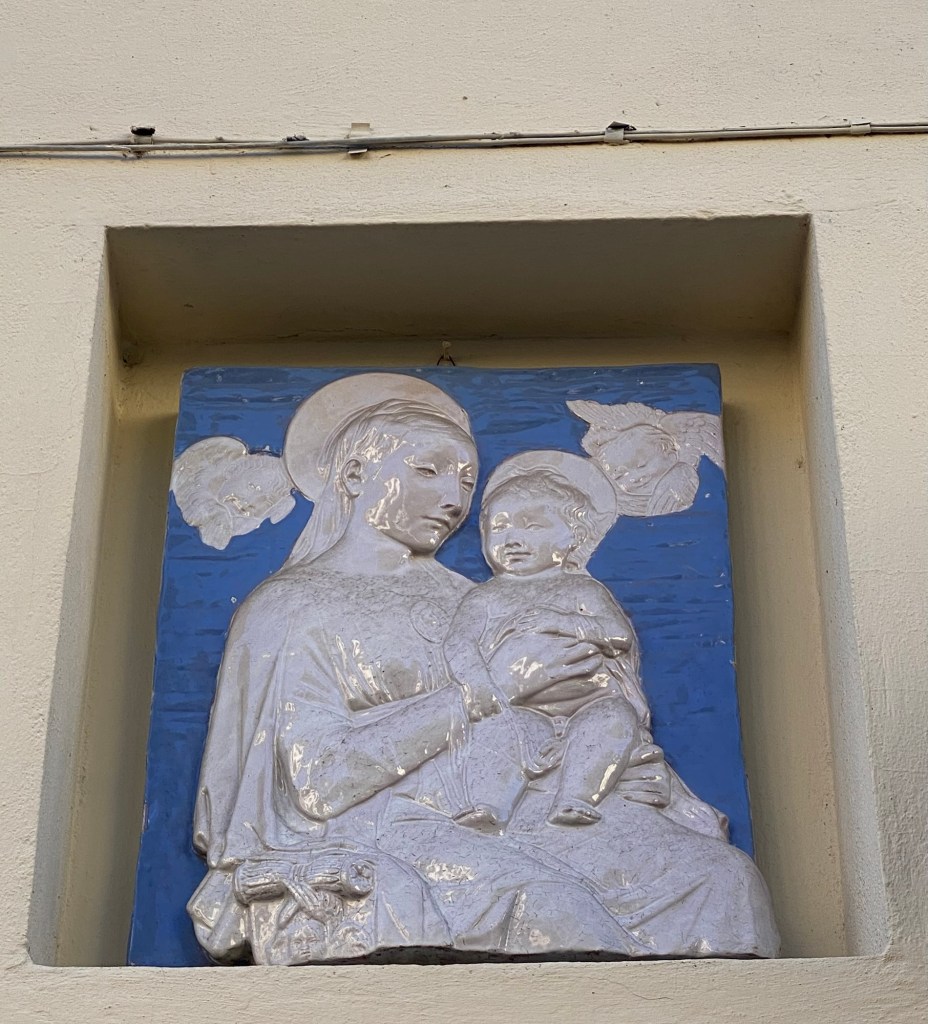
Because this is an Italian home, one needs to add a religious image to make the ensemble complete. In a nod again to the Renaissance, the patron of this building program selected a ceramic relief panel gracefully depicted the Virgin Mary and Christchild. They are attended by 2 cherubim, who provide the figures with some implied heavenly protection. But, beyond the usual subject matter, this work of art makes another reference to the Florentine past: Luca della Robbia (1400-82) was a sculptor from Florence and is noted for his colorful, tin-glazed terracotta statuary, a technique that he invented and passed on.

Now moving to the left side of the palazzo, we see an entirely new set of motifs. Here it seems that the patron wanted to celebrate his city home in grand style. Here we find what I surmise would have been the main entrance to the home of the patron on the upper floors of this grand but rather modern edifice. The family needed a doorway to reflect their status and they got it. Outlined by trim in a semi Gothic arch the grand wooden double doors make us take notice. They are topped by a metal grill which covers a window to let light into the building. The large use of plate glass alone tells me that this is a 20th century building.
Every worthy Renaissance family needed a balcony from which to see and be seen and this significant decoration would have held several family members at one time. The highly decorated exterior sides of the balcony with its dental molding carries three medallions with Medieval or Renaissance looking carve outs. You might want the pleasures of a modern build, but you want to tie yourself visually to the rich Italian Renaissance background of which you are an entitle heir as a Florentine. Even if you are living in the 20th century.
To reach the balcony from the piano nobile, one needed a doorway and the architect provided a grand one here. Outlined in trim that matches that of the entrance below, this time a round arch is employed as the top. And in the semi-circle enclosed by the arch is more sgraffiti, this time not harkening back to country pastimes, but depicting a contemporary motif of an oversized stylized floral design.
Above the balcony ensuite are the windows demarcating the 2nd floor. (In Italian architecture, if you didn’t know, the first floor of a building is designated as O. What in American would be called the second floor is the what Italians call the piano nobile, also called the first floor. This is where the noble family had their living quarters.)



 get back, lauretta!
You are certainly in the right place.
:-))