There’s a prominent spot along the Lungarno in the Oltarno of Florence dedicated to somebody named Nicola Demidoff. There is an elaborate white marble monument dedicated to this person, with a portrait sculpture of him raised on a dais in the center, surrounded by 4 main allegorical figures who seem intent on supplication to children. The whole confection is covered with a glass roof and it is almost impossible not to question who/what/when/where/why about this ensemble when you walk by. I know I always wonder when I am near it. Lorenzo Bartolini, the important 19th century sculptor, created this elaborate monument which makes it doubly interesting to me.

You know I looked into it, don’t you?! Count Nikolai Nikitich Demidov (1773 – 1828) was a Russian industrialist, collector, military commander and art patron of the wealthy Demidov family. He was also the Russian ambassador to Tuscany where one of the Grand Dukes of Tuscany named him the “Count of San Donato.”

Nikolai Demidov inherited his father’s industrial empire aged only 15, including the iron and copper smelting plants of Nizhny Tagil, Nizhny Saldinsky, Verkhne-Saldinsky, Tšerno Istochensky, Visimo Utkinsky, Visimo Shaitansky, Laisky and Vyisky along with 11,550 serfs. He entered the diplomatic service and moved to Paris, becoming ardent supporters of Napoleon I of France. (Thanks to Wikipedia, as always.)
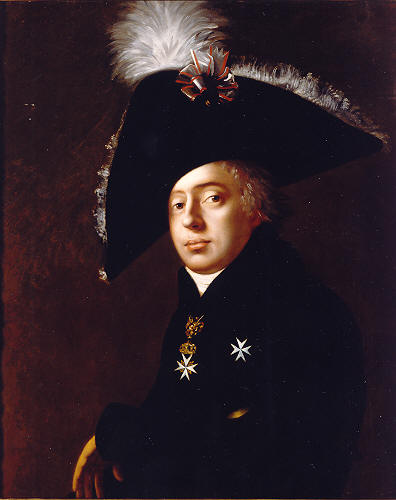
Portrait of Nikolay Nikitich Demidov, Collection Alexandre Tissot Demidoff
However, rising Franco-Russian tensions forced his recall and he, his wife and their children moved back to Russia via Italy (!!), arriving in Russia in 1812. He fought with distinction in the Russo-Turkish War and at the start of the French invasion of Russia he financed the creation of an infantry regiment, naming his son Pavel as one of its officers, which he then commanded against Napoleon’s forces, fighting at Oravais and Borodino.
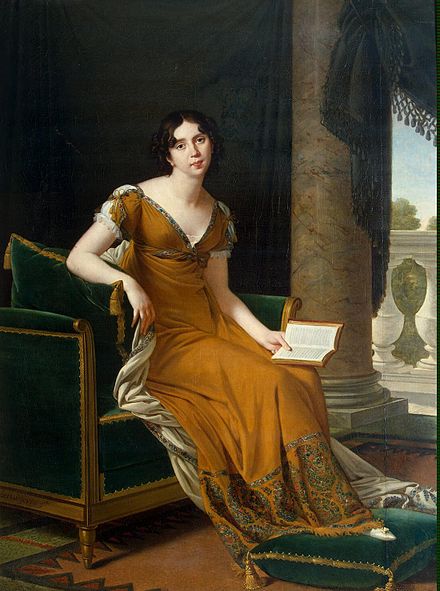
Portrait of his wife, Elisabeta Alexandrovna Stroganova by Robert Lefèvre (c. 1805), Saint-Petersburg, Hermitage
In 1813 he gave his important collections to the mineralogical museum of Moscow founded by his uncle Pavel Grigoryevich to replace those lost in a fire; he also gave art collections to Moscow University. He financed the construction of four cast iron bridges in St. Petersburg. He modernized his factories’ infrastructure, which doubled his fortune. He gave his home over to many industries and public utility services, perfecting the exploitation of mines. At the Nizhny Tagil plant he founded a school in which, in addition to general education subjects, they also taught “the general principles of mechanics and practical mining art.” This school, which gave the best craftsmen for the factories of Demidov and others, was transformed into a district school in 1839 and subordinated to the department of the Ministry of Public Education.

Demidoff also played a significant role in advancing the horticulture of Russia: he acclimatized Bordeaux and Champagne vines and Lucca olive trees to the Crimea, imported horses from England, Merino sheep from Switzerland, ordered Kholmogory cattle, Orenburg goats and Caucasian mountain horses. In addition, he made experiments in the cultivation of cotton and saffron.
Nikolai Demidov served as chamberlain to the Emperor, a Hereditary Commander of the Order of Saint John of Jerusalem, and member of the privy council.

Portrait of Nikolaiy Nikitich Demidov on ceramic by an unknown artist, c. 1820. Kramskoy Historical and Art Museum, Ostrogozhsky
In 1819 he was made Russian ambassador to the court of Tuscany. After divorcing his wife, who moved back to France, he lived his last years in France and Italy among scholars, financing the creation of schools, hospitals and other charitable institutions in Tuscany. He bought 42 acres of marshland north of Florence from the Catholic Church and there built the Villa San Donato from 1827 to 1831, where he set up richly-decorated private rooms, a suite of 14 rooms housing his enormous art collection, a theatre and a foreign languages academy. I’ve posted about this place many years ago and will again.
His collections, reputed among the most lavish private collections in Europe, was divided between his residences in San Donato, Saint Petersburg, Paris and Moscow, and included works by Flemish and Italian masters, decorative art objects and a famous collection of weapons now in the Wallace Collection in London. His collection of ancient Greek and Roman sculptures is now at the Hermitage Museum. By decree of Leopold II, Grand Duke of Tuscany, on 23 February 1827 Demidov was made “Count of San Donato” for the services he had rendered to Tuscany by setting up a silk factory.
He had built a home for the elderly and orphans and donated a special capital for its maintenance. The grateful citizens of Florence in honor of the donor named one of the squares, near the Demidov Charity House, Demidovskaya and placed on this square a statue of Nikolai Nikitich. A public Monument to Nicola Demidoff designed by Lorenzo Bartolini is located on Piazza Demidoff overlooking the river Arno in Oltrarno.
I’ll be returning to Count Demidoff in future posts, for he made a lasting impression on the map of Tuscany during his lifetime. He is a most fascinating figure.
 get back, lauretta!
muito belíssimo esse monumento
Muchas gracias for commenting!