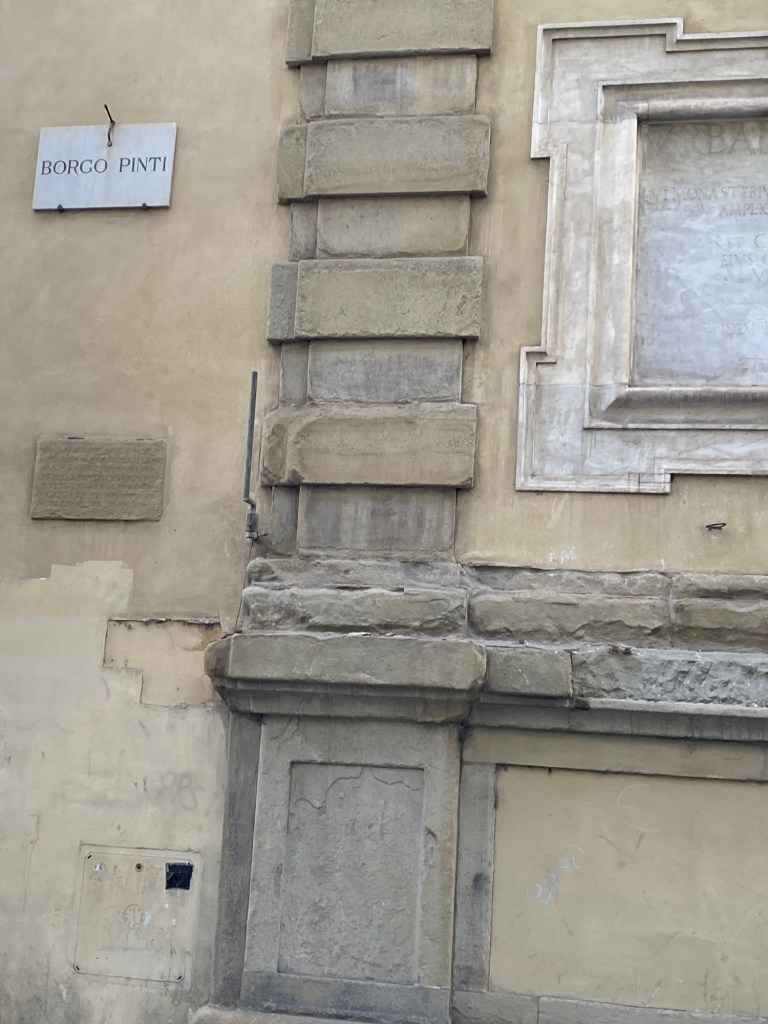
Walking down any major street in the historical center of Florence provides lots of visual entertainment if you keep your eyes wide open. I try to do that always and I am rarely not rewarded for the effort.
Strolling down the Borgo Pinti recently, my peripheral vision fed me an image of this magnificent coat of arms, which my brain at first registered as a face with 2 large eyes and eyebrows, a mustache, and a mouth. Nah, I thought, that can’t be correct. So I stopped and studied and realized 3 bees roughly formed the features of the face I thought I saw. Do you see what I saw?!
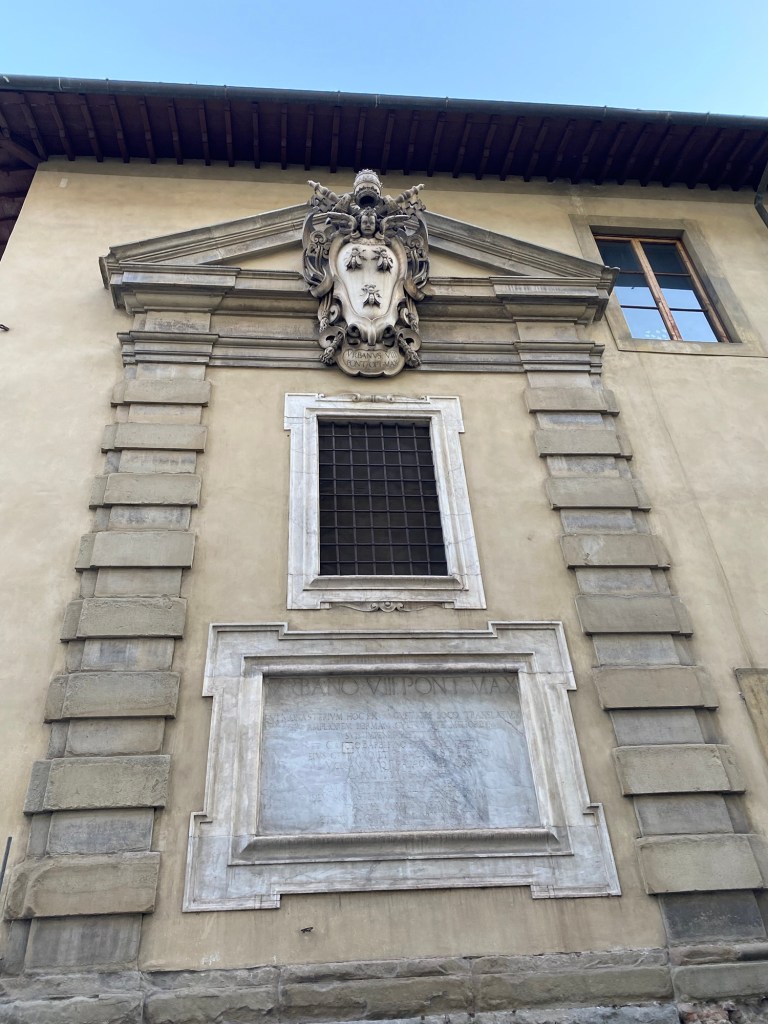
The split second I recognized the bees and realized it was a coat of arms, I knew we were standing in Barberini country. I’m obsessed with the Barberini family, their piazza in Rome, the baldachino over the tomb of St. Peter in the Vatican, and anything else having to do with this famous family. I even have a tattoo of a bee in their honor.
My interest started with the bees. When I was a baby art history student I grabbed on to the bees as a simple way to remember this family. What can I say, I have always liked bees!
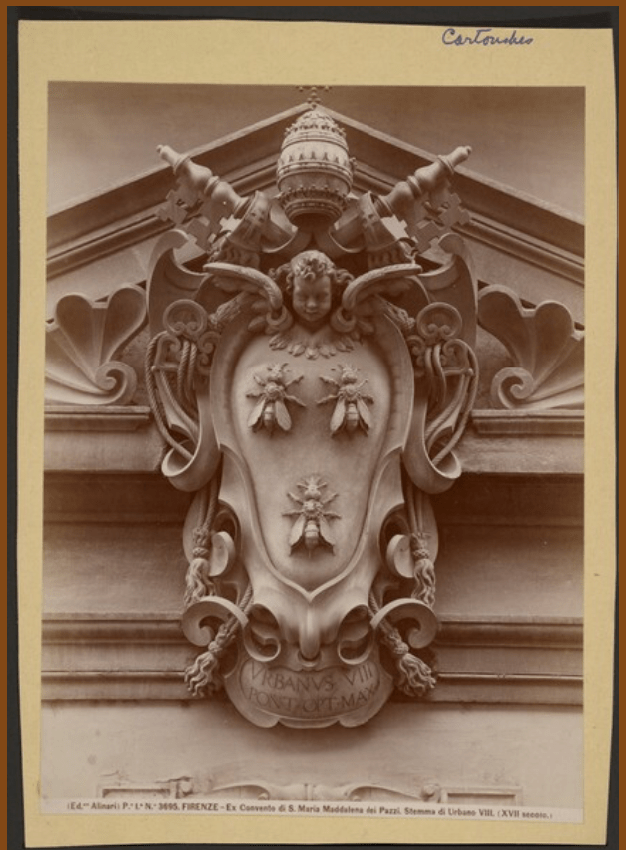
Above is an archival photo of this very same coat of arms of Pope Urban VIII. The Alinari photo tells us this site in Florence that I happened to be walking by was the former cloister of St. Maria Maddalena dei Pazzi. You can see the papal crown and 2 keys connecting Urban with St. Peter, the first pope. The face of a cherub is inset below the crown, with the cherub’s 2 wings extended sideways. In the center area are three large bees. Tassels extend from the sides and bottom. The plaque below the entire work reads Urban XIII, Pont Opt Max.
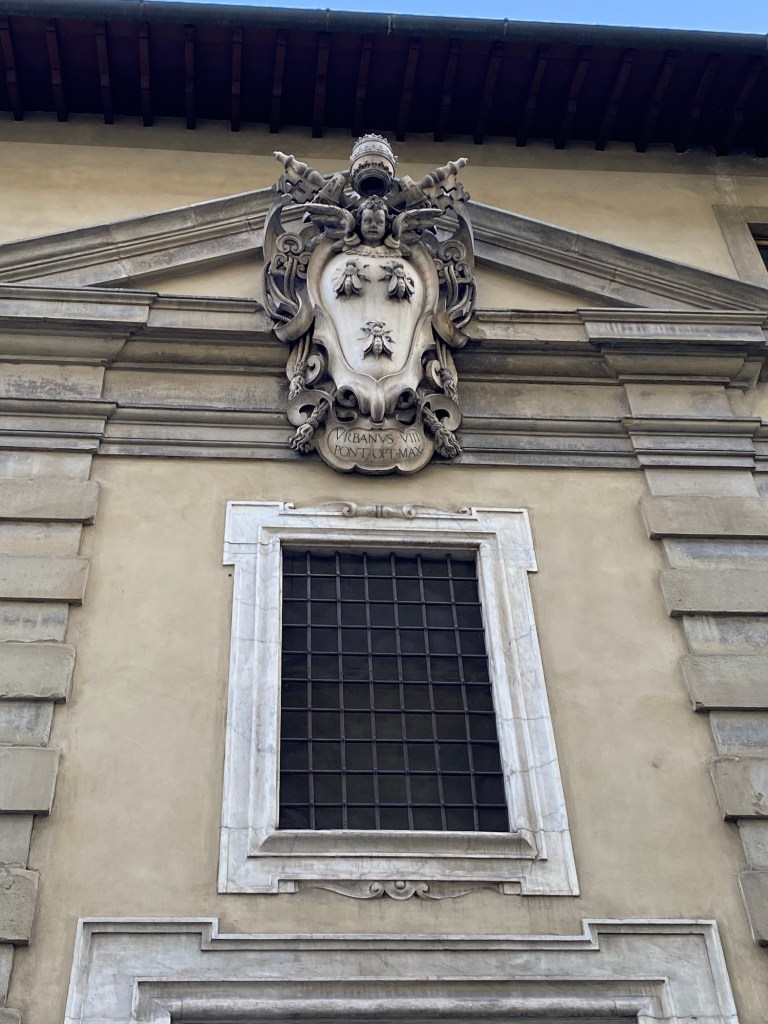
So, naturally, I wanted to know more. First, what was this building?
Santa Maria Maddalena dei Pazzi is a Renaissance-style Roman Catholic church and a former religious building located in Borgo Pinti in central Florence, Italy.
The foundation dates back to 1257, dedicated to Santa Maria Maddalena delle Convertite, in the place where there was already a home for women with bad reputation who followed the rule of San Benedetto; later on the structure passed to the Cistercians of Badia a Settimo, who settled there in 1442. In 1629 the Cistercian monks literally exchanged ownership with the Carmelites of San Frediano in Cestello. The nuns also brought with them the mortal remains of the sister Maria Maddalena de ‘Pazzi who in 1669 was beatified and thus gave the church its name.
Inside you can admire works by Carlo Portelli, Alfonso Boschi, Domenico Puligo. Of particular interest are the martyrdom of Saints Nereo and Achilleo by Domenico Passignano and the large altarpiece by Cosimo Rosselli depicting the Coronation of the Virgin. In the Chapter Room there is the famous Crucifixion by Perugino.
And what’s notable about Urban VIII?

Portrait of Urban VIII by Gian Lorenzo Bernini, c. 1631–1632
(oil on canvas, Galleria Nazionale d’Arte Antica)
Well, I’m happy you asked!
Pope Urban VIII 1568 – 1644), was born in 1568 as Maffeo Vincenzo Barberini. He was the 5th son of a prominent but non-aristocratic family. His father died when he was three and he went to Rome to live with family and was educated by the Jesuits. He took his higher education at Pisa and He would become head of the Catholic Church and ruler of the Papal States from 6 August 1623 to his death, in July 1644. As pope, he expanded the papal territory by force of arms and advantageous politicking, and was also a prominent patron of the arts, commissioning works from artists like Gian Lorenzo Bernini and a reformer of Church missions. His papacy also covered 21 years of the Thirty Years’ War.
The massive debts incurred during his pontificate greatly weakened his successors, who were unable to maintain the papacy’s longstanding political and military influence in Europe. He was also an opponent of Copernicanism and was involved in the Galileo affair, which saw the astronomer tried for heresy. He is the last pope to date to take the pontifical name Urban.
I read somewhere that Urban visited Florence as Pope and I’m guessing that if that is true, he probably made a procession down this major street and the coat of arms was added to welcome him. I can’t find my source as I finish this post. The other info about Urban comes from Wikipedia.
Every street corner in Florence has something to tell us. Are you listening?
 get back, lauretta!