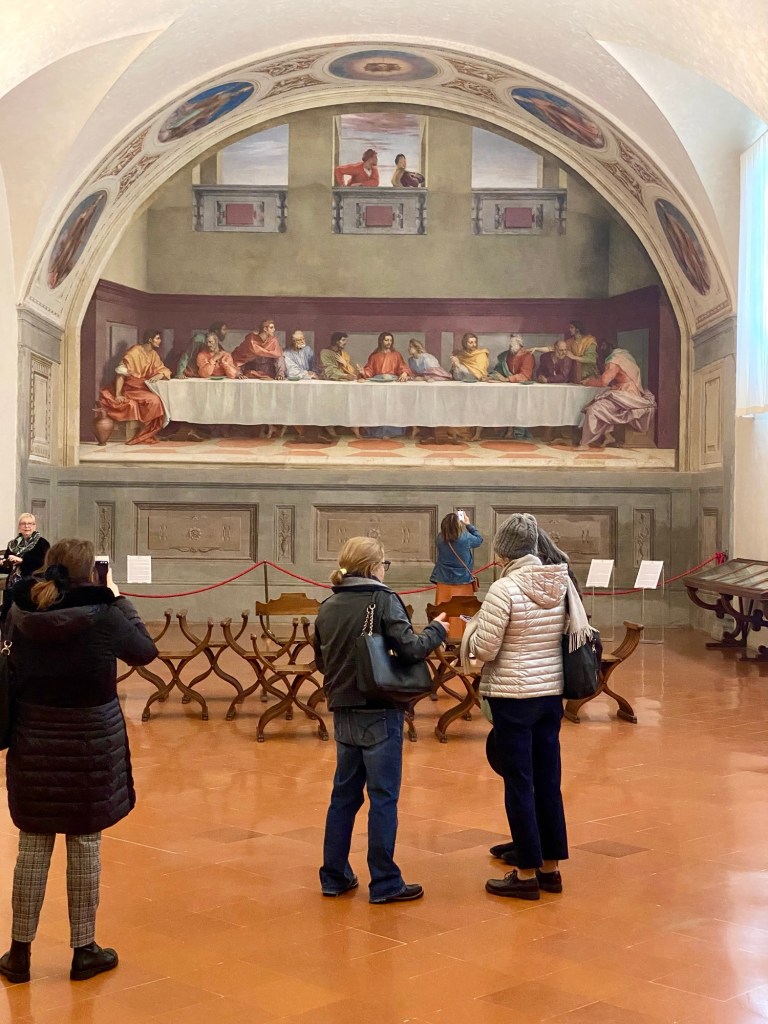
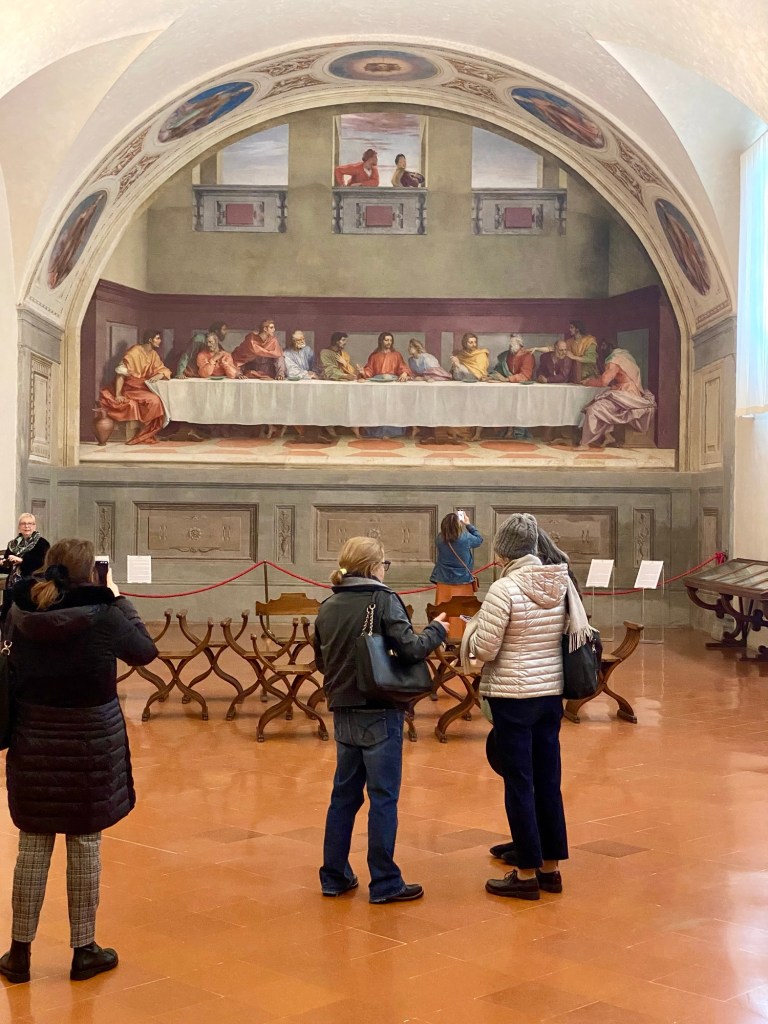
On a recent Saturday morning I visited this incredible fresco that is still in situ and has never suffered any bombing (unlike Leonardo’s Last Supper in Milan). I posted about that very enjoyable day not long ago and today comes the scholarly version, because this gorgeous painting deserves that much and more.
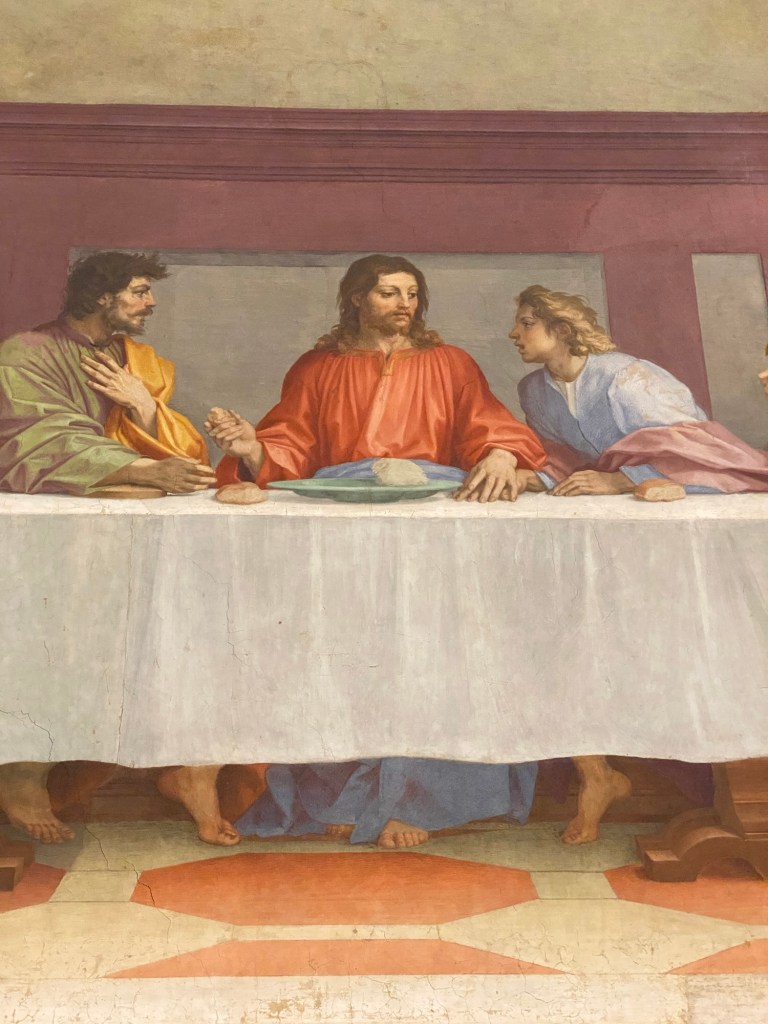
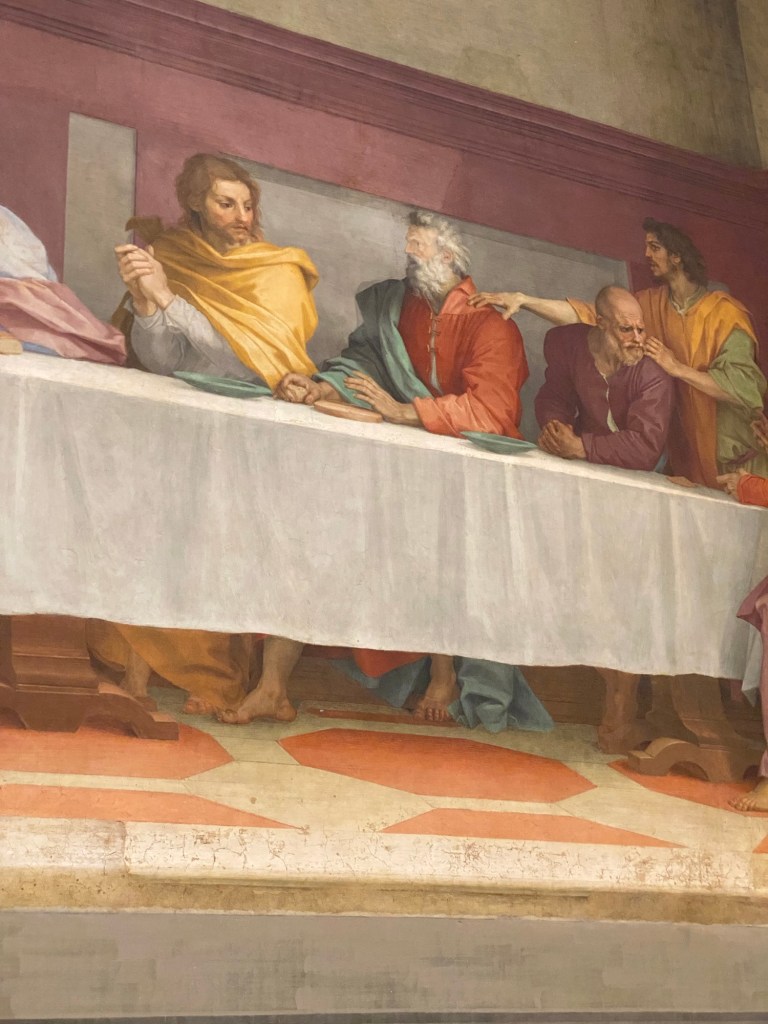
Christ gives the piece of bread to Judas above. This is an unusual portrayal of the theme of the Last Supper; usually Judas is portrayed on the opposite side of the table from Christ and with his back towards the viewer.
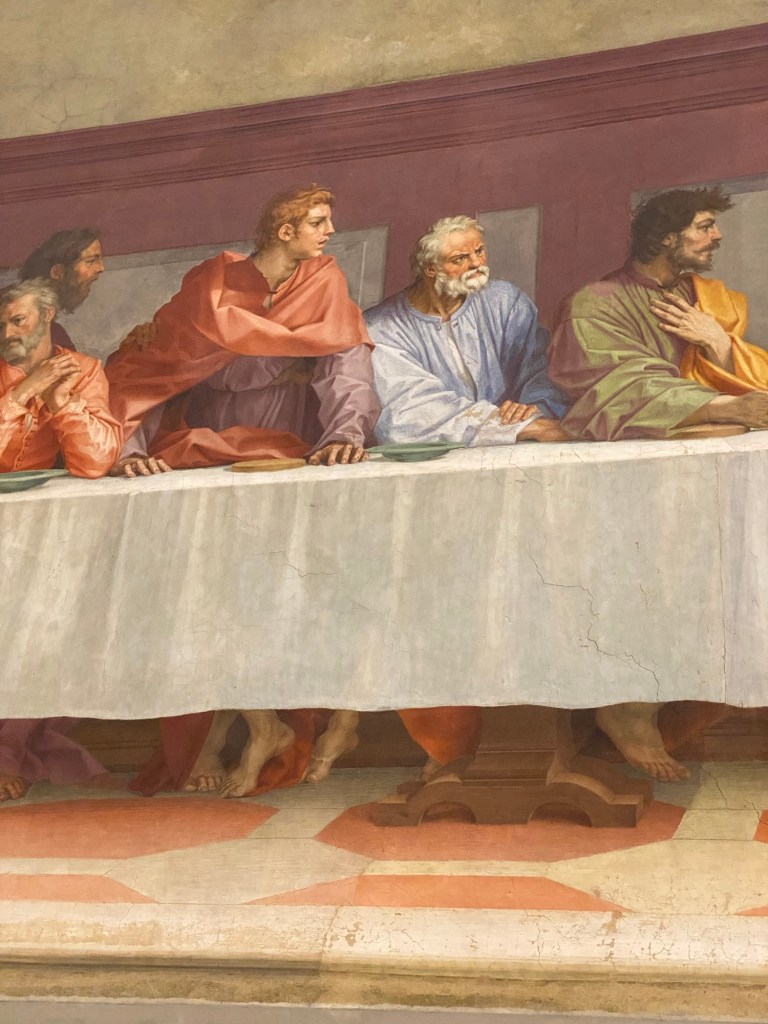
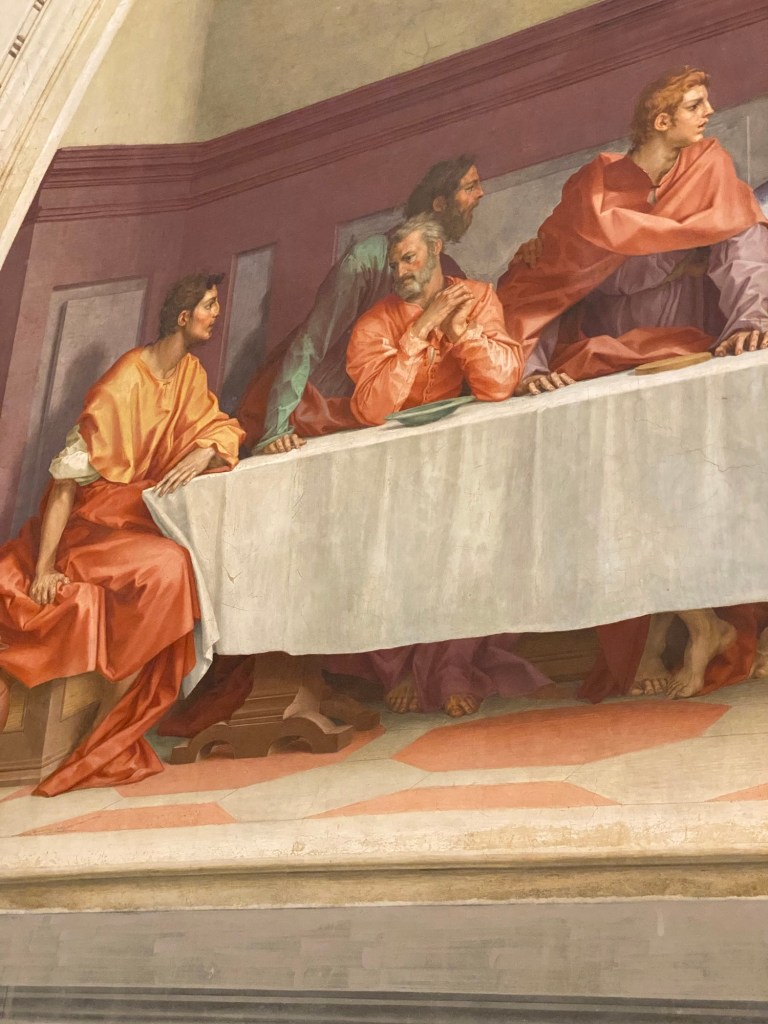
Moving back to Christ at the center, we now move from left to right along this side.
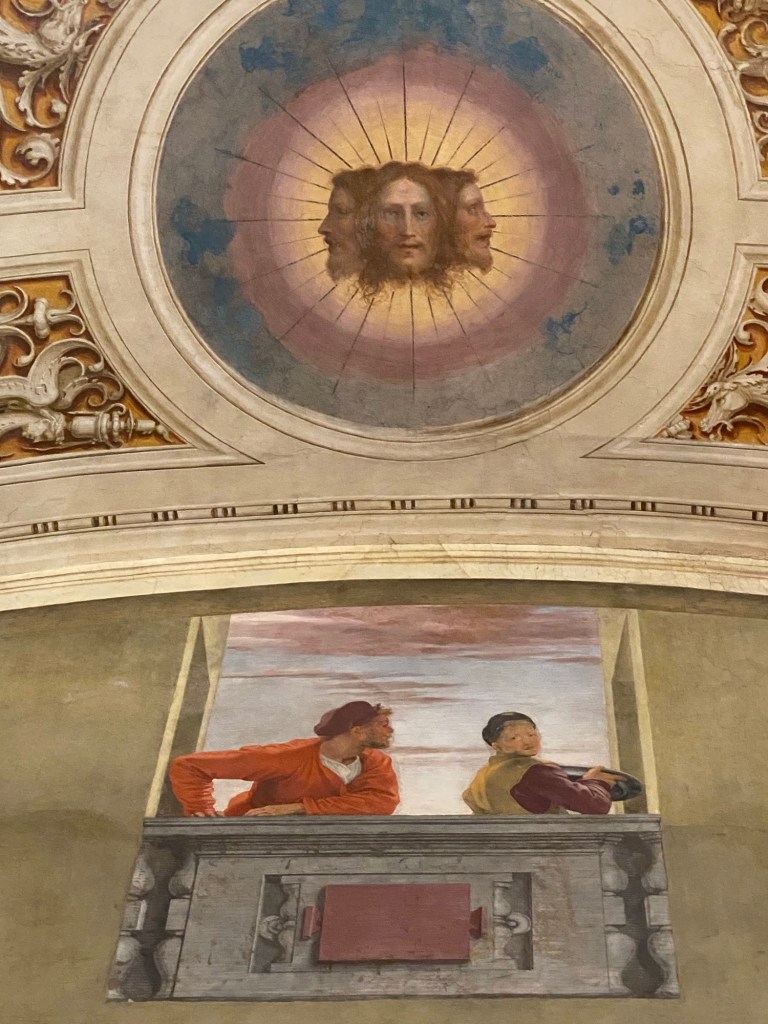
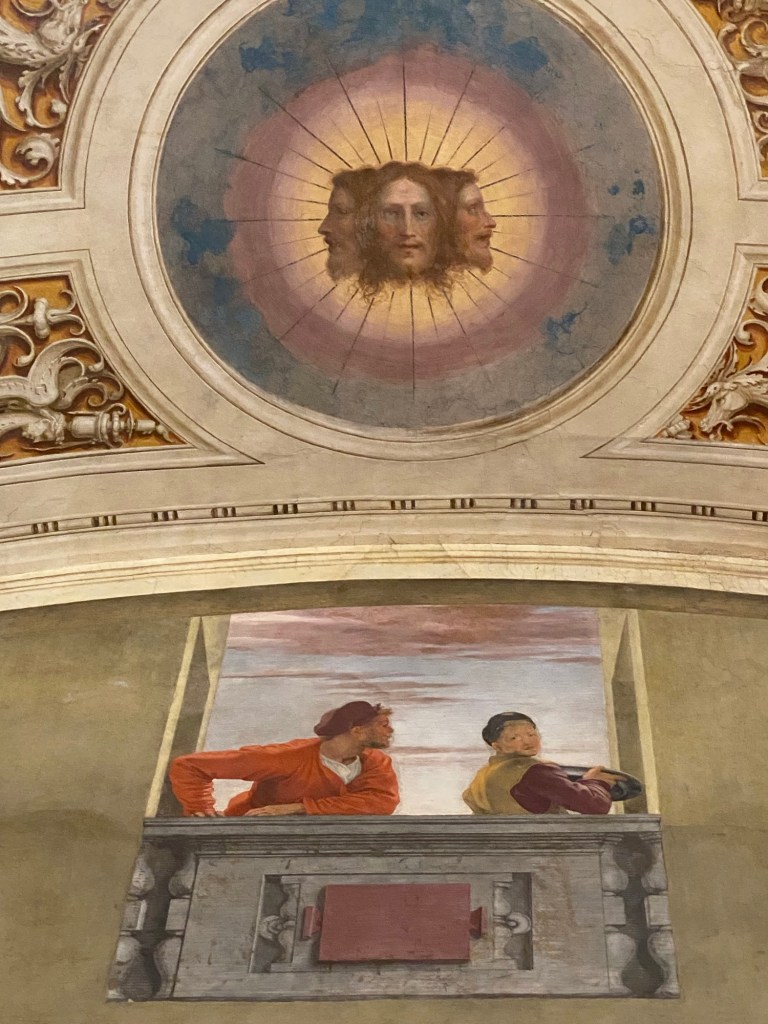
At the top of the arch that surrounds the lunette shaped fresco by Andrea, is his highly unusual depiction of the Trinity. I don’t believe I’ve ever seen anything like it. It reminds me of sculptures of the Janus head in Roman art.
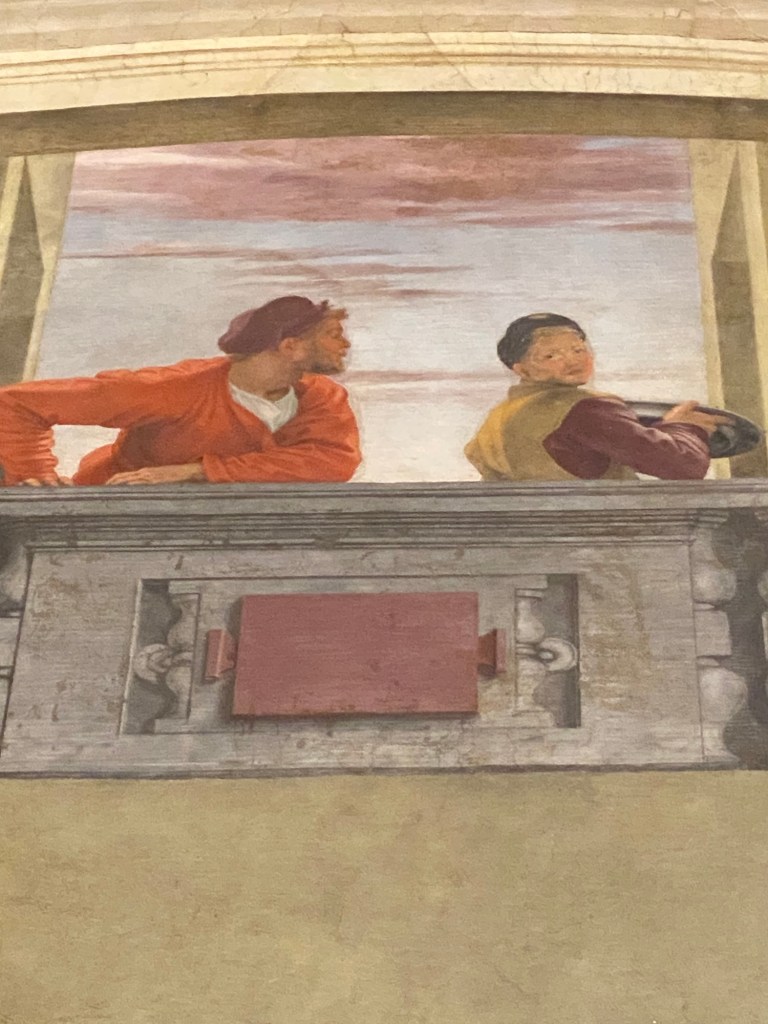
Directly above Christ, this genre scene shows everyday figures from the early 1500s. Am I correct in positing that we have a Florentine in orange who is bothering a servant for the monastery who probably just delivered some food? What is your interpretation?
One of the great things about this museum is that facsimiles of del Sarto red pencil drawings done in preparation for the fresco are exhibited in the same room. These treasured studies are in the Uffizi Museum collection. I choose this drawing to show you, because it reveals the artist’s process. Compare the drawing with the appropriate section of the fresco, further below, for an understanding of his approach. It’s very interesting.
One of the best things about living in Florence is the knowledge that masterpieces like this fresco are almost infinitely available. That thought and feeling is the best thing in the world for me.
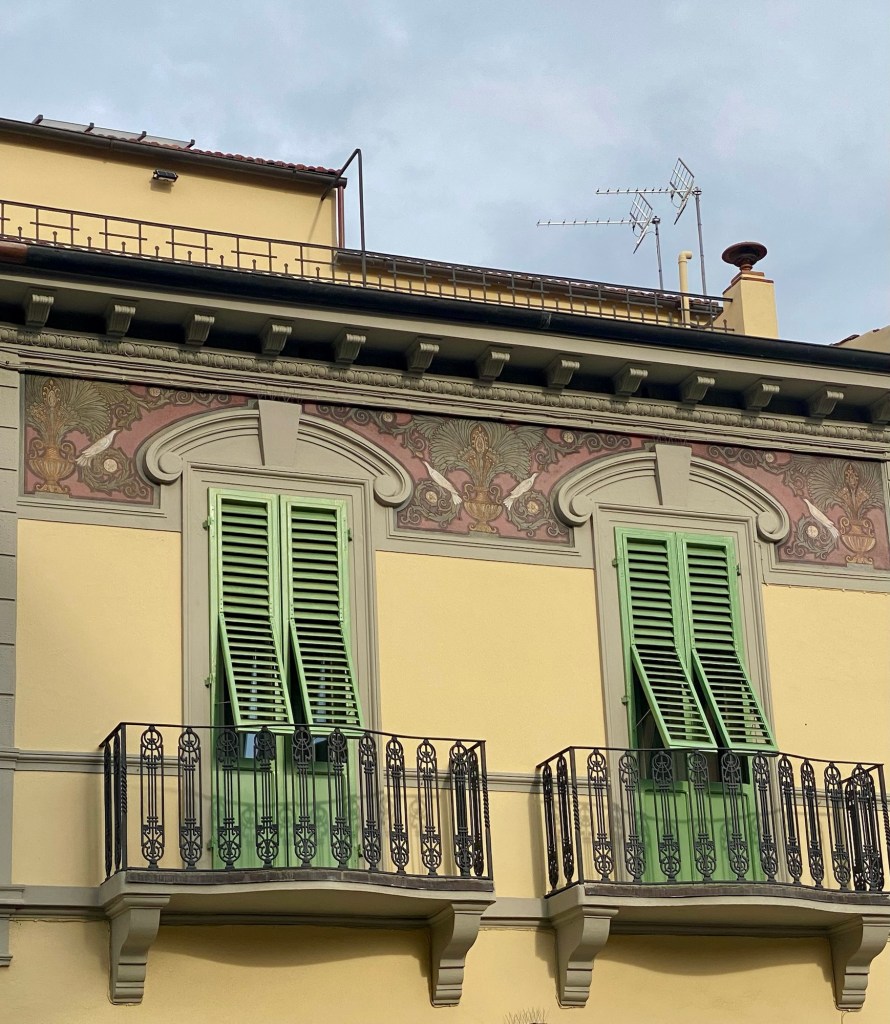
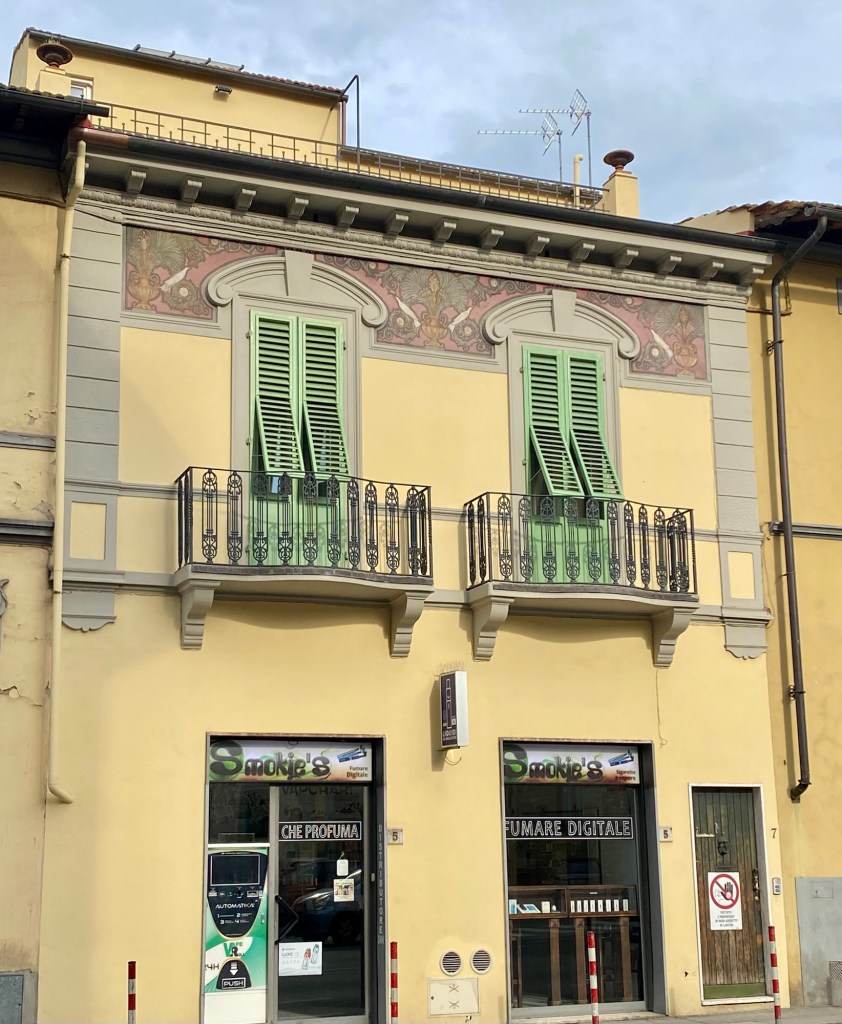
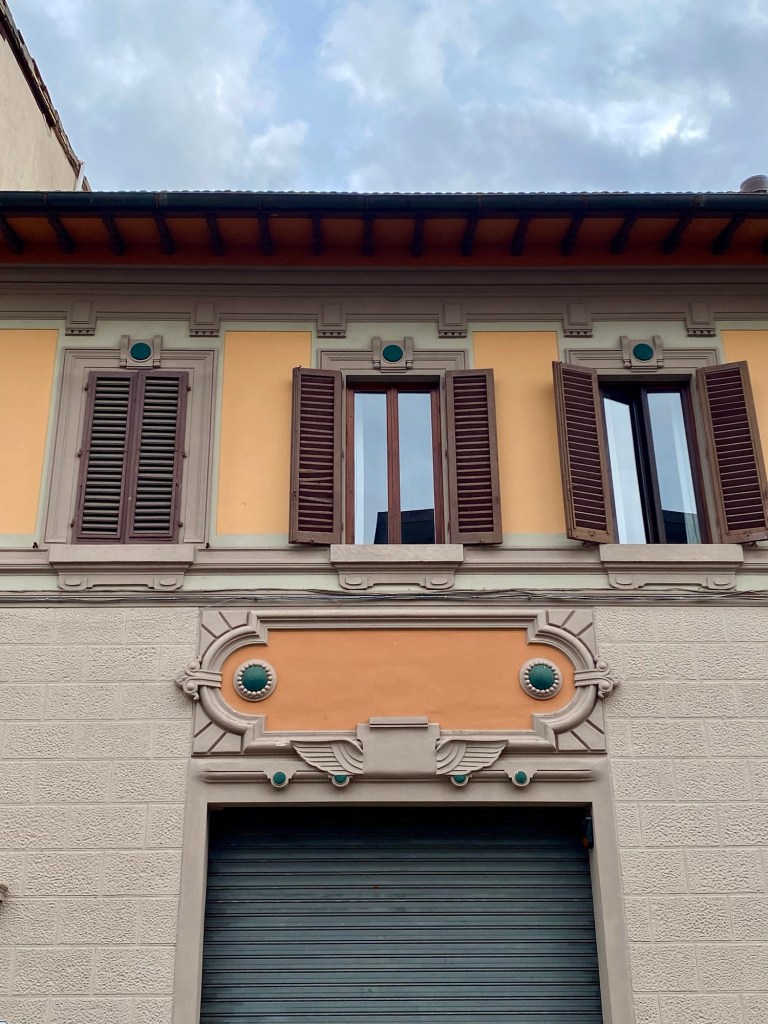
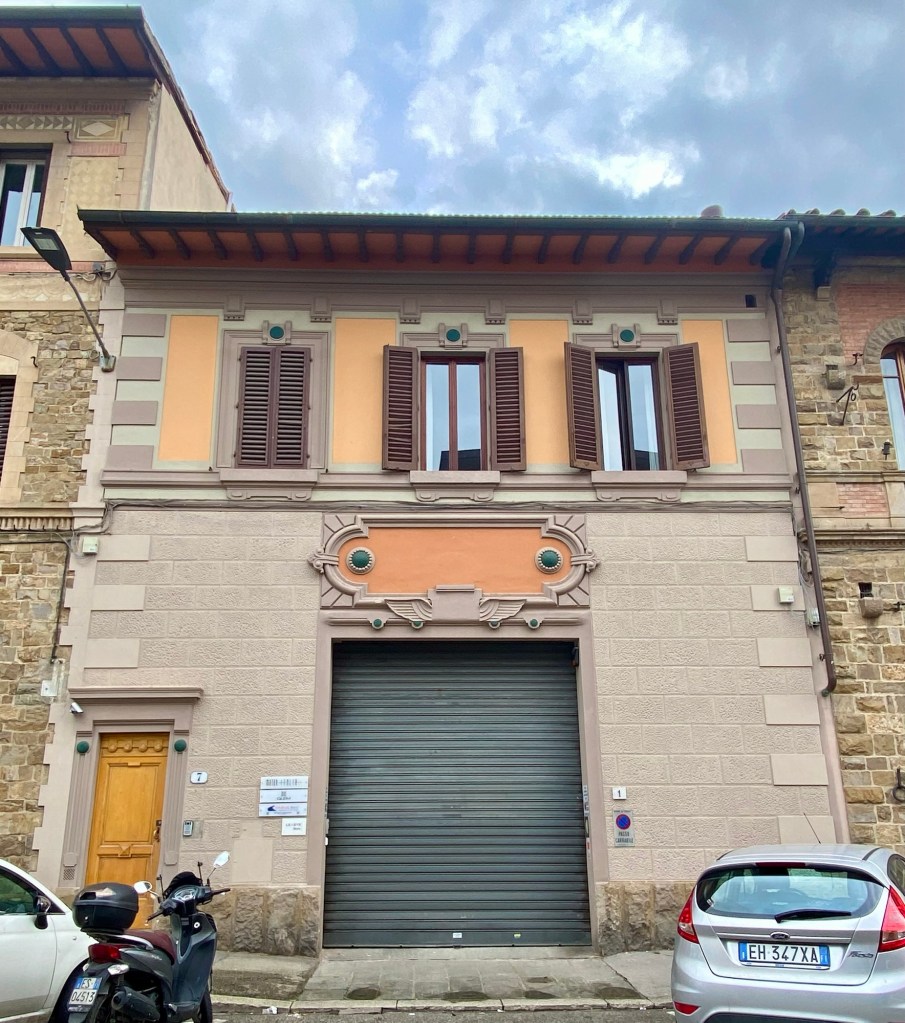
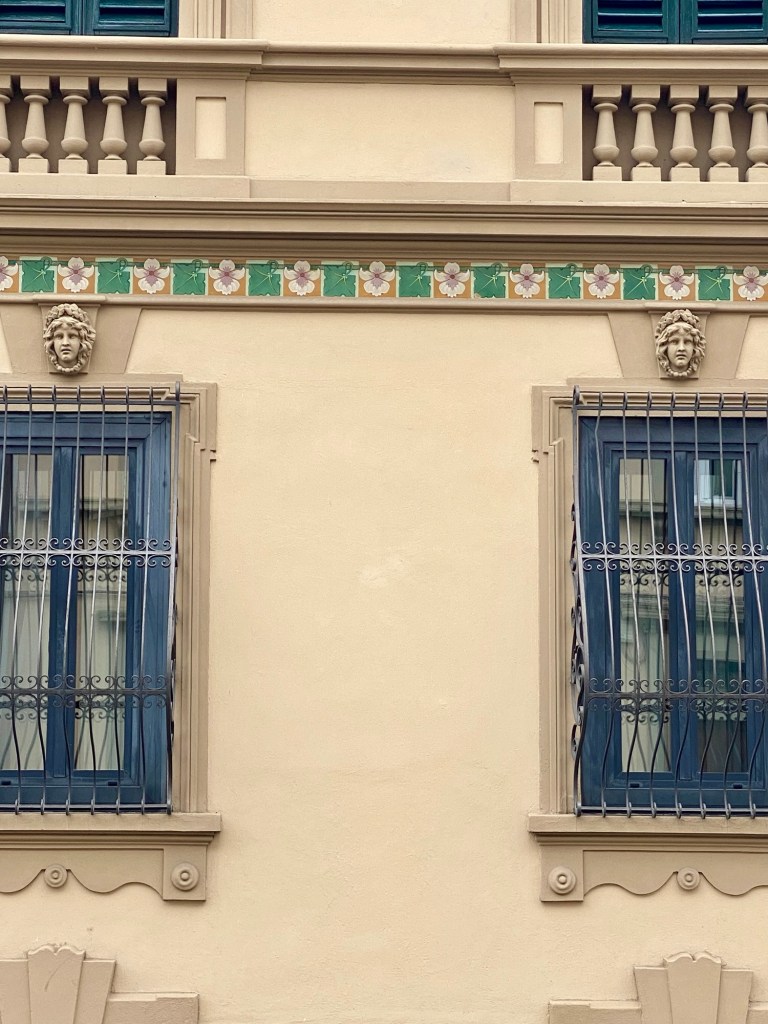
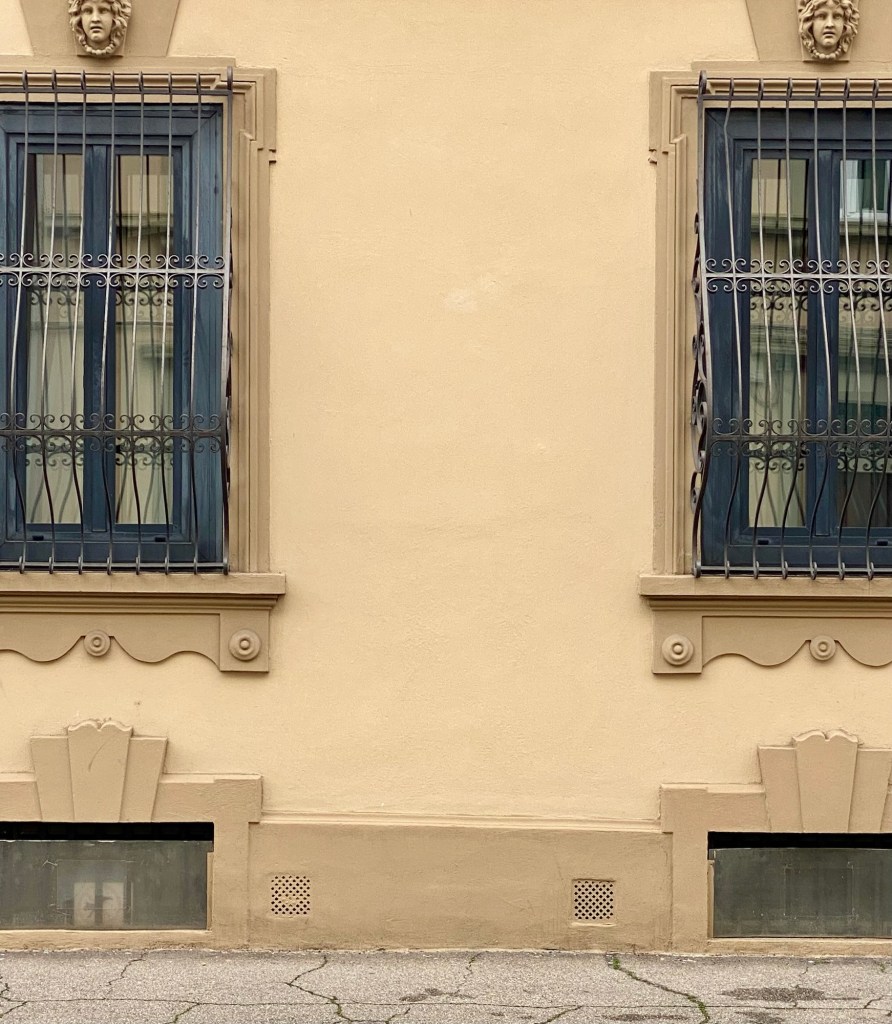
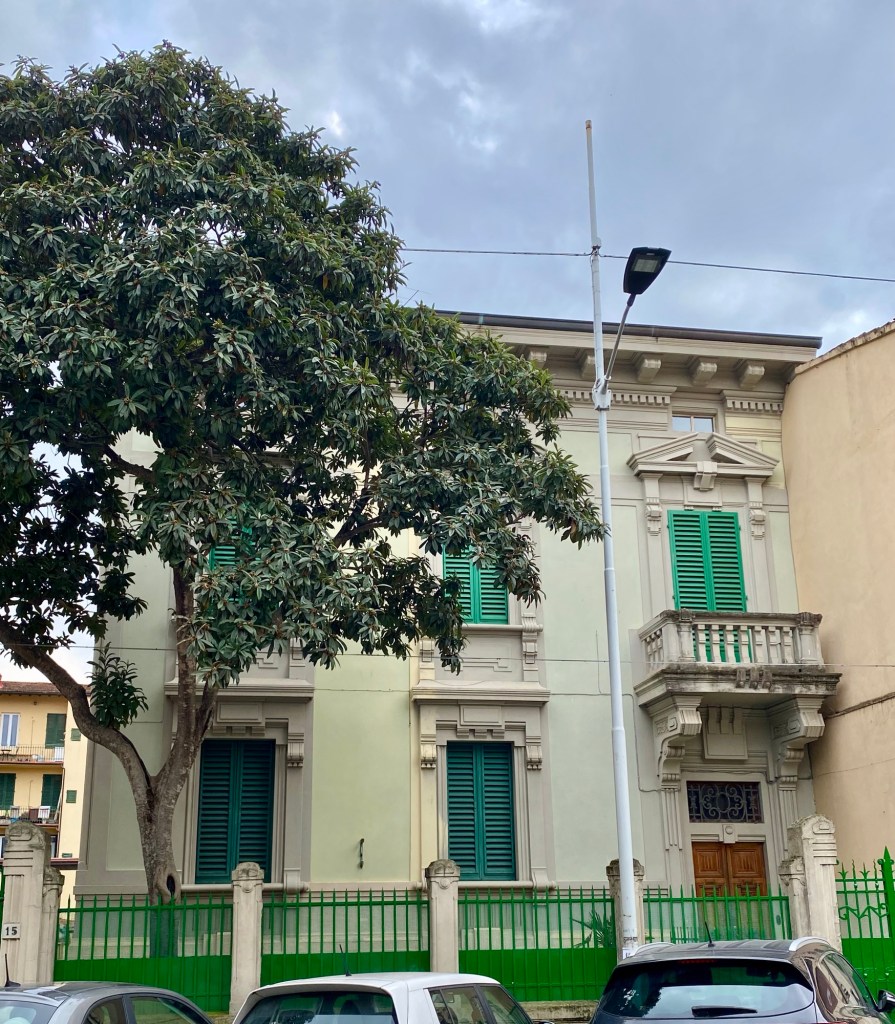
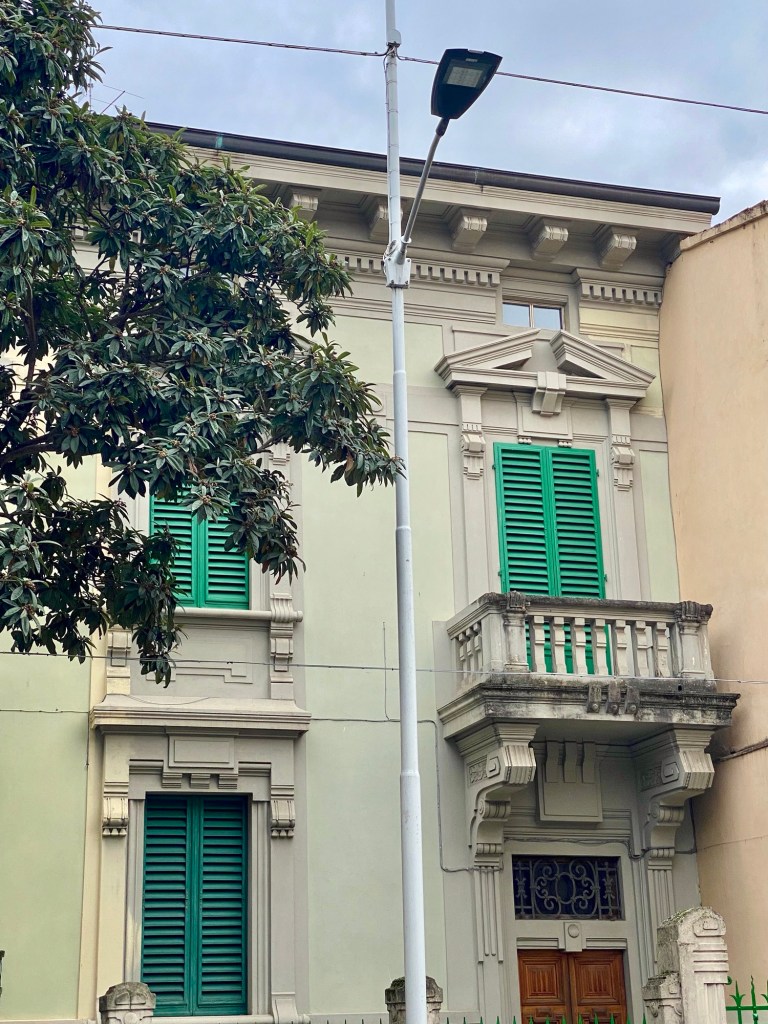
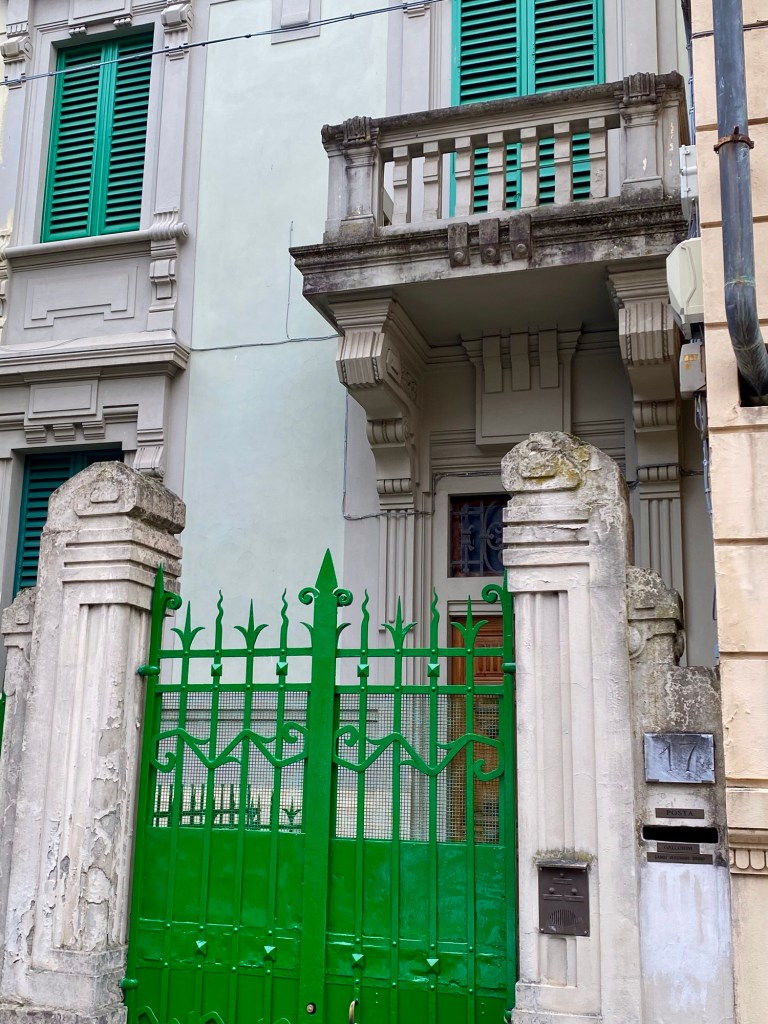
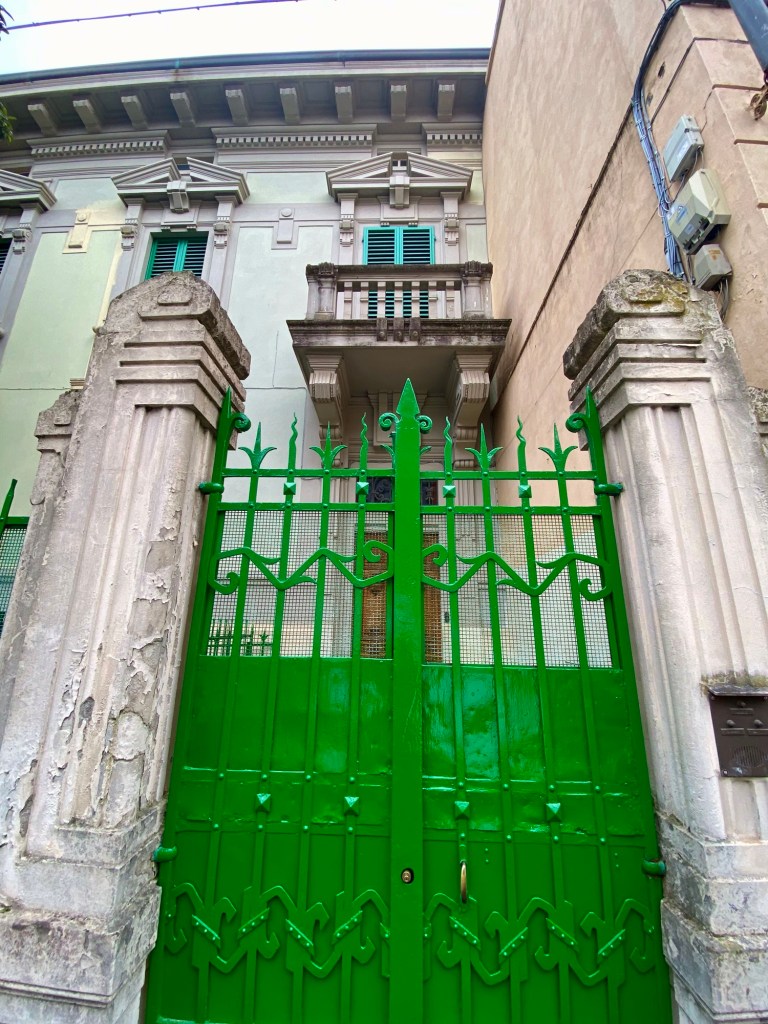
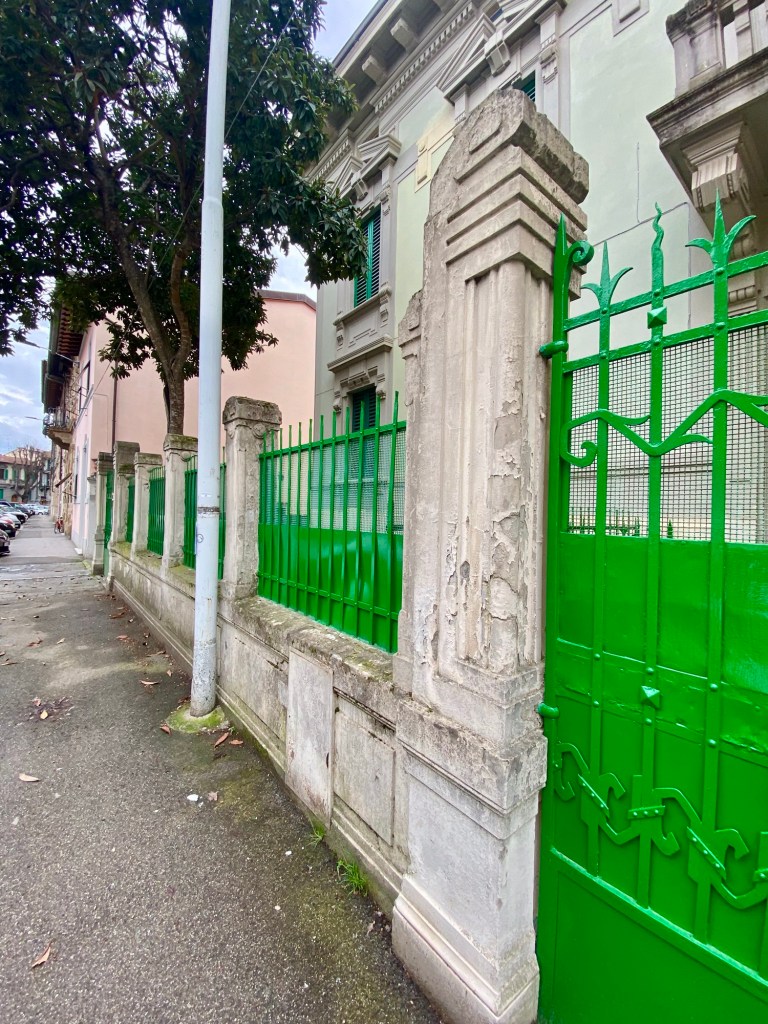
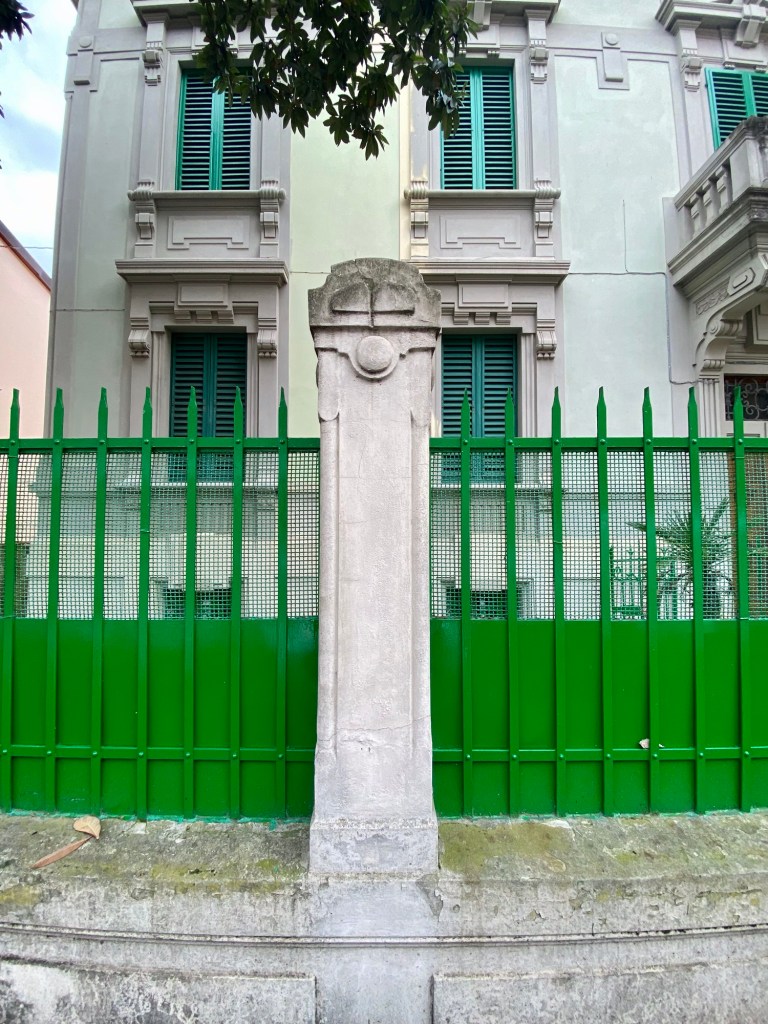
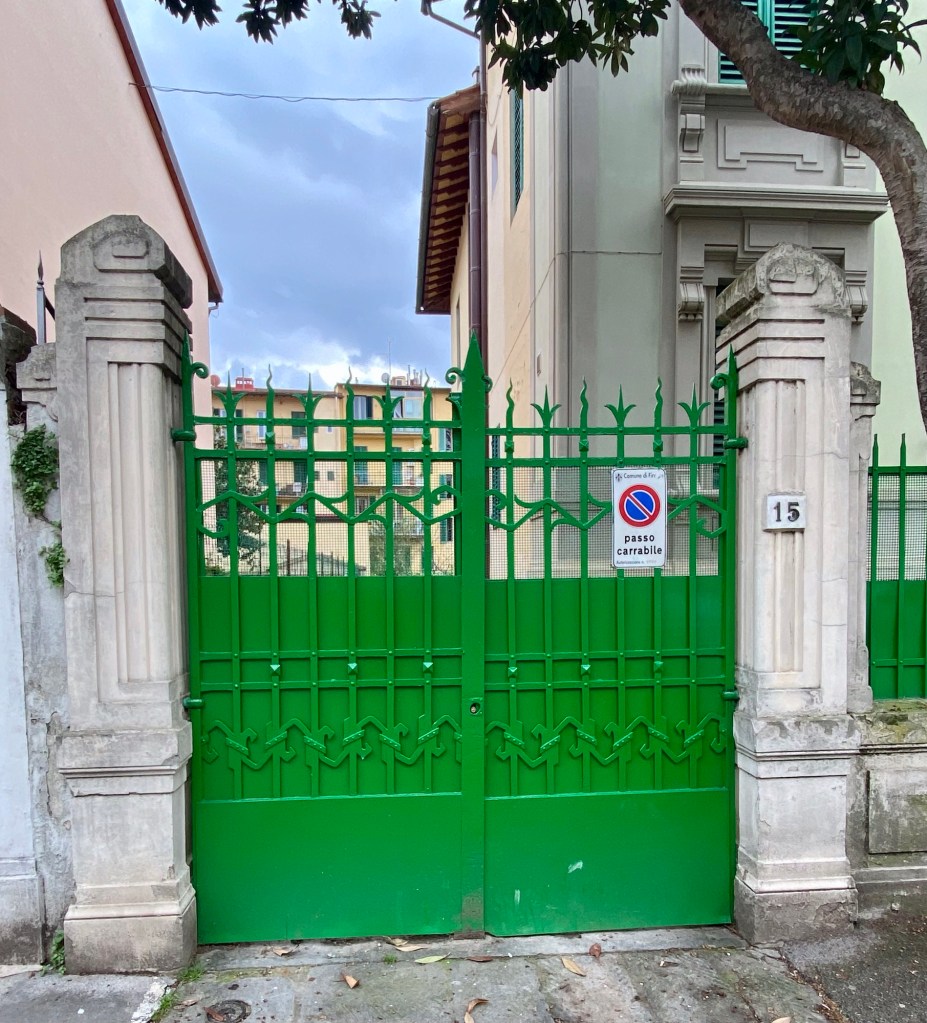
It’s interesting to observe how palazzo decoration changed over the decades. In fact, the overall plan and design of these major, usually domestic architectural structures maintain a pretty strict elevation developed in the Renaissance. The only thing that reflects the decade in which one is built is the applied decoration.
I present, for your appreciation, three examples found in the Gravinana section of Florence, which is on the SW side of the city. I think the deco and nouveau decorations speak for themselves. Enjoy looking at something just a little different from the usual.
Florence offers no end of interesting walks. I’ve never, ever gone out on any walk and not found something fascinating, either visually or historically.
Last weekend I was strolling around the other side of the Arno River from my home. I’ve never had the opportunity to get to know this neighborhood before now. I found a cluster of art deco and art nouveau structures. Fascinating. I love seeing how Italian architects took the basic palazzo plan and added art deco elements that make a very interesting hybrid.
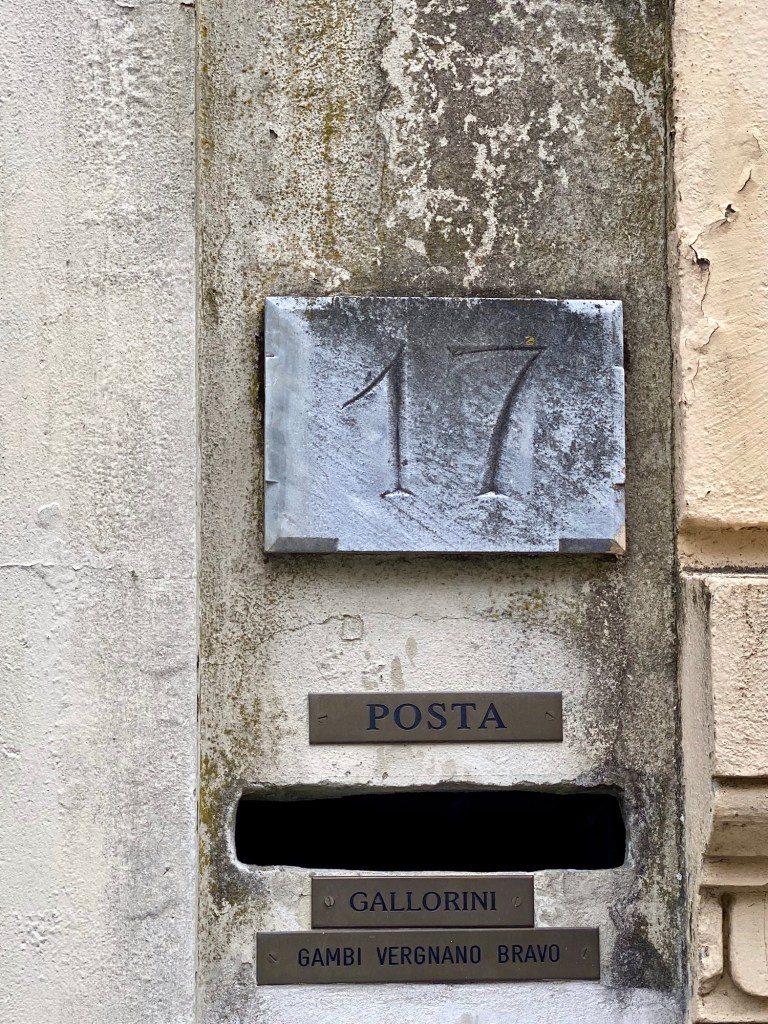
No. 17 is my lucky number, so I’m always happy to see it!
It’s the first of March when I’m writing this so I add rabbit rabbit for good luck, in case you didn’t know.
On a perfect Saturday morning (yesterday in fact) I roll out of bed a little tardi, have a fairly healthy colazione, and head out the door bound for a Renaissance era monastery housing one of the many impressive frescoed Last Supper’s in Florence.
It’s not a far walk and it’s a brisk but mild morning. I’m not very familiar with this part of my neighborhood, so everything is new and I’m very distractible, but I keep on my path so I can fill my senses with art first thing.
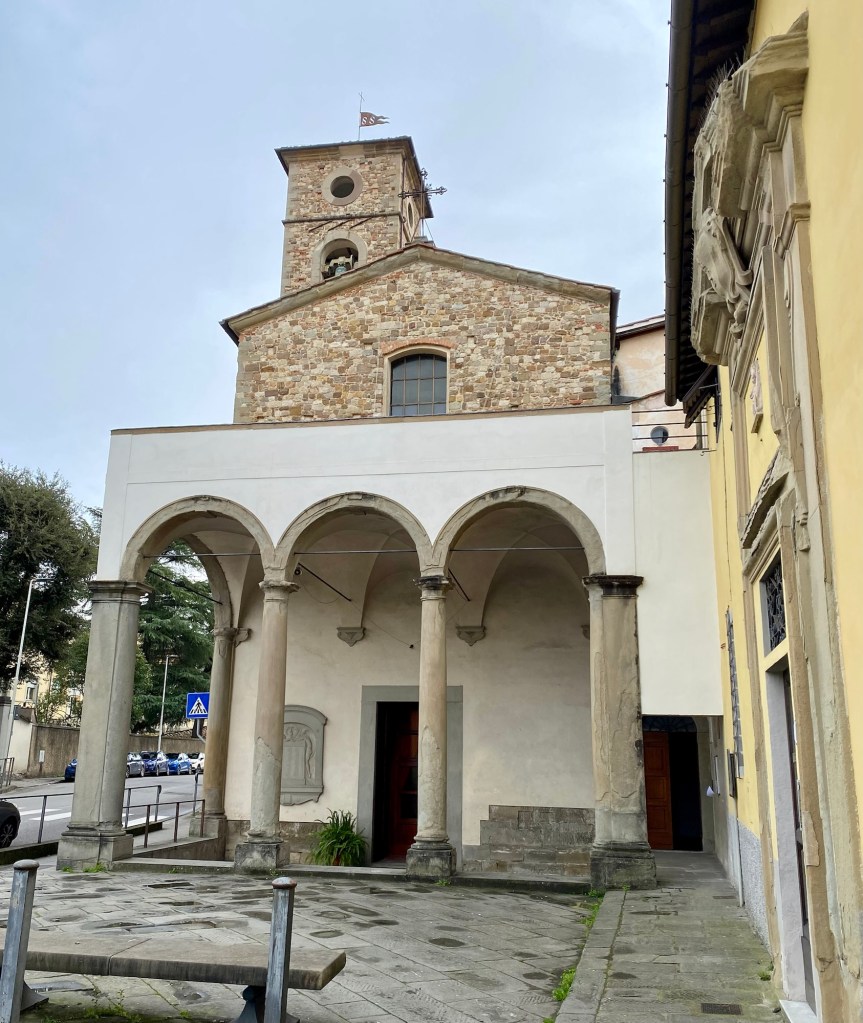
I feel a sense of discovery and contentment when I see the Medieval facade of this august church.
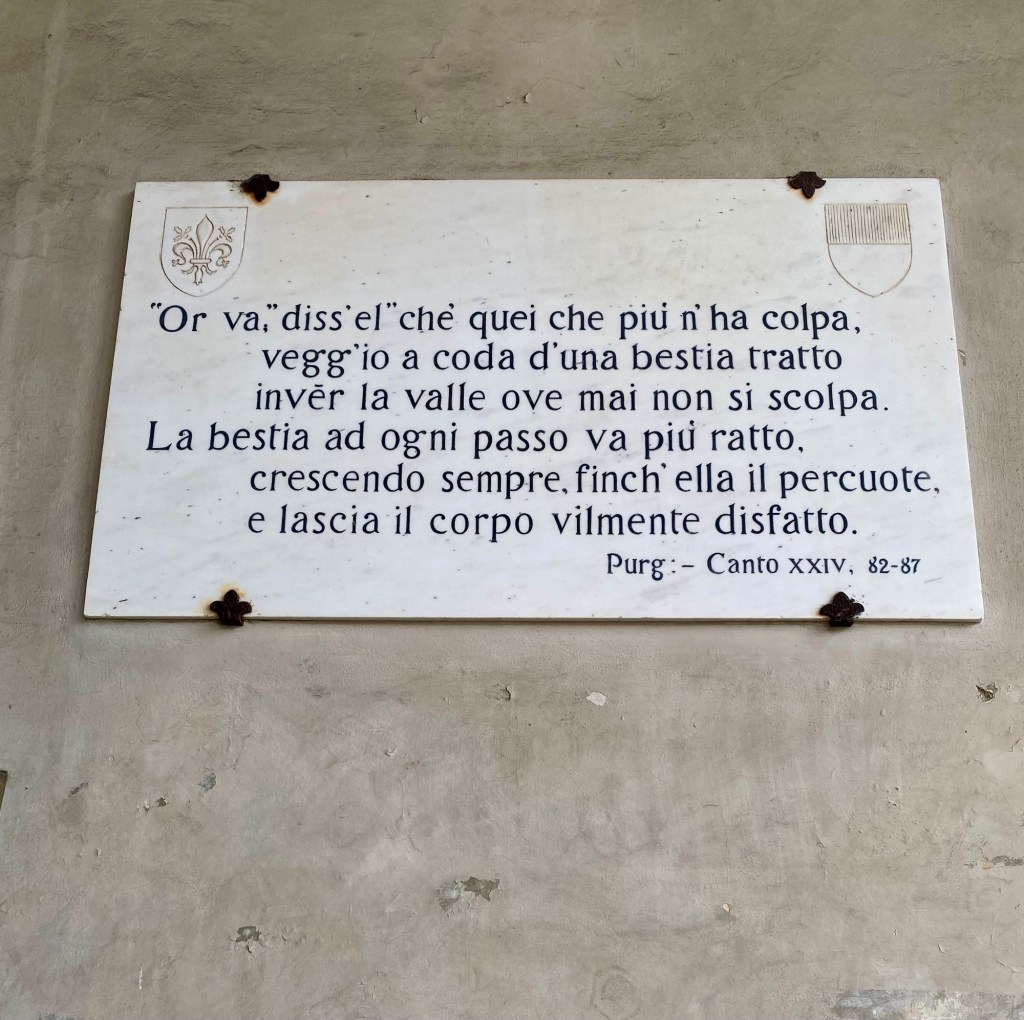
Outside the church I am delighted to see one of the passages from Dante that are sprinkled throughout historic Florence.
I’ve provided a translation from Google for the quote from The Divine Comedy. I will admit I do not understand the significance of this quote in this location, but it gives me something to strive for to get there hopefully, one day.
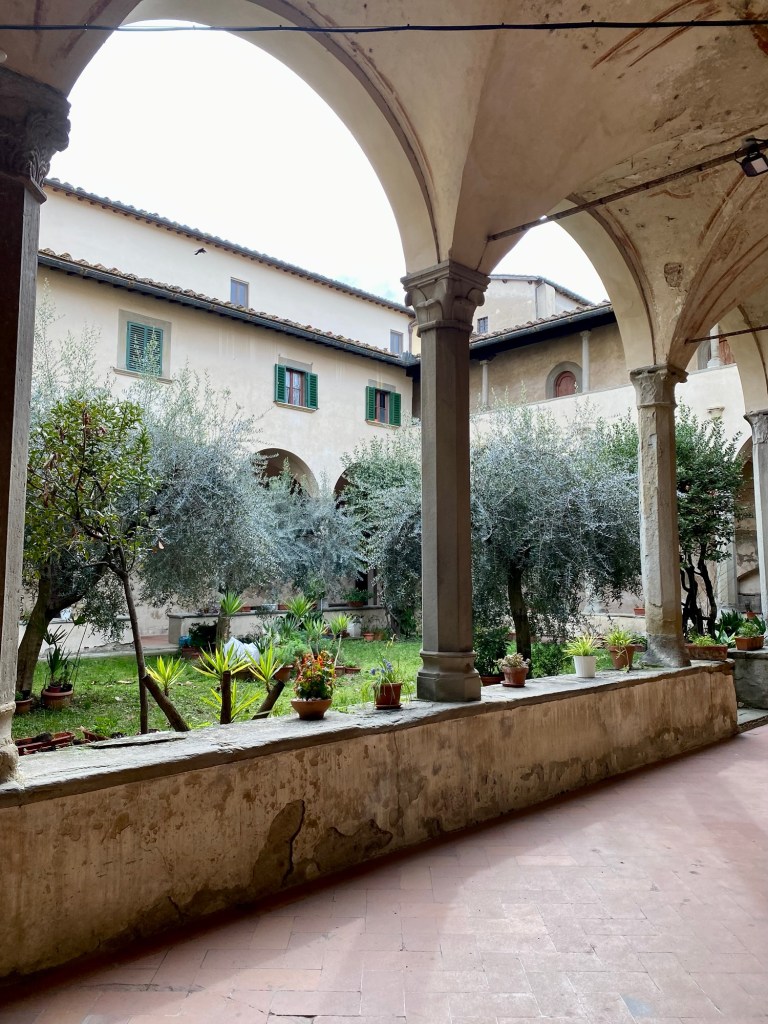
I wander inside a side entrance and I’m soon in a courtyard busy with church ladies arranging flowers for tomorrow’s services (I’m assuming) and a priest who’s met with a young family who gives me a welcoming smile.
I’m a bit confused after trying every open door in the courtyard looking for the monk’s refectory and finally ask one of the women where it is. She directs me back out to the street, past the bar on the corner, and a destra (to the left), which I follow and find what I am looking for.
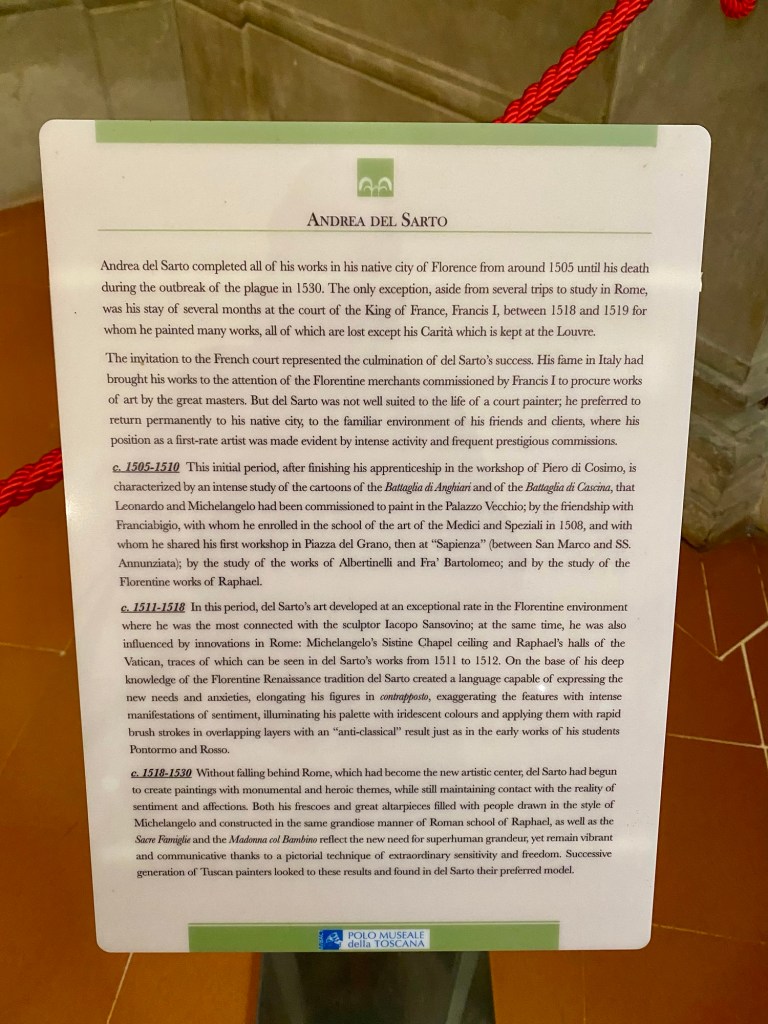
I find the entrance to the refectory and I spend an hour in the delightfully uncrowded space, admiring the masterpiece fresco by Andrea del Sarto, an important Florentine painter of the early 16th century.
After having my fill of the truly amazing artworks housed at this fairly modest museum (the kind of artworks that any American museum would flip over), I go on my merry way, not sure what I will discover, but kind of heading for a small open market I passed by on my way to the church.
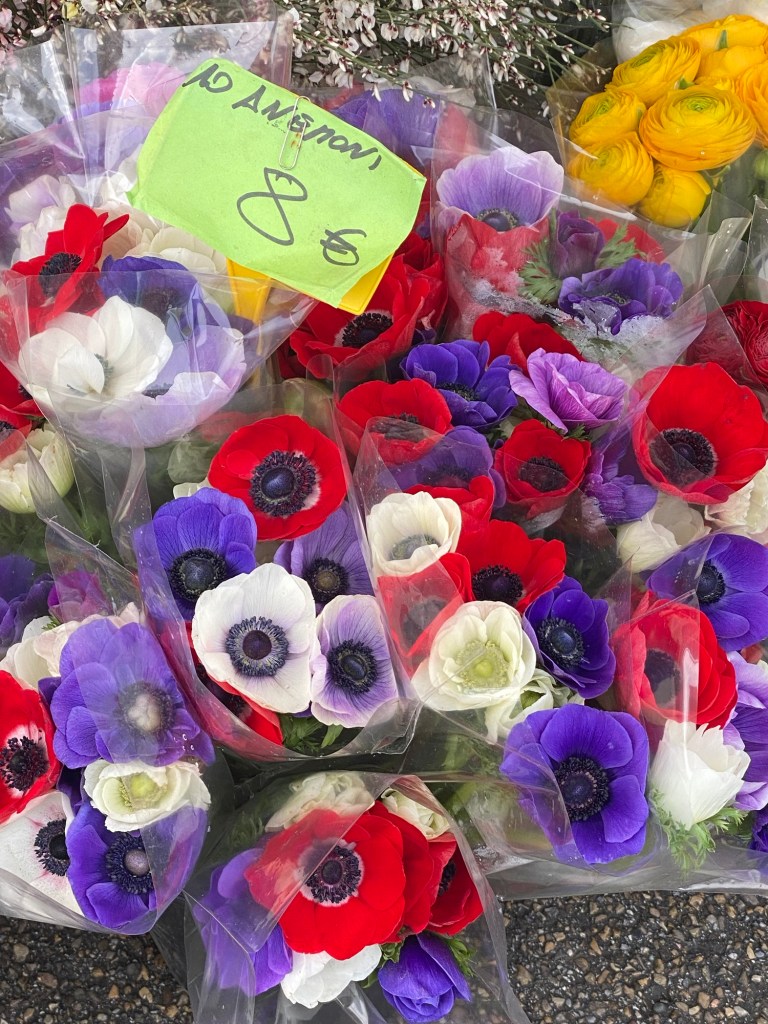
I stop and admire the incredible blooms.
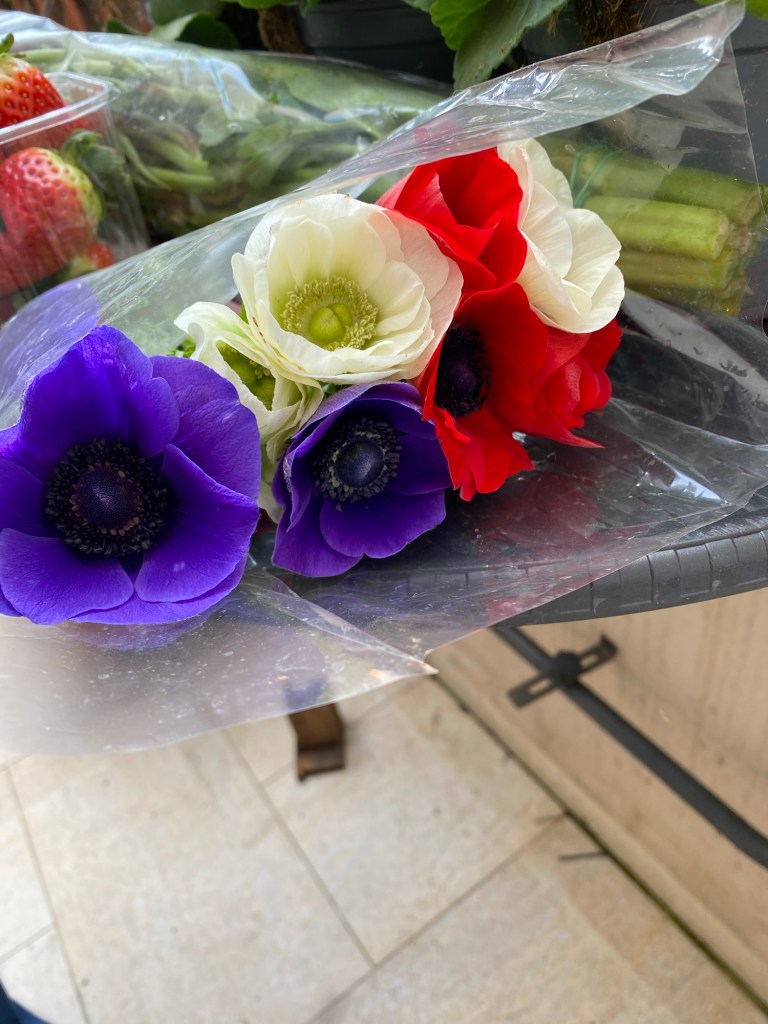
I buy a couple of irresistible flower bunches: one of deep red ranuculus and one of red, purple and white anemones. These are 2 of my very favorite spring blossoms and their availability at this tiny little stand in a modest little market kind of blew my mind, if you want to know the truth. I’m from the interior West of the USA and these flowers are only available in the finest, most exclusive florists back there, at very high prices. I’ve tried (unsuccessfully) to grow these flowers in my Denver garden and never had any luck. So, I carried my little bundles of brightness in my bag, with a spring in my step because I was very very happy!
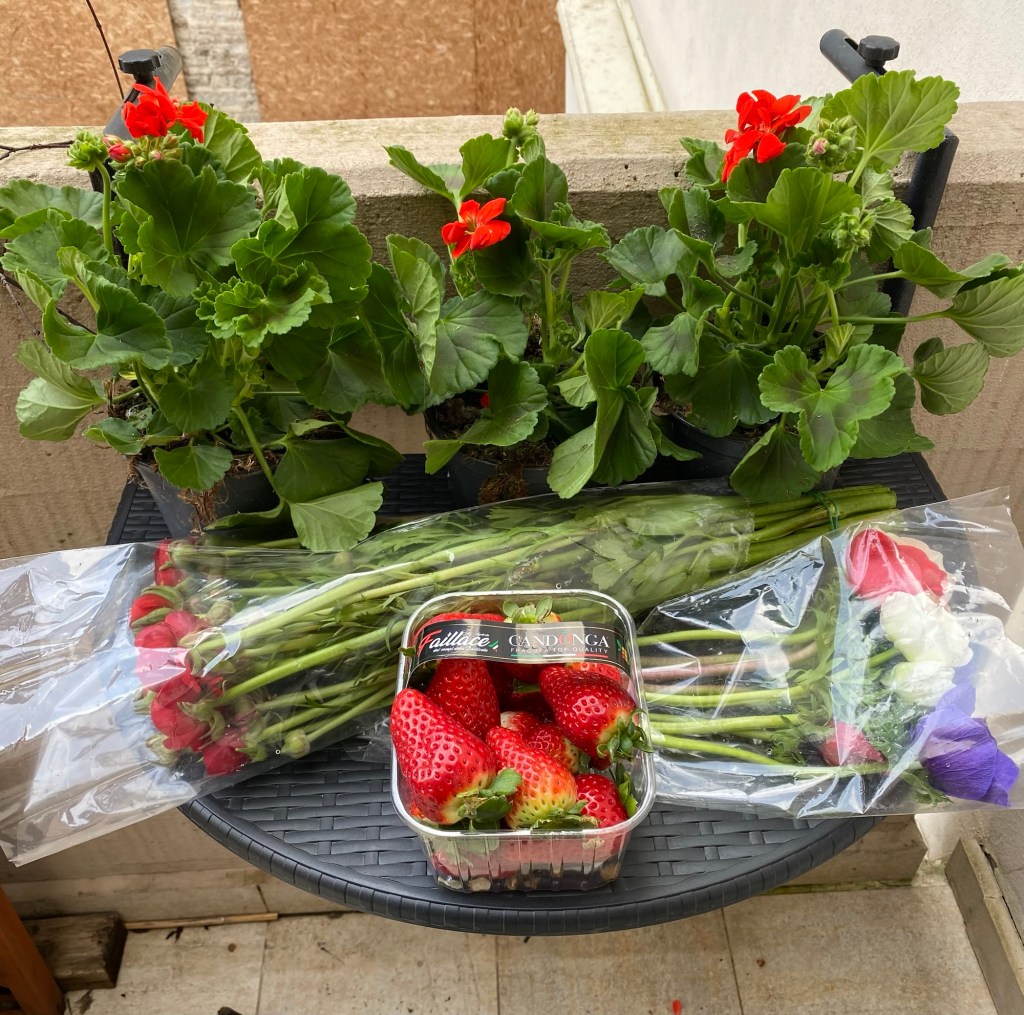
I stopped next at a fruit/veg seller’s stand, under a highway overpass, and was smitten with these luscious strawberries. Of course, I bought a little basket of them as well to enjoy later tonight or tomorrow morning. These ephemeral gifts must be enjoyed almost immediately. You don’t stick them in the fridge and wait to consume. They are ready now and must be eaten subito.
Later I stopped in what turned out to be an award winning and vintage bar/pasticceria and took a cappuccino (that’s how you say it in Italian, you take a coffee, not have or drink a coffee). Marchionne Bar/Pasticceria is the actual name, and Piazza LB Alberti is the actual address. It opened in 1962. I enjoyed looking at all the classic Italian cookies available and thought maybe someday I’ll buy an assortment and see which I like best. Not today, though, bc I’m counting calories.
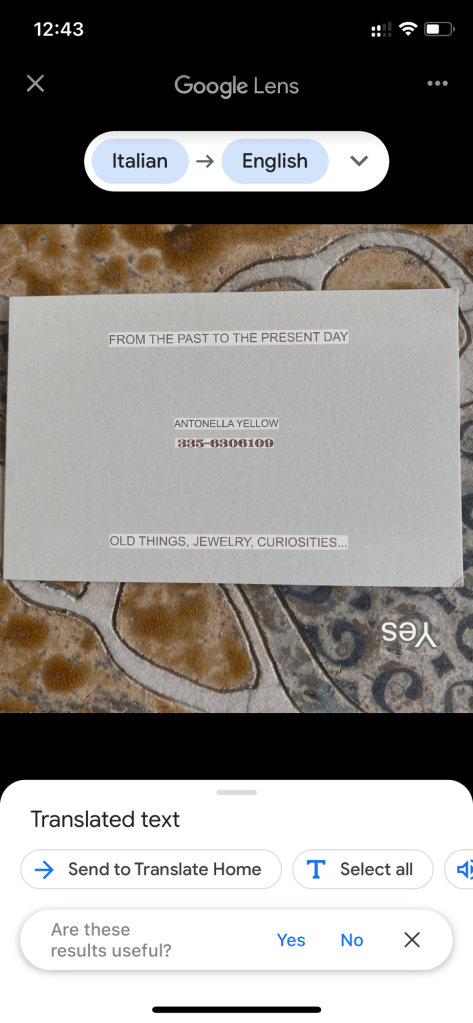
I passed a brocante and walked in and wound up having a nice chat with the owner and her husband about 2 antique mirrors they have that I covet. One was Murano and the other was gold-leafed wood. I’m tempted by both and took her card, see below. I didn’t take pictures of the mirrors though, and I’m kicking myself about that.
And finally I stopped in my local grocery for a couple of things and this little market has become my go-to for plants. Today they had 3 orange/red geranium plants at a very good price and I snapped them up. This week alone at this market I have purchased 2 rosemary plants, one oregano, and now 3 geraniums. I’m delighted they have such a great seasonal selection and keep my eyes peeled every time I’m there.
I came home, made a nice lunch, and now I’m settling down to enjoy a good book and drink some tea. I’m very happy with my day and tomorrow is a free museum day in Florence and I hope to visit one of the big ones!
There’s a prominent spot along the Lungarno in the Oltarno of Florence dedicated to somebody named Nicola Demidoff. There is an elaborate white marble monument dedicated to this person, with a portrait sculpture of him raised on a dais in the center, surrounded by 4 main allegorical figures who seem intent on supplication to children. The whole confection is covered with a glass roof and it is almost impossible not to question who/what/when/where/why about this ensemble when you walk by. I know I always wonder when I am near it. Lorenzo Bartolini, the important 19th century sculptor, created this elaborate monument which makes it doubly interesting to me.
You know I looked into it, don’t you?! Count Nikolai Nikitich Demidov (1773 – 1828) was a Russian industrialist, collector, military commander and art patron of the wealthy Demidov family. He was also the Russian ambassador to Tuscany where one of the Grand Dukes of Tuscany named him the “Count of San Donato.”
Nikolai Demidov inherited his father’s industrial empire aged only 15, including the iron and copper smelting plants of Nizhny Tagil, Nizhny Saldinsky, Verkhne-Saldinsky, Tšerno Istochensky, Visimo Utkinsky, Visimo Shaitansky, Laisky and Vyisky along with 11,550 serfs. He entered the diplomatic service and moved to Paris, becoming ardent supporters of Napoleon I of France. (Thanks to Wikipedia, as always.)
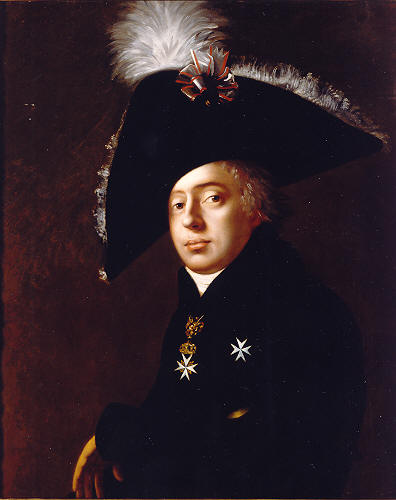
Portrait of Nikolay Nikitich Demidov, Collection Alexandre Tissot Demidoff
However, rising Franco-Russian tensions forced his recall and he, his wife and their children moved back to Russia via Italy (!!), arriving in Russia in 1812. He fought with distinction in the Russo-Turkish War and at the start of the French invasion of Russia he financed the creation of an infantry regiment, naming his son Pavel as one of its officers, which he then commanded against Napoleon’s forces, fighting at Oravais and Borodino.
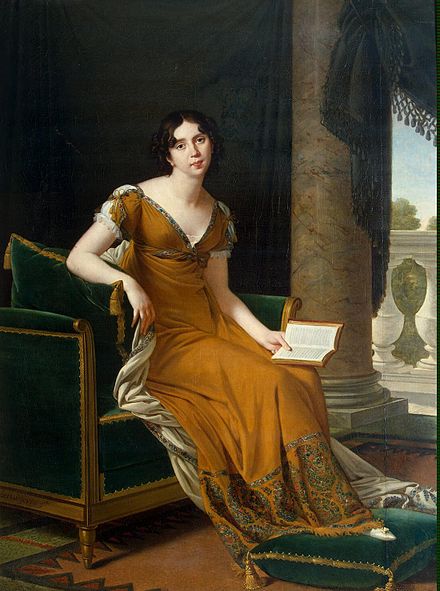
Portrait of his wife, Elisabeta Alexandrovna Stroganova by Robert Lefèvre (c. 1805), Saint-Petersburg, Hermitage
In 1813 he gave his important collections to the mineralogical museum of Moscow founded by his uncle Pavel Grigoryevich to replace those lost in a fire; he also gave art collections to Moscow University. He financed the construction of four cast iron bridges in St. Petersburg. He modernized his factories’ infrastructure, which doubled his fortune. He gave his home over to many industries and public utility services, perfecting the exploitation of mines. At the Nizhny Tagil plant he founded a school in which, in addition to general education subjects, they also taught “the general principles of mechanics and practical mining art.” This school, which gave the best craftsmen for the factories of Demidov and others, was transformed into a district school in 1839 and subordinated to the department of the Ministry of Public Education.
Demidoff also played a significant role in advancing the horticulture of Russia: he acclimatized Bordeaux and Champagne vines and Lucca olive trees to the Crimea, imported horses from England, Merino sheep from Switzerland, ordered Kholmogory cattle, Orenburg goats and Caucasian mountain horses. In addition, he made experiments in the cultivation of cotton and saffron.
Nikolai Demidov served as chamberlain to the Emperor, a Hereditary Commander of the Order of Saint John of Jerusalem, and member of the privy council.
Portrait of Nikolaiy Nikitich Demidov on ceramic by an unknown artist, c. 1820. Kramskoy Historical and Art Museum, Ostrogozhsky
In 1819 he was made Russian ambassador to the court of Tuscany. After divorcing his wife, who moved back to France, he lived his last years in France and Italy among scholars, financing the creation of schools, hospitals and other charitable institutions in Tuscany. He bought 42 acres of marshland north of Florence from the Catholic Church and there built the Villa San Donato from 1827 to 1831, where he set up richly-decorated private rooms, a suite of 14 rooms housing his enormous art collection, a theatre and a foreign languages academy. I’ve posted about this place many years ago and will again.
When I was living in Florence before 2022, the monument was under scaffolding for renovation. It has now been completely restored and sits grandly above the banks of the Arno. The day I took these pictures and videos, the top of the glass roof was being cleaned, which may well be the final step in the renovation.
His collections, reputed among the most lavish private collections in Europe, was divided between his residences in San Donato, Saint Petersburg, Paris and Moscow, and included works by Flemish and Italian masters, decorative art objects and a famous collection of weapons now in the Wallace Collection in London. His collection of ancient Greek and Roman sculptures is now at the Hermitage Museum. By decree of Leopold II, Grand Duke of Tuscany, on 23 February 1827 Demidov was made “Count of San Donato” for the services he had rendered to Tuscany by setting up a silk factory.
He had built a home for the elderly and orphans and donated a special capital for its maintenance. The grateful citizens of Florence in honor of the donor named one of the squares, near the Demidov Charity House, Demidovskaya and placed on this square a statue of Nikolai Nikitich. A public Monument to Nicola Demidoff designed by Lorenzo Bartolini is located on Piazza Demidoff overlooking the river Arno in Oltrarno.
I’ll be returning to Count Demidoff in future posts, for he made a lasting impression on the map of Tuscany during his lifetime. He is a most fascinating figure.























 get back, lauretta!
You must be logged in to post a comment.