I recently posted about the garden at Villa La Quiete, which was renovated and improved by Anna Maria Luisa de’ Medici, the last Medici to survive, in the 18th century. This space was the favored residence of several important women from the Medici family. In the 17th century, Grand Duchesses Cristina of Lorraine and Vittoria della Rovere frequently visited La Quiete, which, from 1650, housed the prestigious Montalve women’s college. The villa housed a school for girls right up to the early years of the 21st century, which is kind of mind-blowing when you think about it.
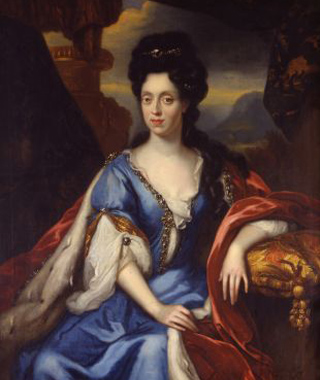
In the 18th century, Anna Maria Luisa, Electress of the Palatinate (wife of Johann Wilhelm, Elector Palatine) and the last descendant of the Medici lineage, indelibly linked her name to this Medici Villa. After returning widowed from Germany following a happy but childless marriage, Anna Maria chose to retire to Villa La Quiete to spend her final years living within the female community of the Montalve college. It was during this time that Anna Maria prepared to bequeath the entire Medici heritage to the city of Florence for the “ornament of the State, for the benefit of the Public, and to attract the curiosity of Foreigners”, as we read on the “Family Pact” document (1737). If you are interested you can Google that pact, which bequeathed to Florence the cultural patrimony that so many flock to see today!
If you take the guided tour of the Villa, you will, as I did, get to see the frescoed apartment of the Electress Palatine, the Church of the Holy Trinity with the Lower Choir, the 17th-century Pharmacy, and a collection of works by Renaissance artists such as Sandro Botticelli and Ridolfo del Ghirlandaio. Notably, the Baroque garden, the subject of my last post, is in the 18th-century form envisioned by the Electress Palatine and just opened to the public for the first time in spring 2025, after a careful restoration made possible thanks to EU PNRR funding.
The pictures below are from my recent visit. I regret I did not take more, but I was highly distracted by the circumstances. I intend to go back in the fall when the villa is hosting an exhibit of treasures including their very own Botticelli if I heard correctly.
Anna Maria Luisa de’ Medici (1667-1743) was the last descendant of the Medici house. The only daughter of Grand Duke Cosimo III and Princess Marguerite Luise d’Orléans, in 1690 she became the second wife of Johann Carl Wilhelm I, Prince Elector of the Palatinate. In 1691 Anna Maria Luisa left for Düsseldorf, capital of the Palatinate; her wedding was celebrated in Innsbruck. In 1716, after a childless marriage and after the death of her husband, Anna Maria Luisa returned to Florence as the Electress of the Palatinate. Italians do love titles.
Upon her return she became a frequent visitor to the Villa. This interest materialized in 1716 with the assumption by the Princess of that patronage that was handed down within the ruling family. Her patronage resulted in the architectural evolution of La Quiete in a real villa in the style of the other Medici villas, among which that of Petraia and Castello. The project of restructuring of Villa La Quiete and its formal gardens started in 1720. This included the construction of the new wing destined for the Novitiate, and an apartment was created for Anna Maria Luisa de’ Medici, after the Princess’s decision to stay for longer periods at the Villa, especially during the summers.
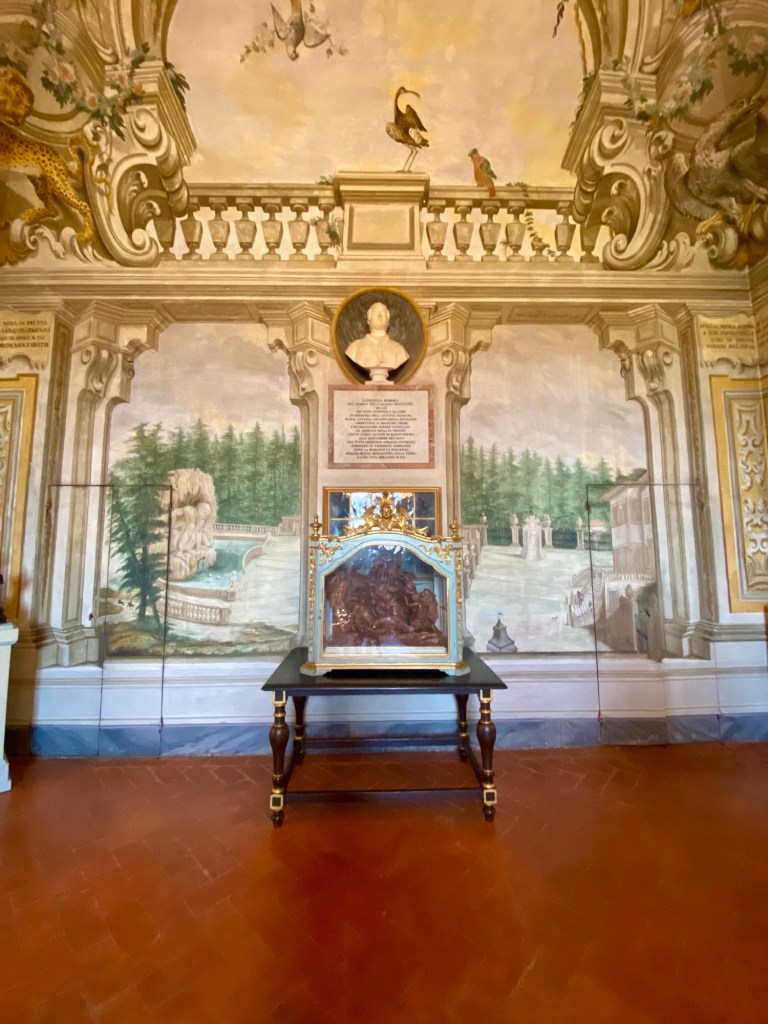
The next few pictures are from her grand salon in the villa. Some are taken from the Facebook Page for the Villa and some are mine.


Under Anna Maria Luisa’s patronage, more than eighty religious paintings and sculptures were brought to Villa, some from the Palazzo Vecchio and some from some of the most active artists in Florence at her time.

Fascinatingly, a door in her grand salon gave Anna Maria direct access to her private rooms on the floors above. We got to see her private stairway!

With the death of Cosimo III the Tuscan throne passed to the Franco-Austrian family of the Habsburg-Lorraine. After the death of her brother Gian Gastone, in 1737, Anna Maria Luisa remained the last descendant of the Medici dynasty. This was precisely the moment when she stipulated what would make the fortune of Florence; she made an agreement called the Family Pact with the new ruling dynasty of the Lorraine that nothing from the Medici dynasty could be transported “out of the capital and State of the Grand Duchy … Galleries, Paintings, Statues, Libraries, Jewels and other precious things … of the succession of the Most Serene Grand Duke, so that they would remain by ornament of the State, for the benefit of the public and to attract the curiosity of foreign visitors.”
With this pact, Anna Maria Luisa made sure that Florence kept the majority of the works of art that were part of the Medici patrimony did not suffer the fate of other art cities which, once their ruling families were extinct or moved away, were literally being emptied of their artistic and cultural treasures.
The historical archive of Villa La Quiete has a section of almost 300 parchments and more than 5000 units (envelopes, manuscript bundles, registers, notebooks, diaries), located within seven archival collections: Congregation of the Minime Ancille of the Blessed Virgin Mary; Congregation of the Minime Ancille of the Holy Trinity, Royal Institute of the Montalve, Brunini family, Baldesi family, Medici family, Gondi family.
Below are pictures of the private chapel in the Villa, created, as you can see, during the Baroque period.


Above: the ceiling fresco
The documents kept refer to the period from the start of the welfare and educational activity carried out by Eleonora Ramirez de Montalvo, and in particular the foundation of the Minime Ancille of the Blessed Virgin Mary in 1626, to the closing of educational activity in the second half of the twentieth century.
The material produced refers to the general administration of the institutes, to the management of the estates, agrarian contracts and rent on their possessions, to the administration of the boarding school, the management of religious obligations, the administration of inheritances and that of their farms.
There is also material on topics such as history, art, literature, educational-pedagogical, social and religious subjects.
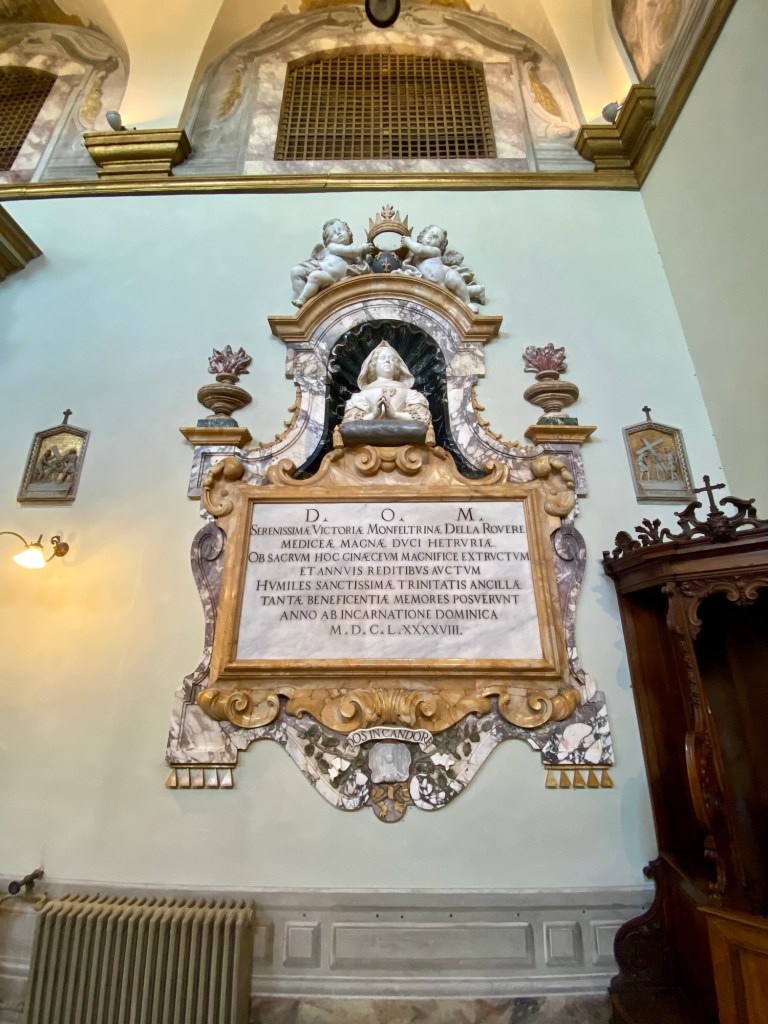
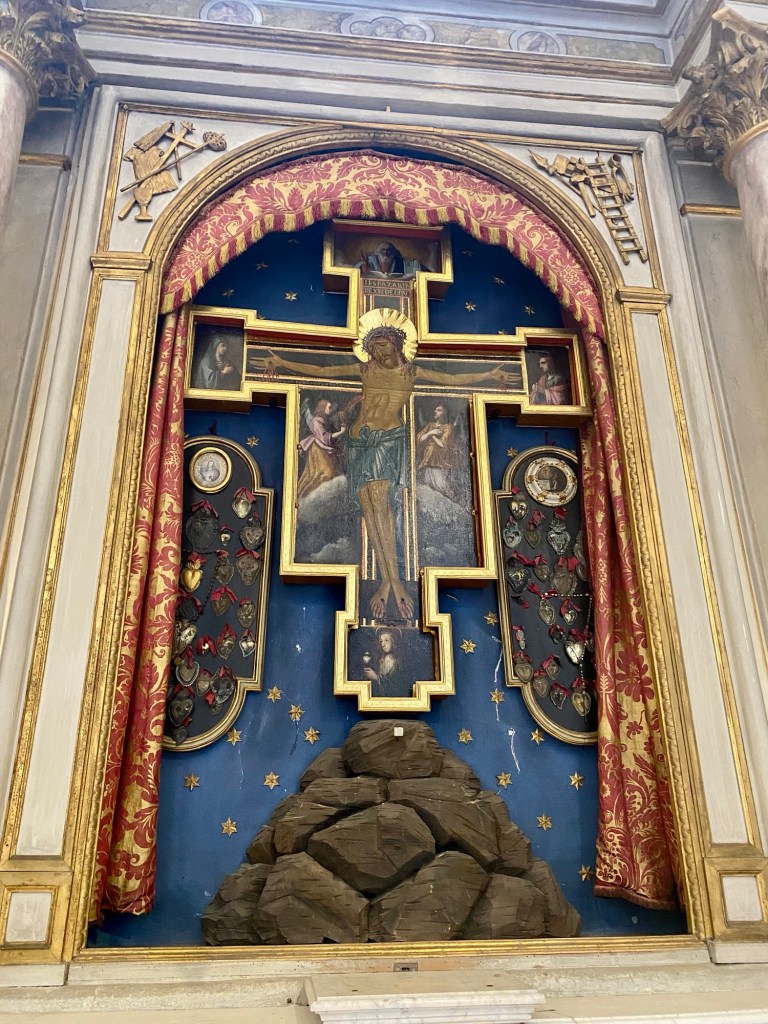
Below are religious paintings and ensembles from the chapel and the outer room, maybe the sacristy?




This villa and its gardens are a wonderful addition to the Florentine cultural scene. Florence has riches that have not yet been opened to the public and I love the chance to see them when they do become visible.
 get back, lauretta!