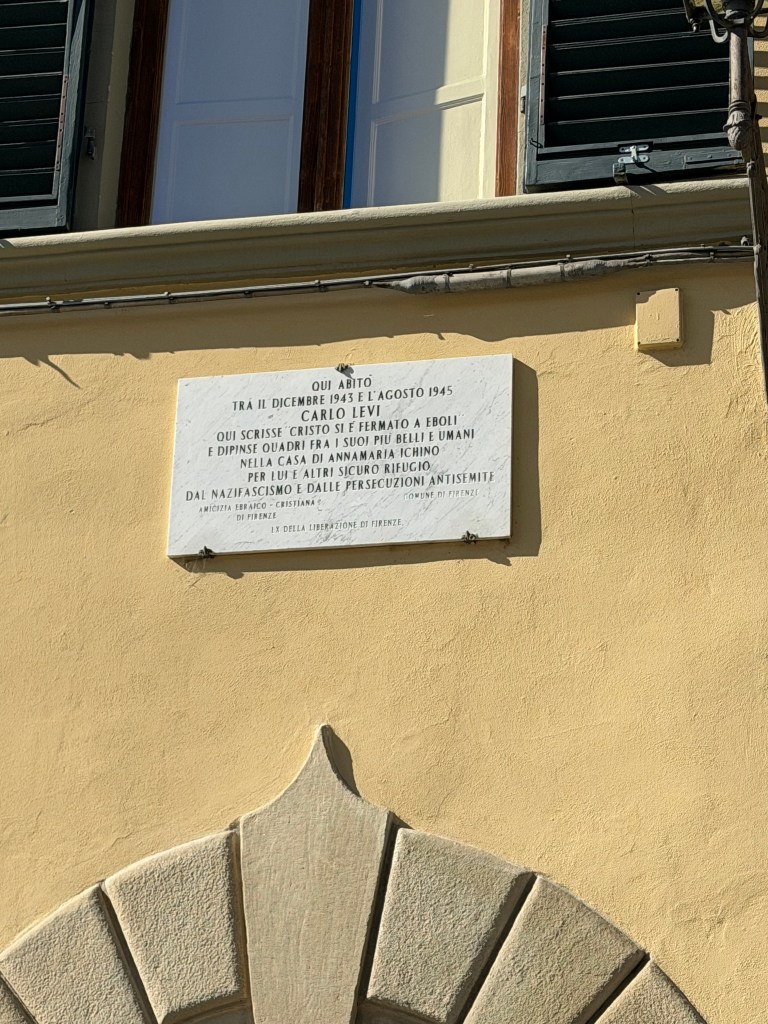
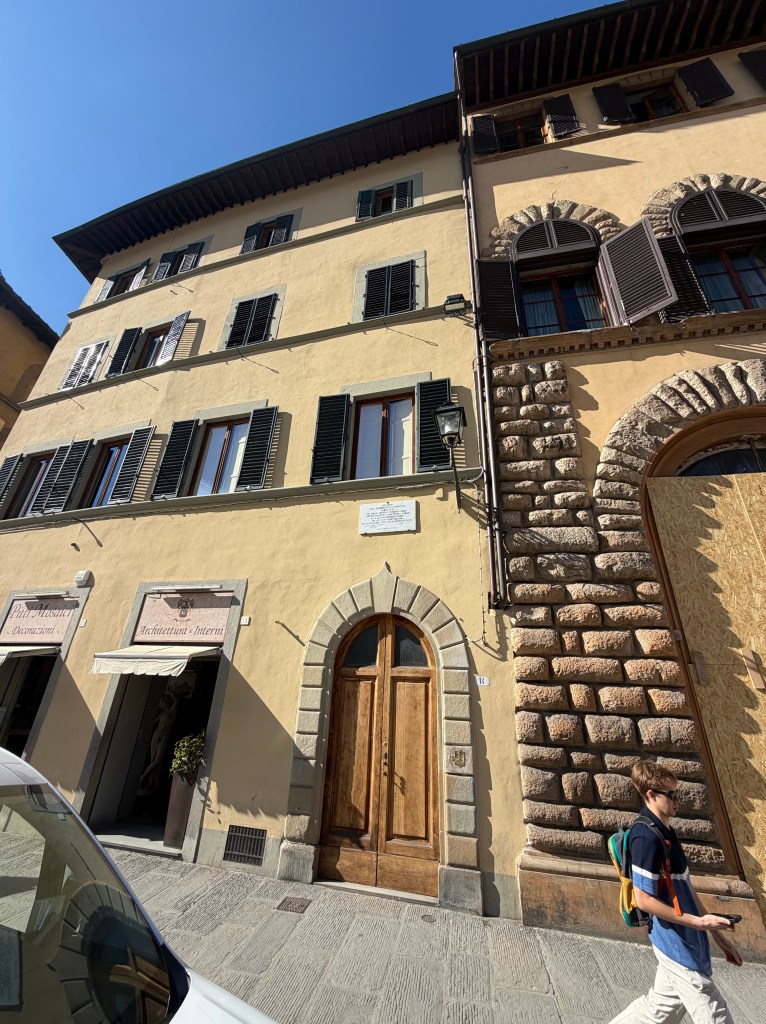
Levi is best known for his book Cristo si è fermato a Eboli (Christ Stopped at Eboli) which he wrote while living in exile in Florence, in this house. The book was published in 1945, a memoir of his time spent in exile in Lucania, Italy, after being arrested in connection with his political activism.
Levi was born in Turin, Piedmont, to wealthy Jewish family. He completed high school and then attended the University of Turin, where he studied medicine and graduated in 1924. While at university, Levi had become friends with Piero Gobetti who sparked his interest in political activism that would continue throughout his life. Soon after graduation from the University of Turin, Levi exhibited some of his art at the XIV Venice Biennale.

Levi never completely abandoned his medical studies and served as assistant to Professor Micheli at the University of Turin’s Clinic from 1924 to 1928, but by 1927 he had decided to dedicate his life to painting. Levi’s early time in Paris, as a painter and as a student of medicine, brought him into contact with many notable personalities of the 20th century, including Sergei Prokofiev, Igor Stravinsky, Alberto Moravia, Giorgio de Chirico, and others.
In 1929, along with Carlo and Nello Rosselli he founded an anti-fascist movement called Giustizia e Libertà, becoming a leader of the Italian branch along with Leone Ginzburg, a Russian Jew from Odessa who had emigrated with his parents to Italy. He also joined with Francesco Menzio in the “Gruppo dei Sei” (“Group of six”), all painters in Turin, including Jessie Boswell, Gigi Chessa, Nicola Galante and Enrico Paulucci.
As a result of his activism and involvement with anti-fascist movements, Levi was arrested and exiled to two towns in a remote area of Italy called Lucania (now Basilicata) from 1935 to 1936. There he encountered a poverty almost unknown in prosperous northern Italy. While there, Levi worked on the side as one of the doctors for the villagers, although he had never practised medicine after graduating from medical school. During his exile he spent much of his time painting.
After his release, he moved to France and lived there from 1939 to 1941. In 1941, he returned to Italy, and was later arrested again in Florence and imprisoned in the Murate prison. He was released following Benito Mussolini’s arrest and sought refuge and lived hidden across the street from the Pitti Palace, where he wrote Cristo si è fermato a Eboli.

The square near the house he hid in has been named after him.
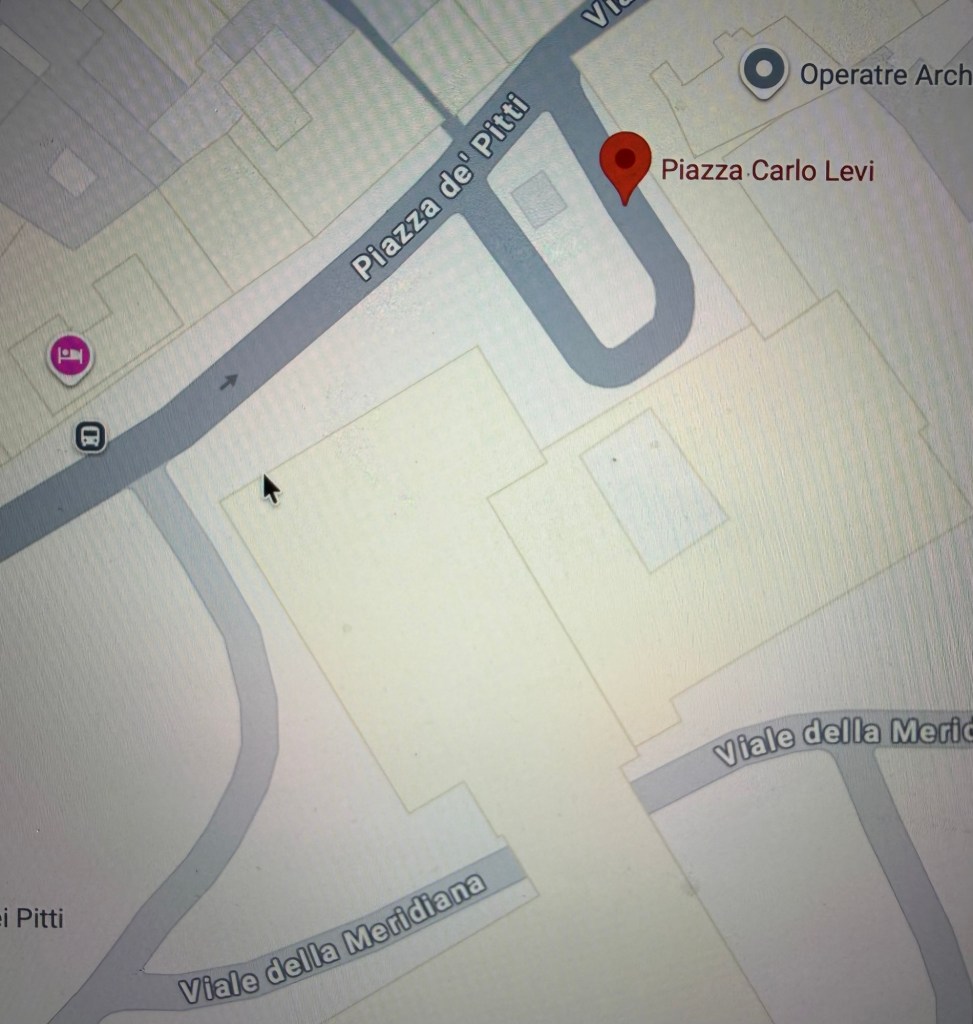
Below is an overview of the house he hid and lived in in Florence.

You can see the 2018 dedication of the piazza here: https://youtu.be/IL0QuK5DliU
 get back, lauretta!