Author: get back, laurettadimmick
Italy and me: the Covid booster
At least 99% of my posts are positive if not effusive about Italy. But, every so often, I bang up against a wall here that nearly knocks me off my feet. This week was one of those weeks.
It’s Saturday morning, 2 weeks before Christmas, as I write this and I have been feeling anything but cheerful. Or well. I don’t have Covid, but I had a nasty reaction to the booster shot that I got on Wednesday.
But, my saga starts well before that. After the vaccine became widely available last winter/spring, I could not get the first two shots in Italy prior to June, because as of that date, they hadn’t opened the availability of shots to foreigners in Italy. Which of course makes no sense, because there are a lot of us and if you are trying to vaccinate a high majority of people, you would vaccinate anyone willing to take the shots.
As it happened, I was returning to the US for the summer anyway, so I decided to not fight the system in Italy and just wait. I arrived June 1 and got my first shot with no hassle at a local supermarket pharmacy on June 2. 3 weeks later I got the second shot. I got Pfizer both times and had no reaction other than a tender injection site.
All was well until the arrival of Omircron variant this past month and the high level of concern that has swept the world since. It has just been 6 months since my double vaccination in the US and technically I should be good for another 3 months, but everyone is being urged to get the booster and in Italy you are theoretically allowed to do that 5 months after your last shot, not like US where you need to wait 6 months.
I have another consideration regarding the booster. I plan to remain in Italy through March of 2022 and then go to France. I have no idea what the system for vaccination in France is and I will be at 9 months by that point after my 2nd vaccination. If the rules become tighter, I might not be allowed into France without the booster and I could be in big trouble.
Sometime over the past 6 months it has become possible for foreigners in Italy to get the vaccine (first shot, 2nd shot and booster), but you know, don’t you, that there would be a difficult, complicated path to do so. Of course you know that. If you follow my blog. Or read anything about Italy.
I am tremendously blessed here in that I have several wonderful Italian friends who help me figure out the byzantine rules here. But, it is easy to take advantage of such friendships and that’s a pet peeve. I try, therefore, to solve my own problems as much as possible by myself.
I’d heard that you go to this website to learn about how to get any one of the 3 shots in Tuscany: https://prenotavaccino.sanita.toscana.it/#/home. It takes you here:

Scrolling down, you come to this item, which is “reserved for those who are not enrolled in the national health care system),” which pertains to me. I can enroll in the national health care system and have. It is expensive and has very little value for money for me. I have opted not to enroll the past 2 years.

Theoretically (n.b.: that’s a key word when living in this country), I should be able to open this page by clicking on the green dot and I’ll be set. But, not so fast.
Clicking takes me to the following screen. It says, “here is the method to register online in Tuscany for any anti Covid vaccine.” Then you fill in the blanks, first and last names, “codice numerico” (hang on, I discuss below), email, cellphone number and click, and I’m not a robot. Seems simple and straightforward, and I do all of it in a rush, but wait, what is the codice numerico (number code) they want?

I try my Codice Fiscale (kind of like a social security number in Italy)–the box will not accept the letters that are a part of this.
I call friends, I go to pharmacists, nobody knows what code this is. Friends look at all of my documents, could it be my passport number? No. Could it be my Florentine residency card number? No. I don’t have my 2021 Permesso di Soggiorno card yet (permit to stay in Italy. I applied for my 2021 card in Oct. of 2020 and still do not have it. This is normal under Covid). So, I try the number associated with my expired PS. No.
I am beginning to pull my hair out a little bit at a time. I’m not panicked because I am well within 6 months of my last shot for now, but then on Monday last, Italy changed the rules again. Now, everyone is required to carry a “super green pass”. Up until now, my CDC card from America has sufficed, but when will that change? Where will I be when it changes? Trying to travel?
I turn to my trusty friends groups on Facebook, such as Foreigners in Florence, and ask questions. Does anybody know what number that is?
The tempo is picking up on these Facebook groups as everyone struggles to figure out how to get the shots (be they 1, 2 or 3). Panic is setting in. We hear that you can go to the big vaccination site in Florence at the basketball stadium, known as Forum Nelson Mandela.

After a few days, somebody on Facebook has figured out the code. It is the number under the bar code on your last application for the Permesso di Soggiorno, only you drop the initial 0.

Here’s my PS receipt. I carry it in my wallet at all times, to prove I’ve applied for a new PS since my last permission to live in Italy is expired. Sure enough, if I drop the 0 and ignore the dash between 5-6, the number works.

I’m ready to break out the prosecco.
Remember, we are days into this process already. So, I click on avanti and am taken into a new page. Rut row: here I must choose between 4 options that describe my particular set of circumstances before making an appointment. None of the sets of circumstances apply to me (for example, I am not embassy personnel, etc.). Catch 22. You’re in Italy.
Dead space. Now what.
I pull out more hair, and consider weeping.
I decide to fib. I say one of the sets of circumstances fits me. I’ll figure I’ll deal with the consequences once I get my reservation.

But, again…not so fast. I am congratulated that my application has been accepted! But then it says the doses are currently limited and they don’t know when I will be able to make a reservation for the vaccine. I am told I find more information by clicking qui, and am thanked for my cooperation.
You know what happens, when I click qui, right? Pages and pages of text that I’ve already read that give me no new information.
Now what?
I contact my British doctor here in Florence and ask him how to get the booster. He says the only way is to make an online reservation at the webpage given at the top of my post.
An Italian friend calls her friend the doctor to ask how I can get the booster when I’m unable to make a reservation online. She says I must go to Mandela and take my chances.

A day later, somebody on Facebook says you can go to Mandela without a reservation and sometimes you can get in and get a shot. My Italian friend has an appointment on Tuesday at 11 for her booster shot at Mandela and she invites me to go with her where maybe…maybe she can talk her way into a shot for me. Such things have happened before.
I meet her there. The authorities will not even listen to her when she asks on my behalf; they tell me to come back tomorrow, Wednesday, for it will be an unannounced “open day.” Meaning, we suppose, anyone can get a shot, without a reservation.
I’m at Mandela at 8 a.m. on Wednesday and hear people murmuring on the sidelines. I find an ally. She tells me they only have Moderna vaccines; she’s there for her first shot; you have to go to the barriers where 2 Italian older men are operatically fending off all comers. One of them has the golden ticket. In fact, she thinks he has 50 golden tickets to hand out to the first 50 persistent (not to say aggressive) people who entreat the man for a slip of paper.
I leave my American body. I transform into a pilgrim, seeking salvation from the one person on earth that can give it to me. I become an aggressive, down-wrapped bundle of puffer coat, not taking no for an answer. I plow my way to the front. I get a slip. I am number 19.

What happened, you ask, to the concept of the “open day,” in which anyone can get a vaccine. Well, it has transformed too. Into 50 golden tickets that will last less than 1 hour. After that, sorry Charlie, the open day is over. And the rumor is, they will have no more of them.
Now, with my slip of paper, I am giddy. I’m still outside in the cold with all the other pilgrims and there’s no queue. They don’t do that here.
We are a chaotic group of pilgrims, all borrowing my pen because we have to fill out the slips of paper on each other’s backs. Now we huddle near the operatic men busy letting in Italians with appointments. No announcements are made. Nobody knows what is going to happen.
Times like this freak me out. As an American, I have never experienced this kind of panicky waiting and neglect by authorities. If I were at home, I could expect organization and someone who knew what would happened next. I could ask questions. Here, it is useless. It always makes me think of WWII movies and people desperate to cross borders. Of course my life doesn’t hinge on decisions made by operatic men at the Mandela Forum on this day, but you need to give that information to my amygdala. It is on high alert.
Somehow, I have become the leader of a small group of pilgrims in this quest. We are composed of an American, a German, 2 Russians. We laugh hysterically at the way Italy is run, because we are all a little bit hysterical. We madly giggle at the way it feels like we are on a scavenger hunt, when we are actually trying to be good global citizens, following the recommended rules for saving humanity from this scourge. I counsel everyone to be aggressive. This is no country for the timid, I say. Who am I?
Then, with no warning, 4 people in our larger group of pilgrims are let inside the barriers by the opera men. We crowd closer in. A little bit later the next 4 are let in, and I am aggressively one of them. I see an opening, or I make an opening, and I am in! I look back longingly at my new German friend; he has been left behind.
Later, he’s in too! We are happy! We discover we now need to fill out a new sheet of paper, but where do we get it and which one? There are 2. One impatient opera man has both sets. He asks me if I want the first shot or 3rd and he’s frustrated when I don’t understand him. Eventually I figure out that “terza” is the name we are using for the booster shot. I get the form. I fill it out on a little round bar table (one of 2 they have provided for 20 people or so) they supply. There are 6 of us at at table meant for 3. Using my pens.
We help each other figure out what information is asked for on the 2 sides of the one sheet we are given. On both sides we are asked to fill in our full names and places, dates of birth. My German friend remarks that Italian bureaucracy is like this: it is either almost non-existent, or Uber-bureaucratic. Seems like the right comment from a German.
We copy each other’s forms, checking boxes we only half understand because we just want to get to the next stop on this scavenger hunt and not be left behind. No one shows us the way. We don’t know where we are going (we hope inside the Mandela building, because it is raining now too) or when. We get into lines. We remark happily that we notice the lines are moving pretty quickly.
We get inside the building and see that it is set up with social distancing, which is kind of funny too, because we have been huddling for the past hour in our school of pilgrims and I assure you there was no social distancing there!

The line of seated people in chairs moves quickly. We arrive individually at a desk with an authority sitting on the opposite side with a screen. I show my forms filled out outside the forum. And ID. And reiterate that I am getting the 3rd shot, told it will be Moderna; I agree. Much of this info is entered into a computer.

Now I am told to wait in another spot with my new form to be filled out by the doctor who administers my booster. When I arrive in this spot, I see my doc; reading his phone.

I give him the benefit of the doubt. It is probably mind-numbing to administer shot after shot for hours on end, day after day.
He calls me in, asks me if I’m Italian with my first name, and we go over my paperwork. All is well. He gives me the shot. I ask him how it’s going. He says he has given around 10,000 shots since May, when he started. I wish him a Buon Natale.

I’m told to go to another waiting area and wait 15 minutes to be sure I don’t have a reaction to the shot.
Fortunately I don’t have a reaction and I meet up again with my German friend. We exchange numbers. It’s as if we have been in combat together.
Postscript: as a part of the process, during the brief interview, I am told to email photos of all my documents and my new form showing I’ve been given the 3rd shot, to an email address. It is highlighted in yellow on the photo of the document below. Please note: the first letter is missing. The authority calls this to my attention and reminds me to remember that it is a “U”. Sending these documents in is supposed to result in me acquiring the “super green pass.” I asked when I will receive it. He makes the “chissa‘?” gesture: who knows?

I notice this and photograph it:

Then I notice this and photograph it in case I need more info later. Because, chissa‘?!!

Advent, day 11, a blast from the past

,
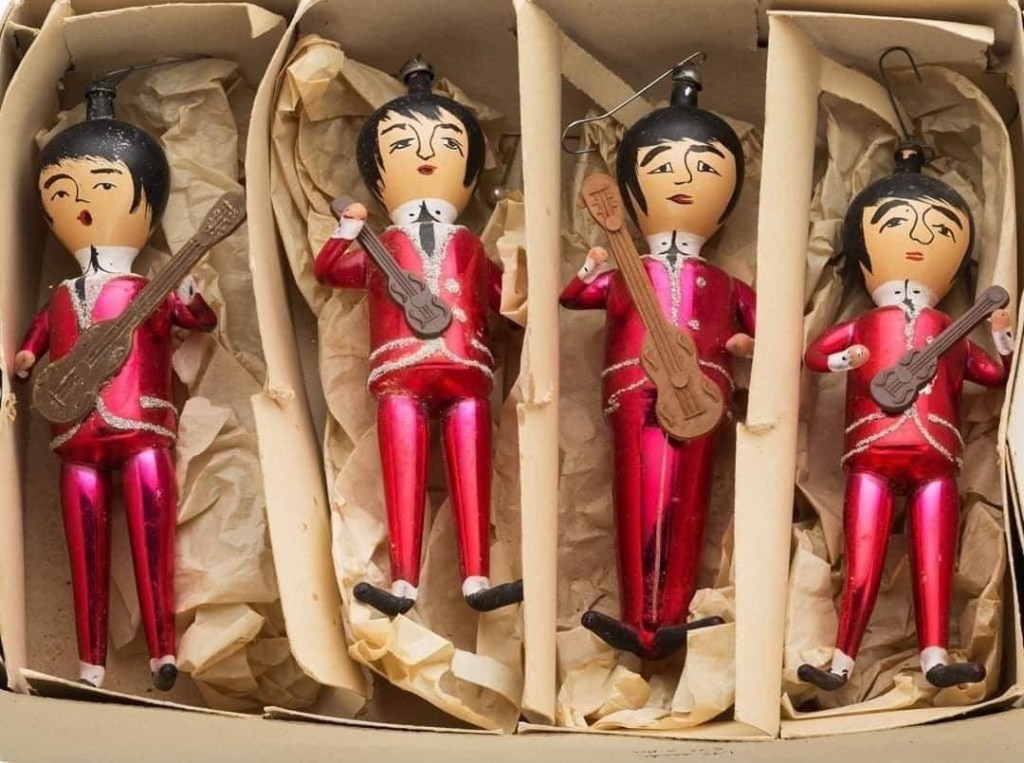
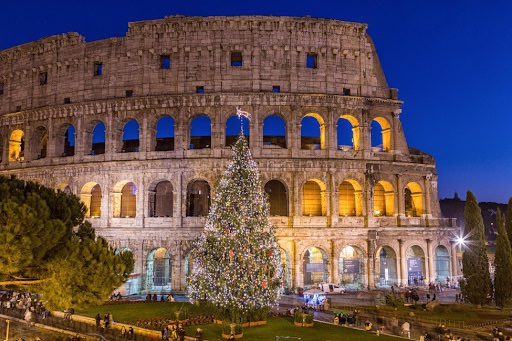
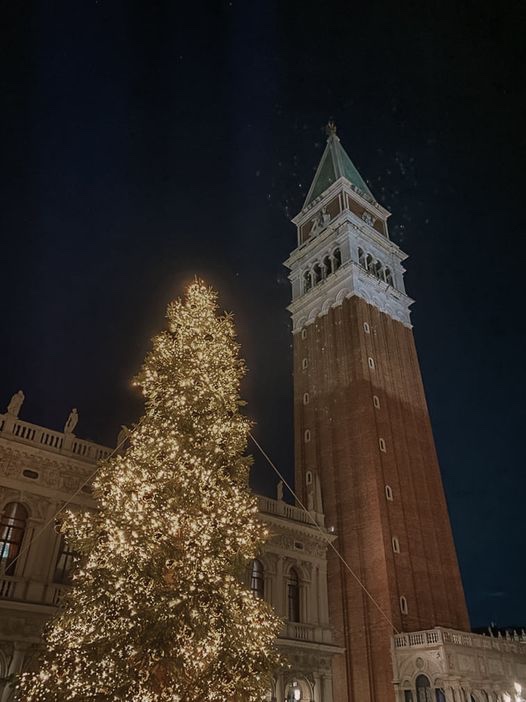
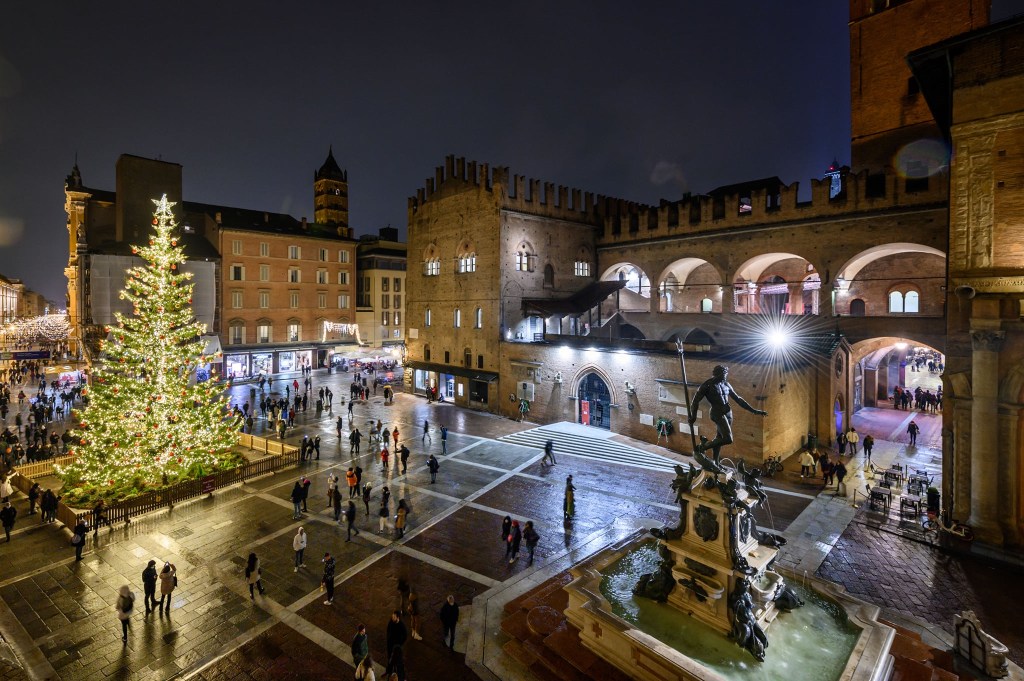
Advent, Day 10, season’s greetings from Rome, Venice, Bologna, and Florence
‘
The exterior of the Modena cathedral and the astonishing first sculptural representation of the King Arthur legend!

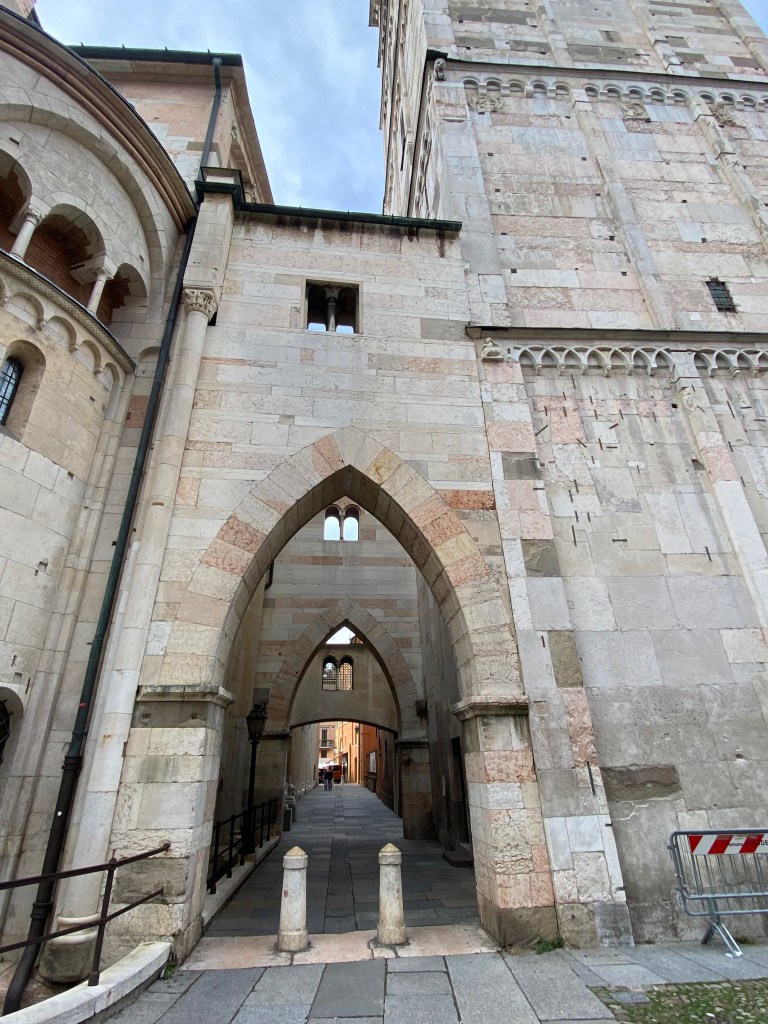
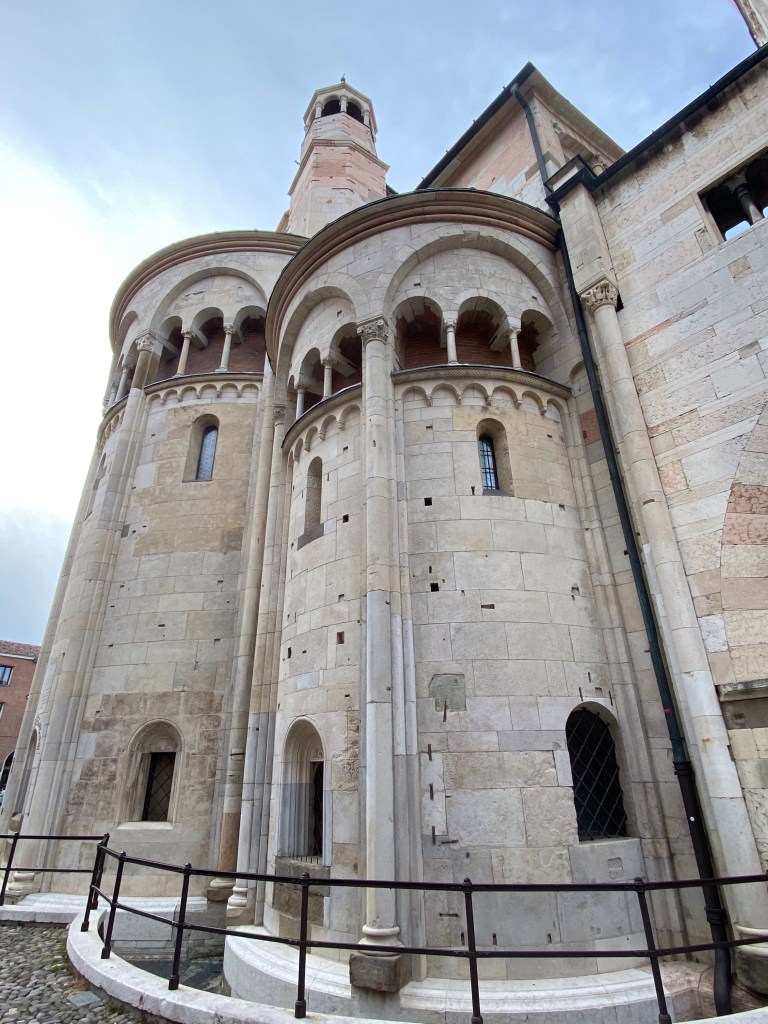
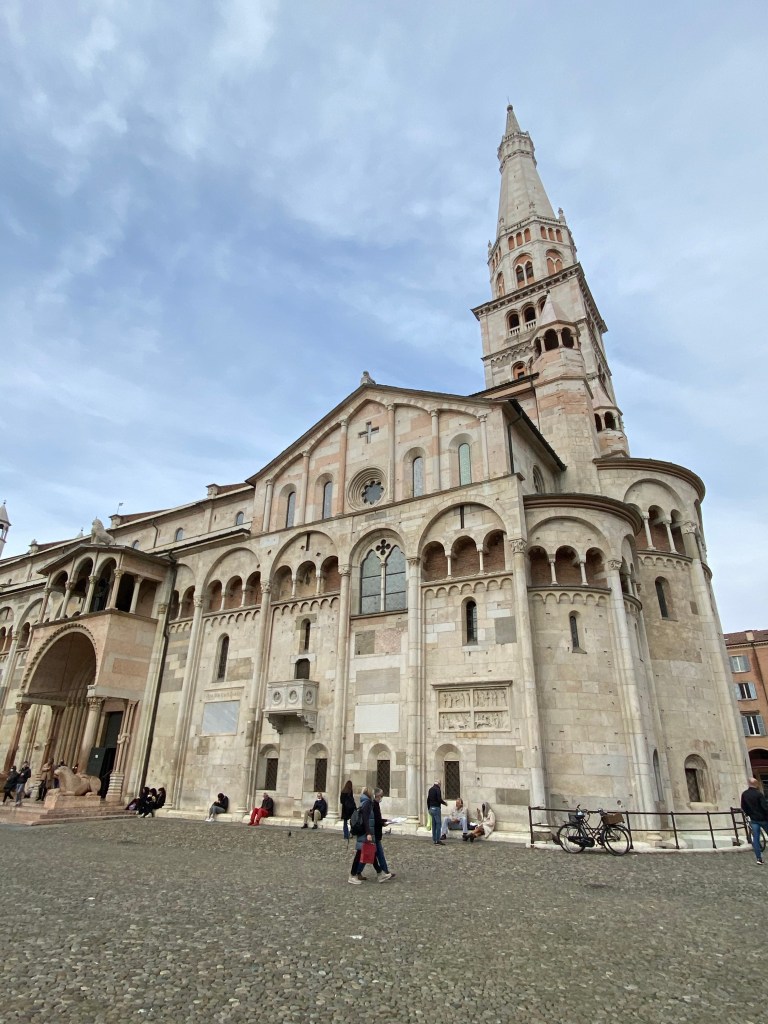
The foundation stone for the new Cathedral was laid on 9th June 1099, when the Modenese community desired a new Duomo to finally put their Patron Saint, Geminiano (312-397), to rest.
The architect was Lanfranco; the sculpture by Wiligelmo. The construction started fast building from the apses, and in 1106 the Saint was solemnly laid to rest in the new crypt. Pope Paschal II and the feudal lady Matilde di Canossa attended the ceremony (this is the story told by the Relatio de innovatione ecclesiae Sancti Geminiani ac de translatione eius beatissimi corporis visible in the Museo del Duomo).
In 1173 the Congress of the Lombard League (of which Modena was a member) was held here. The official consecration of the church took place in 1184 with Pope Lucius III.
From the end of the XII century, replacing the followers of Lanfranco and Wiligelmo, the so-called “Maestri Campionesi” started working on the cathedral, remaining here until the middle of the 13th century. They made several Gothic modifications, such as the rose window, the lateral portals of the facade, the addition of the Porta Regia on Piazza Grande, the false transept, and many internal decorations, plus the wonderful spire of the Ghirlandina tower.
In the first half of the 15th century, the ancient wooden trusses were substituted by the cross vaults in brick and the aisles were enriched by works of arts and monuments.
The Cathedral has always been at the heart of the town life. One legend says that the Emperor Charles V risked breaking a leg when slipping in the nave, while visiting Modena.
During the Baroque period, the church was considered bare and so it was additionally decorated. Someone even proposed destroying the Duomo to build a new church: fortunately his whim was not satisfied.
Other alterations were made in the 18th century, particularly in the central apse of the crypt, and at the end of the following century, when the Cathedral was cleaned up from all the unnecessary decorations.
A solemn Te Deum was performed when Napoleon passed through, and another one when the Estense Dukes returned to Modena after being re-enstated.
Recently the Duomo has been restored in order to conserve it in the best way possible, expecially protecting it from smog and subsidence. So, one can admire the Cathedral as thousands of people have done in 1000 years of history.
Facade
The Cathedral, as many of the churches of the same period, is built in a west-east direction, with the facade is the western side.
The facade, on Corso Duomo, was planned, like the rest of the edifice, by the famous architect Lanfranco, about whom we know little.
The height is exactly the same as the width, lending the church a robust but gentle harmony. All around the exterior, it is decorated with loggias closed under arches, and adorned with wonderful capitals and statues. Three doors are open, though originally only the central one existed: modifications, like the rose window, carried out by the Maestri Campionesi, who worked here from about 1170 to 1320.
The four large reliefs by Wiligelmo are exceptionally important, as they symbolize the renaissance of art after the medieval centuries. They were put on the same level as the central ones, so that people who could not read were able to find the illustrations of the Biblical stories they had heard about.
Starting from the left, in the first relief: God in a mandorla (symbol of inner life and light) with an open book in his hands, over two angels; Adam’s creation and Eve’s from one of his rips (the caption are still visible nowadays); the orginal sin (the protagonists eating the apple offered by the snake, and covering themself with fig leaves).
Second relief: God points disapproving at Adam and Eve, who tear their hair, while an angel drives them away from the Eden; they are then completely dressed working around a plant, their heads bowed under some arches.
Third relief: the first men after the original sin. Cain and Abel offer a lamb and some ears of corn to God, then Cain kills his brother hitting him on the head and is reproached by God.
Fourth reliefs: Cain himself is killed by the blind Lamech as it was predicted (he shoots an arrow with his eyes closed); Noah and his wife during the Flood in an ark which is vaguely similar to the Duomo (the believers are saved by the church is the message); Noah with his sons Sem, Cam and Iafet go out of the ark to populate the world.
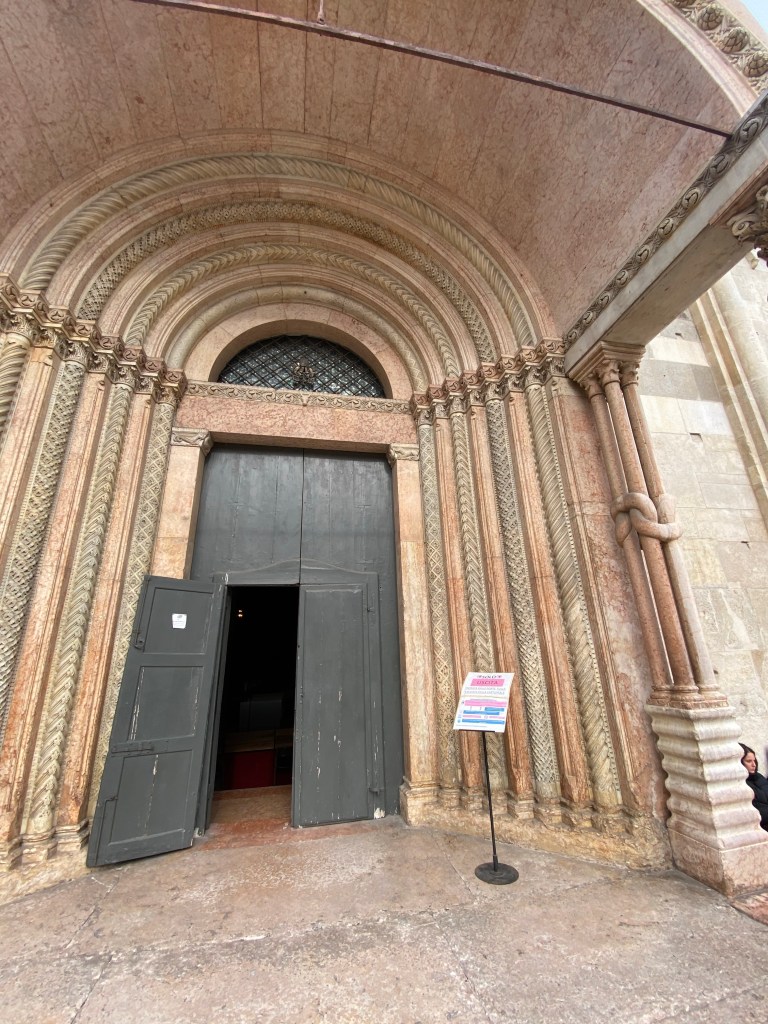
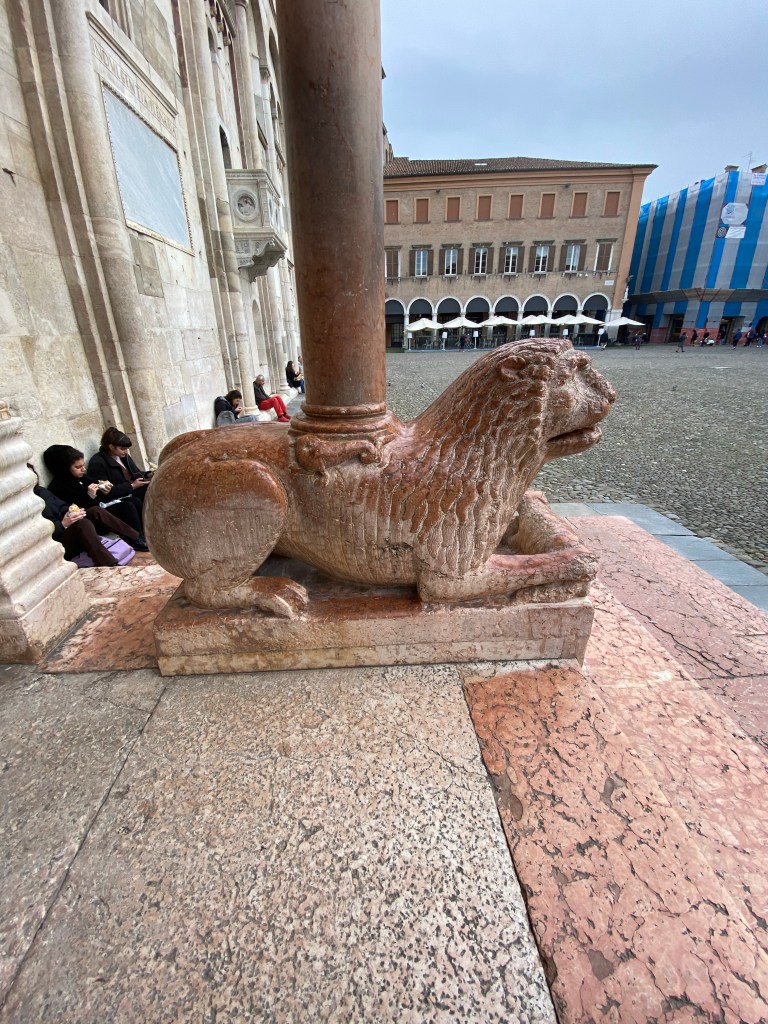
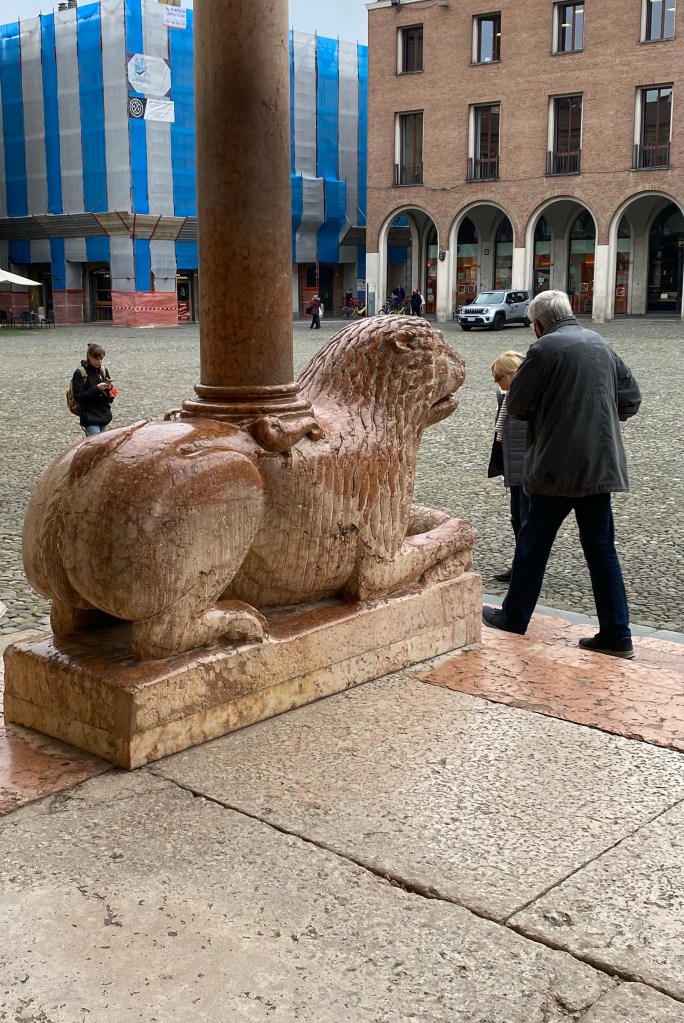
The Major Portal is really interesting and was decorated by Wiligelmo himself. The column-bearing lions are Roman, probably taken from an ancient grave. The extrados is decorated with a rich acanthus tree supported by two male telamons: where men, bizarre and natural beings are hidden (for example, a basilisk, a mermaid, a griffin, vipers, hawks, cranes).
The archivolt presents at the top a two-faced Janus, the Roman protector of doors. In the intrados, prophets (in Italian: Mosè, Aronne, Daniele, Zaccaria, Michea, Abdia, Abacuc, Exechiele, Isaia, Geremia, Malachia, Sofonia. Their names are in the respective niches).
On the left of the Portal, a wonderful inscription, supported by the prophets Enoc and Elijah (symbol of long life for the Cathedral), commemorates the laying of the foundation stone (6th june 1099) and Wiligelmo, the creator of the sculpture work: «Inter scultpres quanto sis dignus onore claret scultura nunc Vuiligelme tua» (in Latin). Also at the sides of the Portal, two panels by Wiligelmo represent angels leaning on upside-down torches (in the left one with an ibis, probably symbol of the sinner’s death).
At the corners: on the left two deer are wrestling with a single head, on the right, two lions trying to break free from a snake (symbol of the man against sin).
Higher than the rose window, the so-called Saint Geminiano cross has a really particular shape. Under it, the images of the four Evangelists, a Christ in ‘almond’ shape by the Campionesi and Samson with the lion. An angel on the top and two turrets (finished in the first years of the 20th century) complete the astonishing facade of the Duomo.
Southern Side
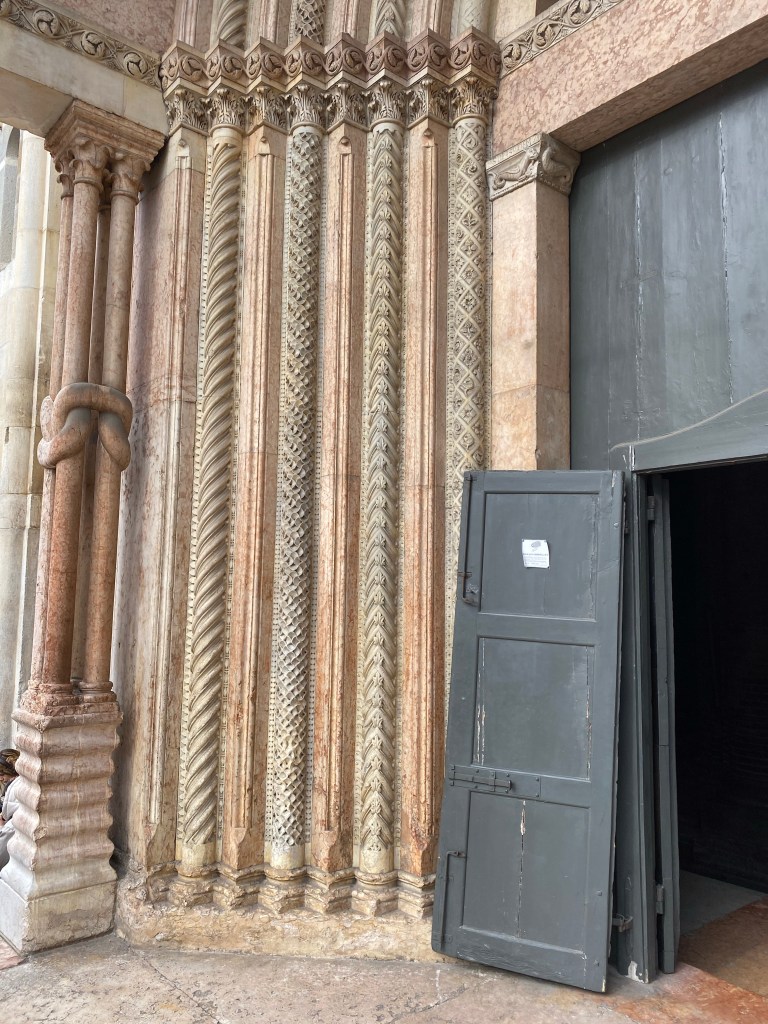
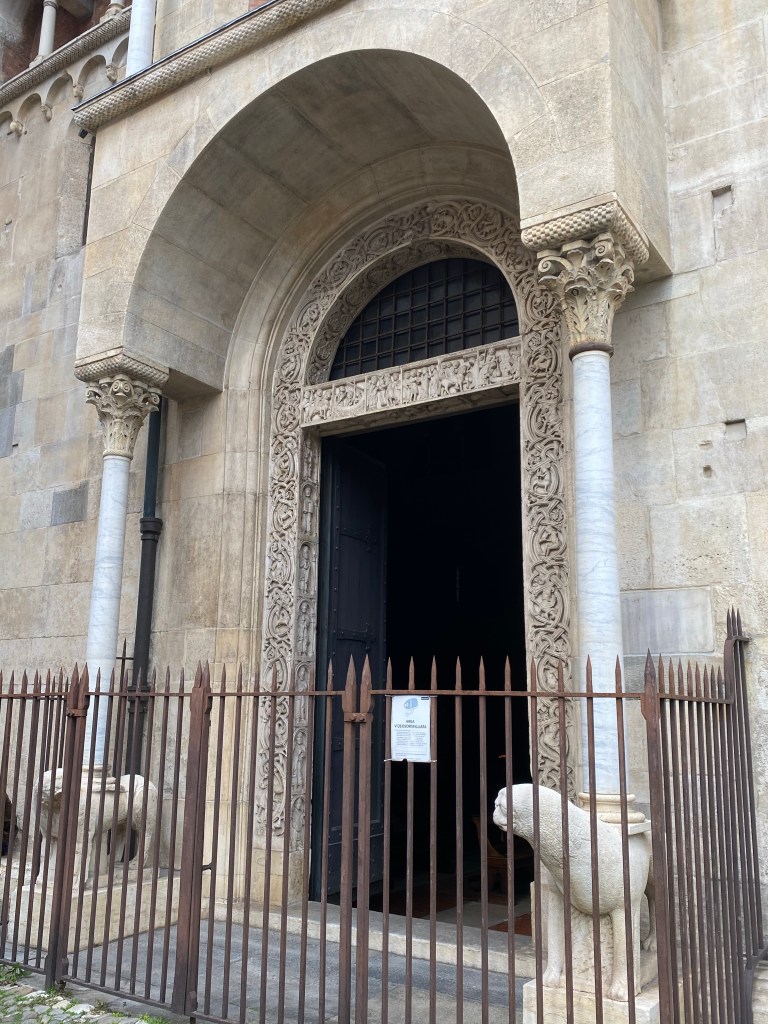
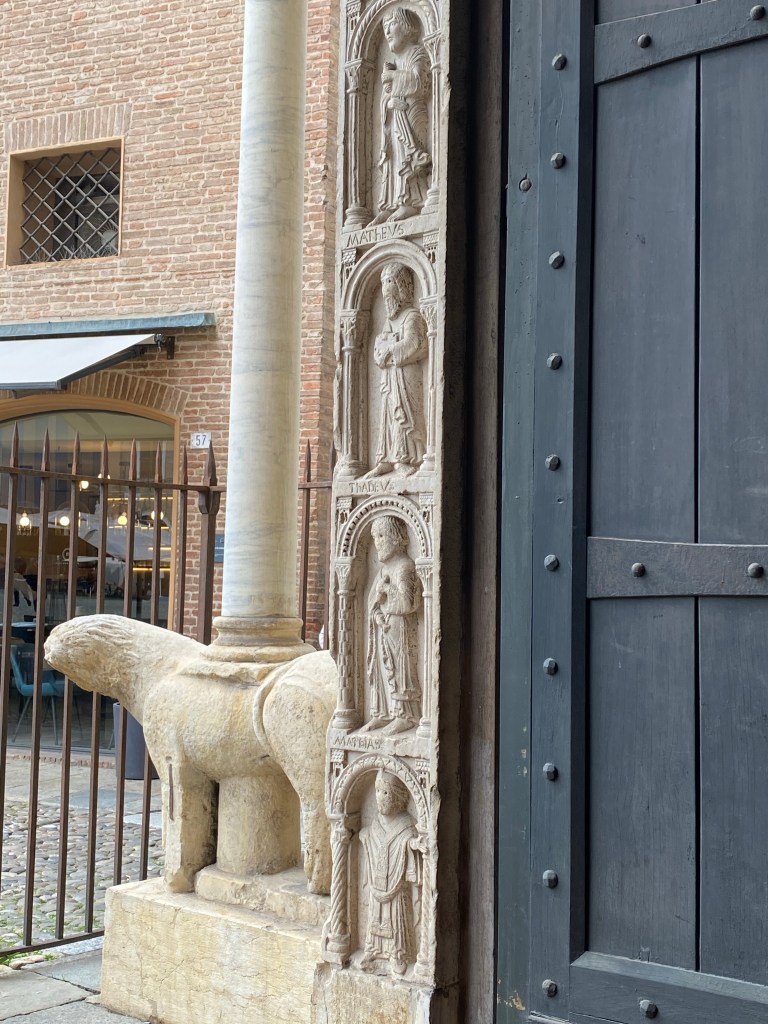
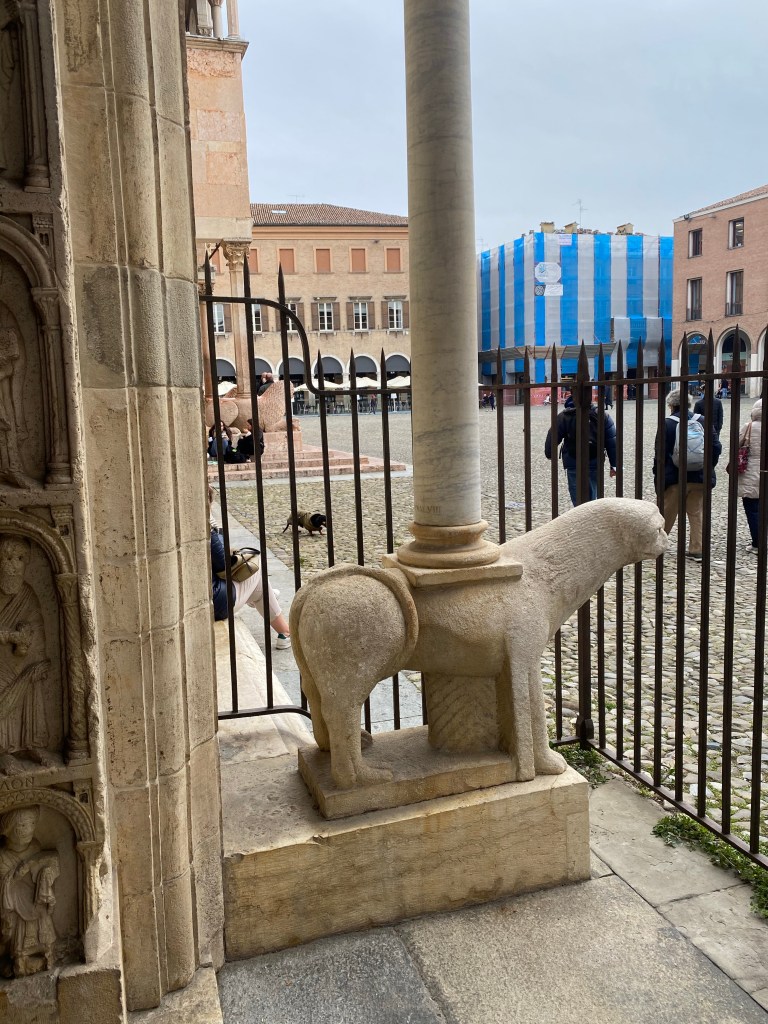
The arches with galleries continue on this side of the Duomo, decorated by original figures sculptured in the stone. After the calle dei Campionesi, the narrow street on the right of the facade, behind a little gate, the Porta dei Principi (the Princes’ door) stands, through which the persons to be baptized passed into the church. The portal was by the so-called Maestro of Saint Geminiano, a contemporary follower of Wiligelmo, modelling it on the major one in the facade.
Besides the two column-bearing lions, in the intrados one can see the Apostles (where Matthias replaces Judas the traitor); in the extrados, an inhabited spray.
The architrave is decorated with six episodes from Saint Geminiano’s life: he sets off to the Orient on horseback and by ship to exorcise the daughter of the Emperor Jovian (a curious winged demon is liberated); he then receives gifts and returns to Modena, where he dies and is buried like a mummy.
The intrados of the architrave itself is particular, as a lamb is kept up by two angels flying in the sky, and looked upon from the corners by Saint John the Baptist and Saint Paul.
On the right of the prothyrum, the Fight between Jacob and the angel and Truth wrenching the tongue of the fraud. Then, a big incision commemorates the consecration of the Duomo of Modena, in 1184, by Pope Lucius III.
A text also commemorates the visit of Pope John Paul II in June 1988.
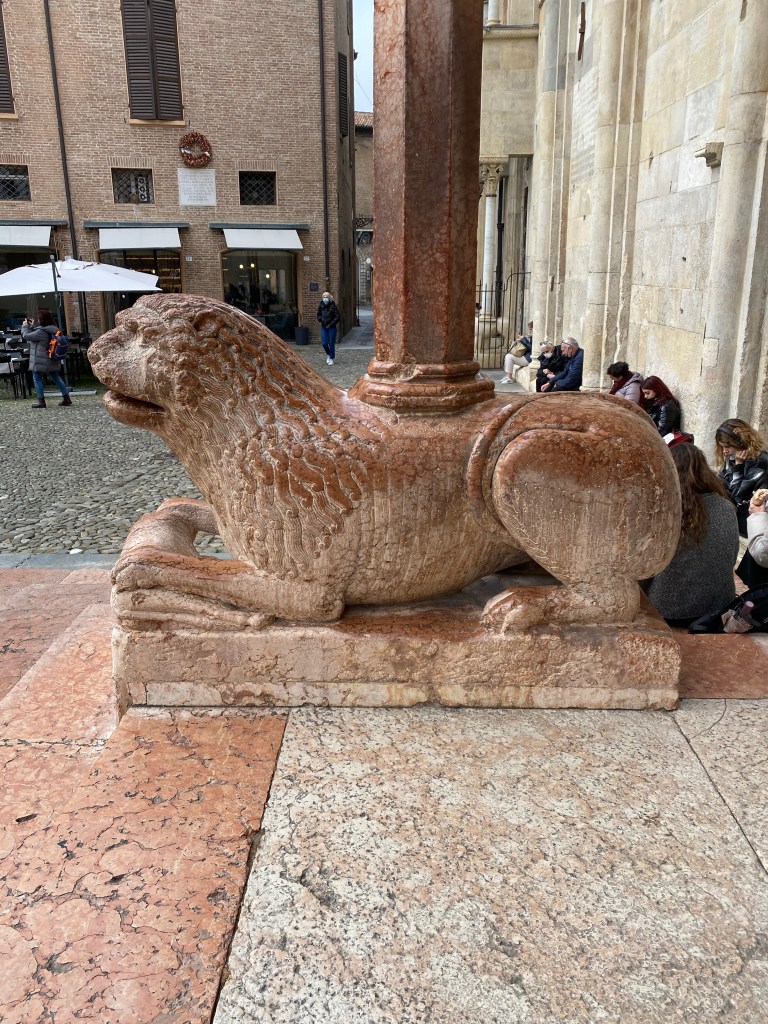
The side open to the Piazza Grande is dominated by the Porta Regia, built in the first years of the 13th century by the Maestri Campionesi. Wrought in red Veronese marble, it is characterized by an extraordinary embrasure with interlaced columns and roses and by the two lions with prey under their paws. The stucture is surmounted by a niche with a statue of the Patron Saint Geminiano (the original one is in the Museums of the Duomo) and an incredible bone of a whale. The balcony is completed with a lion at the top.
Going right, the dummy transept is visible, made by the Maestri Campionesi while building the internal choir, culminating in another lion. In 1501 the pulpit was added by Jacopo and Paolo da Ferrara, representing the four Evangelists, whereas the relief realized in 1442 by Agostino di Duccio was placed here in 1584. It tells the same stories of Saint Geminiano as the Porta dei Principi (the recovery of the Emperor’s daughter, the gifts and the funeral with the miracle of the fog which saved Modena from the barbarians). Between the pulpit and the relief, two plaques commemorate the oath of Pontida on the field of Legnano, when the Lombard League was born against the Emperor Frederick Barbarossa, and the creation, in 1855, of the ecclesiastic province of Modena thanks to Pope Pius IX.
Apses
Already finished in 1106, the year of the translation of Saint Geminiano’s corpse (according to the Relatio conserved in the Museums of the Duomo), the three apses are one of the things to notice about the Cathedral. Here one can appreciate the design of the loggias (which run all around the perimeter) and the splendour of the twenty different types of stone which cover the church.
In the central one, a plaque praises the architect of the Duomo and surmounts a window decorated with flowers. The Modenese measures which are carved in the wall are really interesting: the merchants in Piazza Grande could come here (where the ‘Buona Stima’ office stood) to control the goods against fraud. From the left, the brick, the step, the pole and the pantile: the whole Duomo was built following these measurements, and in fact it bears them out exactly.
Northern Side
Along the northern side of the Duomo via Lanfranco was opened at the end of the 19th century, separating the church from the other edifices of the sacristry and the presbitery (now the Museums of the Duomo). Here one can admire the longest perspective of the architectonic motive with arches and gallery which characterizes the whole Cathedral. There are also wondeful metopes and capitals: each one is different from the other, representing imaginary and naturalistic subjects.
Near the Ghirlandina tower, the Porta della Pescheria (that is ‘Portal of the fish market’) or “delle Donzelle” was the place where pilgrims coming from the via Emilia entered the church. This is the reason why the sculptures are of international and pagan subjects. The name derives from the market which once stood here and from the fact that it was the door dedicated to women. A covered passage connects the church to the sacristry, whereas the preceding arches were built in the Gothic style probably in 1338, to avoid the bell tower leaning towards the Cathedral.
The portal is characterized, like the others, by a pair of column-bearing lions. The sculpture is of an exceptional interest. In the extrados telamons hold up an inhabited spray. In the intrados, the months of the year are represented: January cures a pig; February is wrapped in a blanket in front of a fire; March cuts the grapevine; April brings flowers; May leads a horse as it was the period when wars started; June cuts the grass with a sickle; July reaps the wheat; August thrashes it; September makes wine in a barrel; November sows and December cuts the wood. The cycle of the seasons is so represented, as was the unescapable rhythm of life at the time.
In the architrave there are fables of French origin: a Nereid hunts a Triton; two cocks bring in a fox pretending to be dead; the storks are trying to free themselves from a snake; a wolf and a crane belong to Phaedrus fable.
However, the most incredible subject is the one of the arch. In the keystone, Mardoc holds Guinevere prisoner in a castle, while knights are trying to free her. Among them, King Arthur and Galvagino, as the caption explains: it is the story of the Arthurian legend (or of the Knights of the Round Table). The astonishing thing is that the first known written edition dates back to 1136, whereas the portal was made twenty years before! So it is the most ancient representation of the legend in the world, brought across Medieval Europe by the pilgrims.
made by: web agency modena area9
The remarkable duomo of Modena is dedicated to the Virgin Mary of the Assumption and to St. Geminianus, the patron saint of the city. Consecrated in 1184, it is an important example of the Romanesque style and, along with its bell tower, the Torre della Ghirlandina, and the piazza on which they stand, is designated as a World Heritage Site by UNESCO.
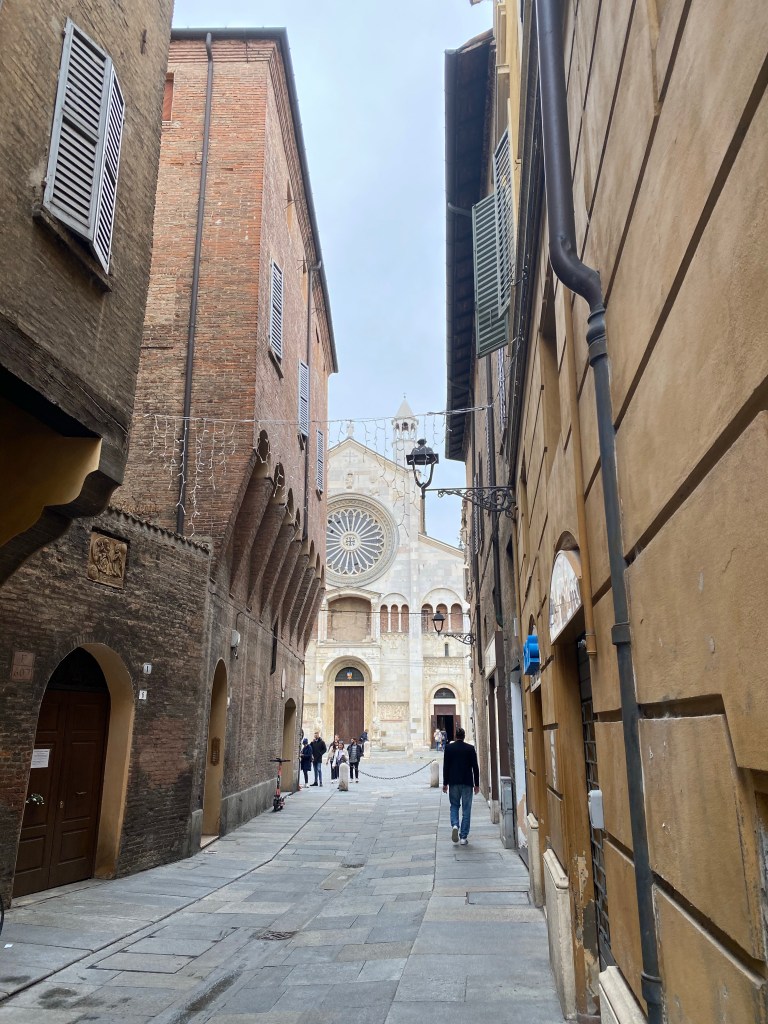
We know that 2 earlier churches had existed on the site of the present cathedral since the 5th century; the discovery of the burial site of Saint Geminianus, Modena’s patron saint, led to the destruction of those churches and to the building of this cathedral by 1099.
The initial design and direction was provided by an architect known as Lanfranco, about whom little is known.
The Saint’s remains are still exhibited in the cathedral’s elaborately decorated crypt, which I will discuss in a separate postWhen I W. The present cathedral was consecrated by Pope Lucius III on July 12, 1184.

After Lanfranco, the Cathedral was embellished by Anselmo da Campione and his heirs, the so-called “Campionese-masters,” who were active from the second half of the 12th century to the first half of the 14th. These were groups of builders and sculptors from Campione, a town on Lake Lugano, who worked like real family workshops. It was the Campionesi Masters who created the large rose window, the two lateral doors on the façade, and the magnificent “Porta Regia” discussed below.
The majestic rose-window was added by Anselmo in the 13th century. The two lions supporting the entrance’s columns were borrowed from other buildings and date to the Roman era.
The façade also has notable reliefs by Wiligelmus, a contemporary of Lanfranco; these include portraits of prophets and patriarchs, and Bible stories. The sculpture ensemble taken as a whole is a masterpiece of the Romanesque era and style. Scholars have especially noted the splendid sculptural achievements in the scenes depicting The creation of Adam and Eve, The original sin; and the The story of Noah.
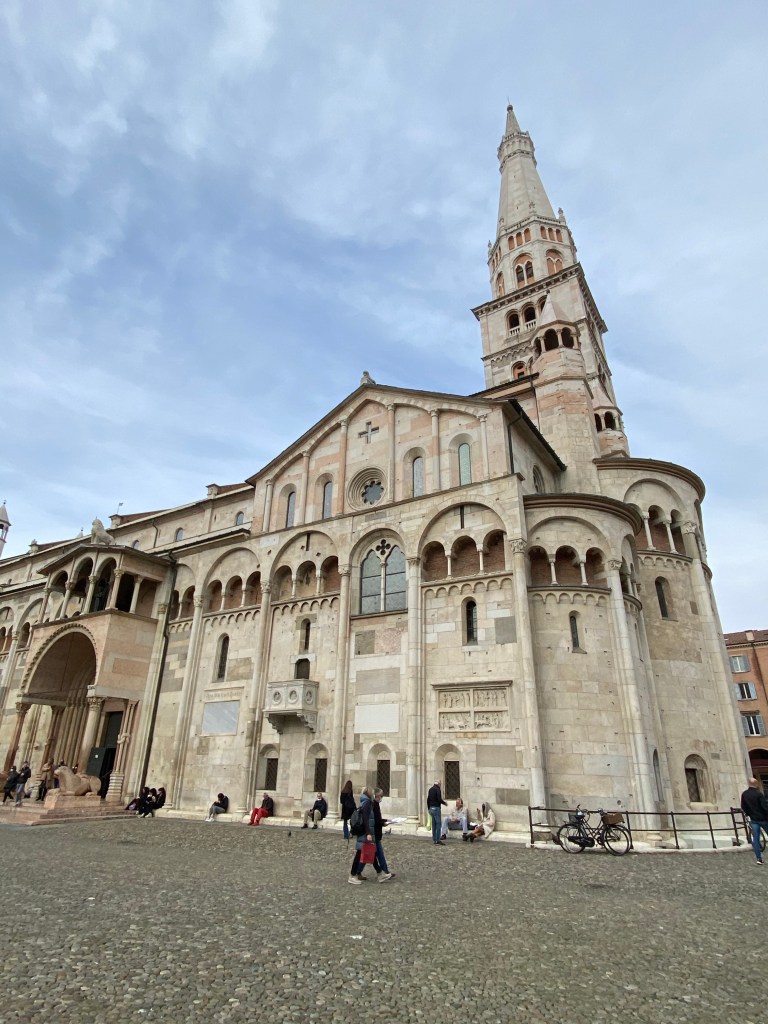


For more on the cathedral, check this source: http://www.unesco.modena.it/en/plan-your-visit/cathedral. The following quote is taken from this source.
“For the front doorway, Wiligelmo also created the sculptures on the façade, depicting sacred, profane, heavenly and monstrous worlds. These portray the spirituality of medieval society together with its faith, hopes, fears, certainties and doubts.
However, the most important example of Wiligelmo’s great art is the decoration of the main portal through which, in simple, but powerful terms, he expresses his contemporaries’ vision of society.
Among the various plant motifs evoking the woods as a dreadful place symbolising the dangers of human life, we have monstrous beings of every kind, sinful creatures threatening the spiritual path of humankind, and a believer fighting a wild herd of lions, dragons and centaurs: monsters taken from ancient repertoires and medieval bestiaries.
So life is portrayed as a difficult journey, with salvation is the ultimate goal; we also find harvest scenes depicting the “Lord’s vineyard.” In the door frames, figures representing patriarchs and prophets announce the birth of Jesus Christ. These images emphasize the symbolic meaning of the church door, which separates the believers gathered inside – the saved ones, from those standing outside, who may fall prey to the Devil. “
The touching expressiveness of Wiligelmo’s reliefs from Genesis is particularly noteworthy. The stories of Adam and Eve, Cain and Abel and Noah’s Ark still maintain their original intensity, emotional charge, and extraordinary narrative force. In recent years researchers have shown great interest in interpreting the meaning of these reliefs, and two different schools of thoughts have emerged from these studies.
In the microcosmic sense, one sees the external sculpture of the Cathedral of Modena as a local response to the problems of the town and its role in the Gregorian Reform. According to this interpretation, the four reliefs from Genesis represent very important subjects related to the Reform: sin, repentance, the need for a well-ordered and properly invested Clergy, and the central role of the Church as the only institution which offers a path to redemption. As a result, all those involved in the overall design of the Cathedral of Modena would have wanted to promote the new alliance with the Papacy, an agreement replacing the city’s previous alliance to the imperial party.
Doorway of the Princes
Here are carved episodes from the life of St. Geminianus by Wiligelmo and his workshop. Opening onto the lovely “Piazza Grande,” this doorway stands out in contrast to the white wall of the cathedral due to the chromatic effects of its rose-colored marbles.
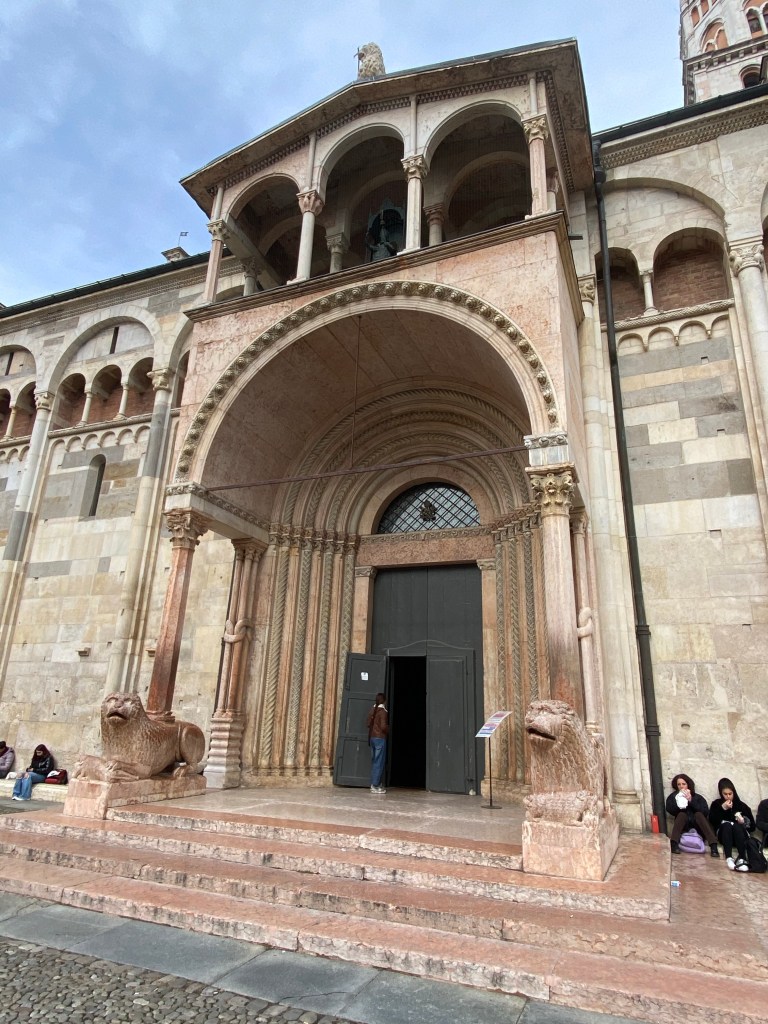
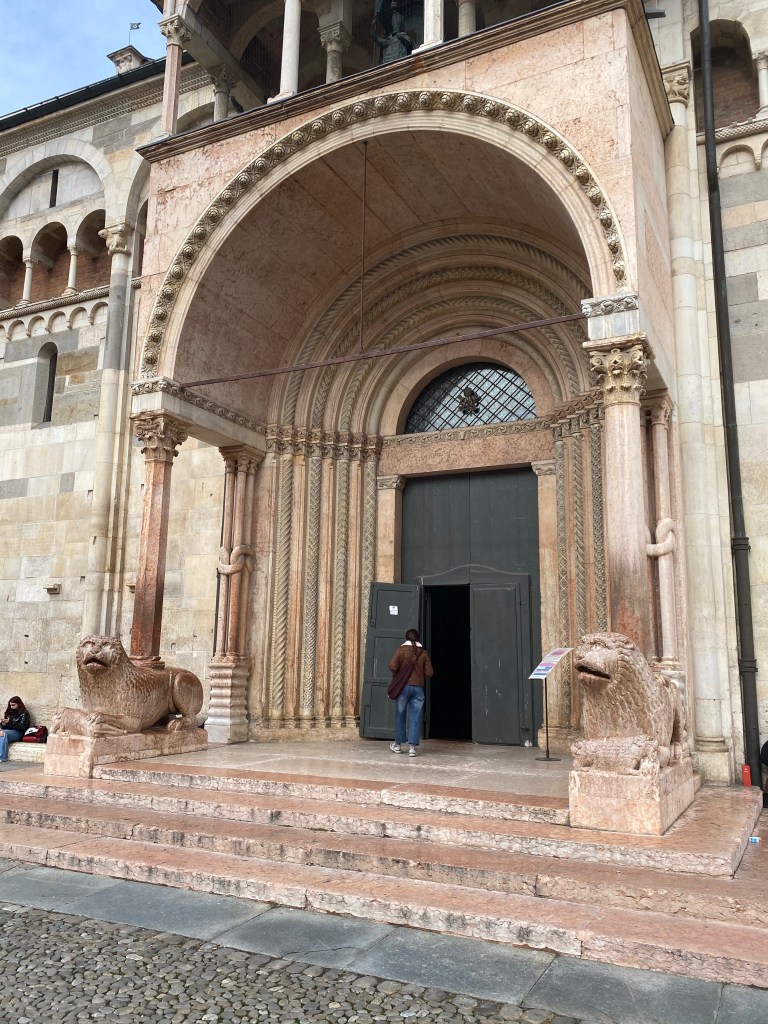

Fish Market Door, north side of church
Of particular note here are the metopes, which are the sculptural reliefs found on the projections of the roof. They representing a lively group of imaginary and monstrous beings. The ones found on the Cathedral today are reproductions, as the originals have been moved into the “Museo lapidario del Duomo” for conservation purposes.
The ?? Gate

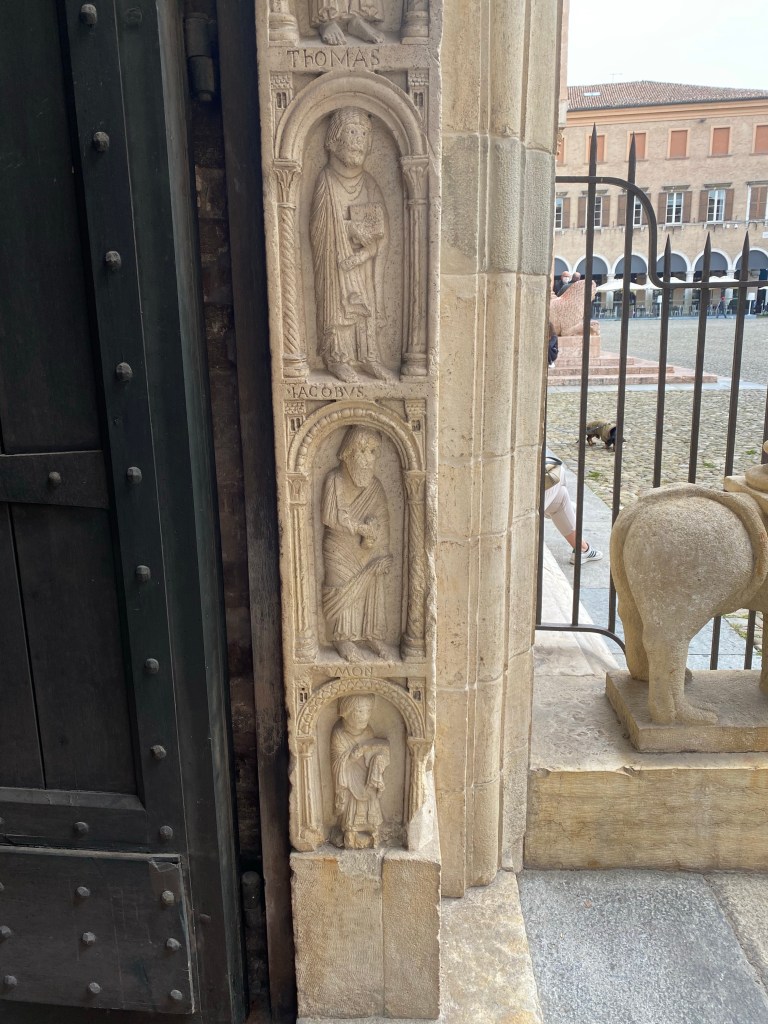
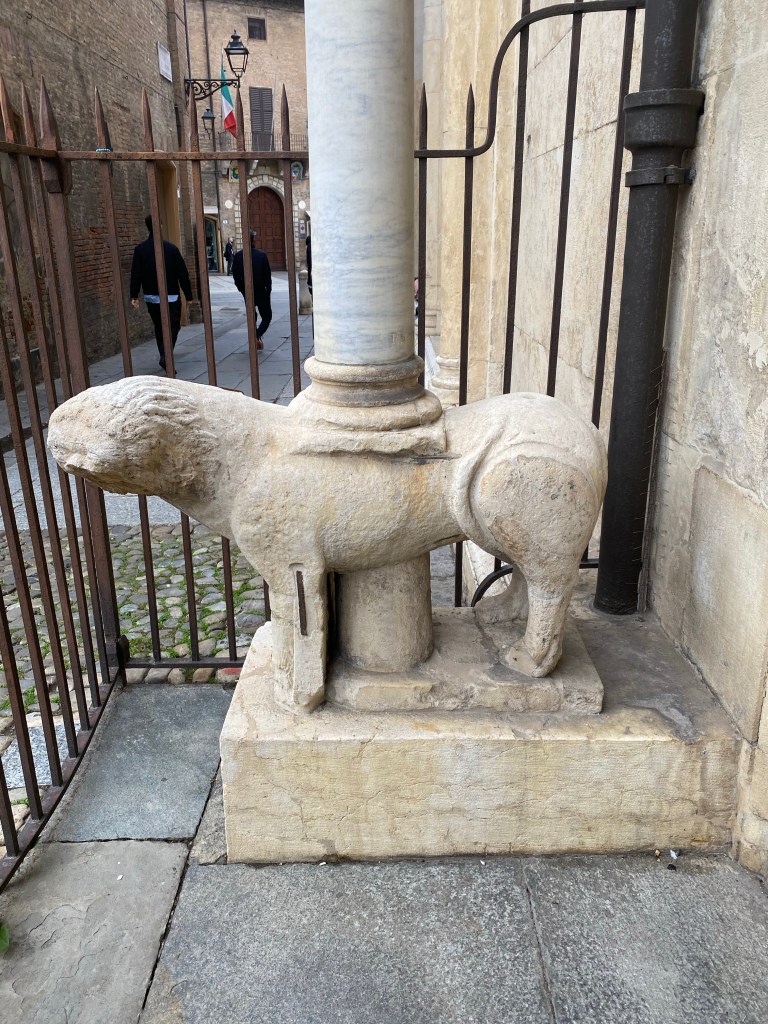
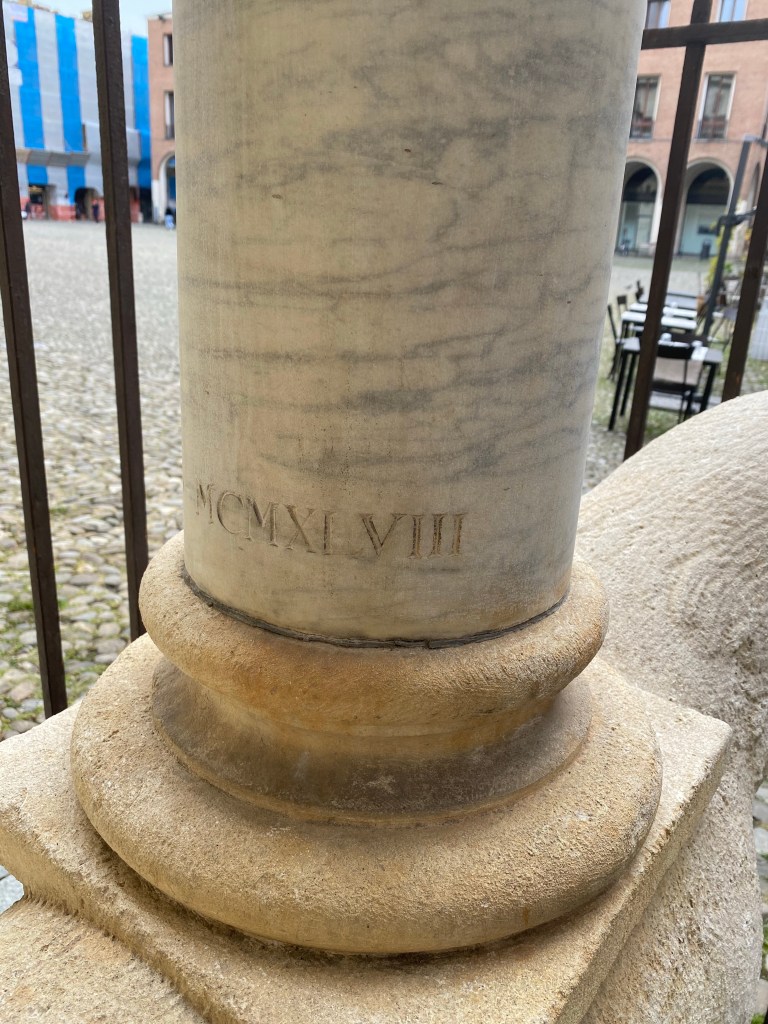
Advent, day 9; the 3 magi and baby Jesus
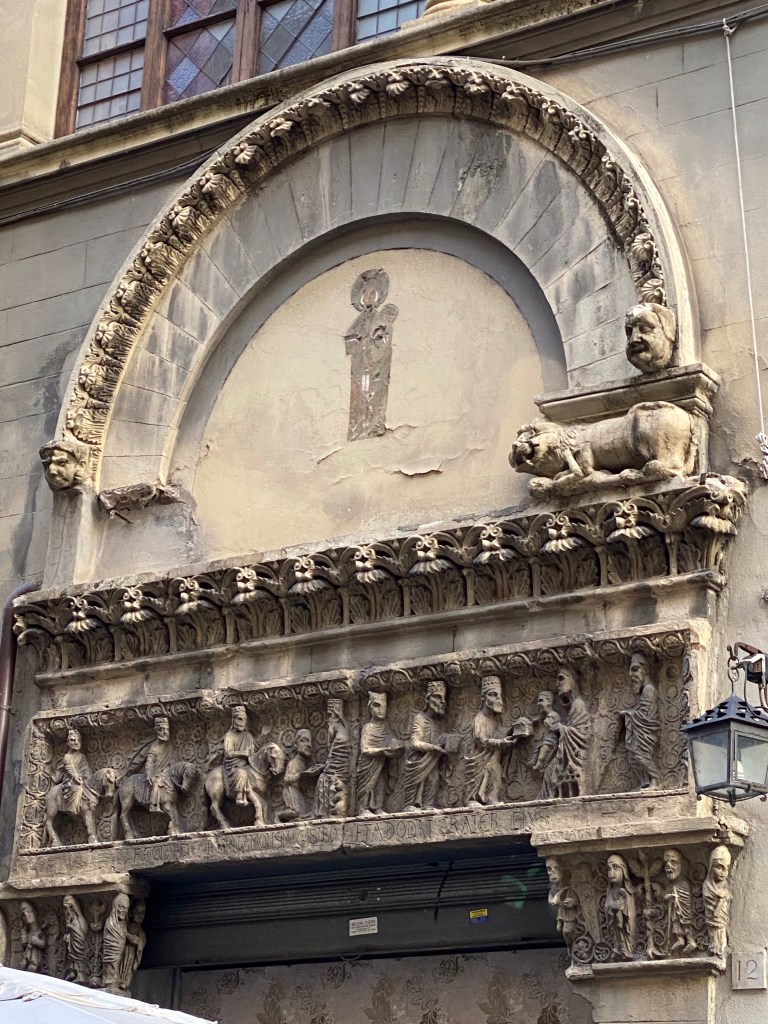
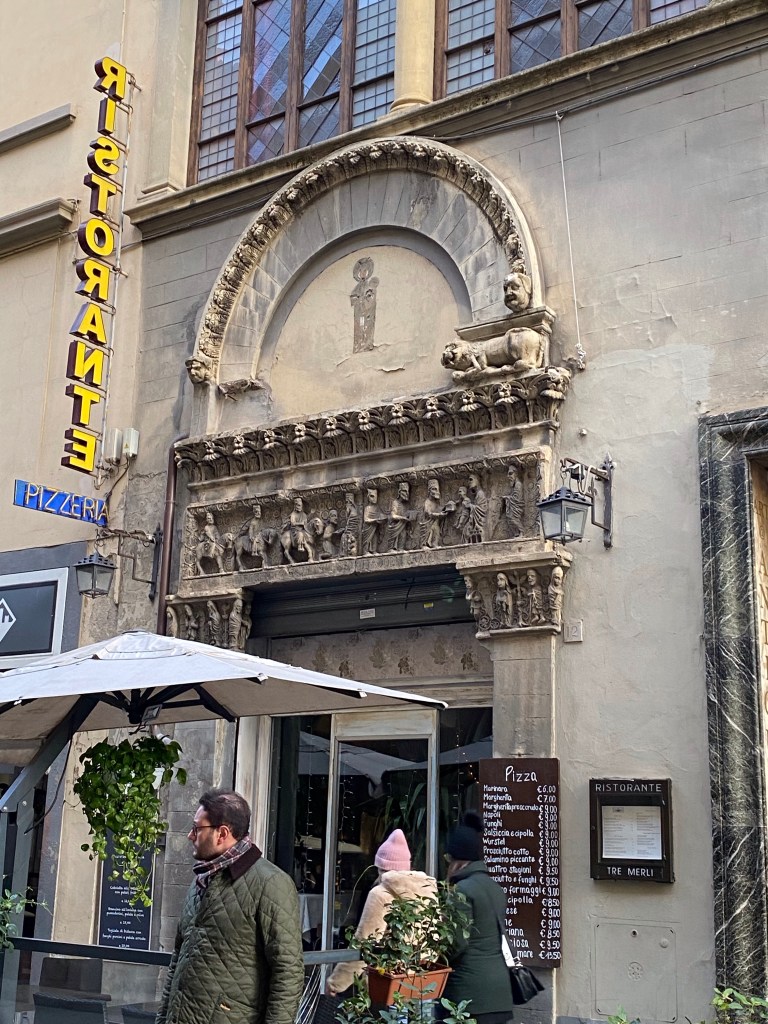
It is not at all unusual in Italy to see old facades left intact and just covered over with the newer inhabitant. A case in point is this Medieval church facade that hovers over a modern pizzeria.
What I like are the medieval sculptures, depicting the arrival of the 3 magi at the birthplace of the Christ child. That’s what we celebrate in Advent. Here it is, in a beautiful old form.
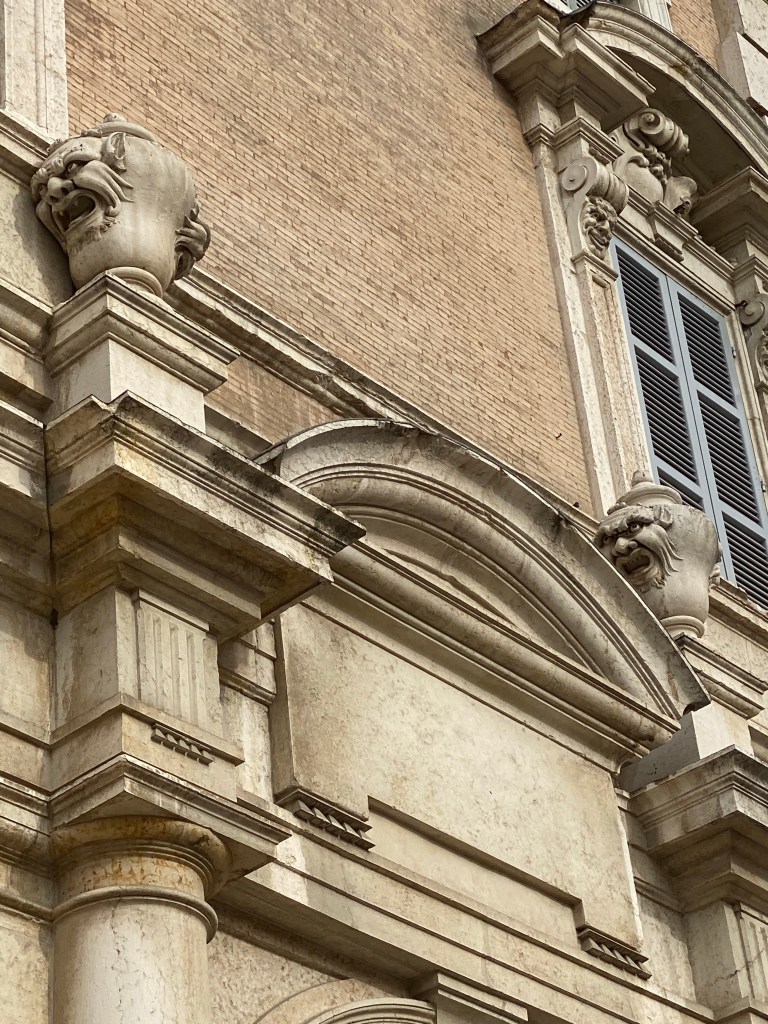
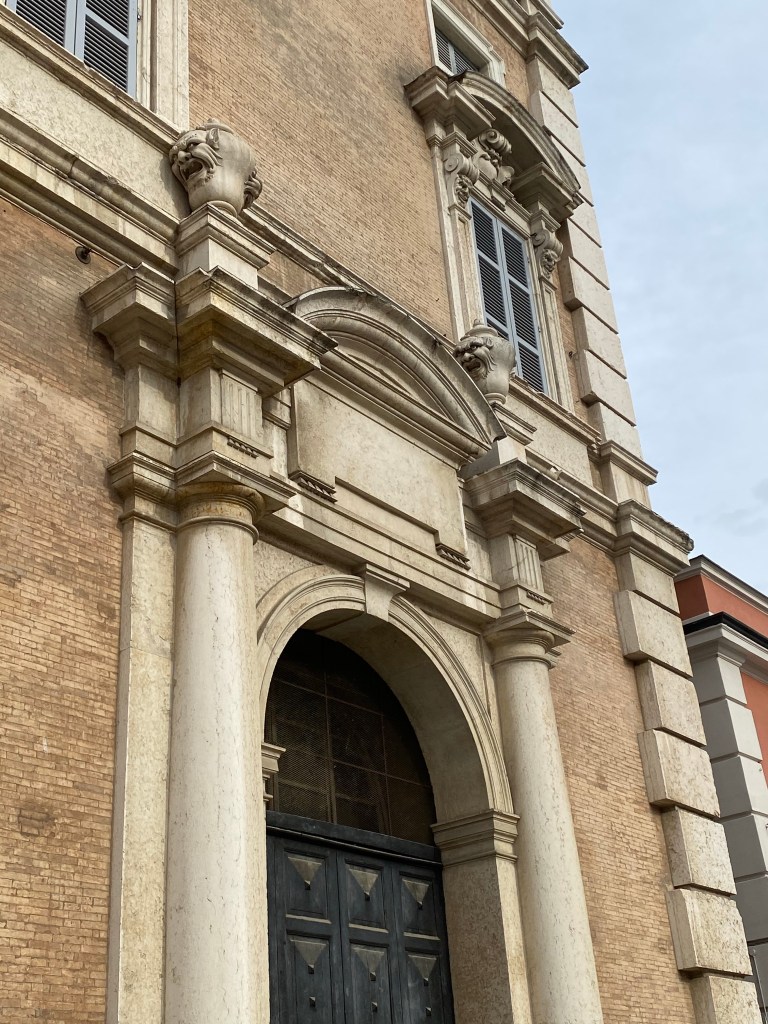
The Ducal palace, Modena


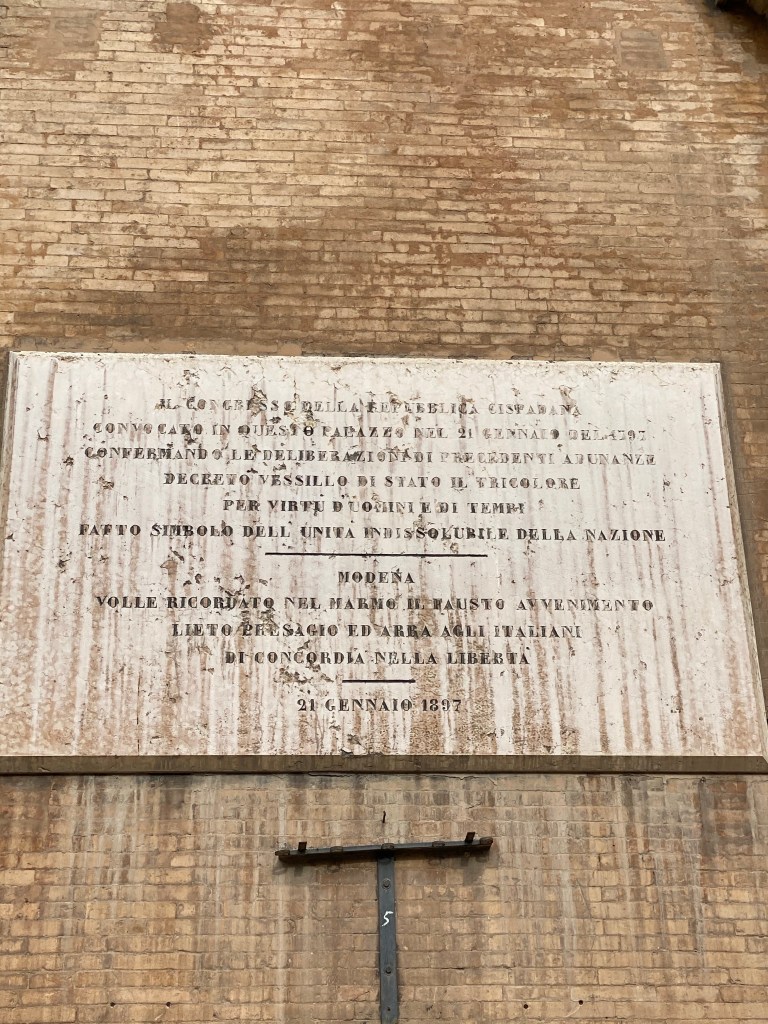


The interior of the lovely Modena cathedral
In a recent post, I looked at the exterior of this beautiful church; today I want to focus on the inside.
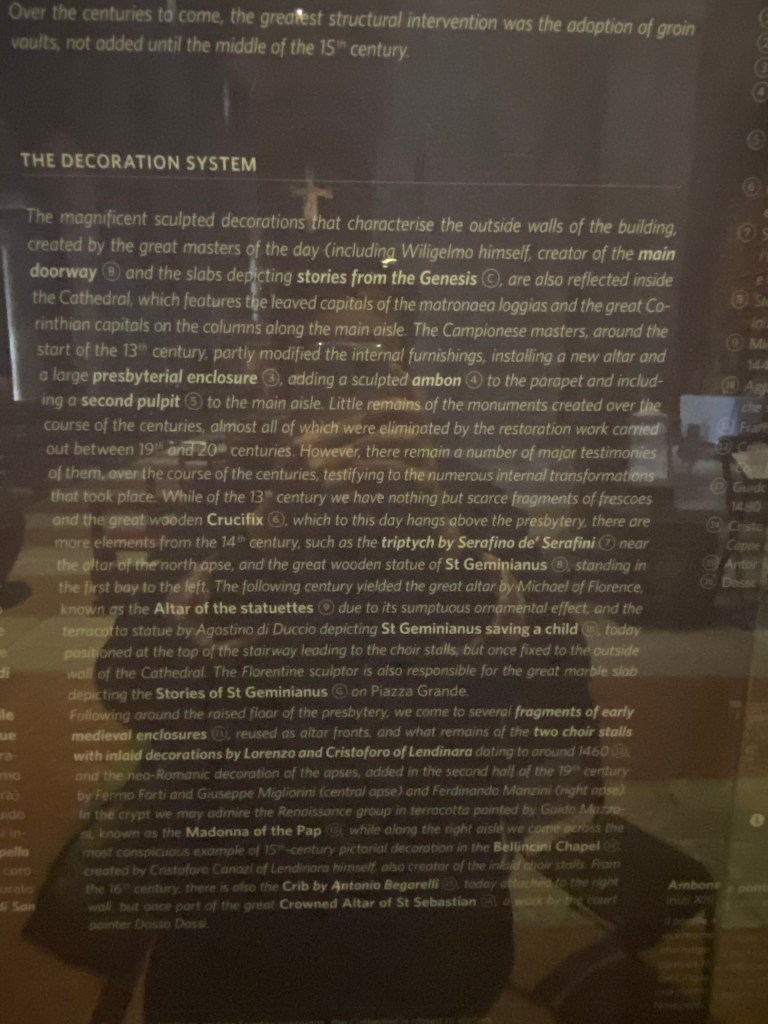
Inside the Cathedral we find other important works, in particular from the 15th and 16th centuries: the Altare delle statuine by Michele da Firenze (1442 ca), the Intarsia of the Choir by Lendinara (1465), the Bellincini Chapel (1475 ca), the “Table of Saint Sebastian” by Dosso Dossi (1518-1522) and the Nativity by Antonio Begarelli (1527).

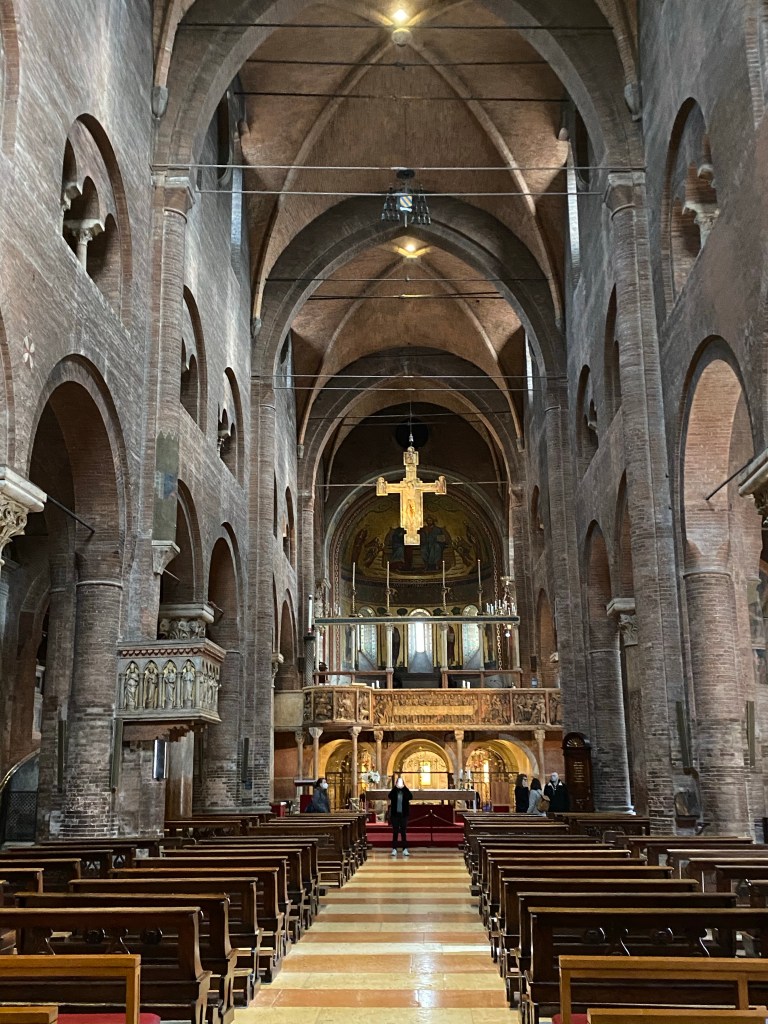


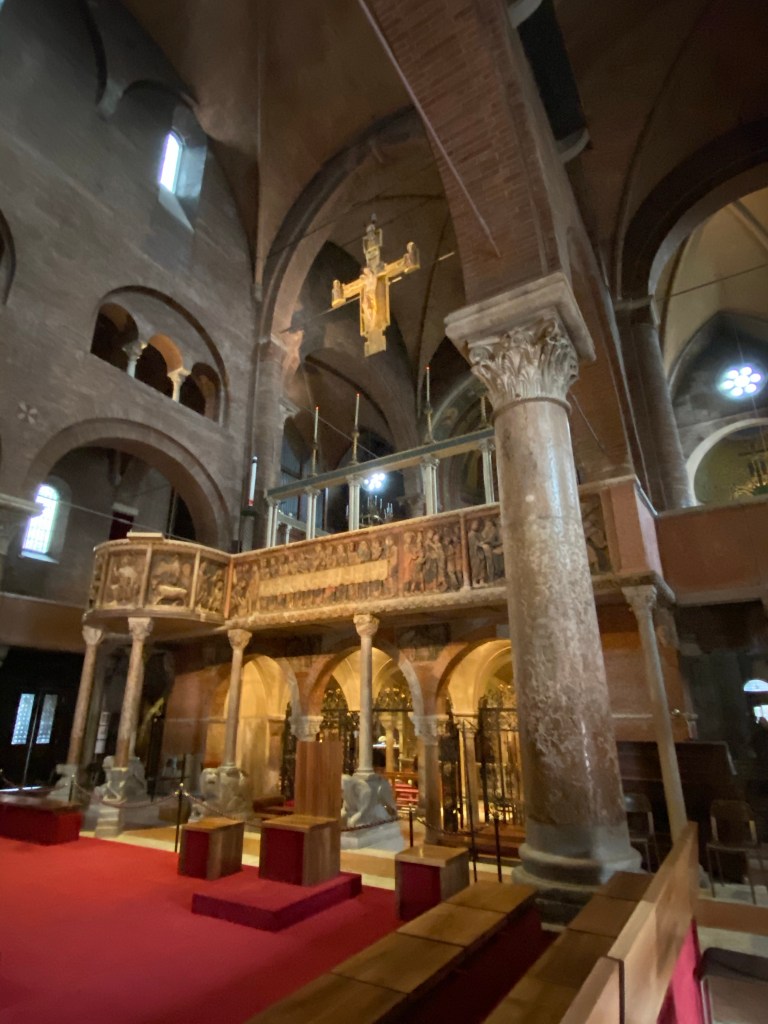


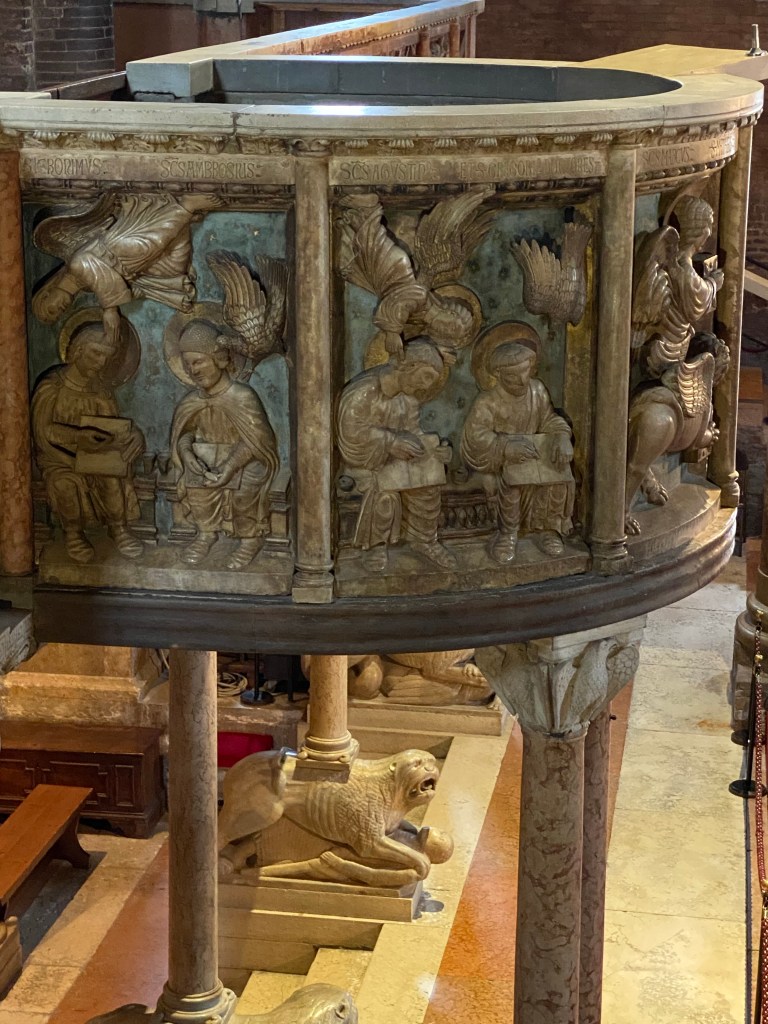

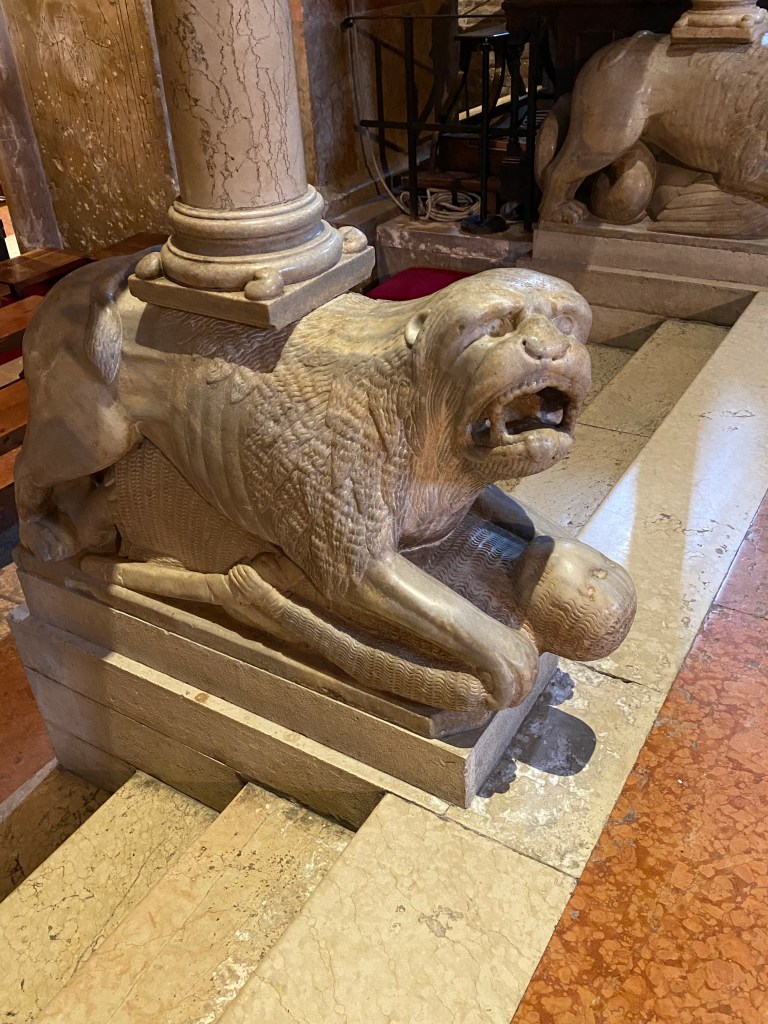
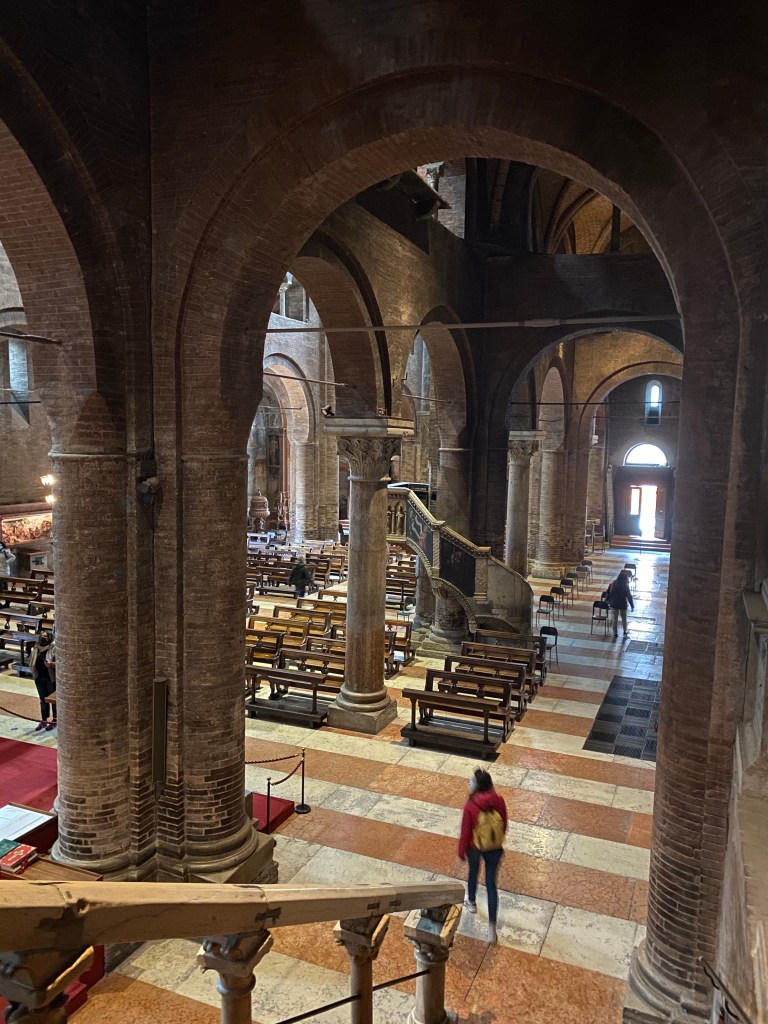
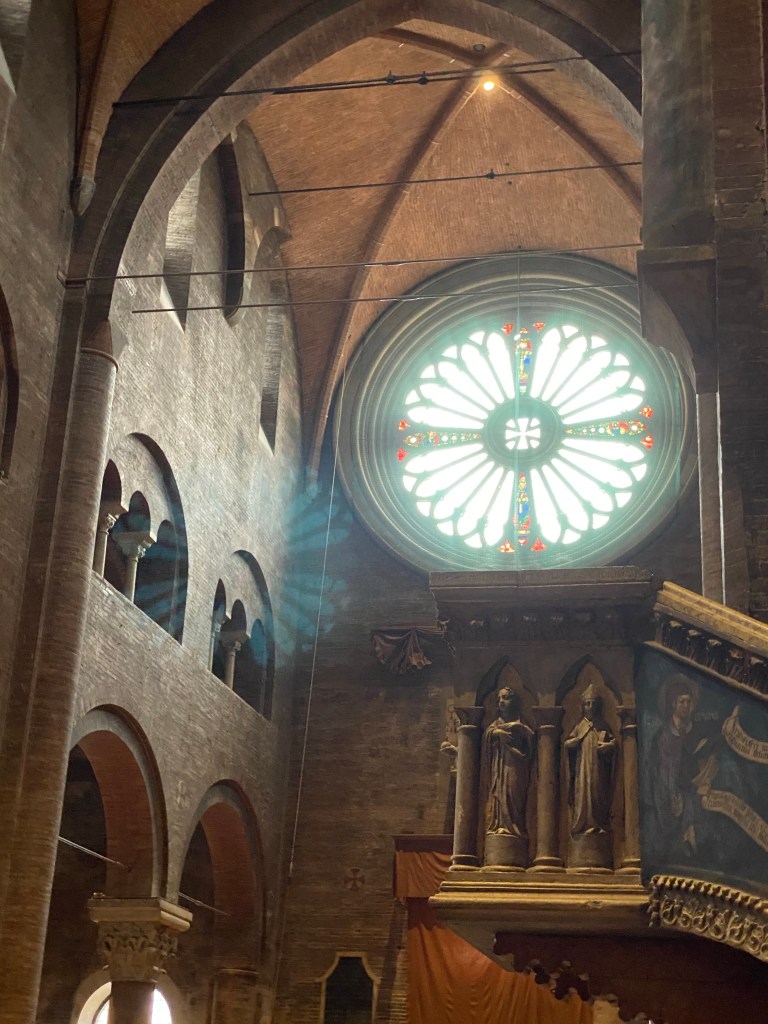
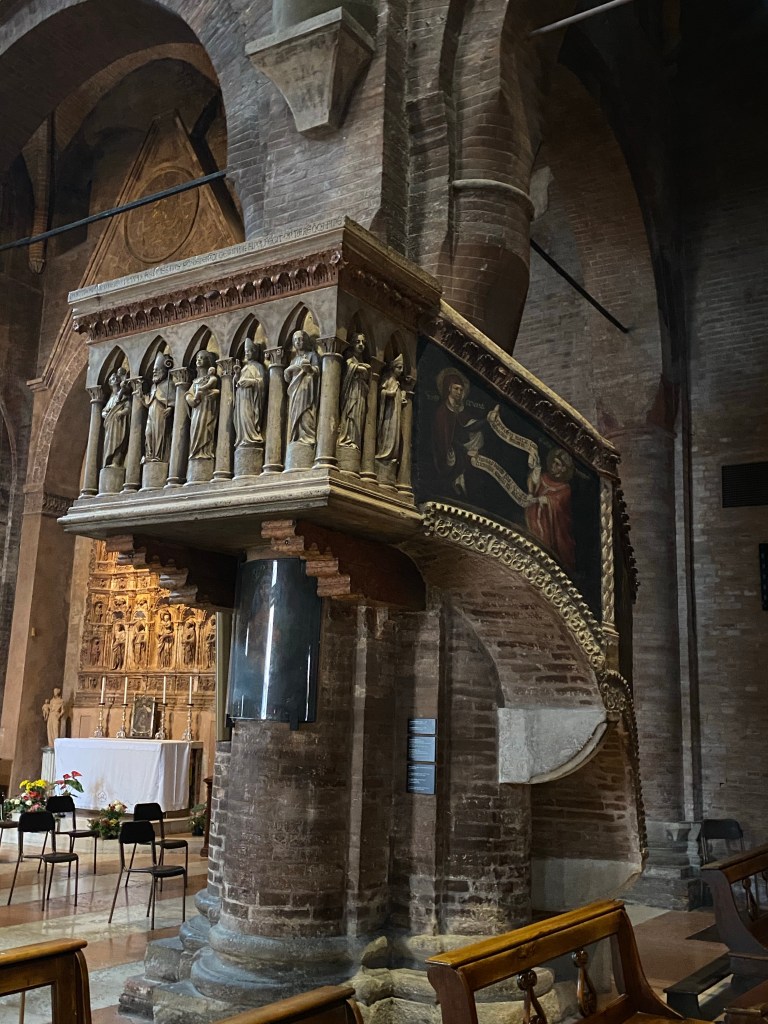
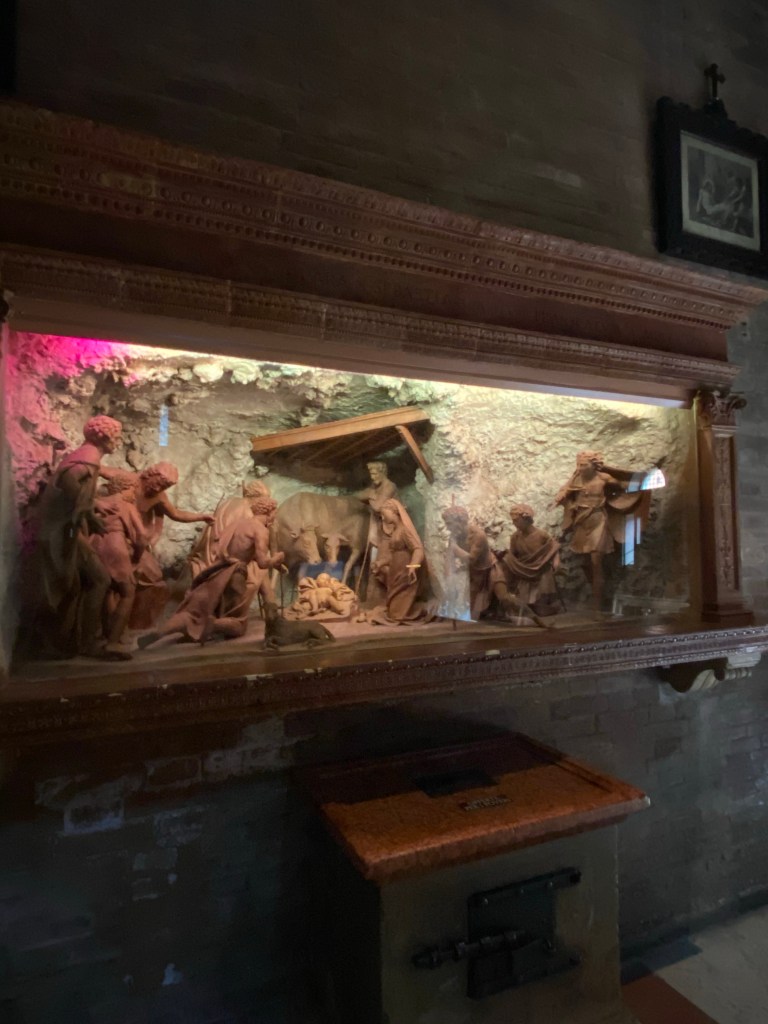
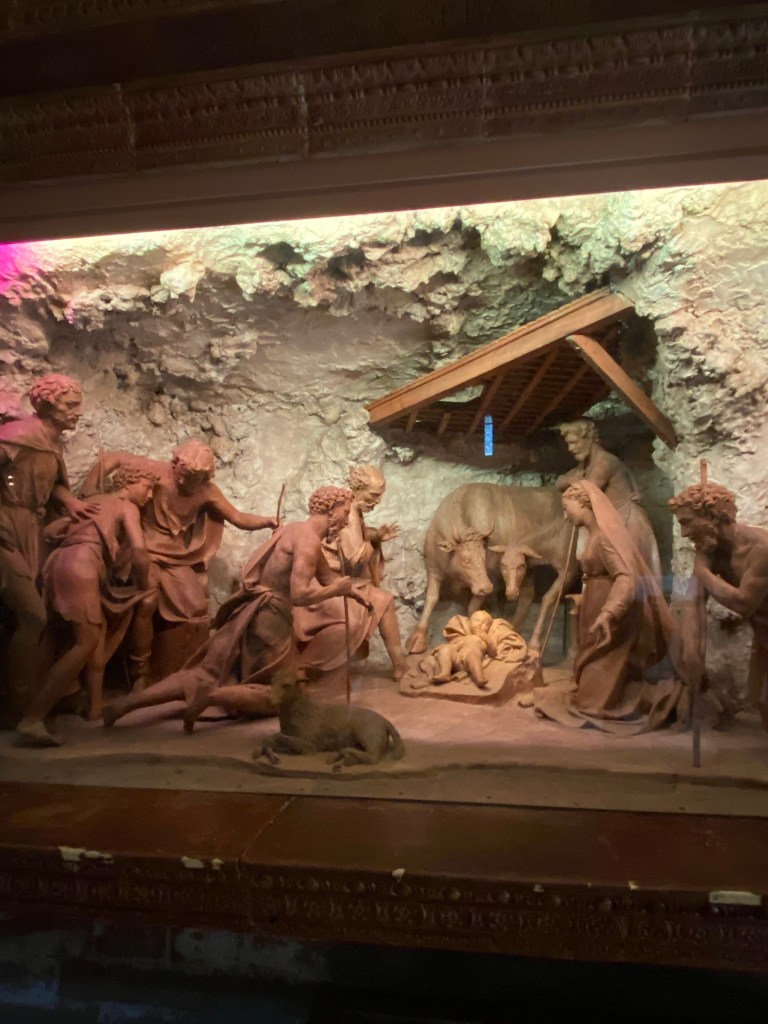
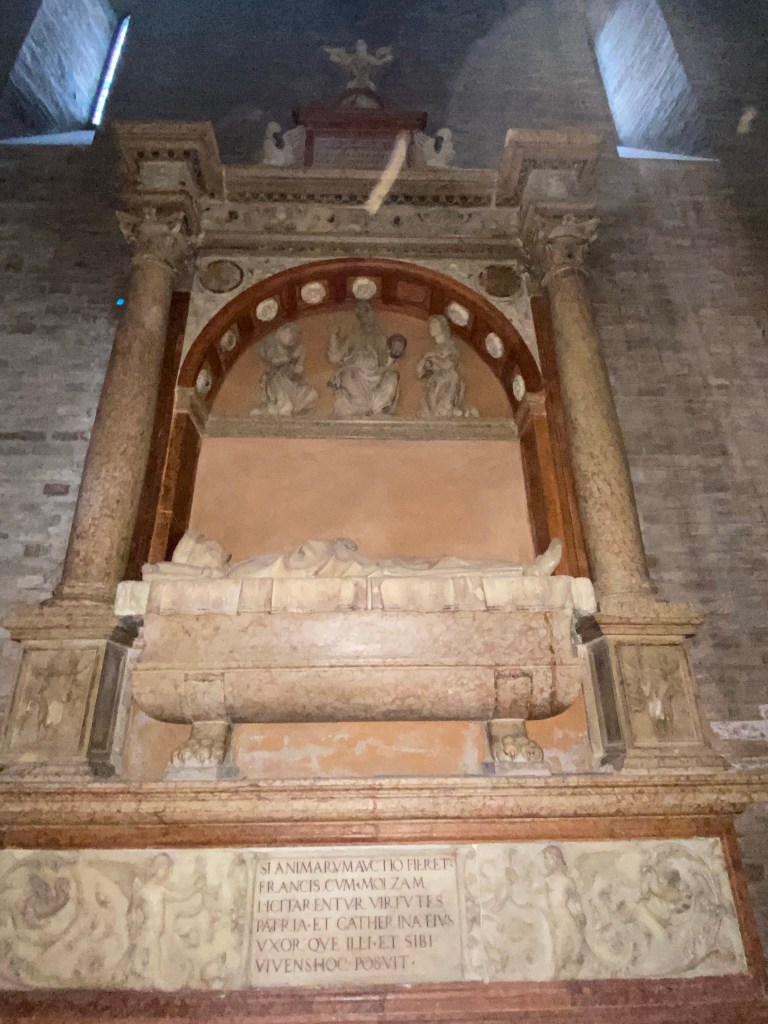

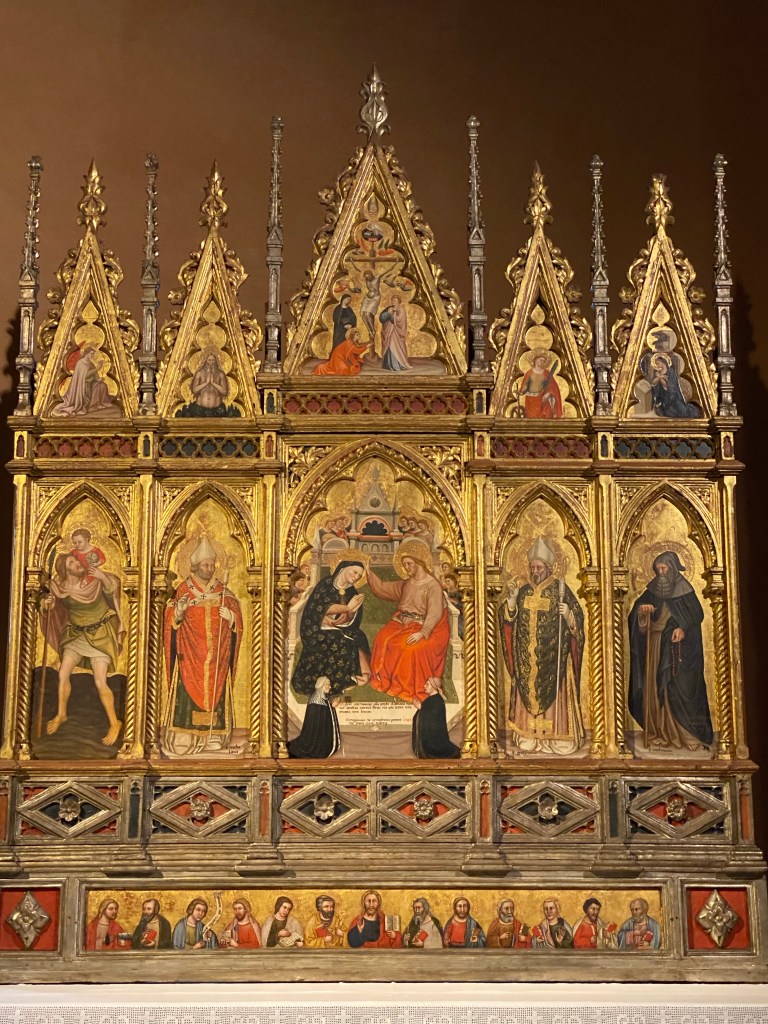
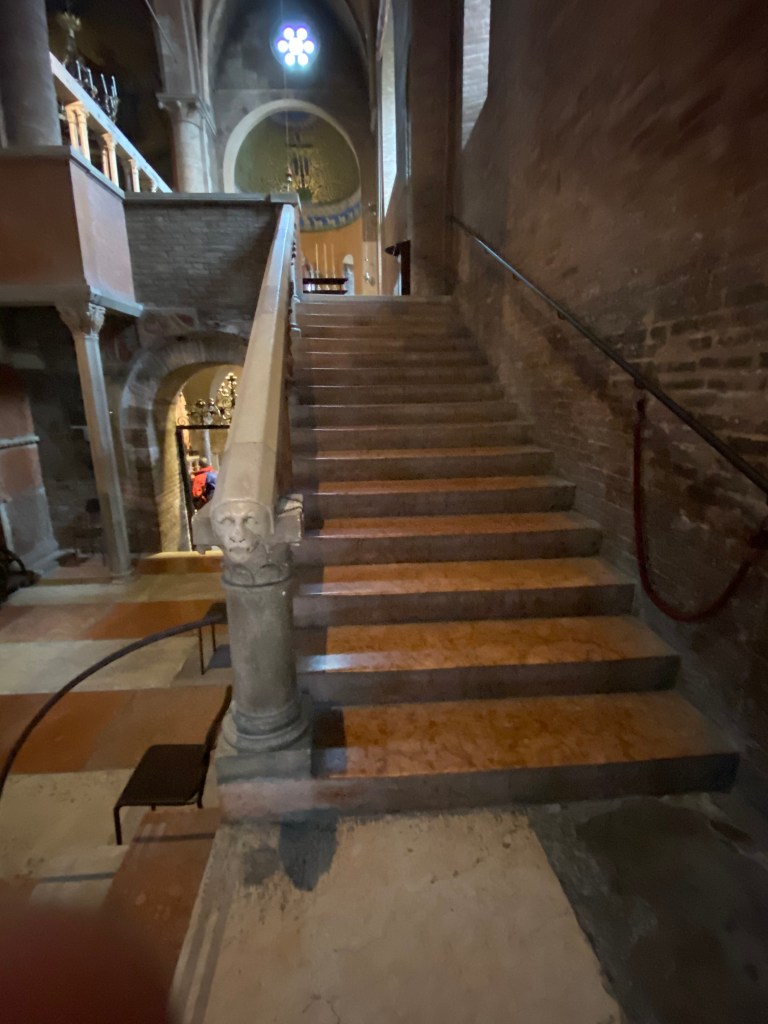
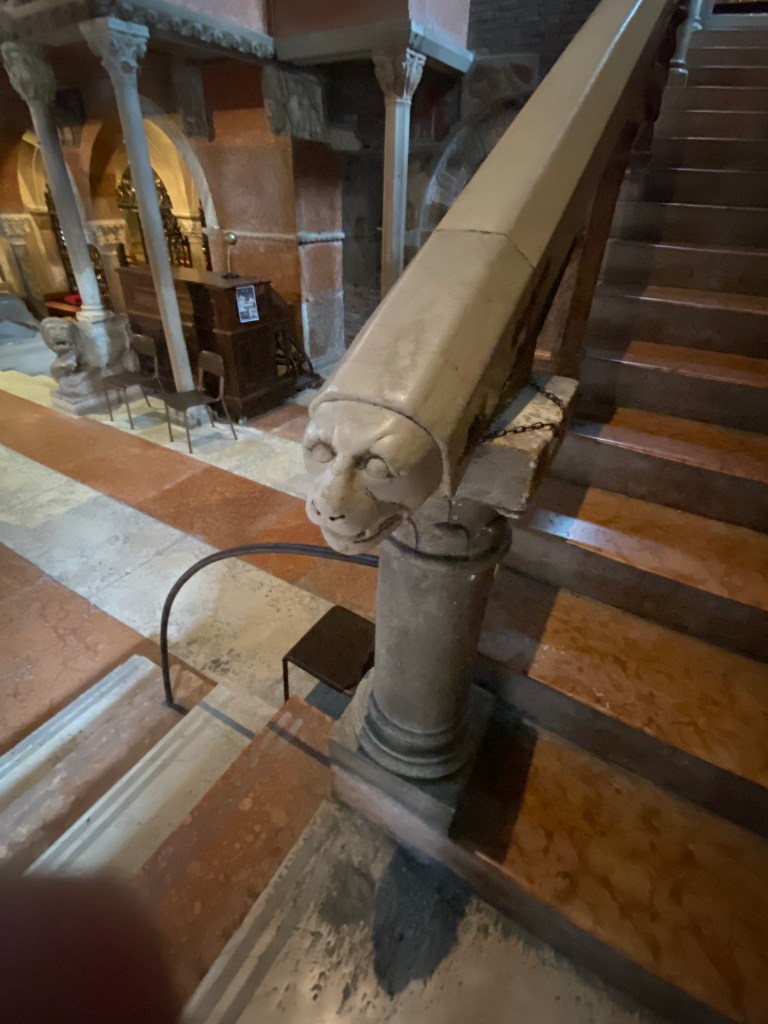
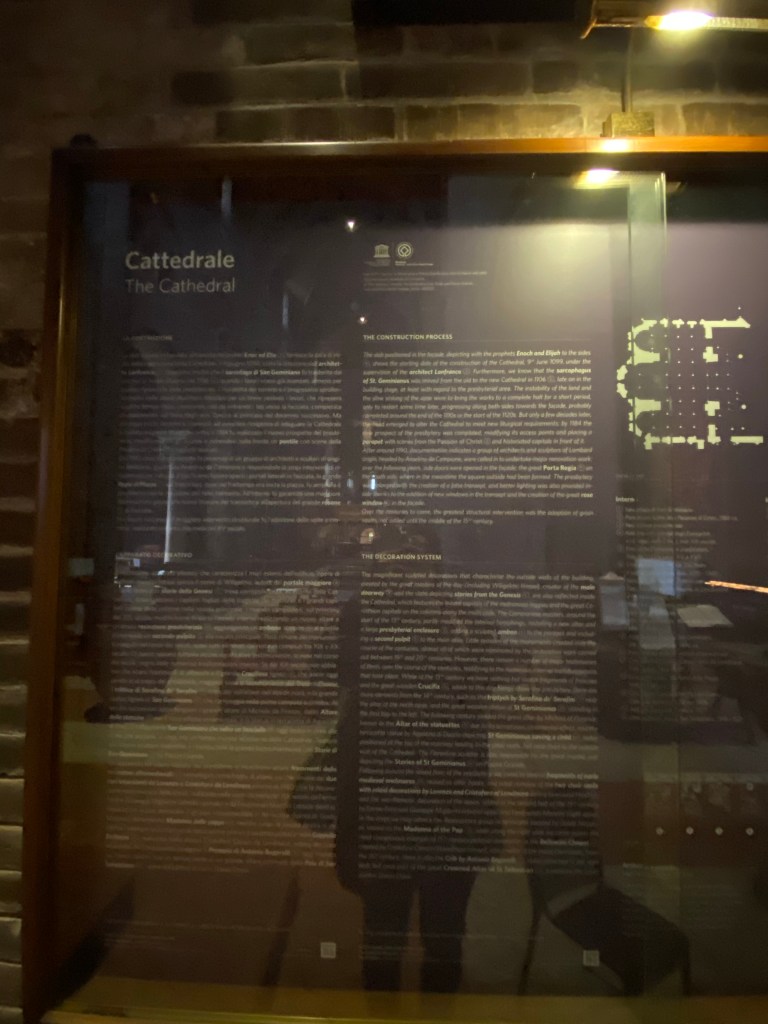
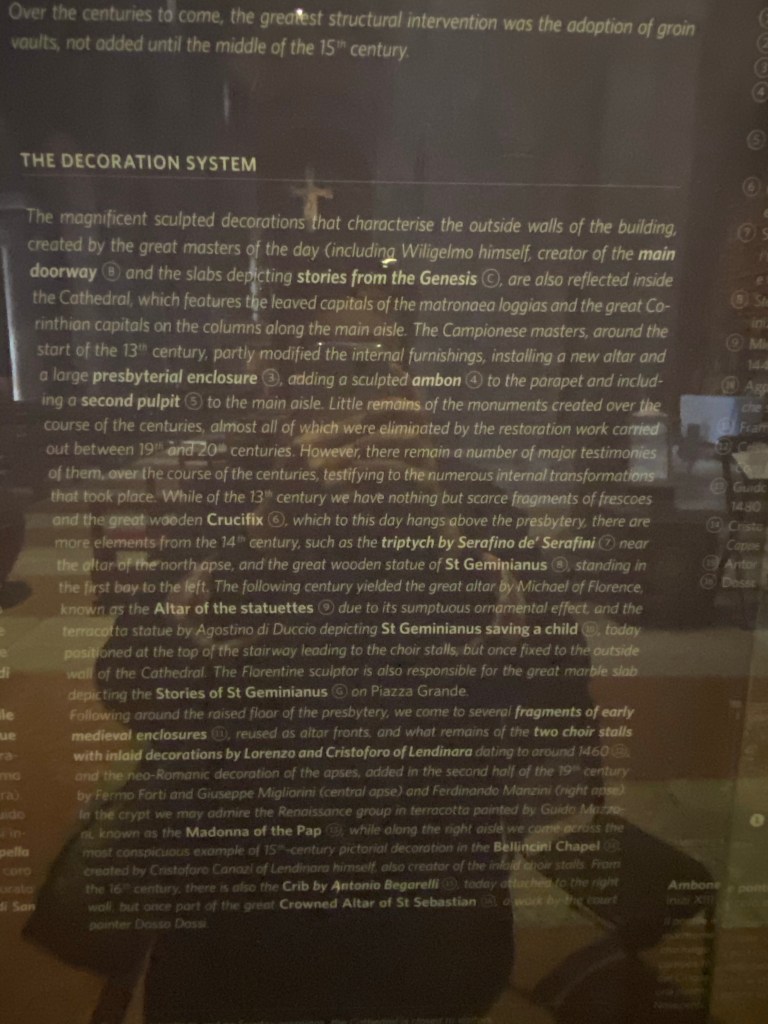


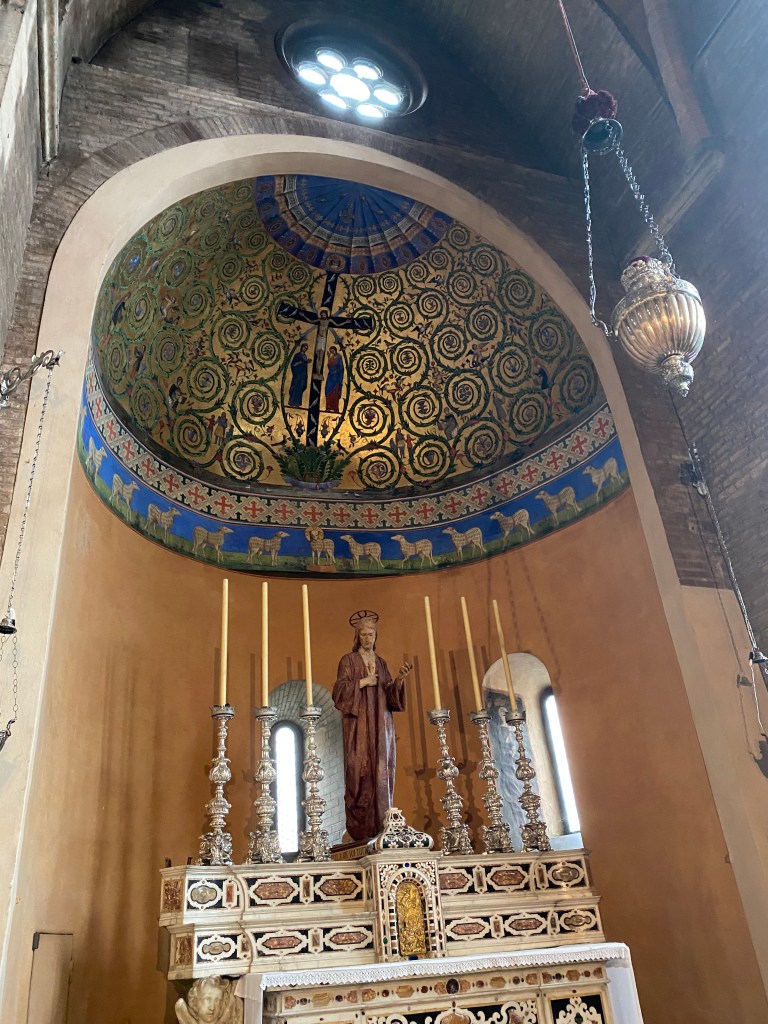

Interior of the Modena Cathedral
The interior of the Duomo is entirely built in brick, apart from some elements (like the capitals), which are in marble. Reflecting the exterior – they were planned as one – it is divided into a nave and two aisles. Looking down the middle, pillars and columns alternate, creating four cross vaults and a dummy transept near the choir, just before the apses. At half height, windows with three lights open on a false women’s gallery, never carried out. Higher, big windows give light to the church.
Starting from the left aisle, on the wall the tomb of bishop Roberto Fontana by Tommaso Loraghi and Ercole da Ferrara (1652); then, a wooden statue of the Patron Saint Geminiano, from the first part of the XIV century by the Campionesi and a marble door leading to via Lanfranco. The great Altare delle Statuine (1440-1) was entirely made in terracotta by Michele da Firenze; on the altar, the Madonna della Piazza or delle Ortolane, a fresco removed from the wall of the Cathedral, painted in 1345 (the name is due to the fact that it was put in the square for the devotion of the market people). In a sculptured marble altar, Saint Sebastian between the Saints Jerome and John by the famous artist Dosso Dossi (1518-21) surmounts a frontal in silver and gold copper of the early XIX century.
On the portal of the nave, the tomb of bishop Francesco Ferrari (1510), among various reliefs, is under the wonderful rose window, the stained glass designed by Giovanni da Modena. Two holy-water stoups originate from really ancient Roman capitals. The most important families of Modena also have their coats of arms cut in the keystones of the vaults (finished in 1453). On the left, around the second pillar, the Pulpit by Enrico da Campione (1322), painted in the following century with stories of Saint Ignatius’ life and sculptured with standing figures along the parapet (XV-XVII century). Over it, Madonna col Bambino, a fresco of the middle of the XIV century; under it, Madonna del latte. Near the second pillar on the right, a little wooden seat, today folded up, is known as the seat of the executioner, probably because he used it during cerimonies. The symbol of the Modenese archdiocese hangs from the third arch.
In the right aisle, after the funeral monument of Lucia Rangoni by Marco Antonio da Morbegno and Anelino da Mantova (1515), there is the imposing Cappella Bellencini: in a beautiful frame of terracotta, the Last Judgment was painted by Bartolomeo and Agnolo degli Erri or by Cristoforo da Lendinara in the XV century (notice the half-naked men at the bottom, the triptych, the angel with sword and scales and the Saints). In the chapel there is a nice baptismal font in rose marble. Then, the interior of the Porta dei Principi, the subtle Crib in terracotta by Antonio Begarelli (1527) and the grave of Francesco Molza (1516, by Bartolomeo Spani).
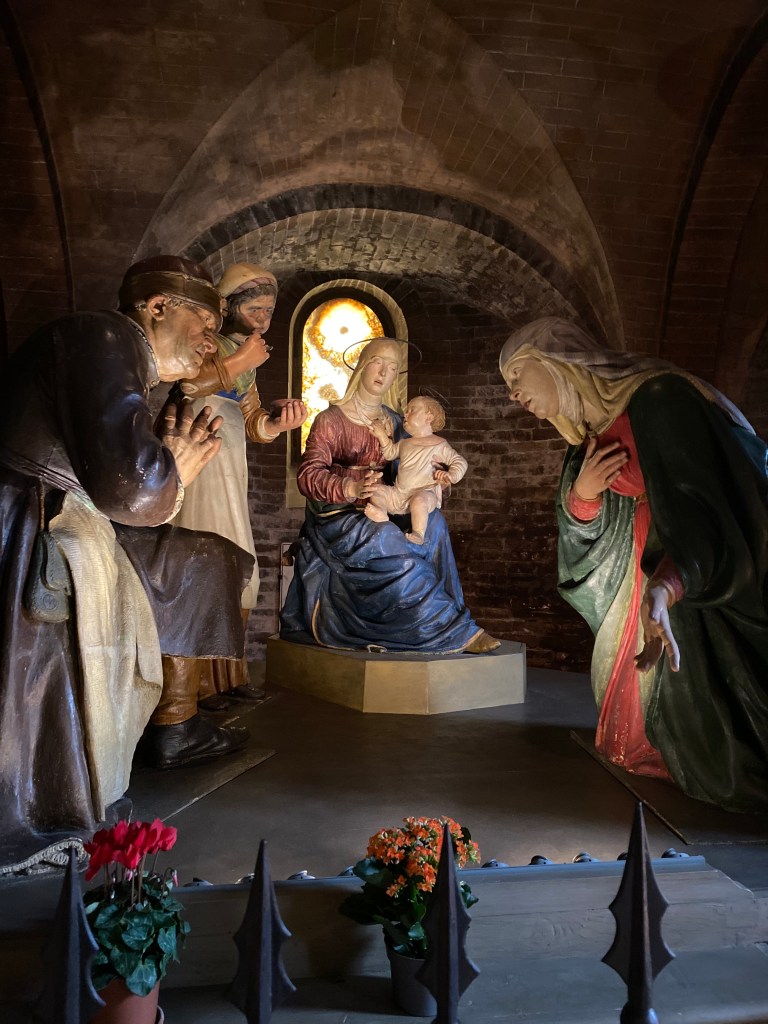
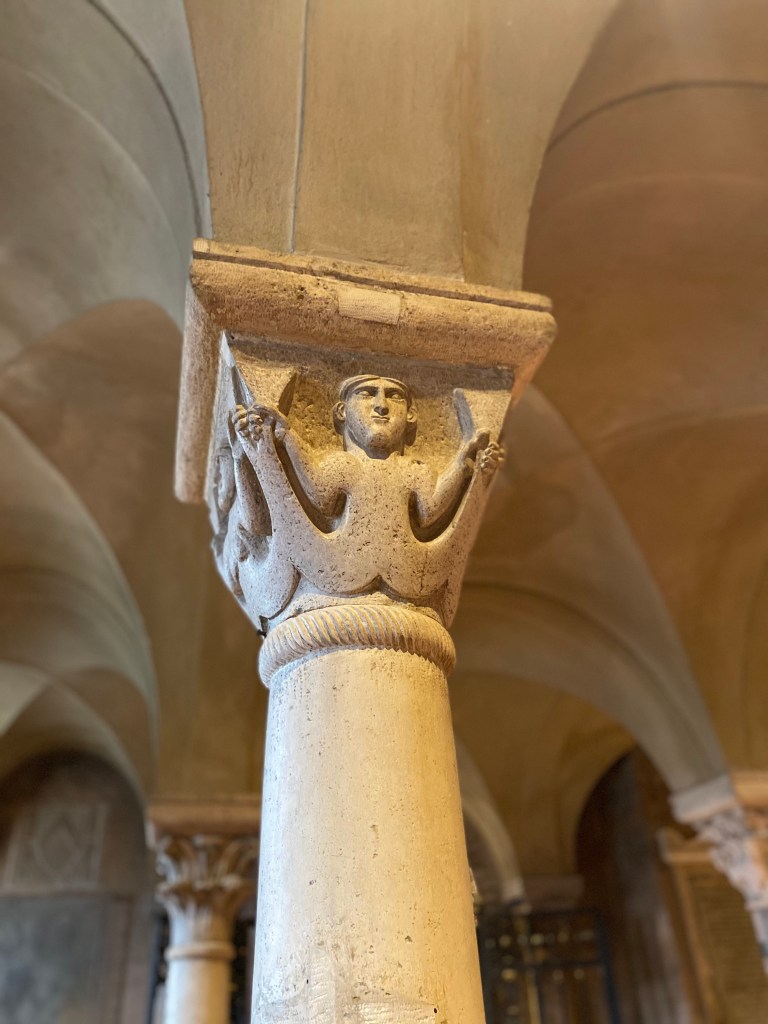
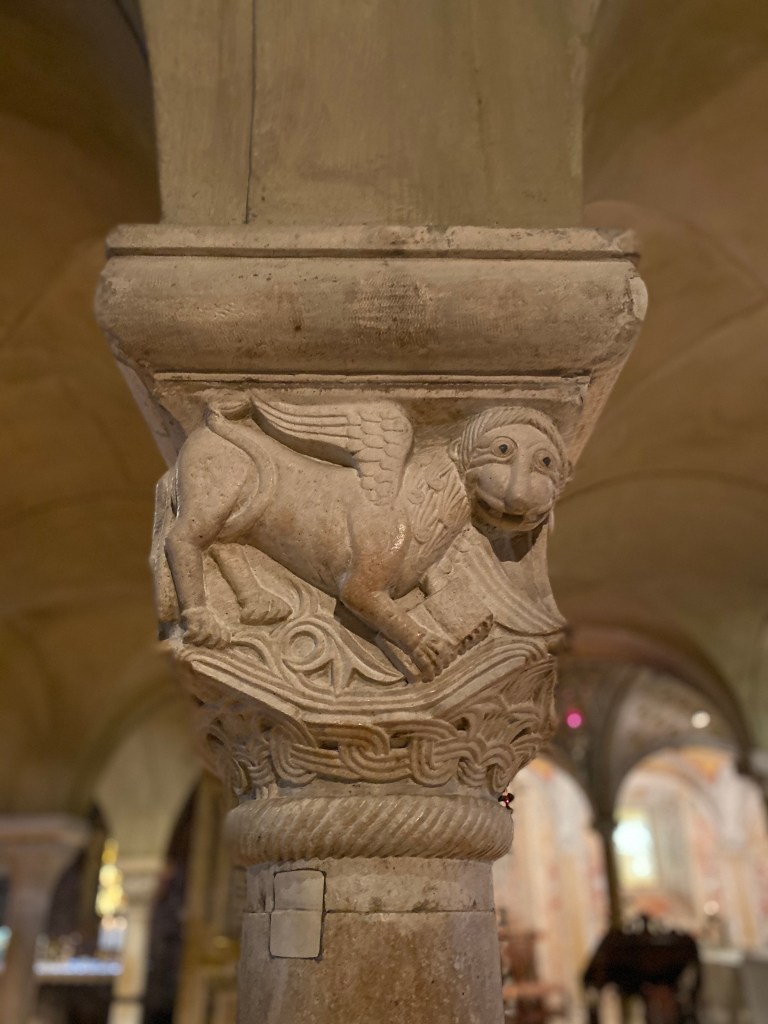
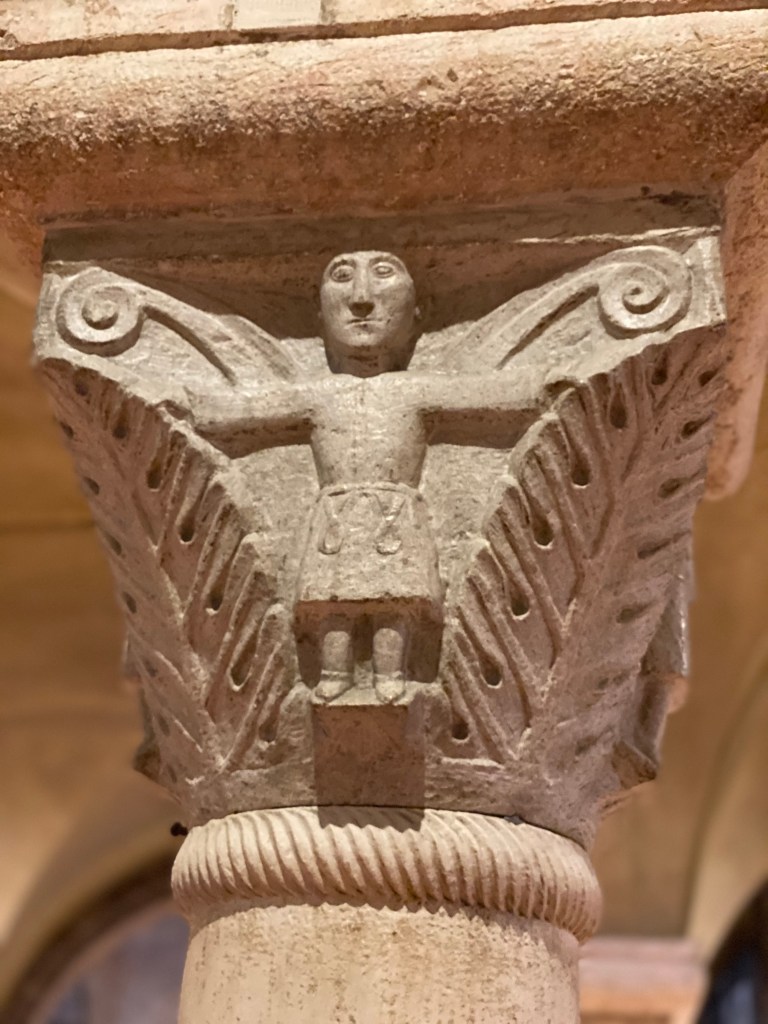
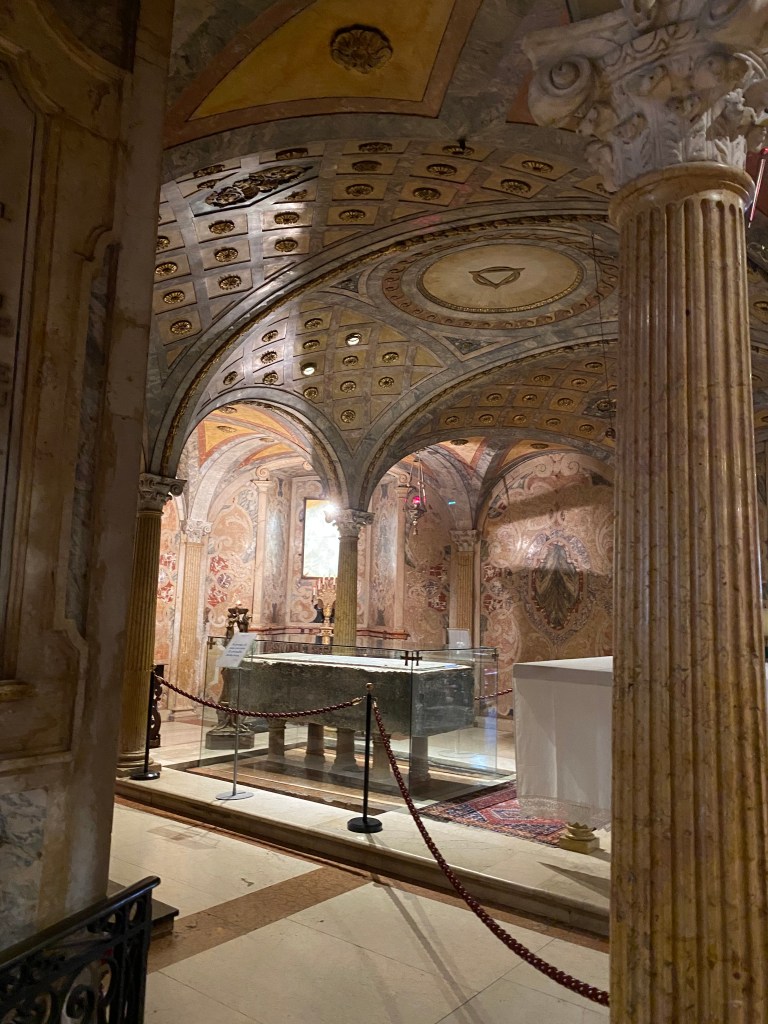
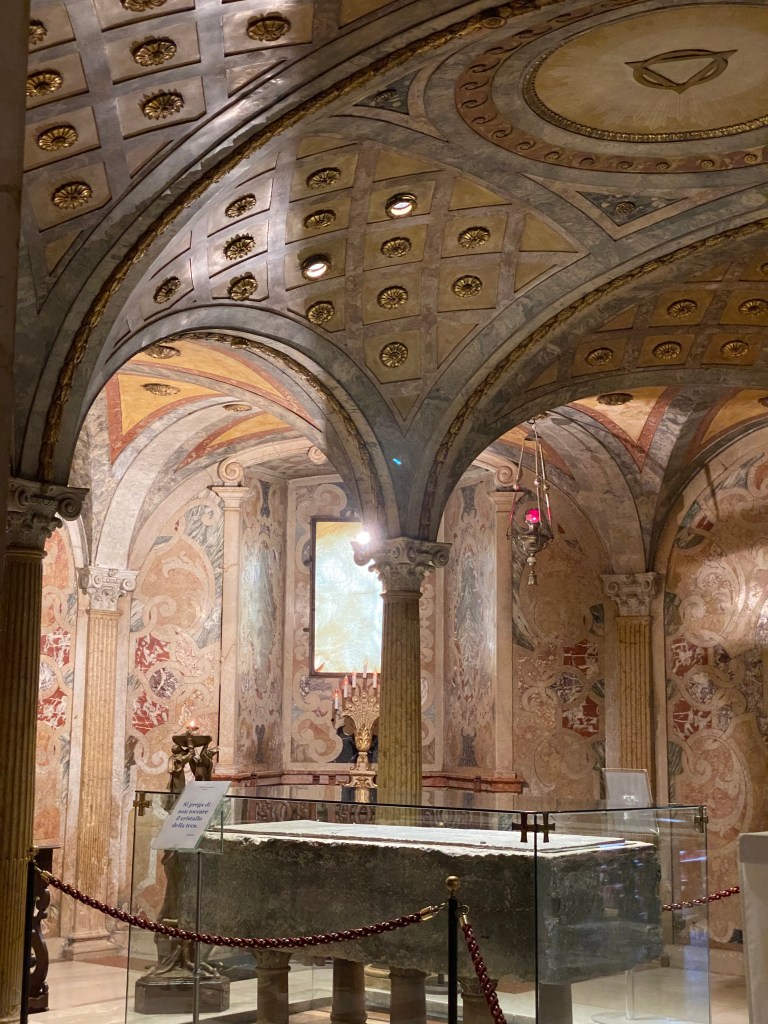
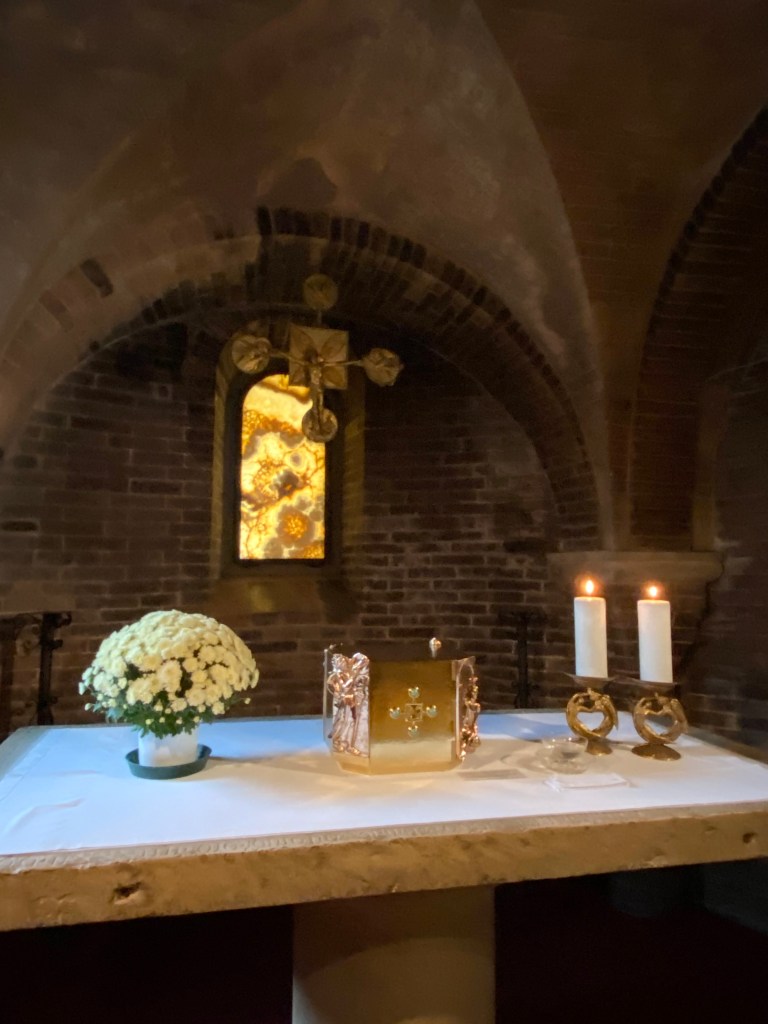
At the end of the aisles, descending some steps, there is the crypt of the Patron Saint Geminiano. Here many graves fill the walls and the floor, but the characterizing elements are the capitals of the numerous columns (sometimes recuperated, sometimes preceding Wiligelmo himself). In the right apse, the Madonna della Pappa or Porrini crib by Guido Mazzoni in painted terracotta (1480-5). A parapet indicates the area of Saint Geminiano’s grave, visible under a crystal shrine: the columns which substain it (IV century AD) once allowed the believers to pass under it as a sing of devotion. The whole apse was decorated in the XVIII century with marble work. Finally, the left apse conserves a Crucified and a golden urn.
Back in the nave, the wonderful parapet and ambo were sculptured and painted, in the years 1165-1225 by the Maestri Campionesi. In the first, from the left: the washing the feet, the Last Supper, Judas’s kiss, Pontius Pilate and Jesus, the flagellation and Cyreneus. In the second, from the left: the Learned Men of the Church and the benedictory Redeemer among the Evangelists, Jesus and Saint Peter. The whole structure is borne by four column-bearing lions (one of them being bitten on the neck by its prey, two are clawing at knights in armour with swords, the fourth traps maybe a dog) and by two telamons, symbolizing the pain of hard work. Capitals, reliefs and marble roses fill the entrance to the crypt.
With backs turned to the rose window, one can go up to the third level of the church, through the left stair way: this raised area is occupied by the presbytery. On the wall, the tomb of Claudio Rangoni, by Niccolò Cavallerino, based on a project by the famous Giulio Romano (1542). Then, two pieces of sculpture: a marble Madonna col Bambino and Saint Geminiano saving a child falling from the Ghirlandina by Agostino di Duccio (1442). Under a modern organ, four pieces of inlaid woodwork with the Evangelists by Cristoforo da Lendinara (1477) and the wooden high-backed chairs. In the apse, a precious Polittico con Incoronazione di Maria, Corcifissione and Saints by Serafino Serafini (1385) surmounts an altar dating back at least to the X century. The door which is opened near the stair conducts, through a raised passage, to the astonishing sacristry, painted in 1507 by Francesco Bianchi Ferrari and furnished with stalls inlaid by the Lendinara (XV century). There are also canvases by Modenese artists such as Francesco Vellani and Bernardino Cervi.
In the nave, there is a XIII-century enclosure with little pink and white columns; on the top, the latin inscription “IESUS CHRISTUS HERI ET HODIE IPSE ET IN SAECULA”, and near it a beautiful spiral marble column. The floor, decorated with marble designs, the XVII-century wooden lectern and the monumental wooden Crucified hanging from the vaulting (second half of the XIII century) are unforgettable. On the wall, the high-backed chairs inlaid in wood by Cristoforo and Lorenzo da Lendinara (1465), of which the central two have also a little cupola. The main altar, dating back to the XIII century, supported by six pairs of columns and by a bigger spiral one, symbolizing Christ among the Apostles. The painting in the apsidal conch is recent: it was carried out in the XIX century by Forti and Migliorini, inspired by the classical themes of the Roman mosaics.
In the right apse, apart from the many windows opening into the dummy transept over Piazza Grande, there are rich candelabrums, a marble altar and the golden XIX-century tables with Santa Lucia and Sant’Eligio. The handrail finishes with the head of a lion, whereas on the wall there are still now remains of the paintings which once covered the interior of the Duomo (XIII-XIV century). Here opens the Porta Regia, the main access to the church from Piazza Grande.
Advent, day 8
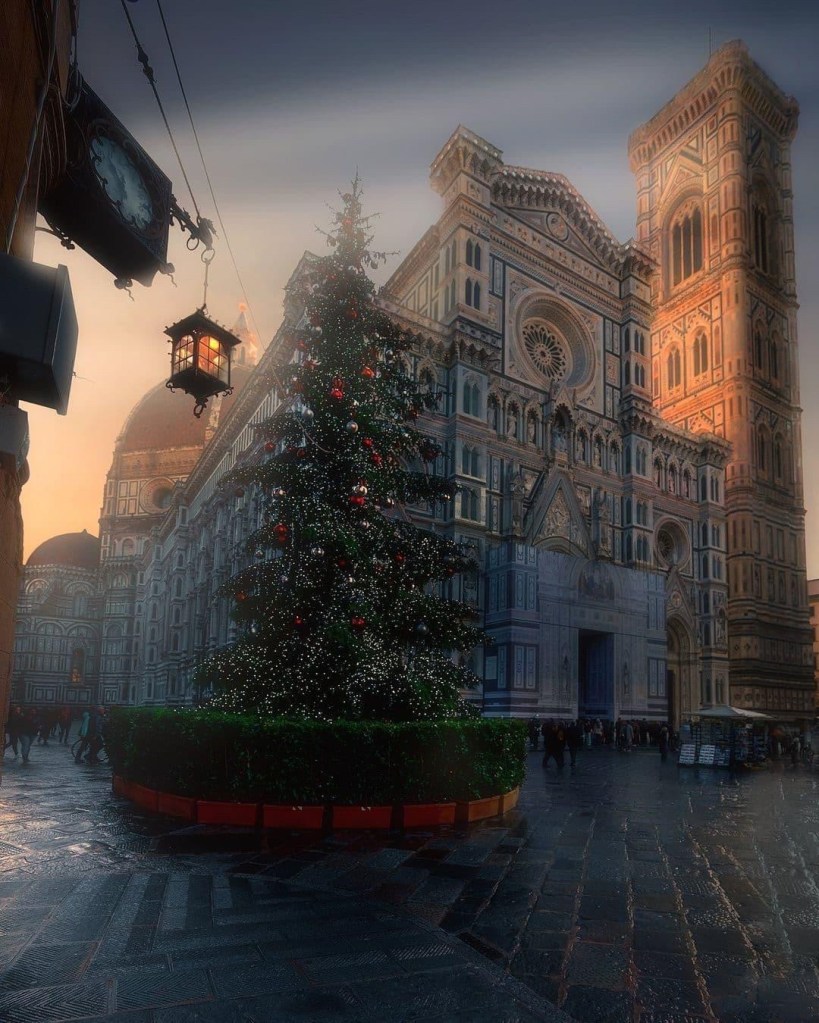
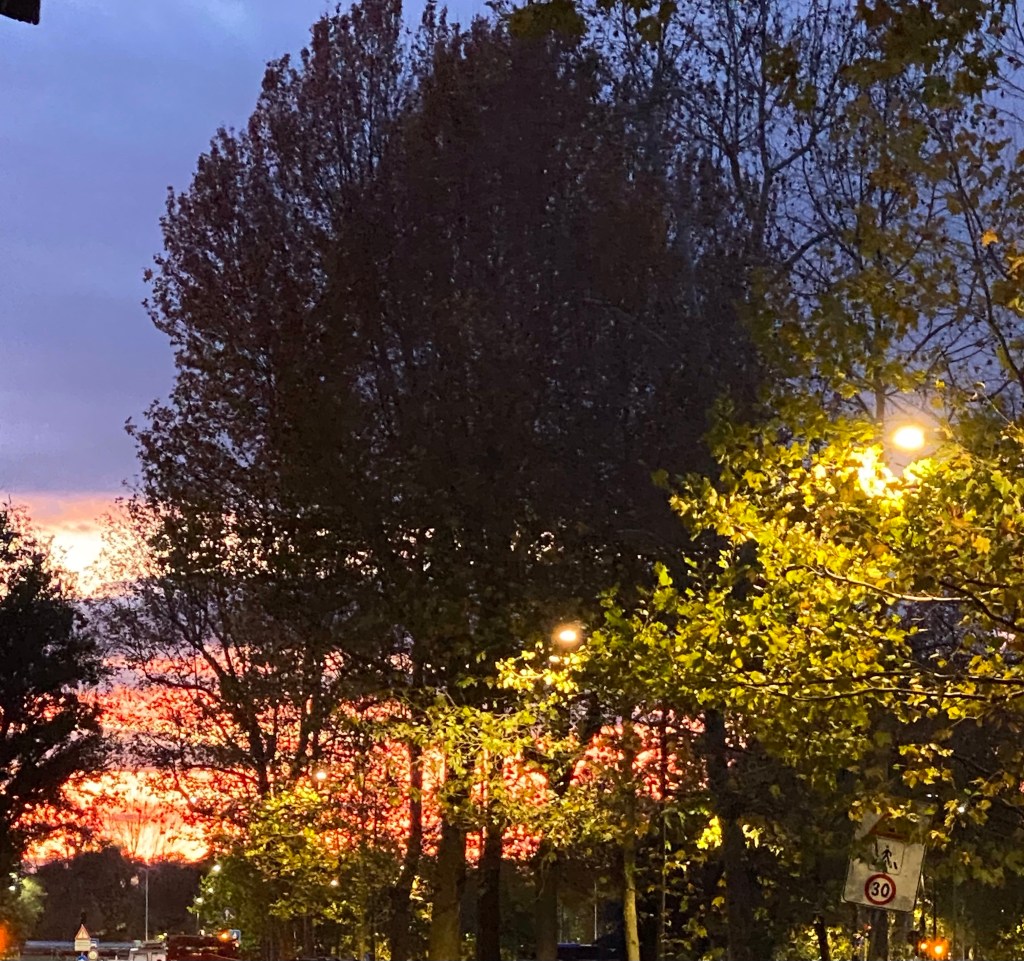
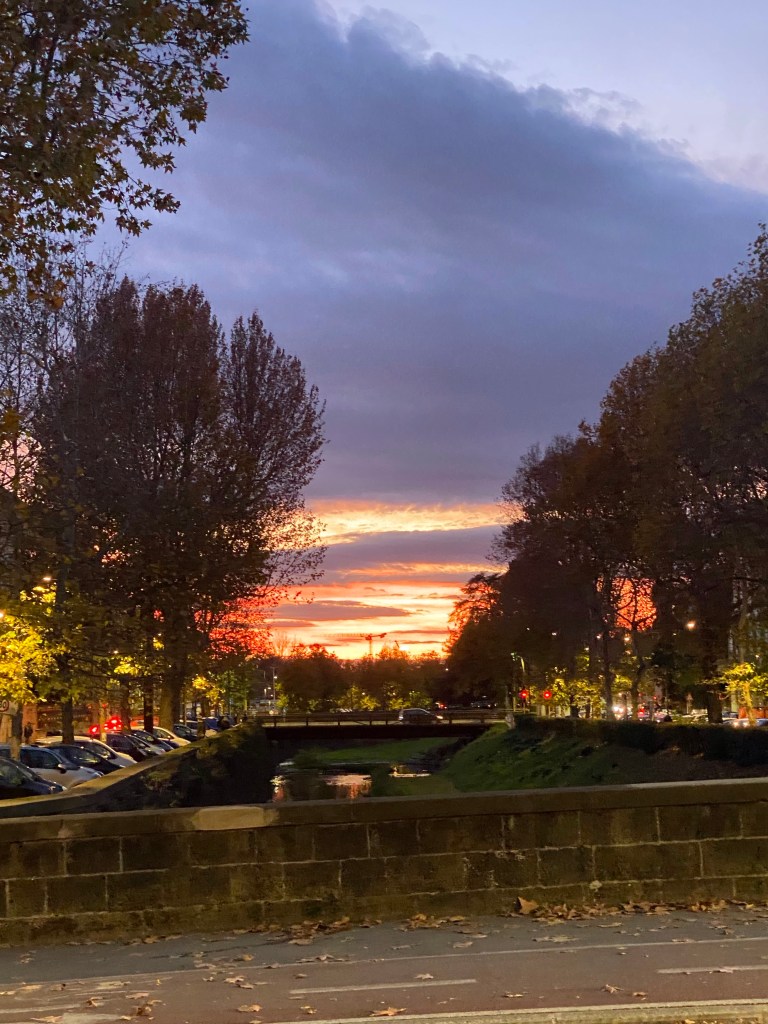
A December sunset in Florence, just down the street from my home.
The crypt of Modena cathedral
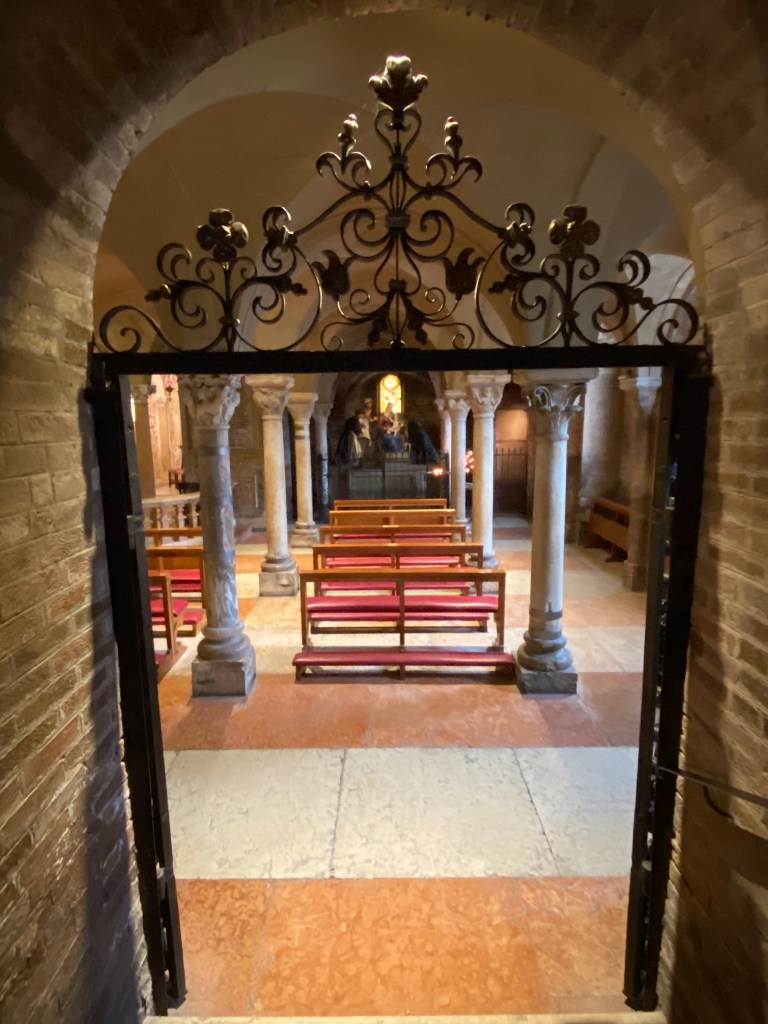
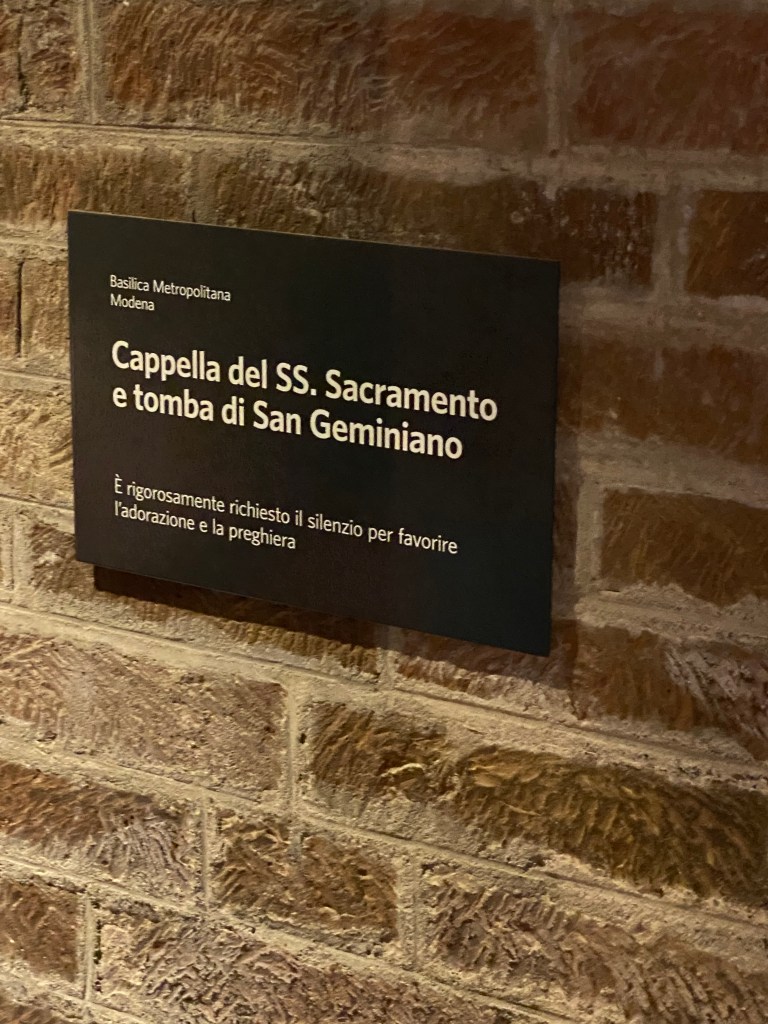
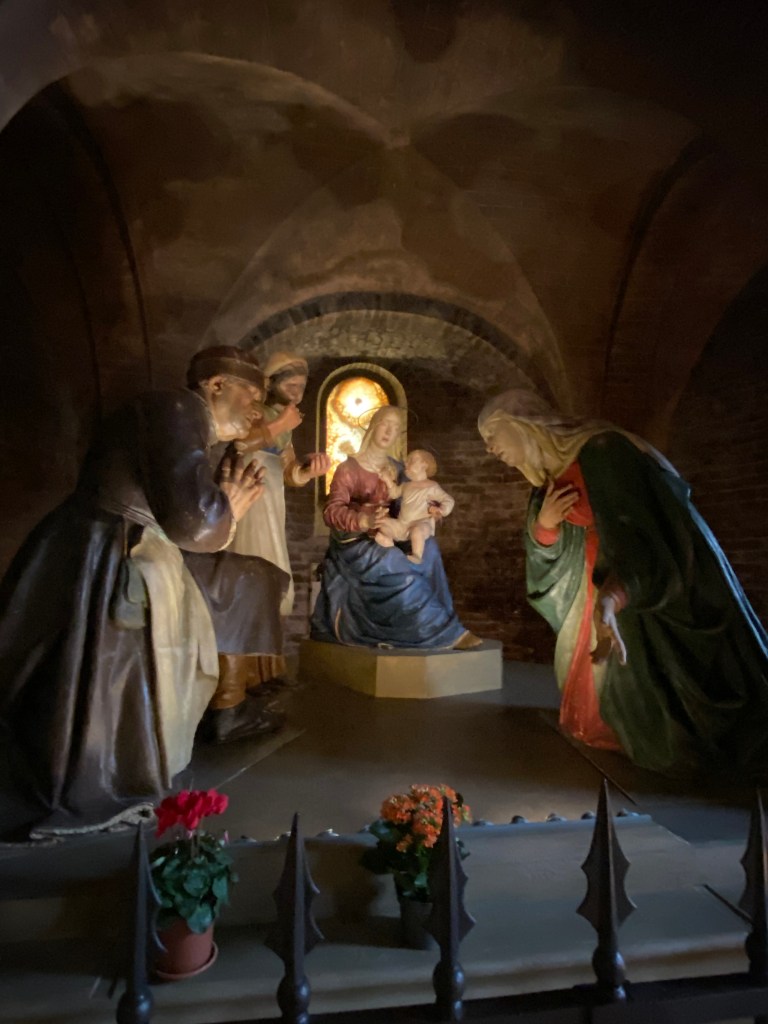
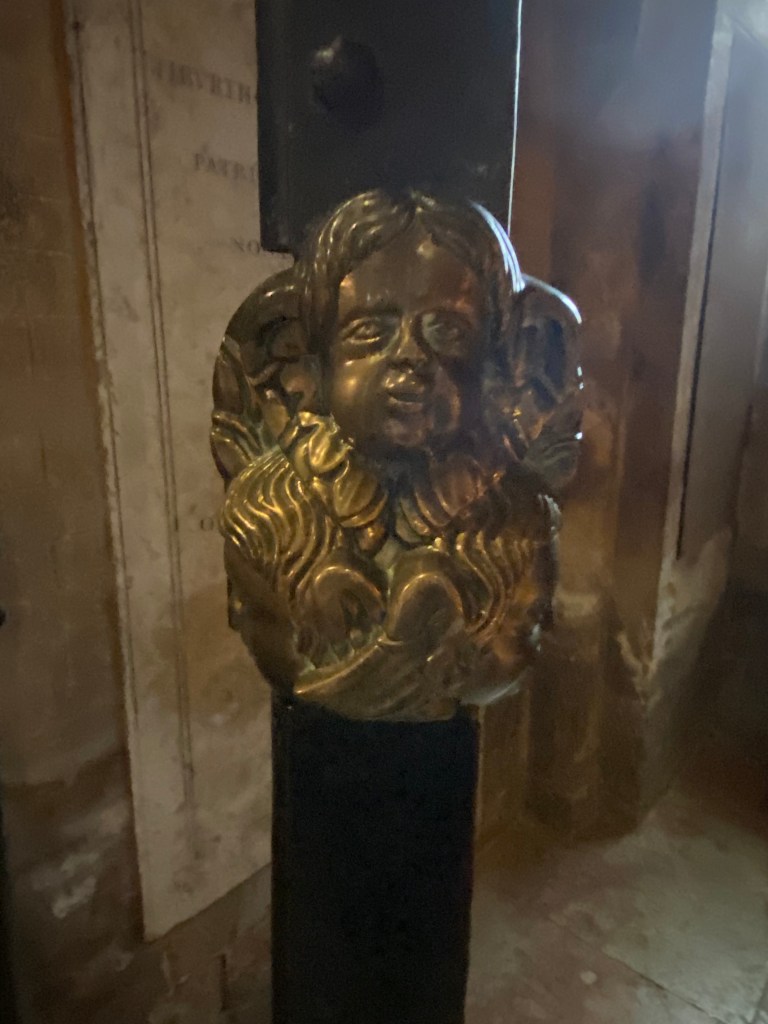
There is a very elaborate, highly finished crypt just beneath the main altar of the Modena cathedral. Santo Geminiano is buried here.
One feature is a group of colored terracotta statues called Madonna della Pappa, made by local artisan Guido Mazzoni at the end of the 14th century.
On the right of the Virgin is “Suor Papina,” a nun who blows the soup onto the spoon before offering it to the Baby Jesus who holds a bensone in his hand.
What is a bensone?
It’s one of the oldest desserts of Modena, popular since middle age and during religious celebrations. It may not be as gourmet as torta Barozzi, but a perfect fit for Modena Cathedral.
Precious marbles and thin onyx slabs decorate the symmetric crypt of Modena Cathedral.
 get back, lauretta!
You must be logged in to post a comment.