Summer daze

On a day when we were blessed with a 10 degree drop in the temperatures, I went out for a long walk in one of my favorite Florentine neighborhoods. I adore the summer sound of cicadas, and they were out in force this day as you will hear!

There are many beautiful little villas lining this gorgeous boulevard in the Oltrarno. Here are some views and details.

The villa above is partially shielded from public view by a stand of bamboo.

Across the street are some art deco and art nouveau era villas.

I was impressed with this brave solo ivy vine climbing its way up a tree trunk. I like spunk wherever I find it!

I stopped and looked up where the loudest sound of cicadas chirring came from. It was a beautiful view with the sun hiding behind a white cumulus cloud for a brief moment.

There’s a school called Liceo Sacro Cuore (Sacred Heart High School) along the boulevard. I thought you would find it interesting that a student can get an American high school diploma here, according to the billboard.

Ad advertisement for the city painted on a sidewalk, complete with a QR code.

Soon, the dome of the duomo comes into view. It never ceases to impress.

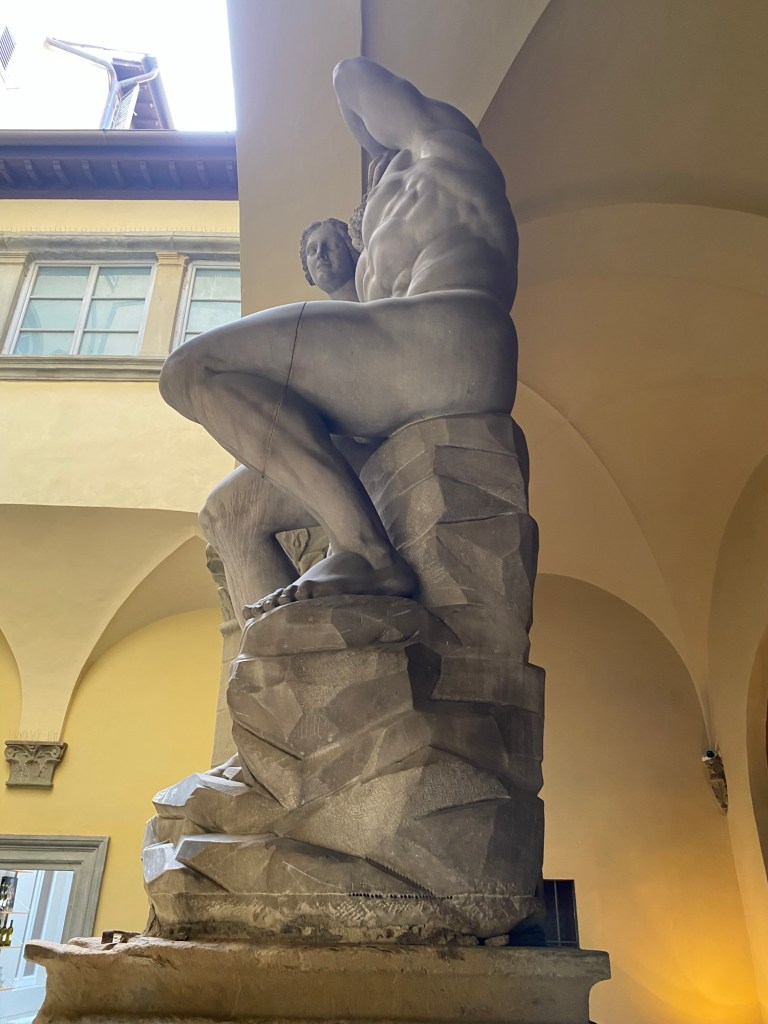
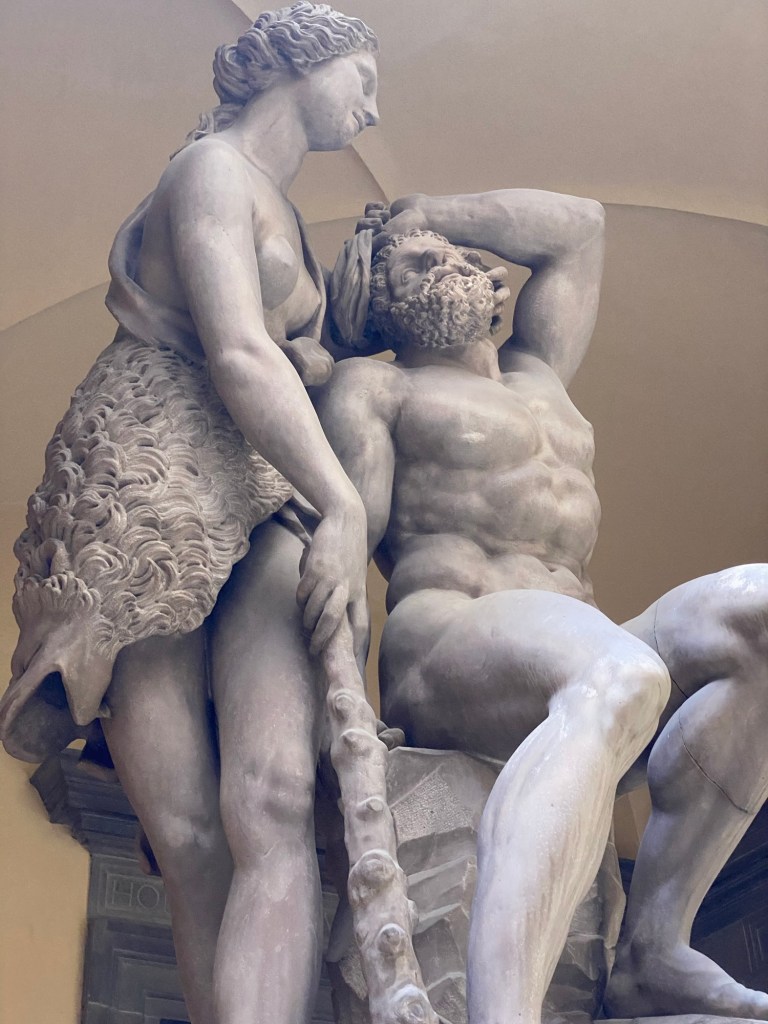
There is a collection of bronze statuary along here, just where the boulevard reaches the Arno River. I’ll be danged if I know what message the sculptures are intended to convey.

How’s this for a beautiful little townhouse? I adore it!

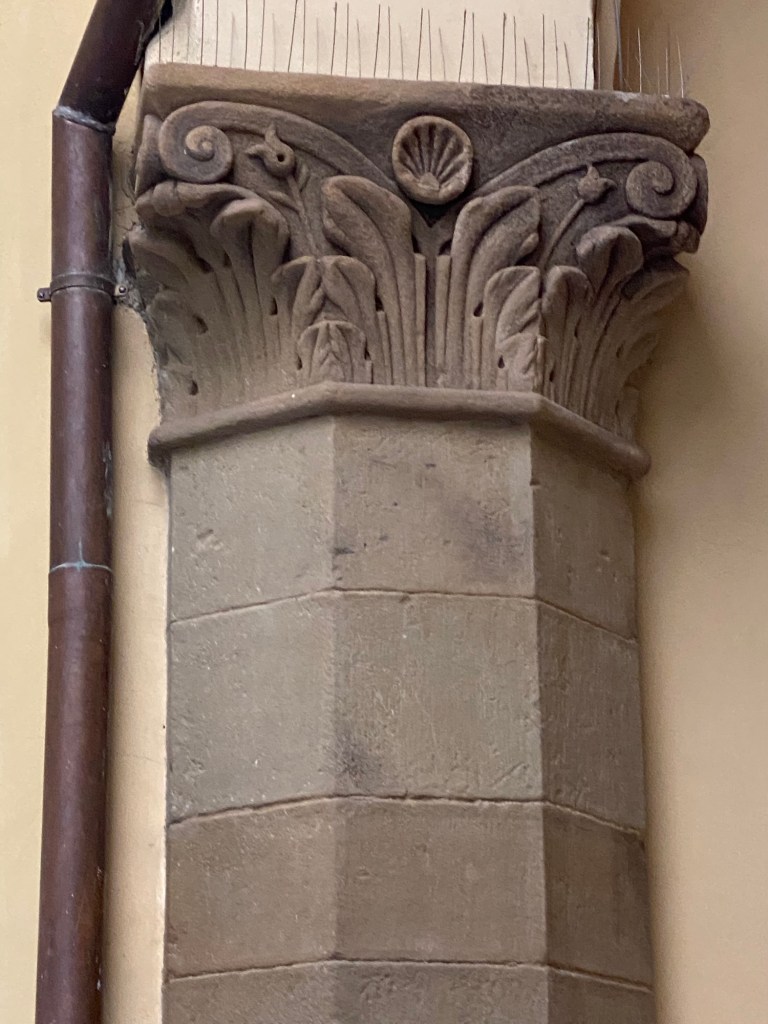
And another palazzo with lovely decoration.

And, nearing home, after crossing the river I come upon my favorite grove of gigantic deciduous trees. The cicadas were very boisterous here as well!

I came home, happy to return to a/c and a good book after all the visual stimulation provided by this amazing city!

Everyday scenes around Florence

The wisteria is undergoing its second florescence of the season, and this remarkable specimen caught my eye when I walking down a narrow city street in the center. I am always charmed by the sight of buoyant nature living in connection with medieval architecture; it is such a contrast.

The engraved marble plaque below notes that Giuseppe Garibaldi stayed in this building on 22 October 1867. It doesn’t seem like the tourists who are crowded around the entrance to the building care a bit about that! They are looking at the menu posted for the restaurant called Osmo.

Down the street on which I live is this artisanal glass making enterprise. The ancient looking brown facade at the end of a long drive way is visible from the street.

I followed the driveway to the end and found this lovely building facade, that looks like a building that Ruskin would like.

To the right is the entrance to the shop.

I never cease to be entertained by the fact that I live within an enclave with streets named after some of Italy’s finest painters!

I was struck by the loveliness of this courtyard with magnolia trees and pretty paving stones. I like the way the iPhone camera handles the direct sunlight. Back in the days of film cameras, we did everything to avoid this kind of shot. But now I like it.

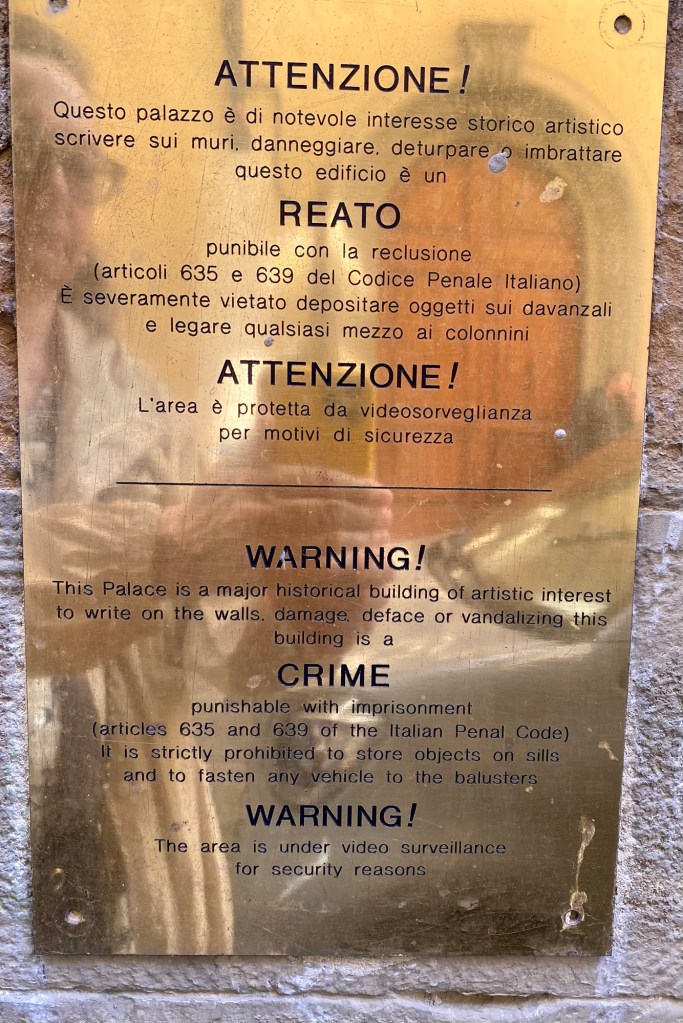
You see signs like this one all around the city. It says Vietato L’affissione, which mean, it’s forbidden to write graffiti or attach posters to the wall. This one is explicit: I’ve never seen a sign like this before that actually cites the precise penal code number.

Sitting on the bus, I noticed that this particular police station is blessed with an image its patron saint (not sure who, sorry). I come from America and I’m not used to religious figures associated with the police.

I see carabinieri vehicles often in the city, but this was a rare sighting of a van especially for the penitentiary. I shudder to think.

You find snack bars on every corner in Italy so you can get a coffee, but you also find vending machines for the same purpose, just in case you are in need of a quicker fix! This one was very interesting in its vast array of offerings. I saw it in Ferrara but added it here because it’s an wildcard among my pix.

I end with a pretty hibiscus blossom. In a city made of stone, it’s not often I happen upon such a pretty flower on its streets.

The best gelato in Italy, bar none

I’ve tried all of the gelaterie in every place I’ve been in Italy over a lifetime, and the clear winner is this Florentine company. Without a doubt.

I can’t treat myself to this heavenly stuff more than once a month, just for health reasons. But this was my July treat. I’m already looking forward to agosto!

This day I chose caramello salato which is salted caramel. It was insanely good!

But typically I go here for their Buontalenti flavor, which was developed by the 16th century architect of the same name, according to tradition. And tradition is everything!

The Savonarola chair??

Once you get hooked into Savonarola, as I have in several posts here since the early spring, he shows up everywhere.

I was watching an interior design show and someone identified a chair as a “Savonarola chair.” I almost fainted. How did I live to be this age and spend as much time in Italy and studying Italian art and culture and never hear that this type of chair has this type of name?!!

Above is a sea of Savonarola chairs, at my favorite spot about 20 minutes from my home. I go there almost every Saturday morning. It’s become kind of a ritual, to start my weekend.

I’ve sat on many of these chairs while studying the gorgeous Renaissance fresco, plus I have seen these chairs and sat on many of them all over Italy. And again, never did I know the name!

An X-chair (also scissors chairDante chair or Savonarola chair) is a chair with an x-shaped frame. The form was known to have been used in Ancient Egypt, Rome and Greece. The Christian faldstool is a type of X-chair. Did you just say to yourself, but what is a faldstool? I did and looked it up and I thank you, Wikipedia:

Faldstool (from the O.H. Ger. falden or falten, “to fold,” and stuol, Mod. Ger. Stuhl, “stool”; from the medieval Latin faldistolium derived, through the old form fauesteuil, from the Mod. Fr. fauteuil) is a portable folding chair, used by a bishop when not occupying the throne in his own cathedral, or when officiating in a cathedral or church other than his own; hence any movable folding stool used during divine service.

All of the folding stools above, my friends, are faldstools.

Wikipedia says this about the so-called Savonarola chair:

A type of folding chair with a frame like an X viewed from the front or the side originated in medieval Italy. Also known as a Savonarola or Dante chair in Italy, or a Luther chair in Germany, the X-chair was a light and practical form that spread through Renaissance Europe. In England, the Glastonbury chair made an X-shape by crossing the front and back legs, while in Spain X-chairs were inlaid with ivory and metals in the Moorish designs.

The use of the name Savonarola chair comes from a 19th-century trade term evoking Girolamo Savonarola, which is a folding armchair of the type standardized during the Italian Renaissance. It is said that a chair like this was found in Savonarola’s small room (known as a cell, but having nothing to do with prison) at the monastery of San Marco right here in Florence! Who knows if that is true, but it is said that’s where the name comes from. It’s a good story, regardless.

The chair in the illustration consists of a wooden flat-arched back rail carved with a coat-of-arms in low relief and connected to the back of the straight arms of the chair and a seat made of narrowly fitted wooden slats. The wood used in the construction of the chair is the typical walnut, as in other gothic and renaissance furniture.

From this source:

https://web.archive.org/web/20141225131328/http://www.apartmenttherapy.com/design-glossary-savonarola-cha-148638

We also learn:

Savonarola Chair: This is another type of X-frame folding chair with arm rests and a back rest, but instead of having four legs, it has several narrow wooden slats, also typically wavy like Dante chairs. It was also named in the 19th century for a famous Renaissance figure, in this case the moralistic Dominican friar who led Florence during the 1490s and is famous for his Bonfire of the Vanities. It is possible that Savonarola did in fact have a chair like this, since monks often used folding chairs in their small cells (below).

The interior of Palazzo Galli Tassi

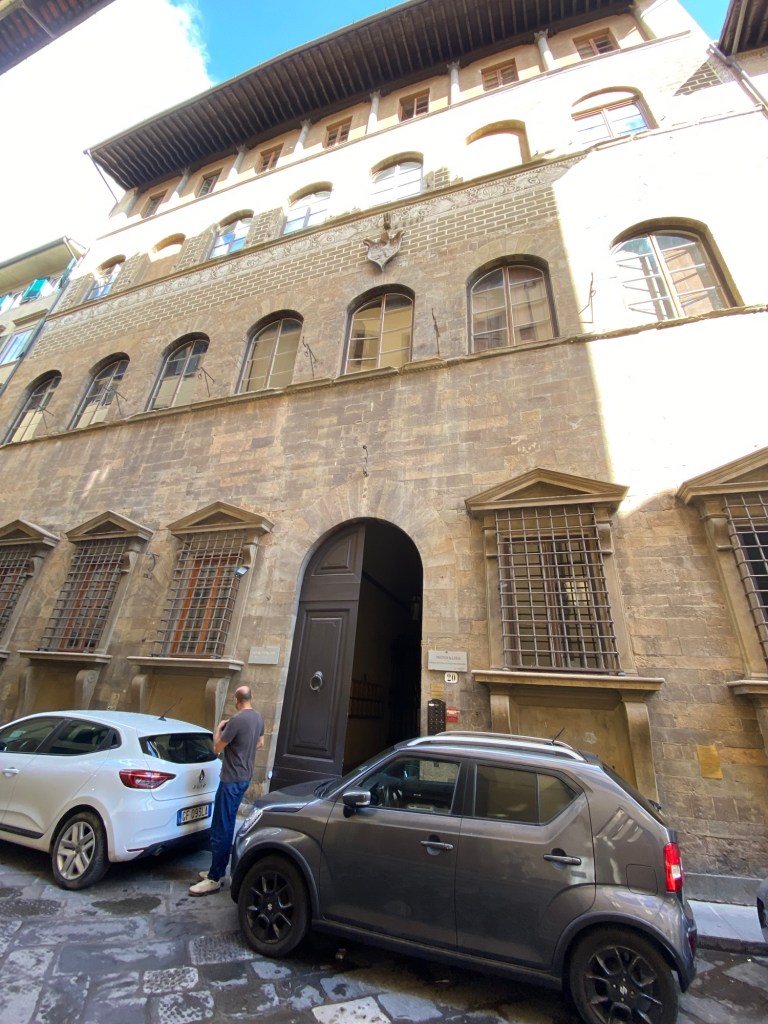
A while back I posted about the exterior of the Renaissance palazzo in Florence in which I have the great pleasure of attending Italian language classes. I’m finally getting back to it to show you the interior.

My video above shows how one enters the building and arrives first in the open air courtyard in the center. At the time of this video, an exhibition involving modern furniture was being installed. In the center you see a young woman in black and her boyfriend?/photographer, taking a bunch of pictures of her in front of the 18th century marble sculpture. Alas, this is the sight everywhere nowadays. If it isn’t a selfie, it’s a casual photoshoot. I long for the days of film cameras where there was less indulgence and a whole lot less posing going on. Pardon my rant.

The building today houses a small hotel and two language schools, as well as a small retail business.

This is my view every time I come to class. I climb the 2 ramps of the grand stairway, decorated overhead with this gorgeous baroque ceiling painted in white, with two neoclassical putti standing in greeting. One bears an inscription relating to Galli Tassi, a one-time owner of the palazzo. The next image shows a Google Translate translation of the inscription on the top statue, the one of the putti holding one arm up.

At the top of the stairs, just under a portion of a remaining fresco, is the 19th century sign for the syrup factory that was once housed in this building during that century.

Hello, I say to myself, just before class.

What a grand stairway!

On the ground floor of this building is this salon with frescoes. I was lucky to take this video before being shooed out by a supercilious hotel worker who seemed to think he was the marchese of the palazzo (he’s not). As a student of the language school I had every right to be there.

However, the rooms of the hotel houses within the building are not open for my gaze , but I found these photos on their website.

A couple other ground floor rooms are occasionally found open by an intrepid investigator (that would be I). I spied an original ceiling decoration and antique fireplace in one sala.

From the 3rd floor of the palazzo, where my school is located, there is another smaller less grand stairway leading to the 4th floor and maybe the roof (? A search I’ll make in another day).

Even this modest stairway, which was probably for staff, appears lovely to me.

And back down in the 3rd floor, here is the door leading to my school.

Open Sesame. The mysteries to be unlocked by the Italian language await.

Details, details, details

It was another hot, sultry day in Florence and I only had the capacity to notice the little things that form a part of bigger things.

I often start a Saturday with a quick (20 minute) walk to view a Renaissance masterpiece fresco where nary a tourist is to be found. And, it’s cool inside. This day, I was drawn to these details on the walk there (the Vespa, the building decoration), but once I arrived my gaze was captured by the wood, the stone, the iron; all the finishes hand-created with either a chisel and hammer, iron tools and fire, or a painting formed with a brush and some paint. It’s all there. No where more lovely than here. You just have to look. It’s all beautiful.

And, not only that, but I learned something completely new that day, and will be posting about it soon. It is a detail of Italian culture, having to do with wooden furniture. Any guesses?!

Ferrara, birthplace of Savonarola

Readers of this blog will recall earlier this spring I did a big post with lots of pictures and videos of the Florentine celebration held annually to mark the brutal execution of Girolamo Savonarola in this city in 1498. But, did you know that the firebrand was born in Ferrara?

He’s commemorated in Ferrara with this statue depicting him in the process of delivering one of his fiery sermons. His importance is shown by the placement of the work of art: it’s in a wide open square surrounded by the city’s most important civic and religious buildings. I got the chills when I walked by the statue, knowing the history of this man the way I do.

The inscription says in English: “To Girolamo Savonarola in corrupt and servile times of vices and tyrants, flagellator.” Well, that’s blunt! He is remembered in Italy for his complaints against the church, predating Martin Luther.

I like being in the know about these things Italian. Savonarola is just one example of thousands.

The cathedral of Ferrara

The Medieval cathedral of Ferrara, whose style blends Romanesque and Gothic, typically looks like this photo below. You can see its distinctive pink and white marble clad bell tower, or campanile, which is the tallest part of the back in this shot, on the right side.

Typically, when I visited Ferrara recently, I found parts of the exterior of this august building under scaffolding. If you’ve spent any time at all in Italy, trying to see specific sights and not just what your tour guide shows you, you will know that scaffolding appears when you least expect or want it. It’s the story of research in Italy. I am often disappointed in this way, but at least I can console myself with the realization that I can return and try again. As indeed I will be doing with Ferrara. I am so grateful for that luxury.

So, above and below are pix of how the cathedral appeared to me on my recent trip.

Below, I am zeroing in on the right of the front of the church.

The Cattedrale di San Giorgio Martire, which is the proper name for this most important church in Ferrara, stands as a remarkable testament to the city’s layered history and architectural evolution, offering a blend of of Romanesque, Gothic, Renaissance and Baroque artistry.

The following elaborately carved bas relief, depicting the saint to whom the church is dedicated, is over the far left entry to the church.

Below is a close-up of the distinctive pink and white marble clad bell tower as it normally appears.

The following are shots of how the bell tower appeared when I was last in Ferrara.

The campanile is said to have been designed by Leon Battista Alberti and was left unfinished for reasons not fully understood. It was not uncommon for architectural projects to be left unfinished in Italy, however, and happened due to political or financial difficulties, including the death of the patrons or conflicts. Alberti’s design was innovative and inspired by Roman triumphal arches and classical proportions, including the golden ratio.

I will have to wait until my next trip to Ferrara to have a good look at this campanile.

Let’s take another look at the full shot of the cathedral. In particular, I want you to notice the arcaded loggia that appears in the exposed side of the church, running along the same side as the bell tower.

This entire side of the church was and is dedicated to commercial activities; it is lined with shops, some very au Courant in 2025 and snazzy, and you can tell by the architecture of the shops themselves as well as the blind loggia that runs above that this aspect of the building is as old as the church itself.

I’ve only seen this use of church walls for commercial space in one other place: in Mantova (Mantua) the same thing occurs on the side of the Basilica di Sant’Andrea. If you look at a map, Ferrara and Mantua are only 56 miles distant. Stylistic similarities are not that surprising, given this closeness. And Alberti was active in Mantua as well, so the possibility of his working in Ferrara is also not surprising.

Below are the shots I took of the shopping arcade attached to the cathedral in Ferrara.

Now, back to the cathedral itself. I didn’t take any shots or videos of the interior of the church because it has been completely redone in a pastiche of the Baroque style, and that is not of interest to me. Pure Baroque, yes. Pastiche Baroque, ho hum.

But, what is interesting is that Ferrara has kept aspects of the Medieval entrance to the church and housed it in a covered vestibule attached to the front of the church. The next few shots show this entryway and its sculptural adornment as currently arranged. It is badly aged, but the “bones” are still there.

So, there you have my experience. I’ll be going back to Ferrara and hope to see the campanile and facade revealed again! Buona giornata.

A Dutch string quartet concert at Palazzo Corsini, Firenze

Would you like to join me at a gorgeous concert in an amazing location? Well, feast your eyes and ears on this post.

Last night was a magical evening. I must start by saying that we had a tremendous thunder storm on Sunday, during which I almost did a dance in the rain on my terrace, so grateful was I for the relief in the temperatures! We cooled off 20 degrees and Monday was a delightful day here: sunny and mild. The relief is palpable, so that any event would be impressed with good feeling. Last night was the concert in a magnificent palace in the city and here are my shots.

I like to arrive early at these events not only to get a good seat but to take in the surroundings. I believe you can see why. This smallish room on the ground floor of the palace is known as the Sala Donna Elena, or the Lady Elena room. It is quite something and the acoustics are marvelous.

Above, this lovely woman in her golden metallic sandals welcomed us and explained a bit about the program. The evening was a fund raiser for seriously ill people in Florence. The music was provided by a stringed quartet from the Netherlands, about whom you will find more information below in this post.

The music began and I was a bit timid at first about filming, but as the evening progressed I became more comfortable and felt free to video.

As I listened to the music and watched the movements and faces of these talented young musicians, I was overcome with emotion, especially as I allowed my gaze to skim the surfaces of the incredible frescoes in this room. With a little imagination, I could feel what it must have been like to be entertained in this way several centuries ago, when candlelit evenings were spent like this instead of watching screens, at least among the most fortunate. Just for an evening I can feel like one of them.

See below for English explanation of these pages.

Above is the evening program.

An Italian woman and a man gave short recitations between the musical numbers, which dealt with different kinds of loss and sadness. It was very moving.

Another magical evening in Florence. The walk home, in the cool summer air, was equally thrilling, as I walked by illuminated monuments in the historic center. How lucky, I thought, am I tonight?

Giovanni Boldini, and his relationship to John Singer Sargent

Boldini is one of the 19th century Italian painters par excellence, secondo me. I happen to like his style very much, but you might judge me when I tell you why. In his work, I see the precursor to John Singer Sargent’s work and HE is one of my favorite painters of ALL time.

But more on that later. First let’s admire the paintings by Boldini from the exhibition recently held in his hometown of Ferrara. You might recall that I made the trip there from Florence recently just to see this show. In 35 degree Celsius heat. Against my better judgment (because of the extreme heat).

Boldini was born in Ferrara in 1842 and studied art in Florence where he was influenced by the Macchiaioli, a group of Italian painters who were precursors to Impressionism. Boldini is best known for his elegant and dynamic portraits, especially of high society figures, mostly women, which earned his great fame during the Belle Epoque period in Paris where he spent most of his career.

Boldini was nicknamed the “master of the swish” due to his distinctive flowing and energetic brushwork, which brought a sense of movement and vitality to his portraits. His style combined naturalism and impressionist influences with a modern, theatrical flair, making him one of the most fashionable portrait painters of his time.

Boldini lived in London for a while, gaining success with portraits of English aristocracy, before settling permanently in Paris in 1872. There he became a central figure in the artistic and social circles, painting portraits of many prominent cultural and social personalities. His work captures the elegance and dynamism of the late 19th and early 20th century society.

In addition to portraits, Boldini also painted landscapes, still life, and genre scenes. His legacy is preserved in major museums and collections, including a dedicated museum in Ferrara. He died in Paris in 1931.

The relationship between Boldini and Sargent was one of close friendship and artistic exchange, especially from the late 19th century into the early 20th. They likely met in Paris in the late 1870s or early 1880s, possibly introduced by their mutual friend Paul Helleu. Both painters moved in the same elite social circles and often painted the same high-society clients, such as Consuelo Vanderbilt.

Boldini was about 14 years older than Sargent and obviously influenced his style. You can tell by studying Sargent’s works that he picked up some stylistic techniques from Boldini. Their friendship was marked by mutual respect and admiration, with Boldini painting at least 3 portraits of his younger friend, including a famous one from 1890 that highlights Sargent’s commanding presence and filled with Boldini’s dynamic brushwork.

Below is one of Boldini’s portraits of Sargent. Could you not see this gentleman appearing in the homes of the current HBO series, The Gilded Age?

This small painting from c. 1890 is a vivid testament to the friendship and mutual admiration between these two leading portraitists of fin-de-siecle Paris. It captures Sargent, standing tall with a commanding presence. Boldini’s characteristic frenetic brushstrokes are featured in the background and his strong, linear composition forms Sargent’s posture, which great detail on his very artistic hands. Sargent’s vividly red cravat draws the eye to the painter’s face.

Yale University owns a small study of Sargent by Boldini, which I reproduce from a screenshot here.

Here’s another work attributed by Boldini and said to represent Sargent.

In 1886, Boldini took over Sargent’s Paris studio when Sargent moved to London, further cementing their professional and personal connection. They maintained contact over the years, sharing artistic ideas and social networks in Paris and London and both were leading portraitists of their era. They shared a prominent standing in producing the most famous portraits of the European world of the Belle Epoche.