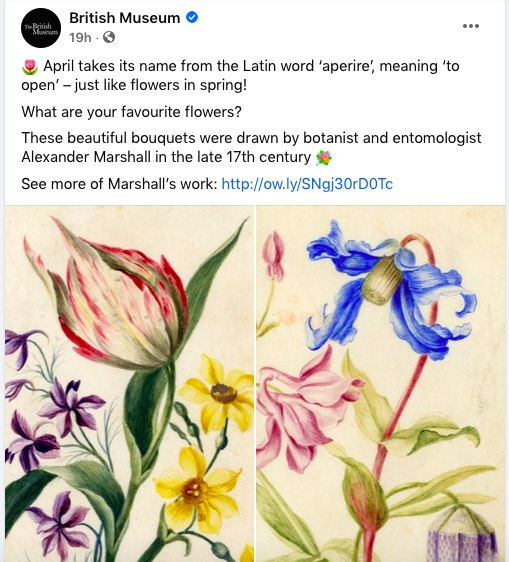
Do you know where the word “April” comes from?
Today… Pesce D’aprile!
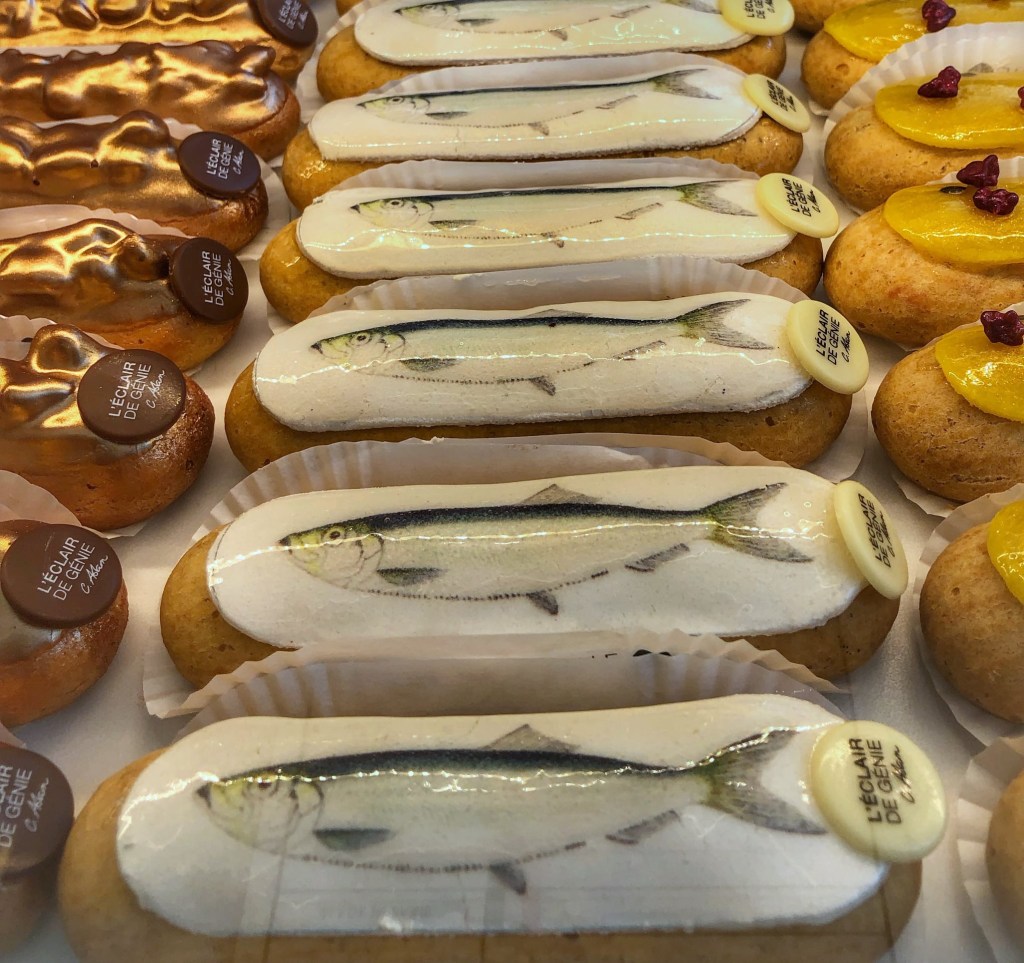
Il pesce d’aprile, April Fools’ Day, is celebrated on April 1st and it is a day during which Italians and French have the custom of playing practical jokes on friends and relatives, following the ancient traditions of tricks played in far-off times.
This custom is supposed to have its origins in the 16th century, but it only really became popular in Italy around 1860-1880, especially in Genoa – which inaugurated this tradition – and was particularly practiced among the upper classes of society.
The explanation of the name pesce d’aprile, literally April’s fish, is often linked in Italy to the zodiac and in particular to the fact that every event that happened on that date was related to the abandoning of the Pisces constellation by the Sun.
Or maybe it’s more simple… “Pesce d’aprile” (April fish) stems from the fact that an increase of young fish is noted at this time of year and the young fish are easily “hooked”!
An ancient joke in Italy is that of the announcement made by Buoncompagno from Florence in the XIII century when he promised to fly over the town of Bologna with a machine he invented on April 1st. The whole population gathered to see the flight, which actually never took place as it was a trick.
As the name hints, the most common prank involved in Pesce d’Aprile is to affix a paper drawing or cutout of a fish onto the back of an unsuspecting victim. Then, everyone else asks if anyone has seen “April’s fish” – when, of course, the victim doesn’t know he or she is the one they’re talking about. Although this may be a bit old-fashioned today, taping a fish onto someone’s back is still something Italian children do.
The first gelato of 2021 for me. This is a big treat, but at the time I was near Badiani and I just cannot resist their Buontalenti flavor. No other Buontalenti is as fine.
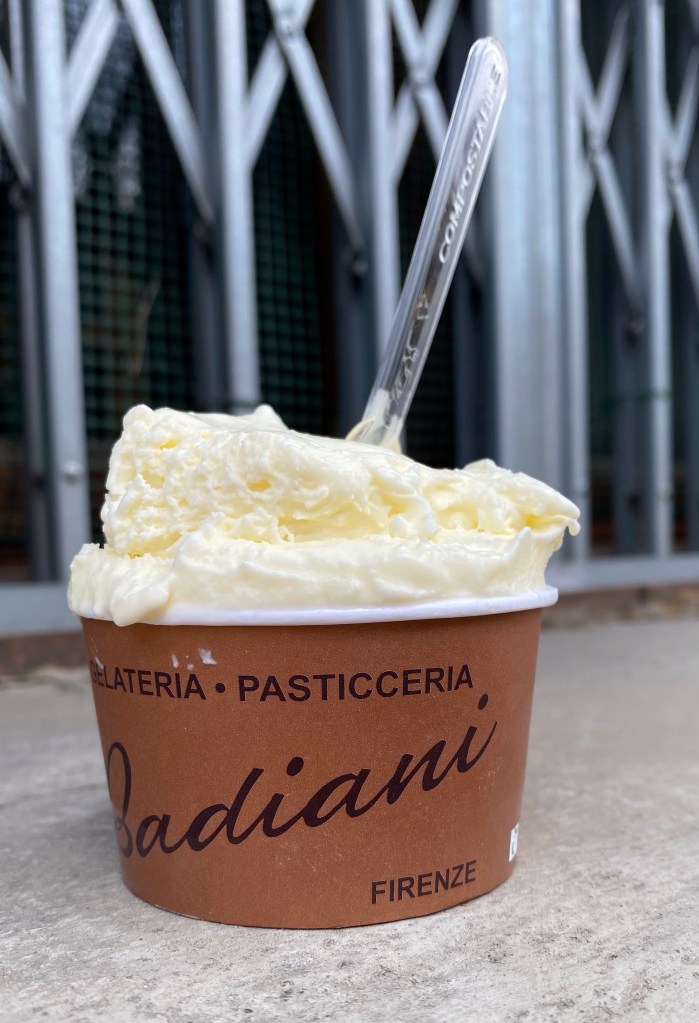
Trust me, this is no April fools! It was absolutely delicious!
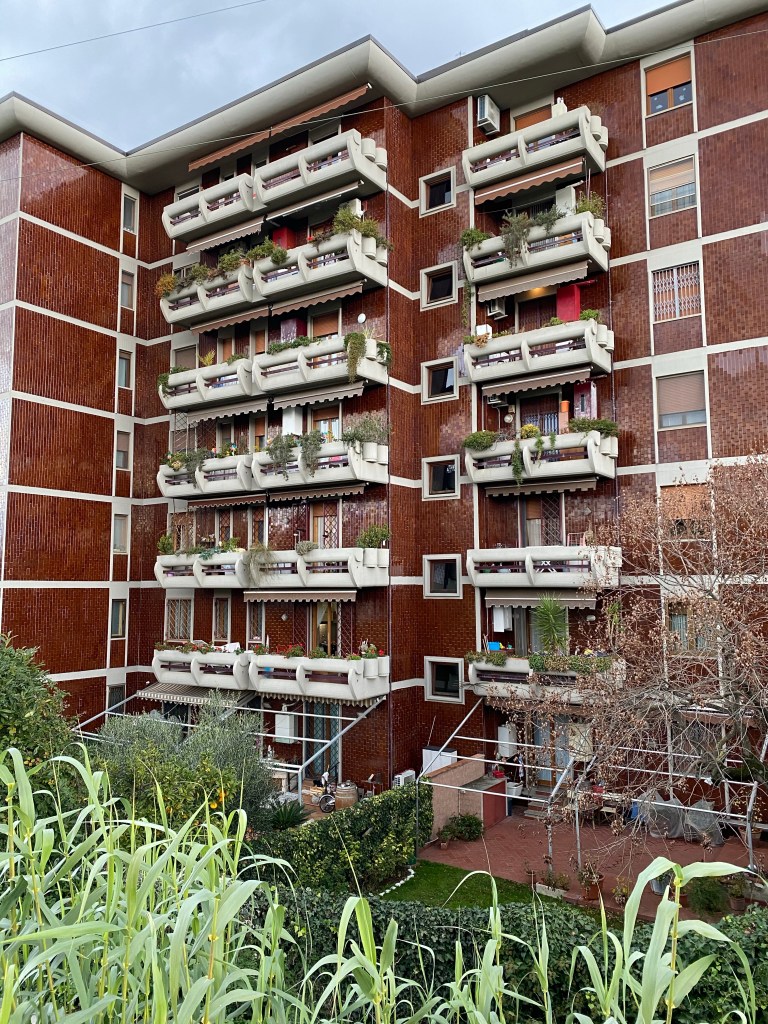
This modernistic apartment building in the western end of Florence, along the Mugnone, shows that architects sometimes really understand that people like to grow stuff. These balconies all have planters embedded in the design.
For the past five springs, during the time I’ve been so lucky to be living in Florence, I’ve seen this spectacular shrub or vine or whatever it is and wondered what it was. Was it in the rose family? I’ve seen it vining through the most spectacular locations: over walls, through lattice, draping over fences.
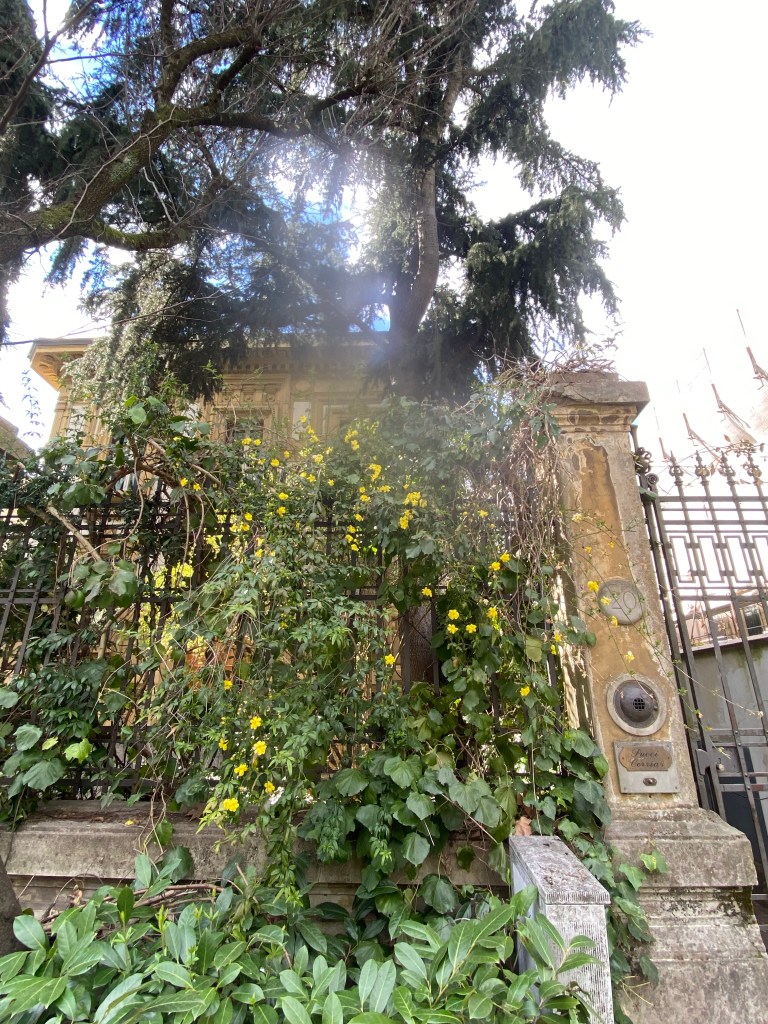
On a recent walk through a tony section of Florence, I was able to get up close and personal with the flowers shrubby thing, and to get some decent pictures of the blossoms.

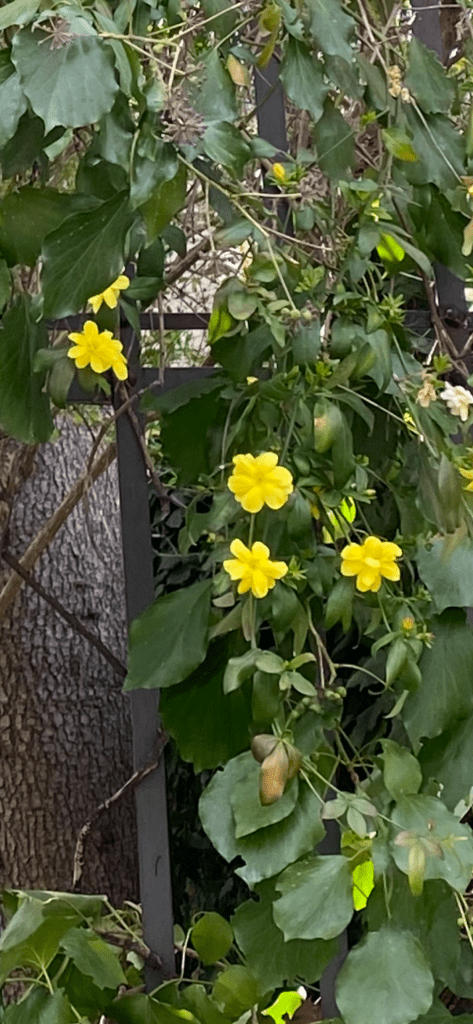
With this closeup and my trusty PlantNet app, I could finally get to the bottom of my query: it is obviously the Jasminum mesnyi. Now how come you didn’t know that?
Wikipedia has some information:
“Jasminum mesnyi, the primrose jasmine or Japanese jasmine, is a species of flowering plant in the family Oleaceae, native to Vietnam and southern China (Guizhou, Sichuan, Yunnan). It is also reportedly naturalized in Mexico, Honduras and parts of the southern United States (Florida, Georgia, Alabama, Louisiana, Texas, Arizona) [and I can personally attest that it grows in Florence].
“Jasminum mesnyi is a scrambling evergreen shrub growing to 10 ft tall by 3–7 ft wide, with fragrant [the ones I’ve seen are not fragrant, believe me, I’ve sniffed any I could reach] yellow flowers in spring and summer. The form usually found in cultivation has semi-double flowers. It is not frost-hardy. With suitable support it can be grown as a slender climber, though in confined spaces it will require regular pruning.
“Jasminum mesnyi has gained the Royal Horticultural Society’s Award of Garden Merit.”
Ugh! So, since I can’t leave my home, I am traveling virtually. Come with me for a visit to the French chateau and gardens of Marqueyssac. Thanks Stephanie Jarvis!

See that pretty white flower that looks like a little daisy? They are low to the ground and blooming all over Florence right now. I checked my app, PlantNet, to learn more.
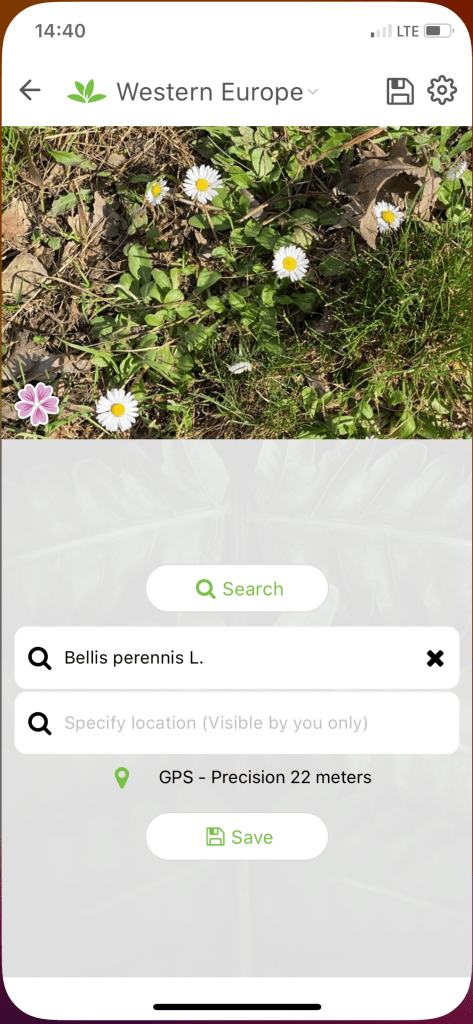
Of course, I had to consult Wikipedia for more info, and I am glad I did!
“Bellis perennis is a common European species of daisy, of the family Asteraceae, often considered the archetypal species of that name.
“Many related plants also share the name “daisy”, so to distinguish this species from other daisies it is sometimes qualified as common daisy, lawn daisy or English daisy. Historically, it has also been commonly known as bruisewort and occasionally woundwort (although the common name woundwort is now more closely associated with Stachys). Bellis perennis is native to western, central and northern Europe, including remote islands such as the Faroe Islands but widely naturalised in most temperate regions including the Americas and Australasia.
“It is a perennial herbaceous plant with short creeping rhizomes and rosettes of small rounded or spoon-shaped leaves that are from 3/4 to 2 inches long and grow flat to the ground. The species habitually colonises lawns, and is difficult to eradicate by mowing – hence the term ‘lawn daisy’. It exhibits the phenomenon of heliotropism where the flowers follow the position of the sun in the sky.
“The flowerheads are composite, in the form of a pseudanthium, consisting of many sessile flowers about 3/4 to 1-1/4 in in diameter, with white ray florets (often tipped red) and yellow disc florets. Each inflorescence is borne on single leafless stems 3/4 – 4 in, rarely 6 in tall. The capitulum, or disc of florets, is surrounded by two rows of green bracts known as “phyllaries”. The achenes are without pappus.
“Etymology: Bellis may come from bellus, Latin for “pretty”, and perennis is Latin for “everlasting”.
“The name “daisy” is considered a corruption of “day’s eye”, because the whole head closes at night and opens in the morning. Chaucer called it “eye of the day”. In Medieval times, Bellis perennis or the English Daisy was commonly known as “Mary’s Rose”. It is also known as bone flower.
“The English daisy is also considered to be a flower of children and innocence.

Daisies by William-Adolphe Bouguereau (1894)
“Daisy is used as a girl’s name and as a nickname for girls named Margaret, after the French name for the oxeye daisy, marguerite.
“Culinary: This daisy may be used as a potherb. Young leaves can be eaten raw in salads or cooked, noting that the leaves become increasingly astringent with age. Flower buds and petals can be eaten raw in sandwiches, soups and salads. It is also used as a tea and as a vitamin supplement.
“Herbal medicine: Bellis perennis has astringent properties and has been used in herbal medicine. In ancient Rome, the surgeons who accompanied Roman legions into battle would order their slaves to pick sacks full of daisies in order to extract their juice; bellum, Latin for “war”, may be the origin of this plant’s scientific name. Bandages were soaked in this juice and would then be used to bind sword and spear cuts.
“Bellis perennis is still used in homeopathy for wounds and after certain surgical procedures, as well as for blunt trauma in animals. Typically, the plant is harvested while in flower when intended for use in homeopathy.
“Bellis perennis flowers have been used in the traditional Austrian medicine internally as tea (or the leaves as a salad) for treatment of disorders of the gastrointestinal and respiratory tract.
“Daisies have traditionally been used for making daisy chains in children’s games.

The daisy chain by Maude Goodman (1936)
Thank you Florence, PlantNet, and Wikipedia. You are keeping the long, boring days of Covid in check (more or less).
Can you tell that I am going a little bit stir crazy? Covid and Italy are a not good mix. It’s been over a year and things are better, but not great yet.
I can’t leave Florence because we are in the Orange Zone still (it’s about to get worse, all of Italy will be in the Red Zone over the weekend of Easter. Won’t be able to leave the house). Spending long days in Florence doesn’t seem bad, does it? If the museums, churches, libraries, and schools were open, it would be fine. But, they aren’t. So, filling the long days, during the sunny days of spring, has become a bit of a challenge.
Yesterday I was on a new walk in a part of Florence I had only ever seen previously from cars and busses. As usual, I was delighted with the plant life I saw.
For example, see this beautiful shrub with the yellow blooms?
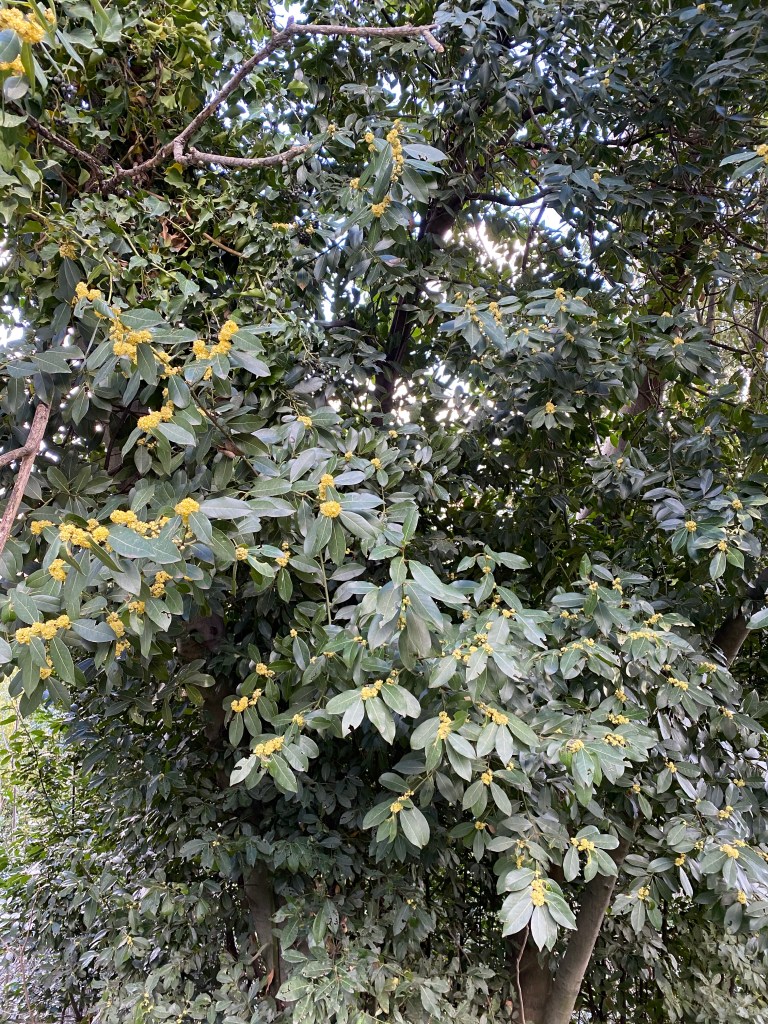
Here’s what I thought to myself: “what is that, I’ve never noticed those particular blooms before?” The shrub itself, which I have now seen at least a million times in my life, was transformed by yellow flowery things and I felt like I’d never seen it before.
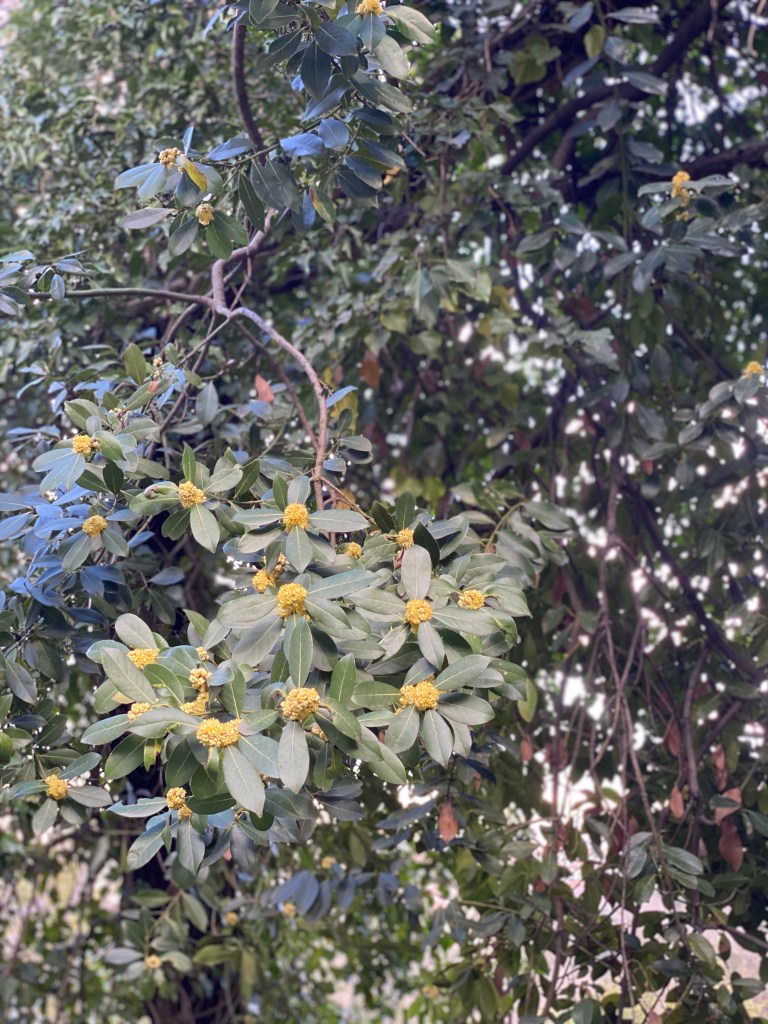
I dusted off my handy plant identifying app (PlantNet) and looked it up:
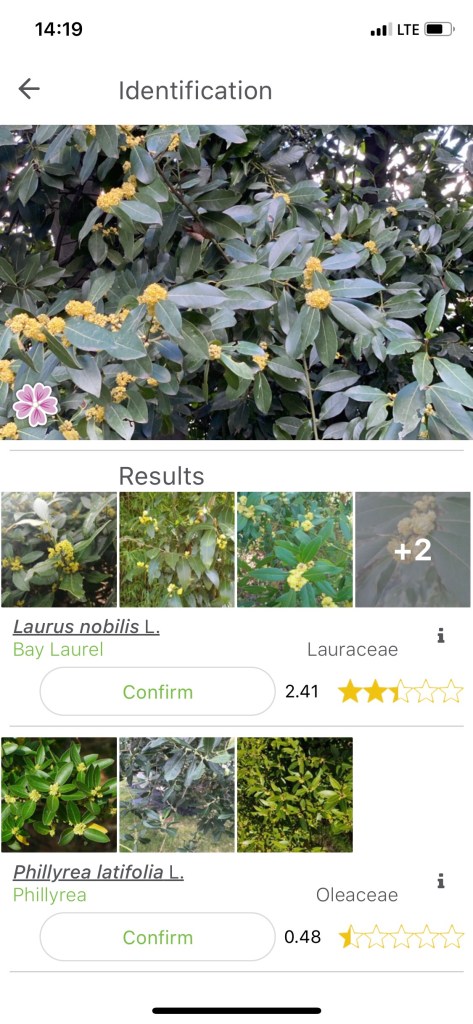
So, it is the laurus nobilis, or noble laurel shrub. Wow, this is fun, I thought! Bay laurel never looked so good before!
When I got home and had time to look up the laurel, I was fascinated to consider details I would, pre-Covid, probably never have taken the time to think about. Here’s what Wikipedia added:
“Laurus nobilis is an aromatic evergreen tree or large shrub with green, glabrous smooth leaves, in the flowering plant family Lauraceae. It is native to the Mediterranean region and is used as bay leaf for seasoning in cooking. Its common names include bay tree, bay laurel, sweet bay, true laurel, Grecian laurel, or simply laurel. Laurus nobilis figures prominently in classical Greco-Roman culture.
“The laurel is an evergreen shrub or small tree, variable in size and sometimes reaching 23–59 ft tall. The genus Laurus includes four accepted species, whose diagnostic key characters often overlap.
“The bay laurel is dioecious (unisexual), with male and female flowers on separate plants. Each flower is pale yellow-green, about 3⁄8 in diameter, and they are borne in pairs beside a leaf. The leaves are glabrous, 2–5 in long and 3⁄4–1 5⁄8 in broad, with an entire untoothed margin. On some leaves the margin undulates. The fruit is a small, shiny black berry-like drupe about 3⁄8 in long that contains one seed.
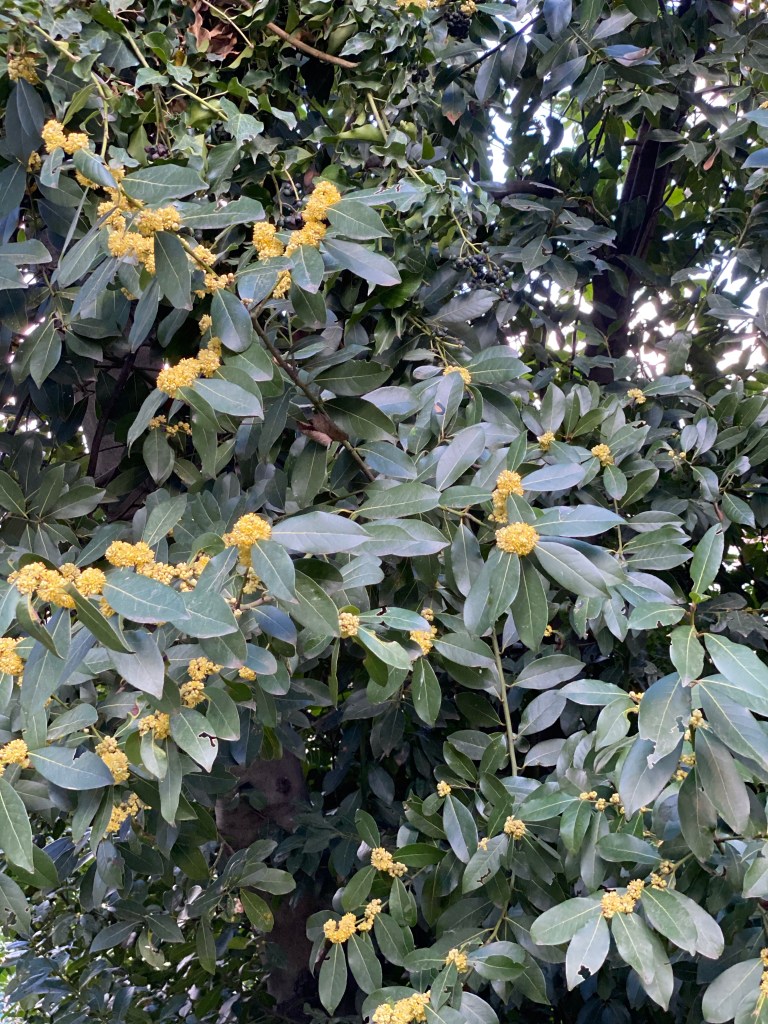
“Laurus nobilis is a widespread relic of the laurel forests that originally covered much of the Mediterranean Basin when the climate of the region was more humid. With the drying of the Mediterranean during the Pliocene era, the laurel forests gradually retreated, and were replaced by the more drought-tolerant sclerophyll plant communities familiar today. Most of the last remaining laurel forests around the Mediterranean are believed to have disappeared approximately ten thousand years ago, although some remnants still persist in the mountains of southern Turkey, northern Syria, southern Spain, north-central Portugal, northern Morocco, the Canary Islands and in Madeira.
The plant is the source of several popular herbs and one spice used in a wide variety of recipes, particularly among Mediterranean cuisines. Most commonly, the aromatic leaves are added whole to Italian pasta sauces. They are typically removed from dishes before serving, unless used as a simple garnish. Whole bay leaves have a long shelf life of about one year, under normal temperature and humidity. Whole bay leaves are used almost exclusively as flavor agents during the food preparation stage.
Ground bay leaves, however, can be ingested safely and are often used in soups and stocks, as well as being a common addition to a Bloody Mary. Dried laurel berries and pressed leaf oil can both be used as robust spices, and the wood can be burnt for strong smoke flavoring.
The Roman naturalist Pliny the Elder listed a variety of conditions which laurel oil was supposed to treat: paralysis, spasms, sciatica, bruises, headaches, catarrhs, ear infections, and rheumatism.
Lauris Nobilis in symbolism:
“Ancient Greece
In ancient Greece, the plant was called daphne, after the mythic mountain nymph of the same name. In the myth of Apollo and Daphne, the god Apollo fell in love with Daphne, a priestess of Gaia (Mother Earth), and when he tried to seduce her she pled for help to Gaia, who transported her to Crete. In Daphne’s place Gaia left a laurel tree, from which Apollo fashioned wreaths to console himself.17 Other versions of the myth, including that of the Roman poet Ovid, state that Daphne was transformed directly into a laurel tree.
“Bay laurel was used to fashion the laurel wreath of ancient Greece, a symbol of highest status. A wreath of bay laurels was given as the prize at the Pythian Games because the games were in honor of Apollo, and the laurel was one of his symbols. According to the poet Lucian, the priestess of Apollo known as the Pythia reputedly chewed laurel leaves from a sacred tree growing inside the temple to induce the enthusiasmos (trance) from which she uttered the oracular prophecies for which she was famous. Some accounts starting in the fourth century BC describe her as shaking a laurel branch while delivering her prophecies. Those who received promising omens from the Pythia were crowned with laurel wreaths as a symbol of Apollo’s favor.
“Rome
“The symbolism carried over to Roman culture, which held the laurel as a symbol of victory. It was also associated with immortality, with ritual purification, prosperity and health. It is also the source of the words baccalaureate and poet laureate, as well as the expressions “assume the laurel” and “resting on one’s laurels”. [And I would add, parenthetically, that the name Lorenzo, as in Lorenzo il Magnifico, is based upon the laurel plant. So is the name Lauretta.]
“Pliny the Elder stated that the Laurel was not permitted for “profane” uses – lighting it on fire at altars “for the propitiation of divinities” was strictly forbidden, because “…it is very evident that the laurel protests against such usage by crackling as it does in the fire, thus, in a manner, giving expression to its abhorrence of such treatment.”
“Laurel was closely associated with the Roman Emperors, beginning with Augustus. Two Laurel trees flanked the entrance to Augustus’ house on the Palatine Hill in Rome, which itself was connected to the Temple of Apollo Palatinus which Augustus had built. Thus the laurels had the dual purpose of advertising Augustus’ victory in the Civil Wars and his close association with Apollo. Suetonius relates the story of Augustus’ wife, and Rome’s first Empress, Livia, who planted a sprig of laurel on the grounds of her villa at Prima Porta after an eagle dropped a hen with the sprig clutched in its beak onto her lap. The sprig grew into a full-size tree which fostered an entire grove of laurel trees, which were in turn added to by subsequent Emperors when they celebrated a triumph. The Emperors in the Julio-Claudian dynasty all sourced their Laurel wreaths from the original tree planted by Livia. It was taken as an omen of the impending end of the Julio-Claudian dynasty that in the reign of Nero the entire grove died, shortly before he was assassinated. Rome’s second Emperor Tiberius wore wreaths of laurel whenever there was stormy weather because it was widely believed that Laurel trees were immune to lightning strikes, affording protection to those who brandished it. One reason for this belief is because laurel does not burn easily and crackles loudly when on fire. It led ancient Romans to believe the plant was inhabited by a “heavenly fire demon”, and was therefore “immune” from outer threats like fire or lightning.
In modern Italy laurel wreaths are worn as a crown by graduating high school students.
 get back, lauretta!
You must be logged in to post a comment.