Palazzo Vecchio, Florence (June 2020) Part 1

One by one, the landmarks of Florence have been re-opening.  With new rules and regulations, one can pay a visit to these famous sites.  I recently enjoyed seeing the Palazzo Vecchio for the first time since the lock down. Very enjoyable to see old friends.


img_6760


Il Salone dei Cinquecento:


img_6652


img_6653


img_6654


img_6608


The Salone dei Cinquecento (‘Hall of the Five Hundred’) is the most imposing chamber in the Palazzo Vecchio, with a length of 170 ft and width of 75 ft. It was built in 1494 by Simone del Pollaiolo, on commission of Savonarola who, replacing the Medici after their exile as the spiritual leader of the Republic, wanted it as a seat of the Grand Council (Consiglio Maggiore) consisting of 500 members.

Later the hall was enlarged by Giorgio Vasari so that Grand Duke Cosimo I could hold his court in this chamber. During this transformation, famous (but unfinished) works were lost, including the Battle of Cascina by Michelangelo, and the Battle of Anghiari by Leonardo da Vinci. Leonardo was commissioned in 1503 to paint one long wall with a battle scene celebrating a famous Florentine victory. He was always trying new methods and materials and decided to mix wax into his pigments. Da Vinci had finished painting part of the wall, but it was not drying fast enough, so he brought in braziers stoked with hot coals to try to hurry the process. As others watched in horror, the wax in the fresco melted under the intense heat and the colors ran down the walls to puddle on the floor. A legend exists that Giorgio Vasari, wanting to preserve Da Vinci’s work, had a false wall built over the top of The Battle of Anghiari before painting his fresco. Attempts made to find Da Vinci’s original work behind the Vasari fresco have so far been inconclusive.

Michelangelo never proceeded beyond the preparatory drawings for the fresco he was commissioned to paint on the opposite wall. Pope Julius II called him to Rome to paint the Sistine Chapel, and the master’s sketches were destroyed by eager young artists who came to study them and took away scraps. The surviving decorations in this hall were made between 1555 and 1572 by Giorgio Vasari and his helpers, among them Livio Agresti from Forlì. They mark the culmination of mannerism and make this hall the showpiece of the palace.


Here are some miscellaneous objets that caught my eye on this day.  All of them are in the Salone dei Cinquecento, unless otherwise noted:

img_6609


img_6610


img_6611


I see the coat of arts of the Medici family all over Florence, but this one is beyond extravagant:

img_6612


img_6613


img_6614


A sculpture by Michelangelo takes a place of honor in this large hall:

img_6615


img_6616


img_6617


img_6618


OK, we have departed the Salone.  All of the following pictures are from subsequent rooms.

img_6619

img_6620

img_6621


img_6622


img_6623


One of the things I like about many Italian stairways is the use of these heavy cords.  I like the way they look and the way they draw on Italian textile traditions.

img_6625


img_6626


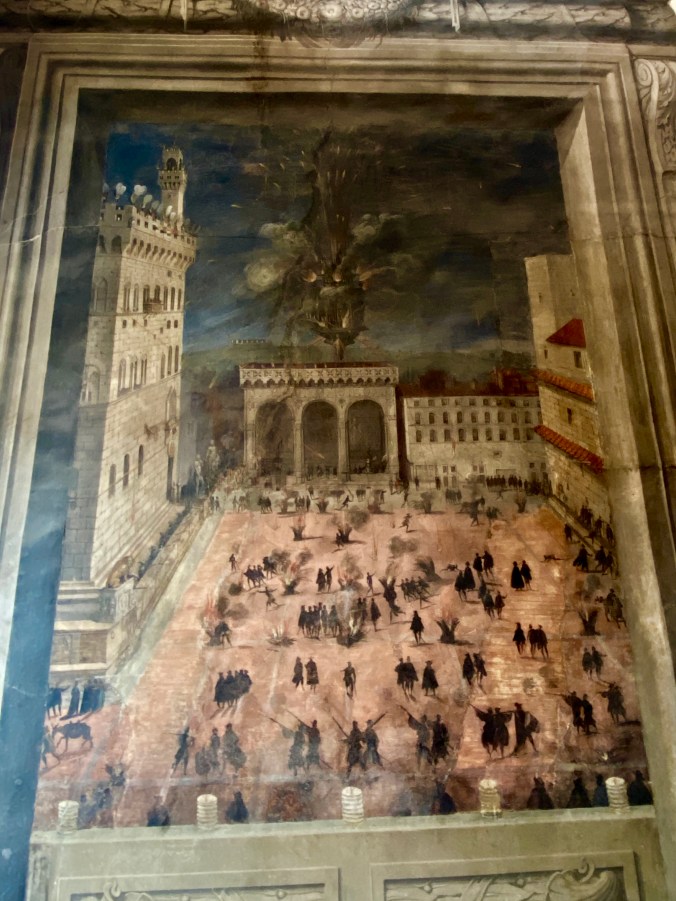
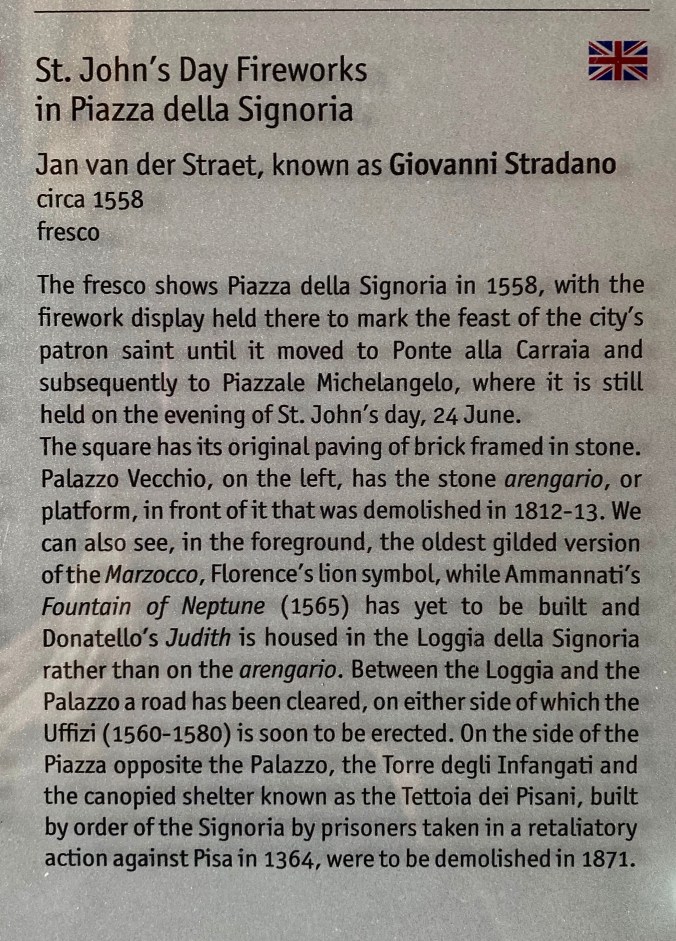
The St. John’s Day Fireworks have been an ongoing Florentine tradition for centuries.  It was fun to see this painting depict it from the 16th century.

img_6627


img_6628


img_6629


img_6630


Here’s another fanciful coat of arts for the Medici family, this one in fresco:

img_6631


And putti carry the crown that will sit on Medici heads:

img_6632


img_6633


img_6634


img_6635


img_6636


img_6637


img_6638


img_6639


img_6640


Here is the original Verrocchio statue.  A copy sits in its original place in an open courtyard on the ground floor.

img_6641


img_6642


img_6644

img_6645


img_6646img_6647


img_6643


img_6648img_6649img_6650

img_6651


img_6655


img_6656


img_6657


img_6658


img_6659


img_6660


img_6661


img_6662


img_6663


img_6664


img_6676

img_6665


Eleonora’s private chapel is a gorgeously painted small room:

img_6668


img_6666


img_6667


img_6669


img_6670


img_6672


img_6671


img_6673


img_6674


img_6675


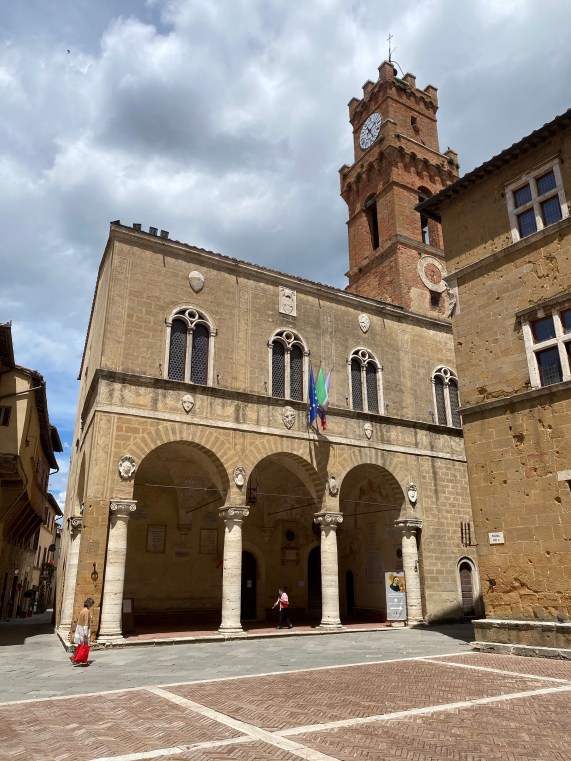
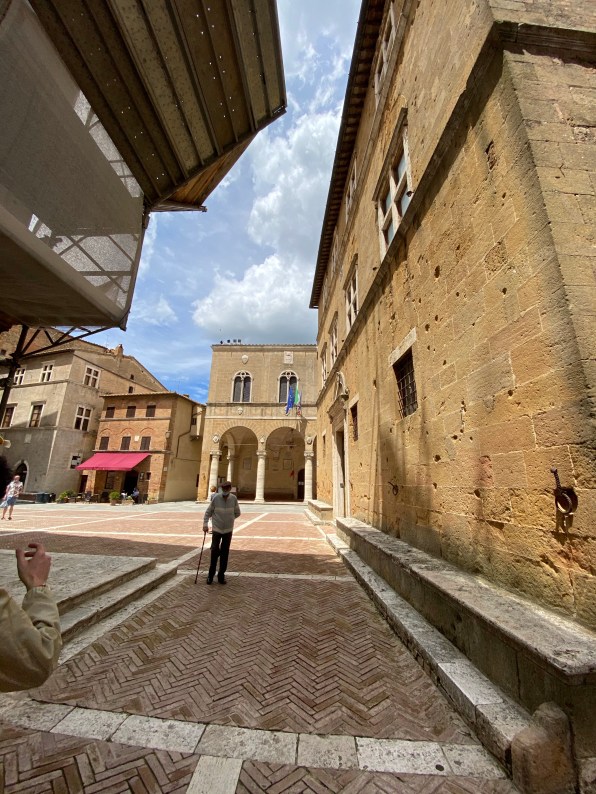
Pienza, the ideal city

Let’s say you are the Pope.  You’re from a small, Medieval village in Tuscany that really isn’t on the map and you want to do something really great for your hometown.  In fact, you want to make it an important rest stop on a famous road that leads from Rome to Bologna and points north, or to Rome and Naples and points south.  What would you do?

Would you create an “ideal city” and make sure it gets notoriety?

That’s exactly what Pope Pius II did.

Born Enea Silvio Bartolomeo Piccolomini, (18 October 1405 – 14 August 1464), he became the head of the Catholic Church and ruler of the Papal States from 19 August 1458 until his death. During his 6 year reign, he transformed his hometown into a marvelous Renaissance borgo.

You enter the city through this gate:
img_6509


img_6510


img_6511

The picture above tells us that Pienza was destroyed on 15 June 1944 and restored by October 1955. If walls could talk.


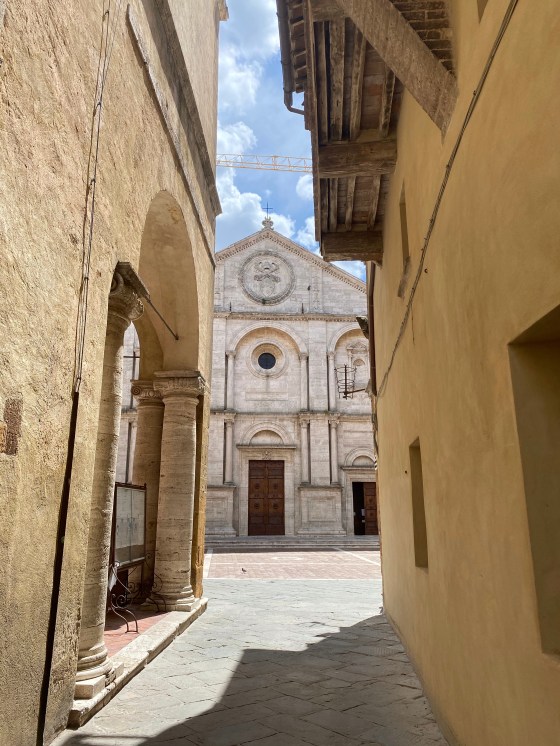
Here is the cathedral Pope Pius II built.

img_6506


img_6498


img_6497


img_6496


img_6492


img_6491


img_6493


img_6494


img_6453


img_6454


img_6455


img_6456


img_6459


img_6460


img_6461


img_6463


img_6464


img_6466


img_6467


img_6468


img_6469


img_6470


img_6471


img_6472


img_6473


img_6474


img_6475


img_6476


img_6482


img_6483


img_6486


img_6491


img_6492


img_6494


img_6495


img_6497


img_6498


img_6499


img_6500


img_6501


img_6503


img_6504


img_6505


img_6507


img_6508


img_6512


img_6513


img_6514


img_6515


img_6516


img_6517


img_6518


img_6519


img_6520


img_6521


img_6522


img_6523


img_6525


img_6526


img_6527


img_6528


img_6529


The Abbey of Monte Oliveto Maggiore

A visit on a gorgeous day to the Abbazia di Monte Oliveto Maggiore in Tuscany is about as good a day trip as I can think of. Leaving Florence on a soft, summer morning, it is a pleasure to drive through beautiful countryside. And once you reach the historic abbey itself, you’ve reached a little piece of heaven.


This large Benedictine monastery is constructed mostly of red brick, making it stand out against the grey clayey and sandy soil of the the Crete senesi, which give this area of Tuscany its name.

The territorial abbey’s abbot functions as the bishop of the land within the abbey’s possession, even though he is not consecrated as a bishop. It is also the mother-house of the Olivetans and the monastery later took the name of Monte Oliveto Maggiore (“the greater”) to distinguish it from successive monasteries at Florence, San Gimignano, Naples and elsewhere.

It was founded in 1313 by Bernardo Tolomei, a jurist from a prominent aristocratic family of Siena. By 1320, it was approved by Bishop Guido Tarlati as Monte Oliveto, with reference to the Mount of Olives and in honor of Christ’s Passion. The monastery was begun in 1320, the new congregation being approved by Pope Clement VI in 1344.

The abbey was for centuries one of the main land possessors in the Siena region.  On January 18, 1765, the monastery was made the seat of the Territorial Abbacy of Monte Oliveto Maggiore.


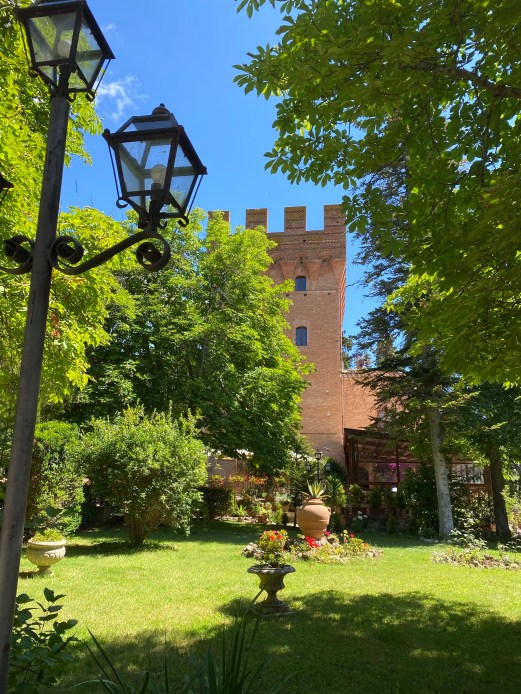
The monastery consists of a medieval palace in red brickwork, surmounted by a massive quadrangular tower with barbicans and merlons. Begun in 1393 as the fortified gate of the complex, it was completed in 1526 and restored in the 19th century. The church’s atrium is on the site of a previous church (1319). The Latin cross formed church was renovated in the Baroque style in 1772 by Giovanni Antinori.

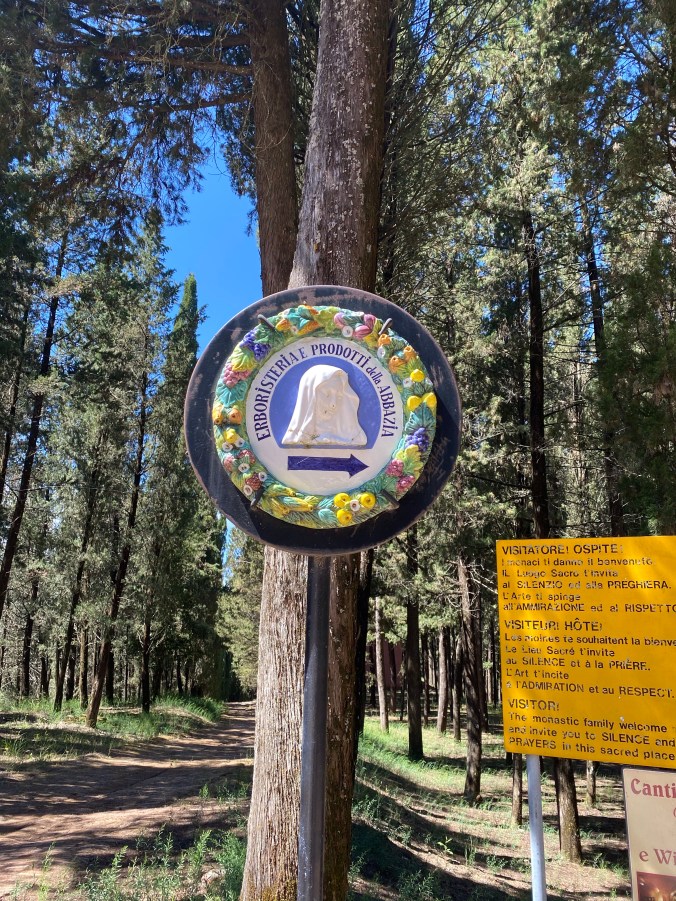
A long alley with cypresses, sided by the botanical garden of the old pharmacy (destroyed in 1896), with a cistern from 1533. At the alley’s end is the bell tower, in Romanesque-Gothic style, and the apse of the church, which has a Gothic façade.


The abbey’s monastic library, housing some 40,000 volumes and incunabula, gives way to  the pharmacy, which houses medicinal herbs in a collection of 17th century vases.


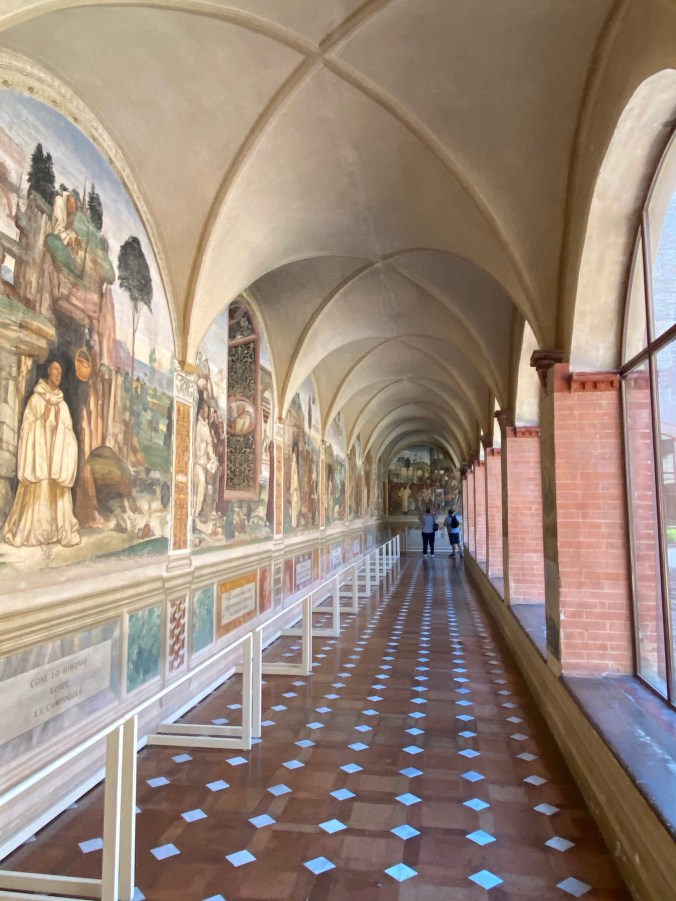
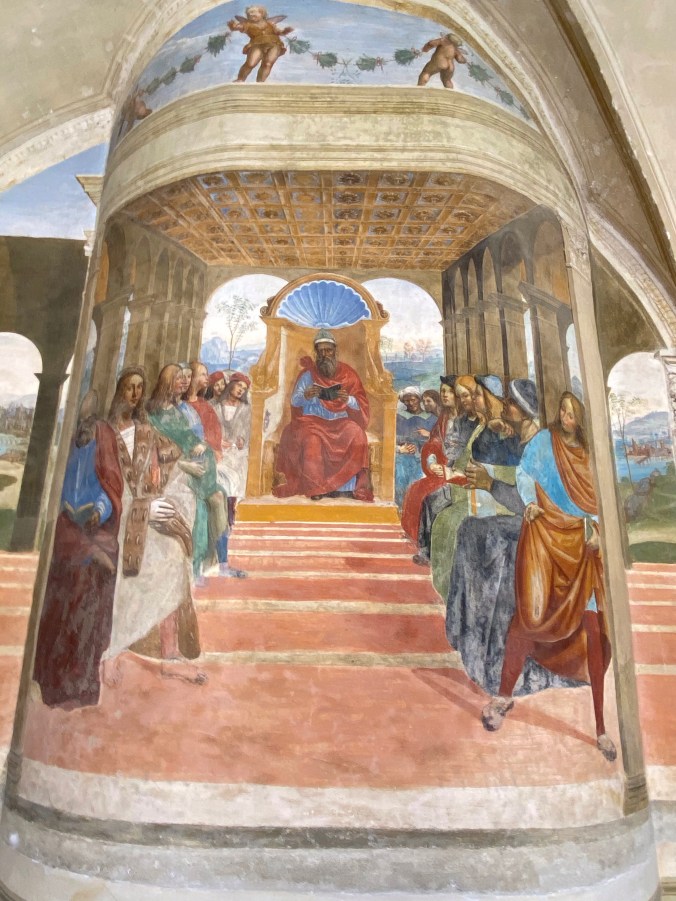
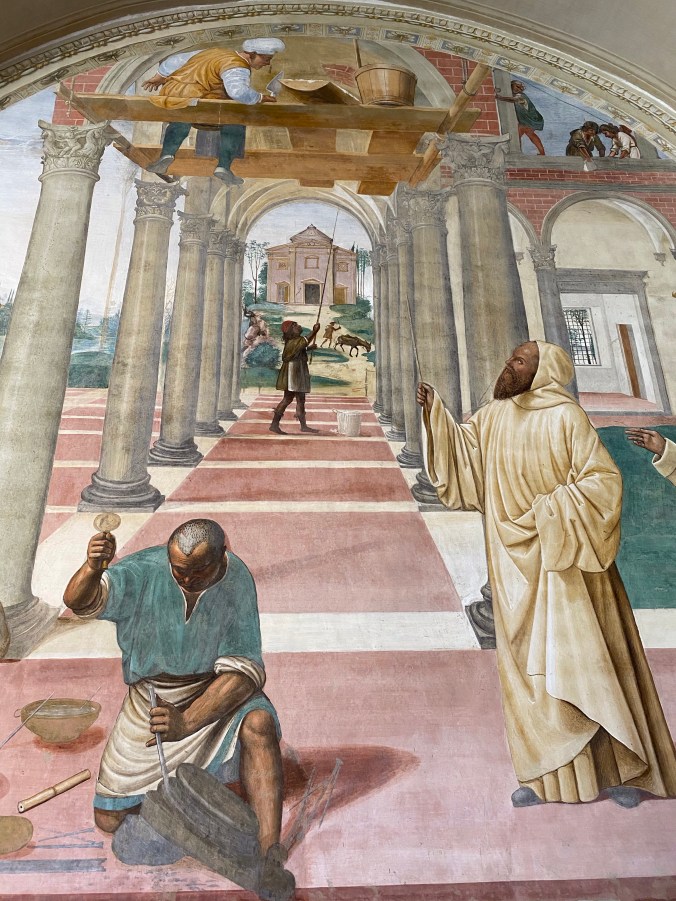
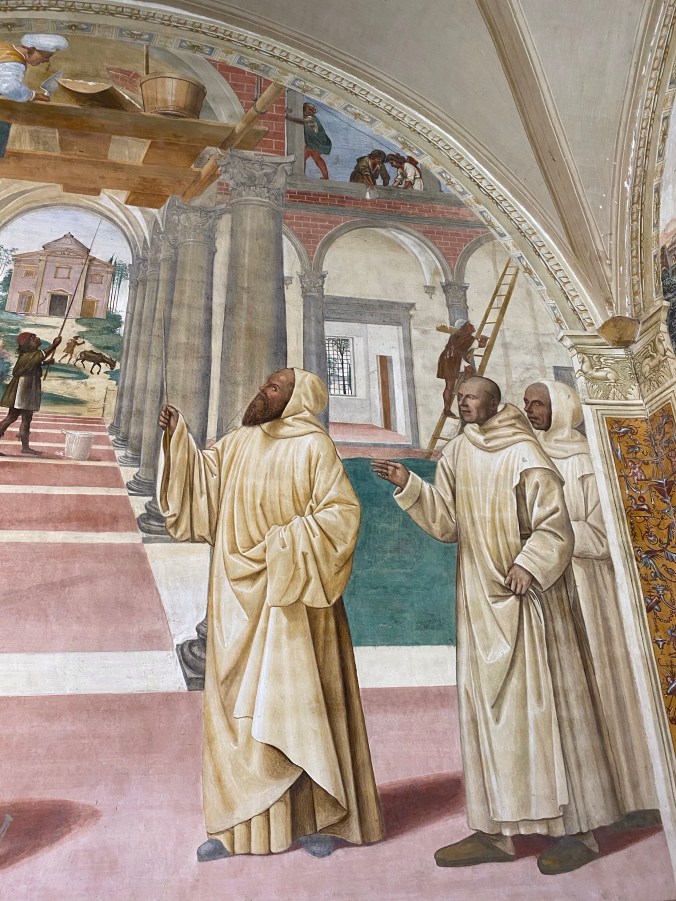
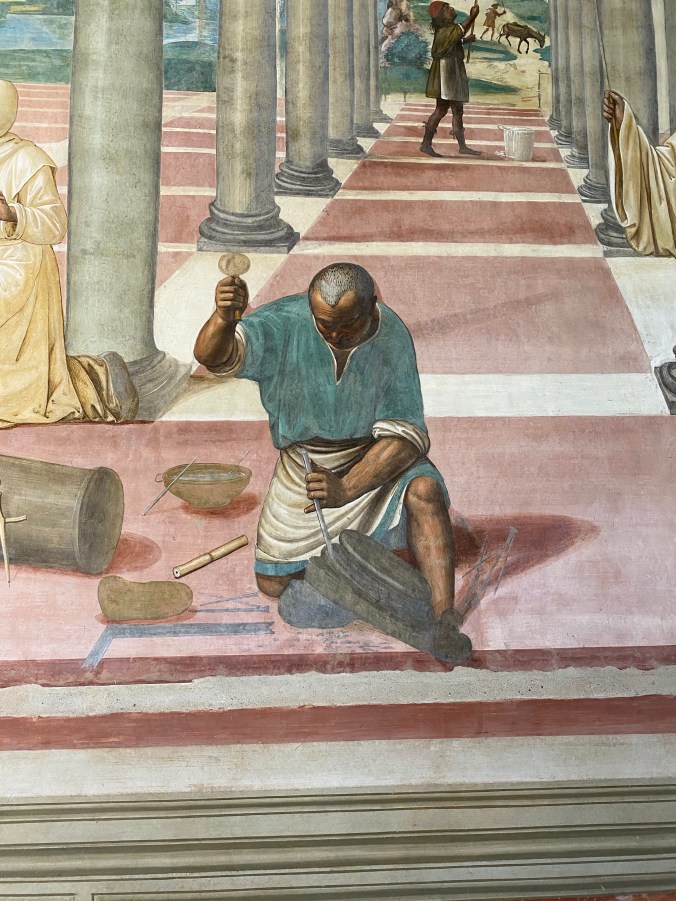
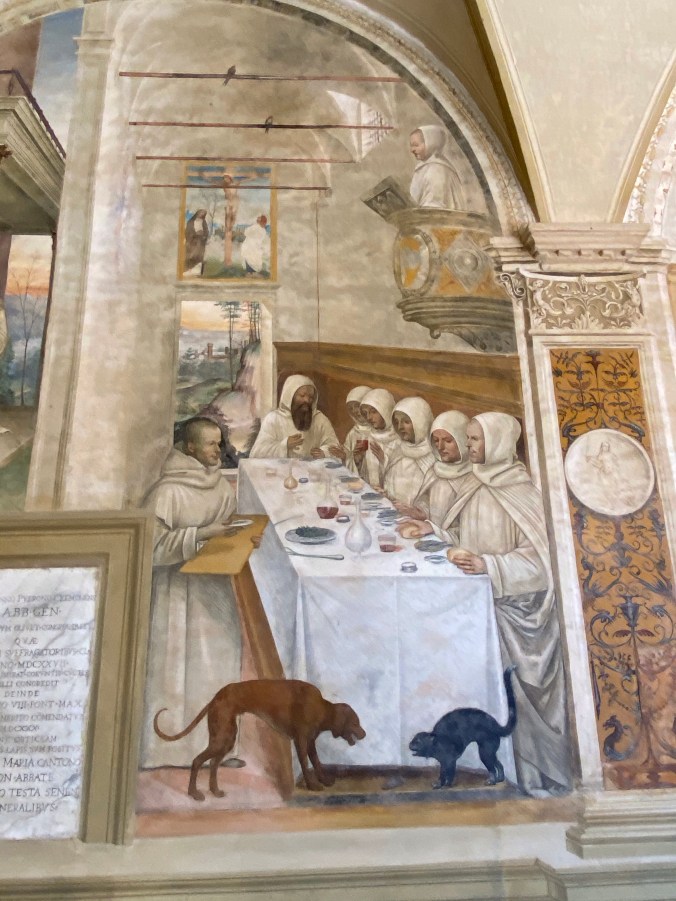
For me, the rectangular Chiostro Grande was the highlight of the visit. The fresco cycle that adorns the walls of the lovely cortile was painted by Luca Signorelli (he created 8 lunettes between 1497-98) and Sodoma, who completed the cycle after 1505.  Sodoma painted 26 of the lunettes.

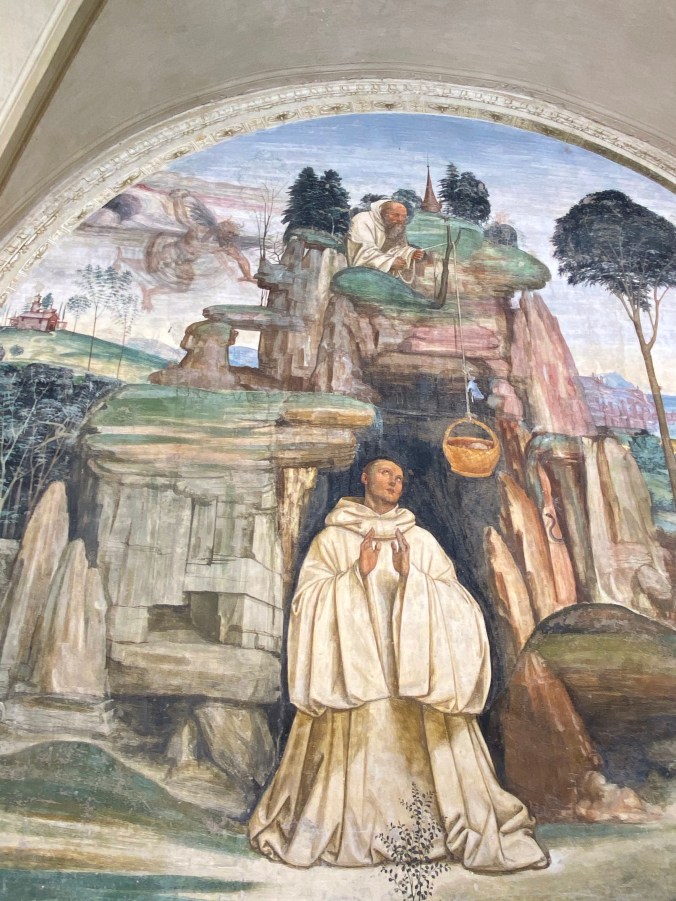
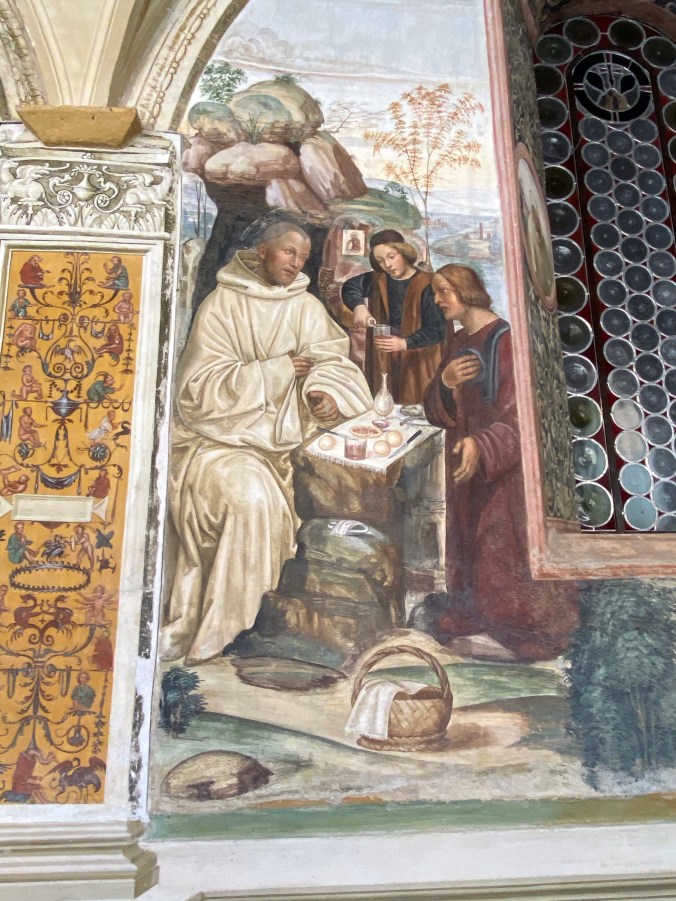
The cloister was constructed between 1426 and 1443.  The notable fresco cycle of the Life of St. Benedict was painted between 1497 and 1510 by Luca Signorelli and il Sodoma.

Wikipedia has an excellent article on these frescoes, telling you the entire program of the frescoes and which artist painted which scenes.

https://it.wikipedia.org/wiki/Storie_di_san_Benedetto_di_Monte_Oliveto_Maggiore

Luca Signorelli (c. 1445-1523) was an Italian Renaissance painter who was noted in particular for his draftsmanship and his deft handling of foreshortening. His massive frescoes of the Last Judgment (1499–1503) in Orvieto Cathedral are considered his masterpiece. Considered to be part of the Tuscan school, Signorelli also worked extensively in Umbria and Rome.

In the Monastery of Monte Oliveto Maggiore Signorelli painted eight frescoes, forming part of a vast series depicting the life of St. Benedict; they are not in great condition.

Luca_signorelli,_storie_di_san_benedetto_a_monteoliveto,_san_benedetto_rimprovera_due_monaci_che_hanno_violato_la_Regola,_dett_02

Luca Signorelli, dettaglio di San Benedetto rimprovera due monaci che hanno violato la Regola

Il Sodoma (1477 – 1549) was the strange nickname given to the Italian Renaissance painter Giovanni Antonio Bazzi. Il Sodoma painted in a manner that superimposed the High Renaissance style of early 16th-century Rome onto the traditions of the provincial Sienese school; he spent the bulk of his professional life in Siena, with two periods in Rome.

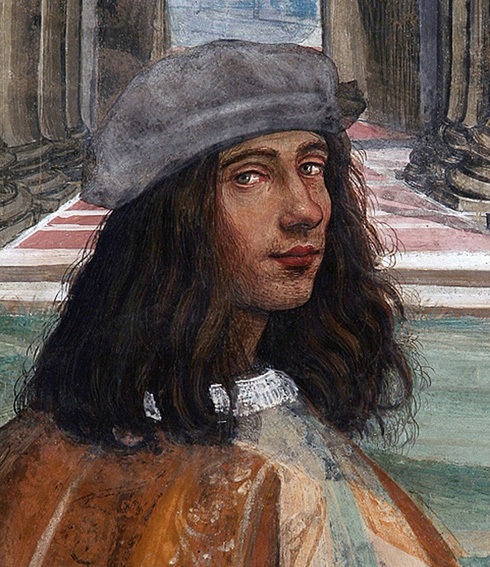
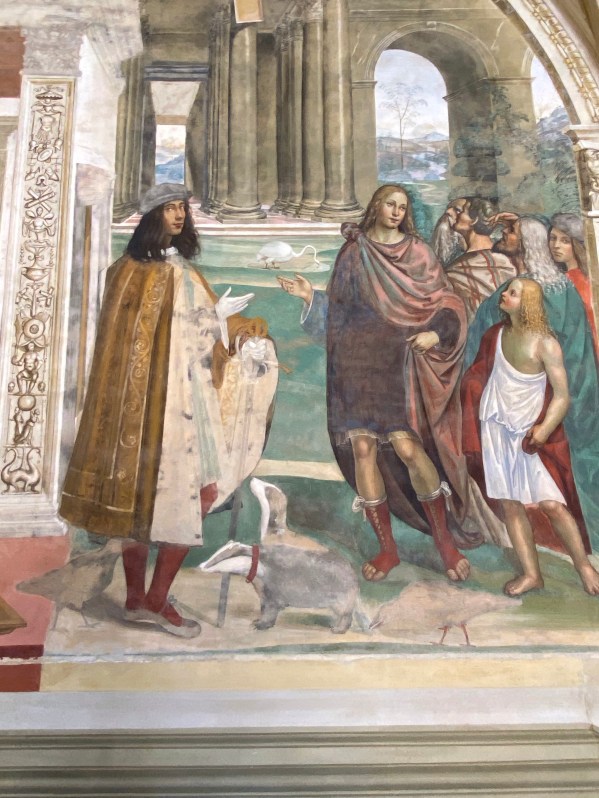
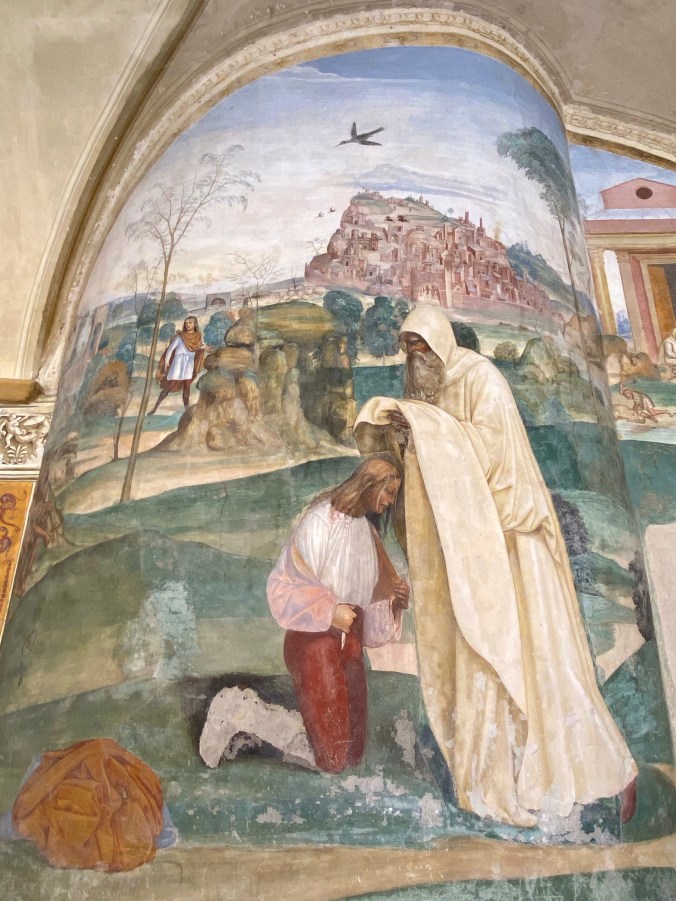
Sodoma was one of the first to paint in the style of the High Renaissance in Siena. His first important works were these frescoes in the Benedictine monastery of Monte Oliveto Maggiore, on the road from Siena to Rome. The frescoes illustrate the life of St Benedict in continuation of the series that Luca Signorelli had begun in 1498. Gaining fluency in the prevailing popular style of Pinturicchio, Sodoma completed the set in 1502 and included a self-portrait with badgers and ravens.

Sodoma_selfportrait

Autoritratto del Sodoma in un dettaglio da uno degli affreschi delle Storie di san Benedetto di Monte Oliveto Maggiore


The fresco above is by Sodoma, showing Benedict leaving the Roman school.


The fresco above is by Sodoma.  It shows a Roman monk giving the hermit habit to Benedict.


The fresco above, by Sodoma, shows the devil breaking the bell.


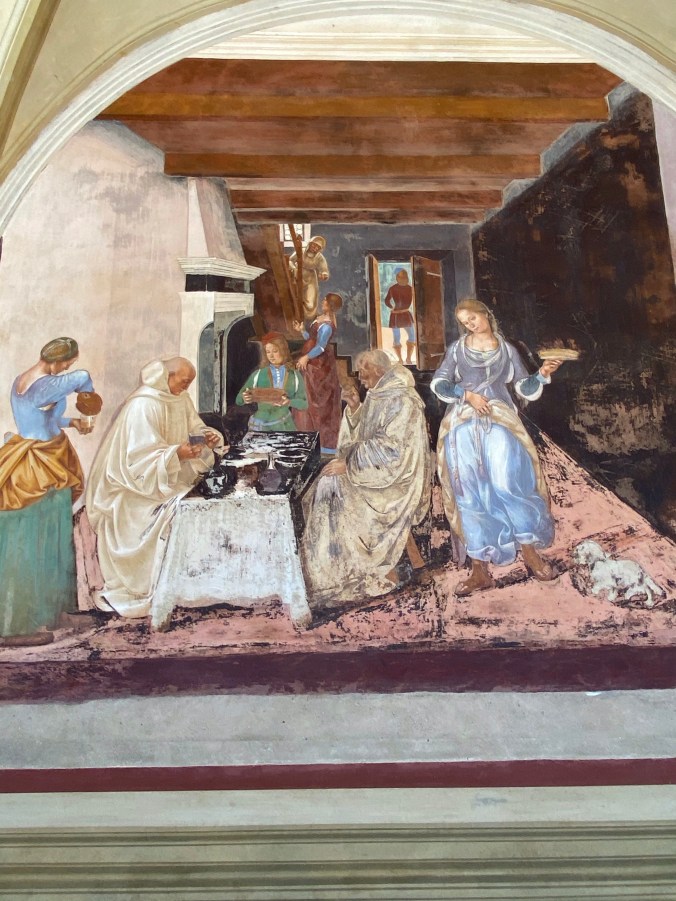
Above, by Sodoma, shows Benedict as a god-inspired priest bringing food to blessed on Easter.


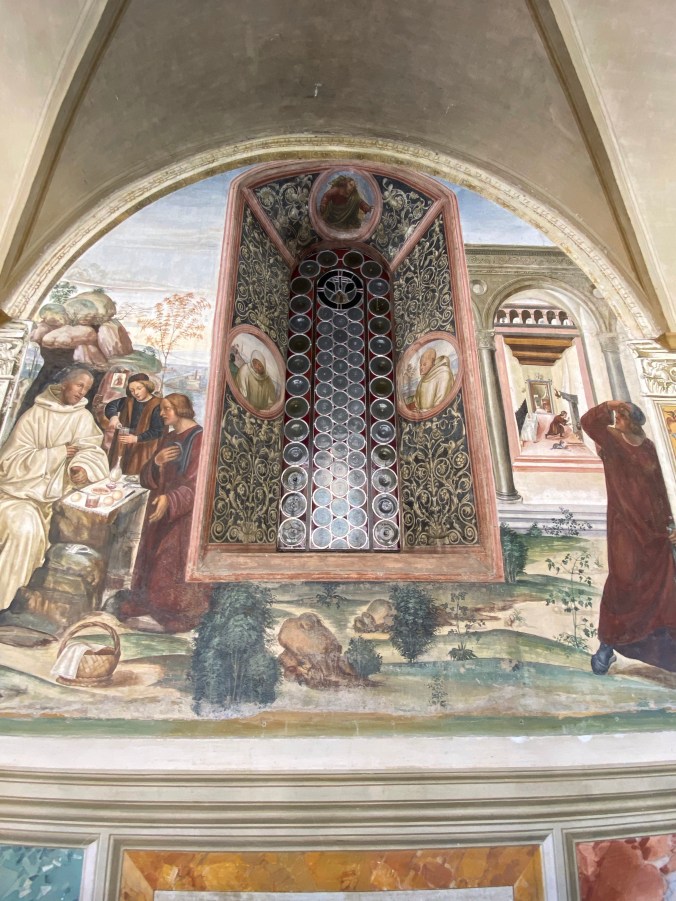
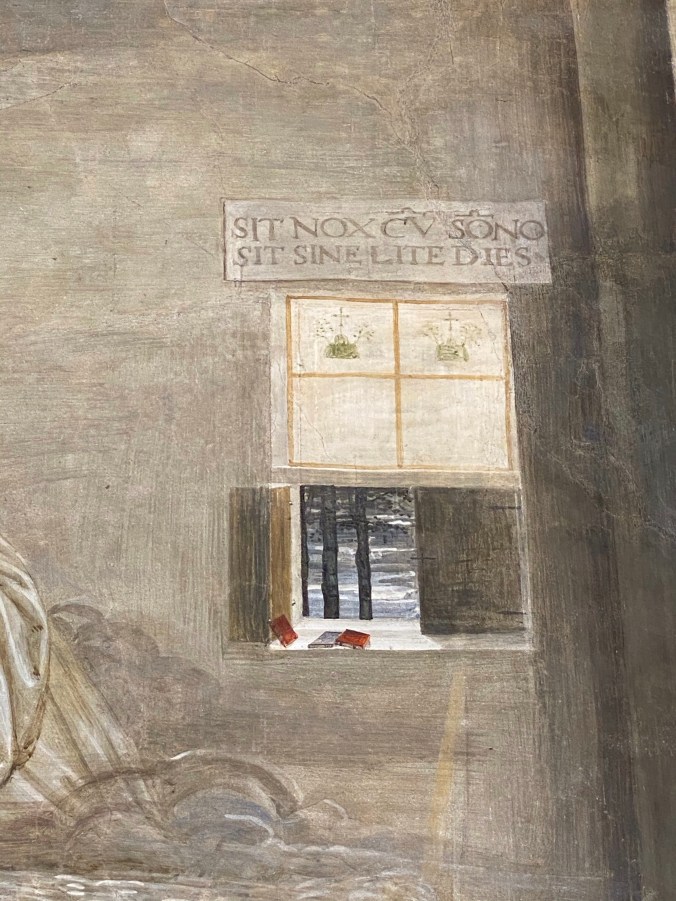
Love the window in this lunette.


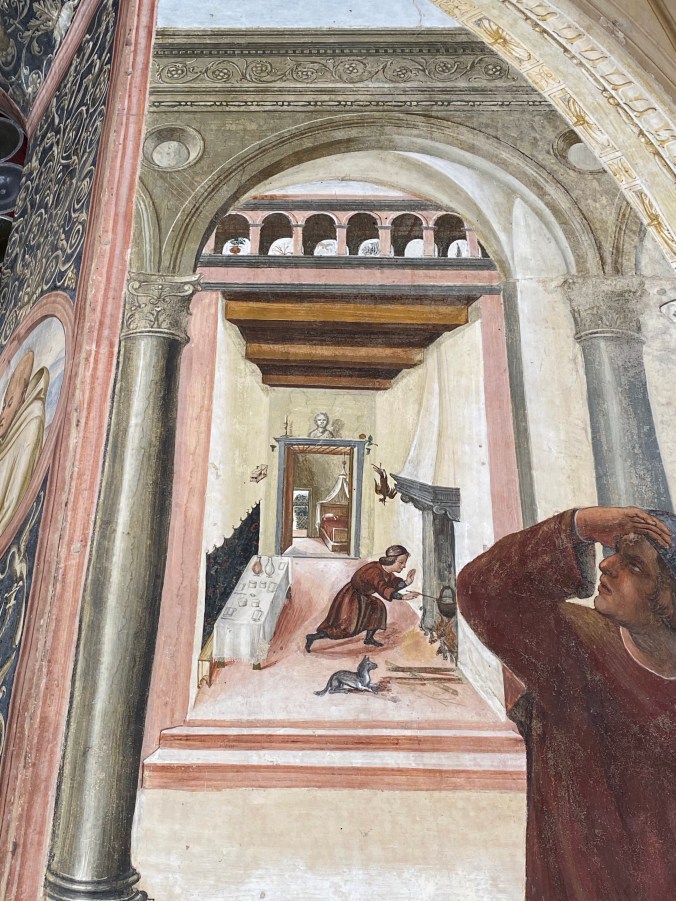
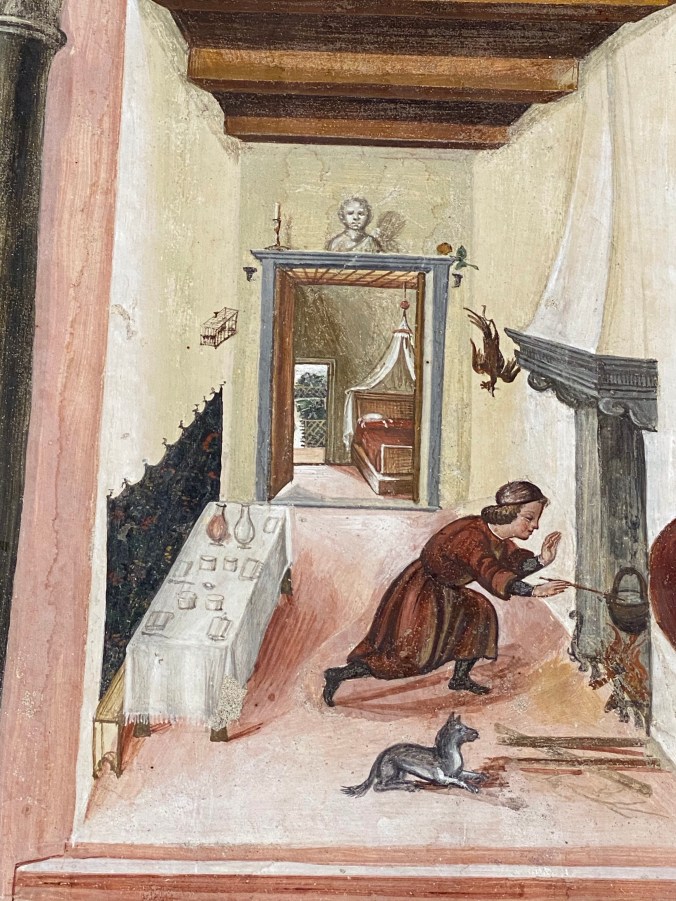
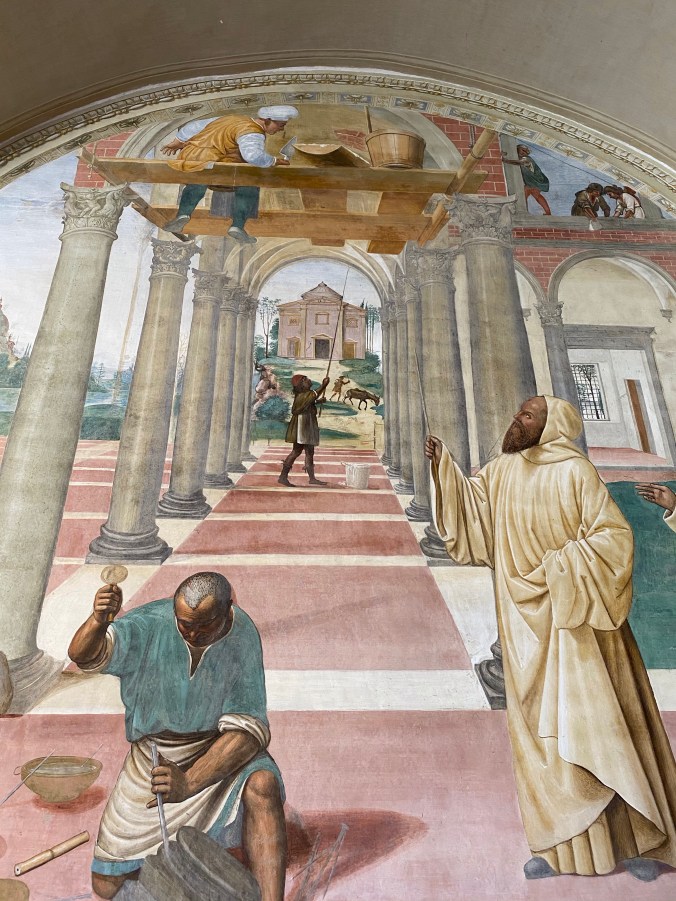
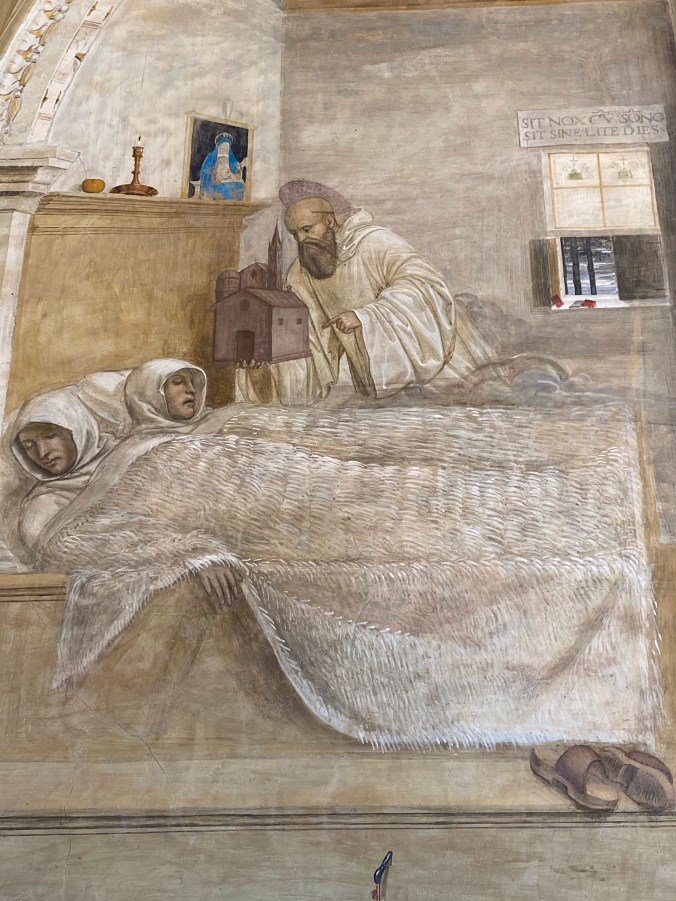
In this lunette, above and below, painted by Sodoma, shows How he blessed the building of twelve monasteries.


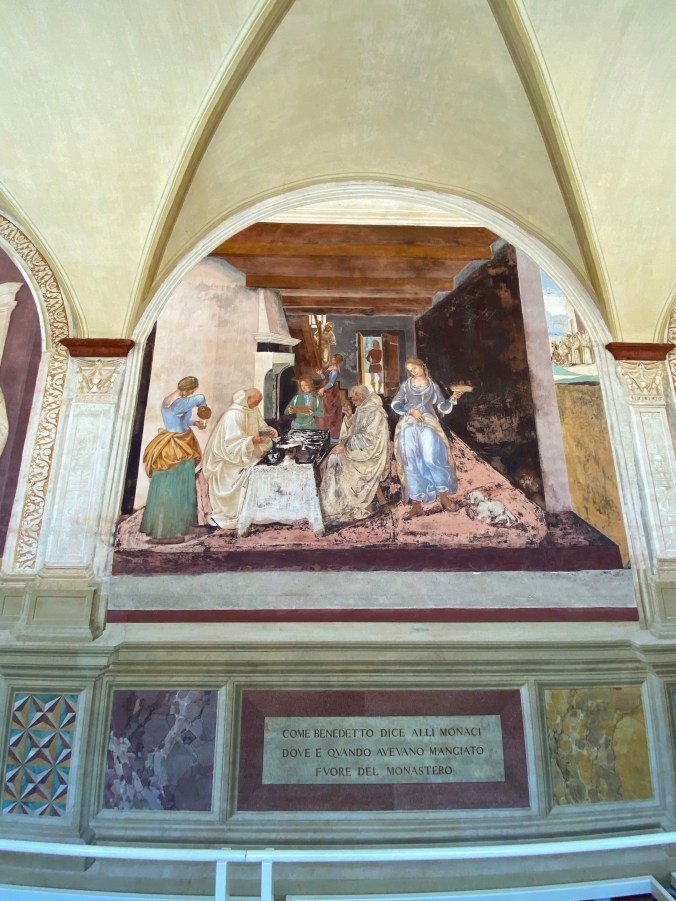
The painting below is by Signorelli and depicts Benedict talking to the monks after they had eaten outside the monastery


Luca_signorelli,_storie_di_san_benedetto_a_monteoliveto,_san_benedetto_rimprovera_due_monaci_che_hanno_violato_la_Regola,_dett_02


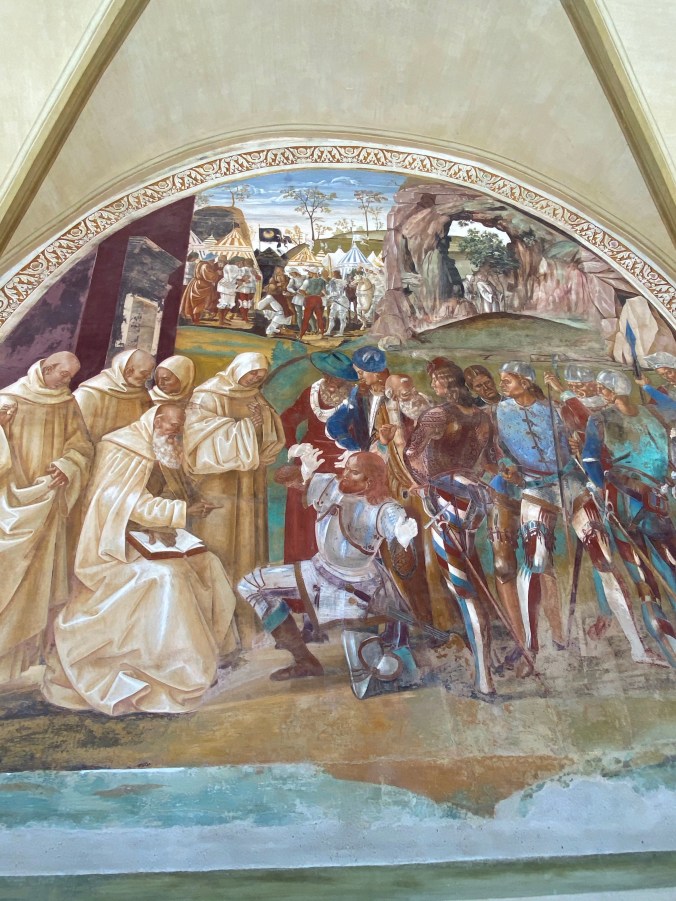
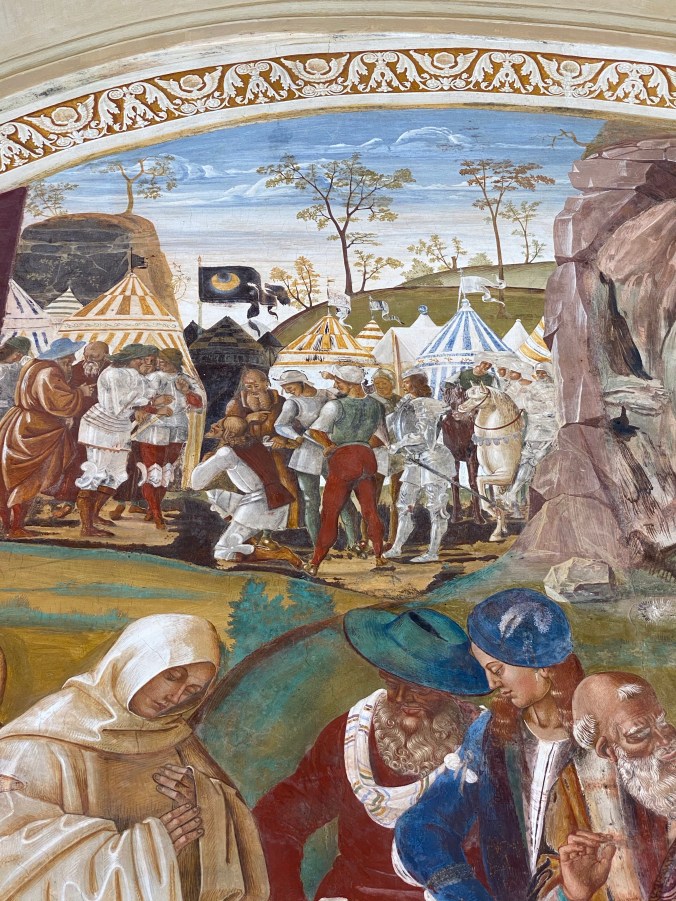
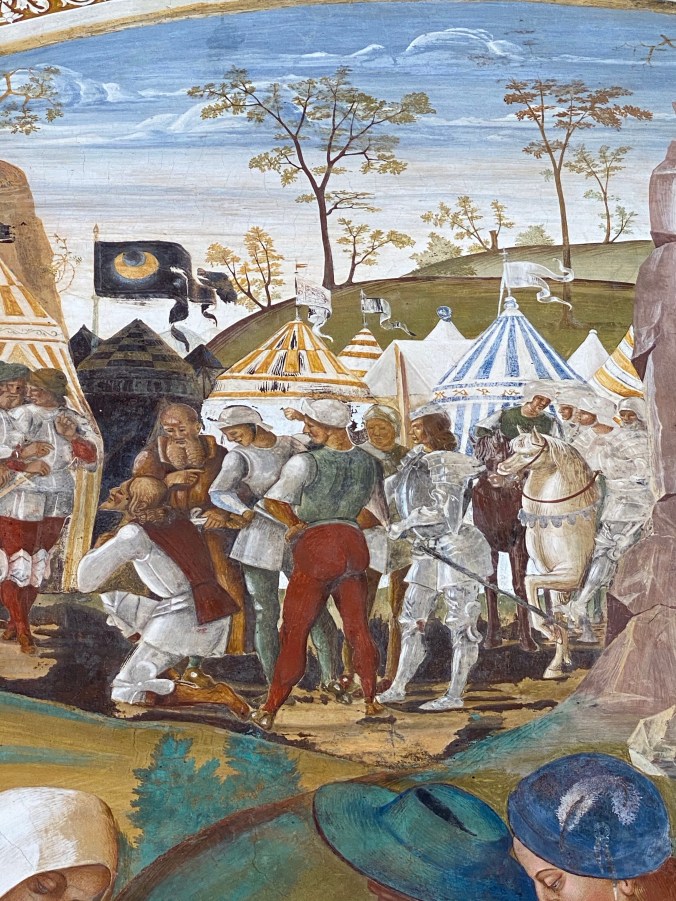
Below: How Benedict discovers Totila’s fiction. In the scene Riggo is seen, disguised as Totila to deceive Benedetto, who arrived in front of the figure of the saint who invites him to take off his clothes; the crowd around composed of monks and warriors expresses his amazement; in the background Riggo tells the story to Totila. It is a crowded scene and set to a theatrical taste [2].


In the scene Riggo is seen, disguised as Totila to deceive Benedetto, who arrived in front of the figure of the saint who invites him to take off his clothes; the crowd around composed of monks and warriors expresses his amazement; in the background Riggo tells the story to Totila. It is a crowded scene and set to a theatrical taste [2].


How Benedict recognizes and welcomes Totila


How Benedict gets plenty of flour and restores the monks


How Benedict appears to two distant monks and he designs the construction of a monastery.
The scene takes place in two stages. On the left the saint appears to one of the two sleeping monks while on the right the work is accomplished


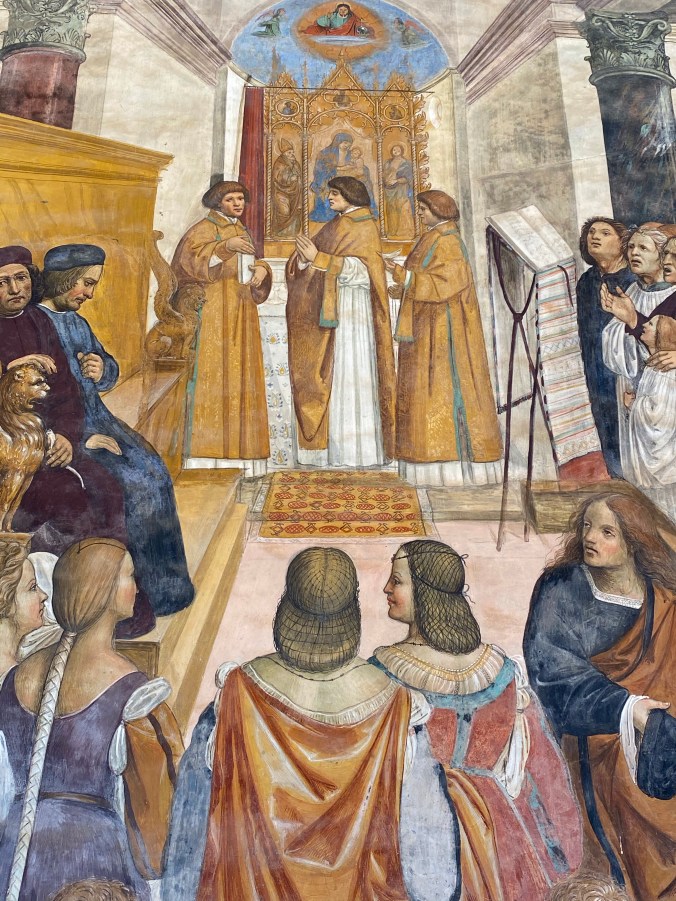
Like Benedict, he excommunicates two nuns and then acquits them that they were dead
Inside a church during the celebration of a mass; to the deacon’s words: If anyone is excommunicated, go out, a woman sees two nuns excommunicated by Saint Benedict come out of the tomb. On the right, in small, the saint reconciles the nuns


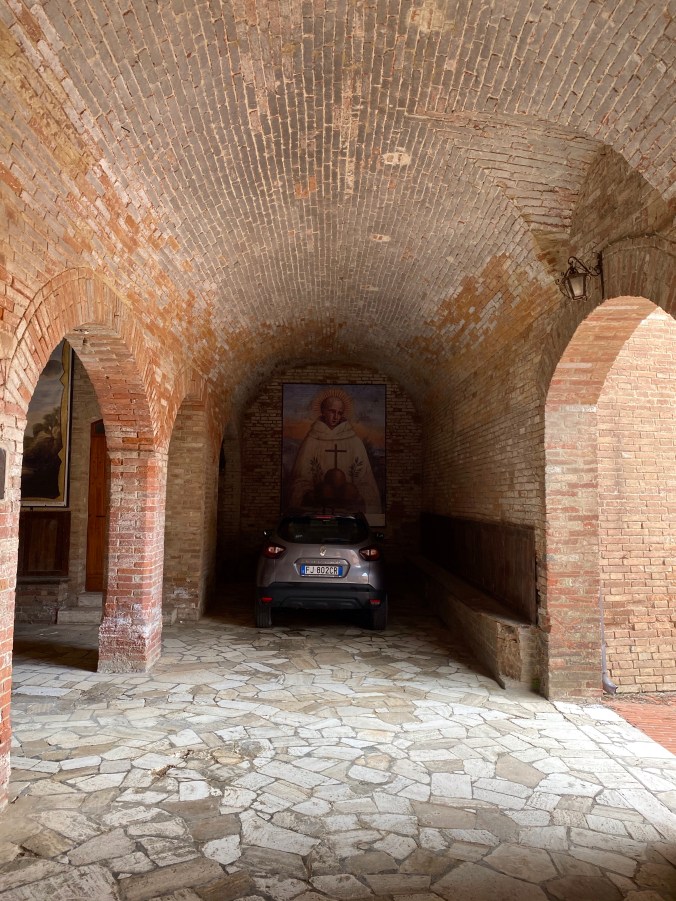
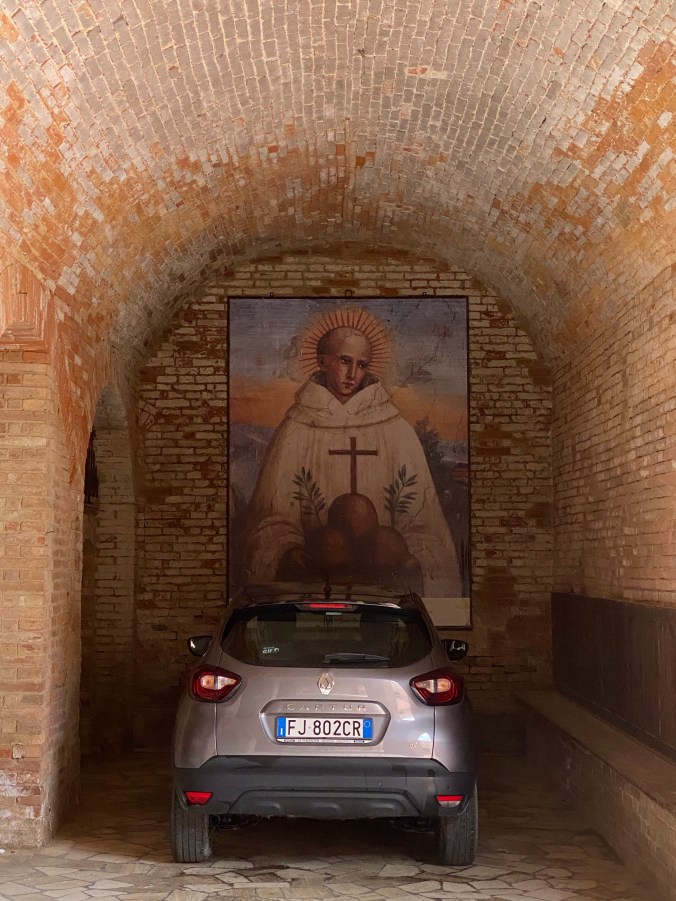
And, last, but not least, the modern incursion into the abbey.  A garage where there used to be a stable. Complete with frescoes.


Museo Bardini has re-opened in Florence

And I paid a visit.  It was not like the old days, where you could wander at will, which is very sad.  Now they have a “percorso” or path, which you have to follow and they have guards in every room watching you like a hawk.  It didn’t feel like they were watching out for Covid.  It felt like they thought I was going to damage or steal the art.  I didn’t care for it.  Plus, I was one of 3 visitors.  I mean, really?

Despite my complaints, the museum is still a wonderful place with a fascinating collection. It is one of my favorite museums in Florence.  Here are a few of my favorite things:


fullsizeoutput_37d9

u0mFmpWkTV6SMSqbNGc28g

JRKX3QjiT%Gdqj7rG3wg8A

The unusual sculpture above, showing a woman breast feeding 2 children at once, is explained in the label above.


fullsizeoutput_3787

fullsizeoutput_3785


Here’s some info about the collector for whom the museum is named:

fullsizeoutput_3771

%2T1EyiDQy6FTZapRJWzgg


And here are some of his eclectic objets:

9YHqZw8eSEiWBvb57VHjzQ

It’s official.  My new favorite art form is medieval sculpture.  I mean, look at the examples above and below.  Did you ever see a sweeter angel above?

Toz7B9JuQGeQFcIigeTwGQ

And, above, check out the lion caryatid figure.  Notice that he has a poor ram pinned below his feet, for all eternity.  The poor ram.  I love the primitive charm of these sculptures!


When I backtracked to take a picture of this gorgeous Renaissance doorway was when I knew my visit yesterday was not going to be the carefree affair of the olden days.  A mean, older woman reprimanded me for taking a few steps back towards where I had come from (although how you would notice the far side of the doorway you are walking through is beyond me), cackling at me that you must follow the path forward (I saw no signs showing me the path ahead either).

But, forget about her…look at the sumptuous doorway.  Wow.  What it must have felt like to use such casings.

W1XCFe0wTgCVo6UJvb0TgA


Going upstairs, like a good girl, I arrived in the room for which I had come.  I could spend hours in this gallery, if they would turn on all of the lights and get rid of the guards acting like I was going to damage the artworks.


fullsizeoutput_378d


fullsizeoutput_378f


fullsizeoutput_378b


Donatello’s Madonna and Child with the Apple

fullsizeoutput_3794


fullsizeoutput_3798

fullsizeoutput_37a8


Donatello’s Madonna and Child, known as the Madonna and the Ropemakers:

fullsizeoutput_37a0


fullsizeoutput_37a4


fullsizeoutput_37a6


And then there are the cassone, or the wooden chests (like a hope chest for an aristocratic Italian woman), that Bardini collected.  If they would turn on the lights in the gallery and let me get close to the works, I would be in heaven.  As it is, I’m halfway to heaven, just looking at the furniture and thinking about the girls/women whose lives they represent.


fullsizeoutput_378f


fullsizeoutput_37b4


fullsizeoutput_37aa


fullsizeoutput_37ac44lFH4W0QkyTmYca8ktY4w


And then there are the cornice: the incredible frames that Bardini collected. Any American art museum would give eye teeth for one of these marvelous frames.


fullsizeoutput_37b6


Moving into another gallery, I pass through another sumptuous doorway casing:

fullsizeoutput_37b8


Beautiful painted crucifixes were also collected by Bardini.  Below them, more cassone.

fullsizeoutput_37be


fullsizeoutput_37bc


fullsizeoutput_37c2


I could spend a day in this museum just studying the ceilings:

fullsizeoutput_37c4


fullsizeoutput_37c6


Or the Sienese sculpture:

fullsizeoutput_37ca

fullsizeoutput_37cf


Below, you might think you are looking at a rug on a floor, but it is a ceiling:

fullsizeoutput_37d1


Upon leaving my favorite galleries, I go down this stairway, lined with rugs hung on walls.  Very effective.

fullsizeoutput_37d5

What a collection.  Despite the guards, I love this museum!

San Giovani Day, June 24, 2020

The Feast of St. John, a Public Holiday in Florence

Today, June 24, is The Feast of St. John the Baptist, and therefore a public holiday in Florence. It is a day off for the general population, with schools and most businesses closed.

In Florence, a parade traditionally occurs at the city center, followed by fireworks in the evening.

This year, with social distancing, will be quite different:

On June 24, San Giovanni, the city’s patron saint, is usually remembered by the pomp and circumstance of a parade, the final of bombastic local sport Calcio Storico and a spectacular late-night firework display. For obvious reasons, crowds will not be cramming the streets this year. Instead, an impressive combined celebration is in the making by Florence, Genoa and Turin, who share a patron saint in St John the Baptist [read]. Florence will be illuminated by a light show instead of fireworks, lasting from sunset until midnight. Porta San Gallo, Porta alla Croce, Torre di San Niccolò, Porta Romana, Porta al Prato, Porta San Frediano, San Miniato al Monte and Istituto degli Innocenti will all act as canvases for the illuminations, but the highlight is likely to be three streams of light cast onto the lantern at the top of Brunelleschi’s Dome.

June 24 will be a day of culture for all, with free entrance to the Museum of the Palazzo Vecchio Museum (10am-3pm), the Bardini Museum and Novecento Museum (both 3-8pm). In terms of music, singer-songwriter Irene Grandi will perform in the Palazzo Vecchio’s Salone dei Cinquecento and Zubin Mehta will conduct the orchestra of the Maggio Musicale Fiorentino opera house in the Duomo.

St. John the Baptist (San Giovanni) is Florence’s patron saint. He was beheaded around the year 30 CE, having been a preacher and religious leader during Jesus’ lifetime. Baptism rituals in the Jordan River were an important part of his ministry. St John’s birthday is celebrated on June 24 in many churches.

Screen Shot 2020-06-22 at 13.42.49

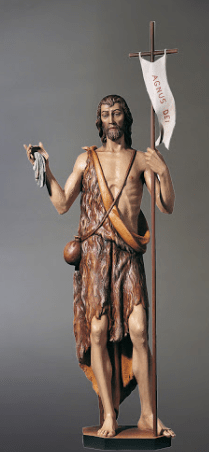
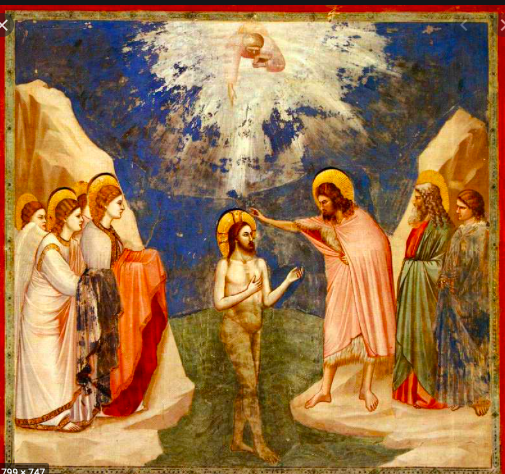
Images of St John the Baptist often depict him wearing a camel-skin robe and with a cross and a lamb. He is often shown baptizing people, particularly Jesus. Below is Giotto’s imagining of the event:

Screen Shot 2020-06-22 at 13.44.41

It is believed that the Cathedral of San Lorenzo in Genoa keeps relics such as John the Baptist’s ashes.  Florence’s cathedral also is said to own some of his relics.

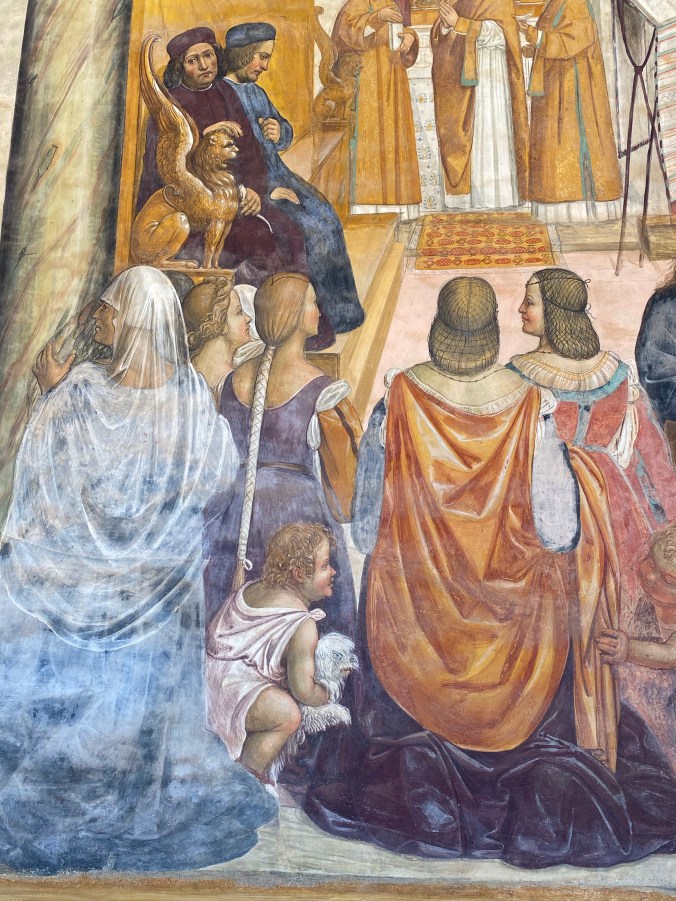
On my recent visit to the Palazzo Vecchio in Florence, I happened upon this interesting fresco which shows the celebration of St. John in the 1500s.  I guess this fireworks tradition is truly an old tradition.

img_6630


img_6629


img_6628


img_6627


So why is St. John the patron saint of Florence?
Well, it happened so long ago we really can’t know for sure, but there are some theories. After their conversion to Christianity (yes, that is how long ago we are talking), the Roman Florentines selected the patron saint that correlated to their original pagan patron, the god Mars.

To make conversion easier, Christians came up with a clever way of associating certain saints with a Roman counterpart.

St. John must have seemed pretty rugged, hanging out in the desert with his hairy undergarment, so maybe that’s why he got matched up with the God of War.

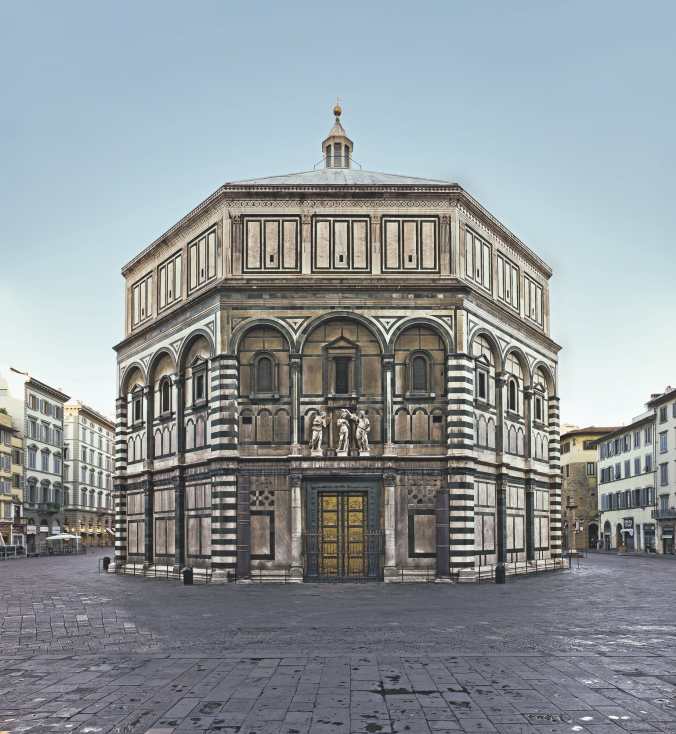
According to tradition, the new Christians then re-founded their main temple to Mars, what we now call the Baptistery, as a church to St. John. The dating is problematic, but we won’t get into that now. Let’s just note that Dante called the building the “beautiful San Giovanni.”

getImage.php

After the mid-13th century, St. John even decorated one half of the new Florentine coin, the florin.

Screen Shot 2020-06-22 at 13.47.42

It is understandable, then, that the feast day of Saint John has been celebrated in Florence from the Middle Ages and on. Traditionally, this holiday included festivities that lasted for as many as three days, corresponding to the European celebration of the Summer Solstice, which typically falls on June 21 – June 24th. Contemporary celebrations, however, tend to be condensed into one day.

So, every year on June 24th, –at least prior to Covid 19– the saint’s feast day, Florence (along with a few other pro-John cities) celebrates the feast of this great patron. The now single-day festival begins with a historic parade, which starts at Piazza Signoria and continues to the Baptistery, with an offering of candles for the Saint in his most sacred house. After the parade, there is a mass, which includes a public showing of the Saint’s relics (an event that only occurs on that day and hence is very holy).

June 24th ends with a traditional fireworks display in Piazzale Michelangelo. Crowds gather around the Arno for the best view of the hill and there is a general sense of merriment all around. These fireworks, called fuochi di San Giovanni, are pretty big and visible from quite a few spots along the water. It is a good show and a great end to a gorgeous summer day full of fun, parades, and costumes.

High water marks

The famous Arno city of Florence has been plagued with floods for centuries.  Walking through the city, you will find many plaques on buildings, showing you the heights the water reached.  It is sobering, to say the least.

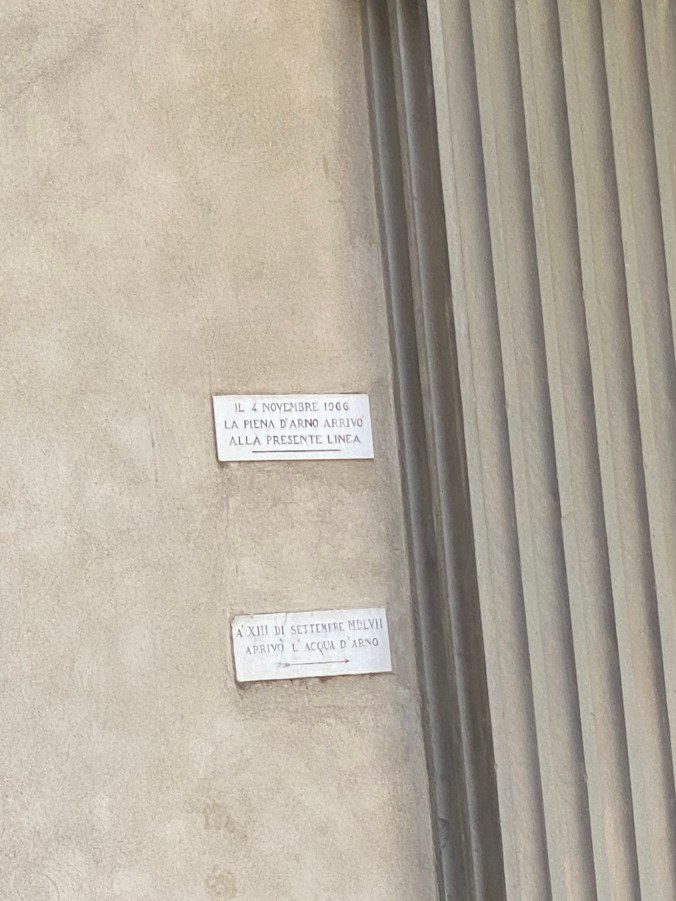
On the front of the Pazzi Chapel, to the far left side, two high water marks point out the incredible heights reached in 2 remarkable years.

Sm4IPF3nRkGufnv6lwXIUQ


See those 2 small white rectangles on the left of the pilaster?  Those mark the flood heights.

vOVH4ftsRReNpD18NEX%yQ

Zeroing in…

n9xrLOGdTi+OmmtAN+MLQQ


Zeroed in:  you can see the 1966 flood reached the highest level marked.  The lower one (which is still pretty high!) is from 1557 if my reading of the Roman numerals is correct.  The time spans in Italy will always blow my mind!


f0+pdrvbSqutAPXb1Yst2g