How art history became an academic (& my favorite) field of study

Before Charles Eliot Norton had become Harvard’s first professor of that discipline, art history had, in general, been considered, not a field of study, but a matter of craft and technique to be taught by painters to other painters.

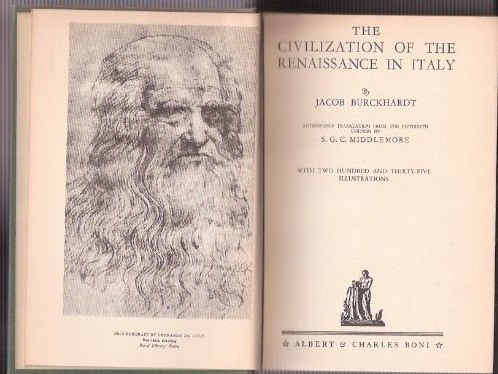
Scholarship about art, and especially about Italian art, entered a new era as the German universities began developing large-scale historical studies like those of Swiss scholar Jacob Burckhardt, whose Civilization of the Renaissance in Italy was published in English in 1878.

Die_Kultur_der_Renaissance_in_Italien

In Great Britain, tastes were influenced by the work of Norton’s close friend Ruskin in books like The Stones of Venice (1851–1853) and The Seven Lamps of Architecture (1849).

The_Seven_Lamps_of_Architecture_-_titlepage

Following Ruskin, Norton loved best in Italy the powerful moral uplift of Dante and of Italy’s medieval Gothic architecture. In Norton’s art history courses, the Renaissance was the unhappy termination of the Middle Ages, which had been the last great era of spiritual unity and well-being.

There was a joke current among Harvard undergraduates that Norton had died and was just being admitted to Heaven, but at his first glimpse staggered backward exclaiming, “Oh! Oh! Oh! So Overdone! So garish! So Renaissance!”

“Norton,” Bernard Berenson commented drily years later, had done what he could at Harvard to restrain “all efforts toward art itself.”

Rachel,Cohen. Bernard Berenson (Jewish Lives) (p. 45). Yale University Press. Kindle Edition.


British Houses of Parliament are physically rotting away

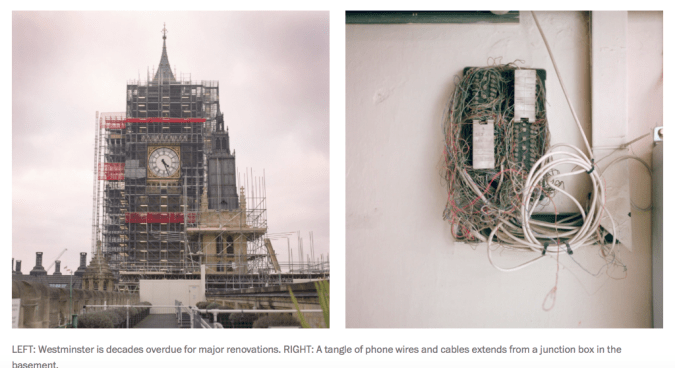
The Palace of Westminster, with its cinematic Big Ben clock, set beside the River Thames, is a survivor — of epic fire, German bombs, sulfuric smog and bad plumbing.Screen Shot 2018-04-30 at 11.06.50 AM

An eccentric masterwork of Victorian genius, its dual chambers for lords and commoners are the living, breathing heart of constitutional monarchy, the home of Parliament, and one of the most photographed buildings in the world.

But Westminster is a wreck, its caretakers say.

The palace is not falling down. Not at all. Its bones, the superstructure, are solid enough, and carrying on, in British fashion, even if its dermis of Yorkshire limestone is spotty.


https://www.washingtonpost.com/news/world/wp/2018/04/25/feature/westminster-home-of-british-democracy-is-rotting-from-within/?utm_term=.0964197cc0fb

Italy’s beauty and complications recognized even in wartime


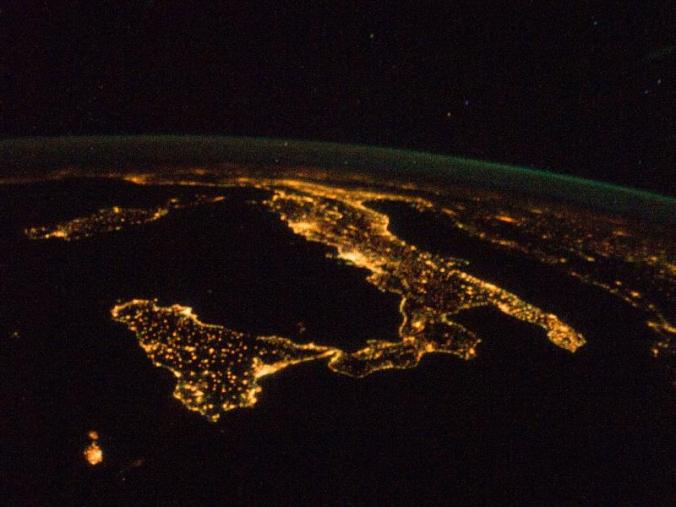
683410main_iss032e020159_1600_800-600


“Trapani! Trapani, don’t you see?” [British] Capt. Edward Croft-Murray exclaimed as the skyline of the Sicilian coastal town first appeared through the porthole of the Allied aircraft. [The Brit] Sitting next to him, Maj. Lionel Fielden, who had been drifting off into daydream for much of the flight from Tunis, opened his eyes to the landscape below. “And there, below us,” Fielden later wrote, “swam through the sea a crescent of sunwashed white houses, lavender hillsides and rust red roofs, and a high campanile whose bells, soft across the water, stole to the mental ear. No country in the world has, for me, the breathtaking beauty of Italy.”

…As soon as the first Monuments Officers reached Sicily, the implications of such a mandate [to preserves as many cultural works as possible] proved as difficult as its scope was vast. The Italian campaign, predicted to be swift by Allied commanders, turned into a 22-month slog. The whole of Italy became a battlefield. In the path of the Allied armies, as troops slowly made their ascent from Sicily to the Alps, lay many beautiful cities, ancient little towns and innumerable masterpieces. As General Mark Clark declared with frustration, fighting in Italy amounted to conducting war “in a goddamn museum.”

 
Read more: https://www.smithsonianmag.com/history/how-monuments-men-saved-italys-treasures-180948005/#W8OkkTPqF2Ar2s8S.99


Allied forces in Florence

From the safe distance of 2018, it is interesting to think back to the situation in Florence during WWII, especially after the Allied Forces liberated the Renaissance citta’.

D378_44_137_0004_600

The leaders and troops of the Allied Forces are my heroes. There are many to name.  General Dwight D. Eisenhower is foremost among them.  I recently wrote a post on his directive, which saved many cultural monuments in Italian. Here is a picture of Ike in Italy:

Screen Shot 2018-04-29 at 12.30.35 PM


As the Allies liberated region after region in Italy, starting from the southern tip and working their way north, thanks to the farsighted leaders, as many cultural works as were possible were saved.

99686daed1bb4cc176004ca149b1c1d8


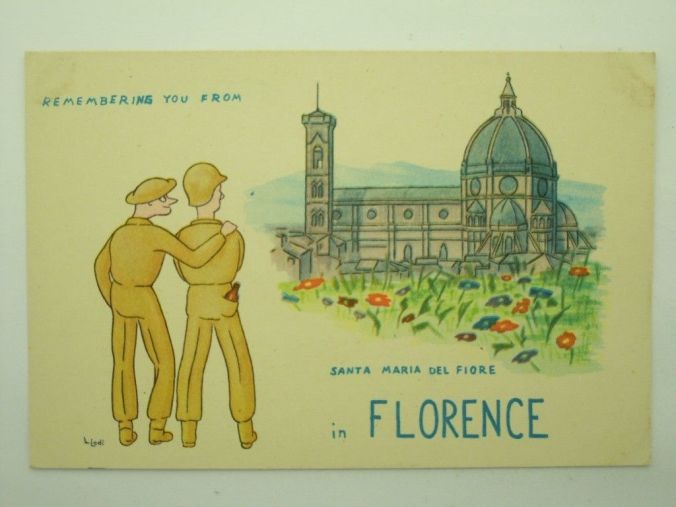
These wonderful postcards, with their simple illustrations of the Florentine architectural masterpieces, tell a poignant story.

s-l225

s-l1600


General Dwight D. Eisenhower as protector of cultural heritage

99686daed1bb4cc176004ca149b1c1d8

The cumulative weight and momentum of General Marshall’s mid-October admonition about the importance of protecting Italy’s cultural treasures, followed by successive warnings from McCloy and Woolley and the reports of Monuments officers themselves, finally produced a change.

On December 29, General Eisenhower Eisenhower issued a directive that placed the responsibility of protecting cultural property squarely upon the shoulders of every commander and, in turn, every officer and every soldier.

Screen Shot 2018-04-29 at 12.30.35 PM


It also, for the first time, introduced the Monuments officers (referenced as “A.M.G. officers”—Allied Military Government) to everyone in uniform.  Here is Eisdenhower’s directive:

To: All Commanders Today we are fighting in a country which has contributed a great deal to our cultural inheritance, a country rich in monuments which by their creation helped and now in their old age illustrate the growth of the civilization which is ours. We are bound to respect those monuments so far as war allows. If we have to choose between destroying a famous building and sacrificing our own men, then our men’s lives count infinitely more and the building must go. But the choice is not always so clear-cut as that. In many cases the monuments can be spared without any detriment to operational needs. Nothing can stand against the argument of military necessity. That is an accepted principle. But the phrase “military necessity” is sometimes used where it would be more truthful to speak of military convenience or even of personal convenience. I do not want it to cloak slackness or indifference. It is a responsibility of higher commanders to determine through A.M.G. Officers the locations of historical monuments whether they be immediately ahead of our front lines or in areas occupied by us. This information passed to lower echelons through normal channels places the responsibility of all Commanders of complying with the spirit of this letter.

signed: DWIGHT D. EISENHOWER

Ike’s directive was bold; it was concise; and it was now official policy. His Chief of Staff, Major General Walter Bedell Smith, issued an accompanying order that provided more specific details on how this new policy should be implemented.

Woolley remarked that Ike’s words “made it clear that the responsibility for the protection of monuments lay with the army as a whole and not with the [Monuments officer] specialist.”

Even Churchill weighed in on the matter: “The weakness of the Monuments and Fine Arts organization in the past was . . . due to the fact that it had . . . depended on an external civilian body not in touch with the Army. . . . The new arrangements which have been worked out in the light of experience are well calculated to promote, as far as military exigencies allow, a more effective effort to protect historical monuments of first importance in the future.”

Many problems lay ahead for implementing this new order. Mistakes would continue. The order would be put to the test in a major way within just six weeks.

But it marked the turning point for the Monuments officers and their work. For the first time since Mason Hammond had landed in Sicily, the Monuments Men had the backing of the Commander-in-Chief. Their work contributed greatly to the experience Eisenhower would take with him to England to plan the invasion of Western Europe as the newly appointed Supreme Commander of the Allied Expeditionary Force.


Edsel, Robert M.. Saving Italy: The Race to Rescue a Nation’s Treasures from the Nazis (p. 68). W. W. Norton & Company. Kindle Edition.
American Girl in Italy

Ninalee Allen Craig, subject of iconic ‘American Girl in Italy’ photos, dies at 94.

“American Girl in Italy” was taken in Florence in 1951 and featured Ninalee Allen, 23 at the time. (Ruth Orkin Photo Archive)
May 3 at 7:09 PM
In August 1951, at a $1-a-night hotel in Florence, two American women came face to face in the hallway one morning.

https://www.washingtonpost.com/local/obituaries/ninalee-allen-craig-subject-of-iconic-photo-american-girl-in-italy-dies-at-90/2018/05/03/91357bc4-4ee3-11e8-84a0-458a1aa9ac0a_story.html?noredirect=on&utm_term=.ea06b052c542

A marvelous May fair in Florence

300x190

  XXIV EDITION

ARTIGIANATO E PALAZZO 2018

The great tradition of italian craftsmanship
from its origins to the present

The 24th ARTIGIANATO E PALAZZO exhibition (Florence, Corsini Gardens, May 17-20, 2018) gets underway with the history of one of the leading examples of Made in Italy excellence, the “Mostra Principe” dedicated to the Richard Ginori porcelain Manufactory and fundraising for the reopening of the Doccia Museum, recently acquired by MiBACT (Italian Ministry of Cultural Heritage and Activities and Tourism).

“The hundreds of requests to take part that we have received this year represent an excellent sign of recovery in the artisan sector, because craftspeople are the lifeblood of Made in Italy,” said Giorgiana Corsini and Neri Torrigiani who, for over twenty-four years, have been involved in organizing the ARTIGIANATO E PALAZZO event and in promoting Italy’s artisan heritage.

During the four-day event in the Limonaia Piccola of the 17th-century Corsini Gardens (open to the public for this occasion), the Richard Ginori company will recreate various phases in the creative process through which, daily since 1735, it has produced unique porcelain pieces, with special live demonstrations to reveal to the public a story that has survived to the present day with a rich tradition of know-how, innovation and beauty.

For the first time, it will be possible to admire outside the plant in Sesto Fiorentino the Manufactory’s artisans at work in their various areas of expertise: from slip casting to decoration, evidence of a wealth of knowledge that has been handed down without interruption from older to younger generations of craftspeople.

For its part, the Doccia Museum will be the recipient of the major fundraising initiative, “ARTIGIANATO E PALAZZO FOR THE DOCCIA MUSEUM”that Giorgiana Corsini and Neri Torrigiani have decided to launch with this year’s event “so that the priceless collection of the Doccia Museum will once again be open to the public”. 8,000 porcelain, ceramic, majolica, terracotta and lead objects and over 13,000 drawings, engraved metal plates, chromolithograph stones, plaster molds and wax sculptures.

The project involves a series of initiatives that will involve the organizers, public and corporate sponsors of the 24th ARTIGIANATO E PALAZZO exhibition, the full proceeds of which will go to the Associazione Amici di Doccia: