Let’s say you are one of the major sculptors of Renaissance Italy, and that you live in Florence. Where would you want to have your studio?
How about, right on the piazza around il duomo? Non e’ male!
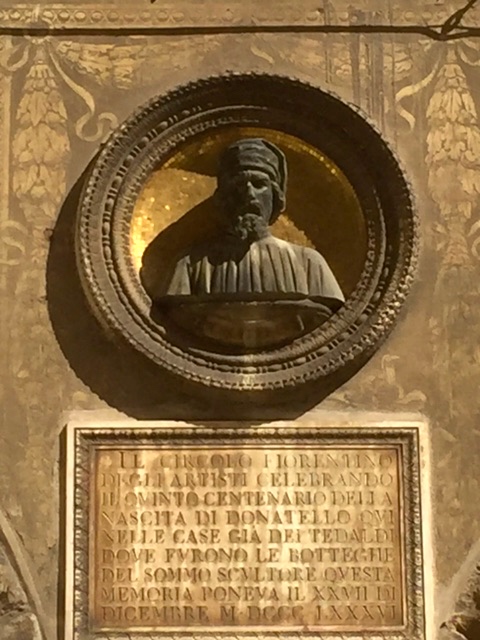
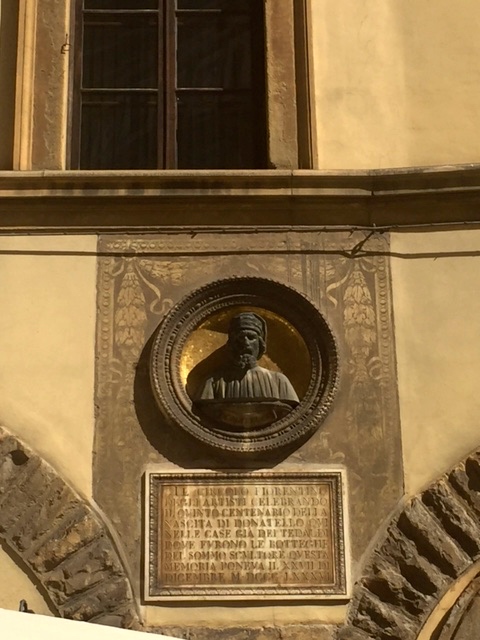

Using the map above, you will find the bust of Donatello and the plaque recording his studio location about where the P in “Panini Toscani.” You can find Panini Toscani words on the upper right side of the map.

We know some, but not enough, about Donatello (c.1386-1466). He was apparently born in Florence and grew up with the Martelli family, where it is hypothesized that he received early training from a goldsmith, before training and working in the studio of the famous metalworker and sculptor, Lorenzo Ghiberti.
There is very little known about his life as he was growing up; however, Vasari tells us a few stories which give insight to the generous and proud man that he was. Vasari, in his “Life of the Artists” where he wrote biographies of other artists, enjoys playing with the name Donato which is a variation on the Italian verb “to donate”. Several pieces of Donatello’s artwork were donated to those whom he held in high esteem.
It is possible to see many pieces of Donatello’s works throughout Florence – but be aware that several pieces available on display outdoors are expert copies since the originals have been moved indoors for safe keeping.
The map below shows the spots in Florence where you can find major Donatello works.

Both the Museo of the Opera del Duomo and the Bargello have extensive works by Donatello. It is so easy to forget that many pieces were made for a specific setting, like the facade of a church or an altar. Once they’re in a museum, even if the work is beautiful on its own, you sense that if viewed in its original position, the work of art would seem different.
If you decide to go outside of Florence and still want to see works he had a part in, here’s a short list to guide you:
PISA
In the San Matteo National Museum in Pisa, you can view the Reliquary of San Rossore, statue, gilded bronze. Via San Matteo in Soarta 1 (Pisa)
LUCCA
At the Villa Guinigi in Lucca, (also known as “pleasure palace” but which is now a national museum), you can admire Madonna and Child relief in tile. Piazza della Magione (ex Manifattura Tabacchi), Lucca
AREZZO
Inside the impressive Cathedral in the center of the historic part of Arezzo, you can admire the baptismal font with a bas-relief marble carving of the Baptism of Christ.
SIENA
Between the Baptistery of San Giovanni, the Cathedral of Siena and the Museum dedicated to the artwork from the Duomo, you will find several works of art dating from the time Donatello worked in Siena.






You must be logged in to post a comment.