Summertime, and the living is easy!

IMG_0894

James jumps into Lake Washington at Madrona Beach.  Fun times in Lake Washington!

IMG_0886

Preceded by an excellent dinner at Cascina Spinasse.  Here’s a shot of the pasta being made just before being cooked with butter and sage.  OMG, can you spell delizioso?

See those sheets of yellow paper or fabric hanging on rods at right?  Those are sheets of egg pasta made right before our eyes.  Amazing (strabiliante)!


Ciao, tutti!

Contest! I need a little inspirtation–can you help? Contest!

I am suffering from a bad case of summer heat doldrums.  Too hot to move.  Too hot to be inspired.

So, to entertain myself and share some beauty of the world, I am going to give away some of my souvenirs from travel over the past few years.

If you will help me choose the subject of my next post, which is the letter R, I will send the winning entry this hand-made, hand-painted and signed ceramic candle holder from Orvieto, Italy.

IMG_0881 IMG_0882

Please send me your suggestion for an artwork or artist from any where in the world that would likely have broad appeal.  The winner will receive this handmade ceramic candlestick.  Post your suggestion in the Comments section by 5 p.m. PST on Thursday, July 18.

S is for spending the summer with John Singer Sargent

Oh my goodness, I have been delinquent!  Sorry, let me get back —pronto— to the reverse alphabet of art. Last post was for the letter T and now I’m ready to move on to the letter S.  Andiamo!
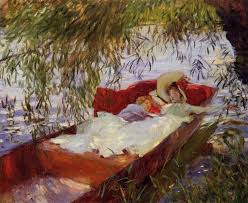
Wouldn’t you love to be passing a summer afternoon with these ladies?  I would!  I bet they are discussing their beaus.

Or, taking a summer afternoon nap to escape the heat in this little outbuilding in Corfu?  I would!

Or, gliding in a gondola over the waterways of Venice?  I would!

Or, observing some exotic ceremony in some Middle Eastern country?  I would!

Or, playing some board game with your friends on some pretty bank of some lovely, cooling stream?  I would!  But I do wonder why all the women have their heads wrapped up in filmy cloth.  Too many insects, I presume.

Mosquito Nets by John Singer Sargent

One activity from which I prefer to be excused, is reading while under mosquito netting.  But, who wouldn’t like to look at the beautifully-painted image?  I would!
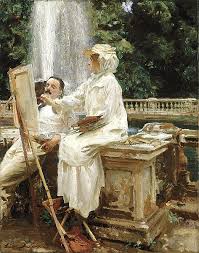
Or, painting a portrait of a gorgeous gentleman while sitting on classical balustrade next to a waterfall? I mean come on!  I would!
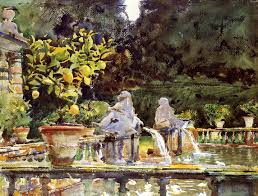
Or standing over water pouring out of a jet and into a pool, while dressed in your most elaborate summer whites. While pausing on a classical balustrade, next to some potted lemon trees in some magnificent Italian locale?  I would!

What child wouldn’t like to spend the evening hours, after the heat of the day has passed, dressed in your coolest cotton clothing, capturing fire flies in a flower garden?  I would!

Or fishing on the side of a cool stream with your feet in the water?  I would!

Or, preparing to dine on an outdoor terrace?  I would!

Or, best of all, who wouldn’t love to lie on the ground, sunk into your voluminous and gorgeous summer fashions and being painted all the while by one of the best painters of all time?  I would!

Who wouldn’t want to spend a summer with John Singer Sargent?

Keep cool, everybody! Arrividerla!

T is for Wayne Thiebaud.

What’s not to love?

https://i0.wp.com/www.bluecanvas.com/images/articles-new/random-inspiration-wayne-thiebaud-1.jpg

I have loved Thiebaud’s paintings since the first one I ever laid eyes upon in the 1970s.  My love is still going strong.

https://i0.wp.com/www.askart.com/AskART/photos/CNY20071112_5498/648.jpg

Plus it is summertime!

https://i0.wp.com/www.pasadenaweekly.com/site_images_upload/photo/2009/09/25/16/Thiebaud.jpg

Get your tan on, people!  And, if you do like a tan, did you know you have Coco Chanel to thank?  She popularized the idea of tanning one’s skin in the 1920s.  Prior to that, no white person wanted a tan, for only the poor who had no choice but to labor outdoors would have let their skin turn brown.

U is for Uffizi; or is it for ukioy-e? Take your pick.

The Uffizi or the art of ukioy-e.  How can I decide?  I love them both.  They are like children, you can’t choose a favorite!

Let’s start in Italy.  How can you go wrong?!!  Well, you can’t!  Did you know that 40% of the world’s art resides in Italy?  It is the truth.  And a lot of the best is in this former office building in Florence.

https://i0.wp.com/upload.wikimedia.org/wikipedia/commons/4/49/Galleria_degli_Uffizi--w.jpg

Galleria degli Uffizi. I could look at this view–in person of course– for minutes, hours, days, weeks, months, or even a lifetime.

https://i0.wp.com/i.telegraph.co.uk/multimedia/archive/02465/Uffizi_Gallery_at__2465390b.jpg

Here’s a nighttime view, looking the opposite direction. Sigh.

https://i0.wp.com/selectitaly.com/images/museums/20090305134757.jpg

Here is just one of the masterpieces included in the Uffizi collection.  Botticelli‘s Birth of Venus.
Time spent looking at this painting is my idea of heaven, although I have little patience with the crowds that gather in front of this beauty.

And, before I get carried away with the incredible Florentine museo, let me turn to ukiyo-e, aka Japanese wood-block prints.

https://i0.wp.com/upload.wikimedia.org/wikipedia/commons/0/0d/Great_Wave_off_Kanagawa2.jpg

Here is a masterpiece by Hokusai known as The Great Wave.  Try to imagine yourself as one of the boaters in the lower right quadrant.  Scary thought!  Is the artist making a statement about the magnificence of nature and man’s tiny role in it?  Maybe.

https://i0.wp.com/www.hurstgallery.com/exhibit/recent/LandscapesandLegends/images/9lg.jpg

And then there is the great Hiroshige as seen in one of his views of the famous road between Tokyo and Kyoto. Notice how the smoke from the bonfire drifts up and out of the composition, even breaking the framing device.  Nice touch Hiroshige.  No wonder you are considered a master artist.

Based upon the realms of art, the letter U is a good, even great, letter!

Ciao, sayanara!

V is for the Venice Biennale

Do you know about the Venice Biennale?   The first Biennale was held in 1895 and it is still one of the major international exhibitions of contemporary art.  It is happening right now in its 55th iteration.  This year’s version was curated by Massimiliano Gioni.  He entitled it “The Encyclopedic Palace” (Il Palazzo Enciclopedico) and it includes 88 “national pavilions” with 158 artists.  Several countries are participating in the important Biennale for the first time, including Angola, the Bahamas, the Kingdom of Bahrain, the Ivory Coast, the Republic of Kosovo, Kuwait, Maldives, Paraguay, Tuvalu and, perhaps most surprisingly, the Holy See!

If you’d like to know more about this year’s exhibition, here is a link:

http://www.labiennale.org/en/art/

I haven’t been to this year’s exhibition (nor would I want to be in Venice in the summer heat and crowds, but that’s just me!). I was there one August for the Biennale.  It was the 1980s and the Museum of Fine Arts, Boston, where I was a curator, lent a painting to the exhibition. I had the great privilege of being sent from the Museum to Venice to oversee the packing up of the painting and I got to accompany it back to Boston.  This is a major perk of being a museum curator!  I have some crazy ass stories to tell about that entire episode, which I will tell some other time.

But, even though I don’t want to rush over to Venice for this year’s Biennale, I still am interested in what’s happening there.

One of the most interesting looking installations–although not an endorsed inclusion in the actual Biennale–is this:

Artist and optical wizard Rudolf Stingel took over three stories of the wonderful Palazzo Grassi (which is owned by billionaire art collector Francois Pinault) and covered the interior walls, and floors with the pattern of one kilim carpet.  I hear that the crowds are loving the installation and there is much buzz about it.

W is for Warhol

Back to the alphabet in art.

Andy Warhol. Marilyn Monroe. Campbell’s Tomato Soup. Pop Art. Celebrity.

https://i0.wp.com/www.byshmoo.com/wp-content/uploads/2013/03/Marilyn-1964-by-Andy-Warhol.jpg

https://i0.wp.com/artobserved.com/artimages/2008/10/andy-warhol-marilyn.jpg

https://i0.wp.com/upload.wikimedia.org/wikipedia/en/thumb/9/95/Warhol-Campbell_Soup-1-screenprint-1968.jpg/170px-Warhol-Campbell_Soup-1-screenprint-1968.jpg

Here’s a picture of Warhol:  life is art.

https://i0.wp.com/www.devorzongallery.com/files/imagecache/node_body/files/images/artist-full/andy-warhol.jpg

I once had an Andy Warhol siting in Manhattan in the 1980s.  I was at Christie’s, the famous art auctioneers, on Park Avenue, and Andy was there too.  We were both looking at the current offerings (i.e. the next bunch of paintings for sale) and, once I saw him, I stopped looking at the art on the walls and looked instead at Andy.  He was so “put together” as his easily noticed persona as art god, that I followed him from section to section, never taking my eyes off of him unless he seemed to notice me.  Which he mostly didn’t.  And, when he did, he just thought I was one of the usual culture vultures.  At least, I assume that was his assumption.

It was very, very cool, and I am pretty sure I didn’t freak him out. I know how to stalk someone surreptitiously. It’s just a skill I have developed over time.

Never forget that it was Mr. Warhol that first coined the term “15 minutes of fame.”

Happy 4th of July!  Be famous for 15 minutes if you can!

P.S.  If it is hot where you are, try watching Marilyn Monroe in The Seven Year Itch. It will cool you off and make you smile.  Not bad for an old movie!

Japanese couturiers

I’m taking a break from the alphabet to talk about this fun exhibition I saw today at the Seattle Art Museum.  Plus the fact that the museum is air conditioned, which is a definite plus in this streak of hot weather here.

https://getbacklauretta.com/wp-content/uploads/2013/07/dafc3-minaret.jpg

Issey Miyake is just one of the designers included.  Here he is:

https://i0.wp.com/www.webwombat.com.au/lifestyle/fashion_beauty/images/miyake1.JPG

https://getbacklauretta.com/wp-content/uploads/2013/07/20e0f-reikawakubo3.jpg

Rei Kawakubo’s work was included.  Here she is:

https://i0.wp.com/static.vogue.com/voguepedia/images/8/8b/Rei-Kawakubo.jpg

Here’s another design by Rei:

I just can’t resist adding another:

https://i0.wp.com/fashionista.com/uploads/2012/06/Comme-Des-Garc-RF12-2900-300x450.jpg

And Yohji Yamamoto is in the exhibition:

https://getbacklauretta.com/wp-content/uploads/2013/07/e7b19-yohji-yamamoto-fall-07.jpg

Here’s his picture:

https://i0.wp.com/www.inspirare.com/home/wp-content/uploads/2013/01/Yohji-Yamamoto-Japanese-fashion-designers.jpeg

It’s a fun show and a cool place!

X is for the portrait of Pope Leo X. Some guys have all the luck.

Quick: what is the one thing that every Italian Renaissance man– including Lorenzo the Magnificent, ruler of the Florentine republic— wanted?

To have their son named Pope, of course!

And Lorenzo got his wish!

And on top of that, Lorenzo’s son, known as Pope Leo X, had his portrait painted by Raphael.  Wow, some people really do have all the luck!

Pope Leo X had the good fortune to be born in Florence (in 1475), the second son of il magnifico.  His birthname was Giovanni di Lorenzo de’ Medici.  In Italian families, the eldest son inherited the business or other elite endeavors of the father; the second son went into the church.  Young Giovanni was therefore destined to rise in church hierarchy and, sure enough, was made a cardinale in 1489 at the ripe age of 14. He must have been filled with wisdom at this very mature age.  Yuk, yuk.

Giovanni became Pope (il Papa) Leo X in 1513, and he remained in this most elite office until his death in 1521 at the age of  46.  The church was losing ground during this time and il papa did everything he could think of to stop the losses.  He succeeded in making his nephew the duke of Urbino, but only by leading a costly war which severely damaged papal finances. Some of his cardinals tried to poison him, but he escaped this fate just narrowly.

Leo X is probably best known for granting indulgences to pay for the reconstruction and beautification of the St. Peter’s and the Vatican; for example, he commissioned Raphael to paint what are now known as the Raphael Rooms, which were the central, and largest, works of the painter’s career. One of Raphael’s best known works is The School of Athens in the  Stanza della Segnatura, seen here.

File:Raffael Stanza della Segnatura.jpg

Leo X seemed to have been quite unwilling to accept that the way he conducted church business was not condoned and, as a result, Martin Luther wrote the 95 Theses.  Leo X condemned Luther in his Papal Bull of 1520.  He couldn’t stop the march of reform, however, and the Protestant Reformation succeeded. This pope died in 1521 and is buried in Rome in the church Santa Maria sopra Minerva.  I suspect there is a big reason why he wasn’t buried in St. Peter’s, as were some of his fellow popes.  But, I don’t have an answer for that at this time.

Now, on to Raphael, one of the greatest artists of the Italian Renaissance. Here is a portrait of him as a young man.

https://i0.wp.com/upload.wikimedia.org/wikipedia/commons/9/94/Sanzio_00.jpg

Raphael’s father was a court painter and, from a very early age, Raphael showed immense talent.  His artistic ability and connections took him first to Florence and then to Rome.  Of course he knew both Leonardo and Michelangelo.  Pope Leo X kept Raphael busy with commissions for the Vatican, and it therefore comes as no surprise that he as well painted the pontiff’s portrait.  Here it is again:

Here are a few of Raphael’s other portraits, so you can get some sense of what he achieved in his highly realistic treatment of Pope Leo X.

Y is for Yves Saint-Laurent.

https://i0.wp.com/www.metmuseum.org/toah/images/h2/h2_C.I.69.23.jpg

This great dress was designed by Yves Saint Laurent, the well-known French couturier, for his fall-winter collection of 1965-66.  Saint Laurent was born in Algeria in 1936, and would later in his life live in Morocco (see my earlier post on Saint Laurent’s fantastic garden in Marrakech), which gives his life a kind of North-African symmetry.  He called this The Mondrian Day Dress, 5.

https://i0.wp.com/angelasancartier.net/wp-content/uploads/Christian-Dior-chemise.jpg

In the mid-1950s, designers started playing around with dress shapes, and the “sack dress” like this one by Christian Dior evolved as a fashionable new version of the shift. Saint Laurent had worked within this framework but was evolving away from the looseness of the format.  Of course, the French designer was also familiar with the flat planes of color in paintings by Piet Mondrian.

https://i0.wp.com/www.artchive.com/artchive/m/mondrian/mondrian_blue_plane.jpg

So, Saint Laurent began boldly borrowing Mondrian’s color block idea and added it to the new shift design with which he was experimenting.

https://i0.wp.com/www.fondation-pb-ysl.net/medias/images/couture_1962_1970.jpg

https://i0.wp.com/museumpublicity.com/wp-content/uploads/2011/04/Yves-Saint-Laurent.jpg

By piecing together each block of colored jersey, and setting them into an overall “composition” reminiscent of Mondrian, he imperceptibly hid all of the shaping within the grid of seams to accommodate the body underneath. Saint Laurent achieved a new and exciting, while very referential, feat of dressmaking.  What terrific fun he must have had!