On loan to Denver Art Museum.
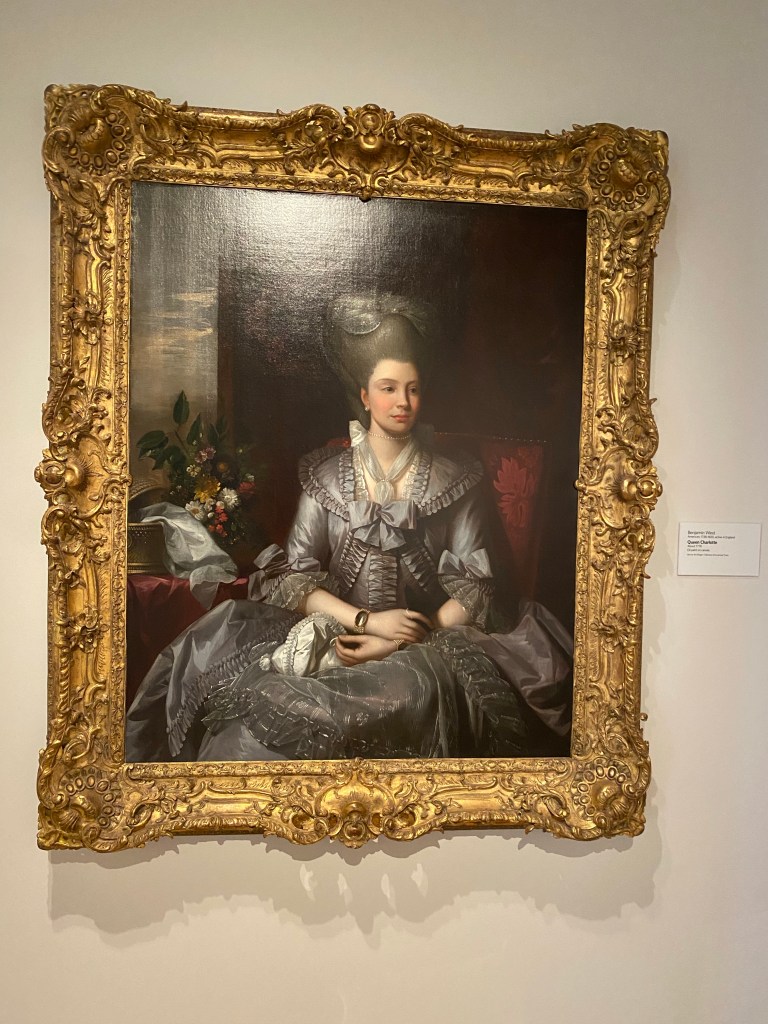

Benjamin West is a fascinating figure in American art history. He was born in 1738 in Pennsylvania, in a house that is now in the borough of Swarthmore on the campus of Swarthmore College. He was the tenth child of an innkeeper, John West, and his wife, Sarah Searson. The family later moved to Newtown Square, Pennsylvania, where his father was the proprietor of the Square Tavern, still standing in that town.
West told the novelist John Galt, with whom, late in his life, he collaborated on a memoir, The Life and Studies of Benjamin West, that, when he was a child, Native Americans showed him how to make paint by mixing some clay from the river bank with bear grease in a pot. West was an autodidact; while excelling at the arts, “he had little [formal] education and, even when president of the Royal Academy, could scarcely spell”. One day, his mother left him alone with his little sister Sally. Benjamin discovered some bottles of ink and began to paint Sally’s portrait. When his mother came home, she noticed the painting, picked it up and said, “Why, it’s Sally!”, and kissed him. Later, he noted, “My mother’s kiss made me a painter”.
From these simple origins, he went on to become a major figure in British art history, of which the painting on loan in Denver is a representative.
From 1746 to 1759, West worked in Pennsylvania, mostly painting portraits. While West was in Lancaster in 1756, his patron, a gunsmith named William Henry, encouraged him to paint a Death of Socrates based on an engraving in Charles Rollin’s Ancient History. His resulting composition, which significantly differs from the source, has been called “the most ambitious and interesting painting produced in colonial America”.

Dr William Smith, then the provost of the College of Philadelphia, saw the painting in Henry’s house and decided to become West’s patron, offering him education and, more importantly, connections with wealthy and politically connected Pennsylvanians. During this time West met John Wollaston, a famous painter who had immigrated from London. West learned Wollaston’s techniques for painting the shimmer of silk and satin, and also adopted some of “his mannerisms, the most prominent of which was to give all his subjects large almond-shaped eyes, which clients thought very chic”.
West was a close friend of Benjamin Franklin, whose portrait he painted. Franklin was the godfather of West’s second son, Benjamin.
Benjamin Franklin Drawing Electricity from the Sky, c. 1816, now housed in the Philadelphia Museum of Art
In 1760 West went abroad, first to Italy. Sponsored by Dr. Smith and William Allen, then reputed to be the wealthiest man in Philadelphia, West traveled to Italy in 1760 in the company of the Scot William Patoun, a painter who later became an art collector. In common with many artists, architects, and lovers of the fine arts at that time he conducted a Grand Tour. West expanded his repertoire by copying works of Italian painters such as Titian and Raphael direct from the originals. In Rome he met a number of international neo-classical artists including German-born Anton Rafael Mengs, Scottish Gavin Hamilton, and Austrian Angelica Kauffman.
In August 1763, West arrived in England, on what he initially intended as a visit on his way back to America. In fact, he never returned to America. He stayed for a month at Bath with William Allen, who was also in the country, and visited his half-brother Thomas West at Reading at the urging of his father. In London he was introduced to Richard Wilson and his student Joshua Reynolds. He moved into a house in Bedford Street, Covent Garden. The first picture he painted in England, Angelica and Medora, along with a portrait of General Robert Monckton, and his Cymon and Iphigenia, painted in Rome, were shown at the exhibition in Spring Gardens in 1764.
In 1765, he married Elizabeth Shewell, an American he met in Philadelphia.
Dr Markham, then Headmaster of Westminster School, introduced West to Samuel Johnson, Edmund Burke, Thomas Newton, Bishop of Bristol, James Johnson, Bishop of Worcester, and Robert Hay Drummond, Archbishop of York. All three prelates commissioned work from him. In 1766 West proposed a scheme to decorate St Paul’s Cathedral with paintings. It was rejected by the Bishop of London, but his idea of painting an altarpiece for St Stephen Walbrook was accepted. At around this time he also received acclaim for his classical subjects, such as Orestes and Pylades and The Continence of Scipio.
West was known in England as the “American Raphael.” His Raphaelesque painting of Archangel Michael Binding the Devil is in the collection of Trinity College, Cambridge.
Drummond tried to raise subscriptions to fund an annuity for West, so that he could give up portraiture and devote himself entirely to more ambitious compositions. Having failed in this, he tried—with greater success—to convince King George III to patronise West. West was soon on good terms with the king, and the two men conducted long discussions on the state of art in England, including the idea of the establishment of a Royal Academy. The academy came into being in 1768, with West one of the primary leaders of an opposition group formed out of the existing Society of Artists of Great Britain; Joshua Reynolds was its first president.
West painted around sixty pictures for George III between 1768 and 1801. From 1772 he was described in Royal Academy catalogues as “Historical Painter to the King” and from 1780 he received an annual stipend from the King of £100. In the 1780s he gave drawing lessons to the Princesses and in 1791 he succeeded Richard Dalton as Surveyor of the King’s Pictures.
Between 1776 and 1778 George III commissioned as set of five double or group portraits of his family to hang together in the King’s Closet at St James’s Palace. His Queen and twelve of his children are included in the arrangement (two appear twice); every portrait is filled with action, instruction and affection, making them seem almost like extended versions of the conversation pieces commissioned by George III’s parents. In this double portrait the Queen and the Princess Royal are engaged in tatting a piece of material or embroidery between them; on the table beside the Queen is a bust of Minerva, a sheet of music and papers; in the distance are St James’s Park and Westminster Abbey. As if all this were not improving enough there is a sheet of drawings by Raphael. West was paid 150 guineas for this painting which was exhibited at the Royal Academy in 1777.




























 get back, lauretta!
You must be logged in to post a comment.