Allied forces in Florence

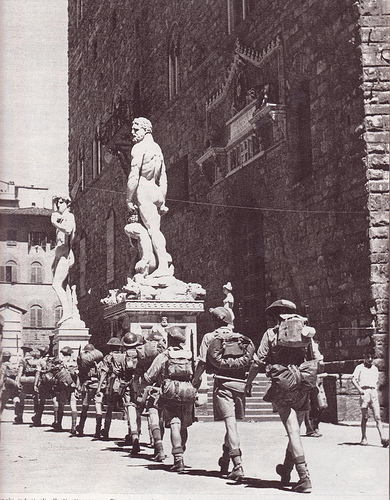
From the safe distance of 2018, it is interesting to think back to the situation in Florence during WWII, especially after the Allied Forces liberated the Renaissance citta’.

D378_44_137_0004_600

The leaders and troops of the Allied Forces are my heroes. There are many to name.  General Dwight D. Eisenhower is foremost among them.  I recently wrote a post on his directive, which saved many cultural monuments in Italian. Here is a picture of Ike in Italy:

Screen Shot 2018-04-29 at 12.30.35 PM


As the Allies liberated region after region in Italy, starting from the southern tip and working their way north, thanks to the farsighted leaders, as many cultural works as were possible were saved.

99686daed1bb4cc176004ca149b1c1d8


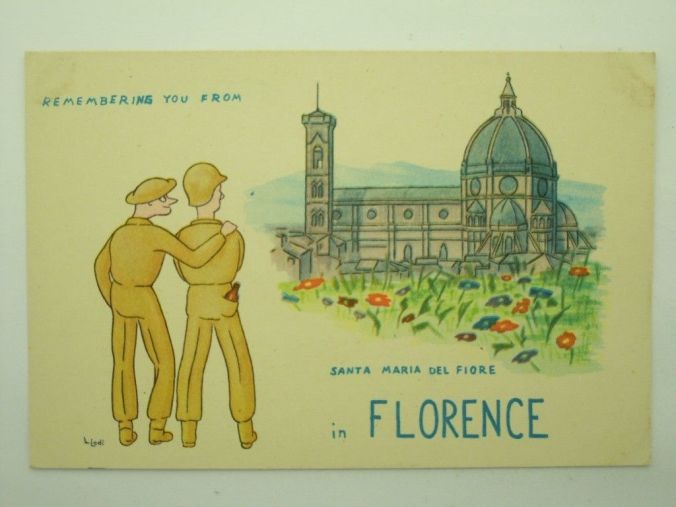
These wonderful postcards, with their simple illustrations of the Florentine architectural masterpieces, tell a poignant story.

s-l225

s-l1600


General Dwight D. Eisenhower as protector of cultural heritage

99686daed1bb4cc176004ca149b1c1d8

The cumulative weight and momentum of General Marshall’s mid-October admonition about the importance of protecting Italy’s cultural treasures, followed by successive warnings from McCloy and Woolley and the reports of Monuments officers themselves, finally produced a change.

On December 29, General Eisenhower Eisenhower issued a directive that placed the responsibility of protecting cultural property squarely upon the shoulders of every commander and, in turn, every officer and every soldier.

Screen Shot 2018-04-29 at 12.30.35 PM


It also, for the first time, introduced the Monuments officers (referenced as “A.M.G. officers”—Allied Military Government) to everyone in uniform.  Here is Eisdenhower’s directive:

To: All Commanders Today we are fighting in a country which has contributed a great deal to our cultural inheritance, a country rich in monuments which by their creation helped and now in their old age illustrate the growth of the civilization which is ours. We are bound to respect those monuments so far as war allows. If we have to choose between destroying a famous building and sacrificing our own men, then our men’s lives count infinitely more and the building must go. But the choice is not always so clear-cut as that. In many cases the monuments can be spared without any detriment to operational needs. Nothing can stand against the argument of military necessity. That is an accepted principle. But the phrase “military necessity” is sometimes used where it would be more truthful to speak of military convenience or even of personal convenience. I do not want it to cloak slackness or indifference. It is a responsibility of higher commanders to determine through A.M.G. Officers the locations of historical monuments whether they be immediately ahead of our front lines or in areas occupied by us. This information passed to lower echelons through normal channels places the responsibility of all Commanders of complying with the spirit of this letter.

signed: DWIGHT D. EISENHOWER

Ike’s directive was bold; it was concise; and it was now official policy. His Chief of Staff, Major General Walter Bedell Smith, issued an accompanying order that provided more specific details on how this new policy should be implemented.

Woolley remarked that Ike’s words “made it clear that the responsibility for the protection of monuments lay with the army as a whole and not with the [Monuments officer] specialist.”

Even Churchill weighed in on the matter: “The weakness of the Monuments and Fine Arts organization in the past was . . . due to the fact that it had . . . depended on an external civilian body not in touch with the Army. . . . The new arrangements which have been worked out in the light of experience are well calculated to promote, as far as military exigencies allow, a more effective effort to protect historical monuments of first importance in the future.”

Many problems lay ahead for implementing this new order. Mistakes would continue. The order would be put to the test in a major way within just six weeks.

But it marked the turning point for the Monuments officers and their work. For the first time since Mason Hammond had landed in Sicily, the Monuments Men had the backing of the Commander-in-Chief. Their work contributed greatly to the experience Eisenhower would take with him to England to plan the invasion of Western Europe as the newly appointed Supreme Commander of the Allied Expeditionary Force.


Edsel, Robert M.. Saving Italy: The Race to Rescue a Nation’s Treasures from the Nazis (p. 68). W. W. Norton & Company. Kindle Edition.

Wartime Florence

In 1565, by connecting the Uffizi and the Pitti and provided the Medici with an escape route in the event of political unrest. Its narrow hallways are decorated with more than a thousand paintings, mostly self-portraits, by many of the artists whose works adorn the walls of the city’s museums and churches. Farther north is the Palazzo Vecchio (the town hall), the Duomo, and the Accademia, home to the world’s most famous piece of marble, Michelangelo’s David.

In the summer of 1944, war placed this legendary city, and centuries of creative achievements, in danger of utter destruction.

ON NOVEMBER 10, 1943, Adolf Hitler remarked to Ambassador Rudolf Rahn, “Florence is too beautiful a city to destroy. Do what you can to protect it: you have my permission and assistance.” Hitler’s affection for the city initially gave Florentine Superintendent Giovanni Poggi and other city officials hope that Florence would be spared the fate of Naples. The fact that Rome and Siena had escaped major damage also encouraged them.

But, as Allied soldiers inched closer each day, a small group of dedicated souls—now seen as guardian angels of Florence—became increasingly concerned that the coming battle would overtake their city. They had few resources and dwindling options. These benefactors’ best hope was to push Germany and the Allies to jointly declare Florence an “open city,” first suggested by the Director of the Kunsthistorisches Institut, Friedrich Kriegbaum.

But for a city to be declared “open,” it had to be undefended; there could be no military targets; and both sides had to have freedom of entry. In Florence, German forces had positioned two artillery batteries in the della Gherardesca and dei Semplici Gardens. They had stationed soldiers at numerous mortar positions in the city.

Additionally, Florence, like Rome before it fell to the Allies, served as a major rail transport hub for the German Army. Even after the Allies’ air attacks on the Santa Maria Novella and Campo di Marte marshaling yards, men and materiel moved through the city.

Undaunted by these facts, German leaders referred to Florence as an “open city,” accusing the Allies of refusing to publicly affirm that designation. For their part, the Allies wouldn’t declare Florence an open city until the Germans removed their guns and soldiers.

The standoff held through the spring and early summer of 1944, while Allied forces were engaged in combat operations hundreds of miles to the south. Things grew much more urgent following the liberation of Rome in June and of Siena in July.

City officials believed that their portable art treasures, tucked away by Poggi in Tuscan villas, were safe. But protecting the city’s architectural treasures still depended upon securing an official, unequivocal declaration of Florence as an open city.

Members of the principal group working toward this designation were the German Consul, Gerhard Wolf; the Archbishop of Florence, Cardinal Elia Dalla Costa; the Extraordinary Envoy and Minister Plenipotentiary of San Marino to the Holy See, Marchese Filippo Serlupi Crescenzi; and the Swiss Consul in Florence, Carlo Alessandro Steinhäuslin. These four men did more to save Florence than anyone else.

After four years of service in the German Army, Gerhard Wolf attended Heidelberg University, where he met Rudolf Rahn, who would become a lifelong friend. In the years following graduation, both would enter Germany’s Foreign Service. Seeking to distance himself from the Nazi Party, Wolf accepted a position as the German Consul to Florence.

Cardinal Dalla Costa, a seventy-two-year-old prelate, was another of the city’s guardians. Soft-spoken yet forceful, he assumed an increasingly visible role in defense of the city. During Hitler’s 1938 visit, he ordered that the windows of his palace be shut in symbolic protest. He declined to participate in the official celebrations, explaining that he did not worship “any other cross, if not that of Christ.”

As the situation became more desperate, the cardinal agreed to issue notices that stated, “His Eminence Cardinal Elia Dalla Costa, Archbishop of Florence, declares that this building and the artworks inside, are under the protection of the Holy See.” While he pleaded with the German commanders to respect Florence as an open city, he did so knowing that, “in order to truly protect Florentine works of art, it would be necessary to place a huge pavilion made of impenetrable steel and unbreakable bronze, to cover the entire city.”

Edsel, Robert M.. Saving Italy: The Race to Rescue a Nation’s Treasures from the Nazis, W. W. Norton & Company. Kindle Edition.


Saving Florence’s art during WWII

ON JULY 4, the same day Keller arrived in Siena, Superintendent of Florentine Galleries Giovanni Poggi received a summons to report to the German Military Commander of Tuscany, Colonel Metzner. With barely a greeting, Metzner asked “if Villa Bossi-Pucci in Montagnana contained works of art of such importance to require their transportation across the Apennines” to northern Italy?

Poggi, fluent in both German and French, was surprised by Metzner’s sudden mention of Montagnana, site of the Villa Bossi-Pucci, which served as one of Tuscany’s thirty-eight art repositories. The constant shifting of the battlefield had prevented Poggi and his team from reaching many of the Tuscan repositories, but the Germans had no such impediment.

Metzner’s sudden curiosity about the Villa Bossi-Pucci—which housed close to three hundred masterpieces from the Uffizi Gallery and the Palatine Gallery at the Pitti Palace, including Botticelli’s Minerva and the Centaur, Giovanni Bellini’s Pietà, and Caravaggio’s Sleeping Amor—was cause for great concern. By July 1944, few men in the world had more hands-on experience protecting works of art than Poggi, a native Florentine described by Hartt as “a character who walked out from one of Ghirlandaio’s frescoes.”

Poggi oversaw a domain that included the provinces of Florence, Arezzo, and Pistoia. At age sixty-four, he had lived long enough to witness war engulf his homeland twice. Fate selected Poggi to be a defender of the arts. An illustrious connoisseur and curator, he had been appointed Director of the esteemed Uffizi Gallery in 1912, at the age of thirty-two.

The following year, he helped recover the world’s most famous painting, Leonardo da Vinci’s Mona Lisa, stolen from the Louvre in 1911. The painting had been missing for more than two years before surfacing in a Florence hotel. After a brief showing at the Uffizi, and a tour through Italy, Poggi accompanied the painting back to Paris in December 1913.

Just six months later, the outbreak of the Great War consumed Europe. The burning of the library in Louvain galvanized art officials across the continent. Few if any nations had more at risk than Italy, no single city more than Florence. Poggi’s quick work protecting the Uffizi’s treasures drew the attention of officials in Rome. Soon they enlisted his aid in safeguarding prominent masterpieces in other Italian cities.

Now, for the second time in twenty-six years, Poggi found himself responsible for protecting the treasures of Tuscany from a world at war. Poggi calmly answered Metzner’s question, telling him that there were indeed highly important works from the galleries and museums of the State in Montagnana.

But, “due to agreements taken with the General Direction of the Arts and with the Office directed by Colonel Langsdorff, it had been decided, as with the other repositories, not to remove anything unless there were some urgent peril, and in that case paintings would have been moved to Florence and not across the Apennines.” Unfazed, Metzner pressed Poggi further, asking in an ominous tone, “So you are rejecting our offer?” Ten months of dealing with German officers had taught Poggi to appeal to their authority—and ego. He explained: “We are not rejecting it, on the contrary, we are grateful. We accept it in the event that it becomes necessary to move these things to Florence.” The meeting concluded soon thereafter; Poggi assumed his replies had settled the matter.

THE OUTBREAK OF war in 1940 had caused Italian superintendents to transfer collections to areas outside the city centers. Acting with “frenzied lucidity,” Poggi and his team had moved almost six hundred major works to privately owned villas and palaces in the Tuscan countryside in less than two weeks. That number had increased more than eighteenfold—to 11,139 various art objects—within six weeks. Those that couldn’t be moved, usually due to their size and weight, had to be protected in situ, often by employing the most ingenious of methods.

Local artisans built a brick tomb around Michelangelo’s towering sculpture of David, and smaller ones for each of his adjacent works, referred to as the Slaves. Poggi hoped that these brick silos would provide protection against bomb fragments or even the collapse of the roof in the event of a direct hit on the building. With the dramatic increase in Allied bombing of Italian cities in the fall of 1942, Poggi and other superintendents received orders to make additional evacuations from the cities.

This required him to secure more villas for storage. The groupings of art were historic. Villa di Torre a Cona contained not only Michelangelo’s statues from the Medici tombs in the Church of San Lorenzo but all of the contents of the master’s family home, Casa Buonarroti. This collection contained two of his earliest works and many of his letters and drawings. Never before had so many of Michelangelo’s works

been gathered in one place. Sitting alongside were masterpieces by Verrocchio, Donatello, Della Robbia, Lorenzo Monaco, and the most important surviving work by the Flemish painter Hugo van der Goes, the Portinari Altarpiece. The quality and rarity of the art was simply staggering. The Castle of Montegufoni housed 246 masterpieces from the Uffizi and the Pitti by great masters such as Cimabue, Giotto, Botticelli, Raphael, Andrea del Sarto, Pontormo, and Rubens.

The repository at Poppiano sheltered Pontormo’s emotive masterpiece, Deposition from the Cross, from the Capponi Chapel in the Church of Santa Felicita, and Rosso Fiorentino’s crowning achievement, Descent from the Cross, from the town of Volterra. The Palazzo Pretorio at Poppi held Hans Memling’s Portrait of a Young Man and Michelangelo’s Mask of a Faun; the Oratory of Sant’Onofrio at Dicomano contained Roman sculptures and sarcophagi; the villa at Poggio a Caiano housed Donatello’s Saint George and Michelangelo’s Bacchus. The quality and importance of each villa’s contents surpassed the last, each filled with the accomplishments of civilization’s most creative minds. The fall of the Badoglio-led government and the occupation of Italy by German forces in September 1943 prompted most Italian art officials, including Lavagnino and Rotondi, to relocate their collections to the Vatican. But Poggi made the decision to keep the Tuscan artworks within his reach at their existing countryside repositories.

These villas, he believed, afforded more protection from aerial attack than any fortress in an urban setting. By the time he realized that the Tuscan repositories lay in the path of the coming ground battle, it was too late to return all of the works of art to Florence. And that gave rise to another concern, one he could do nothing about: perhaps overconfident at the time, Poggi had allowed many of the masterpieces to be transported from Florence uncrated. Poggi certainly knew that the safest place for a painting was hanging on the wall of a museum.

Once it began a journey, the risks of damage increased dramatically. Moving uncrated paintings in trucks exposed them to dust. Canvases were vulnerable to tears, punctures, and scratches. Vibration alone could cause the wood of a panel painting to split. Poggi also knew well that paintings on panel are reactive to sudden changes in humidity. Low humidity during winter weather diminishes the moisture in the wood, increasing the risk it might crack. Sculpture, whether marble (more durable) or terra-cotta (more fragile), was always at risk of being chipped, much less ruined if dropped. Subsequent moves would compound these risks even further,

SS Colonel Alexander Langsdorff, head of the Kunstschutz, to discuss how best to protect the Florence repositories from the looming battle. Anti insisted that the treasures be evacuated again and moved north, but his argument ignored the shortage of transportation and the speed with which enemy troops were approaching Tuscany. After a heated discussion, Poggi prevailed. The art would remain in the existing repositories. “It is too late,” Anti noted ominously in his diary.

In early July, Social Republic officials once again pressed for the works of art to be transported northward. Certain that he knew what was best for “his” works of art, Poggi shrewdly parried the request with the Medici Family Pact of 1737, which required that their collection (the core of the Uffizi and Pitti collections) “never be removed or taken outside its capital and the Grand Duchy.” At this stage of the war, Poggi had no real power to keep Fascist officials or the Germans from removing works of art. Clever excuses and tricks were his only tools.

Several days later, Poggi received a shocking telephone call from the German Consul, Dr. Gerhard Wolf, informing him that Wehrmacht troops had loaded 291 paintings from the Villa Bossi-Pucci repository at Montagnana onto trucks and taken them to the small town of Marano sul Panaro near Modena, some ninety miles north of Florence. This was the same villa Colonel Metzner had questioned Poggi about just days earlier. “At one blow at least an

eighth of the most prized contents of the Uffizi and Pitti had vanished.” Further queries by Consul Wolf later revealed the treachery: the paintings had been taken—and were already en route north—before Metzner’s portentous meeting with Poggi on July 4. Gerhard Wolf requested that Langsdorff report to Florence to resolve the matter. Without transportation, Poggi could do nothing. On Sunday evening, July 16, Poggi received a call from Consul Wolf’s assistant, advising him that a different German unit had removed works of art from a second, as-yet-unidentified repository. Poggi should expect to take custody of them at German Military Headquarters, in Florence’s Piazza San Marco, the next day at 8 a.m.

With no sign of Langsdorff, and no further word about the disposition of the artworks from Villa Bossi-Pucci, this latest news horrified and infuriated Poggi. The following morning, Poggi and other officials watched three German trucks pull into Piazza San Marco, right on time. The officer in charge of the operation, Colonel Hoffmann, informed them “that since the castle of Oliveto was under the fire of the Allied artillery, the military command of the area had decided on the immediate transport to Florence of the works of art.” The unloading of paintings commenced, notably those from the Horne Foundation museum and altarpieces from the city’s churches—eighty-four paintings, twenty-three crates, and five frames. For reasons Hoffmann didn’t explain, more than one hundred paintings had been left behind. While Poggi tried to make sense of it all, the custodian of the repository at the Castello Guicciardini in Oliveto, Augusto Conti, who had accompanied the trucks into Florence, discreetly informed him that Hoffmann’s explanation was a lie. The area around the castello had been quiet, void of any combat activity. Conti then shared even more distressing news.

Two panel paintings by German Renaissance painter Lucas Cranach the Elder—Adam and Eve—had been loaded into an ambulance. He had no idea what had happened to them after that. Poggi knew both paintings well—and he knew that Hitler did too. During the Führer’s 1938 tour of the Uffizi, Poggi remembered watching how much Hitler had admired the German painter’s works. The disappearance of such masterpieces, which had entered the collection of the Medici in the late eighteenth century, caused great alarm among Florentine officials. Langsdorff finally arrived in Florence on July 17.

Poggi assumed he could rely on the senior representative of the Kunstschutz, just as he had in May, when Langsdorff had provided cranes, trucks, and personnel to return Ghiberti’s Baptistery doors to the Pitti Palace. Poggi began by informing Langsdorff of the removals from the Castello Guicciardini in Oliveto that Colonel Hoffmann had delivered just hours earlier. That a portion of the contents from the Oliveto repository never made it to Florence, in particular the two Cranach paintings of Adam and Eve, worried him.

These removals violated the agreement made among Poggi, Carlo Anti, and Langsdorff at their June 18 meeting: in the event of any emergency evacuations of repositories, works of art were to be brought to Florence. Under no circumstances could this occur again. Langsdorff assured Poggi that not only would he investigate what had happened to the missing items, he would accept full responsibility for locating and returning the Cranach paintings to Florence. As part of his investigation, Langsdorff asked Poggi to prepare a memorandum summarizing what he knew about the removal of art from the Villa Bossi-Pucci. When the report was completed, he wanted it delivered to the Hotel Excelsior, where he had a room overlooking the Ponte Santa Trinita and the Ponte Vecchio.

This response hardly satisfied Poggi, but, under the circumstances, he could do little else. News of continued Allied advances forced Langsdorff to reassess orders he had received from Army High Command (OKH) three days earlier, stating, “The rescue of art objects by the troops has to generally be stopped.” The order also included a directive stating that any art objects that had already been removed should be turned over to the “bishops of Bologna or Modena.” German troops had in fact attempted a delivery of the Montagnana items, but the bishops had turned them away, stating they didn’t have sufficient space to store the items nor did they have authority to accept such responsibility. Cranach paintings, and he repeated his promise to find and return them to Florence. What Langsdorff didn’t tell Poggi was that the Cranachs were already safe. In fact, they were in his possession, “handed over by the troops . . . asking me to take them north, so that they would not fall into the hands of the British or the Americans.” In the course of his debriefing of Infantry Regiment 71’s Oberleutnant Feldhusen in Oliveto, Langsdorff learned that the Cranachs had been “separated from the rest because they were ‘Germanic art’ and could not be exposed to the danger of being returned to Florence.” Never mind the fact that Infantry Regiment 71 had traveled those same unsafe, bomb-cratered roads into Florence two nights earlier. He then wrote out a receipt for “two undamaged pictures, Adam and Eve, by Lukas Cranach which are to be taken to Germany by the undersigned, MV Abt. Chef Langsdorff,” and handed it to the Oberleutnant. Using the safe passage afforded by an ambulance, Langsdorff and his “passengers”—Adam and Eve—set out for Florence, just as he had assured Poggi he would do. Wednesday evening, July 19, Poggi stopped by the Hotel Excelsior to visit with Langsdorff and deliver the memorandum he’d been asked to prepare concerning the Montagnana removals. Much to Poggi’s surprise, Langsdorff had already checked out and departed Florence. Had Poggi thought to ask the concierge, he might have learned that Langsdorff left the hotel with two life-size parcels that, oddly enough, had arrived two nights before in an ambulance. In just two weeks, Poggi had been duped by the German Military Commander of Florence, Colonel Metzner, and lied to by the officer who delivered the works of art from Oliveto, Colonel Hoffmann. But those two betrayals paled in comparison to the disappointment he felt toward Langsdorff. Unlike the other two officers, Langsdorff was the senior German Kunstschutz official in Italy. He had an obligation to protect art, not to steal it.

Edsel, Robert M.. Saving Italy: The Race to Rescue a Nation’s Treasures from the Nazis (pp. 148-149). W. W. Norton & Company. Kindle Edition.


When you think of Dante, do you think of Longfellow too?

Henry Wadsworth Longfellow (1807 – 1882) was an American poet and educator whose works include “Paul Revere’s Ride“, The Song of Hiawatha, and Evangeline. He was also the first American to translate Dante Alighieri‘s Divine Comedy.
Longfellow spent several years translating Dante Alighieri’s Divine Comedy. To aid him in perfecting the translation and reviewing proofs, he invited friends to weekly meetings every Wednesday starting in 1864. The “Dante Club”, as it was called, regularly included William Dean Howells, James Russell Lowell, Charles Eliot Norton and other occasional guests. The full 3-volume translation was published in the spring of 1867, though Longfellow would continue to revise it, and went through four printings in its first year.

He was also important as a translator; his translation of Dante became a required possession for those who wanted to be a part of high culture. He also encouraged and supported other translators.

Is Longfellow’s translation of Dante the best?


Henry Wadsworth Longfellow’s translation finds a new champion in Joseph Luzzi, in “How to Read Dante in the 21st Century” in the online edition of The American Scholar:

dante

… one of the few truly successful English translations comes from Henry Wadsworth Longfellow, a professor of Italian at Harvard and an acclaimed poet. He produced one of the first complete, and in many respects still the best, English translations of The Divine Comedy in 1867. It did not hurt that Longfellow had also experienced the kind of traumatic loss—the death of his young wife after her dress caught fire—that brought him closer to the melancholy spirit of Dante’s writing, shaped by the lacerating exile from his beloved Florence in 1302. Longfellow succeeded in capturing the original brilliance of Dante’s lines with a close, sometimes awkwardly literal translation that allows the Tuscan to shine through the English, as though this “foreign” veneer were merely a protective layer added over the still-visible source. The critic Walter Benjamin wrote that a great translation calls our attention to a work’s original language even when we don’t speak that foreign tongue. Such extreme faithfulness can make the language of the translation feel unnatural—as though the source were shaping the translation into its own alien image.

Henry_Wadsworth_Longfellow

Longfellow’s English indeed comes across as Italianate: in surrendering to the letter and spirit of Dante’s Tuscan, he loses the quirks and perks of his mother tongue. For example, he translates Dante’s beautifully compact Paradiso 2.7

L’acqua ch’io prendo già mai non si corse;

with an equally concise and evocative

The sea I sail has never yet been passed:

Emulating Dante’s talent for internal rhymes laced with hypnotic sonic patterns, Longfellow expertly repeats the s’s to give his line a sinuous, propulsive feel, which is exactly what Dante aims for in his line, as he gestures toward the originality and joy of embarking on the final leg of a divinely sanctioned journey. Thus, Longfellow demonstrates the scholarly chops necessary to convey Dante’s encyclopedic learning, and the poetic talent needed to reproduce the sound and spirit—the respiro, breath—of the original Tuscan.

Read the whole essay here – it’s fairly short and very interesting.

https://bookhaven.stanford.edu/2016/03/is-longfellows-translation-of-dante-the-best-one-writer-makes-the-case/

Italy is a place where retirement is welcome

But it is rare for [Italians] to view work as anything but a necessary evil. A survey commissioned by the weekly newsmagazine Panorama in 2006 found that two-thirds of Italians would give up their work if they could be guaranteed the relatively modest sum of € 5,000 a month.

In the same way, retirement is usually seen as entirely positive. There seems to be none of the fretting that goes on in Anglo-Saxon societies about how to cope with a loss of identity.

I have known plenty of Italians who have gone into retirement, and sometimes I have bumped into them in the street or when they have made a return visit to the offices where they worked. Not once have I heard any of them express anything but unmitigated delight at no longer having a job.

Silvio Berlusconi was still prime minister at the age of seventy-five. Mario Monti, who replaced Berlusconi in 2011, took over as head of government when he was sixty-eight. His cabinet, which was brought in as a new broom that would sweep clean and introduce wide-ranging reforms, had the highest average age of any in the European Union at the time.

And after the election that followed the fall of Monti’s government, the new parliament reelected a president, Giorgio Napolitano, who was eighty-seven. For truly untrammeled “gray power,” however, nothing compares with the universities. A study published as Monti and his ministers were settling in behind their highly polished desks found that the average age of Italy’s professors was sixty-three and that many were still clinging to their positions and the vast patronage they were afforded when they were well over seventy. Their average age was the highest anywhere.

It means that young Italians are not just imbibing the theories and attitudes of the previous generation, which is natural, but of the one before that, and in extreme cases even the one before that. The appointment of two younger prime ministers, Enrico Letta in 2013 and Matteo Renzi in 2014, has led to a rejuvenation at the highest levels of government. Renzi became Italy’s youngest ever prime minister at the age of just thirty-nine. And he set about naming a cabinet that included a party colleague who was only thirty-three at the time of her appointment.

But it remained to be seen whether the process would extend to other areas of Italian life, and particularly higher education. The role played by the elderly in the formation of Italy’s future elite continued to represent a formidable obstacle to innovation, modernization and the rethinking of established ideas. This may have some link to the enthusiasm with which so many young Italians embrace the culture of their parents. Perhaps the most striking example of this is to be found in the area of rock music: currently the ages of three of the most popular singers are fifty-two, fifty-six and sixty. Aging rock stars have kept going.


Hooper, John. The Italians, Penguin Publishing Group. Kindle Edition.


The Marshall Plan

main-qimg-deb590d4e0568e0d4c4f2d7dc7b4aff7-c

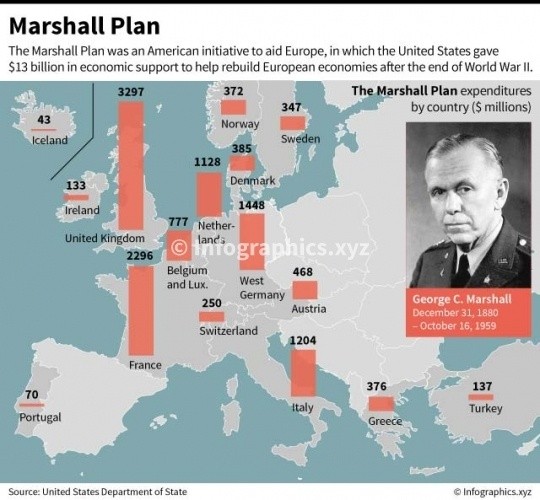
FROM JUNE 1947 to its termination at the end of 1951, the Marshall Plan provided approximately $13 billion to finance the recovery and rehabilitation of war-torn and postwar weary Western Europe.

In today’s dollars that sum equals roughly $100 billion, and as a comparable share of U.S. Gross National Product it would be in excess of $500 billion.

It was a mammoth sum, more than the United States spent to govern itself in the first fifteen years of the twentieth century.

More than the provision of dollars and aid, the Marshall Plan was the cornerstone of American foreign policy for much of those formative and consequential postwar years.

It was a monumental undertaking and—echoing Walt Whitman’s famous lines—it contained multitudes and contradictions.

For, after the war, Europe increasingly found itself looking across the Atlantic to the United States. The United States was the only power whose economy had flourished during the war. Europe needed the goods and natural resources abundant in the United States to fuel its recovery.

But, at the same time, Europe was not able to offer the United States goods or resources in return, nor could it draw on stores of investments or invisible earnings (like shipping or insurance).

Europe had a balance-of-payments problem with the United States: in 1946 Europe’s overseas trade debt was $5 billion and growing. It was known as the “Dollar Gap.” It was the key problem looming behind Europe’s incipient recovery and it was becoming dire.

From 1941 to 1945, American industry had mobilized its prodigious production capacity for the war effort.

By the end of the war, thirteen rationing programs were in effect, covering scarce commodities ranging from gasoline and shoes to sugar and red meat. Consumer goods such as refrigerators and automobiles were largely unavailable. Women were asked to leave the home and enter the workforce. By one count more than a quarter of American wives worked for pay during the war.

Americans were asked to save as never before. In 1940, personal savings amounted to around $4 billion. By 1945, it was $137.5 billion. All of this sacrifice was summoned after a decade-long economic depression.


from Behrman, Greg. The Most Noble Adventure: The Marshall Plan and the Time When America Helped Save Europe. Free Press. Kindle Edition.