American/Italian connection
Women’s March, Florence
Small but strong. The Women’s March took place all over the world this weekend. We had a small but vocal cohort in Florence and I felt proud to be a part of it.

We met in the Piazza in front of San Lorenzo. I thought about this important church and its history within the story of Florence, and felt honored to be there and to be living now, and to be a part of this beautiful city’s fabric.

My new friend, Jen, kindly knitted me a pink hat for the occasion!

Please, let there only be one Trump term.
A good pencil is hard to find
I am betting this is a topic you have never thought about. Why would you?
But, I have become an expert on the topic, and I have news for you: you cannot find a decent pencil in Italy.
Now I am guessing that if you go to an art supply store, or an engineering store (are there such things?), you could buy a fancy pencil that would put my favorite ones from the US of A to shame.
But, I am talking about being a student here, in a language school for foreigners, and trying to take notes. Not an artist or a engineer.
I typically write with ink, because it flows so much better than pencils and I like a fine point. But, I had to take such fast notes and so many notes in language school, and so often made so many mistakes as I wrote Italian, that my ink written notes look like a scratch pad. More lines through words than just plain words. A mess.
So, I looked high and low for erasable ink pens. I found a bunch. They were all worthless. The points were too thick, the erasers were not good. I ended up tearing the paper. So, I went back to pencils. My notes had looked (and functioned) worse in the erasable ink than in plain ink crossed out. At least then my paper didn’t have rips in it.
Another issue is that when you think you have located a decent wooden #2 pencil here, it will not have an eraser on the end. Or, it will have an eraser that is made out of something like marshmallow fluff. It looks like an eraser, so you buy the pencil(s, since you might stock up when you think you’ve finally spotted a winner).
So, you take out your new pencil, which you must also carry a sharpener for as well. Because you will break the lead, many times. The lead isn’t that great. And, if you are like me and want a sharp point, well…you will need that sharpener. And you will need to empty it pretty often. And, in all likelihood, your lead will break many times while you are manually sharpening it, and before long your new pencil will be a stub, and worse, still not that useful.
And, by that point, you will have missed the entire discussion (in Italian) of the subjunctive tense. And so, now, how will you ever be able to talk about wishes, or hopes, or things like that?
You won’t.
Anyway, you finally get your pencil stub sharpened and you start writing furiously, maybe even trying to look at your neighbor’s notes (which will be in Korean or Japanese or German), while trying to find your sea legs in the subjunctive. And damn, before you know it, you have made another mistake but you feel a bit smug, since you have a new pencil, albeit a stub, with an eraser!!
You flip that sucker over and start to erase and the entire eraser breaks off at the line where the pencil meets the eraser.
So, the next day, in desperation, when you are walking to your yoga class in the Piazza della Republicca, you pass a tourist souvenir kiosk and you notice that they sell pretty Florentine paper wrapped pencils and they have erasers. Never in your lifetime did you think you could be so excited about the prospect of a new pencil.
You don’t have time to buy the pencil because you are already late for yoga, but visions of that pencil dances in your head in every down dog you do. You cannot wait to be done with yoga and back in the loggia by the Post Office to buy that pencil. You are obsessed. Plus, it’s pretty to boot and, hello, if you read my blog, you know beauty is at the top of my list, all my lists!
You buy the pencil and take it home and admire it and hope it will be the one. You sharpen it when you get home and try it out. You discover that the pretty Florentine paper is the only thing that makes this pencil different from the ones you’ve already tried.
So, when you go back to the USA to renew your Visa at the Italian Consulate in Chicago, you take a shopping list with you. And no one can believe it, but at the top of your list are #2 Pencils, with erasers at the end. And you feel very safe and secure, ready to go back and try the subjunctive again.
Thanks Boeing! You made my adult life of travel possible!
The United States of America in Florence
A long stroll down the north bank of the Lungarno today took me by the American Consulate.


After passing further west, past the consulate, I turned back and shot the consulate in its Florentine cityscape. You can see the American flag just over the head of the middle bike rider.


WWII footage, the liberation of Florence
Remember.
On this date in 1944 the retreating Nazi troops were leaving Florence in advance of the Allies arrival up the Italian peninsula. The retreating Germans did everything they could to wreak havoc for the Allies, destroying communication channels and destroying every bridge over the Arno, with the exception of the Ponte Vecchio.
In this picture below you see the destroyed Ponte Santa Trinita, with the Ponte Vecchio blessedly still in situ.

Here’s a heartbreaking overview of the Lungarno in the Oltrarno, next to Ponte Vecchio.

Naturally many Florentines were displaced from their homes and some were allowed to take shelter inside the Palazzo Pitti and the Boboli Gardens, where temporary beds were set up, as below.


To remember those dark days, La Compagnia delle Seggiole will perform portions of Benjamin Britten’s “War Requiem,” tonight in the Piazza outside the Pitti. The Requiem was written to celebrate the reconstruction of the Gothic cathedral of Coventry. Entrance is free.
New York laundry in Florence
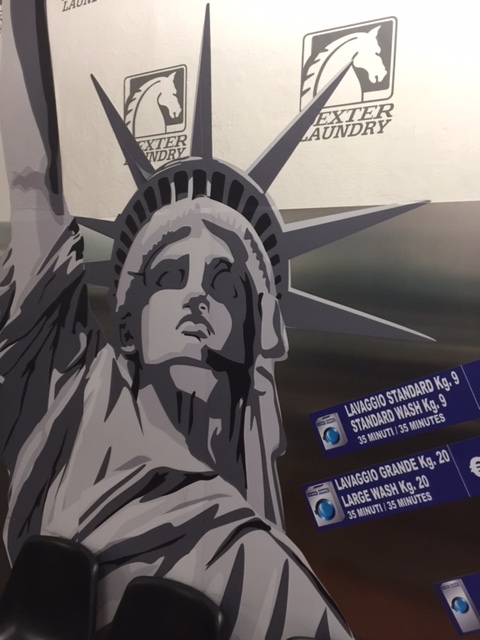
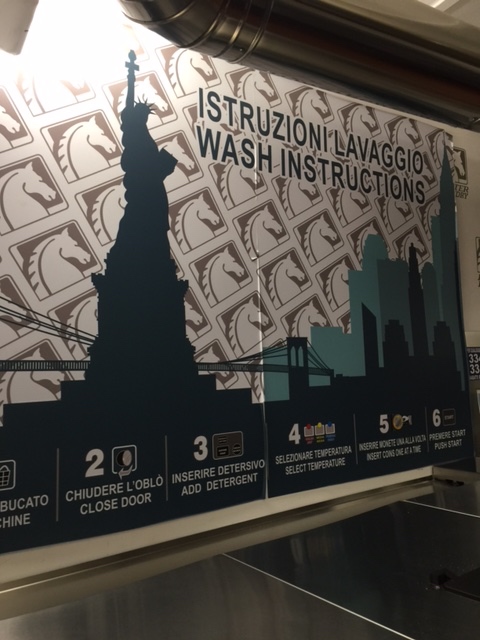
In my evening sojourn last night (at sunset, to beat the heat, when it is only 100 degrees F), I wandered by this modern, clean laundromat in Florence. It’s funny to me that they use Statue of Liberty imagery to promote their laundry. Is NYC known for its cleanliness? I think not!

Biblioteca Nazionale Centrale di Firenze, or the BNFC
See this rather formidable looking building? It is one of most important libraries in Europe. Once housed inside the Uffizi, since 1935 has been located in this building designed around 1911 by Cesare Bazzani and later enlarged by V. Mazzei. It is located along the Arno River in the quarter of Santa Croce.

Sometime very soon, (more or less) armed with my newly (more or less) acquired Italian language skills , I’ll be entering this august archive to start my research on Florence after WWII.
Wish me a lot of luck: this place has a reputation for being formidable and working hard to keep people out.

I’m not afraid to admit that I’m a bit intimidated!


You may take a virtual tour of the library’s exterior here: http://arno66-archive.netseven.it/vt/index.htm


Ah, what mysteries are held inside!
Here’s some formal data on the library, from Wikipedia:
The library was founded in 1714 when scholar Antonio Magliabechi bequeathed his entire collection of approximately 30,000 volumes to the city of Florence. By 1743, it was required that a copy of every work published in Tuscany be submitted to the library.
Originally known as the Magliabechiana, the library was opened to the public in 1747. Its holdings were combined with those of the Biblioteca Palatina (Firenze) in 1861, and by 1885, the library had been renamed as the National Central Library of Florence, or the BNCF. Since 1870, the library has collected copies of all Italian publications.
The National Library System (SBN), located in the BNCF, is responsible for the automation of library services and the indexing of national holdings.
Unfortunately, a major flood of the Arno River in 1966 damaged nearly one-third of the library’s holdings, most notably its periodicals and Palatine and Magliabechi collections. The Restoration Center was subsequently established and may be credited with saving many of these priceless artifacts. However, much work remains to be done and some items were forever lost.
Obama in Milan
Not a new picture, but a great one:

 get back, lauretta!
You must be logged in to post a comment.