A medieval alley, alive & well, in Florence

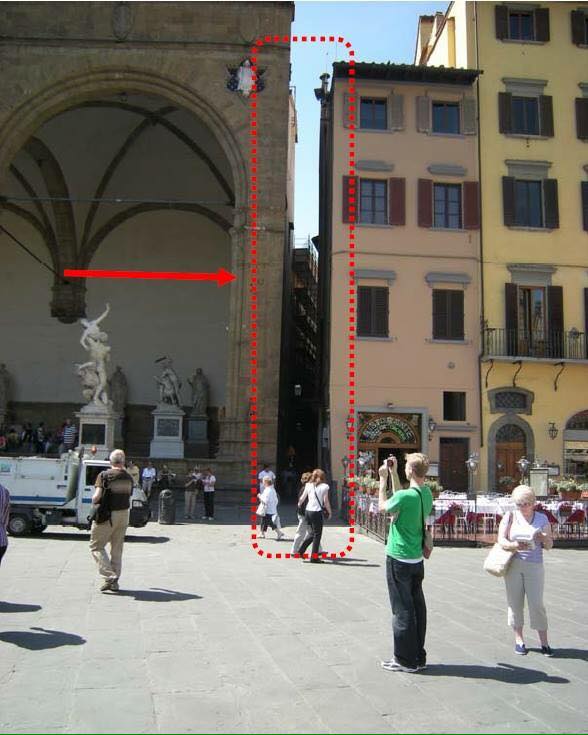
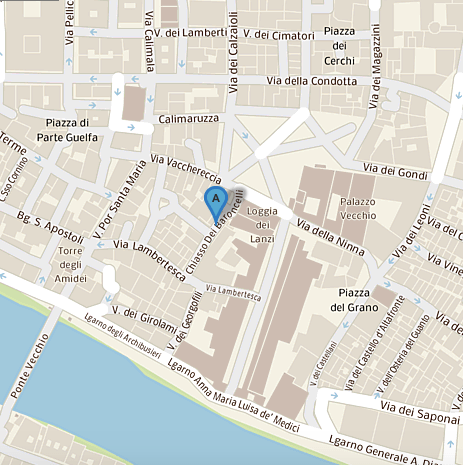
There’s an alley dating back to the medieval period leading out of (or into?) the Piazza della Signoria. Called the Chiasso di Baroncelli, this alley has seen some history.  If alleys could talk!

38870738_285520925589402_4007460849470930944_n

Let’s just think a minute the events this alley has withstood: 16th and 19th century city demolition and rebuilding, German mining during WWII, the infamous 1966 flood and so much more.

Bounded on the southern end, where it meets via Lambertesca, buildings shield the alley from sunlight.

Screen Shot 2018-08-10 at 11.15.42 AM

Next time you are walking around the piazza, stop and take a look.


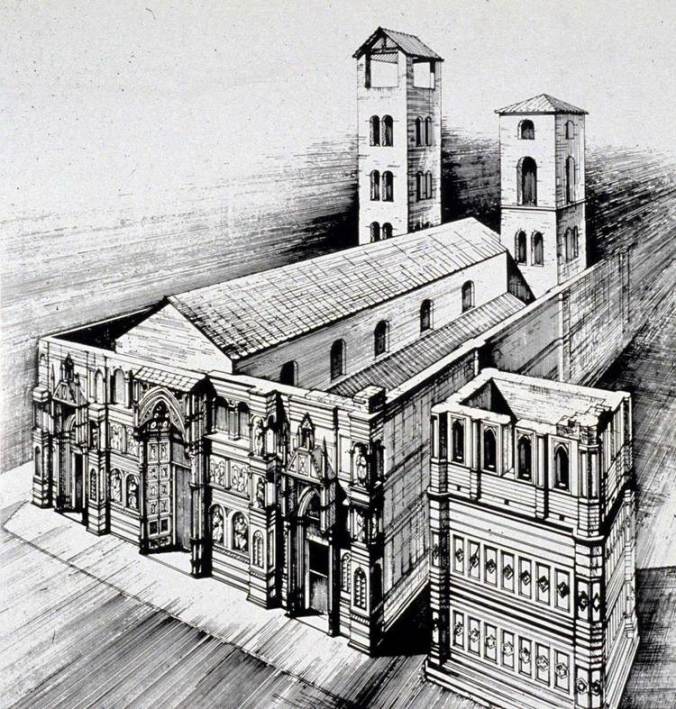
Church of San Salvador, Florence’s 1st Christian Cathedral, and Santa Reparata

In the 1st C. AD, Christian converts began to invade Florentia. The Christians were persecuted—thrown to lions in the amphitheater—on and off throughout the third century A.D. But by 313 a bishop was living safely in Florence; it’s likely that the first Christian cathedral was built around this time too.

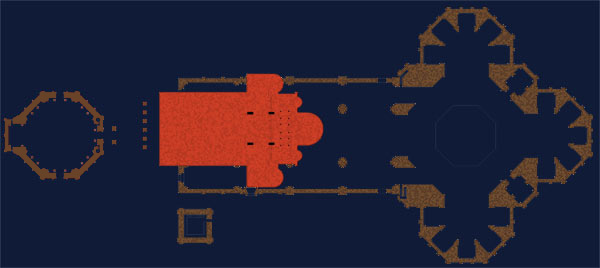
The Church of San Salvador was the name of the edifice, and its location was quite near if not directly under what is now the Cathedral of Santa Maria del Fiore in the Piazza del Duomo.

Immagine2

Sandwiched between the first cathedral and the last was Santa Reparata, a church named for a twelve-year-old female martyr. The young saint was said to have appeared in the middle of a 5th-century battle between a host of Vandals and Goths and the citizens of Fiesole.

Santa Reparata suddenly arrived on the spot with a bloodred banner and a lily in her hand. Miraculously, following close behind her was the Roman general Stilicho with a fresh legion of troops. The barbarians fought a losing battle, and the Florentines built a new cathedral in remembrance of the girl’s military assistance.

sezionereparata

You can read more about the church of Santa Reparata, which would rebuilt as il Duomo later on here: https://operaduomo.firenze.it/blog/posts/la-nuova-musealizzazione-di-santa-reparata

Holler, Anne. Florencewalks: Four Intimate Walking Tours of Florence’s Most Historic and Enchanting Neighborhoods (Kindle Locations 57-65). Henry Holt and Co.. Kindle Edition.

Piazza Beccaria, Firenze, and the former Alhambra Theater

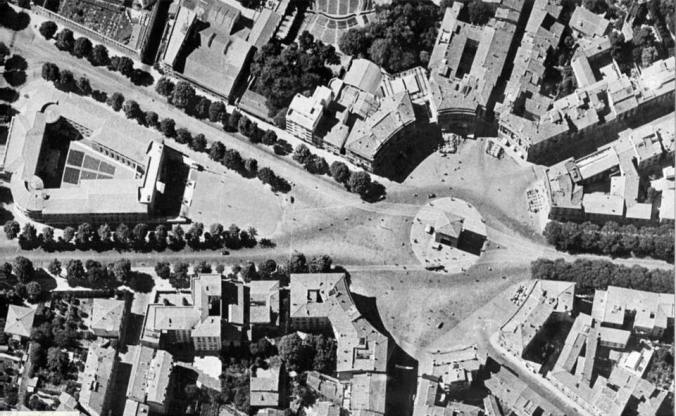
Here’s an aerial photo of Florence’s Piazza Beccaria, taken sometime between 1945 and 1980.

The photo can be dated because on the left we see the home of the G.I.L. (Gioventù Italiana Littorioand, on the other side of the avenue, the Alhambra theater.  Both structures were demolished in order to build the Archivio di Stati, constructed in 1980.


37230978_256805448460950_4536284465932009472_n

The Gioventù Italiana del Littorio (Italian Youth of the Lictor) was the consolidated youth movement of the National Fascist Party of Italy, established in 1937 to supervise and influence the minds of the young. The GIL was in particular established to counteract the influence of the Catholic church. You can read more about the organization and the building in Florence here:

https://it.wikipedia.org/wiki/Casa_della_Gioventù_Italiana_del_Littorio.


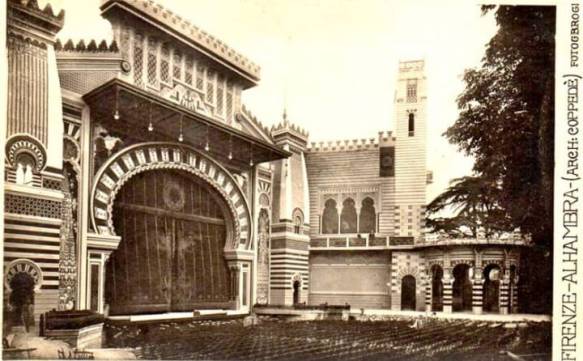
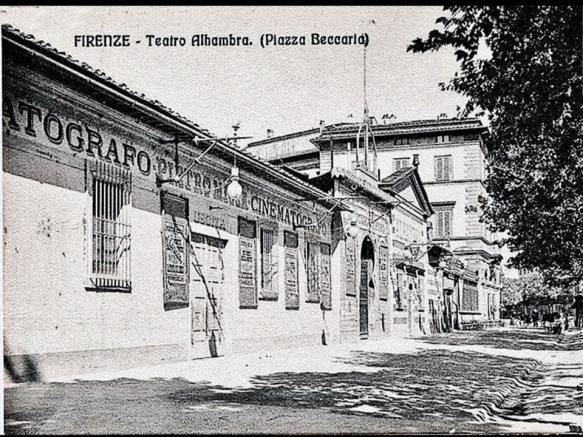
The Teatro Alhambra was built in 1889 and demolished in 1961. Here are a couple of vintage photos of the theater:


38218446_1746941632092157_7069145049681887232_n

Il famoso teatro, al suo posto ora c’è il palazzo del giornale La Nazione.


38303994_277675016373993_4432572005144854528_n

And here’s a program from the Alhambra:

38277405_278061729668655_8897744607362678784_n

ALHAMBRA. Programma. Lunedì 2 giugno 1890.

More on Alhambra theater here: http://www.chnt.at/wp-content/uploads/eBook_CHNT19_Bardi.pdf

Villa Medici a Fiesole, the garden edition

A few days ago I posted on the marvel that is the Villa Medici a Fiesole.  There I covered the construction and importance of the Villa as a precursor for Renaissance villa design. That post kept growing and growing, so I decided to make a 2nd post on just the gardens.

So, let’s talk (garden) turkey:

images

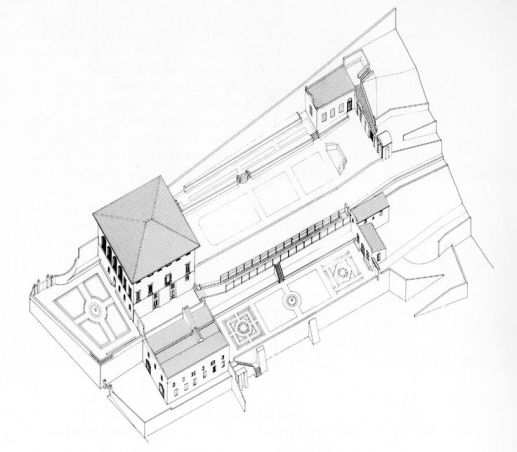
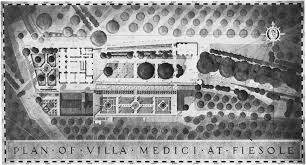
In the imagine (picture, in Italian) above you see how Michelozzo and later architects sited the palazzo and its wonderful gardens.  The palazzo itself sits on the center left side of the plan.

IMG_0782

Looking outward from the palazzo within the gardens at the villa.

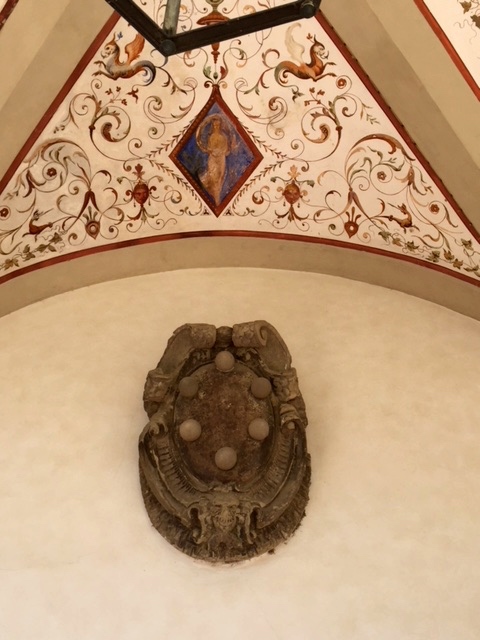
Below, with stonework that recalls grotto architecture, is the entrance to the gardens.  I can’t remember who the sculptured bust represents, but it is no doubt one Medici or another.  The coat-of-arms beneath the bust is, of course, most definitely that of the Medici.

IMG_0760


So, let’s look at a plan of the site. The palazzo is not numbered but you can see where the 4 main gardens exist.

Screen Shot 2018-07-24 at 5.26.58 PM

We’ll start our tour in garden #1.  You walk through or beside #1 when you enter the grounds and approach the palazzo from the west. You can see the white-washed palazzo on the far right side.


As you walk along the pea gravel path from the entry gate to the palazzo, you have this immediate view of the garden with its terracotta pots filled with apple-red geraniums.

IMG_0762

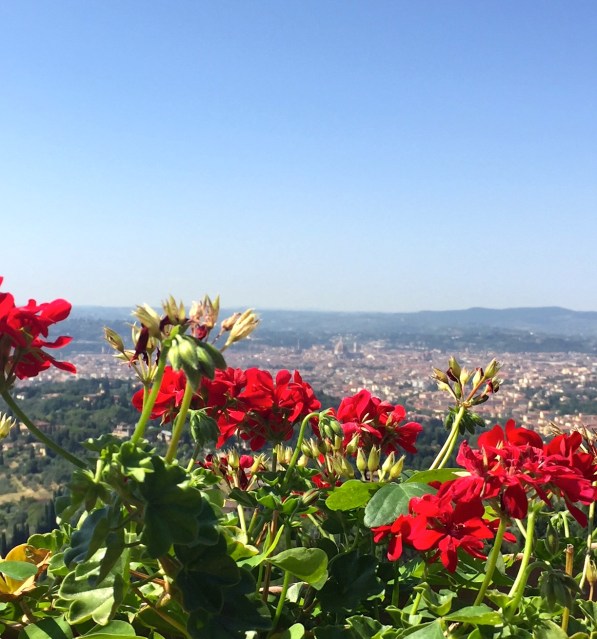
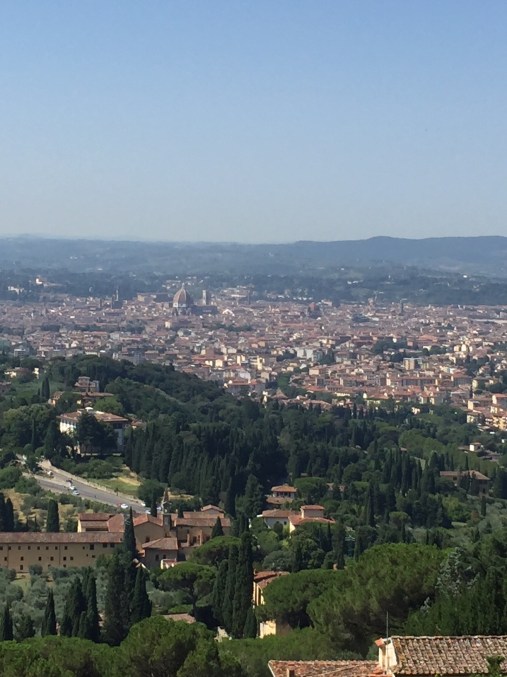
If you can peel your eyes away from the palazzo, which is now fully presented ahead of you, you can already gaze over the geraniums and be rewarded with a spectacular view of Florence. The unmistakable center of the city is marked with the dome of the Duomo.

IMG_0764


Below, the city of Florence as seen from garden #1 at Villa Medici. Wow.

IMG_0761


I’m going to try to avoid the view for a minute, because it always steals the show.  Let’s look at just the plantings and layout of garden #1, shall we?

The north side of garden #1 is constructed with a high wall covered with vines, a small outbuilding, used I think, like a pavillion.  A border of pink roses line the length of the north side of garden #1.

IMG_0796


IMG_0795


Within garden #1, as you look back from the Palazzo end, is laid out with large specimen trees, grass (very unusual in an Italian garden), and potted citrus, lemon and oranges mostly.  The building in the lower section of the photo is the entry gate to the Villa.

IMG_0801IMG_0802

Along this northern border of the garden, a fountain, with a grotto-like finishing of stones, is set into the short wall.  It provides a relief from the steady gaze of border wall with its oval form, and on both sides of the fountain one can walk up a few steps to walk to the pavillion at the west end.

IMG_0793


Below: looking back at the palazzo and garden #1 from west to east:

IMG_0821


To enter garden #2, you must pass along the walkway to the south of the palazzo.  You  climb this tall hill, which is guarded by 2 terracotta lions.

IMG_0846


Angels in the architecture of the gate proclaim the (almost?) divine majesty of the Medici family.

IMG_0851


Through the gate, you see garden #2, with its own set of panoramic views, awaiting you.

IMG_0849


I don’t know if everyone else is like me, but when I passed under the gate leading to garden #2, I was drawn like a magnet to the end walls of the property, where this view, framed by cypress trees, awaits the spectator.  I mean, come on (and people ask me why I choose to live in Italy…don’t I miss the USA???)!!

IMG_0855


Garden #2 is a more private, secluded space than #1.  The palazzo on this, the west side, has magnificent magnolia trees, and, as you can see, the palazzo itself has many windows and arched openings to give those inside the palazzo a gorgeous smallish garden to observe, with extraordinary views available to anyone standing near the short walls that separate the site from the ravines below.


IMG_0860


A low and wide fountain occupies the geometrically divided garden #2.

IMG_0857


After strolling through this garden, lost in thought about the people who had walked through this garden throughout the last 500+ years, I tore myself away, for new gardens #3 & 4 awaited.


This is what the view leading back to garden #1 looks like. You pass through the gateway again, and walk along the gravel path to a structure on the east end of garden #1.

IMG_0856IMG_0856


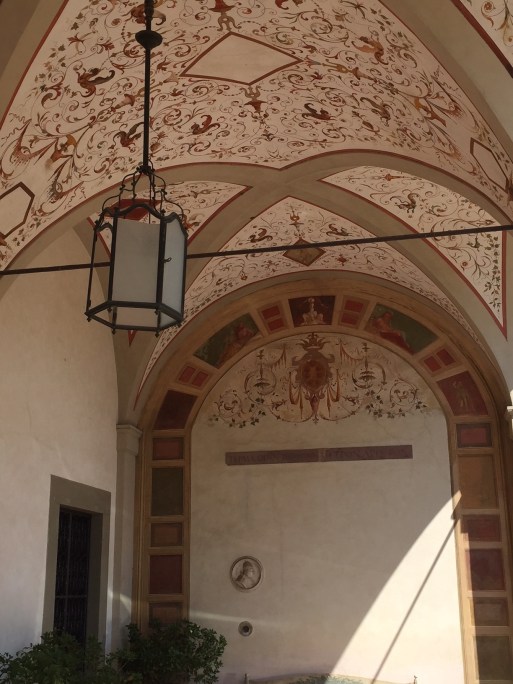
On the west end of garden #1, sits the backside of the first gateway.  However, this is no regular backside! It is a semi-enclosed room with its own frescoes. The main fresco provides an imaginary walkway to follow into the depths of an imaginary garden.

IMG_0830IMG_0831IMG_0826

IMG_0824


To the right side of this small structure, you find a set of stairs leading to gardens 3 and 4.  Unfortunately, caught up in the wonder of this Medici sponsored experience of passing between gardens, I forgot to take pictures. Dang it.  The stairs lead you to a long, plant covered passage.  This passage is quite long, with another pea stone path.  It was the end of July when I visited this Medici villa, and the plants splayed over this path were not in bloom.  I am not sure what the plant is, but it didn’t look like wisteria.  Maybe it is honeysuckle? Not sure.  Whatever it is, this covered passageway is garden #3 and I don’t have any pictures of it.

Garden #3 takes you from the east end of the site to the center of garden #4, pictured below.  As you walk through garden #3, you have tantalizing views of garden #4, and, once again, the city of Florence in the background.  Is it any wonder that I failed to take pictures of garden #3 itself?!

IMG_0842IMG_0841IMG_0903

Oh wait, I do have one photo of garden #3

IMG_0874

Beautiful, isn’t it, garden #3?


To enter the final garden, #4,  you take these picturesque stairs below to the lower level. Now you are in the final garden, and it more than earns its position as the climax of this site’s garden experience:

IMG_0878

Each side of this marvelous little stairway is planted with wisteria, and although the wisteria season is essentially over in the Arno valley, I could see the purple racemes in my imagination.  I loved walking down these stairs, the wisteria branches tried to wrap you up from both sides.  It was a very cool experience.


Here’s the big reward awaiting any visitor to garden #4, an unparalleled vista of the city of Florence, spread out before your eyes.

IMG_0844


When you can tear yourself away from the views that open from garden #4, you can get lost for a while in the flowers that take center stage in this lowest level of the Villa Medici a Fiesole.

For example, below is the closest thing to an English-style border that I’ve ever seen in Italy. You are looking up from garden #4 through the passage (garden #3), and don’t fail to notice the cypress trees that also grace these plantings.

IMG_0880IMG_0883


Let’s look for a second at the geometric beds laid out in garden #4.  It is mostly marigolds which fill these beds.

IMG_0884IMG_0888IMG_0889


Look back up at the palazzo from garden #4, and this is what you see.

IMG_0892


The picture below show how landscape architects (could it have been Michelozzo who designed the palazzo?) treated the change in levels.  This picture serves like a painting, with fore, middle, and backgrounds treated with hard and soft scapes.

IMG_0893

IMG_0889

IMG_0901


Much use of wisteria is made on the west end of garden #4, which also has some modern architecture in it.  Can you imagine living here, at the west end of the Medici villa?

IMG_0894


IMG_0843IMG_0844

Water makes a lovely cameo in garden #4, in the shape of a low circle at the exact center of the site.

IMG_0900

Before departing, let’s take one last look at Florence from way up here:

IMG_0844IMG_0844


And, finally, we must depart, or else the custodian might get nervous and come looking for us.


And now we depart, climbing the beautiful framed stairway from garden #4 to #3.

IMG_0902

Pass through garden #3, constantly looking back and down and notice your senses have been used to the max.  Seeing, hearing, touching, and the scent of the carefully used roses, have worked together to create an unforgettable experience.

IMG_0914


Walking along the Via Beato Angelico that leads from the center of Fiesole down into the outskirts of Florence.  One last backward glance, to see the Villa Medici in all its glory.  Note the swimming pool that I doubt very much was added originally by Michelozzo.  Or, who knows?!


IMG_0922


Villa Medici at Fiesole

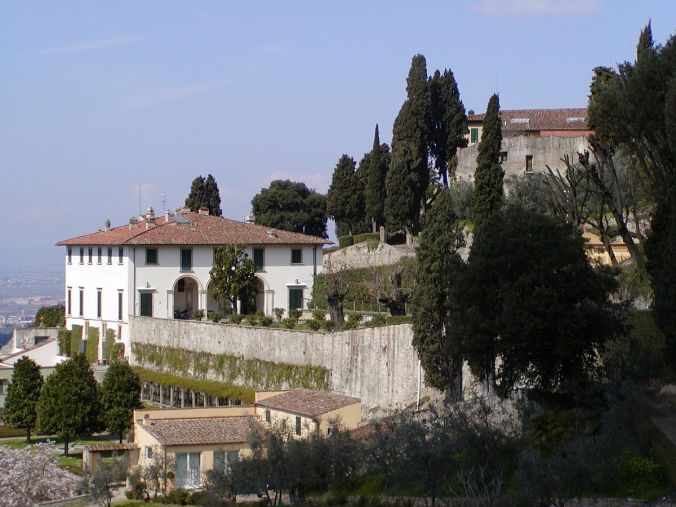
I was in Fiesole this morning, to catch a breath of fresher, cooler air than at home in Florence and also to see a Medici Villa.  I had an appointment to see the grounds of the Villa Medici at Fiesole; the villa itself can’t be visited as it is a private residence.

IMG_0764

Can you see the tiny Duomo of Florence over the red geraniums, right in the middle?

This is a view you would have of Florence if you were a Medici.

IMG_0760

It’s a pretty well-known fact that Florence tends to get a little hot in the summer.  That is actually an understatement.  Today it was 33 Celsius, with is pretty darn hot.

It is cooler in Fiesole, high above on the hills north of Florence. That is why the Medici had this villa constructed.

IMG_0761

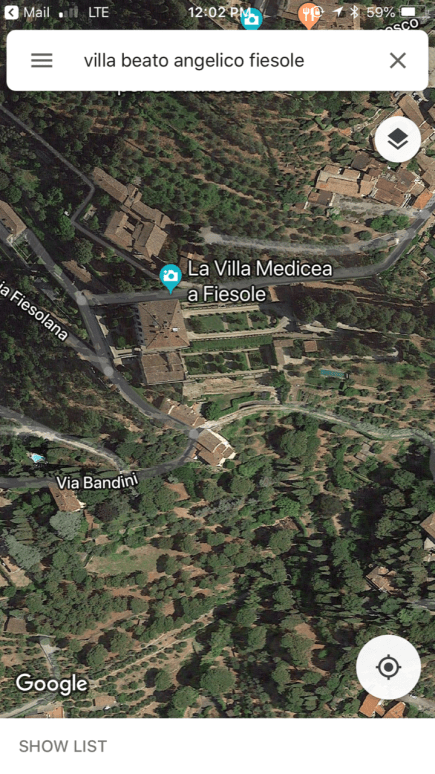
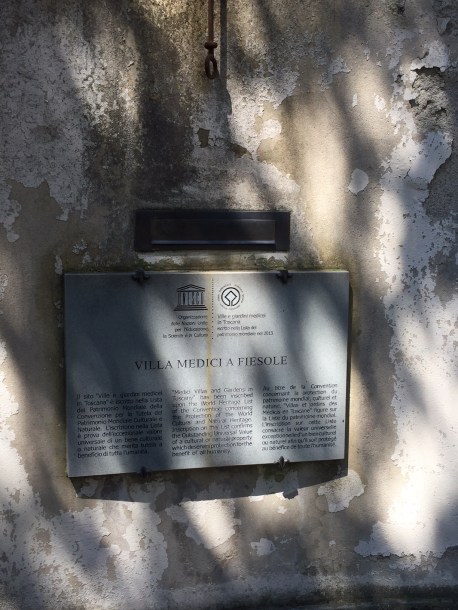
Located on the via Beato Angelico 2 stands one of the oldest villas belonging to the Medici family, the 4th, after the 2 villas in Mugello (Cafaggiolo and Il Trebbio) and the Villa at Careggi. Sometimes called Belcanto or the Palagio di Fiesole, this villa is among the best preserved of the many Medici villas, but at the same time it is also among the less well-known.

Here is a Google earth view of the Villa.

IMG_0926IMG_0927IMG_0928

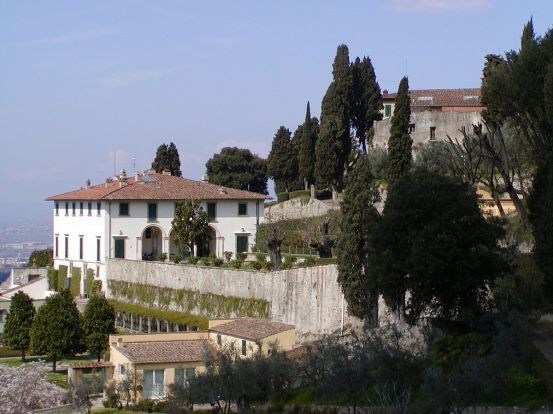
The villa was built between 1451-57. The site was obviously chosen for its panoramic views, despite the fact that the site is on a very steep slope.  It was necessary to make a large terrace, to support the palazzo, the out buildings and the vast gardens.

KIC000148

Villa Medici at Fiesole by Michelozzi in 1460

8d8e5e742d0b6afe3ee4495bf1f358ce--medici-villas


images

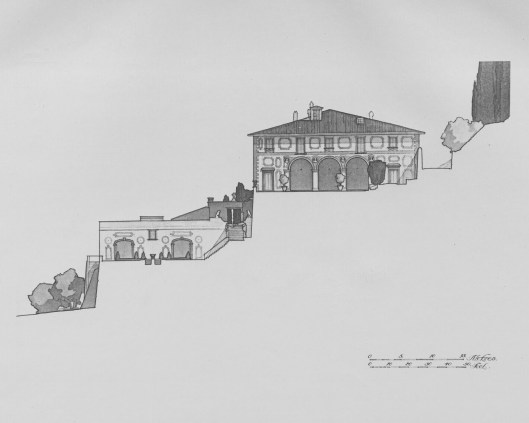
Michelozzo was not bound by pre-existing buildings and built a sober quadrangular palazzo which was whitewashed and had windows framed by stone cornices. Large open galleries, with incredible views of the landscape, were a main feature of the design.

1200px-Villa_Medici_a_Fiesole_1

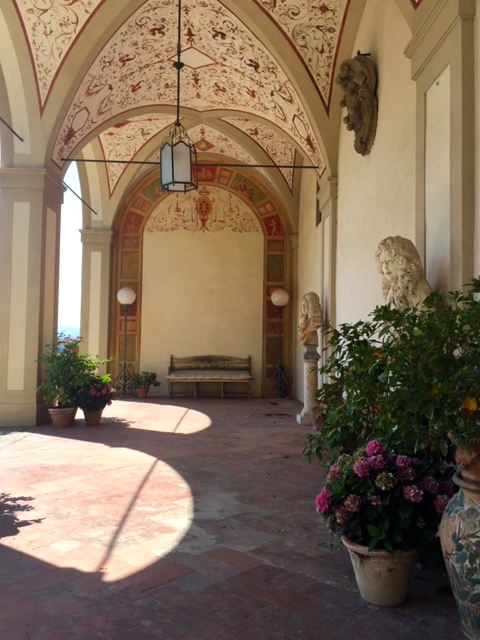
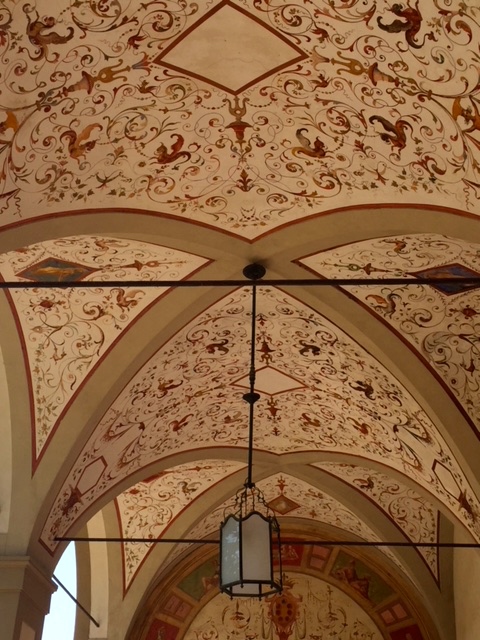
Here are some views of the main loggia at the front of the palazzo.

IMG_0765

IMG_0768

IMG_0785IMG_0789IMG_0775

You know you are in Medici country when you see the coat-of-arms with the Medici palle in a prominent position within the loggia.

IMG_0776


This villa was very different from previous Medici villas: it is much more open to the outer world than any previous villa, and it has no central courtyard.

There are no defensive-military components, meaning there are no turrets, no elevated walkways supported by corbels, or any moats.

The formal and functional innovations of the villa in Fiesole revealed new aesthetic values; including, above all, a new attention to the landscape and the visual domain.

Likewise, the agricultural and productive components of villa design were essentially elminated, in favor of a total dedication to leisure and physical activity that favored contemplation and intellectual activity.

It was, in fact, the first time that a rural residence had only a garden, instead of being surrounded by an agricultural estate.

These factors, combined with the lack of military structures, are the significant characteristics that make this villa one of the clearest prototypes for later Renaissance villa design.

1200px-Villa_Medici_a_Fiesole_1

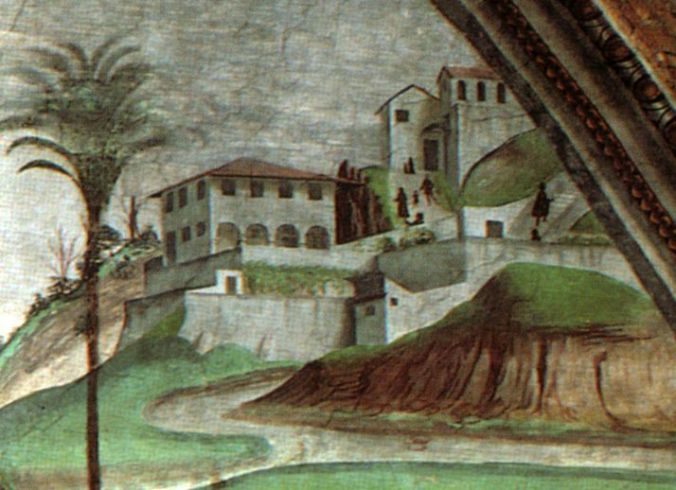
Amazingly, we have a contemporary Renaissance-era view of the villa, as depicted in this fresco by Domenico Ghirlandaio in the Cappella Tornabuoni  at the church of Santa Maria Novella, painted between 1485 and 1490. Art historians live for moments like this. It is very rewarding to have a painted picture to give us an idea about how the villa originally looked and it is just plain fun to have such a record of an extant Renaissance building.

07434f395cdf87f87d3c7cf76a64c362-2

The Villa Medici is linked to one of the most dramatic events of the Medici family history: the Pazzi Conspiracy (1478), when some members of the Pazzi family, along with Francesco Salivate and Cardinal Girolamo Riario, and supported by Pope Sixtus IV, designed a plot to get rid of what they considered to be the increasingly oppressive growth of the power of the Medici within the Florentine Republic. 

Originally, the plan was to kill the two scions of the Medici family, Lorenzo and Giuliano, during a banquet organized at this Medici Villa at Fiesole on April 25, 1478, through the use of poison that Jacopo de’ Pazzi and Cardinal Riario would surreptitiously place in the drinks meant for the two brothers.

The plot was foiled when Giuliano became suddenly ill.  The dinner was canceled and made the enterprise useless.  Undiverted from their aim, the murderers were postponed until the following day, during the Mass at the Florence Cathedral. Of course, we know that while Giuliano was killed, Lorenzo was able to save himself by bolting himself into the sacristy.

It is so interesting to walk around the palazzo and out buildings, thinking about the history that happened here, and who was walking these paths 500 years and more ago.  That is not to even mention the connected gardens, about which I’ll be writing a separate post soon.


.


Did you know? Firenze

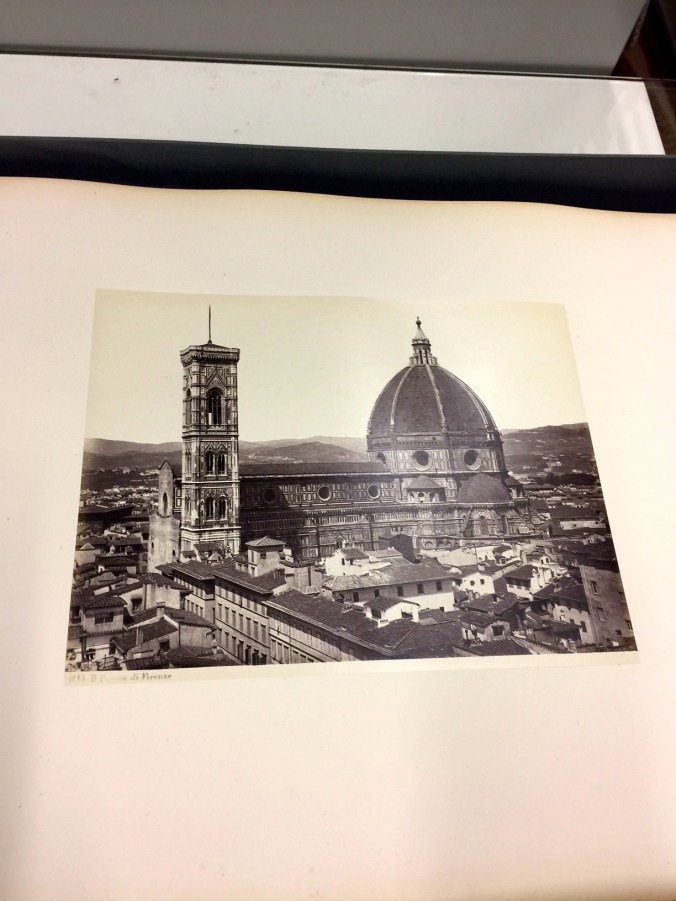
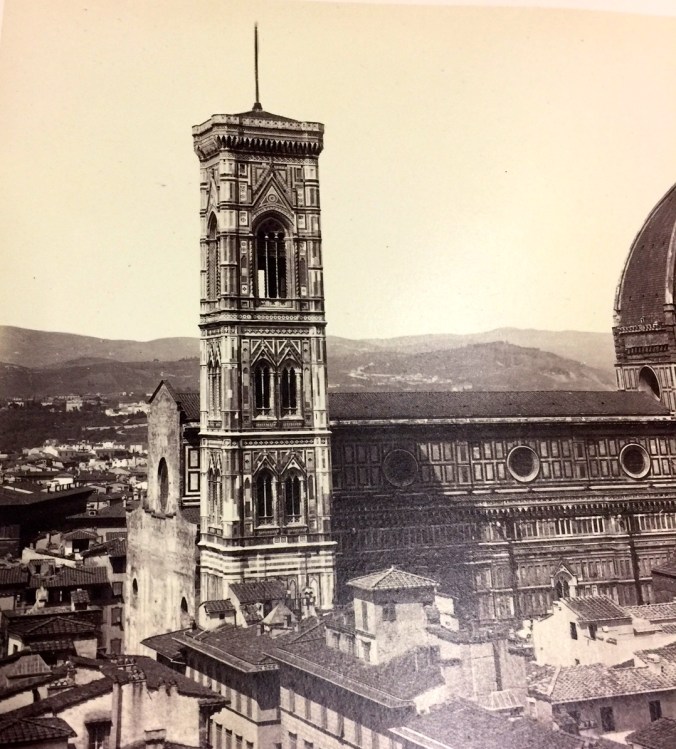
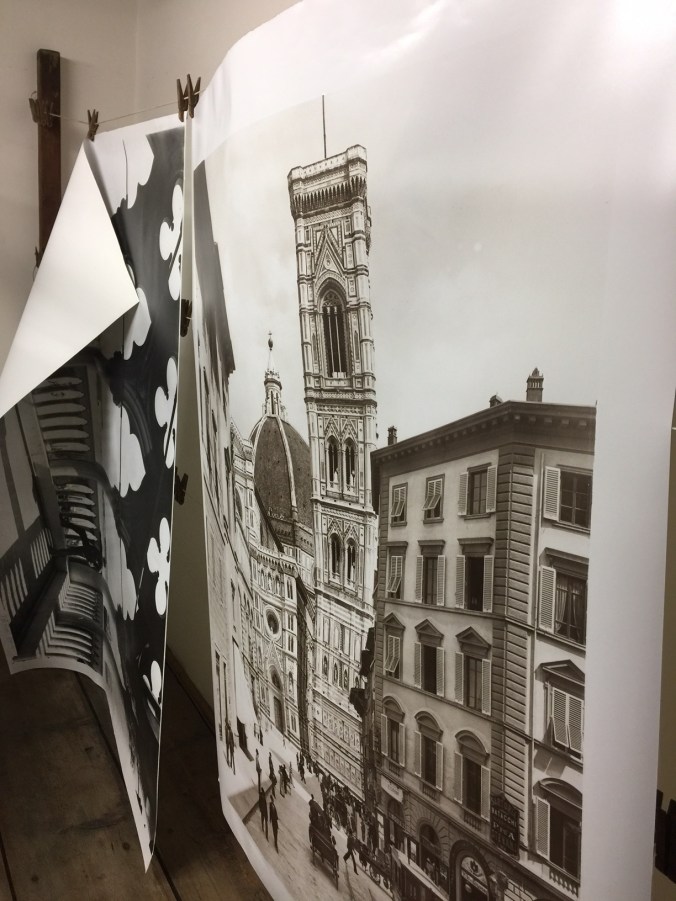
When looking through a photograph album at the Alinari archives, I was shown this photograph of the Duomo in Florence taken sometime before 1874 when the album was created.

IMG_0517


IMG_0516


When you zero in on the facade of the Duomo, things get very interesting.  Instead of the brightly colored and highly embellished facade on the cathedral that one sees nowadays in Florence, this photograph reveals that the facade was left unfinished and unembellished after the Renaissance.

IMG_0515


The following photo, of the Duomo today, shows the facade that was added to the building in the 1870s.

IMG_0523

Grand Tour photo albums, a travel souvenir

If you were a young, aristocratic European man in the late 18th through 19th centuries, you might well have taken a Grand Tour.  After finishing your formal education, you would take a kind of gap year (or year and a half), traveling to and through the finest European capitals, including, in Italy, cities such as Venice, Milan, Florence, Rome and Naples.

IMG_0508

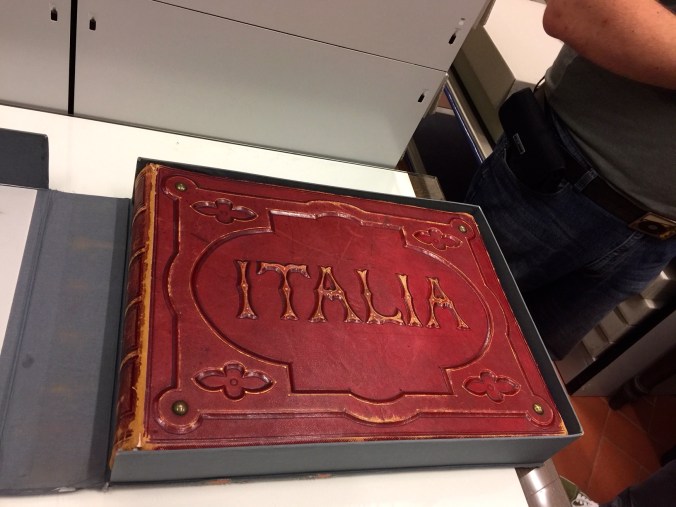
You might have asked Alinari Brothers or another similar firm to create an album for you, comprised of their photographs of your favorite places. The Fratelli Alinari archives in Florence have many of these albums in their archives, and I had the opportunity to look at one of them from 1874.

It begins with a hand-tooled red leather cover.  The book measures roughly 20 x 30 inches.

IMG_0509


IMG_0510


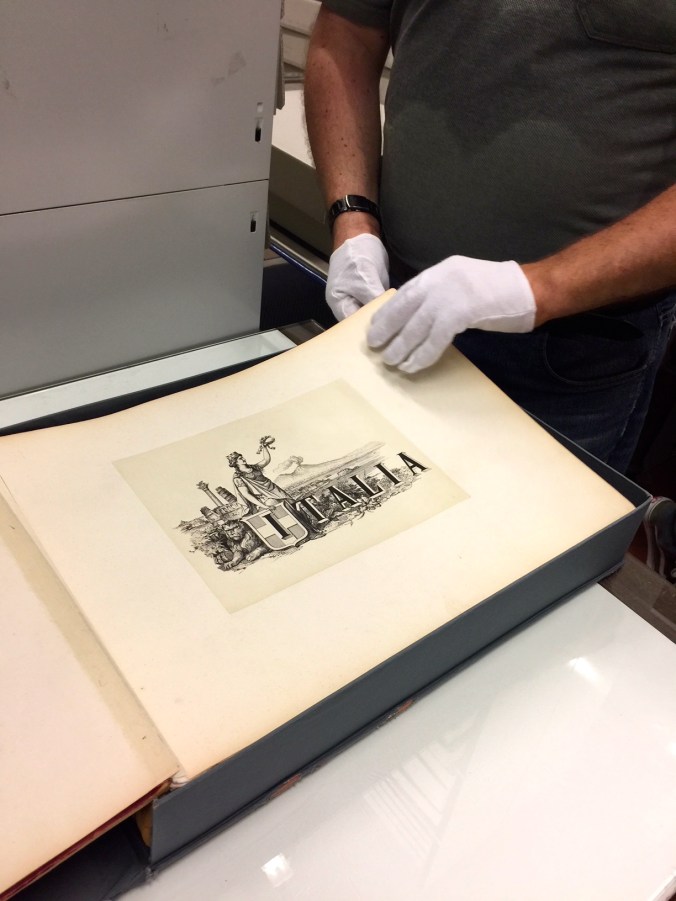
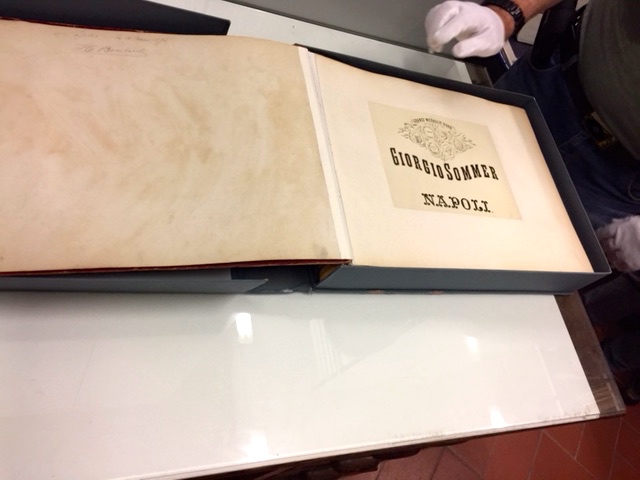
The Frontispiece reveals that this album was created in Naples, by the Giorgio Sommer firm.

IMG_0506IMG_0507


This particular album begins with photographs of Torino, Milano, and Venice, as here:

IMG_0512


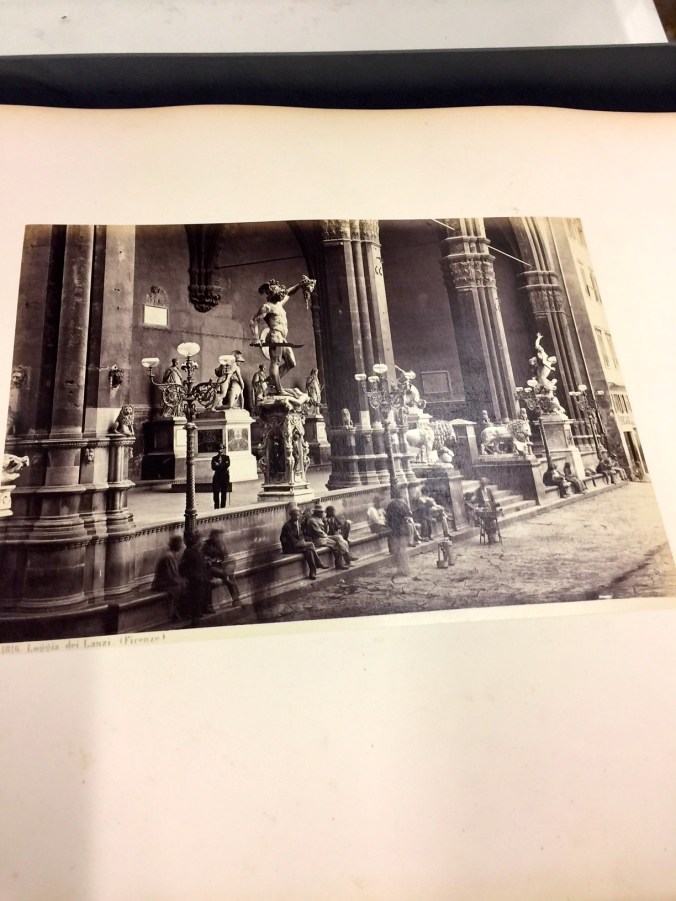
This album then moves to Firenze, and here are 3 images from this section of the book:

IMG_0515IMG_0514

IMG_0517


Next, the book moves on visually to Rome.  Here is a picture of oxen pulling carts through the Roman forum.

IMG_0519


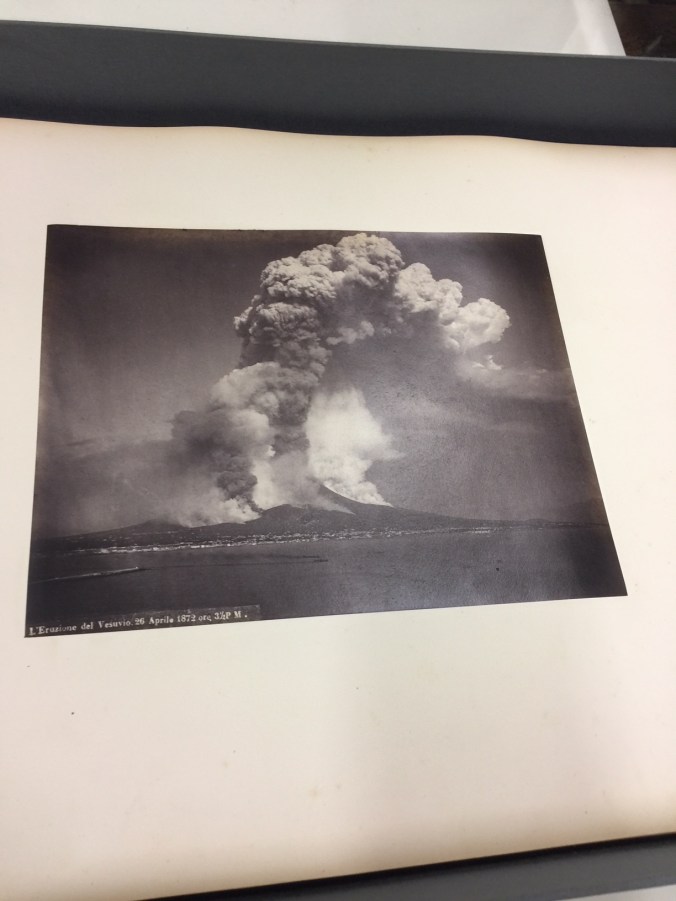
Then it was on to Naples.  The following is a picture of Mt. Vesuvius erupting in 1872.

IMG_0520

I could (and will) spend hours looking through these albums!
According to my guide at the Alinari archives, an album like this would have cost a young gentleman about $1500 in today’s money.


Piazza Beccaria, molti anni fa

Piazza Beccaria, many years ago.

35265840_226451901496305_9196519922795020288_n

Florence’s grand Piazza Beccaria was designed by the architect Giuseppe Poggi when Florence was made the Capital of the Kingdom of Italy.

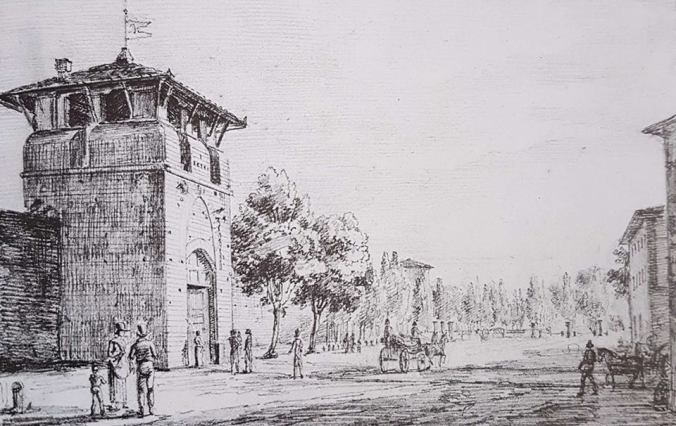
It was originally called the Piazza alla Croce because one of the gates in the medieval walls that surrounded Florence, the Porta alla Croce, was located there and was left –more or less– intact.  This is the gate you see in the vintage photo above.

In 1876, the piazza was renamed in honor of Cesare Bonesana Marchese di Beccaria.   A number of concave palazzi were built to encircle the piazza. Just to the south stands the State Archives, where the Casa della Gioventu Italiana del Littorio previously stood.

In 2003 – 2004, a three-story underground parking garage was built under the square.  I walk over it every time I’m headed to the great shopping district to the east.  Two of the most beautiful modern (20th century) ville are located a stone’s throw away.

The Porta alla Croce was thankfully spared the destruction of the walls.

Poggi created a circular space in this piazza, with the ancient gate as a fulcrum, and a series of grand palazzi with concave facades. Moving south from the square, towards the Arno, the avenue had to bifurcate, leaving a plot of land in the center which is now occupied by the State Archives.

Screen Shot 2018-06-15 at 12.33.00 PM


At the bifurcation of the Giovine Italia and Amendola avenues, the building that houses the Archivio di Stato faces the place where until 1977 the Italian Youth House of the Littorio of Florence stood. Before that there were the so-called “Pratoni della Zecca”, an area that Poggi had planned to magnify the view from the hill of San Miniato towards Piazza Beccaria and vice versa.

Between 2003 and 2004, the square was affected by important works for the construction of an underground car park, for a total of 205 parking spaces organized on three floors, designed by the architects Paolo di Nardo and Fabio Rossetti , who in parallel also intervened in the partial rearrangement of the square’s furnishings [1] .

On the side and at the center of the circular avenues that cut it in half, the square presents three green areas (previously four) crossed by a pedestrian path that passes under the Porta alla Croce ; for several years the green space to the east, opposite to the one facing the center , has been deformed and reduced to the point of completely losing the elegant elliptical design; that just north of the portal was, instead, paved. The green flower beds are kept in lawn. On the west side, on 11 September 2009, the Municipality of Florence, in memory of Teresa Sarti Strada , planted a red maple . [2] . On the opposite side, however, the design of the flowerbeds has some trees (including a tall magnolia ) and bushes.