Deep inside Monte Kronio on Sicily seen above, an ancient secret has been kept for millennia in the hot, humid and sulfurous caves.
People have been visiting the caves of Monte Kronio since as far back as 8,000 years ago. They’ve left behind vessels from the Copper Age (early 6th to early 3rd millennium B.C.) as well as various sizes of ceramic storage jars, jugs and basins. In the deepest cavities of the mountain these artifacts sometimes lie with human skeletons.

One of the most puzzling of questions around this prehistoric site has been what those vessels contained. What substance was so precious it might mollify a deity or properly accompany dead chiefs and warriors on their trip to the underworld?
Using tiny samples, scraped from these ancient artifacts, the analysis of scientists revealed a surprising answer: wine. And that discovery has big implications for the story archaeologists tell about the people who lived in this time and place.

In November 2012, a team of expert geographers and speleologists ventured into the dangerous underground complex of Monte Kronio. They escorted archaeologists from the Superintendence of Agrigento, going down more than 300 feet to document artifacts and to take samples. The scientists scraped the inner walls of five ceramic vessels, removing about 100 mg (0.0035 ounces) of powder from each.

It was found that 4 of the 5 Copper Age large storage jars contained an organic residue. Two contained animal fats and another held plant residues, thanks to what was believed to be a semi-liquid kind of stew partially absorbed by the walls of the jars.
But the 4th jar held the greatest surprise: pure grape wine from 5,000 years ago, and these Monte Kronio samples are some of the oldest wines known so far for Europe and the Mediterranean region.
This is an incredible surprise, considering that the Southern Anatolia and Transcaucasian region were traditionally believed to be the cradle of grape domestication and early viticulture. Later studies used Neolithic ceramic samples from Georgia, and pushed back the discovery of traces of pure grape wine even further, to 6,000-5,800 B.C.
There are tremendous historical implications for how archaeologists can now understand Copper Age Sicilian cultures.
From an economic standpoint, the evidence of wine implies that people at this time and place were cultivating grapevines. Viticulture requires specific terrains, climates and irrigation systems.
Archaeologists hadn’t, up to this point, included all these agricultural strategies in their theories about settlement patterns in these Copper Age Sicilian communities. It looks like researchers need to more deeply consider ways these people might have transformed the landscapes where they lived.
The discovery of wine from this time period has an even bigger impact on what archaeologists knew about commerce and the trade of goods across the whole Mediterranean at this time. For instance, Sicily completely lacks metal ores. But the discovery of little copper artifacts – things like daggers, chisels and pins had been found at several sites – shows that Sicilians somehow developed metallurgy by the Copper Age.
The traditional explanation has been that Sicily engaged in an embryonic commercial relationship with people in the Aegean, especially with the northwestern regions of the Peloponnese. But that doesn’t really make a lot of sense because the Sicilian communities didn’t have much of anything to offer in exchange for the metals. The lure of wine, though, might have been what brought the Aegeans to Sicily, especially if other settlements hadn’t come this far in viticulture yet.
Wine has been known as a magical substance since its appearances in Homeric tales. As red as blood, it had the unique power to bring euphoria and an altered state of consciousness and perception.
All of this is taken from https://www.thelocal.it/20180215/prehistoric-wine-italy-inaccessible-caves-rethink-ancient-sicilian-culture
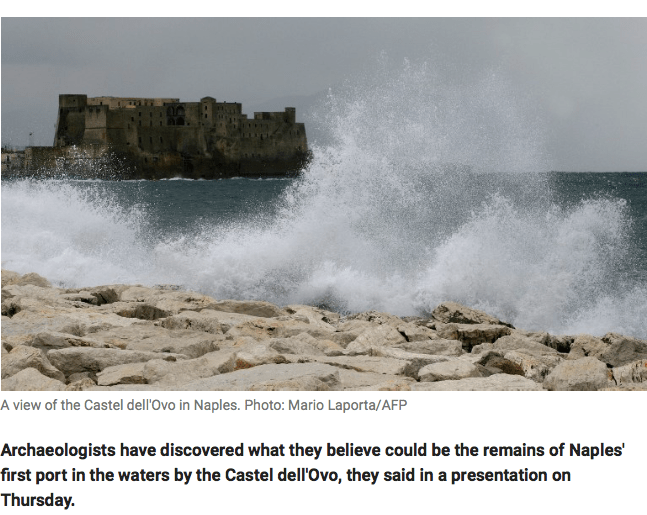 https://www.thelocal.it/20180316/remains-of-ancient-port-discovered-under-naples-seafront?utm_source=dlvr.it&utm_medium=twitter


 get back, lauretta!
You must be logged in to post a comment.