Architecture
In and under Orvieto
Above and underground in Orvieto
This past week I have been very lucky to have a very dear friend visiting, and so I’ve been playing a bit more tourist than I normally do in Italy. We wanted to get out of Florence a bit, so we headed to nearby Orvieto, somewhere I have never been, and only about two hours on the regional (slow) train. Orvieto is located on a (very tall) hill, so we took the funicular from the bottom of the hill where the train dropped us off to the old town, and then headed straight for the main piazza del Duomo. We picked up tickets for our main interest first, and while we waited headed into the Duomo. Orvieto’s Duomo is pretty low-key overall, but the chapels are what are most noticeable and they are much more ornate than the rest of the empty-feeling church.

The church is similar in feel to the Duomo in Siena, but as previously noted the chapels here are what are incredibly ornate. One chapel in particular was created for a piece of bloody cloth from when the wafer began to drip with the actual blood of Christ to convince a doubting priest. The cloth and host were taken to the pope, a miracle was declared and the chapel was built where the cloth is enshrined to this day. The majority of the frescos in that chapel were done by Luca Signorelli, and are said to have influenced Michelangelo’s frescos in the Sistine Chapel. The influence is obvious; Signorelli’s figures are incredibly muscular.
After viewing the church we headed from the beautiful city aboveground to under the ground, to the main attraction of Orvieto and what we were most excited to see: the Orvieto underground. During the time of the Etruscans thousands of man-made caves were dug out of the hillside and they are spread throughout the city. I tried to find an example of the map that you can see there, but was unsuccessful, but imagine a small Italian town city map: now draw thousands of red circles all over it and you’ll have an idea of how many caves there were and the reach of them. We took a guided tour in English, and were able to get some backstory on the caves and see them up close and personal.
The caves look pretty much like you would expect– they are caves after all– but what is perhaps most surprising is the temperature drop after you descend even just one level down into the caves. It is so much cooler there, and it is no surprise that the Etruscans used the caves for things such as olive oil making. Below you can see an ancient olive oil press. The straining mat is modern, but something similar would have been used to press the oil out of the olives and prevent pieces of the olives from joining the oil.
 The caves were incredibly extensive; we felt we had seen so much, but in reality we only covered two tiny circles on the map of thousands. At one point our guide pointed out that while it seemed we had covered a lot of ground, it had all been vertical, and there certainly were a lot of stairs– this was not a tour for those who can’t do stairs– or the claustrophobic! The caves were quite spacious, but the tiny staircases and passages between them, not so much.

Many of the rooms in the caves were studded with holes, as you can see in the photograph above. For a long time they believed that these holes had a different purpose, but now archeologists are pretty certain that they were used to raise pigeons, which are actually a pretty common food in Orvieto, one of the things the city is known for (the others being ceramics, Orvieto classico wine from Trebbiano grapes, and olive oil). The pigeons were self-maintaining, because they would fly out the window that was ever-present to eat, and also bring back food for their young. Unlike other animals such as rabbits, people did not have to put in as much effort to raise them.
After some time the caves reached their final hurrah when the people of Orvieto were forbidden from digging out any more caves due to the instability of the area; landslides, thanks to the instability caused by the caves were increasing and there was fear that the entire city might disappear. Now there are spikes driven through the hill to protect the city, but the caves are now an archeological and historical site as opposed to a functional one.
Orvieto, being a hill town, had beautiful views, and we spent the rest of the afternoon wandering and enjoying them before heading back to Florence on the train. Below you can see a convent (I believe) from the hillside where we entered the underground caves.
 Orvieto was sacked by the Romans, but the city withstood their attacks for two years thanks to its prime hilltop position: easy to defend. There are walls around the city as well, and facing the train station you can climb atop for the best view of the valley below.
 Sometimes living in Florence it’s easy to forget that Italy isn’t really a land of cities. I’m lucky enough to have a view of the hills from my balcony, but visiting a small hill town is a good reminder of what Italian life is really like for most people– in the past, and in the present.

05/08/2014 · · in Escapes, Europe, Off the Beaten Track, Out & About. ·
Happy summer!
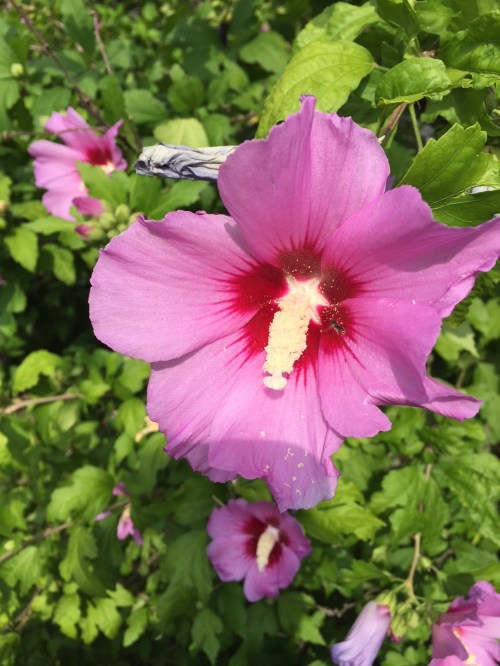
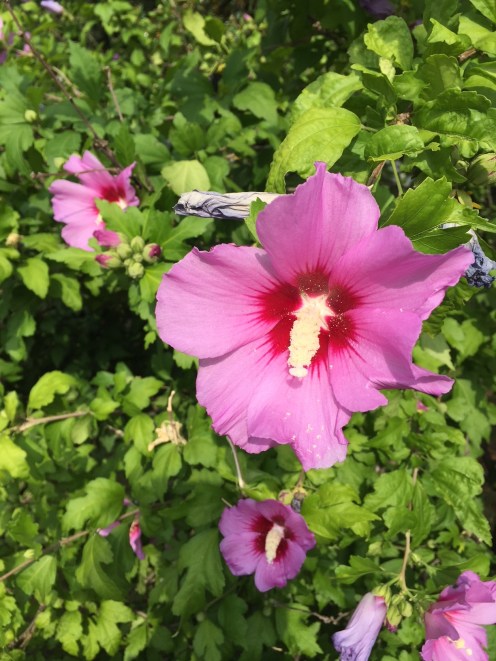
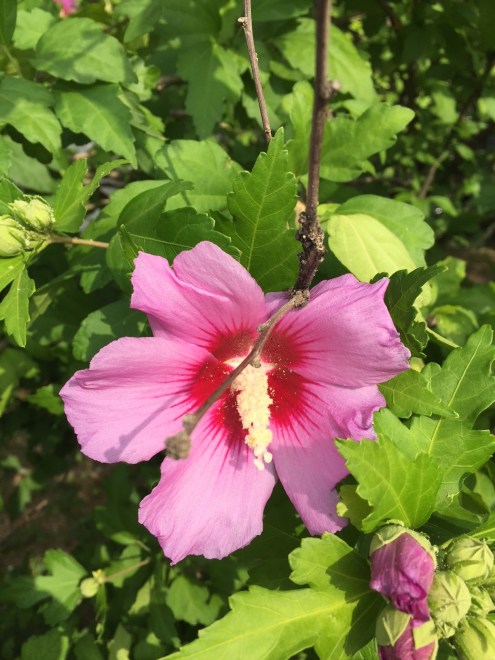
Crossing over the PONTE SAN NICCOLÒ today, I ran right into branches of this pretty rose-of-sharon shrub. I have one just like it in my garden in Denver. In Denver, this shrub doesn’t bloom until August. It obviously happens much sooner in Italy! Most things do!
Florence’s many bridges are fun to read about: http://www.aboutflorence.com/firenze/ponti-di-firenze/ponte-san-niccolo-firenze.html
Piazza Beccaria, molti anni fa
Piazza Beccaria, many years ago.

Florence’s grand Piazza Beccaria was designed by the architect Giuseppe Poggi when Florence was made the Capital of the Kingdom of Italy.
It was originally called the Piazza alla Croce because one of the gates in the medieval walls that surrounded Florence, the Porta alla Croce, was located there and was left –more or less– intact. This is the gate you see in the vintage photo above.
In 1876, the piazza was renamed in honor of Cesare Bonesana Marchese di Beccaria. A number of concave palazzi were built to encircle the piazza. Just to the south stands the State Archives, where the Casa della Gioventu Italiana del Littorio previously stood.
In 2003 – 2004, a three-story underground parking garage was built under the square. I walk over it every time I’m headed to the great shopping district to the east. Two of the most beautiful modern (20th century) ville are located a stone’s throw away.
The Porta alla Croce was thankfully spared the destruction of the walls.
Poggi created a circular space in this piazza, with the ancient gate as a fulcrum, and a series of grand palazzi with concave facades. Moving south from the square, towards the Arno, the avenue had to bifurcate, leaving a plot of land in the center which is now occupied by the State Archives.

At the bifurcation of the Giovine Italia and Amendola avenues, the building that houses the Archivio di Stato faces the place where until 1977 the Italian Youth House of the Littorio of Florence stood. Before that there were the so-called “Pratoni della Zecca”, an area that Poggi had planned to magnify the view from the hill of San Miniato towards Piazza Beccaria and vice versa.
Between 2003 and 2004, the square was affected by important works for the construction of an underground car park, for a total of 205 parking spaces organized on three floors, designed by the architects Paolo di Nardo and Fabio Rossetti , who in parallel also intervened in the partial rearrangement of the square’s furnishings [1] .
On the side and at the center of the circular avenues that cut it in half, the square presents three green areas (previously four) crossed by a pedestrian path that passes under the Porta alla Croce ; for several years the green space to the east, opposite to the one facing the center , has been deformed and reduced to the point of completely losing the elegant elliptical design; that just north of the portal was, instead, paved. The green flower beds are kept in lawn. On the west side, on 11 September 2009, the Municipality of Florence, in memory of Teresa Sarti Strada , planted a red maple . [2] . On the opposite side, however, the design of the flowerbeds has some trees (including a tall magnolia ) and bushes.
Arts & Crafts period, Italian manufacture
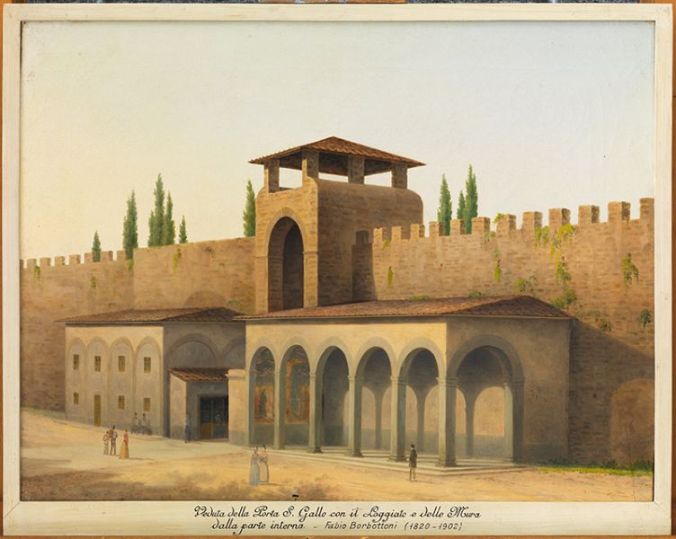
Porta a Prato, Firenze, early 1800s
Una fantastica Porta a Prato acquerellata, inizi 900, Firenze. Watercolor by Fabio Borbottoni (1820-1920)
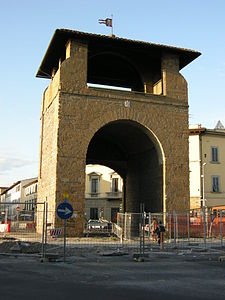
How it looks today:
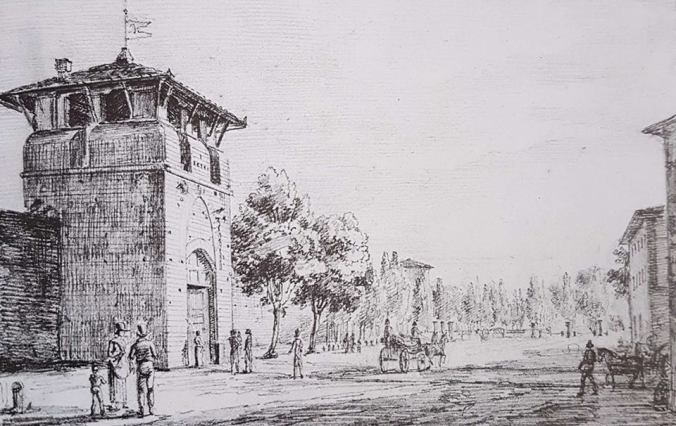
Giuseppe Gherardi. Porta al Prato. Disegno del 1826
Where Leonardo performed cadaver dissections
Today’s issue of The Florentine carried the following news item. Before reading the article, just consider for a moment: how many hospitals do you know that:
- Are over 700 years old?
- Is the place where Leonardo allegedly performed dissections?
- Have guided tours of their basements?
- Have an underground passageway to a convent?
I know the answer is none! It is mind blowing to consider all of this! (I was lucky enough to walk by this hospital 2x a day for almost 10 months; my Italian language school is across the street. It was comforting to know that when I truly lost my mind [because learning another language is molto difficile!], I was not too far from medical treatment. :-) )
Santa Maria Nuova Hospital to restore its basements
Oldest hospital in Florence celebrates 730th anniversary
JUNE 19, 2018 – 11:42
The oldest hospital in Florence, Santa Maria Nuova, has launched a fundraising campaign during its 730th year.

Santa Maria Nuova Hospital, photo credit @labuccia66 via Instagram
On June 21, the Santa Maria Nuova Foundation has organized an invitation-only fundraising dinner with the sole purpose of restoring the hospital’s basements.
The subterranean zone of the historic building is home to “Leonardo’s basins”, supposed to be where Da Vinci dissected human cadavers, although records bear no proof of this having occurred, and the underground passageway that the oblate nuns, the hospital’s former nurses, used to reach the wards from the nearby convent.

One of “Leonardo’s basins” at Florence’s Santa Maria Nuova Hospital
On June 23, the hospital will be opening its doors to the public with a book presentation scheduled at 11am, free guided tours at 7pm (meet outside the hospital entrance at 6:50pm) and a classical concert at 9pm in the church of Sant’Egidio.
“We are delighted to welcome Florentines to celebrate the city’s oldest hospital, which is 730 years old this year,” announced Giancarlo Landini, president of the Santa Maria Nuova Foundation. “It’s an opportunity to remember the history of this extraordinary place of care and help, which was founded in 1288 by Folco Portinari, the father of Beatrice immortalized by Dante, and who thanks to the generosity of benefactors was able to receive important works of art.
We also celebrate today’s Santa Maria Nuova, showing how we have reached this restoration and we will look to the future, considering how to make the most of our artistic and historic heritage, starting with the restoration and renewal of the former crypt of the church of Sant’Egidio and the hospital’s basements, the reason why the foundation has organized the fundraising dinner on June 21.”
At the press presentation, Tuscany’s health councillor Stefania Saccardi commented, “In recent years, the regional health unit has modernized the hospital while protecting its historic value. Now, through the hospital’s foundation, the time has come to restore its basements.”
Giorgio Vasari, a new film
A new film, Le memorie di Giorgio Vasari, premiered at the Bari International Film Festival in April of this year. Vasari, the painter, architect, and historian of art, was an eclectic figure of the Italian Renaissance. I got to see the film today at the best movie theater in the world, the Odeon in Florence’s historic center. It was a feast for the eyes!
Luca Verdone directed the film and captured, together with the cinematographer, Gianluca Gallucci, the deep, rich, saturated colors of the Italian world in which Vasari lived. The story is told in first person, with Vasari himself telling us rather idiosyncratic events in Vasari’s life and the works of art he created using the stylistic themes and content he learned from his masters, Michelangelo and Andrea Del Sarto.
Vasari's greatest fame today is not so much linked to his works as tohis treatise, The Lives of the most excellent Italian painters, sculptors and architects, from Cimabue to the present time, published in  1550 and reissued with additions in 1568. A treatise "of a technical and historical-critical nature on the 3 major arts (architecture, sculpture and painting) was a milestone in the study of the life and    works of the more than 160 artists included.

Luca Verdone has brought to life the story of an important artist anddesigner, one who has never before been brought to the big screen.
If Vasari isn’t playing at a theater near you, you can learn about him in these two fine BBC documentaries.
Stazione Leopolda, Firenze
If you’ve ever been lucky enough to come to Florence and if you arrived by train, chances are good that you’ve been at the Stazione Santa Maria Novella to the west of the historic center of the city. Every time I’m in that station nowadays, I always time travel in my mind back to the day when I was 27 years old and first set foot in Florence and Europe. Just walking through this classic 1930s building makes me remember the wonder and excitement I felt that day.
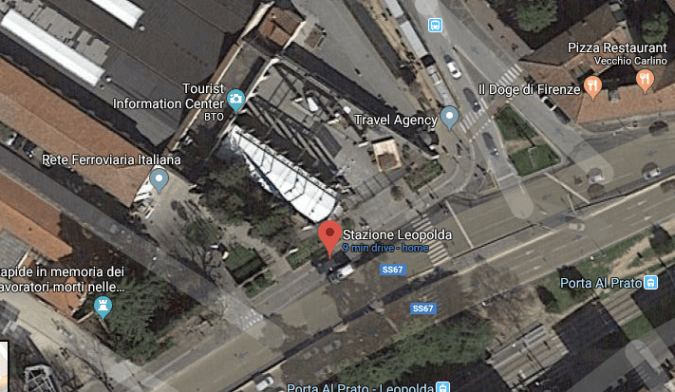
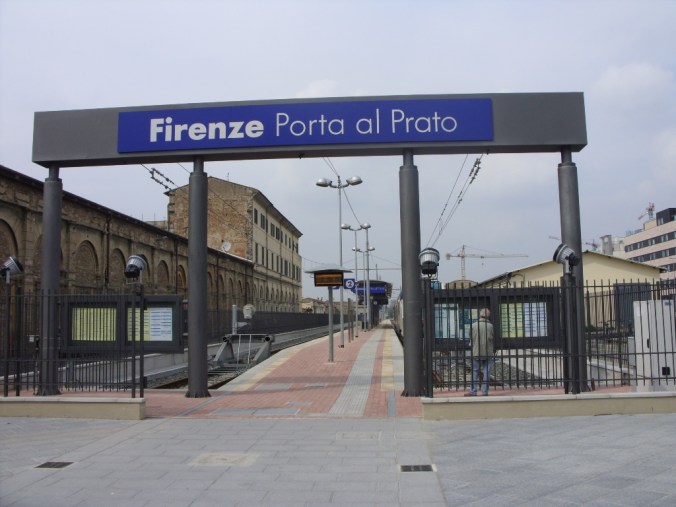
But, you probably didn’t know that this famous stazione was not Florence’s first train station. That distinction goes to the Stazione Leopolda which is over by the Porta al Prato, just outside what would have been the circle of walls surrounding Florence when the station was built. It is also next to the Teatro Maggio Musicale Fiorentino, located on the Viale Fratelli Rosselli. The stazione has gone through many transformations, as you will see below, but it is still in situ and is used today as a venue for many exhibitions, meetings and congresses.
Here’s a Google Map image to help you situate the area in your mind:
So, let’s time travel back to the 1840s together and have a look at this interesting building complex.
Today it looks like this:
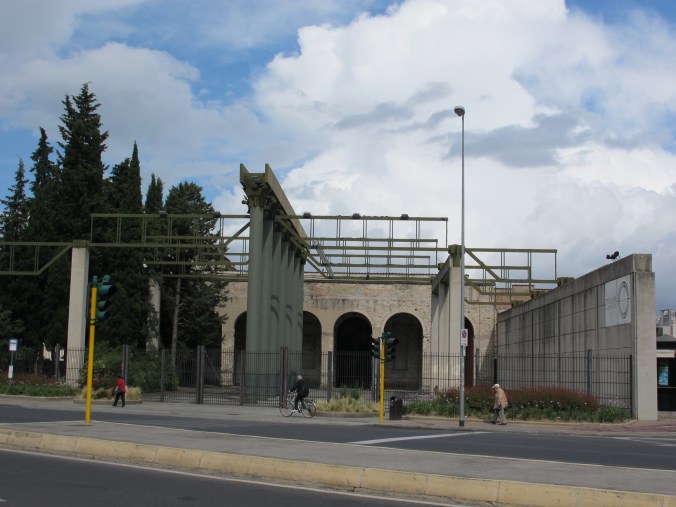
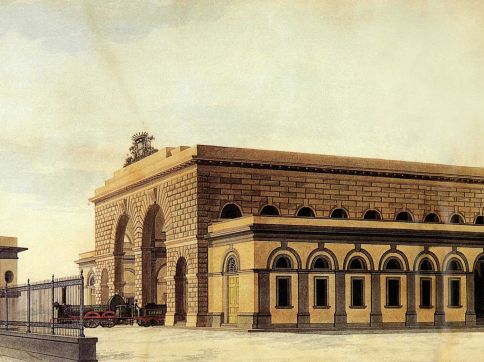
But when it was first inaugurated in 1848, it looked like this:
And by 1861 it looked like this:
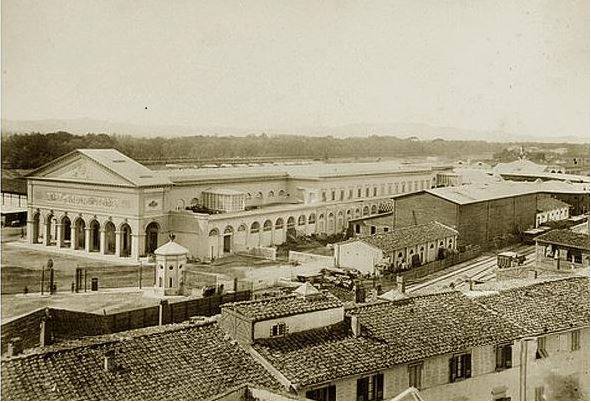
Stazione Leopolda. Foto del 1861.
Do you know your railroad history? Well, the very first railway line constructed in all of Tuscany was the route that connected Livorno, an important port, to Pisa. In 1841, work began to connect Florence with Livorno as well.
A new station in Florence would thus be needed to allow for arrivals and departures on the new Livorno/Florence line and the Grand Duke Leopold II commissioned architect Enrico Presenti to build a large terminus station to be situated in an open space just outside the Florentine walls, near Porta al Prato. The new station, Stazione Leopolda, was opened on 12 June 1848, taking its name from the Duke himself.
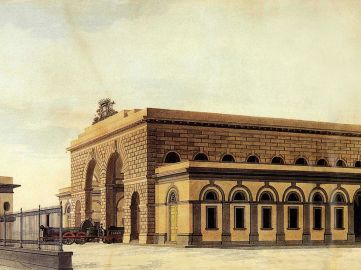
The new station was designed with 3 large rooms, the central one was for the tracks and the arrivals/departures and the 2 side rooms were for services. The station was constructed with a stone and stucco finish, using rounded arches and pilasters borrowed from the neoclassical style.
Almost simultaneously, another train station was envisioned and built; this one was constructed closer into the city center and this is the station that is still in use for passenger arrivals and departures 24/7, the Stazione Santa Maria Novella. As time went on, the SMN stazione saw a continuous increase in passenger traffic and it was decided to divert all regional and national lines to it, and to close the Leopolda. This happened by 1860.
Now it just so happened that the reunification of Italy was happening through these same years. Authorities had to figure out what to use the Leopolda for and, since the first annual Esposizione Nazionale Italiana delle Arti e delle Scienze was scheduled to be held in Florence in 1861, it was decided to rework and reuse the Leopolda for this grand exposition. Architect Giuseppe Martelli (1792-1874) was commissioned in 1861 to rework the Leopoldo in order to provide a good venue for the exposition.
It opened to great fanfare and the day it opened it looked something like this:
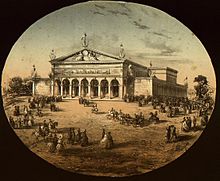
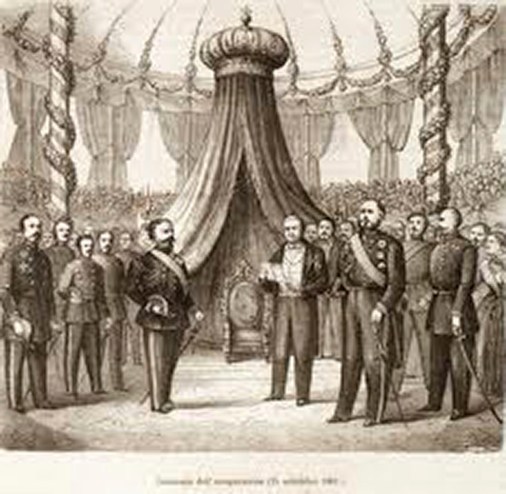
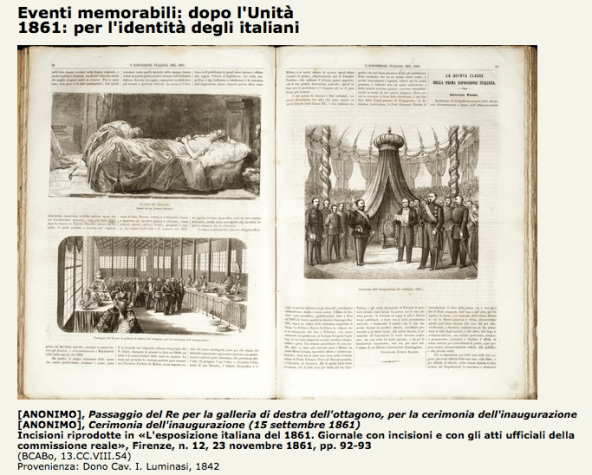
The exposition was large, with more than 6,000 exhibitors in the fields of the arts, sciences, and Italian industries. It was visited by about 30,000 people.
Incidentally, this exhibition was one of the first venues in which the nascent school of the macchiaioli were shown.
On March 17, 1861 the new Kingdom of Italy was officially proclaimed, with King Vittorio Emanuele II as the the monarch. He was on hand to inaugurate the exposition later that same year.
Unfortunately, the exhibition was a disappointment financially and the annual expositions did not come to pass. Italy would have a few subsequent expos, but never an annual event as such.
The Leopolda, having served 2 purposes so far in its history as first a passenger train station and then the home of a grand exposition, it would soon be reworked again, for Florence soon became the capitol of the new Italian state in 1865.
This time architect Marco Treves was commissioned to expand and modify the Leopolda so it could house many small offices needed for the bureaucracy in Florence. Treves added a mezzanine to make better use of the interior space.
In 1871 the Capitol of Italy was moved to Rome and, you guessed it, the Leopolda was yet again put to another use. It came to house a workshop for train maintenance, using small parts of the old, original railroad tracks.
During the WWI, bullets were manufactured in Leopolda. During WWII, Leopolda housed factories devoted to maintaining and repairing train equipment. During the Nazi occupation, Resistance workers used the site to sabotage and clog up the delivery of raw materials. These activities continued right up to May 2, 1944, when Florence was bombed and the workshops were closed.
In the post-war period the building was once again modified, leaving intact essentially one large room in the center of the building which was used until 1993 as a railway depot. After that, the complex was repurposed once again.
Finally–or perhaps I should say currently–the Leopolda got a spruced up front by Gae Aplenty in 1996 and the old train station connection to the space ended. Today the space is open for fashion events and exhibitions, among which is the Pitti Imaggine, SRL which oversees the Leopolda nowadays.
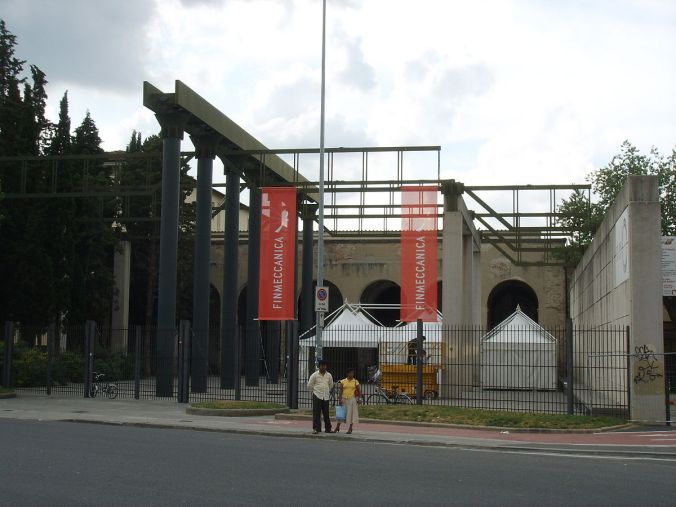
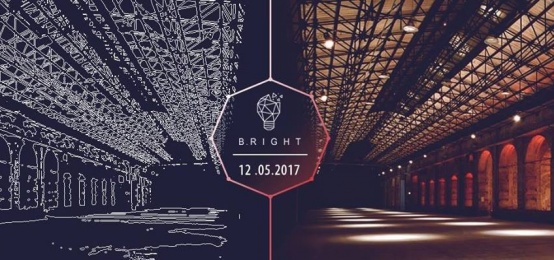
Indeed, today the Leopolda is one of the most exhibition spaces in all of Florence, managed by Stazione Leopolda Srl (a Pitti Immagine company) and the great central vault is now used for music, fashion and markets.
Why doesn’t the Leaning Tower of Pisa fall over?
The Leaning Tower of Pisa has withstood earthquakes for centuries. Now, scientists know why.
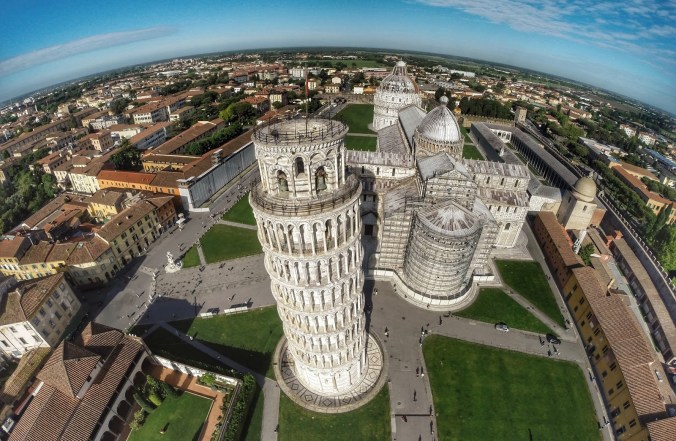
Partially constructed on unexpectedly soft soil, the ancient bell tower began to lean before it was even finished, a historical goof that went on to become one of the world’s historical oddities — and made the tower a UNESCO World Heritage site.
How can something so obviously structurally unsound endure in an earthquake-prone region for hundreds of years? People who assemble an IKEA cabinet and have 18 pieces left over don’t expect to pass a wobbly Hemnes down to their great-grandchildren.
Professor George Mylonakis wanted to know why.
You can read all about it here:
 get back, lauretta!
You must be logged in to post a comment.