Quick as in an hour. I found this BBC documentary very enjoyable and informative and a good reminder of how the Renaissance developed under Medici patronage. (I found the tie-ins to art being the hot commodity it is in the modern world less interesting/persuasive). A great, quick visual trip to see the world created by the Medici clan.
Architecture
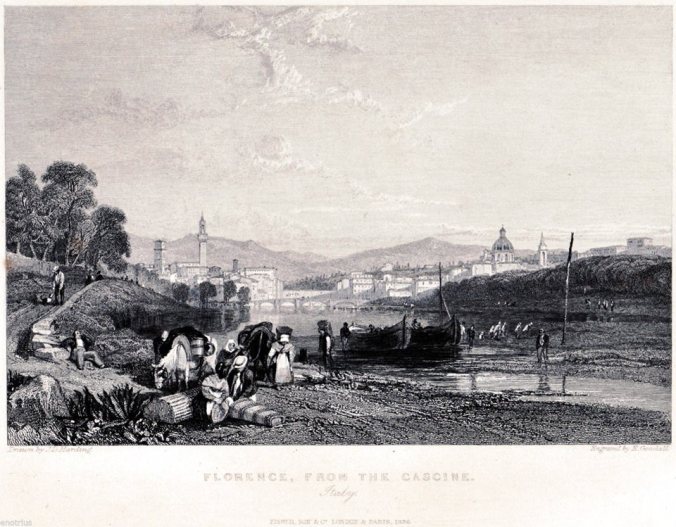
Florence from the Cascine, an old view
I love to look at old images of Florence through the ages. Here is a good one!
Firenze, Panorama dalle Cascine. Stampa Antica.
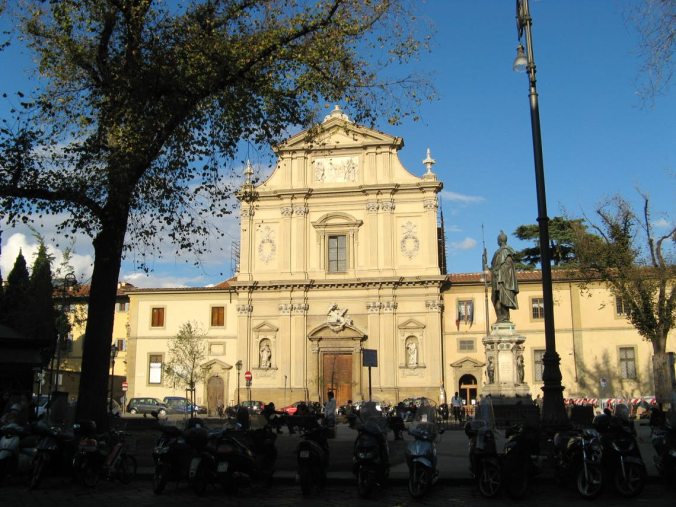
San Marco, Firenze
The monastery of San Marco, which stood just two blocks north of the Palazzo Medici, had been founded in the thirteenth century. However, it had been completely renovated and considerably expanded by Lorenzo the Magnificent’s grandfather, Cosimo de’ Medici in the 1450s.
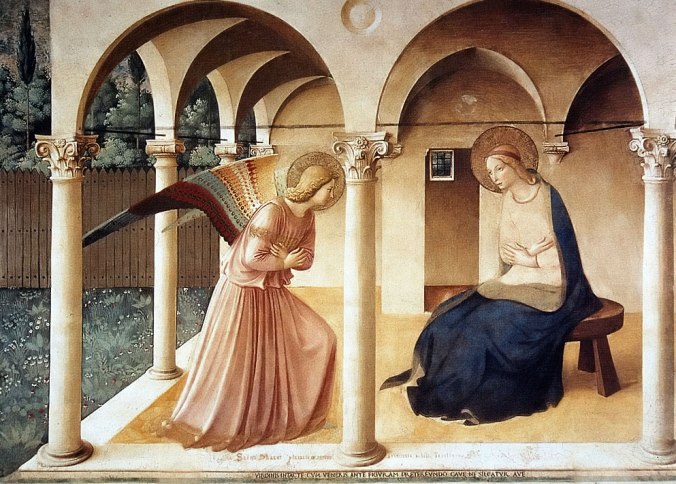
Cosimo had used his favourite architect Michelozzo Michelozzi, and incorporated the work of the resident monk Fra Angelico, one of the great early Renaissance artists.
Michelozzi would be responsible for some of the finest early Renaissance architecture in Florence, including the renovation of the Palazzo della Signoria and the design of the Medici villa at Careggi.
For his part, Fra Angelico’s ethereal paintings would heavily influence Michelangelo, whose depiction of God’s finger passing on life to Adam in the Sistine Chapel was directly inspired by the artist-monk.
The work of Fra Angelico and Michelozzi came together at San Marco in the delightful shaded San Antonio cloister, whose delicate pillars and colourful frescoes enclosed a tranquil green garden in the midst of the monastery.
Cosimo de’ Medici had undertaken the renovation of San Marco late in his life, intending it as absolution for the sin of usury, which had enabled him to accumulate his fortune as a banker. Yet there had also been a less manifest reason for Cosimo’s benevolence, one that explained why in particular he chose to lavish his wealth on San Marco, rather than other similarly prestigious monasteries in the city.
Before the 1433 coup which had removed Cosimo from power in Florence, almost costing him his life, he had managed in the nick of time to transfer secretly to San Marco a large quantity of the funds held in the Medici bank in Florence.
After Cosimo’s banishment into exile, his enemies had raided all Medici premises, as well as those of known supporters, but had been unable to discover the whereabouts of these funds, which had been held on trust, without a word, by the monks at San Marco.
In consequence, Cosimo had spared no expense on the rebuilding of San Marco, which eventually cost 30,000 florins – an unprecedented sum at the time.
The monastery had been furnished with a library, together with many hundreds of religious manuscripts, intended for public use – the first lending library in Europe.
Instead of the usual communal dormitory, each monk was assigned his own cell, many of which contained frescoes painted by Fra Angelico and his assistants. These were mainly portrayals of angels and biblical scenes.
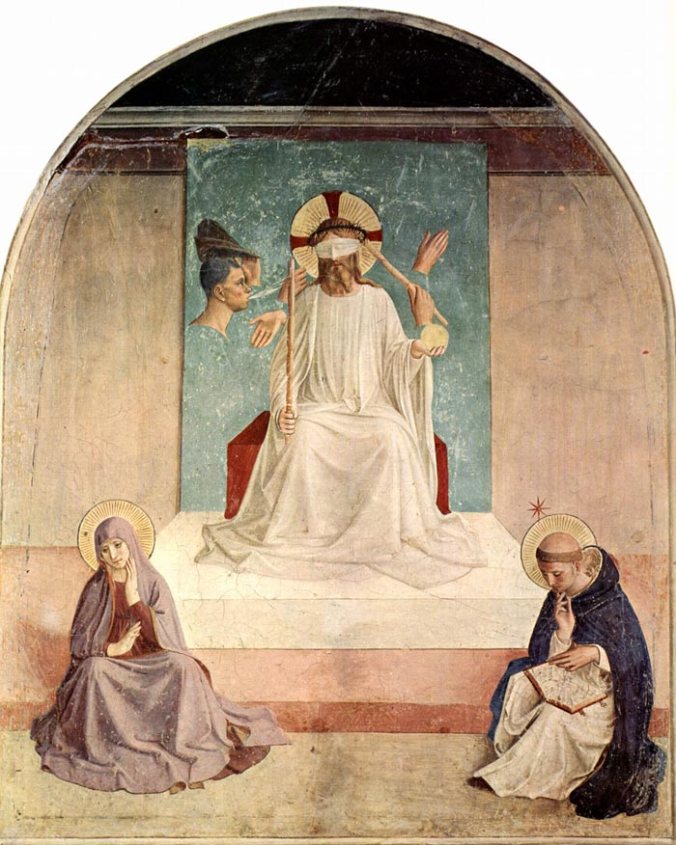
A special double cell, sumptuously frescoed, had been created for Cosimo’s personal use, to which he would often retire for periods of contemplation.
However, he had taken a more active role in the creation of the gardens across the street from San Marco: as a man who delighted in retiring to the countryside, he had done his best to create a pastoral space here within the walls of the city. These gardens would in turn become a favourite spot of Lorenzo the Magnificent, who began decorating the shady spaces with pieces of ancient classical sculpture.
.
Strathern, Paul. Death in Florence: The Medici, Savonarola, and the Battle for the Soul of a Renaissance City, Pegasus. Kindle Edition.
\
Un concerto in Fiesole
On a recent beautiful weekend, I had the chance to visit Villa Salviati, a gorgeous locale in the hills outside of Florence. Singers from a Florentine operatic school performed in the main building’s cortile. It was so beautiful and here’s a sample.
Villa Salviati

Villa Salviati is home to the Historical Archives of the European Union, a unique resource for researchers at the EUI and far beyond.
By housing the European Union archives, the long international tradition of this villa is continued. Over the centuries this villa had Italian, French, Swedish and American owners.
The estate has naturally strong ties to Florence as well, as the original owners, the Salviati family, wealthy wool merchants and bankers, were in the 15th century closely connected to the Medici that held great power and influence in the city.
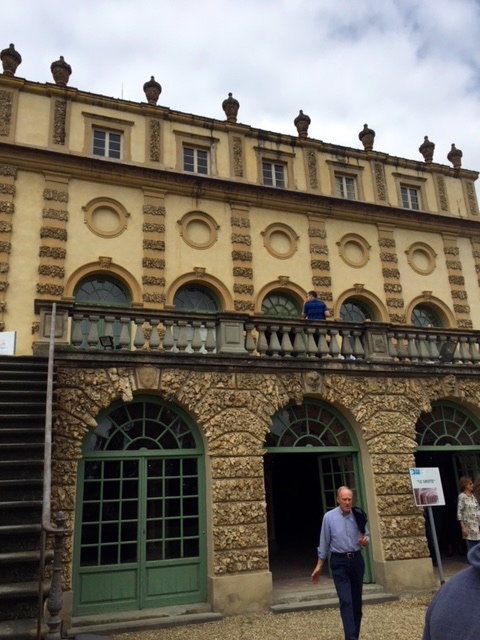
The Salviati family’s fortune grew and they went on to add grottos to the site which still stand today. The grottos are made up of frescoes and elaborate stonework that hark back to an era of affluence.
https://www.eui.eu/ServicesAndAdmin/LogisticsService/EUICampus/VillaSalviati
An entryway that takes my breath away
I wonder what it would be like to come home to this Florentine entryway every day. I think it almost magical, because it is so gorgeous!
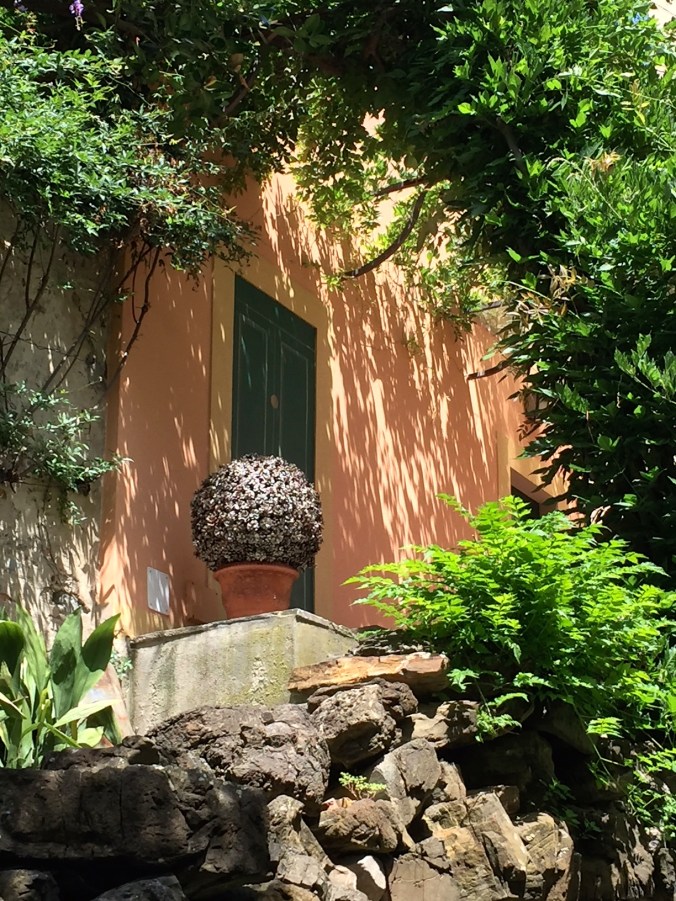
Villa Salviati

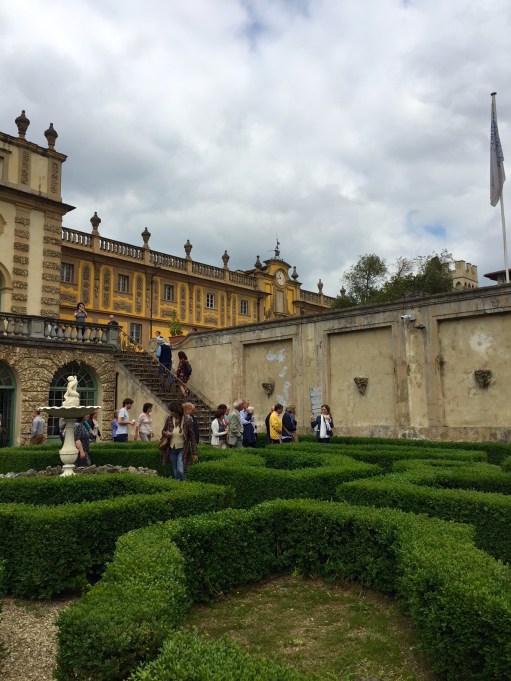
A couple of weekends ago, I had the pleasure of visiting a famous villa in Fiesole, the Villa Saliviati.
Of course the villa has its own (gorgeous) chapel; here is a detail of the ceiling:
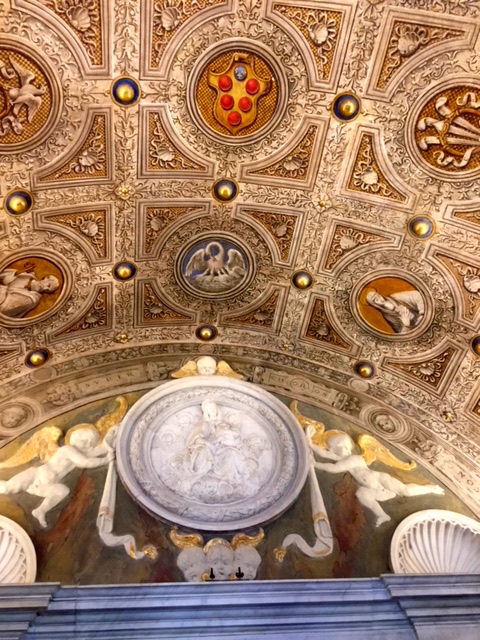
And the villa also has a grotto:
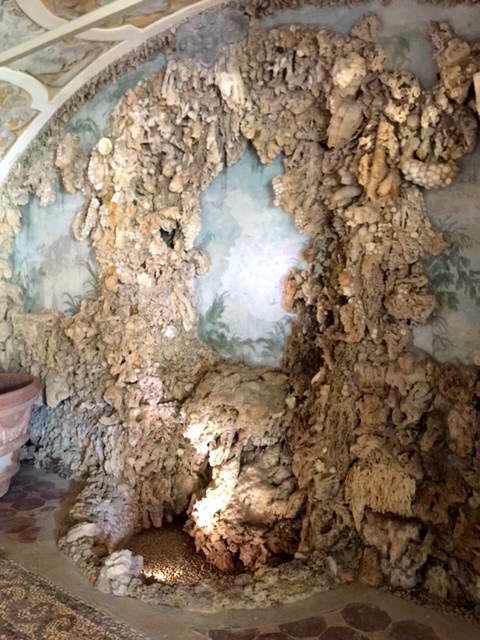
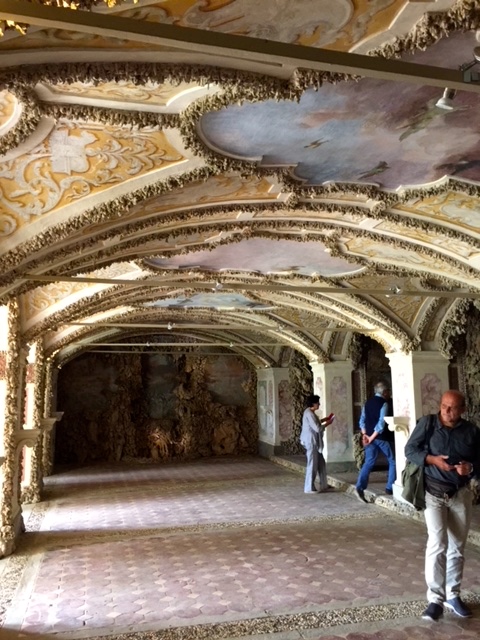
There is a lot of interesting interior detailing:
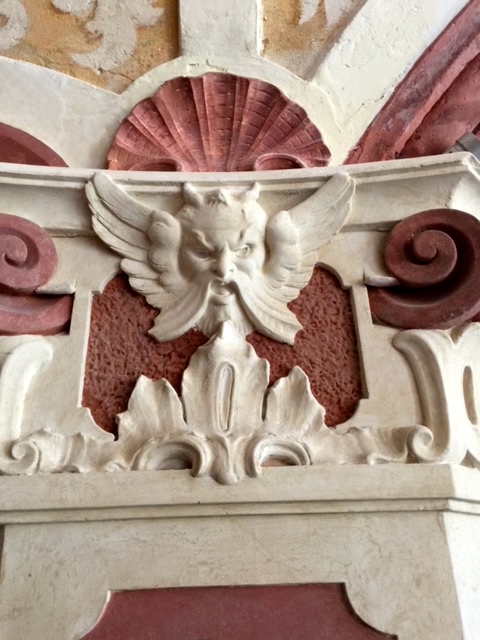


So, now you’ve seen my pictures, let’s get some info from Wiki on the Villa:
History [ edit | wikitesto change ]
In the 14th century, the castle of the Montegonzi was built on this property land already belonged to the Del Palagio. In 1445, Arcangelo Montegonzi sold it to Alamanno Salviati , the man who introduced the cultivation of salamanna and jasmine grapesin Tuscany.
Alamanno commissioned Mielcozzian workers to reduce the castle to a villa, with a garden and woods . In 1490, the nephews of Alamanno, dividing their uncle’s assets, and gave the villa to Jacopo, who was related to Lorenzo de ‘Medici.
In 1493, new, considerable renovations were undertaken, to which perhaps Giuliano da Sangallo took part and which lasted about a decade.
Giovan Francesco Rustici also took part in the works. Between 1522 and 1526 he created for the villa a series of terracotta roundels with mythological subjects (such as Apollo and Marsyas or Jupiter and Bellerophon ).

Today the Villa’s Limonaia is the the headquarters of the Historical Archives of the European Union.
In 1529, the house was sacked by the anti-cult faction and between 1568 and 1583 Alamanno di Jacopo Salviati and his son Jacopo further enlarged and embellished the villa, with the gardens ( 1570 – 1579 ) and the buildings that border the northern border and create a scenic backdrop connected to the villa.
New Year’s eve, 1638, was an event to remember. That evening, in this villa, the severed head of the lover of Caterina Canacci, was brought to the villa, hidden under the linen that the wife of Salviati, Veronica Cybo, sent him weekly.
The villa then passed to the Aldobrandini – Borghese and on December 30th 1844 it was bought “with a closed gate” (ie with all the furnishings) from the Englishman Arturo Vansittard.
Then came the tenor Giovanni Matteo De Candia aka Mario, who lived there with his wife, the soprano Giulia Grisi , the Swedish banker Gustave Hagerman and finally, in 1901, the Turri.

The grotto:
During the WWII, the grotto was used as the post of an allied command: Lensi Orlandi recounted the memory of nocturnal visits of “kind and rich Florentine, often mature matrons”, who “crossed the threshold of those rooms to give honor to the admired winners” [2 ] .
There followed a long semi-abandonment, in which the villa was not accessible even to scholars (he visited Lensi-Orlandi in 1950, but could not Harold Acton in 1973 ).
In 2000 the monumental complex, together with its gardens, was purchased by the Italian Government to be destined for the European University Institute , which made it the seat of the Historical Archives of the European Union ; one can mention, among the various documents contained in them, the personal papers of the founding fathers, such as Alcide De Gasperi , Paul-Henri Spaak , Altiero Spinelli and Ernesto Rossi .
The end of the renovations took place in October 2009 and on December 17, 2009 the President of the Republic Giorgio Napolitanoinaugurated the Historical Archives of the European Union .
This villa was in communication with Villa Emilia (which was higher up) – which in ancient times was a convent of Cistercian nuns suppressed in 1453 – through an underground gallery : hence the other name with which the villa is known, “del Ponte at the Badia “.
Architecture [ edit | wikitesto change ]

The courtyard
The main body of the villa reveals its military origins, especially in the two crenellated turrets, in the corner, and in the crowning with the walkway on corbels , very similar, for example, to that of the villa of Careggi . It is made up of two adjacent buildings, but with similar architectural features: the east one is more massive and tall, the west one is of smaller volume and height.
The building is arranged around the central courtyard, portico on three sides with columns in pietra serena with Corinthian capitals ;the entablature towards the inside is decorated with graffito friezes, with the rounds of the Rustici inserted into this strip in correspondence with the round arches.
The interiors are often covered by vaulted , barrel and cross vaults .
Gardens [ edit | wikitesto change ]

The gardens
You get to the south facing of the villa through a long cypress avenue that once led to the Via Faentina and that after the construction of the railway was modified, creating a passage on it.
The Italian garden , in front of the villa, is built on three terraces at different levels and, although it is being restored, it is made up of geometric flower beds in boxwood with flowery essences. The property is then surrounded by a large English park , where there are, among other things, a bamboo grove, two ponds and, scattered here and there, various items of furniture, such as statues, temples, caves, fountains, pavilions and more.
Villa Salviati , or villa of the Ponte alla Badia , is located along the homonymous street near via Bolognese in Florence , [1]
Florence, an open-air museum and a protected UNESCO site
I think it is always worth reminding ourselves that Florence, the Renaissance city, is one of the most beautiful and visited art cities in the world. It is truly an open-air museum, placed in the UNESCO’s World Heritage List in 1982. Let’s make a quick rundown of some of the major sites within the city.
Piazza Duomo is the religious centre of the city, featuring the Cathedral of Santa Maria del Fiore and the majestic Brunelleschi’s Dome, Giotto’s Bell Tower, and the Baptistery of St. John the Baptist, with its world renowned bronze doors.
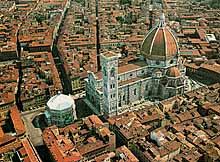
The square is surrounded by wonderful palaces, such as the Archbishop’s Palace, the 14th-century Loggia del Bigallo and the recently renovated Museo dell’Opera del Duomo (Museum of the Works of the Cathedral) which recreates the original feeling of the 14th-century façade according to the first project by Arnolfo di Cambio with great technical virtuosity.
The absolute masterpiece housed within the Museo dell’ Opera is the Deposition (or Pietà) sculpted by Michelangelo for his own grave.

In the sculpture, Nicodemo, represented at the top centre, has Michelangelo’s facial features. Some parts of this marble sculpture are unfinished, as Michelangelo often did in order to witness the spirit struggling to break free from block of stone. In 1555, in an outburst of rage, the same artist partially damaged his own sculpture with a hammer.
Piazza della Signoria is the heart of the socio-political life, as well as the seat of civil power with Palazzo Vecchio (previously known as dei Priori and della Signoria). The square hosts important works of art such as the equestrian monument of Cosimo I de’ Medici, by Giambologna. Next to the palace, you can admire the fountain of Neptune by Bartolomeo Ammannati, also called the ‘Biancone’ due to the huge white marble statue of the sea god at the centre of the fountain, riding in a chariot roomed by four horses.
In front of the main entrance of Palazzo Vecchio, you will find copies of two sculptures by Donatello: Marzocco (the lion symbolising the city of Florence) and Judith Beheading Holofernes, in addition to a copy of the David by Michelangelo, whose original statue is preserved inside the Galleria dell’Accademia (Gallery of the Academy of Florence). Next to David, the statue of Hercules and Cacus by Baccio Bandinelli, symbolises strength and ingenuity prevailing over evil.
On the right, facing Palazzo della Signoria, you will find the Uffizi Gallery, one of the most important museums in the world, which once hosted the offices and the state archives of the Grand-Duke. The museum boasts an incomparable collection of Italian and European art from the 13th century on.
In addition to masterpieces by Cimabue, Giotto, Masaccio, Botticelli, Leonardo, Piero della Francesca, Michelangelo, Raphael, Titian, Caravaggio, Dürer, and many others, there is also a remarkable collection of ancient sculptures.
The Vasarian Corridor is a spectacular elevated enclosed passageway, connecting Palazzo Vecchio with Palazzo Pitti and offering, from above Ponte Vecchio, a breath-taking view on monuments and on the Arno with its bridges. The corridor hosts a collection of self-portraits, in addition to an important 17th and 18th-century collection of paintings.
The Galleria dell’Accademia hosts the highest number of sculptures by Michelangelo, such as the Prisoners, St. Matthew and the famous David, in addition to important paintings from the second half of 13th century to the end of 16th century, as well as the Musical Instruments Museum.
The National Museum of the Bargello, located inside a palace built in mid-13th century for the Capitano del Popolo (Captain of the People), boasts some of the most important statues of the Renaissance by Ghiberti, Donatello, Verrocchio, the Della Robbia family, Michelangelo, Giambologna, and others. Do not miss the prestigious collections of little bronze statues, maiolica, wax models, enamels, medals, ivory, tapestry, furniture, seals and textiles coming from the Medicean collections or donated by private collectors.
Palazzo Pitti, with its wonderful Boboli Gardens, represents one of the most important monumental complexes with its museums – the Palatine Gallery, the Monumental Apartments, the Silver Museum, the Modern Art Gallery, the Costume Gallery, the Porcelain Museum and the Carriages Museum.
Among the most representative testimonies of the Florence Renaissance, the city boasts some masterpieces planned by Filippo Brunelleschi (in addition to his world renowned Dome) – the Ospedale degli Innocenti (Hospital of the Innocents) and the two churches of San Lorenzo and Santo Spirito – and by Leon Battista Alberti – the façade of the Santa Maria Novella church and Palazzo Rucellai.
Piazza della Repubblica is the “élite square” of the city, with its great historic cafés and 19th-century buildings. The historic centre of Florence is a shopping and entertainment paradise, with the most famous fashion designer boutiques, traditional handicraft workshops, historical markets and typical restaurants, as well as American bars, lounge bars and discos.
Do not miss the churches of San Miniato al Monte, Santa Croce and Santa Maria Novella, as well as the great masterpieces of Italian 20th -century architects, such as the Central Railway Station of Santa Maria Novella and the Artemio Franchi football stadium, respectively by Giovanni Michelucci and Pier Luigi Nervi.
Pantheon, all dressed up
Palazzo dei Pittori, my new neighbor
My new apartment is right across due viale from the very handsome Palazzo dei Pittori. The palazzo and I are separated by 2 viale or boulevards and one stream (the Mugnone), and I always admire the facade of the palazzo whenever I gaze across this space. There is nothing blocking my view except some beautiful green trees and a stream, and two grand-scale viali or boulevards. The Palazzo provides a gorgeous backdrop!
Here is a Youtube video about the palazzo and its current iteration.
And here is some background info garnered from the web on this fine structure:
On Saturday May 16th, 2016, the beautiful Palazzo dei Pittori reopened to the public – on the occasion of the 150th anniversary of Florence Capital – a building that has always fascinated and intrigued Florentines and others. The president of the culture commission of the Municipality participated in the event.
The building, intended for the studies of artists, has always been called “Palazzo dei Pittori” and located on the southern bank of the Mugnone stream, today Viale Giovanni Milton, at numbers 47 and 49.
The building was commissioned by an English painter named Lemon who was living in Florence. It was designed by the architect and engineer Tito Bellini and built in the 2nd half of the 19th century to host artists of various nationalities including English, German, Russian, Swiss and also Italians, all of whom created art during the time that Florence was the capital of Italy (1860-1865).
The Palazzo dei Pittori itself was built during the “Umbertino period,” with its large spaces and austere decoration.
From its construction to the present day, there have been many well and lesser known artists who have worked in the palace, including the Sicilian sculptor Domenico Trentacoste, the Macchiaiolo painter Egisto Ferroni, Giovanni and Romeo Costetti, the sculptor Giuseppe Graziosi and many others. It was also home to a prestigious school of painting called the “Florentine School of Painting,” directed by professors Giuseppe Rossi and Alberto Zardo.
Other creative artists also worked in this atelier, including poets and writers such as Gabriele D’Annunzio and Mario Luzi.
This is therefore a place that houses an important but forgotten past, vaguely mysterious, waiting to be discovered.
Palazzo Davanzati and Elia Volpi
One of my favorite places in Florence is the Palazzo Davanzati. One look at one of the rooms in the palazzo will show you why I love it. I visited it on my very first trip to Florence, almost 40 years ago. It hasn’t changed one bit, except maybe it is even better now with more didactic info available.
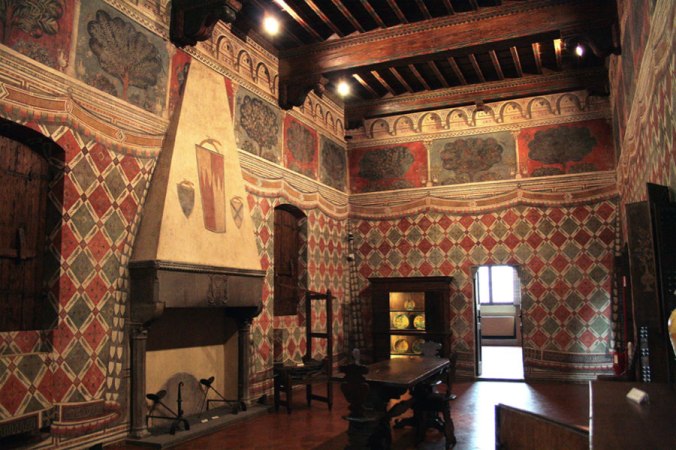
We have the art dealer, Elia Volpi (1858–1938), to thank for having saved the Palazzo as it appears today. In Florence, Volpi is known as the “father” of the Museum of the Old Florentine House in Palazzo Davanzati, as he was responsible for restoring the building and turning it into a private museum in 1910.
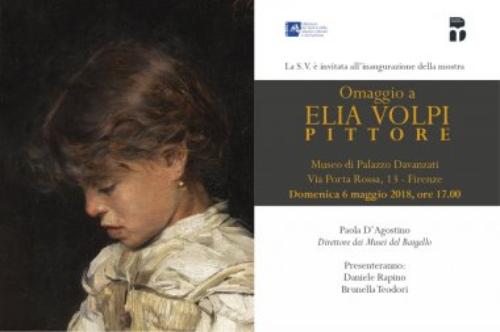
Now the museum, on via Porta Rossa, is opening its “Homage to Elia Volpi the Painter” exhibition, which offers the chance to discover a lesser-known side of the illustrious collector and antiquarian, that is, to see him as an artist.
Volpi trained at Florence’s Academy of Fine Arts. The current exhibition focuses on his training and the paintings he produced from the 1870s through the 1890s, with examples of his sketches and finished paintings, mostly in pristine condition. All of these works have been donated to the museum from private collections.
Volpi’s sketches are testament to his studies of the Italian Renaissance masters and, along with the male nudes, show off the early artistic skills of a young Volpi.
The paintings demonstrate his broad range; during the 1880s he explored church scenes before concentrating on the subjects and style of the Macchiaioli and more contemporary artists such as Francesco Gioli and Niccolò Cannicci.
The show also includes a multimedia section featuring a video that focuses on the artist’s personal life and a touch-screen panel with photographs that demonstrate the creation of the museum.
The exhibition is open from May 6 to August 5 in the Palazzo Davanzati Museum.
The source of this info comes from:
http://www.theflorentine.net/art-culture/2018/05/elia-volpi-exhibition-palazzo-davanzati/
 get back, lauretta!
You must be logged in to post a comment.