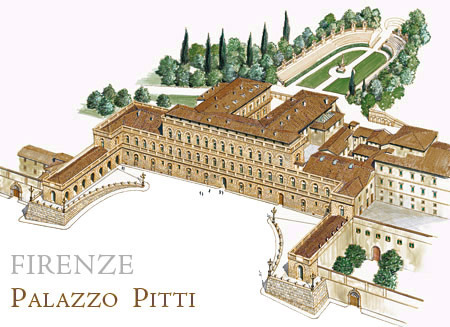
At Palazzo Pitti, the builders had it much easier, since their source [of stone] (the Boboli hill) was right behind the palace. In fact, Palazzo Pitti sits on the hollowed out part of one of these quarries.
At Palazzo Pitti, the builders had it much easier, since their source [of stone] (the Boboli hill) was right behind the palace. In fact, Palazzo Pitti sits on the hollowed out part of one of these quarries.
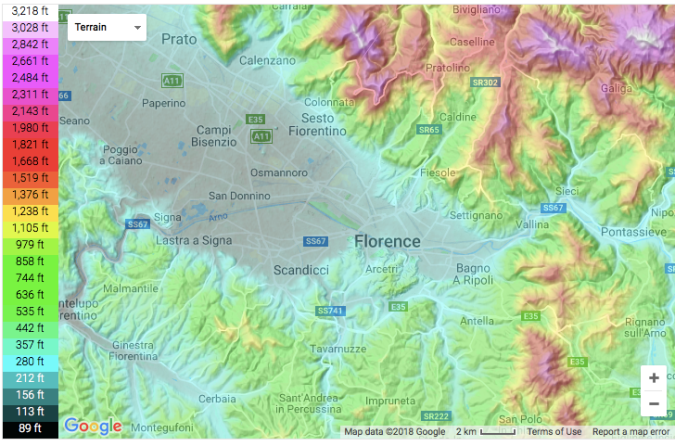
Has it ever occurred to you that the stony city of Florence was literally carved out of the surrounding hills? It’s quite true. Countless local quarries provided the blocks of stone for the walls of medieval and Renaissance churches and palaces, and for the columns and architectural ornaments to decorate them. Pietraforte, a kind of light brown limestone, came from quarries at Costa San Giorgio, in the Boboli hill between Santa Felicità and Porta Romana, at Bellosguardo, and around Marignolle and Le Campore, all south of the Arno. To the north, the hills of Fiesole, Maiano and Settignano provided the blueish-grey sandstone pietra serena.
In the 13th century, load after load of pietraforte was hauled over the Arno to the outskirts of Florence to construct the enormous basilicas of Santa Maria Novella and Santa Croce. Even the piers inside these two churches are of pietraforte. Look at Palazzo Vecchio, the Log-gia dei Lanzi, the Bargello and Orsanmichele, and you are looking at pieces of the southern hills transformed into architecture. The gigantic blocks of rustication that you see on the façades of the 15th-century Palazzo Medici were cut out of pietraforte quarries. Filippo Strozzi, whose palace rivals that of the Medici in size, had endless loads of stone brought from quarries at Boboli and Marignolle. It is said that between November 1495 and March 1497, Strozzi’s heavily-laden carts rattled over the Arno more than a thousand times. At Palazzo Pitti, the builders had it much easier, since their source (the Boboli hill) was right behind the palace. In fact, Palazzo Pitti sits on the hollowed out part of one of these quarries.
If pietraforte was used mainly for the construction of walls, pietra serena was used above all for columns, stairs, doors and windows. The oldest of these quarries, dating back to Etruscan times, were at Monte Ceceri in Fiesole, and they continued to be worked during the Roman and early medieval periods. The demand for pietra serena was so high that in the 13th century new quarries had to be opened further east, around Vincigliata and Settignano. By the 15th century, when Brunelleschi’s architectural style boosted the popularity of pietra serena to unprecedented heights, it was also being extracted at Golfolina, west of Florence.
Brunelleschi chose quarries that would provide enormous blocks of pietra serena from which he could cut entire column shafts. He quarried the stone for the loggia of the Ospedale degli Innocenti at Trassinaia, near Vincigliata. The columns for San Lorenzo came from a site nearby, still known as the Cava delle Colonne.
http://www.theflorentine.net/art-culture/2006/09/quarries-near-florence/

In its heyday, Bagni di Lucca, with its cool climate and great variety of hot springs had been a very fashionable European holiday resort and spa town. Beautiful elegant hotels had been built all around the spas. Villas, owned by heads of state and various ambassadors and dignitaries were crammed with antique furniture, musical instruments and rare books.

There were cultural centres, casinos, Anglican churches and cemeteries, restaurants and theatres. Famous poets, singers, playwrights, writers, actors and actresses used to flock there in the summer months. Presumably, many wars and marriages were arranged and important state decisions taken inside those thick stone walls, so far from indiscreet ears.

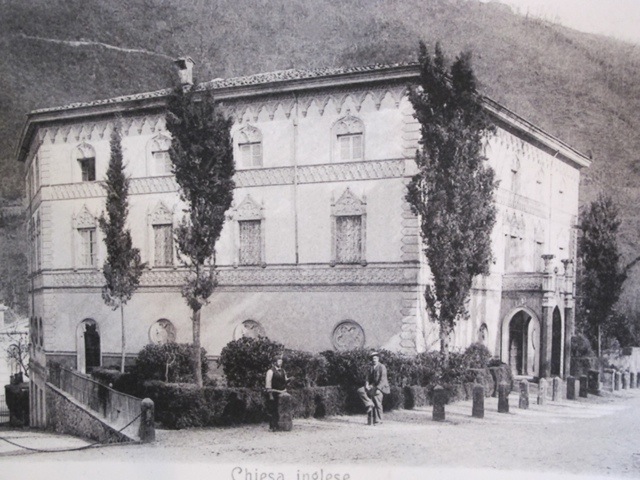
With the advent of fascism in Italy, renewed nationalism and World War Two, the “guests” of Bagni di Lucca suddenly became completely undesirable, and were later either deported or forced to flee.
Their properties were confiscated which meant that the local fascist bosses, for the most part rude uneducated thugs, suddenly had access to and became owners of luxurious properties full of rare works of art. There are tales of grand pianos being chopped up for firewood, rare books being transported to the local paper mills and being sold by the kilo, manuscripts being burnt on bonfires, and paintings being thrown out on to the grass where rain and sun eventually got the better of them.
Some of the villas miraculously passed into the hands of new owners. Deeds were drawn up, and illiterate mountain folk suddenly felt like princes and princesses. Some were used for more sinister purposes, housing torture and detention centres for political opponents, intellectuals and partisans or worse, boarding houses for Jewish and gypsy children before they left for their final destinations.
The grand rooms and theatres, which had housed great composers and musicians, were turned almost overnight into brothels or barracks for Mussolini’s troops.
At last! Many dignitaries thought that law and order has been restored. We are in charge again and those foreigners got what they deserved!
Of course, things didn’t quite turn out as expected. Italy did not get its empire, but instead a humiliating loss in which not only did it once again have to bow down to the overwhelming power of the Anglo-American armies, but it also had to sign really unfair future agreements, thus becoming a near slave to the foreign oil barons, military-industrial complexes, big Pharma religion and cars and motorways.
After the war there was no money for the upkeep and maintenance of the once magnificent hotels and spa complexes and anyway the whole of Italy was busy doing other things. People were emigrating in hordes, abandoning villages, hilltops and mountains for large industrial cities in the north, going to work in the booming car industries or in foreign cities.
The people were all working like busy bees for their new masters, building motorways and high rise blocks of flats, spraying clean fields, vineyards and fruit farms with toxic pesticides, getting rich and watching TV.
Bagni di Lucca became a ghost town. Gone were the shepherds and their flocks, the orderly rows of vegetables, the pigs, cows, geese and ducks, the large families and old traditions. Winters passed and vegetation covered the villages and country lanes. Vines grew over and smothered the beautiful old buildings until there was nothing left, except memories in books which no one ever opened.
Small factories sprang up in Bagni di Lucca: paper mills spewing out clouds of black smoke and colouring the rivers pink and blue, and the souvenir industry which exported plastic figurines to many parts of the world. The owners of these businesses became very wealthy and the only people left who had not emigrated elsewhere worked entirely for the “benefactors” who could therefore pay as little or as much as they liked, as people had no other alternative.
In the 1960s and 70s, people had started to talk about the possibility of starting up the tourist business once more but this was generally discouraged by the benefactors as it would have meant distraction for their workers. So by the time the international association arrived in town they were entering a world which might as well have been in a time warp.
Actually, as we later found out, they, being mostly highly intelligent and educated people, had vision and they had realised back then that it was time to flee the big cities before globalisation, the de-industrialisation of Italy, mass unemployment, climate change, wars for oil and water and social unrest hit us all. They were right about that, they just chose the wrong place.
Welcome to Tuscany.
Lord, Anna. Welcome to the Tuscan Dream: Italy’s Broken Heart (p. 63). Scribo Srl. Kindle Edition.
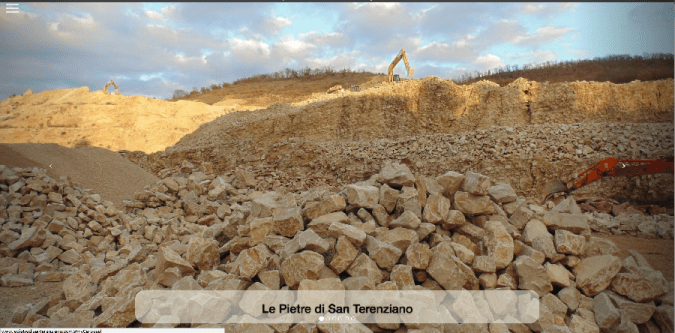
The Settignano quarries yielded macigno, a fine-grained grey sandstone that was much prized in Florence. It is a gravely beautiful material in a range of dark-greenish and bluish greys, fine enough to carve in crisp detail and with a quality of simultaneously absorbing and reflecting the light, producing a paradoxical impression of dark luminosity.
This is the material that Brunelleschi used for the columns and capitals of his buildings. Michelangelo would employ it in the same way in his projects at San Lorenzo in Florence.
The Florentines, being interested in this stone enough to make fine distinctions, gave names to the differing grades, the finest type being pietra del fossato, and the others including pietra serena and pietra forte.
Michelangelo, who had immense sensitivity to stone, went further than these broad categories. He knew that each quarry, every stratum, would produce material of subtly differing character. The contract for the stairs and two doors of the library Michelangelo was building at San Lorenzo in the 1520s stipulated that the pietra serena supplied should be of the same ‘colour and flavour’ (‘ colore et sapore’) as in the sample. ‘Flavour’ is a wonderful word to use of stone: bringing out its sensuous character as if it were actually edible.
When he designed buildings in Rome, Michelangelo was attentive to the qualities of the local material, travertine, a limestone noted for the pits and troughs in its surface – as different in its flavour and colour from Florentine sandstone as roast beef is from pâté de foie gras. His use of travertine for the walls of St Peter’s and the palaces on the Capitoline Hill made the most of its rugged nature.
For sculpture he used only the finest type of pure white marble, known as statuario, found particularly in certain quarries above Carrara. Even this sculptor’s marble, according to the sculptor and goldsmith Benvenuto Cellini, came in at least five or six grades, the first having a ‘very coarse grain’ and the softest, which he describes almost like flesh, ‘the most cohesive, the most beautiful and the tenderest marble in the world to work from’.
Michelangelo was renowned for his ability to discern the quality of a potential piece while it was still in the rockface. When he was engaged from 1516 onwards on large construction projects at San Lorenzo in Florence which involved the quarrying, transport, dressing and carving of huge amounts of both marble and macigno, a majority of the masons he employed were from Settignano.
Gayford, Martin. Michelangelo: His Epic Life (Kindle Locations 803-811). Penguin Books Ltd. Kindle Edition.
Before Charles Eliot Norton had become Harvard’s first professor of that discipline, art history had, in general, been considered, not a field of study, but a matter of craft and technique to be taught by painters to other painters.
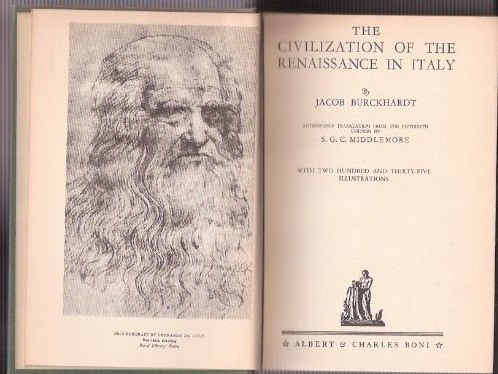
Scholarship about art, and especially about Italian art, entered a new era as the German universities began developing large-scale historical studies like those of Swiss scholar Jacob Burckhardt, whose Civilization of the Renaissance in Italy was published in English in 1878.
In Great Britain, tastes were influenced by the work of Norton’s close friend Ruskin in books like The Stones of Venice (1851–1853) and The Seven Lamps of Architecture (1849).

Following Ruskin, Norton loved best in Italy the powerful moral uplift of Dante and of Italy’s medieval Gothic architecture. In Norton’s art history courses, the Renaissance was the unhappy termination of the Middle Ages, which had been the last great era of spiritual unity and well-being.
There was a joke current among Harvard undergraduates that Norton had died and was just being admitted to Heaven, but at his first glimpse staggered backward exclaiming, “Oh! Oh! Oh! So Overdone! So garish! So Renaissance!”
“Norton,” Bernard Berenson commented drily years later, had done what he could at Harvard to restrain “all efforts toward art itself.”
Rachel,Cohen. Bernard Berenson (Jewish Lives) (p. 45). Yale University Press. Kindle Edition.
LONDON
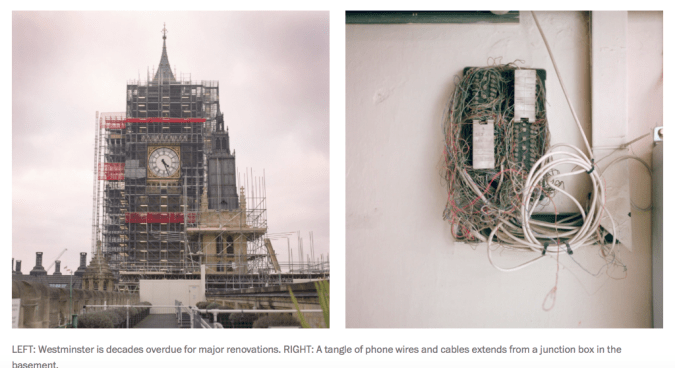
An eccentric masterwork of Victorian genius, its dual chambers for lords and commoners are the living, breathing heart of constitutional monarchy, the home of Parliament, and one of the most photographed buildings in the world.
But Westminster is a wreck, its caretakers say.
The palace is not falling down. Not at all. Its bones, the superstructure, are solid enough, and carrying on, in British fashion, even if its dermis of Yorkshire limestone is spotty.
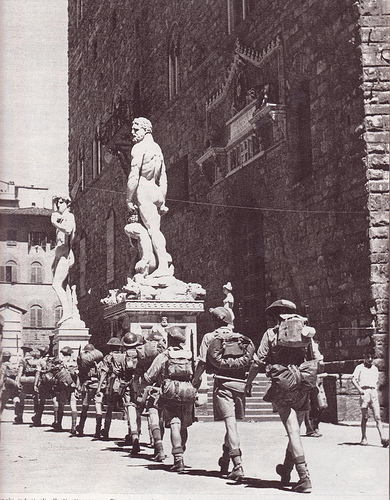
From the safe distance of 2018, it is interesting to think back to the situation in Florence during WWII, especially after the Allied Forces liberated the Renaissance citta’.

The leaders and troops of the Allied Forces are my heroes. There are many to name. General Dwight D. Eisenhower is foremost among them. I recently wrote a post on his directive, which saved many cultural monuments in Italian. Here is a picture of Ike in Italy:

As the Allies liberated region after region in Italy, starting from the southern tip and working their way north, thanks to the farsighted leaders, as many cultural works as were possible were saved.
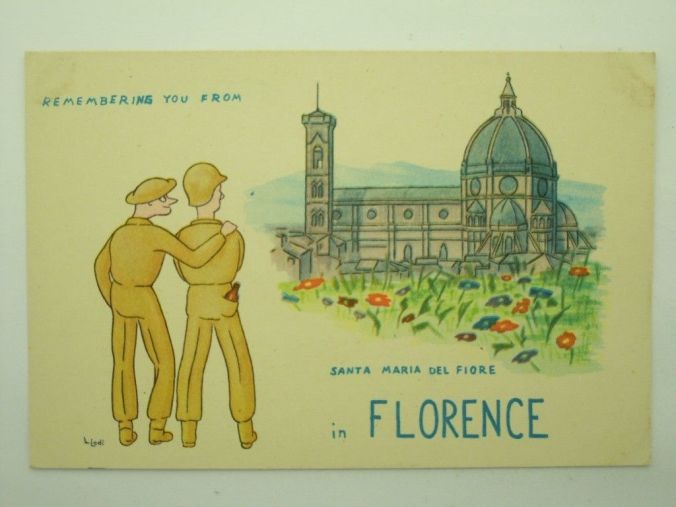
These wonderful postcards, with their simple illustrations of the Florentine architectural masterpieces, tell a poignant story.

The cumulative weight and momentum of General Marshall’s mid-October admonition about the importance of protecting Italy’s cultural treasures, followed by successive warnings from McCloy and Woolley and the reports of Monuments officers themselves, finally produced a change.
On December 29, General Eisenhower Eisenhower issued a directive that placed the responsibility of protecting cultural property squarely upon the shoulders of every commander and, in turn, every officer and every soldier.
It also, for the first time, introduced the Monuments officers (referenced as “A.M.G. officers”—Allied Military Government) to everyone in uniform. Here is Eisdenhower’s directive:
To: All Commanders Today we are fighting in a country which has contributed a great deal to our cultural inheritance, a country rich in monuments which by their creation helped and now in their old age illustrate the growth of the civilization which is ours. We are bound to respect those monuments so far as war allows. If we have to choose between destroying a famous building and sacrificing our own men, then our men’s lives count infinitely more and the building must go. But the choice is not always so clear-cut as that. In many cases the monuments can be spared without any detriment to operational needs. Nothing can stand against the argument of military necessity. That is an accepted principle. But the phrase “military necessity” is sometimes used where it would be more truthful to speak of military convenience or even of personal convenience. I do not want it to cloak slackness or indifference. It is a responsibility of higher commanders to determine through A.M.G. Officers the locations of historical monuments whether they be immediately ahead of our front lines or in areas occupied by us. This information passed to lower echelons through normal channels places the responsibility of all Commanders of complying with the spirit of this letter.
signed: DWIGHT D. EISENHOWER
Ike’s directive was bold; it was concise; and it was now official policy. His Chief of Staff, Major General Walter Bedell Smith, issued an accompanying order that provided more specific details on how this new policy should be implemented.
Woolley remarked that Ike’s words “made it clear that the responsibility for the protection of monuments lay with the army as a whole and not with the [Monuments officer] specialist.”
Even Churchill weighed in on the matter: “The weakness of the Monuments and Fine Arts organization in the past was . . . due to the fact that it had . . . depended on an external civilian body not in touch with the Army. . . . The new arrangements which have been worked out in the light of experience are well calculated to promote, as far as military exigencies allow, a more effective effort to protect historical monuments of first importance in the future.”
Many problems lay ahead for implementing this new order. Mistakes would continue. The order would be put to the test in a major way within just six weeks.
But it marked the turning point for the Monuments officers and their work. For the first time since Mason Hammond had landed in Sicily, the Monuments Men had the backing of the Commander-in-Chief. Their work contributed greatly to the experience Eisenhower would take with him to England to plan the invasion of Western Europe as the newly appointed Supreme Commander of the Allied Expeditionary Force.
Edsel, Robert M.. Saving Italy: The Race to Rescue a Nation’s Treasures from the Nazis (p. 68). W. W. Norton & Company. Kindle Edition.


The villa, the formal garden and the vast park have a splendid location and enjoy a spectacular view over Florence. The place takes its name from a 16th century spring that flows in a thick wood uphill from the villa and which by gravity supplies the water necessary to work the many fountains in the garden and park.
It is likely that the villa itself was built on top of Etruscan ruins, traces of which can be seen in the underground chambers and the immediate surroundings for example in the cyclopean walls which rise in the park. It was however subjected to a series of renovations and transformations before architect Giovannozzi gave it its present day look in the early twentieth Century.
The garden is built on three terraces that slope southwards and has a wooded parterre parallel to the villa. Paolo Peyron was the creator of the lake and the architectural and monumental structure above it. The prestigious statues that decorate the garden in the place of those which were destroyed during World War II come from the Venetian villas of the Brenta.
http://www.fiesoleforyou.it/en/villa-peyron/
info: www.bardinipeyron.it

The eclectic collection consists of nearly 300 works or models, mainly sculptures, by Carnielo, as well as some paintings by Carniello, and some of his colleagues Silvestro Lega, Michele Gordigiani, and Arturo Calosci. Among the works of Carnielo are some macabre sculptures such as Tenax Vitae, Dying Mozart, and Angel of Death.
The small palace is built in the Italian counterpart of Art Nouveau, known as Stile Liberty, and was donated to the commune in 1957 by the sculptor’s son. In October 2015, the museum was temporarily closed.[1]
The design and construction of the palace dates to the 1880s and appears to have involved Rinaldo Carnielo and Enrico Lusini. The facade has various inscriptions including a bust of the artist with the inscription “Non ominis moriar”. A scroll in the center facade states “Onorate l’arte che è vita della vita” (Honor art which is the life of life).[2]
 get back, lauretta!
You must be logged in to post a comment.