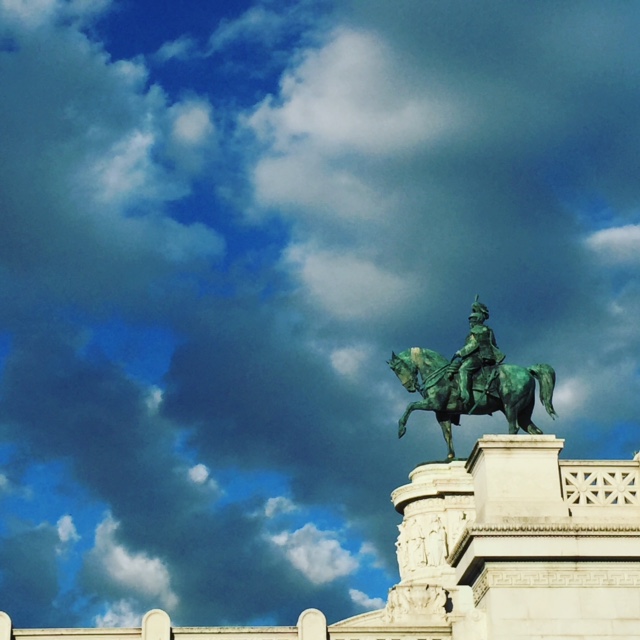
Palazzo Strozzi: an incredible, historic building now repurposed as a superb exhibition space

The Palazzo Strozzi is a superb example of Renaissance civil noble residential architecture in the historic center of Florence.  And it has been repurposed to delightful service of the modern world.

220px-Palazzo_Strozzi_2


Today the palace is used for temporary international expositions, like the one I viewed yesterday, devoted to Bill Viola.


banner-pg2-ing


Before looking at the exhibition, let’s discuss the incredible building:

Filippo Strozzi the Elder (1428 – 1491), the banker and statesman, commissioned the structure after his return to Florence in November of 1466.

Stile_di_niccolò_fiorentino,_filippo_strozzi_(1426-91),_1489,_recto

As a major Medici rival, Strozzi wanted to build the most magnificent home in the city to assert his family’s prominence.  The palace may as well have been intended as a political statement of his own status.  Based on the wishes of Strozzi himself, the palazzo would be built to look like a small fortress in the heart of the city.

The palace was begun in 1489 and designed by Benedetto da Maiano.

250px-Palazzo_Strozzi_03

The Strozzi palace was clearly inspired by the Palazzo Medici, with its rusticated stone exterior, but it is much larger and has more harmonious proportions than its predecessor.  Whereas the Palazzo Medici was sited on a corner lot and thus has only two main sides, the Stozzi is surrounded on all four sides by streets. The Strozzi palace faces the historical  and fashionable Via de’ Tornabuoni, as well as the Piazza Strozzi and on Via Strozzi. The building thus required three imposing entranceways, each flanked by rectangular windows. The Strozzi family’s coat of arms is found in the upper floors.

The siting of the Strozzi in the center major streets provided the challenge of how to integrate a cross-axis in keeping with the Renaissance desire for strict internal symmetry.  As a result, the ground plan of Palazzo Strozzi is rigorously symmetrical on its two axes.

The Strozzi family acquired a great number of buildings in this area were acquired during the 70s and demolished them all to to provide enough space for his new home.

The original architect, Benedetto da Maiano, died in 1497; Simone del Pollaiolo (il Cronaca) took over and was responsible for the completion of the palace. Pollaiolo died in Florence in 1508, but is credited with the design and finish of the central courtyard or cortile, surrounded by an arcade inspired by Michelozzo.

The external facade is adnorned with splendid torch holders, flag holders and rings to tie horses made by Niccolò di Nofri, an iron-worker known as il Caparra.

Unfortunately, Filippo Strozzi died in 1491, long before the construction’s completion in 1538.  Strozzi’s children were the first to live in the palazzo, moving in around 1505.  Ironically, Duke Cosimo I de’ Medici confiscated the palazzo in the same year, not returning it to the Strozzi family until thirty years later.

The palazzo remained the seat of the Strozzi family. Although the family lived in Rome for centuries, the palazzo was returned to its original splendour in the mid-1800s with the Princess Antonietta, and then with Prince Piero, who, from 1886 to 1889, had the building renovated by architect Pietro Berti.  In 1937 the family sold the building to the Istituto Nazionale delle Assicurazioni, and many changes were made to the edifice.  It was later given to the city of Florence in 1999. It is now home to the Institute of Humanist Studies and to the Fondazione Palazzo Strozzi.

Since July 2006, the Fondazione Palazzo Strozzi has been able to create a rich and innovative calendar of events and exhibits, in these areas of the building: Piano Nobile, la Strozzina and Il Cortile.

The Gabinetto G.P. Viesseux and the Renaissance Studies Institute both have also occupied the building since 1940.  Here also is the seat of the Istituto Nazionale del Rinascimento and the noted Gabinetto Vieusseux, with a library and reading room.

Today the palace is used for temporary international expositions like the now-annual antique show, founded as the Biennale dell’Antiquariato in 1959, fashion shows and other cultural and artistic events.


Allora, on to Bill Viola and his video art.

In the exhibition “Electric Renaissance,” Viola seems to have taken certain Renaissance masterpieces and created video dialogues with them.  I would say he is tremendously fortunate to have been able to borrow the original Italian artworks and, even if you don’t love Viola’s work, you will be rewarded with a small, select group of historic masterworks.  For example:

Here’s his dialogue between his video of 3 contemporary women greeting each other, in relationship to Pontormo’s

IMG_3759


IMG_3758  IMG_3757


Other installations stand on their own.  This screen is about 200 feet long by 15 feet high.

IMG_3761


IMG_3766IMG_3767IMG_3768IMG_3769IMG_3770IMG_3771


It grows on you.
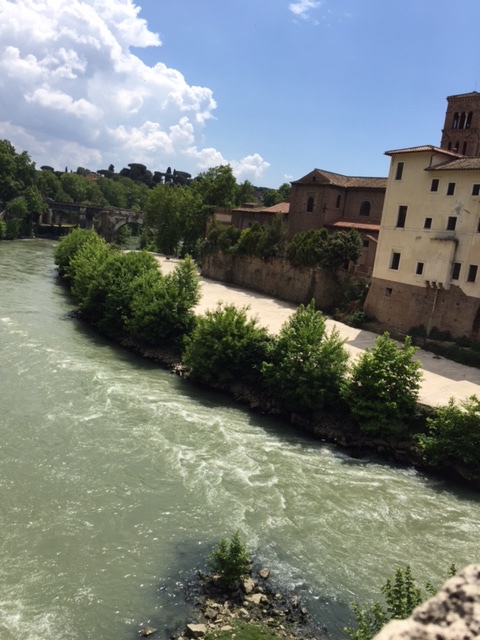
I love this approach to the Duomo.  I walk this path every day.  It never grows old.


IMG_3695

I love this angle of the Duomo as well.  The thousands of tourists gather everyday at the facade of the cathedral, which is clean and polished.  I prefer the gritty side view.  It seems more authentic.

IMG_3696


The side view is actually more authentic, because the fancy facade of the church is a 19th-century confection.  The side is the original building.

IMG_3697

Gritty and real and I love it.  How lucky I feel to see it daily!

IMG_3698

Isola Tiberino, Roma

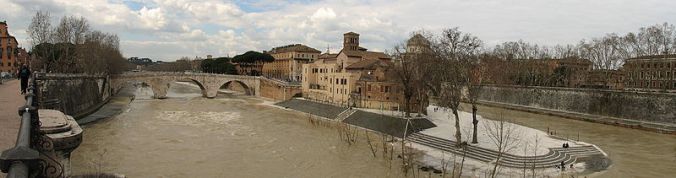
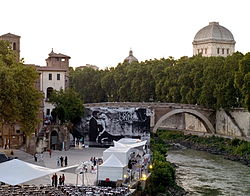
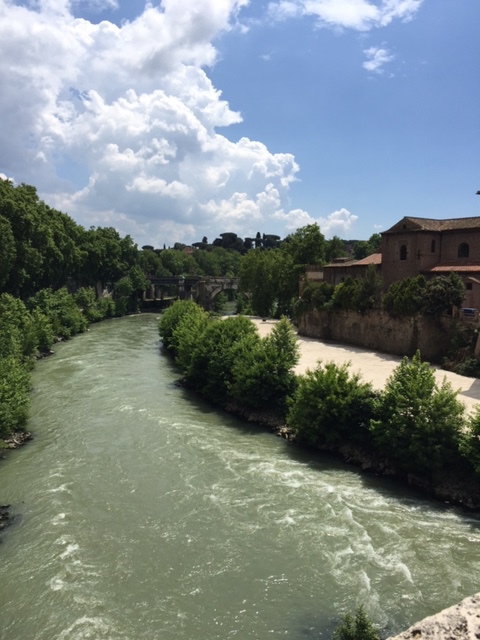
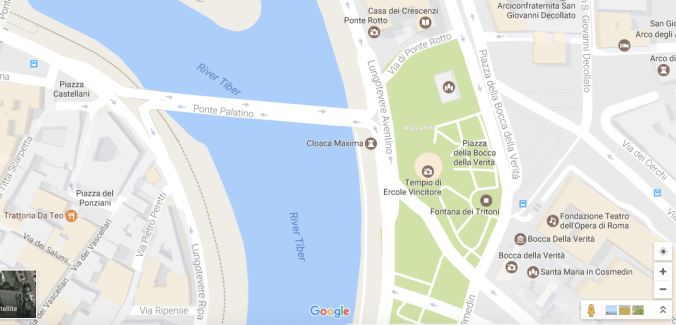
If you like to stroll along the banks of the Tiber River, as I do when the weather is fine, you’ll eventually encounter the small river island known as Isola Tiberino.

800px-Tiber_island_panorama

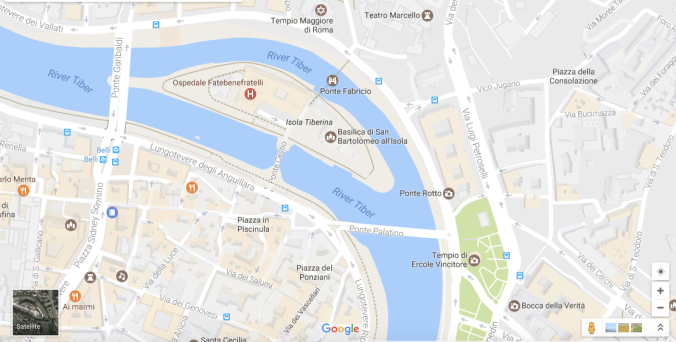
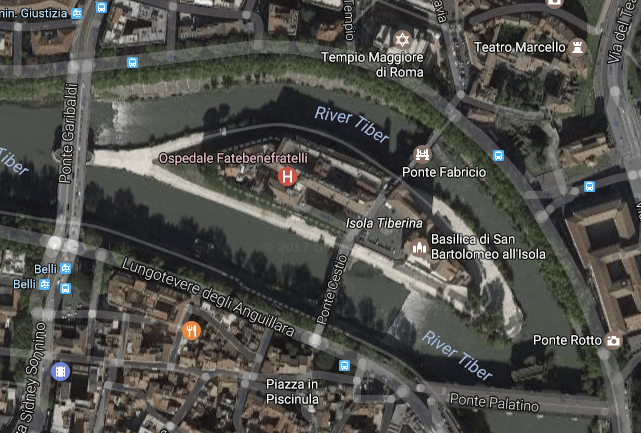
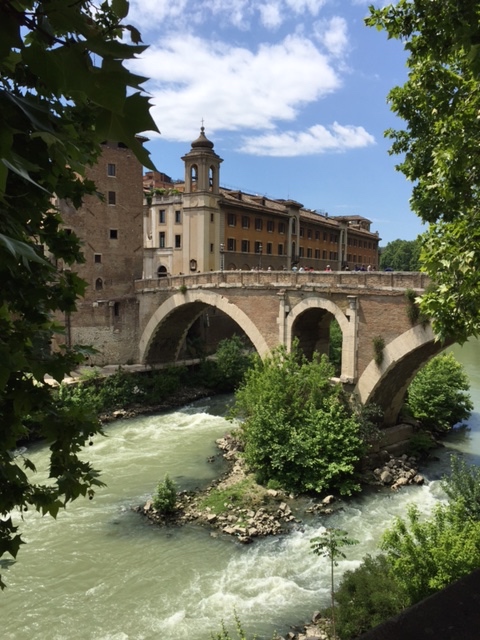
The Tiber Island is the only island in the southern bend of the Tiber river. The purposely boat-shaped island is approximately 270 metres (890 feet) long and 67 metres (220 feet) wide.  It is  and has been connected with bridges to both sides of the river since antiquity.
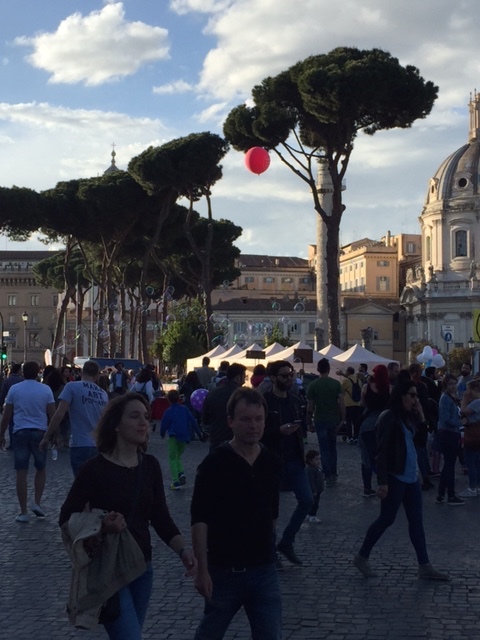
Screen Shot 2017-05-10 at 12.13.08 PM.png

In antiquity, an ancient temple of Asclepius, the Greek god of medicine and healing, was built on the island.

Ancient sources say there was a great plague in Rome in 293 BC and the Senate consulted the Sibyl who instructed them to build a temple to Aesculapius. The Senate sent a delegation to Epidauros to obtain a statue of the deity. As instructed, the delegation went on board a ship to sail out and obtain a statue.

Screen Shot 2017-05-10 at 12.39.49 PM.png

They obtained a snake from a temple and put it on the ship. It immediately curled itself around the ship’s mast, which was deemed as a good sign by them. Upon their return up the Tiber river, the snake is said to have slithered off the ship and swam onto the island. They believed that this was a sign from Aesculapius, a sign which meant that he wanted his temple to be built on that island.

This location may have been chosen for the Aesculapius Temple because it was separate from the rest of the city, which could help protect whoever was there from plague and illnesses.


250px-Tiber_Island


250px-Cinema_ile_Tiberine_Rome


250px-Tiber.island.church.rome.arp

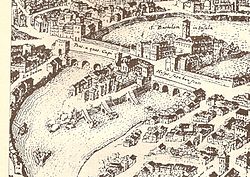
The island eventually became so identified with that temple, that it was modeled to resemble a ship as a reminder of how it came to be. The Romans added travertine facing by the banks to resemble a ship’s prow and stern, and erected an obelisk in the middle to symbolizing the vessel’s mast. Walls were put around the island, and it came to resemble a Roman ship. Faint vestiges of Aesculapius’ rod with an entwining snake are still visible on the “prow”.

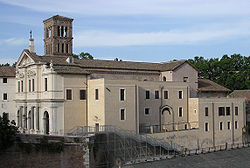
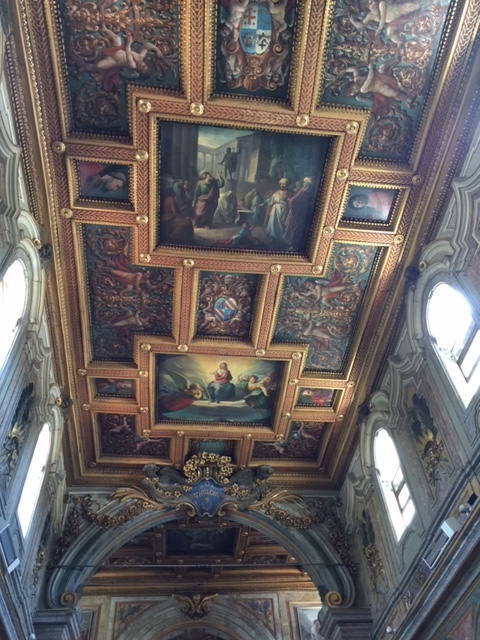
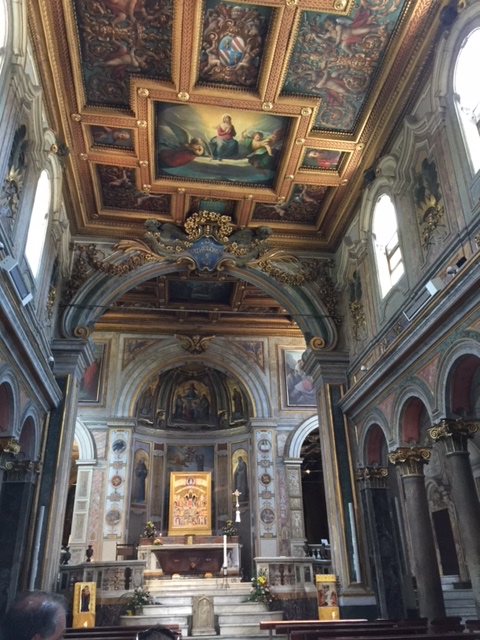
In 998 San Bartolomeo all’Isola (with a different original name) was built over the Aesculapius temple’s ruins on the eastern side (downstream end) of the island.


IMG_2876


The island is still considered a place of healing because a hospital, founded in 1584, was built on the island and is still operating. It is staffed by the Hospitaller Order of St. John of God or “Fatebenefratelli”. The hospital was built on the western half of the island.

IMG_2877

IMG_2884


Interior ceiling and apse of the Basilica di San Bartolomeo:

IMG_2880IMG_2881


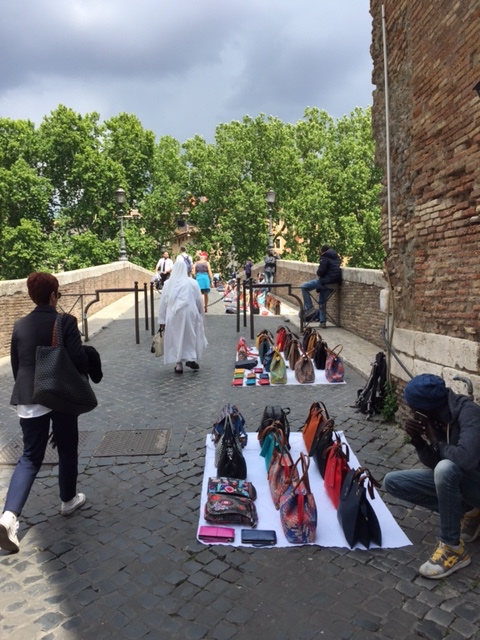
Today the island is a popular place to stroll on a fine day, to dine in the couple of trattorie, or to have an ice cream.  African hawkers of knock-off goods line the 2 bridges, selling their wares until officials come along.

IMG_2883

2200 year old Roman temple, Hercules Olivarius

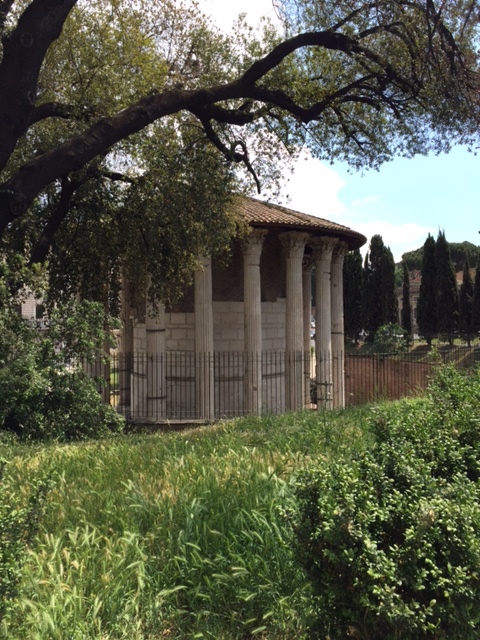
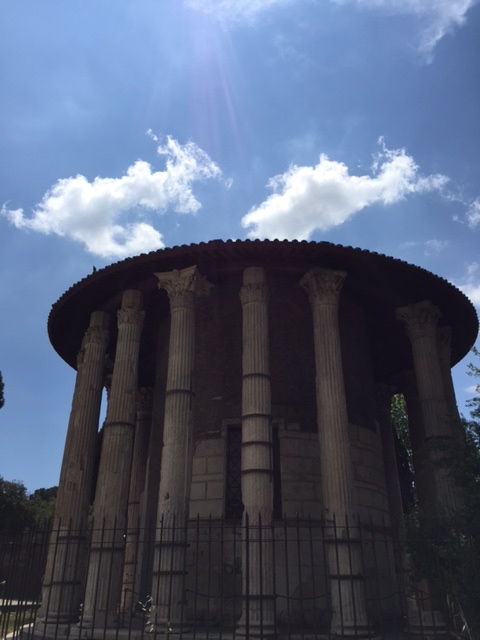
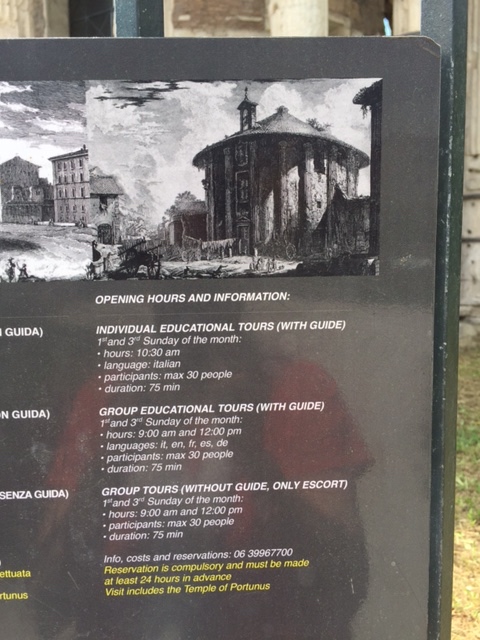
There’s a beautiful, small, round Roman temple not far from the banks of the Tiber River that seems to get no love.
IMG_2885
Screen Shot 2017-05-09 at 7.54.56 PM.png
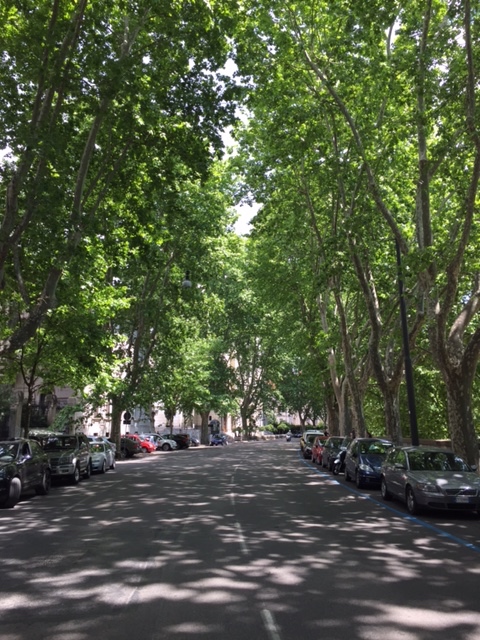
But, I love it!  I took a long walk today along the Rome side of the Tiber, under the beautiful plane trees.  The street looks like this:
IMG_2874
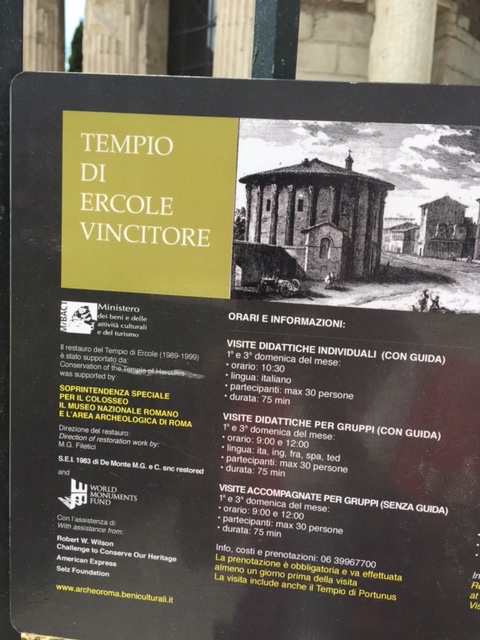
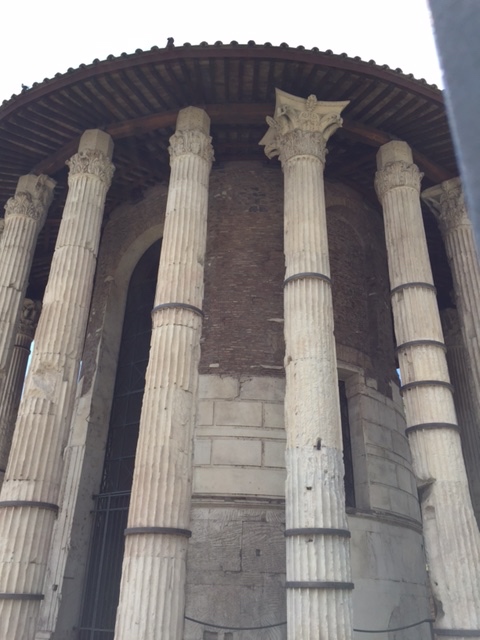
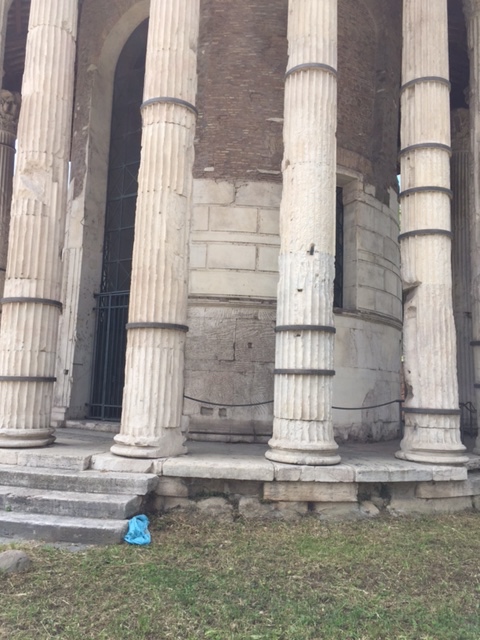
The temple I love is the Temple of Hercules the Victor (Italian: Tempio di Ercole Vincitore). It dates to the later 2nd century BC, consisting of a circular cella within a concentric ring of twenty Corinthian columns. These elements supported an architrave, which has disappeared.
The original wall of the cella, built of travertine and marble blocks. The temple is the earliest surviving marble building in Rome.
IMG_2887
IMG_2888
IMG_2889
IMG_2890
IMG_2891


Oh, the places you’ll build! Hadrian’s Villa,Tivoli

Sometimes you just need some space for yourself.
Especially if you need to get away from the hustle and bustle of running an Empire.  This is really important when you feel you are not appreciated by those you rule.  Ungrateful is what they are.
images-3
That’s exactly the position Hadrian found himself in, so he built the modest little Villa Adriana (at Tivoli, near Rome) for himself.
images-2
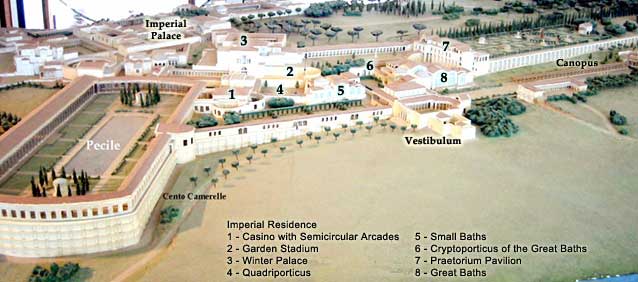
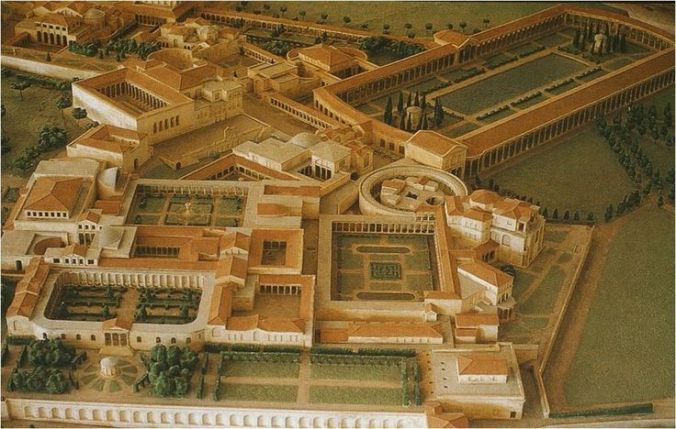
Well, I understate it a bit: his villa was an exceptional complex of classical buildings created in the 2nd century A.D.. Hadrian’s villa combined the best elements of the architectural heritage of Egypt, Greece and Rome as Hadrian attempted to build himself an ‘ideal city,’ albeit in the country, as his personal retreat.
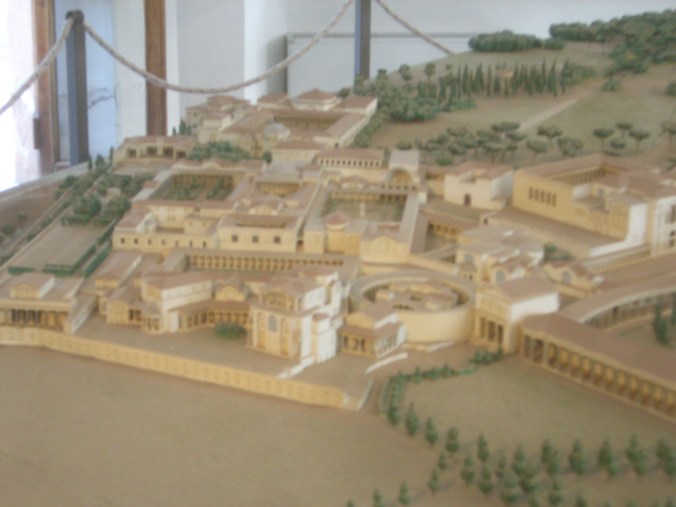
Representation of the West-side of Hadrian's Villa
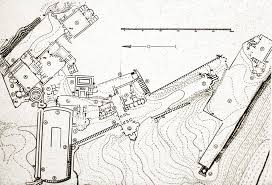
The villa was a sumptuous complex of over 30 buildings, covering an area of at least 100 hectares (c. 250 acres), maybe even 300 hectares. Although Hadrian’s Villa is a Unesco world Heritage Site, much of it remains unexcavated.
images-4
Hadrian’s choice of an imperial palace outside Rome, instead one of the several palaces in the city, was probably influenced by the miserable relations he had with the senate and the local Roman aristocracy!
25ac4f3298254a6923fb1663b70a39b7
Hadrian was born in Spain, just like his predecessor Trajan, and the senate and the local aristocracy had trouble coming to terms with another provincial on the imperial throne.
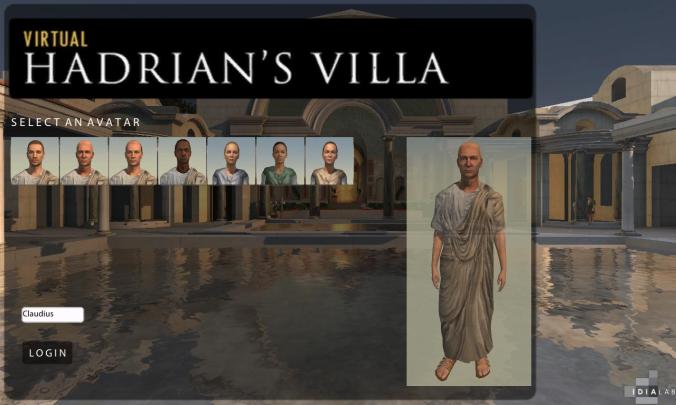
VirtualHadriansVilla_IDIALab_Login

The way Hadrian had assumed power only reinforced their opposition to him. Trajan adopted Hadrian on his deathbed; this was immediately cast in doubt, and when four military leaders, all Roman aristocrats who had been close to Trajan and hence possible contenders for the throne, were assassinated immediately after Trajan’s death, the senate immediately suspected Hadrian of having ordered the killings.

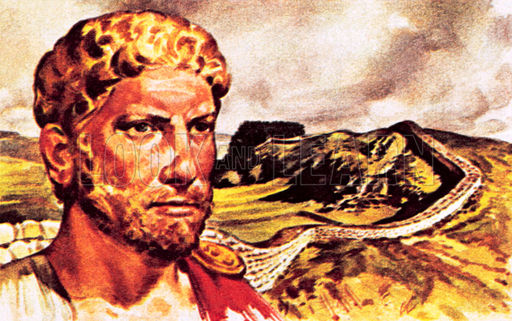
The Roman Emperor Hadrian and Hadrian's Wall

Hadrian didn’t return to Rome until eleven months after Trajan’s death, and denied any wrongdoing, but his relationship with the senate never recovered from the crisis. As a consequence Hadrian stayed very little in Rome. He travelled extensively throughout most of the empire in two prolonged periods, in 121-125 CE and in 128-134 CE, and when in Italy he avoided Rome.  You see him in the picture above with a representation of his famous wall, built wherever he felt it was needed in his Empire.

Representations of Hadrian's Villa site maps 1

When he absolutely had to be in Rome, he had his villa in Tivoli. Located some 28 km E. of Rome, Tivoli stood on a hillside, surrounded by two minor tributaries to the Aniene.  Thus Tivoli and the villa were easily reached from Rome by land via the Via Tiburtina and by boat on the Aniene, which was navigable at the time.

While I still don’t have access to my pictures from my camera, here’s what I can post until I get them.

In fact, to show off his tastes and inclinations, Hadrian reproduced inside this residence the places and monuments that had fascinated him during his innumerable travels.

images-4

IMG_2726

IMG_2727

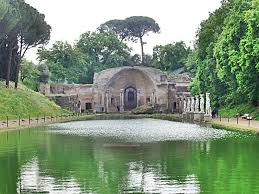
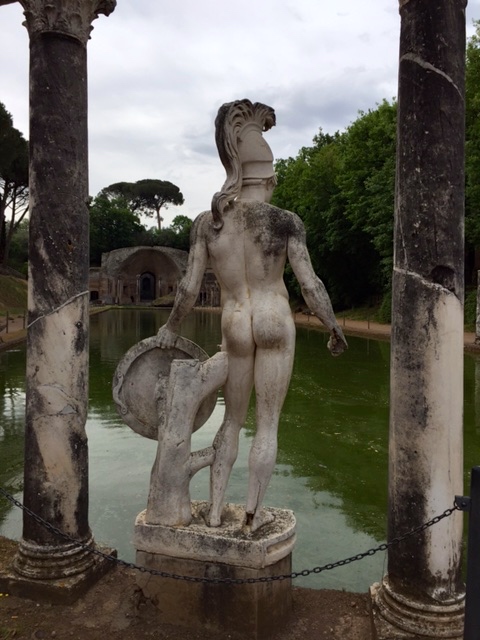
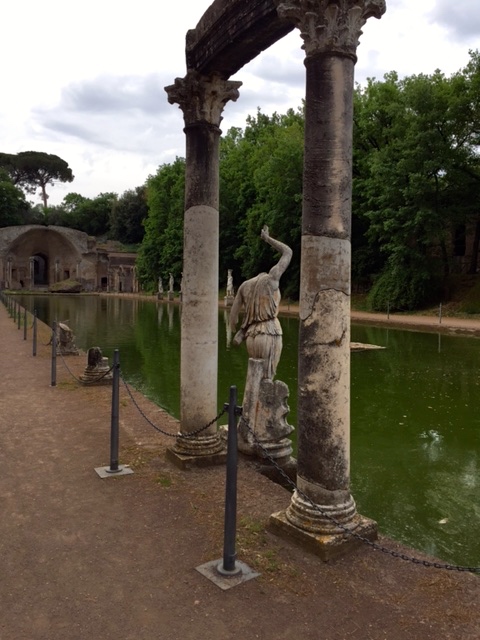
Then there is the Canopus, a long water basin embellished with columns and statues that culminates in a temple topped by an umbrella dome.