Vincent Van Gogh at the Denver Art Museum


“They are immense stretches of wheat fields under turbulent skies, and I made a point of trying to express sadness, extreme loneliness.”– Vincent van Gogh wrote to his brother and sister-in-law shortly before his death.
This article is excerpted from “Vincent van Gogh: The Paris Wheat Field” in Nature as Muse: Inventing Impressionist Landscape.


Vincent van Gogh was born in the Netherlands in 1853 and lived there during his formational years as an artist. He arrived in Paris in spring 1886 at age 33. The self-taught painter had already made several attempts over the past years to systematically study art. Having tried his hand as an art dealer, a teacher, a preacher, a bookseller, a theology student, and a missionary, he had recently left Holland to attend the Antwerp Academy of Art, but had stayed only a few months. Now in Paris, he was determined to dive into the world of art for good. On his brother Theo’s advice, he intended to enter the studio of Fernand Cormon, connect with other painters, become familiar with the art movements of the time, and tap into the flourishing trade in art, because “one must be in the artists’ world.”


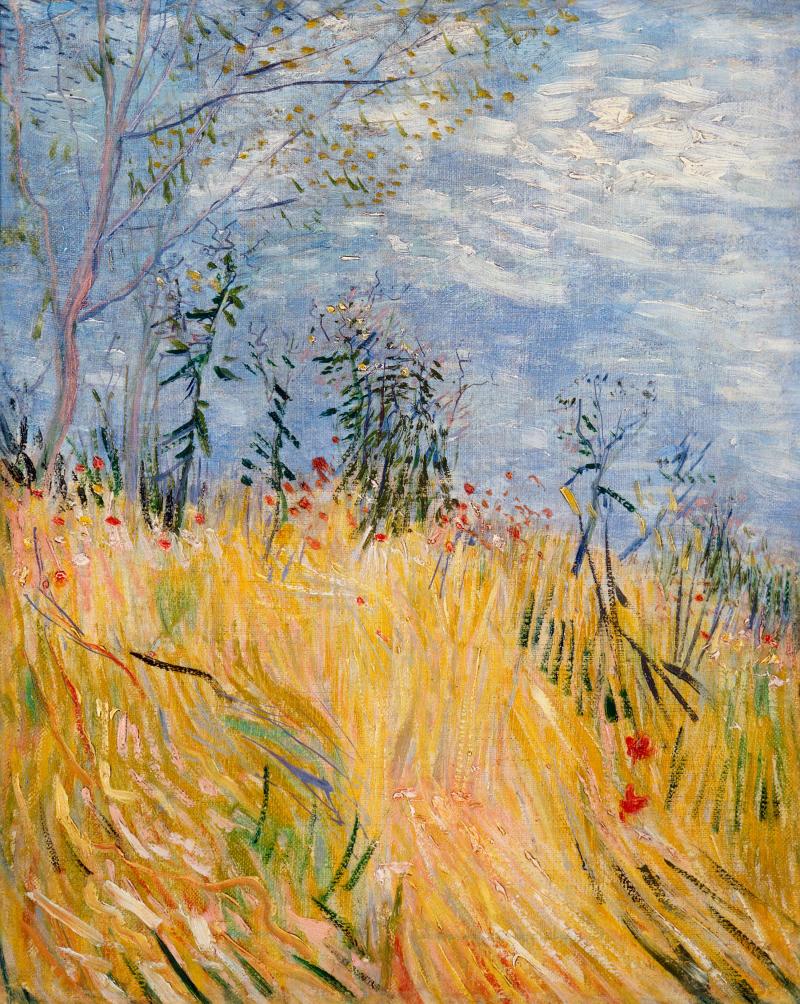
Edge of a Wheat Field with Poppies, painted in the summer of 1887, gives a sense of the many influences van Gogh was exposed to during his first year in the “hotbed of ideas” (as he called Paris in a letter to his sister).


The small painting captivates us with its bright contrast between the orange yellow of the field and the complementary radiant blue of the sky, the dark green of the new shoots coming up and the vivid vermillion of the poppies, sprinkled across the canvas in free dashes. The vertical space is evenly divided between earth and sky. The vantage point is surprisingly low to the ground; we look at the scene as though up a hill. This is not the vast expanse of field shown in a Caillebotte painting or van Gogh’s later landscapes, but a detail—a highly fragmented view. A slender poplar arcs along the left edge of the painting, and clusters of budding stalks seem to dance on the horizon line.


With no identifying urban features inside the frame, it is impossible to say whether van Gogh’s wheat field was located in Montmartre, where he was living at the time, or in the vicinity of Paris. While the city of one million inhabitants lay spread out at his feet on one side of the hill of Montmartre, the original rural aspect of the neighborhood was still visible on the other, close by his apartment. Montmartre had been incorporated into the city only a few years earlier, and the far side of the hill was still largely rural in character, complete with vegetable gardens, fields, and windmills, as well as a wide view over the open expanse of the Île de France. This area and the nearby village of Asnières, where he painted views of the Seine and of leisure life, provided van Gogh with many of his rural motifs during his two-year stay in Paris.


The upright format, relatively rare in landscape painting, and the unconventional perspective, which divides the surface of the painting evenly between sky and field, reveal van Gogh’s fascination with Japanese art and its influence on his work in Paris. The colored woodblock prints of artists such as Hokusai and Hiroshige had already captured the interest of the Impressionists, strengthening their resolve to free painting from mere representation. Japonisme—enthusiasm for Japanese art and culture—reached its peak in Paris in the 1880s. Ever more dealers stocked woodblock prints, and even department stores sold them at affordable prices; upon his arrival, van Gogh was able to rapidly amass a considerable collection. He exhibited a selection of his prints at the Café Tambourin in March 1887. “The exhibition of Japanese prints that I had at the Tambourin had quite an influence on Anquetin and Bernard,” he later wrote to Theo.

Van Gogh, too, was under the spell, and that year he began to systematically incorporate Japanese motifs into his own work through copies and free interpretations of such prints. In doing so, he replaced the more subdued tonalities of the originals with bright colors intensified through complementary contrasts. Edge of a Wheat Field with Poppies, with its Asian-inspired asymmetrical composition and feather of a poplar tree, may be one of the earliest examples of how van Gogh carried the spatial considerations of Japanese prints into his own work.

While these prints may have been the impetus for the flat, dynamic compositions he created in Paris, van Gogh also looked to Japan as a model for his ideal of a painters colony, where artists could overcome envy and rivalry to work cooperatively. He believed he might find a version of this utopian Japan in the Midi region of southern France. After two years in Paris, van Gogh set out for Arles in spring 1888. He wrote to Theo: “Look, we love Japanese painting, we’ve experienced its influence—all the Impressionists have that in common—and we wouldn’t go to Japan, in other words, to what is the equivalent of Japan, the south? So I believe that the future of the new art still lies in the south after all.”


The ripe field under a cloudy summer sky was to become a dominant motif in van Gogh’s work during his years in the southern towns of Arles and Saint-Rémy-de-Provence, and later in Auvers. The small Wheat Field from the environs of Paris is the very first rendering of this motif— an empty field under an open sky, without peasants or livestock. He reinterpreted the idea in a tremendous range of paintings, sounding out the limits of perspective, composition, and color. The field was an open, many-layered metaphor for van Gogh. In a letter to Theo and his wife, Johanna, shortly before his death, Vincent wrote of his pictures: “They’re immense stretches of wheatfields under turbulent skies, and I made a point of trying to express sadness, extreme loneliness.”


This attempt to render the emotional inner life of the individual through art—a notion that would not even have occurred to the Impressionists—marks the transition from the positivistic stance of Impressionism to the absolute subjectivity of the Expressionists. A new era had begun.

An odd painting at the Denver Art Museum

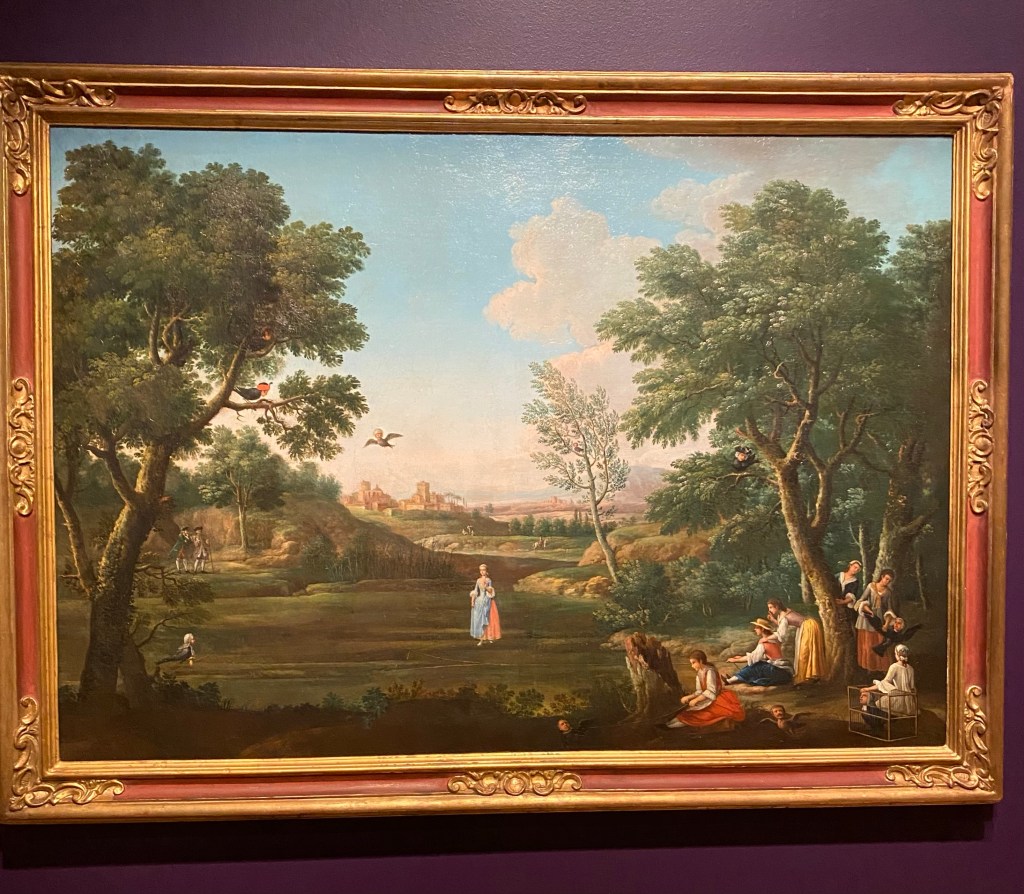
The painting is one of a pair illustrating an allegory of male naiveté and the slyness of women. “Civetta” is the Italian word for “screech-owl” but is also used informally to describe a flirtatious woman, or coquette. In the painting male birds are caught in traps set by women using an attractive woman as bait.

Personally I know from my years of living in Florence that a coquettish woman is colloquially called a Civetta in Italy. Perhaps this began as referring to flirtation with large eyes? Whatever it was, that’s the slang.

I’ve never seen a depiction of a game in which owls had men’s heads, but I remembered this 2 part sculptural group in Florence called Il Gioco della Civetta. It still doesn’t seem to be the same game being played in the painting, but until I can get back to Italy, it will remain a mystery to me.

The sculptural group of the The Owl Game (Gioco della Civetta) is located in the Boboli Gardens and consists of two white marble statues depicting two young men while playing. The aim of this game was to take the hat off to the other player who, in order to try to escape, had to bend over continuously (in Italian ‘fare civetta’). Therefore, one character is outstretched to grab the hat, while the other is attempting to deftly dodge the opponent’s move. The jacket of one of the two players is unbuttoned, precisely because of the abrupt movement that he makes by throwing himself backwards, and both figures are supported by tree stumps.

The Owl Game was originally commissioned to a sculptor known as ‘Matteo scultore’ in 1618 and its execution, which lasted for several years, was completed by different artists. The modelling was probably done by Orazio Mochi, who took inspiration from Giambologna’s Uccellatori. The statues were then sculpted by Romolo Ferrucci del Tadda, who left the group unfinished at his death, missing one figure. After various assignments, the work was finally completed by Bartolomeo Rossi in 1622. Unfortunately, The Owl Game in stone deteriorated quickly and got destroyed.

In 1775, Grand Duke Peter Leopold entrusted sculptor Giovanni Battista Capezzuoli with the task of remaking the work and the artist decided to sculpt it out of white marble instead of bigia stone. From the panel of the Giuochi rusticali (Rustic games) made by Vascellini in 1788, the group appeared to be consisting of three figures, while only two figures have survived to present days. When looking at the 18th-century replica, it is no longer possible to distinguish the hands of the various sculptors who worked on the original group in stone: Pizzorusso (1989) attributes the original of the figure on the left to Bartolomeo Rossi and the one on the right to Romolo Ferrucci del Tadda. The realisation in marble of the original group diluted the stylistic features of previous artists. The copyist was inspired by 16th-century representations of ‘peasants’, relying on the narrative and playful style that was typical of 17th-century genre painting.

At any rate, the painting is strange!

Let’s make a quick trip to Japan!

(oh, how I wish!)

At least I can easily visit the Japanese section of the Denver Art Museum without a lot of time or expense. This museum had the good fortune of having a talented Japanese curator for decades, and he built an important collection here in Denver. I taught the subject of Japanese art history at a local university many years ago and I always love tripping to Japan in Denver, or anywhere!

These were not my best attempts at photography or videography that day. Oh well, you can’t win them all!

A view of St. Peter’s in Rome, c. 1855

I made a new friend at the Denver Art Museum recently. This fairly recent acquisition delighted me!

This is why I love the history of art! I can time travel and see what St. Peter’s looked like around 1855. I’ve stood on the Janiculum Hill in Rome many times and gazed at St. Peter’s from this vantage point. It looks oh, so different nowadays!

Born near Edinburgh, Roberts came to be known as the “Scottish Canaletto” after the 18-century Italian cityscape painter famed for his precise representations of cities and their buildings. For over two decades Roberts traveled through Europe, North Africa, and the Middle East painting and architectural and topographical subjects. He painted this picture following a visit to Italy in 1853, the final stop of his travels before returning to London. For over a century such works had been enormously popular among British collectors as mementos of their Italian sojourns. In an inscription by Roberts he informs us that the work was a gift to the wife of his friend Joseph Arden, “…A Souvenir / of her Visit to Rome.”

Berthe Morisot, Soupière et Pomme

Another old friend from the Denver Art Museum is this lovely still-life by Berthe Morisot.

Born in 1841, Berthe Morisot wanted to become a professional artist, which countered the societal expectations of her upper middle-class family. If paint she must, she was expected to take up painting as a hobby and not as a professional career. Morisot persisted and not only became a well-known artist but also developed a radical style. She identified strongly with the aesthetic principles of the Impressionists, a group of young artists who, in the early 1870s, began to challenge the status quo of what constituted excellence in the art of painting. Impressionist paintings are characterized by an emphasis on the play of light, loose brushstrokes, and “modern” scenes of everyday events taking place in urban or country settings.

Morisot was a central member of the Impressionists and her home was a meeting place for intellectuals and artists. Morisot’s connection with these painters, particularly Edouard Manet, allowed for the exchange of artistic ideas, comparison, and criticism. She exhibited in seven of the eight Impressionist exhibitions and, even though she was not financially dependent on sales, her work fetched prices similar to (or higher than) many other well-known members of the group such as Monet and Renoir.

Morisot, who is perhaps more well-known for her landscapes and images of women, painted relatively few still lifes (Soup Tureen and Apple is one of only four from the 1870s).

The Impressionists liked to paint subjects from modern life, but during Morisot’s formative years throughout the 1860s, women couldn’t wander the streets alone or paint in cafes. Given this handicap, she compensated during her early career by selecting subjects close at hand for her as a woman, such as intimate domestic scenes or other still-life paintings. The objects in this painting probably came from her home. She chose to arrange them on a shiny table top, which offered the added dimension of reflections on the surface. The covered goblet allowed her to demonstrate her skill in representing a challenging subject like clear glass.

Like many other Impressionists, Morisot worked quickly and in a sketchy style suited to her aim, which was to “capture something transient.” Looking at Morisot’s pearly colors and light brushstrokes, many art critics assumed that her working process was as delicate as her finished paintings, even likening it to the scattering of flower petals. But Morisot herself described painting as being “engaged in a pitched battle,” and her mother claimed that when Morisot was working she had “an anxious, unhappy, almost fierce look.”

I’ve always admired this fine painting in Denver by the important Impressionist, Morisot. The icy shades with pale blues and light green make this work soothing for me to look at.

Thomas Cole’s Dream of Arcadia, 1838

I’ve been haunting the Denver Art Museum lately, reacquainting myself with old friends. And by friends I mean works of art that I used to be in charge of. That was a long time ago, but I’m happy to find that my old friends still are looking great!

Among many friends, this stunning example of 19th century American art by Thomas Cole is and was always one of my favorites. He was an English born, self-taught painter. Both Cole and I had/have a thing for Italy.

In this painting, The Dream of Arcadia from about 1838, Cole drew his inspiration from Greece. The art museum’s website supplies this information:

The theme of Thomas Cole’s Dream of Arcadia is man’s relationship to unspoiled nature. Cole felt that the American wilderness was beginning to disappear as a result of the industrialization of the nation. In this painting, Cole harks back to the land of Arcadia, a rustic, secluded area of ancient Greece. The people who lived in Arcadia led simple, happy lives, in harmony with nature. Cole creates an idyllic image of an unblemished landscape—one where people frolic in the trees, sheep roam the hillside, and children play in the gentle river.

I’ll be posting other old friends from the museum over the next weeks. I’m so happy to see them again!