I love to let my mind wander into the distant past, trying to picture the way things might have been.
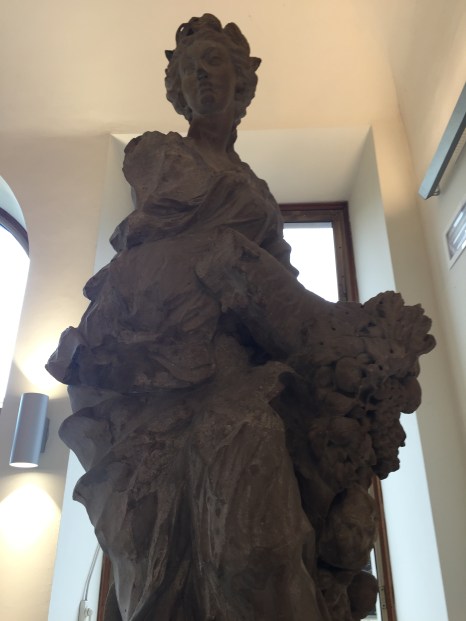
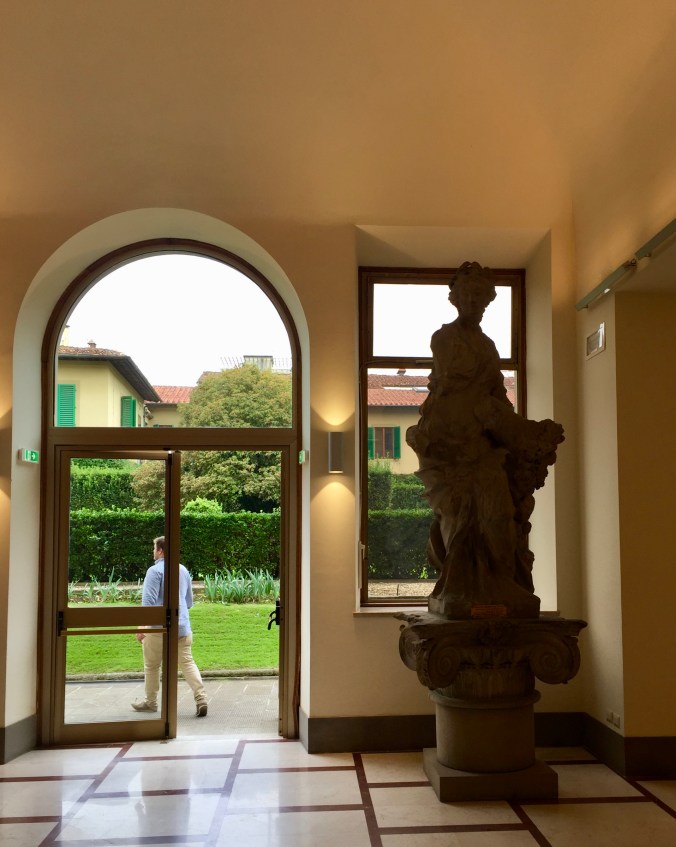
Last week I was invited to visit a show in the beautiful exhibition space of the Fondazione Cassa di Risparmio di Firenze on via Bufalini. There I bumped into a heroically-sized statue of a somewhat recognisable woman. “Hey, I know you!” I thought to myself.
She certainly looked familiar. I wondered if she was related to one of the four allegorical statues of the seasons occupying the corners of the Ponte Santa Trinita. (Those four statues were done by Pietro Francavilla [Spring], Taddeo Landini [Winter] and Giovanni Caccini [Summer and Autumn] and placed on the bridge in 1608.)
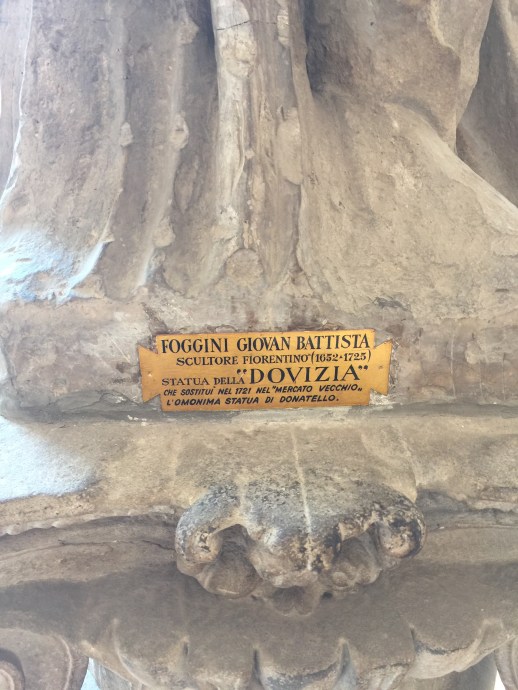
Fortunately, a label attached to the statue revealed the figure and the sculptor: La Dovizia (Abundance) by Giovan Battista Foggini:
Ah ha! I now knew exactly what I was looking at! My mind zinged back into two places almost simultaneously, first to the camp and later the Forum of Roman Florence. and then to the Renaissance placement of a statue of Abundance by Donatello.
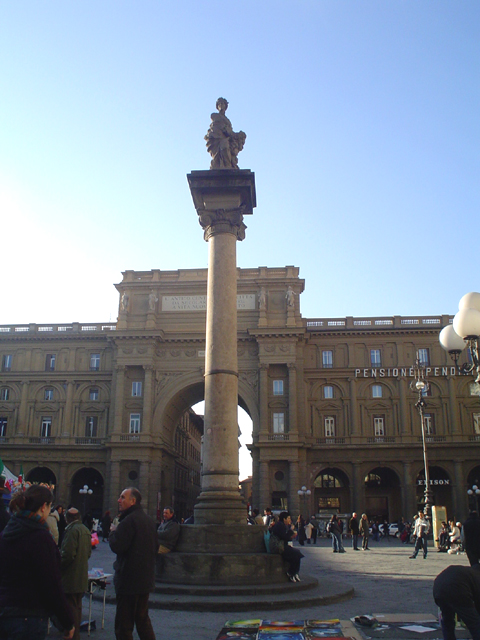
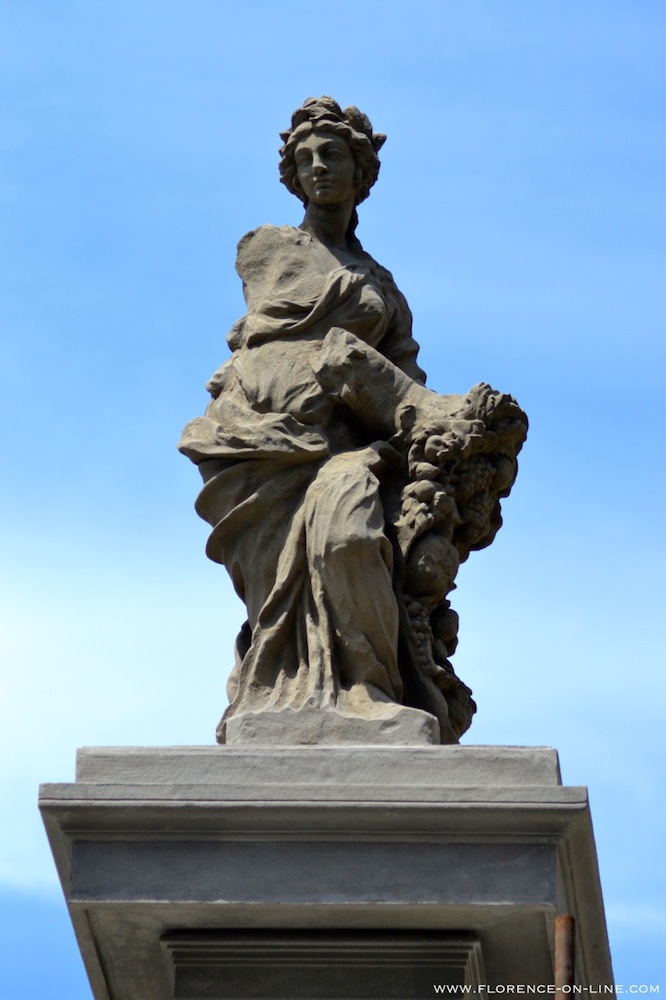
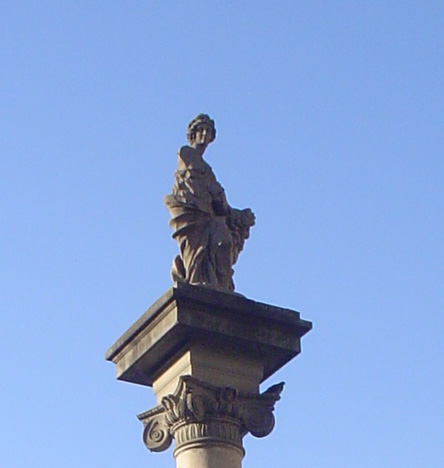
Both of these past moments happened in the space now occupied by the Piazza della Repubblica in Florence. The giant woman I encountered last week on the Via Bufalini was the statue of Abundance that replaced Donatello’s (now lost) figure on the same column, a replacement which occurred in 1721 (according to the label).
The column, still topped by a statue, sits at the exact point where the two Roman roads intersected in ancient Florence, the cardo (now via Roma and via Calimala) and decumanus (now via degli Strozzi, via degli Speziali, and via del Corso).
Now I needed to find out more about Giovanni Battista (Giambattista) Foggini, to satisfy my curiosity. He was an artist in Florence (1652 – 1725) who became, in 1676, the court sculptor for Cosimo III. He went on to become the Medici’s Architetto Primario e Primo scultore della Casa Serenissima as well as Soprintendente dei Lavori (1687–1725).
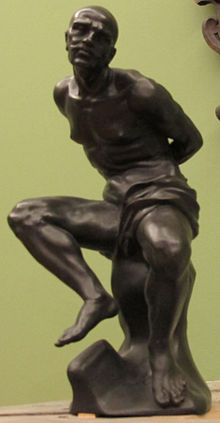
Foggini is best known today as the creator of many small bronze statuary figures and groups. In 1687, Foggini acquired the foundry in Borgo Pinti that had once belonged to the sculptor Giambologna. This allowed him to specialise in small bronzes, produced mainly and profitably for export. His adaptation of Pietro Tacca’s Moors was, for example, the basis of the bronze and ceramic reproductions for the connoisseur market well into the 18th century.
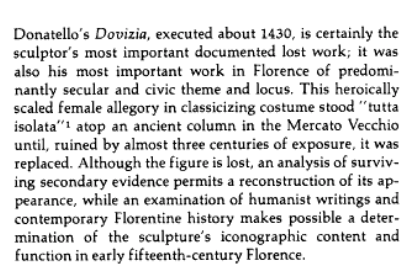
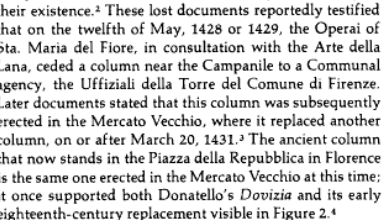
One of my grad school professors published an article on the Donatello Abundance (“Donatello’s Lost Dovizia for the Mercato Vecchio: Wealth and Charity as Florentine Civic Virtues by David G. Wilkins). Here are couple of excerpts from that scholarly publication:
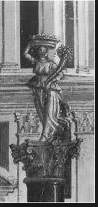
Here is an image of what Donatello’s lost sculpture might have looked like:
You just never know who or what you will bump into in this fascinating city of Florence.
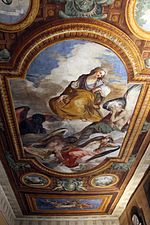
I recently visited, on a lovely parcel of land just outside of beautiful Firenze, a once-magnificent villa known as Villa la Quiete. Located upon the Castello hill, at the foot of the Monte Morello, this villa is considered to be among the most important settings of its kind. It takes its name from a fresco by Giovanni da San Giovanni entitled, La Quiete, which dominates the winds (see below).
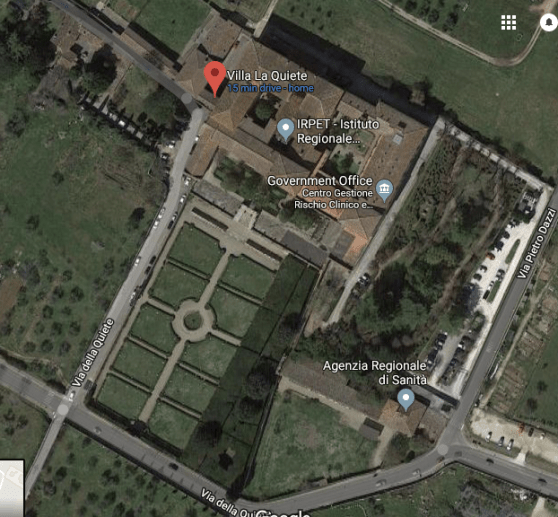
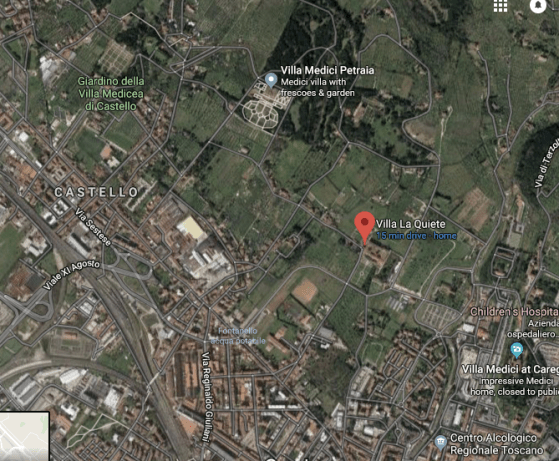
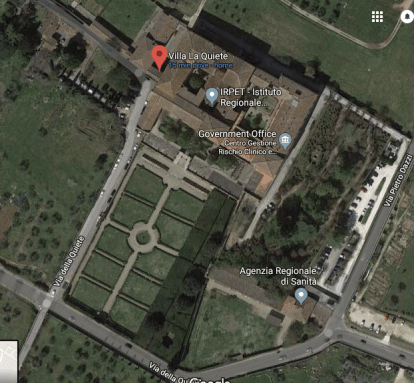
The Medici family particularly loved this area and owned some of its most beautiful residences, including the Villa di Careggi, Villa di Castello, and the Villa della Petraia. You can locate Villa la Quiete on these 2 Google Earth slides below and, in the last one, also locate the 3 Medici villas just mentioned.
This parcel of land has lots of history, naturally. In 1438 it was given by the Florentine Republic to the condottiere Niccola da Tolentino, for his military services. In 1453 the Medici acquired the land, and later Cosimo I passed it to the commander of the Order of Santo Stefano.
In 1627 the property was again acquired by a Medici, this time by Cristina di Lorena. She had the palazzo rebuilt, and had a suspended passage constructed (a small variant of the Vasari Corridor), connecting the villa to a nearby Camaldolese monastery. Cristina also commissioned the painting of la quiete che pacifica i venti, by Giovanni da San Giovanni in 1632.
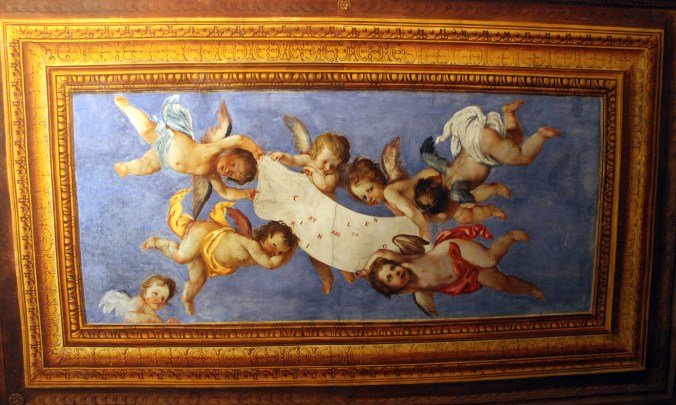
Cristina’s name even appears in another fresco, by Giovanni da San Giovani. in which curious anagram masquerading as a hymn inscribed on a scroll supported by putti in flight.
The villa has, thereafter, been known as Villa la Quiete.
The complex was bequeathed to Cristina’s grandson, the Grand Duke Ferdinando II. Later on, in 1650, the villa was sold to Eleonora Ramirez de Montalvo, who dedicated it as a country retreat for a congregation she founded, the Montalves. At that time the villa was called Istituto della Quiete.
After Eleonora’s death, her friend the Grand Duchess Vittoria della Rovere administered the Institute, and sponsored the construction of the Montalve church, completed in 1688.
Anna Maria Luisa de’ Medici, the last descendant of the Medici family, resided in the villa between 1720 and 1730 and she furnished it with objects from the Palazzo Vecchio and Palazzo Pitti.
Anna Maria had the villa renovated and redecorated and she installed a beautiful grand garden, bringing water to it by a pipe to the nearby Fonte delle Lepricine.
The director of this new, vast garden was the botanist Sebastiano Rapi, who just happened to be the person in charge of the Giardino Boboli. Rapi, with the support of Anna Maria, brought the best botanical and fruit species from the various Medici villas.
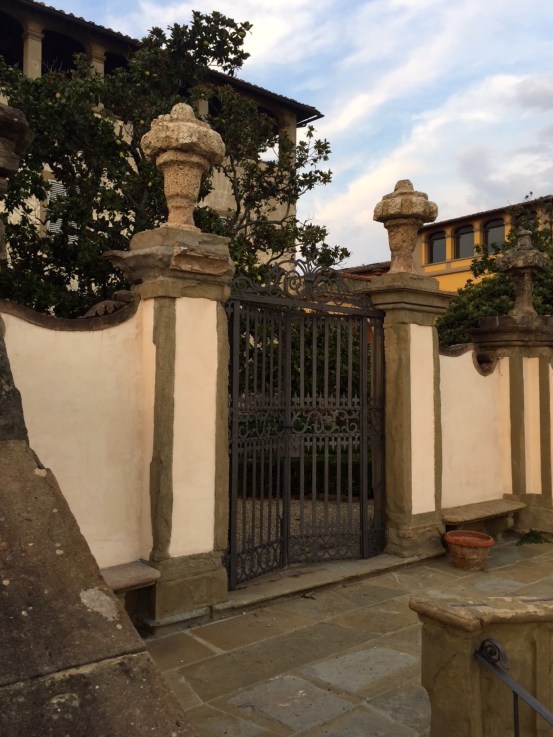
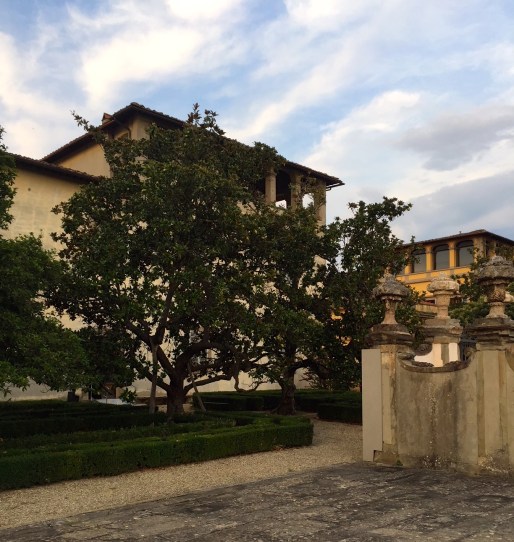
Even today, the specimen magnolia trees they selected still grow in a courtyard connecting the garden to the palazzo.
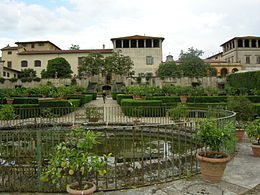
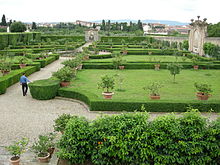
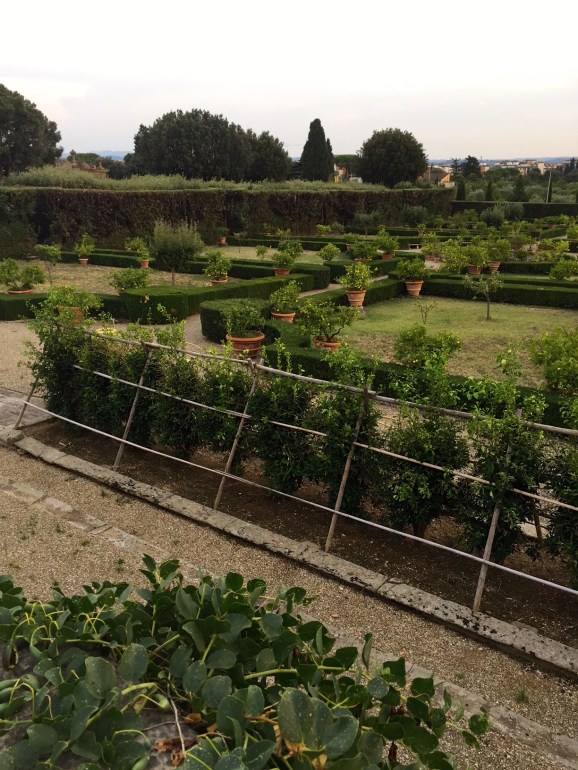
The garden today remains one of the rare examples of an 18th-century garden, with no changes in the plantings, other than refreshing them. You can see the layout of the formal, rectangular gardens, lined with pots of lemon trees, in the Google slide:
The secular order of Montalve, dedicated to the education of girls of good family, only had to abandon their church of San Jacopo di Ripoli in 1886, and they brought their numerous furnishings and works of art with them to the Villa la Quiete.
It was only in 1937 that the order became religious. The villa complex remained for a long time the seat of the education institute, ending only in 1992. The last pupil graduated in 2001.
In February 1992 the villa, together with the entire real estate of the Conservatory of the Montalve alla Quiete, passed University of Florence. A small part of the villa has been used by the University for the Center for Culture for Foreigners and Polo offices.
It is possible to visit the villa, as I did, only by appointment and in the months of July and August on Tuesday and Thursday evenings. To arrange a visit, contact the Ufficio Servizi Didattico Divulgativi, Sistema Museale D’Ateneo, tel 055-2756444 or by email to edumsn@unifi.it.
In a few days I will be writing a post about the artworks located in the villa.
The surrealists in the autumn of 1942: in the last row Jimmy Ernst, Peggy Guggenheim, John Ferren, Marcel Duchamp and Piet Mondrian, in the center row Max Ernst, Amédée Ozenfant, André Breton, Fernand Léger and Berenice Abbott, Stanley William Hayter, Leonora Carrington. Photography by Hermann Landshoff in the Münchner Stadtmuseum in Munich
Mandatory photo credit:
Münchner Stadtmuseum, Sammlung Fotografie / Archiv Landshoff / BPK/Alinari Archives
WARNING:
Permission must be required for non editorial use. Please contact Alinari Archives
Travel can be good for your health. Recently a good friend and I, at the end of a week that for both of us was filled with stress and problems, decided to get the heck out of Dodge for a day.
We left home for a day to wander in the wider, wondrous world of the outer sections of the province of Firenze.
We landed in Vinci, to see the village near the farmhouse where Leonardo was born.
For us, it was just what the doctor ordered.
Vinci is a very, very charming borgo:
Of course the town is famous because the legendary genius Leonardo da Vinci was born in a nearby farmhouse. Every inch of this little village proclaims “Leonardo!”
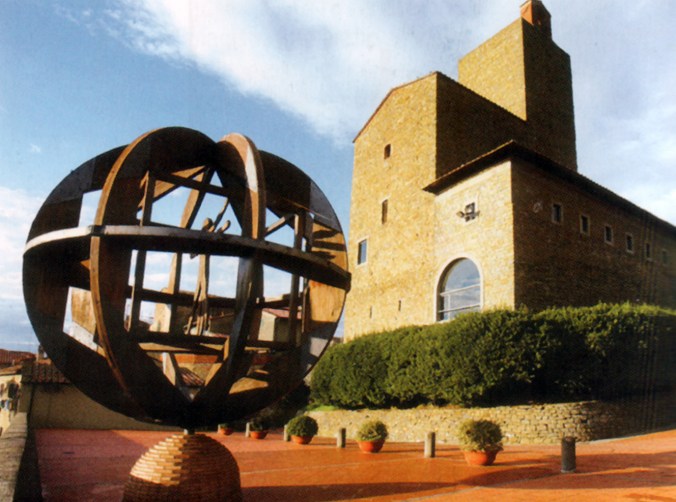
The main attraction in the village is the Museo Leonardino, housed inside the building that was formerly the Castello dei Conti Guidi, originally built in the 12th century.
The castle is located high atop the town’s highest hill. Inside the museo, you encounter a hologram of Leonardo:
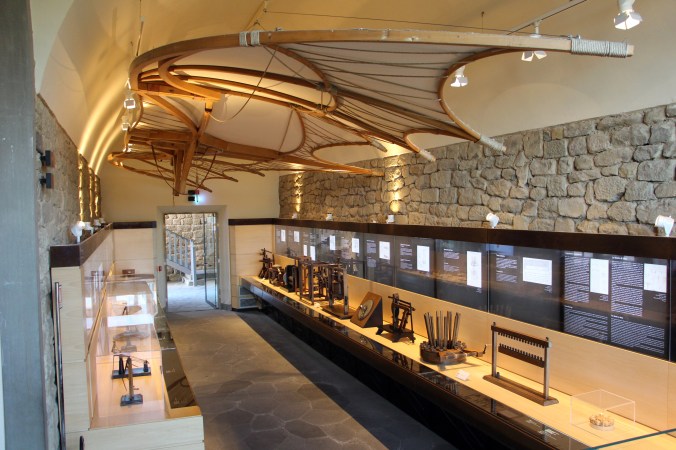
The museum takes up 3 floors of the castle, showcasing a collection of the original designs found in Leonardo’s notebooks as well as 40 different models of various machines that were he designed.
Most interesting of all of these, to me, was the wooden paraglider that Leonardo created.
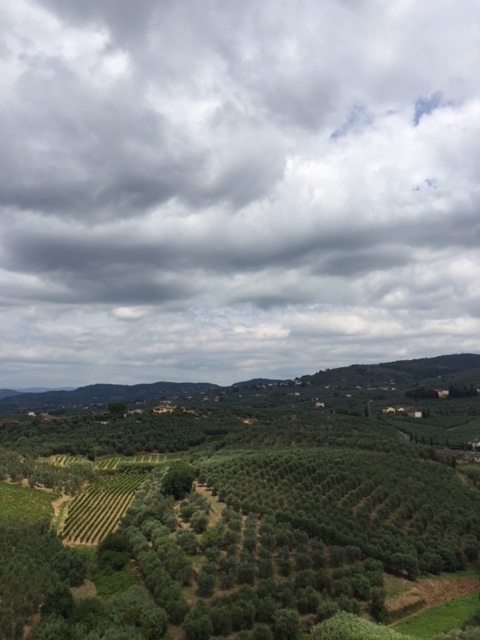
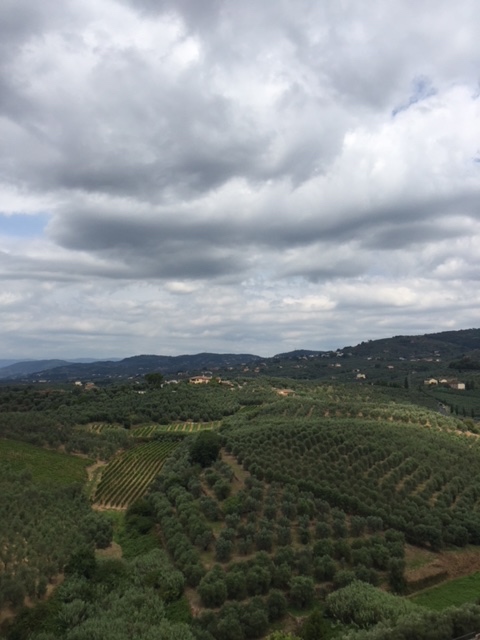
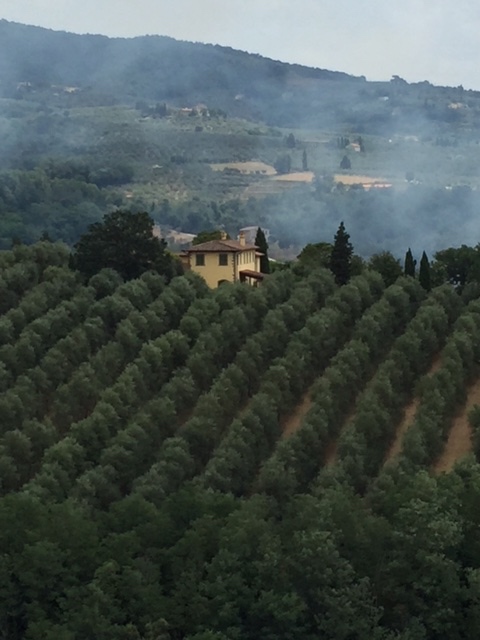
Vinci is surrounded by the Tuscan hills and there are various vineyards and olive groves around the town which have remained the same since ancient times.
The town is spread over an area of 54 sq km and the population is close to 14,000. The economy of Vinci is based on agriculture, production of wine and olive oil, pottery and items like paper, clothes and furniture.
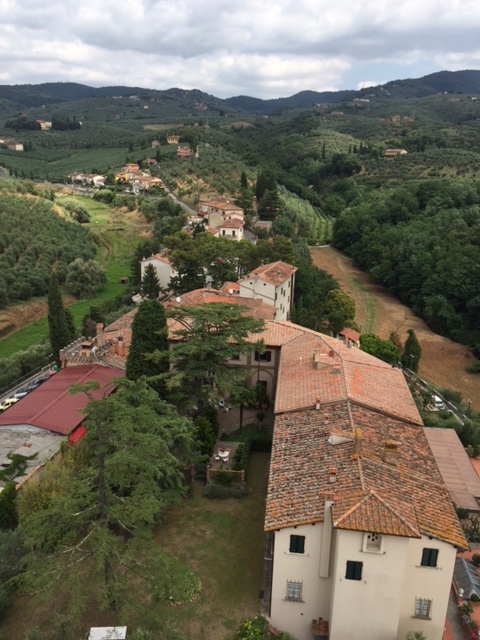
After seeing the main exhibition space, you can also climb up to the top of the castle and view the surrounding countryside.
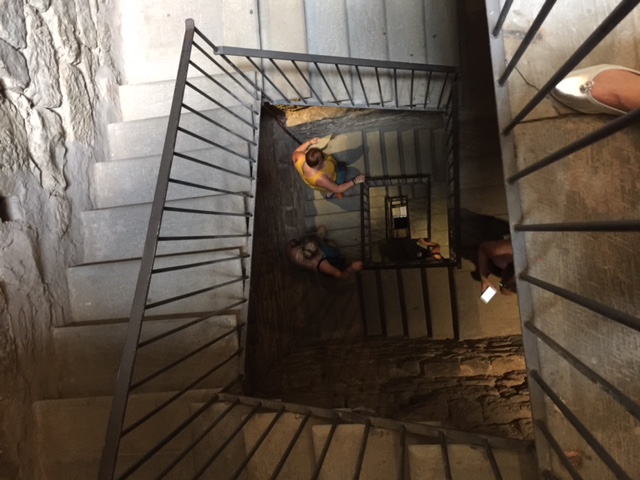
Before you are afforded the spectacular views, however, you must climb an endless set of stairs leading up, up and up.
Trust me, the view above does not begin to capture the length and height of this stairway. Several stops are needed on the way up to catch your breath.
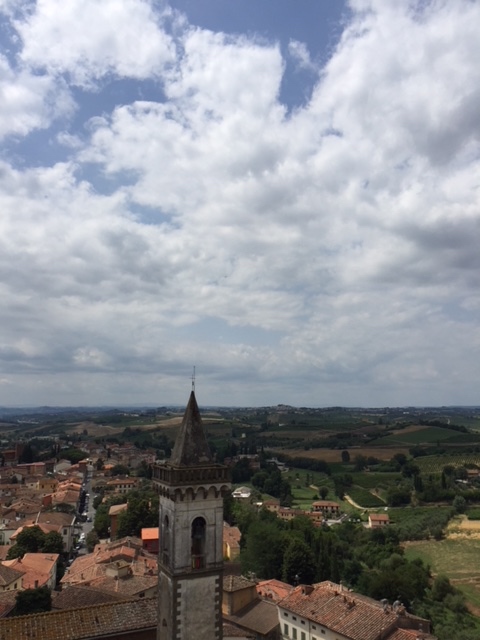
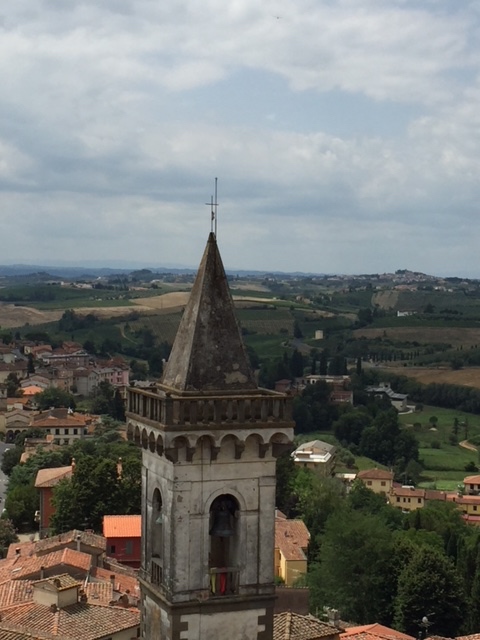
The views from the top terrazzo of the Museo di Leonardo are as vast as they are gorgeous. What a perfectly farmed section of Tuscany, filled with groves and groves of olives and grapes. The groves are in perfectly formed lines, such as you never see anywhere else. Wonder how that happened?
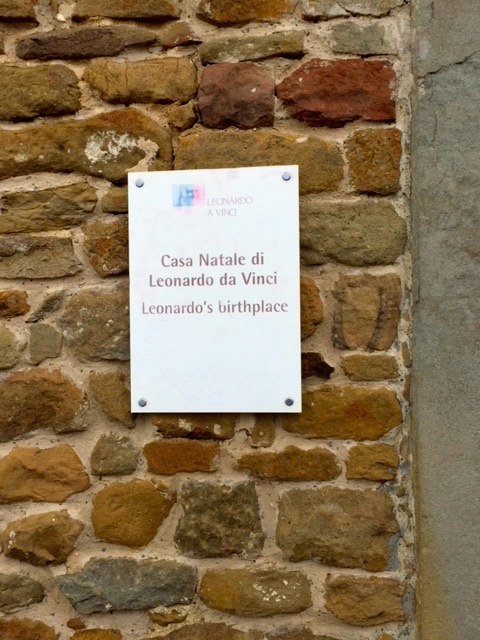
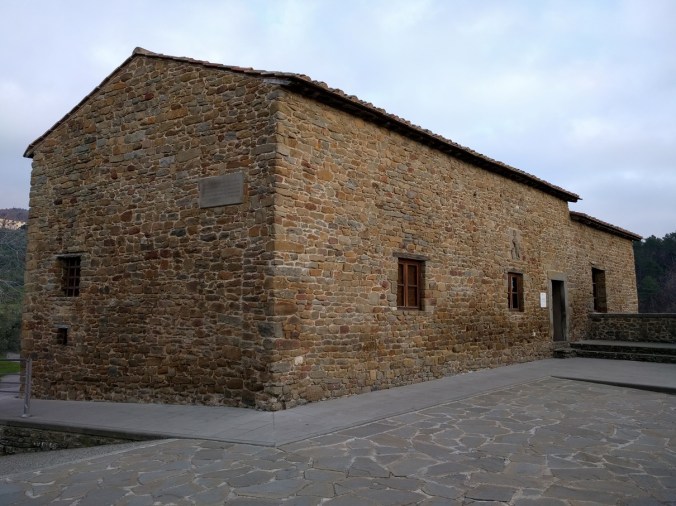
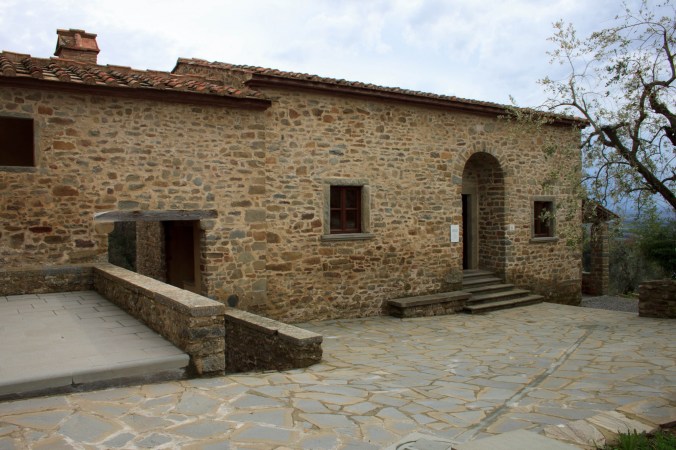
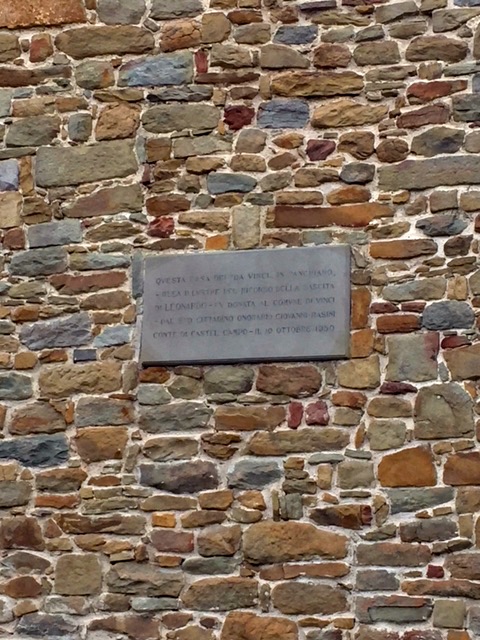
Leonardo Da Vinci was born in a small farmhouse which is located just 3 km from the center of the town. You could walk it, if you have a lot of stamina. On a day of 30 C., I didn’t. We drove.
If you were a young, aristocratic European man in the late 18th through 19th centuries, you might well have taken a Grand Tour. After finishing your formal education, you would take a kind of gap year (or year and a half), traveling to and through the finest European capitals, including, in Italy, cities such as Venice, Milan, Florence, Rome and Naples.
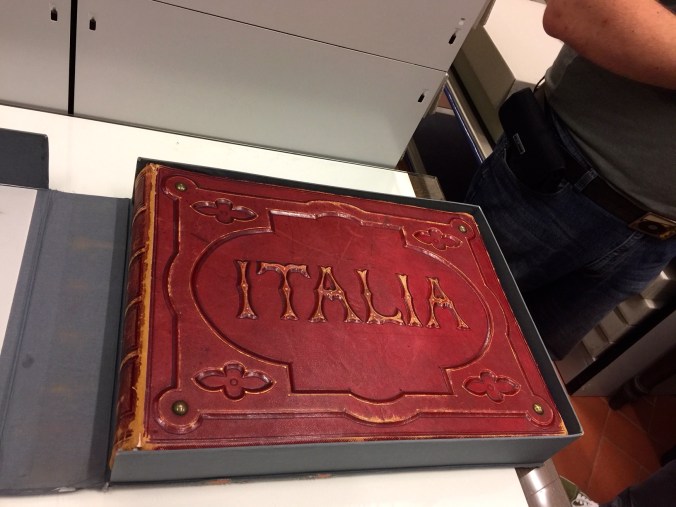
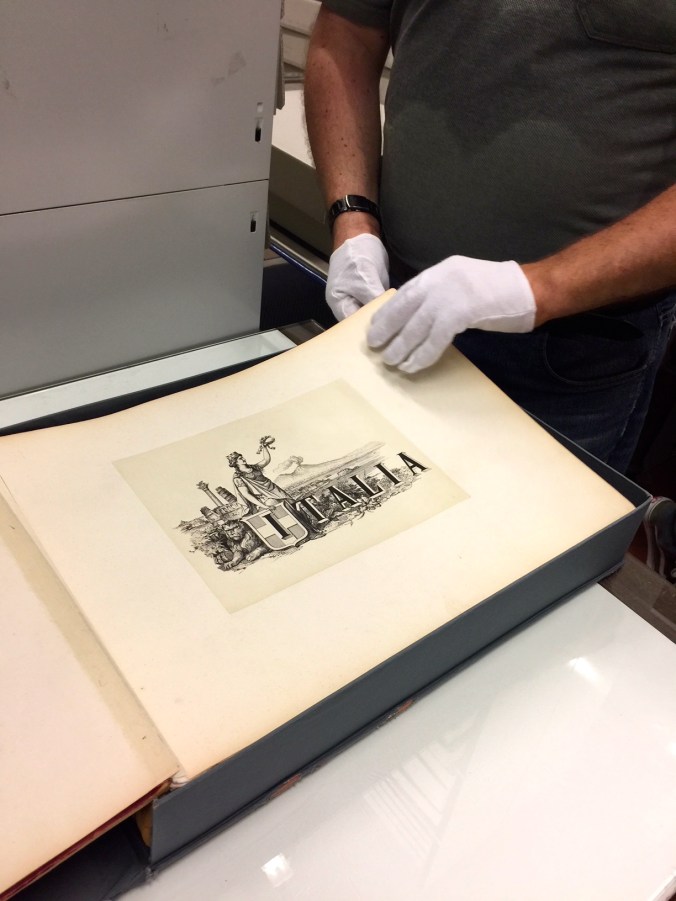
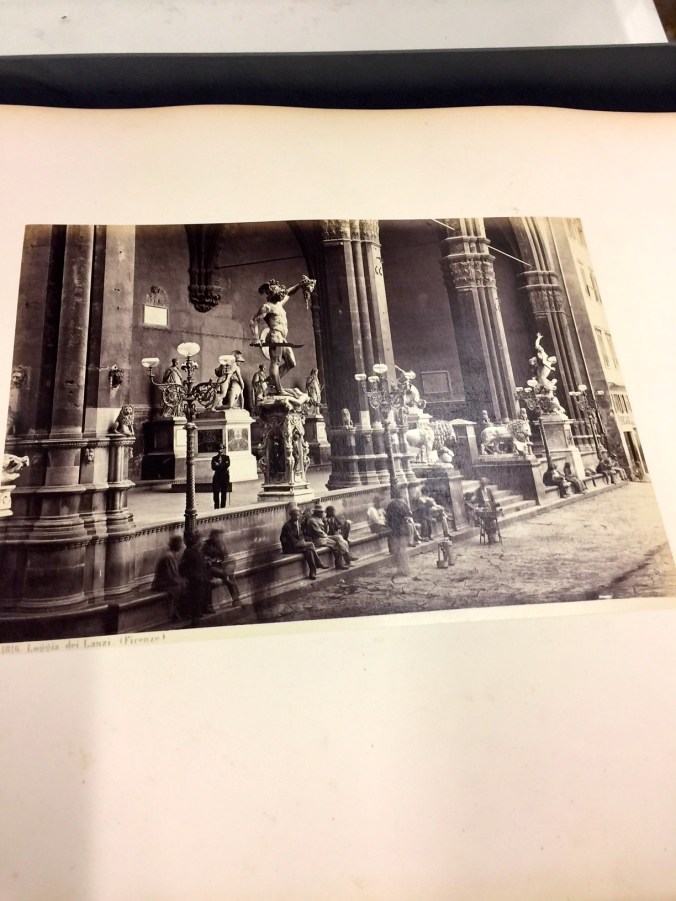
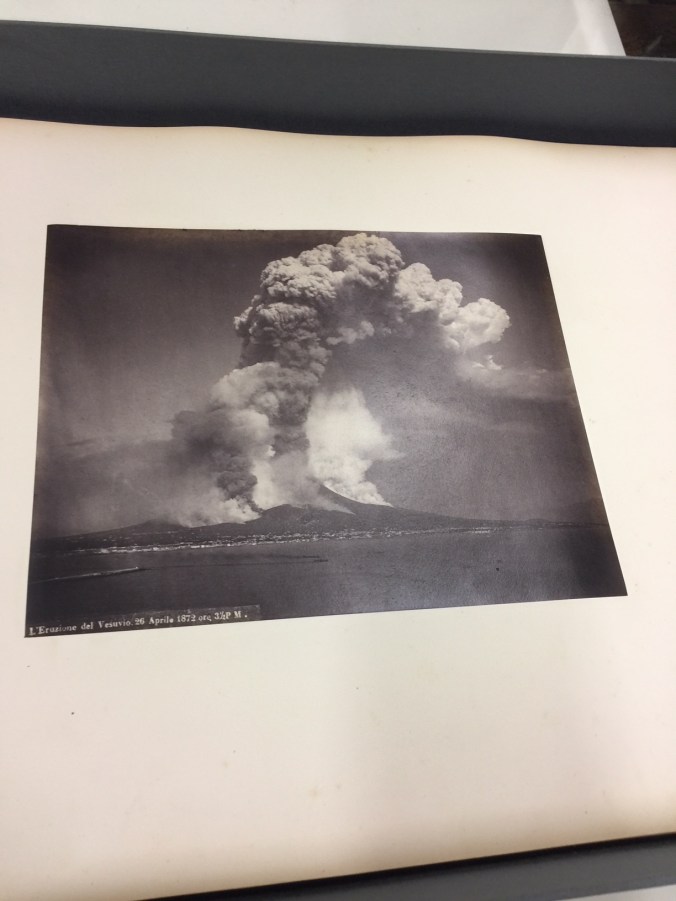
You might have asked Alinari Brothers or another similar firm to create an album for you, comprised of their photographs of your favorite places. The Fratelli Alinari archives in Florence have many of these albums in their archives, and I had the opportunity to look at one of them from 1874.
It begins with a hand-tooled red leather cover. The book measures roughly 20 x 30 inches.
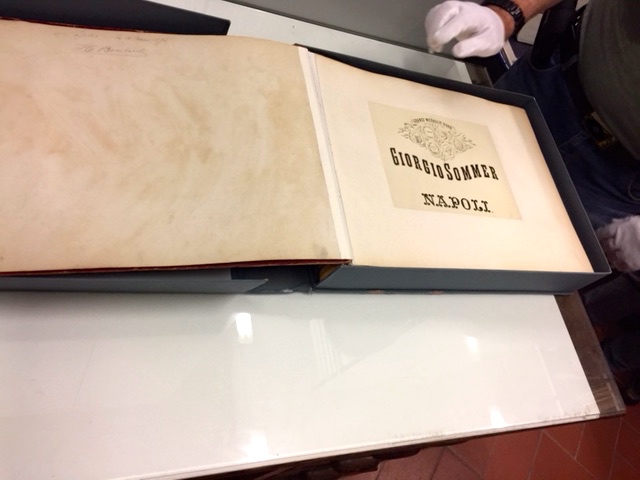
The Frontispiece reveals that this album was created in Naples, by the Giorgio Sommer firm.
This particular album begins with photographs of Torino, Milano, and Venice, as here:
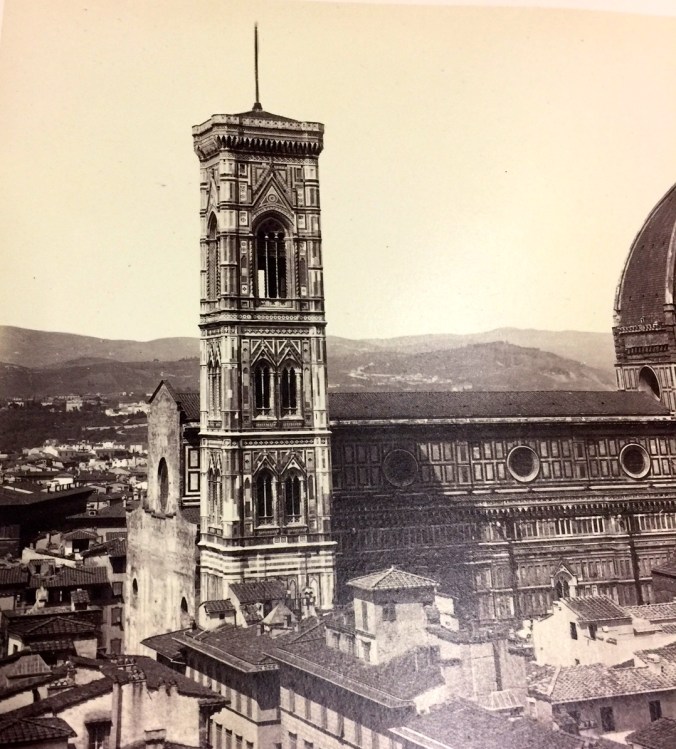
This album then moves to Firenze, and here are 3 images from this section of the book:
Next, the book moves on visually to Rome. Here is a picture of oxen pulling carts through the Roman forum.
Then it was on to Naples. The following is a picture of Mt. Vesuvius erupting in 1872.
I could (and will) spend hours looking through these albums!
According to my guide at the Alinari archives, an album like this would have cost a young gentleman about $1500 in today’s money.
Yesterday I posted about Andrea del Sarto’s Last Supper in Florence. Attached to the same building is a small but fine museum of 15th and 16th century art, in addition to the main event of the Last Supper.
I might lose my membership in the world of art historians because while I took pictures of a few of the artworks that grabbed my attention in this smallish museum, I didn’t take adequate pictures (or, god forbid, hand-written notes) of the labels that identify the artist. From the depths of my heart, I apologize. It was a hot, hot, hot day in Florence and I simply failed to live up to my creed. :-)
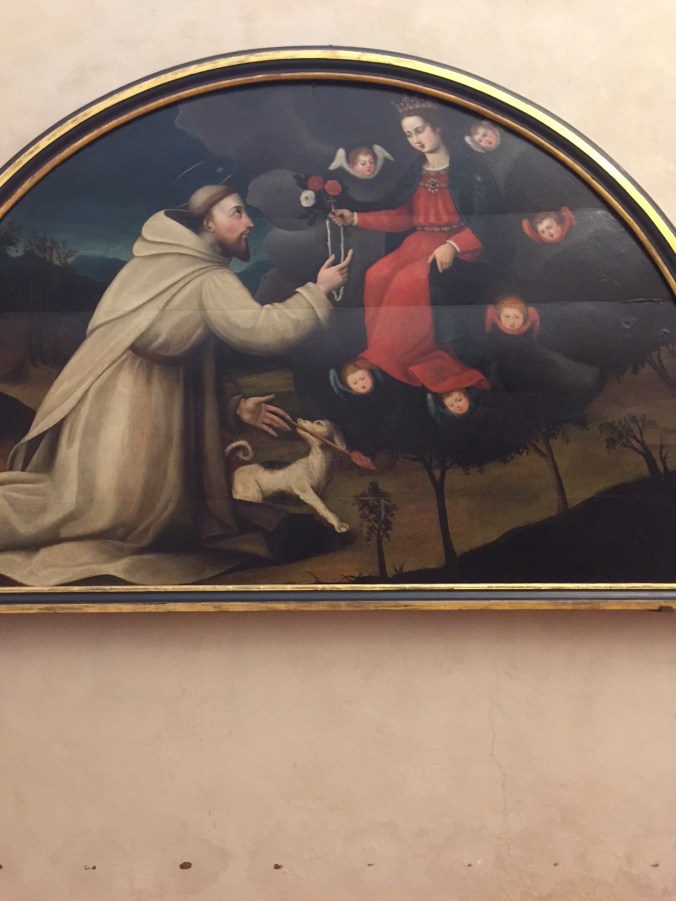
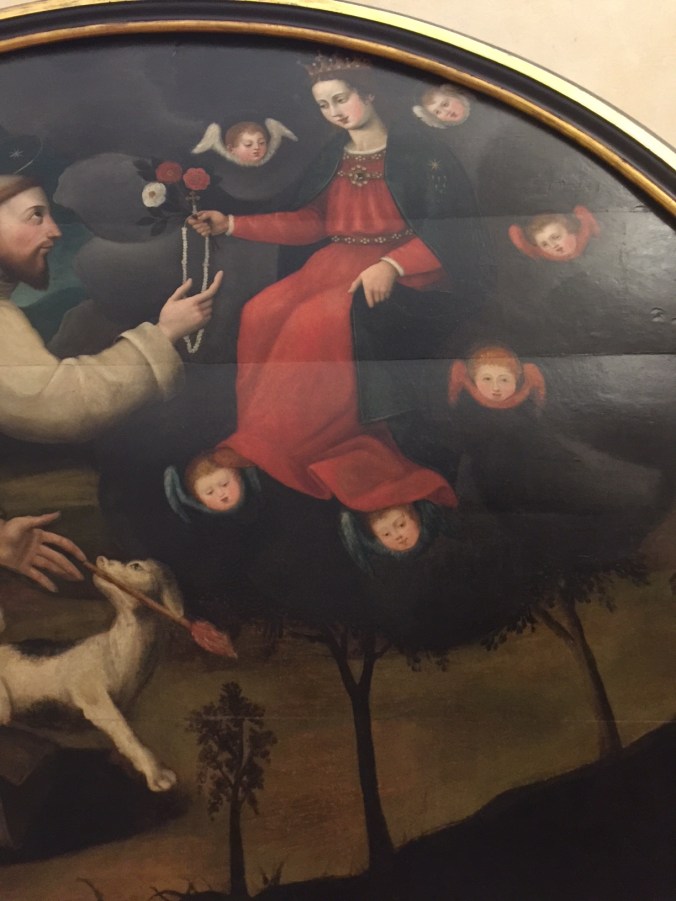
But this odd painting certainly did grab my attention! It is, I assume, a vision of Saint Mary in heaven, bestowing a string of pearls? beads? to someone below her on earth, I would guess?
Anyway, what I liked is the bodiless angels floating around Mary in the shape of a mandorla (almond). Their heads and wings are kind of creepy, floating as they do around Mary.
And, speaking of being surrounded by cherubim and seraphim, look at this oil painting!
Again, I would be fired as a curator, but I don’t know who painted this work. (But I know where the label is if I need the info; it’s right beside the painting for goodness sake! My art historical training is playing out in this post, as a kind of Catholic guilt. I am smiling as I write this silly thing.)
But, check out the multitudes surrounding Christ on the cross, above whom is God the Father, and below is Mary and 2 others.
But, as entertaining to me as the 2 works above were, the one that really gave me a jolt was this:
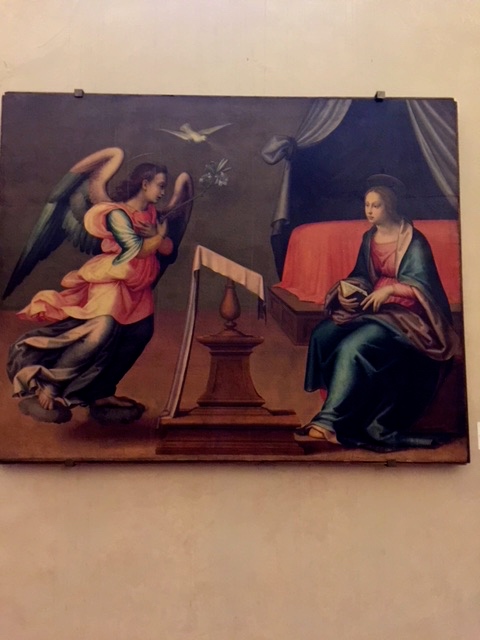
It represents, of course, the Annunciation, when the angel Gabriele tells the Virgin Mary that she will bear the Son of God. I’ve seen thousands of renditions of this scene, which one of the most hopeful moments in Christian art.
But, what I have never seen before is Gabriel standing on 2 little clouds, one for each foot, that makes it look like he is hover-boarding up to Mary!
Crazy funny to me!
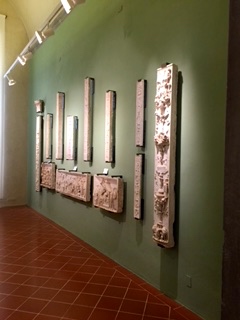
There are many fine works of painting and some sculpture in this fine museum.
I don’t usually give this kind of advice or information.
Typically I write my impressions of places I visit, without giving away too much info, mainly because Florence is so heavily visited and information is easily obtainable.
But today I will share a secret. It is good for any time of year, but in summer, it serves 2 purposes. You will be in peace, perhaps even alone, and you can appreciate an under-known masterwork by a well-known artist.
So, let’s say it’s over 90 degrees F.; you are in Florence; you love Renaissance art; you’ve visited all of the usual venues (museums/churches/artworks); and you’ve had it up to your eyebrows with the swarms of tourists that engulf this city. What to do?
Head yourself over to an empty, cool, beautiful former refectory on the east end of Florence. It’s easy to get to by taxi or by bus and when you get there you will probably be alone, like I was last week, in the space.
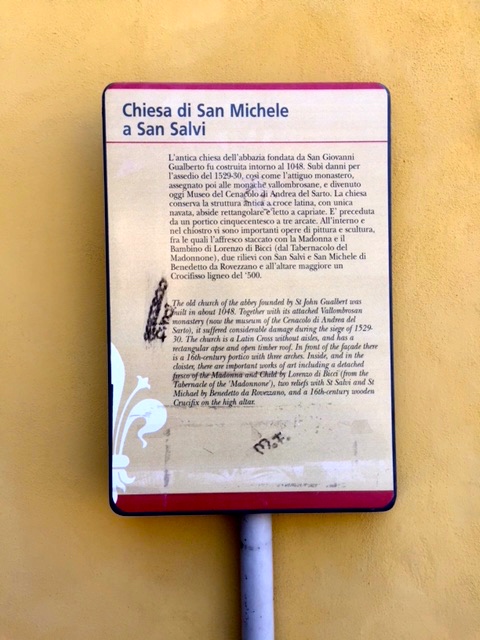
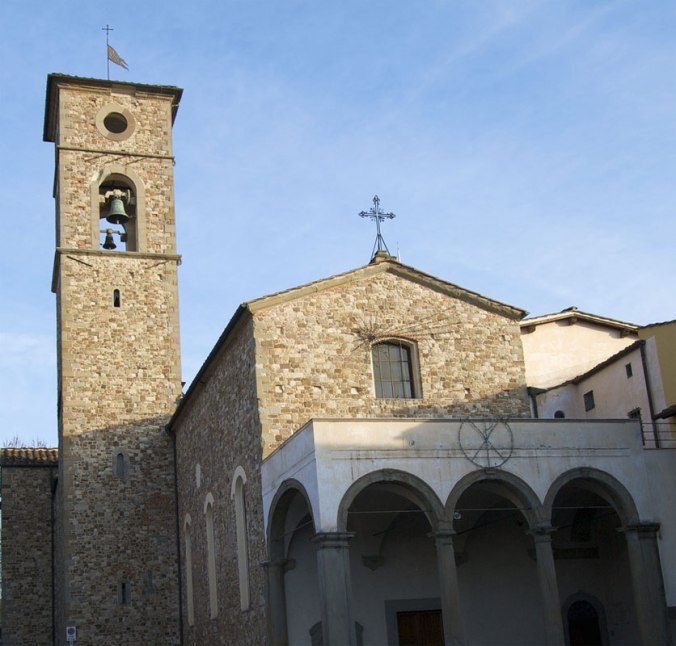
This church of San Michele a San Salvi is one of the most important ancient churches located outside Florence’s (former) circle of medieval walls.The adjacent Cenacle of San Salvi is a real hidden gem of the city.
You can find the location on the right side of this Google map screen shot. It is marked with a pin and titled “Cenacolo di Andrea del Sarto.”
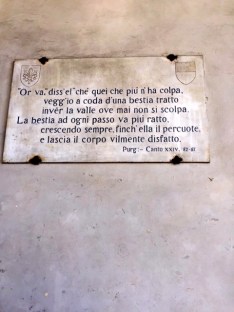
(For some reason I am not educated enough to understand, the picture above shows the plaque with a citation from Dante’s Purgatorio, which is placed on a wall near the church’s facade. If you know why it’s there, please leave me a comment! Grazie!!)
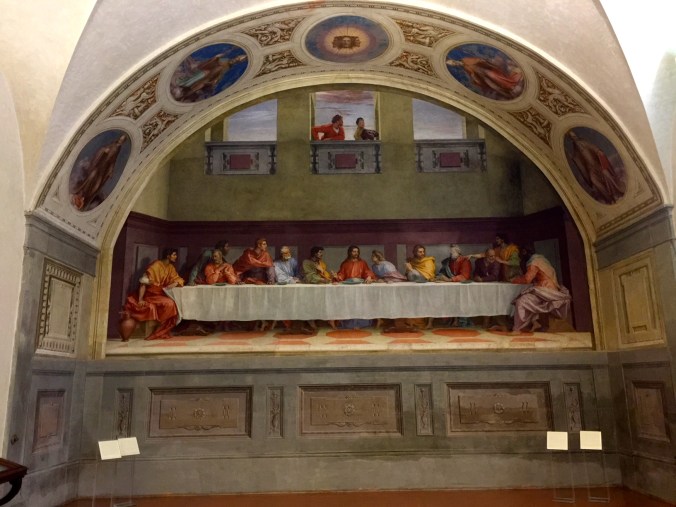
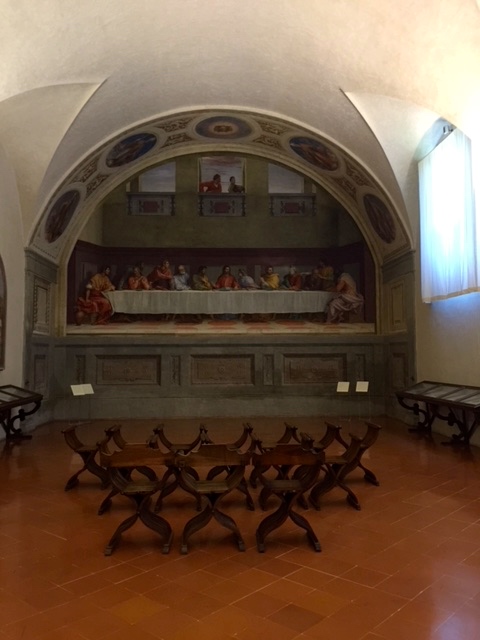
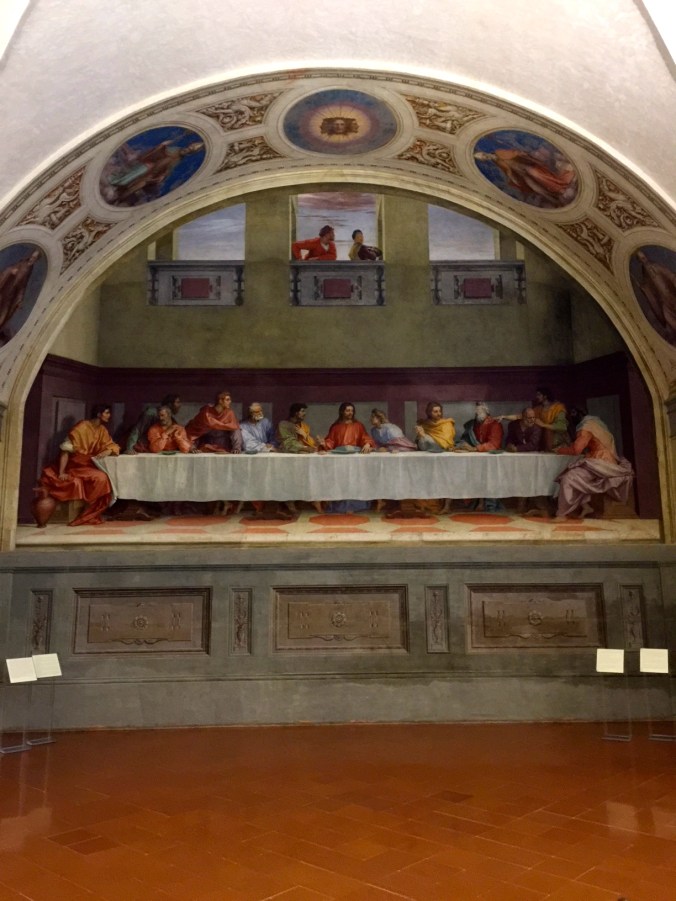
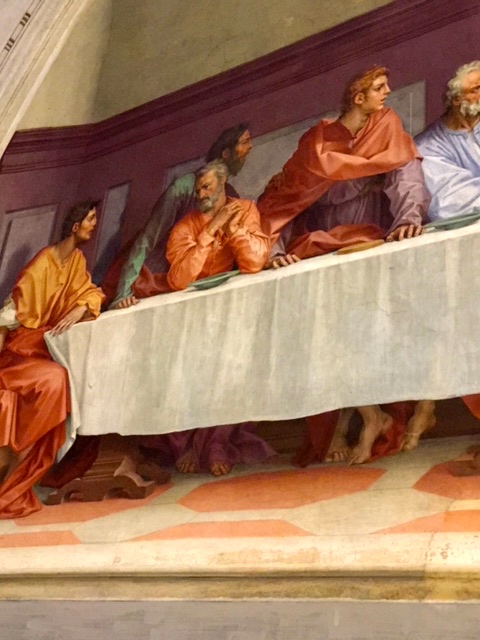
By traveling to this location, you will be rewarded not only with a coolish tranquility but also with a masterpiece: Andrea del Sarto’s fresco of The Last Supper (called Cenacoli in Italian),which is as monumental as it is beautiful.
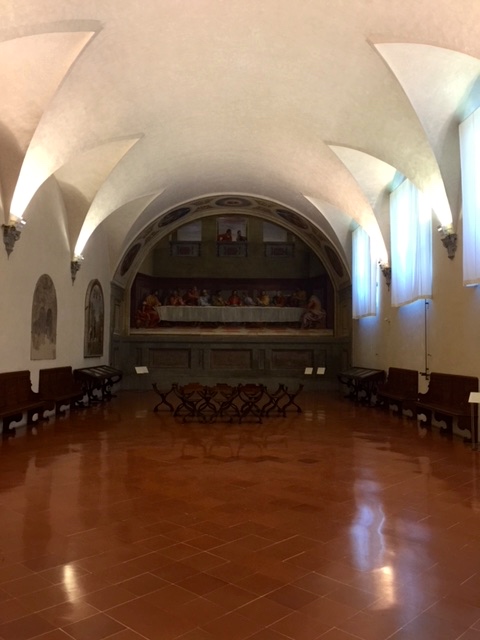
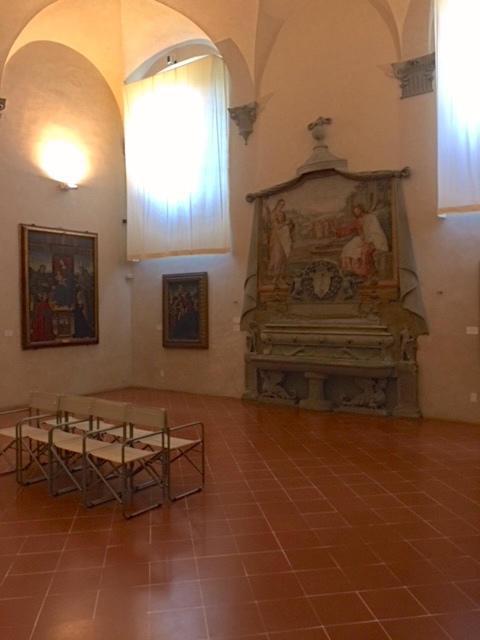
You walk into this calm typically Tuscan space (pale walls, red floor, accents of gray pietra serena stone) and this is what you see. For me, this is where my blood pressure begins to regulate; soon I will be lost in the experience of the painting.
This relatively unknown jewel of the art of fresco was lovingly described by none other than the world’s first true art historian, Giorgio Vasari. About it he said: “Andrea del Sarto, the flawless painter, is the author of the Last Supper kept in the Great Refectory of the San Salvi convent. [The fresco has] endless majesty with its absolute grace of all the painted figures.”
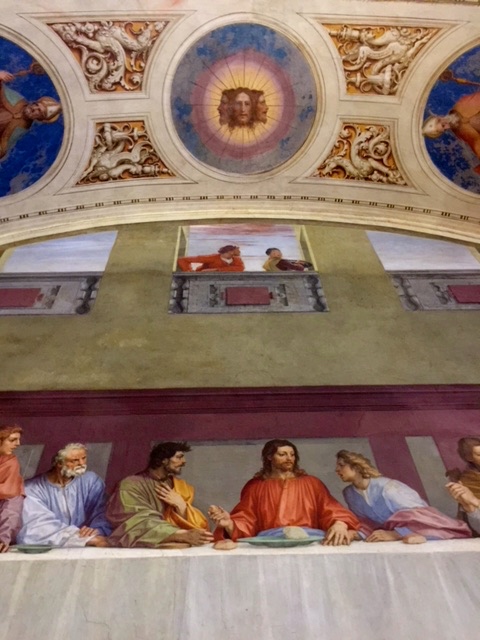
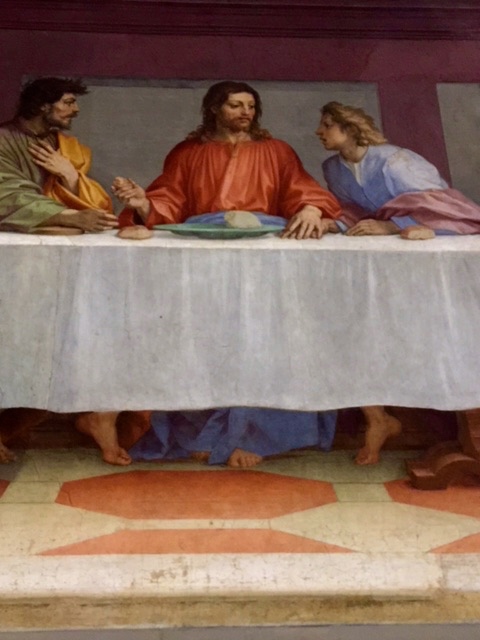
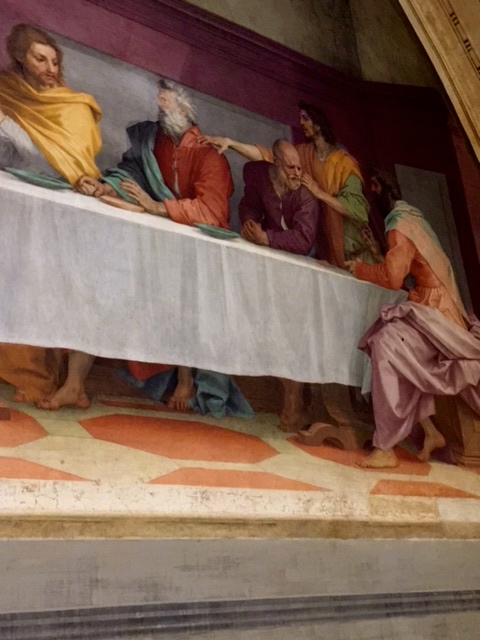
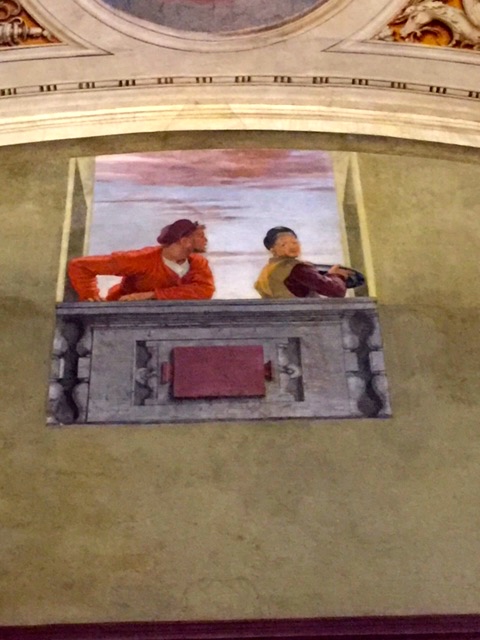
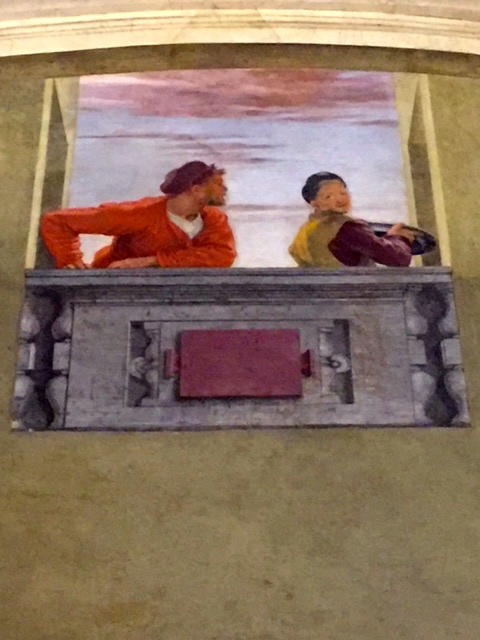
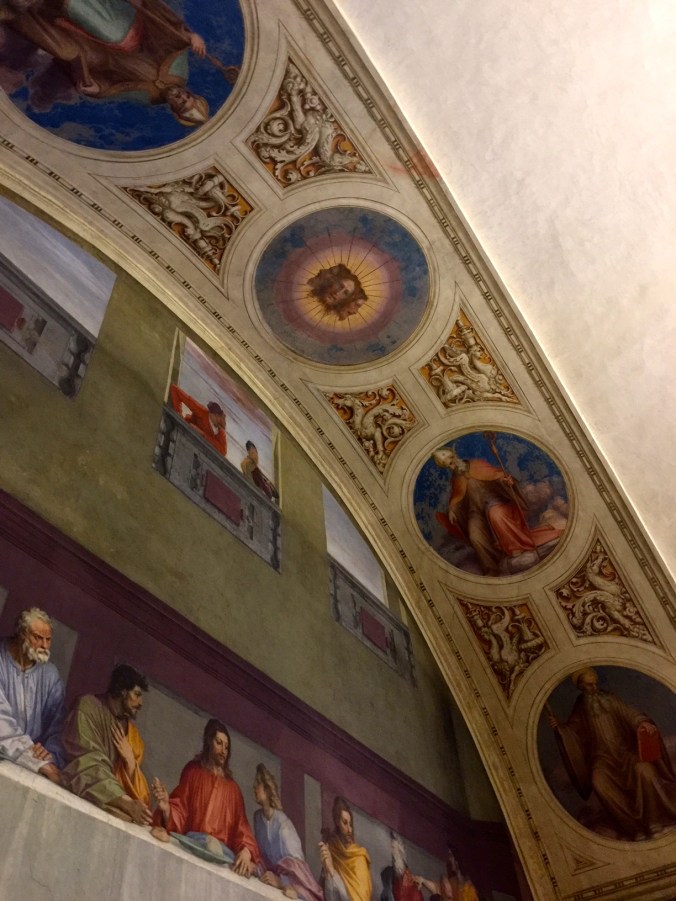
Here are some details of the glorious painting:
I simply adore this casual slice of everyday Florentine life captured by Andrea del Sarto in the top of the lunette over the last supper. One man appears to just be hanging out on a balcony over the people eating, while the other, possibly a server for the dinner, seems to be walking away.
Not pictured here, but to the right and left of the room, along the walls in glass topped cases, are many sketches for the fresco by Andrea del Sarto. It is a rare opportunity to see sketches by an artist from this period. And, to see them in conjunction with the final work is an extraordinary opportunity.
Notice in the picture above, Andrea del Sarto’s treatment of the Trinity. A 3-faced head shot of sorts.
Who knows!? You might be as lucky as I was and have the place all to your self on the middle of a Saturday in July. This is almost unheard of in Firenze!
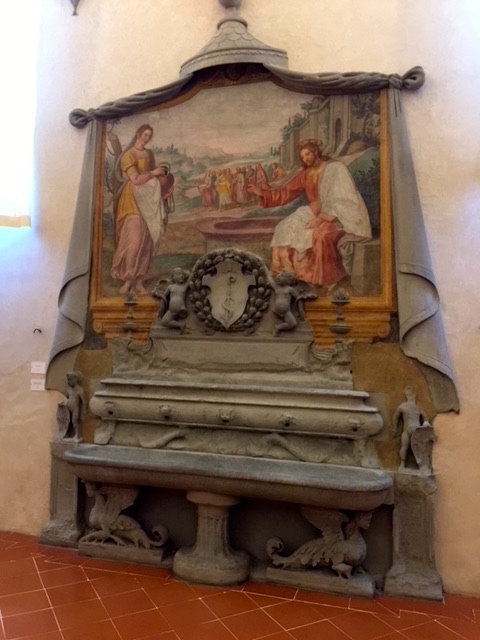
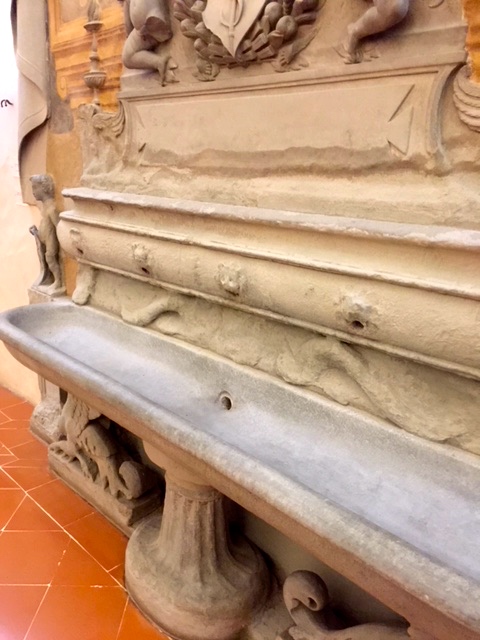
Just outside the refectory is a fountain where the convent members could wash their hands before entering the refectory to dine.
(The following is taken from the source listed at the end of this post.)
This past week I have been very lucky to have a very dear friend visiting, and so I’ve been playing a bit more tourist than I normally do in Italy. We wanted to get out of Florence a bit, so we headed to nearby Orvieto, somewhere I have never been, and only about two hours on the regional (slow) train. Orvieto is located on a (very tall) hill, so we took the funicular from the bottom of the hill where the train dropped us off to the old town, and then headed straight for the main piazza del Duomo. We picked up tickets for our main interest first, and while we waited headed into the Duomo. Orvieto’s Duomo is pretty low-key overall, but the chapels are what are most noticeable and they are much more ornate than the rest of the empty-feeling church.
The church is similar in feel to the Duomo in Siena, but as previously noted the chapels here are what are incredibly ornate. One chapel in particular was created for a piece of bloody cloth from when the wafer began to drip with the actual blood of Christ to convince a doubting priest. The cloth and host were taken to the pope, a miracle was declared and the chapel was built where the cloth is enshrined to this day. The majority of the frescos in that chapel were done by Luca Signorelli, and are said to have influenced Michelangelo’s frescos in the Sistine Chapel. The influence is obvious; Signorelli’s figures are incredibly muscular.
After viewing the church we headed from the beautiful city aboveground to under the ground, to the main attraction of Orvieto and what we were most excited to see: the Orvieto underground. During the time of the Etruscans thousands of man-made caves were dug out of the hillside and they are spread throughout the city. I tried to find an example of the map that you can see there, but was unsuccessful, but imagine a small Italian town city map: now draw thousands of red circles all over it and you’ll have an idea of how many caves there were and the reach of them. We took a guided tour in English, and were able to get some backstory on the caves and see them up close and personal.
The caves look pretty much like you would expect– they are caves after all– but what is perhaps most surprising is the temperature drop after you descend even just one level down into the caves. It is so much cooler there, and it is no surprise that the Etruscans used the caves for things such as olive oil making. Below you can see an ancient olive oil press. The straining mat is modern, but something similar would have been used to press the oil out of the olives and prevent pieces of the olives from joining the oil.
The caves were incredibly extensive; we felt we had seen so much, but in reality we only covered two tiny circles on the map of thousands. At one point our guide pointed out that while it seemed we had covered a lot of ground, it had all been vertical, and there certainly were a lot of stairs– this was not a tour for those who can’t do stairs– or the claustrophobic! The caves were quite spacious, but the tiny staircases and passages between them, not so much.
Many of the rooms in the caves were studded with holes, as you can see in the photograph above. For a long time they believed that these holes had a different purpose, but now archeologists are pretty certain that they were used to raise pigeons, which are actually a pretty common food in Orvieto, one of the things the city is known for (the others being ceramics, Orvieto classico wine from Trebbiano grapes, and olive oil). The pigeons were self-maintaining, because they would fly out the window that was ever-present to eat, and also bring back food for their young. Unlike other animals such as rabbits, people did not have to put in as much effort to raise them.
After some time the caves reached their final hurrah when the people of Orvieto were forbidden from digging out any more caves due to the instability of the area; landslides, thanks to the instability caused by the caves were increasing and there was fear that the entire city might disappear. Now there are spikes driven through the hill to protect the city, but the caves are now an archeological and historical site as opposed to a functional one.
Orvieto, being a hill town, had beautiful views, and we spent the rest of the afternoon wandering and enjoying them before heading back to Florence on the train. Below you can see a convent (I believe) from the hillside where we entered the underground caves.
Orvieto was sacked by the Romans, but the city withstood their attacks for two years thanks to its prime hilltop position: easy to defend. There are walls around the city as well, and facing the train station you can climb atop for the best view of the valley below.
Sometimes living in Florence it’s easy to forget that Italy isn’t really a land of cities. I’m lucky enough to have a view of the hills from my balcony, but visiting a small hill town is a good reminder of what Italian life is really like for most people– in the past, and in the present.
It was the sort of thing that would never happen to George Clooney: As I stepped off the packed vaporetto onto the island of Murano, I slipped on the rain-slicked dock and my trolley bag went click-clacking across the dock’s wooden planks. When neither the suitcase nor I fell into the Venice Lagoon, my audience — a boat full of amused Italian passengers — went back to their cellphones and newspapers and the vaporetto chugged off toward Venice.
It was an inauspicious start to a journey that many a trusted tastemaker advised me not to take. Despite the fact that vintage Murano glass is avidly sought by museum curators and interior designers around the world, there is a prevailing sense that contemporary Murano has lost some of its mystique; a trip to the island is usually the purview of package tour operators and first-time visitors to Venice.
Rumors that some of the “Murano” glass sold on the island is actually made in China or Mexico haven’t helped; nor has a global recession that’s been particularly harsh to southern Europe and its artisans who create exquisite but often expensive wares.
A canal on the island of Murano. Credit Francesco Lastrucci for The New York Times
But in just one day in September spent poking around the island, it was abundantly clear that talented artisans are still creating gorgeous glass objects. And blending the latest technology with ancient techniques has been Murano’s recipe for survival for the last seven centuries.
Glassware, of course, has been around for millenniums — the Romans produced beautiful pieces — but the knowledge and techniques were eventually forgotten and lost in Europe during the Middle Ages. Its revival can be traced to the Republic of Venice’s trade with the Middle East, where glassmaking traditions had continued in Byzantium and the Muslim world. Through their trading partners, the Venetians learned the secrets of production and established a thriving industry that produced elegant blown glass and mirrors, which quickly became coveted symbols of style and status across Europe.
After repeated fires at the factories leveled parts of the city, the doge moved all glassmaking enterprises to the small island of Murano in 1291, creating what some call the world’s first industrial park. Besides containing the risk of fire, the move controlled comings and goings to ensure that rival empires did not pilfer talent or techniques.
Today Murano still maintains an industrial vibe, resembling a gritty micro-Venice with a largely working-class population of 7,000 residents and an annual influx of more than five million tourists. There are some photogenic canals and bridges and even a lighthouse, but much of the island is a maze of nearly deserted lanes winding through a dense jumble of seemingly derelict factories. The retail action is mostly confined to the main streets, which are packed with the showrooms of well-known manufacturers like Seguso, Venini, Barovier & Toso, Cenedese and Mazzega and smaller stores selling a wildly diverse array of off-brand objects to suit every purse.
Because I wanted to avoid the hawkers and product overload while learning a lot about Murano in a short time, I hired a guide, Guido Lion, from the bespoke travel operation IC Bellagio. Mr. Lion arranged a tour that allowed me to visit several maestros in trusted workshops like Cenedese (now owned by Seguso) and walk through their showrooms with no impulse to buy but rather to trace the history of glass production and innovation.
As is the case today when the best way forward seems to start at the intersection of cutting-edge technology and quality, so it was after World War II, when Gino Cenedese opened a glassworks that became an incubator of innovation in the 1950s, ’60s and ’70s. The introduction of gas furnaces and torches suddenly allowed maestros to work at consistently higher temperatures and to create ever thicker and more sculptural pieces of glass. Among these are the “sommerso” vases created by Antonio Da Ros, which appear to be a composite of two, three or more vases of different colors — one inside the other — fused into an outer vessel of clear glass; these are highly prized items by collectors of midcentury design.
After Cenedese’s museumlike displays, it took a minute to adjust to the creatively chaotic atmosphere at Massimiliano Schiavon’s vast shop and showroom, where the ground-floor furnaces are nestled amid product displays and continuing projects, such as the black glass vintage movie camera that was being made during my visit as a wedding gift for Mr. Clooney.
Mr. Schiavon’s work betrays an affinity for vivid colors and exceptionally large bowls, vases and platters — some more than 30 inches in diameter. Most are priced upward of 2,000 euros. He also designs collections that reveal the 21st-century glassmaker’s ability to mimic other materials like that movie camera as well as Navajo weavings or African tribal baskets.
The Schiavon atelier had been recommended to me by Francesca Bortolotto Possati, the dynamic chief executive of the Bauer Hotel group, whose lobbies and halls are clad with Murano glass objects commissioned from Seguso by her grandfather in the 1940s. Several years ago, when I interviewed her for an article on Venice’s luxury hotels, she was wearing a stunning necklace I assumed was onyx or agate until she told me it was “just glass” made by a lovely girl on Murano. “Her father was a maestro, and now she makes these gorgeous and very modern pieces.”
That’s how I met Manuela Zanvettori — a jeweler who doesn’t wear much jewelry — and how I purchased a year’s worth of glass gifts for female friends.
“I don’t like the weight and feel of things around my neck or wrists,” Ms. Zanvettori said as she pulled out a tray of rings in her light-filled atelier a few steps off Murano’s bustling Fondamenta dei Vetrai. “But I can wear rings, and these are so substantial that you really feel ‘dressed’ with just this one piece.”
The large and luminous glass rings look simultaneously modern and medieval, like the chunky bling you might see on a pope or cardinal’s finger in an old-master portrait. The fact that they cost just 25 euros takes away the sting of worrying that they might break. In contrast, her new Air collection is almost futuristic, with pendants and earrings composed of nearly weightless bubbles of clear glass filled with delicate shavings of gold, silver and copper.
Artisans who focus on just one type of product — say, jewelry, mirrors or chandeliers — are nothing new on Murano. Fratelli Barbini is a family-run enterprise that has made mirrors since 1600. Stepping into its showroom offers a sweep through the intervening 414 years in palace décor, ranging from mirrors in massive baroque frames to curvy 18th-century styles made entirely of an elaborate mosaic of hand-cut black and mirrored glass. A 20-inch-high vanity mirror might cost $350, and something in the 10-meter-tall range first created for one of Philippe Starck’s hotel interiors can easily run you $40,000. According to Guido Barbini, who has worked in the family business for 55 years, the mirrors are all hand-silvered in house and all relief decoration is carved by hand rather than etched with acid. An intricate pieced mirror can take up to two weeks to assemble.
While the niche firm Andromeda hasn’t been around for 400 years, it can perhaps rival Barbini in terms of its luxury hotel presence, although Andromeda’s creations hang from the ceiling rather than the wall. Chandeliers in all their variety are the specialty of Andromeda, which works with designers like Mr. Starck, Karim Rashid and Tobia Scarpa to create one-of-a-kind lighting fixtures. For home use, it has simpler lines, such as the streamlined Sublime chandeliers and sconces in pale shades of turquoise and jade.
Just as the introduction of gas to the furnaces unleashed an era of innovation on Murano, so now is LED lighting technology. Well-placed LED lights can turn the glass rods and discs of a typical chandelier into a sort of luminous fiber-optic cable, setting the structure ablaze from within.
Inspired by the potential of LEDs and his love of “making what does not exist,” Gianluca Vecchi, whose father founded Andromeda in 1973, is starting a brand called Khidr, featuring small pieces that look like large crystals or gemstones. They cast a magical light through thick masses of lushly colored glass. No two Khidr lamps will be the same. Clients can suggest size or color, but the rest is left to the maestro at the furnace. The showroom is set to open in November, and prices start at about 600 euros.
At Seguso, among the oldest and most revered names on the island — going back 23 generations to 1397 — the trend is toward custom everything, including the tours available to visitors. Rather than marching crowds of tourists though its operation, Seguso has created “Night in the Furnace” dinner events and “Glass Experience” tours for six or fewer guests, who typically pay $200 to $300 a person to spend several hours seeing every aspect of the glassmaking process and its long history in the hands of Seguso maestros.
The current generation’s grandfather, Archimede Seguso, was a pioneer in revolutionizing the industry in the mid-20th century. The prolific family has had many ventures on the island, withstanding the tides of taste and fortune.
“In past centuries there were hundreds of furnaces working on Murano; today it is more likely dozens,” said Antonio Seguso, a grandson of Archimede who branched out on his own in 2012.
Until the 1980s, one of Archimede’s sons, Livio Seguso, had his own factory but left the commercial business to explore glass from a purely artistic perspective, creating totemlike sculptures of wood, steel or marble supporting glass discs. Later works are wall mounted or even suspended from the ceiling with interlocking circles of steel and glass. His studio and gallery is on the Fondamenta Venier near Murano’s miniversion of the Rialto Bridge; while it maintains irregular hours, a call or email in advance can usually secure an appointment.
Not far from Mr. Seguso’s studio, Murano’s Glass Museum is expanding its displays of modern and contemporary glass. But more newsworthy is that elsewhere in Venice, Murano glass is also being celebrated as fine art. Across the lagoon, exhibitions at the recently opened Stanze del Vetro on the island of San Giorgio Maggiore focus exclusively on local glass.













 get back, lauretta!
You must be logged in to post a comment.