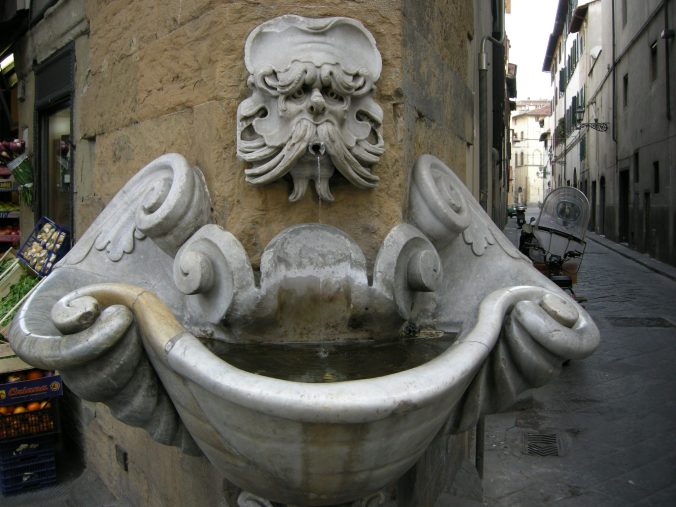
You can count on one hand the famous fountains of Florence. Here’s a good survey of them.
http://www.theflorentine.net/art-culture/2018/04/fountains-in-florence-italy/
You can count on one hand the famous fountains of Florence. Here’s a good survey of them.
http://www.theflorentine.net/art-culture/2018/04/fountains-in-florence-italy/
A few years ago it was announced that the Corcoran Gallery of Art, Washington’s oldest private art museum, and its venerable college of art and design would cease to exist as an independent institution, and its components — artwork, historic building and school program — will be taken over by the National Gallery of Art and George Washington University.
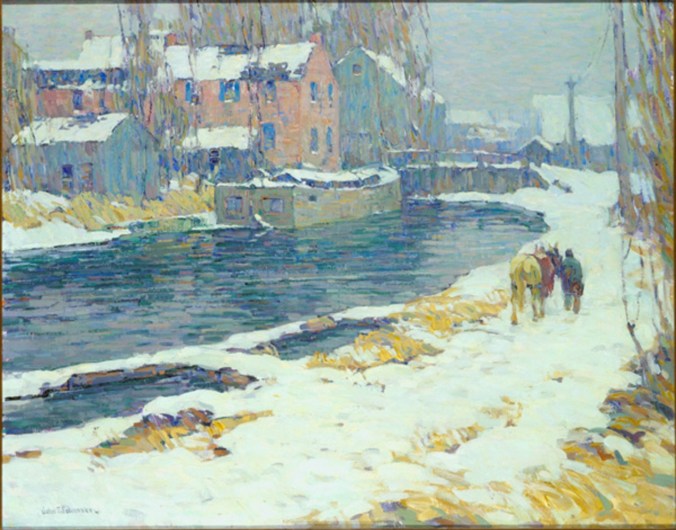 John Fulton Folinsbee’s “Grey Thaw,” one of the works in the Corcoran’s collection. (Corcoran Gallery of Art’s board of trustees )
This week it was announced that the Corcoran’s board of trustees has decided that it will distribute almost 11,000 works remaining in its renowned collection, a historic giveaway that includes paintings by Washington Color School artist Sam Gilliam, photographs by Ansel Adams and Dorothea Lange, and prints by 19th-century French master Honoré Daumier.
Almost 9,000 pieces will go to the American University Museum at the Katzen Arts Center, with others headed to 10 Smithsonian Institution museums, several universities and the U.S. Supreme Court.
The distribution marks the final stage of the dismantling of the famed Washington institution. Under a controversial 2014 deal, the National Gallery of Art had first dibs on the entire collection and ended up acquiring about 40 percent of the 19,493 works. George Washington University gained control of the museum’s independent school and its two historic buildings, including the Flagg Building on 17th Street NW.
For more, please see these sources:
Dante, the Divine Comedy: “Consider your origins: you were not made to live as brutes, but to follow virtue and knowledge.”
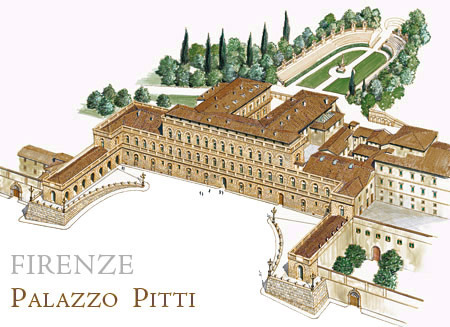
At Palazzo Pitti, the builders had it much easier, since their source [of stone] (the Boboli hill) was right behind the palace. In fact, Palazzo Pitti sits on the hollowed out part of one of these quarries.
Papal excess, the Metropolitan Museum of Art and Stephen Colbert.
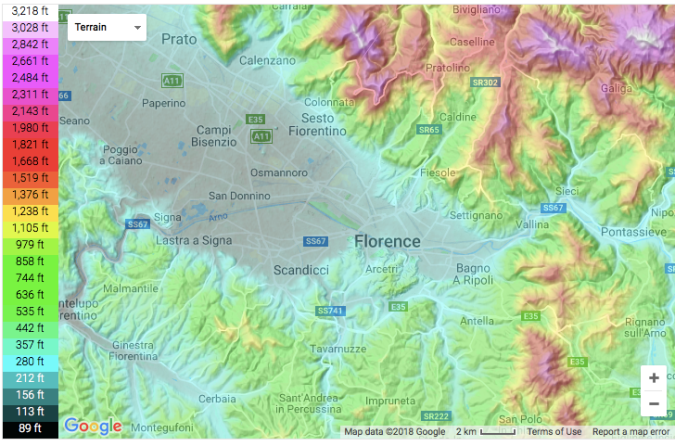
Has it ever occurred to you that the stony city of Florence was literally carved out of the surrounding hills? It’s quite true. Countless local quarries provided the blocks of stone for the walls of medieval and Renaissance churches and palaces, and for the columns and architectural ornaments to decorate them. Pietraforte, a kind of light brown limestone, came from quarries at Costa San Giorgio, in the Boboli hill between Santa Felicità and Porta Romana, at Bellosguardo, and around Marignolle and Le Campore, all south of the Arno. To the north, the hills of Fiesole, Maiano and Settignano provided the blueish-grey sandstone pietra serena.
In the 13th century, load after load of pietraforte was hauled over the Arno to the outskirts of Florence to construct the enormous basilicas of Santa Maria Novella and Santa Croce. Even the piers inside these two churches are of pietraforte. Look at Palazzo Vecchio, the Log-gia dei Lanzi, the Bargello and Orsanmichele, and you are looking at pieces of the southern hills transformed into architecture. The gigantic blocks of rustication that you see on the façades of the 15th-century Palazzo Medici were cut out of pietraforte quarries. Filippo Strozzi, whose palace rivals that of the Medici in size, had endless loads of stone brought from quarries at Boboli and Marignolle. It is said that between November 1495 and March 1497, Strozzi’s heavily-laden carts rattled over the Arno more than a thousand times. At Palazzo Pitti, the builders had it much easier, since their source (the Boboli hill) was right behind the palace. In fact, Palazzo Pitti sits on the hollowed out part of one of these quarries.
If pietraforte was used mainly for the construction of walls, pietra serena was used above all for columns, stairs, doors and windows. The oldest of these quarries, dating back to Etruscan times, were at Monte Ceceri in Fiesole, and they continued to be worked during the Roman and early medieval periods. The demand for pietra serena was so high that in the 13th century new quarries had to be opened further east, around Vincigliata and Settignano. By the 15th century, when Brunelleschi’s architectural style boosted the popularity of pietra serena to unprecedented heights, it was also being extracted at Golfolina, west of Florence.
Brunelleschi chose quarries that would provide enormous blocks of pietra serena from which he could cut entire column shafts. He quarried the stone for the loggia of the Ospedale degli Innocenti at Trassinaia, near Vincigliata. The columns for San Lorenzo came from a site nearby, still known as the Cava delle Colonne.
http://www.theflorentine.net/art-culture/2006/09/quarries-near-florence/
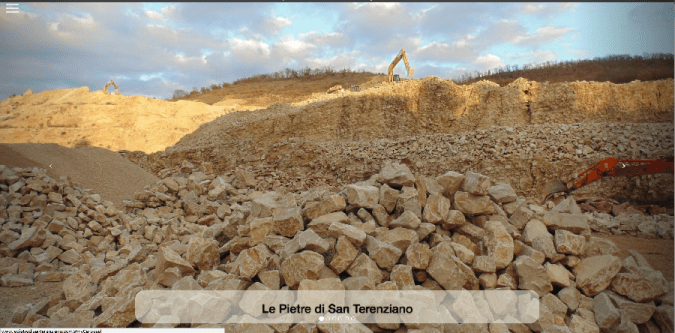
The Settignano quarries yielded macigno, a fine-grained grey sandstone that was much prized in Florence. It is a gravely beautiful material in a range of dark-greenish and bluish greys, fine enough to carve in crisp detail and with a quality of simultaneously absorbing and reflecting the light, producing a paradoxical impression of dark luminosity.
This is the material that Brunelleschi used for the columns and capitals of his buildings. Michelangelo would employ it in the same way in his projects at San Lorenzo in Florence.
The Florentines, being interested in this stone enough to make fine distinctions, gave names to the differing grades, the finest type being pietra del fossato, and the others including pietra serena and pietra forte.
Michelangelo, who had immense sensitivity to stone, went further than these broad categories. He knew that each quarry, every stratum, would produce material of subtly differing character. The contract for the stairs and two doors of the library Michelangelo was building at San Lorenzo in the 1520s stipulated that the pietra serena supplied should be of the same ‘colour and flavour’ (‘ colore et sapore’) as in the sample. ‘Flavour’ is a wonderful word to use of stone: bringing out its sensuous character as if it were actually edible.
When he designed buildings in Rome, Michelangelo was attentive to the qualities of the local material, travertine, a limestone noted for the pits and troughs in its surface – as different in its flavour and colour from Florentine sandstone as roast beef is from pâté de foie gras. His use of travertine for the walls of St Peter’s and the palaces on the Capitoline Hill made the most of its rugged nature.
For sculpture he used only the finest type of pure white marble, known as statuario, found particularly in certain quarries above Carrara. Even this sculptor’s marble, according to the sculptor and goldsmith Benvenuto Cellini, came in at least five or six grades, the first having a ‘very coarse grain’ and the softest, which he describes almost like flesh, ‘the most cohesive, the most beautiful and the tenderest marble in the world to work from’.
Michelangelo was renowned for his ability to discern the quality of a potential piece while it was still in the rockface. When he was engaged from 1516 onwards on large construction projects at San Lorenzo in Florence which involved the quarrying, transport, dressing and carving of huge amounts of both marble and macigno, a majority of the masons he employed were from Settignano.
Gayford, Martin. Michelangelo: His Epic Life (Kindle Locations 803-811). Penguin Books Ltd. Kindle Edition.
Before Charles Eliot Norton had become Harvard’s first professor of that discipline, art history had, in general, been considered, not a field of study, but a matter of craft and technique to be taught by painters to other painters.
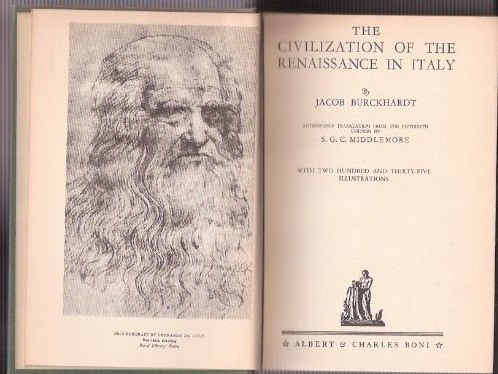
Scholarship about art, and especially about Italian art, entered a new era as the German universities began developing large-scale historical studies like those of Swiss scholar Jacob Burckhardt, whose Civilization of the Renaissance in Italy was published in English in 1878.
In Great Britain, tastes were influenced by the work of Norton’s close friend Ruskin in books like The Stones of Venice (1851–1853) and The Seven Lamps of Architecture (1849).

Following Ruskin, Norton loved best in Italy the powerful moral uplift of Dante and of Italy’s medieval Gothic architecture. In Norton’s art history courses, the Renaissance was the unhappy termination of the Middle Ages, which had been the last great era of spiritual unity and well-being.
There was a joke current among Harvard undergraduates that Norton had died and was just being admitted to Heaven, but at his first glimpse staggered backward exclaiming, “Oh! Oh! Oh! So Overdone! So garish! So Renaissance!”
“Norton,” Bernard Berenson commented drily years later, had done what he could at Harvard to restrain “all efforts toward art itself.”
Rachel,Cohen. Bernard Berenson (Jewish Lives) (p. 45). Yale University Press. Kindle Edition.
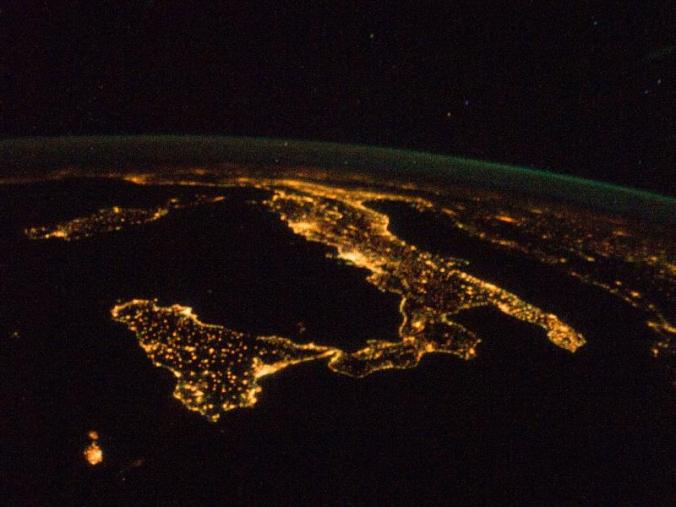
“Trapani! Trapani, don’t you see?” [British] Capt. Edward Croft-Murray exclaimed as the skyline of the Sicilian coastal town first appeared through the porthole of the Allied aircraft. [The Brit] Sitting next to him, Maj. Lionel Fielden, who had been drifting off into daydream for much of the flight from Tunis, opened his eyes to the landscape below. “And there, below us,” Fielden later wrote, “swam through the sea a crescent of sunwashed white houses, lavender hillsides and rust red roofs, and a high campanile whose bells, soft across the water, stole to the mental ear. No country in the world has, for me, the breathtaking beauty of Italy.”
…As soon as the first Monuments Officers reached Sicily, the implications of such a mandate [to preserves as many cultural works as possible] proved as difficult as its scope was vast. The Italian campaign, predicted to be swift by Allied commanders, turned into a 22-month slog. The whole of Italy became a battlefield. In the path of the Allied armies, as troops slowly made their ascent from Sicily to the Alps, lay many beautiful cities, ancient little towns and innumerable masterpieces. As General Mark Clark declared with frustration, fighting in Italy amounted to conducting war “in a goddamn museum.”
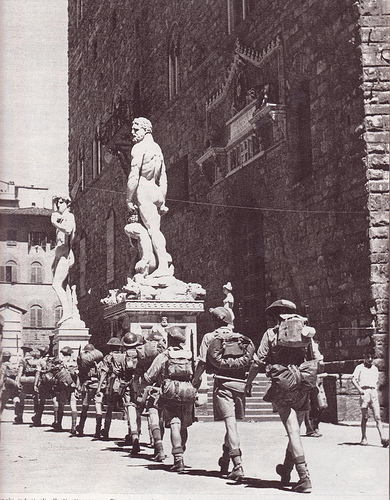
From the safe distance of 2018, it is interesting to think back to the situation in Florence during WWII, especially after the Allied Forces liberated the Renaissance citta’.

The leaders and troops of the Allied Forces are my heroes. There are many to name. General Dwight D. Eisenhower is foremost among them. I recently wrote a post on his directive, which saved many cultural monuments in Italian. Here is a picture of Ike in Italy:

As the Allies liberated region after region in Italy, starting from the southern tip and working their way north, thanks to the farsighted leaders, as many cultural works as were possible were saved.
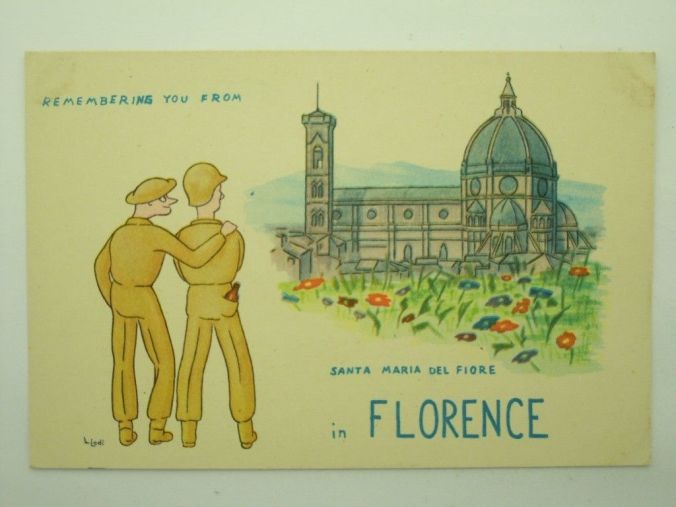
These wonderful postcards, with their simple illustrations of the Florentine architectural masterpieces, tell a poignant story.

 get back, lauretta!
You must be logged in to post a comment.