Do you know the work of Tamara de Lempicka?

images-4


If not, I think you’ll like her work.
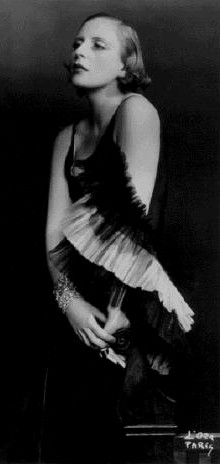
 

Tamara_de_Lempicka

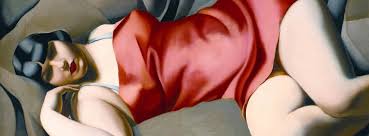
Tamara de Łempicka (1898 – 1980) was a Polish Art Deco painter.  Influenced by Cubism, Lempicka became the leading representative of the Art Deco style across two continents, and she was a favorite artist of many Hollywood stars. She was the most fashionable portrait painter of her generation among the haute bourgeoisie and aristocracy, painting images of duchesses, grand dukes and socialites. Through her network of friends, she was also able to display her paintings in the most elite salons of the era.

She also led a very colorful personal life.
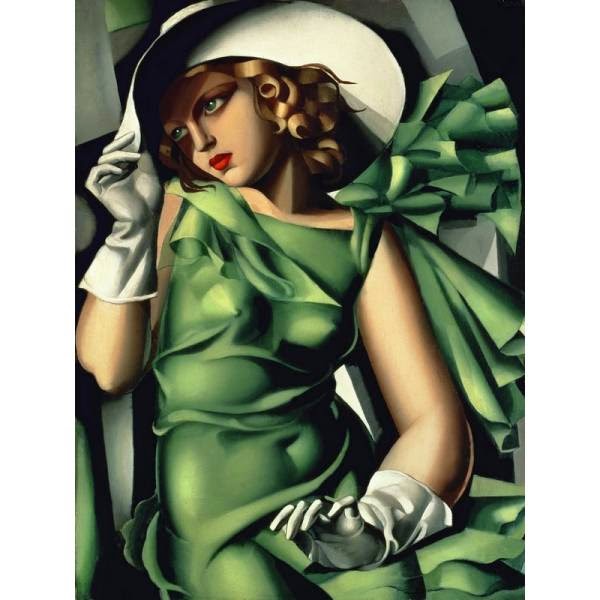
giovane-donna-con-i-guanti-tamara-de-lempicka

She was born in Warsaw, Congress Poland, under the rulership of the Russian Empire. Her wealthy and prominent father, Boris Gurwik-Górski, was a Russian Jewish attorney for a French trading company.  She attended a boarding school  in Switzerland and spent the winter of 1911 with her grandmother in Italy and on the French Riviera. She got her first taste of the Great Masters of Italian painting then.

In 1912, her parents divorced, and Maria, which was her given name, went to live with her rich aunt in St. Petersburg. When her mother remarried, she was determined to break away to make a life of her own. In 1913, at the age of fifteen, while attending the opera, Maria spotted the man she decided to marry.  Her well-connected uncle helped her and 3 years later, in 1916, she married Tadeusz Łempicki (1888–1951) in St. Petersburg. He was a lawyer and womanizer, who was presumably tempted by Maria’s significant dowry.

In 1917, during the Russian Revolution, Tadeusz Łempicki was arrested in the dead of night by the Bolsheviks. Maria searched the prisons for him and after several weeks, with the help of the Swedish consul, she secured his release. They escaped to Paris to where Maria’s family had also escaped. Once there, they changed their last names to de Lempicka.

In Paris, the Lempickas lived for a while from the sale of family jewels. Tadeusz was unwilling or unable to find suitable work, which added to the domestic strain, and Maria gave birth to Kizette Lempicka.

Her sister, the designer Adrienne Gorska, made furniture for her Paris apartment and studio in the Art Deco style, complete with chrome-plating. The flat at 7 Rue Mechain was built by the architect Robert Mallet-Stevens, known for his clean lines.

“The Musician” (1929), oil on canvas

Lempicka’s developed her distinctive and bold artistic style at the Académie de la Grand Chaumière under the instruction of Nabi painter, Maurice Denis, as well as the Cubist Andre’ Lhote. Lempicka was particularly influenced by what Lhote sometimes referred to as “soft cubism” and by the “synthetic cubism” of Denis, epitomizing the cool yet sensual side of the Art Deco movement.  Of Picasso she said “he embodies the novelty of destruction.” She was less impressed with many of the Impressionists.  She thought they drew badly and employed “dirty” colors. Lempicka’s technique would be novel, clean, precise, and elegant.

For her first major show, in Milan, Italy in 1925, under the sponsorship of Count Emmanuele Castelbarco, Lempicka painted 28 new works in six months. A portrait would take her three weeks of work, allowing for the nuisance of dealing with a difficult sitter; by 1927, Lempicka could charge 50,000 French francs for a portrait, a sum equal then to about USD $2,000.  Through Castelbarco, she was introduced to Italy’s great man of letters and notorious lover, Gabriele d’Annunzio. She visited the poet twice at his villa on Lake Garda, seeking to paint his portrait; he in turn was set on seduction. After her unsuccessful attempts to secure the commission, she went away angry, while d’Annunzio also remained unsatisfied.

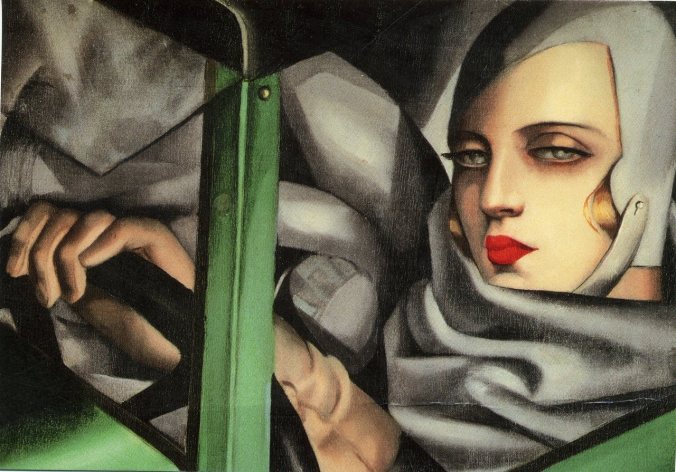
In 1925, Lempicka painted her iconic work Autoportrait (Tamara in a Green Bugatti)  for the cover of the German fashion magazine Die Dame.

images-3

tamara-de-lempicka-autoritatto-torino-2015

As summed up by the magazine Auto-Journal in 1974, “the self-portrait of Tamara de Lempicka is a real image of the independent woman who asserts herself. Her hands are gloved, she is helmeted, and inaccessible; a cold and disturbing beauty [through which] pierces a formidable being—this woman is free!”

In 1927 Lempicka won her first major award, the first prize at the Exposition Internationale des Beaux Arts in Bordeaux, France, for her portrait of Kizette on the Balcony.
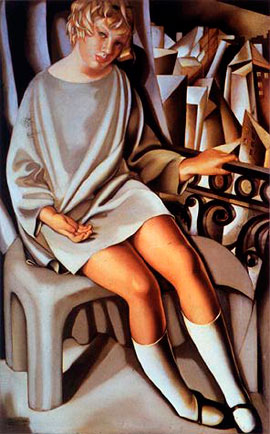
kizette-on-the-balcony_01

Tamara de Lempicka was an important figure in the Roaring Twenties in Paris. She was a part of the bohemian life: she knew Pablo Picasso, Jean Cocteau, and Andre’ Gide. Famous for her libido, she was bisexual and her affairs with both men and women were conducted in ways that were considered scandalous at the time. She was closely associated with lesbian and bisexual women in writing and artistic circles, such as Violet Trefusis, Vita Sackville-West, and Colette.  She also became involved with Suzy Solider, a night club singer at the Boîte de Nuit, whose portrait she later painted.
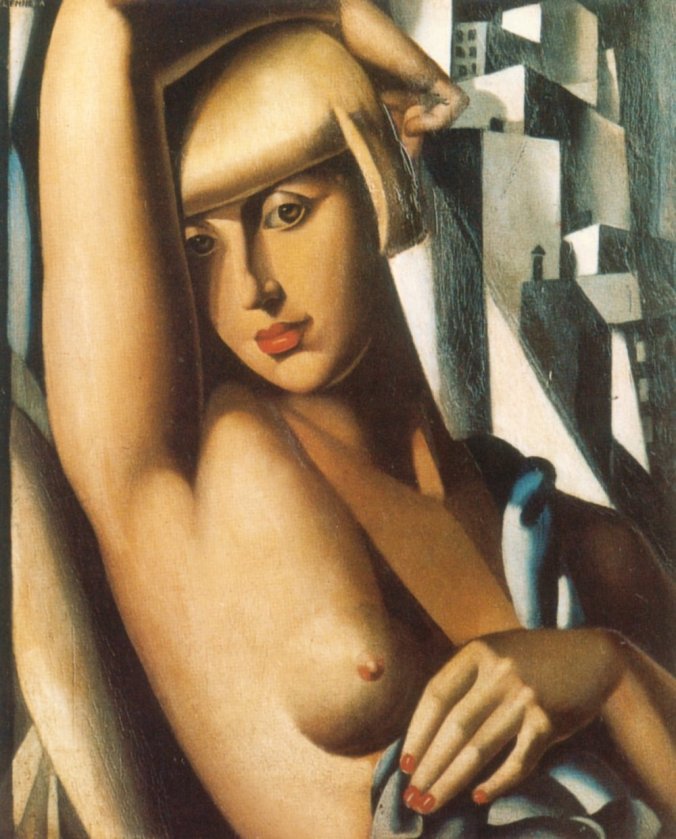
portrait-of-suzy-solidor-1933

Lempicka’s husband eventually abandoned her in 1927; they divorced in 1931 in Paris.

Lempicka rarely saw her daughter. When Kizette was not away at boarding school (France or England), the girl was often with her grandmother Lavina. When Lempicka informed her mother and daughter that she would not be returning from America for Christmas in 1929, Lavina was so angry that she burned Lempicka’s enormous collection of designer hats; Kizette watched them burn, one by one.

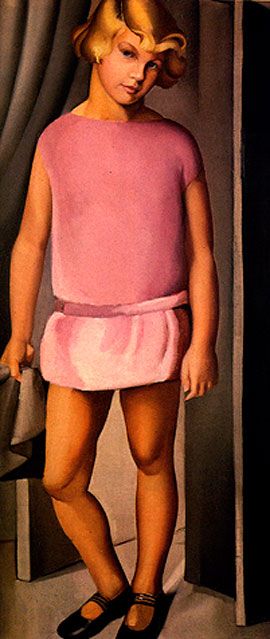
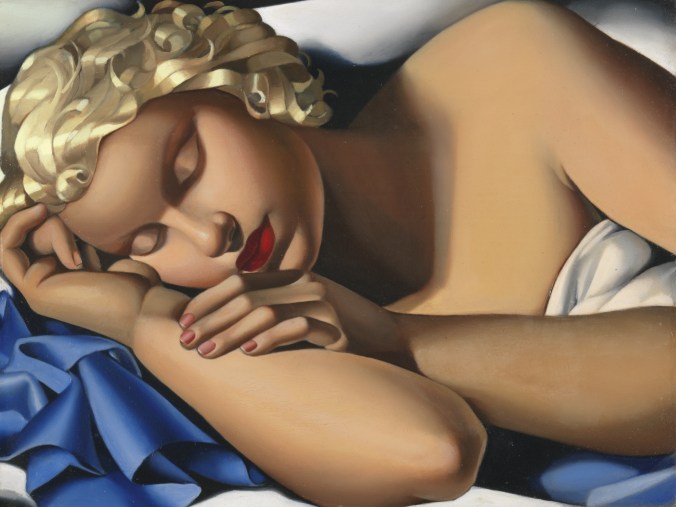
Despite the fact that Kizette rarely saw her mother, she was immortalized in her mother’s paintings. Some paintings of her include:
be200a343a6902b0188d71290247ec59--portrait-paintings-lempicka

Kizette in Pink, 1926


dff501e9ae7653e89ec8a232856b7f1c

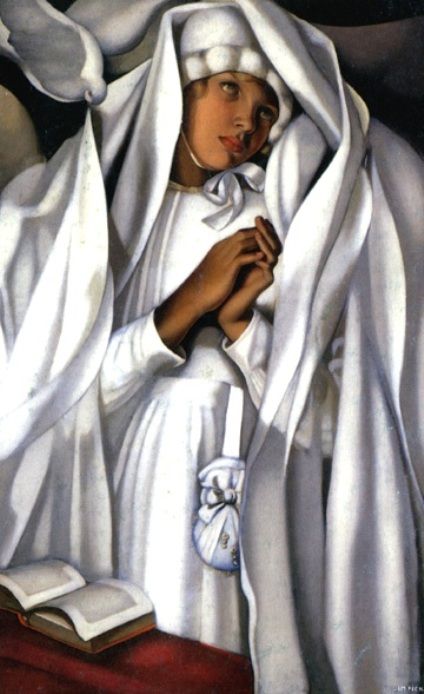
In 1931 Lempicka won a bronze medal at the Exposition Internationale in Poznan, Poland, for another portrait of her daughter, Kizette’s First Communion.
 

723N09139_7G6YD

Kizette Sleeping, 1934


48332f6b44d2a572858d70732f1fd0de--lempicka-art-gallery

Portrait of Baroness Kizette, 1954–5


Even in paintings of other female sitters, the women depicted tend to resemble Kizette.

In 1928, her longtime patron the Austro-Hungarian Baron Raoul Kuffnervon Dioszeg  (1886–1961) visited her studio and commissioned her to paint his mistress, Nana de Herrera.  Here is that painting:
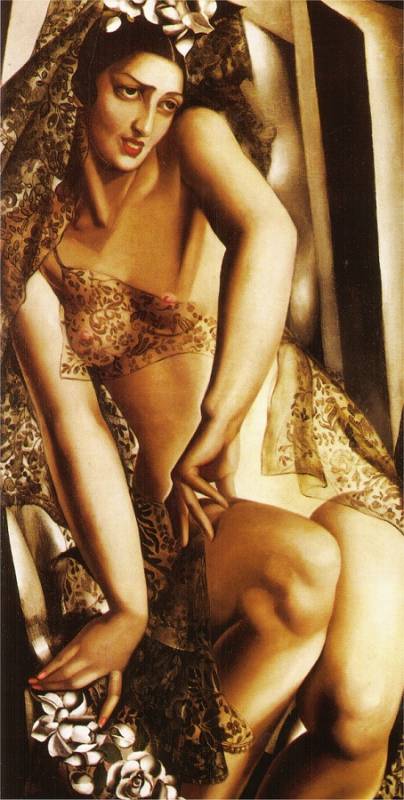
tamara-de-lempicka-nana-de-herrera-1928-648885

After Lempicka finished the portrait, she took the mistress’s place in the Baron’s life.

Lempicka travelled to the United States for the first time in 1929, to paint a commissioned portrait for Rufus T. Bush and to arrange a show of her work at the Carnegie Institute in Pittsburgh. The show went well but the money she earned was lost when the bank she used collapsed following the Stock Market Crash of 1929.

Lempicka continued both her heavy workload and her frenetic social life through the next decade. The Great Depression had little effect on her; in the early 1930s she was painting King Alfonso XIII of Spain and Queen Elizabeth of Greece.

Museums began to collect her works. In 1933 she traveled to Chicago where she worked with Georgia O’Keefe, Santiago Martinez Delgado and Willem de Kooning. Her social position was cemented when she married her lover, Baron Kuffner, on 3 February 1934 in Zurich.

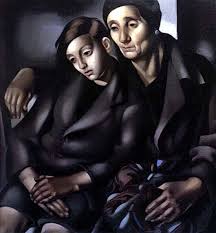
The Baron took her out of her quasi-bohemian life and finally secured her place in high society again, with a title to boot. She repaid him by convincing him to sell many of his estates in Eastern Europe and move his money to Switzerland. Presciently, she saw the coming of WWII from a long way off, much sooner than most of her contemporaries. She did make a few concessions to the changing times as the decade passed; her art featured a few refugees and common people, and even a Christian saint or two, as well as the usual aristocrats and cold nudes.

images-8

images-9

images-10


In the winter of 1939, Lempicka and her husband started an “extended vacation” in the United States. She immediately arranged for a show of her work in New York, though the Baron and Baroness chose to settle in Beverly Hills, CA, living in the former residence of Hollywood director King Vidor.  She cultivated a Garboesque manner. The Baroness would visit the Hollywood stars on their studio sets, such as Tyrone Power, Walter Pidgeon, and George Sanders and they would come to her studio to see her at work.

She did war relief work, like many others at the time; and she managed to get Kizette out of Nazi-occupied Paris, via Lisbon, in 1941.

In 1943, the couple relocated to New York City.  Even though she continued to live in style, socializing continuously, her popularity as a society painter had diminished greatly. They traveled to Europe frequently to visit fashionable spas and so that the Baron could attend to Hungarian refugee work. For a while, she continued to paint in her trademark style, although her range of subject matter expanded to include still lifes, and even some abstracts.
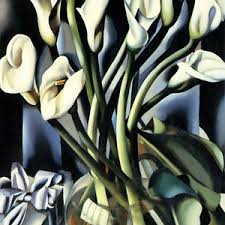
images-5


Yet eventually she adopted a new style, using palette knife instead of brushes. Her new work was not well received when she exhibited in 1962 at the Iolas Gallery. Lempicka determined never to show her work again, and retired from active life as a professional artist.

Insofar as she still painted at all, Lempicka sometimes reworked earlier pieces in her new style. The crisp and direct Amethyste (1946), for example, became the pink and fuzzy Girl with Guitar (1963). She showcased at the Ror Volmar Gallery in Paris in 1961.
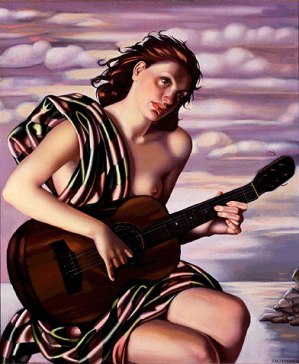
94-2               

After Baron Kuffner’s death from a heart attack on 3 November 1961 on the ocean liner  Liberte’ en route to New York, she sold most of her possessions and made three around-the-world trips by ship. Finally Lempicka moved to Houston, Texas to be with Kizette and her family. Kizette had married Harold Foxhall, who was then chief geologist for the Dow Chemical Company and together they had two daughters.

In 1978 Tamara moved to Cuernavaca, Mexico, to live among an aging international set and some of the younger aristocrats. After Kizette’s husband died of cancer, she was with her mother for three months.  Tamara died in 1980. 

Lempicka lived long enough to watch the wheel of fashion turn a full circle: before she died a new generation had discovered her art and greeted it with enthusiasm. A retrospective in 1973 drew positive reviews. At the time of her death, her early Art Deco paintings were being shown and purchased once again.

A stage play, Tamara, was inspired by her meeting with Gabriele D’Annunzio and was first staged in Toronto; it then ran in Los Angeles for eleven years (1984–1995) at the VFW Post, making it the longest running play in Los Angeles, and some 240 actors were employed over the years. The play was also subsequently produced at the Seventh Regiment Armory in New York City.

In 2005, the actress and artist Kara Wilson performed Deco Diva, a one-woman stage play based on Lempicka’s life. Her life and her relationship with one of her models is fictionalized in Ellis Avery’s novel The Last Nude, which won the American Library Association Stonewall Book Awards Barbara Gittings Literature Award for 2013.
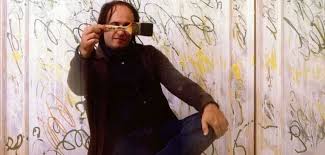
Mario Schifano

Chi e’?  Tu sai?

images-2


I have to admit that I have not known this artist until Italian class today.  So, I decided to look into him. Here’s what I learned:

images

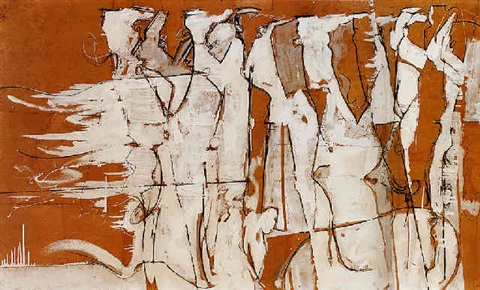
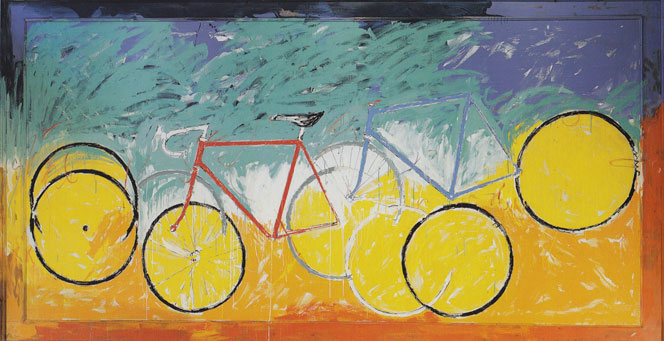
Mario Schifano (1934 – 1998) was an Italian painter and collagist of the Postmodern tradition.  He also achieved some renown as a film-maker and rock musician.

mario-schifano-omaggio-a-balla

He is considered to be one of the most significant and pre-eminent artists of Italian postmodernism. His work was exhibited in the famous 1962 “New Realists” show at the Sidney Janis Gallery with other young Pop art and Nouveau realisme luminaries luminaries, including Andry Warhol and Roy Lichtenstein.  Schifano became part of the core group of artists comprising the “Scuola romana”  alongside Franco Angeli and Tano Festa. Reputed as a prolific and exuberant artist, he nonetheless struggled with a lifelong drug habit that earned him the label maledetto, or “cursed”.  

IW_Mario-Schifano-Bici_03

Stiffen died in 1998 after a life of excess: drugs, prison, asylums and suicide attempt.

Living atop Florence!

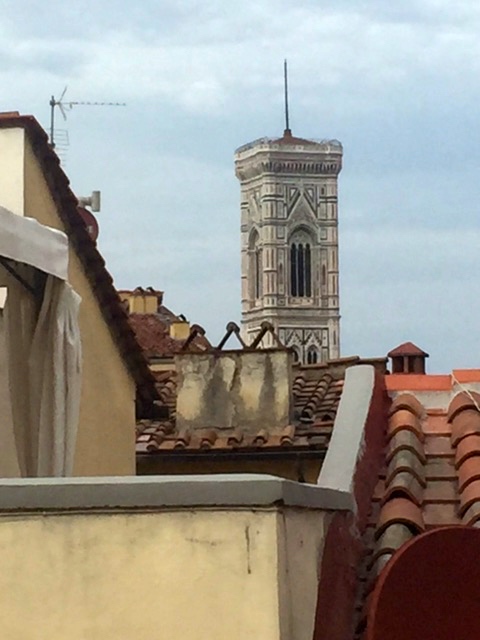
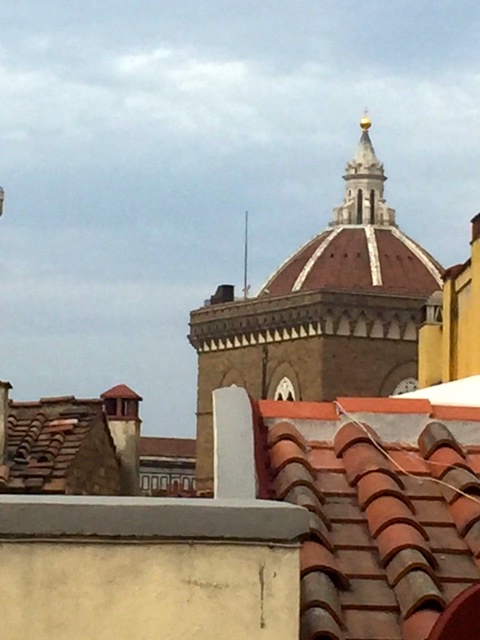
You may look at the photo below and think, that’s not the best shot of Giotto’s Campanile that she’s posted recently.

IMG_4024

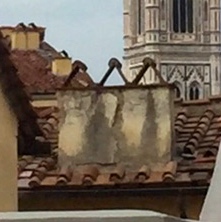
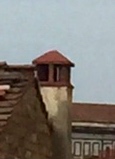
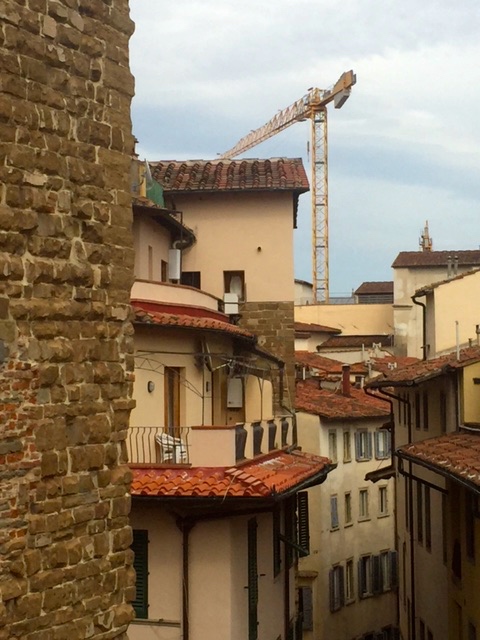
And you’d be right!  It isn’t!  But, what I’m trying to focus on is the terra cotta chimney topper on the chimney in the middle of the picture.  See it?

IMG_4024

This thing.  I’m talking about this chimney topper of 3 upside down V’s.

What I’ve noticed about living up high above historic Florence is that there are all manner of interesting and artistic chimney toppers.  I love looking at them.

For example, there’s also this one:

IMG_4027

I know, you’re probably looking at the Duomo dome.  But I’m focusing right now on this thing:

IMG_4027

It’s another cool terra cotta chimney topper and it looks like a little Roman temple!

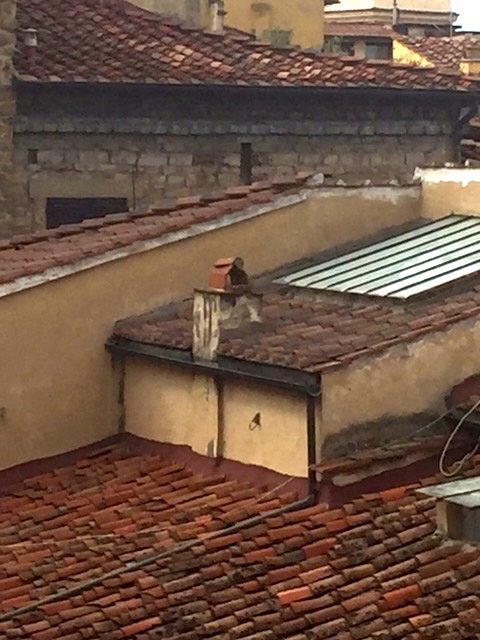
Then there’s this:

IMG_4025

I’m sure that by now your eye is trained and you can focus right on the chimney topper.  This one looks like a little barn with a rolled top.

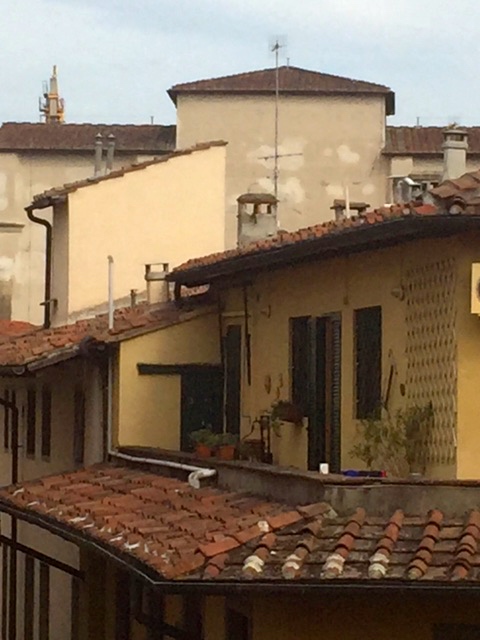
I’ve yet to see any two chimney toppers alike!


IMG_4031

I mean, just look at all the types in any one view!  It’s rather amazing.

IMG_4030

And then I start noticing how people up at this level like to decorate their terraces.  Check out the line of matching ceramic pots in the picture above.  See them?

IMG_4030

There.  You got it!


Art deco Madonna and Child, Florence

I walk by this lovely sculpture about 2x every day, and half the time I am so busy looking down at the cobblestones so I don’t trip that I don’t even look up and see it.

But when I do look up at the palazzo, it repays me with its beauty.  I love the rendering of the time-worn subject but here treated with art deco forms.  So lovely.


IMG_4015IMG_4016


The inscription underneath reads: A Maria Per La Pace, Le Donne Cristiane (to Maria of the Peace, the Christian women).  

What if?

What if you woke up today in Florence and decided you wanted to live in a fantasy world?

Let’s say you thought to yourself  “wouldn’t it be cool if I could go into a Renaissance palace in the center of Florence, and be a welcome guest?”

And, further, wouldn’t it be groovy if, when you were in that Renaissance palace, as a welcome guest, you could sit down for a while on a very comfortable, velvet covered chair, and enjoy a glass of nice local wine, while something amazing entertains you.

And, to increase the fantasy, what if this entire experience was air-conditioned, while Florence sizzles in the heat of the summer outside?

And what if I told you that this is actually not a fantasy, but something you could truly experience?!  How fast would you beat it there?


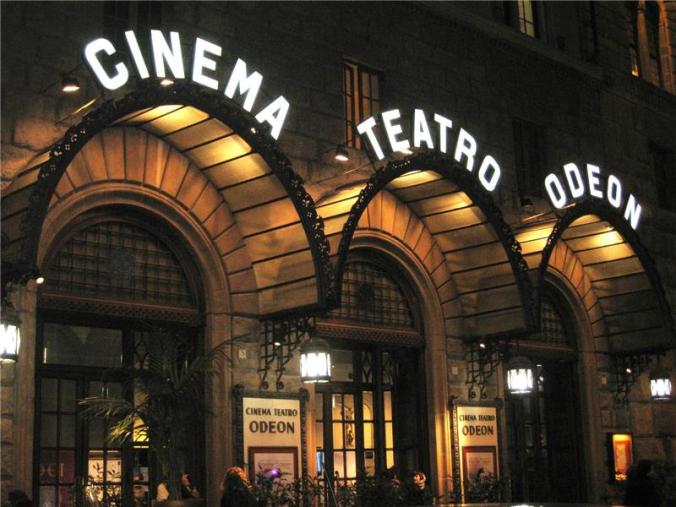
red_cinema_odeon

One of my favorite places in Florence ticks all of the boxes above.  I love going to this place!

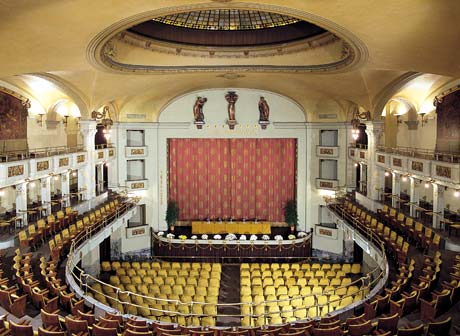
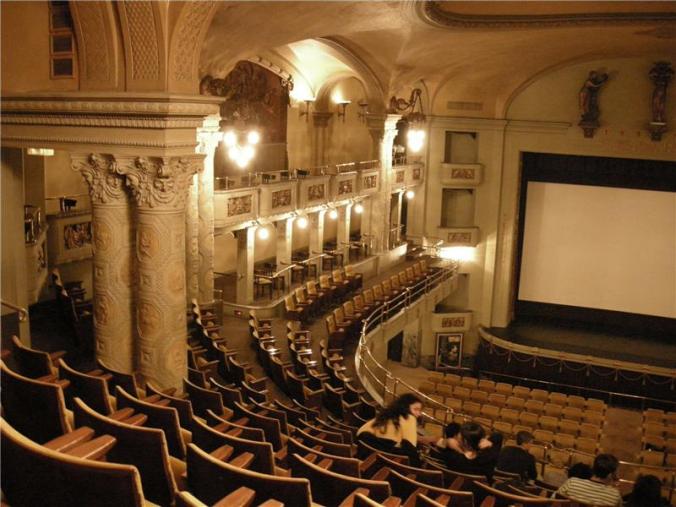
The classic art nouveau/deco interior is gilded and gorgeous and makes an average evening at the movies feel like an elegant affair!  And an added bonus is, it has air conditioning!  A great place to pass a summer evening in broiling Florence.

So, let’s start with the building, which is the Palazzo Stozzino, constructed in 1450s and 60s.  Here t’is!

Palazzo_dello_strozzino_01

Work on the palace began in 1457. None other than Filippo Brunelleschi is thought to have designed it, but several other architects, among them Michelozzo, also had a hand in the edifice. The façade is attributed to Michelozzo, at least in the lower part, with its rusticated stone facing. Higher floors have been changed during various periods of renovation; they were changed a lot in the 19th century. 

Inside the Renaissance palace was a courtyard surrounded by an elegant porch with columns; it is thought Michelozzo designed the cortile and that it was built around 1460. The Palazzo Strozzino took its name after the larger Palazzo Strozzi.

The entire area around the palazzi Strozzi and Strozzini was changed during the 1860s, when Florence became the capitol of Italy.  Many buildings were razed.  Fortunately, these two palaces were spared.

The story goes that it was the suggestion of a famous Italian actress, Eleonora Duse, to transform the Strozzino into a cinema. Apparently the people who owned the palace in the 1920s were considering turning the building into a luxury hotel.  Duse is said to have convinced them into building this stately cinema instead. 

At any rate, it was somehow decided to create a cinema in the Strozzino’s courtyard. The Cinema Teatro Savoia was designed by noted architect Marcello Piacentini in 1920 and finished in 1922; the theatre was lavishly inaugurated in December of 1922.

2odeon


red_cinema_odeon_france_firenze

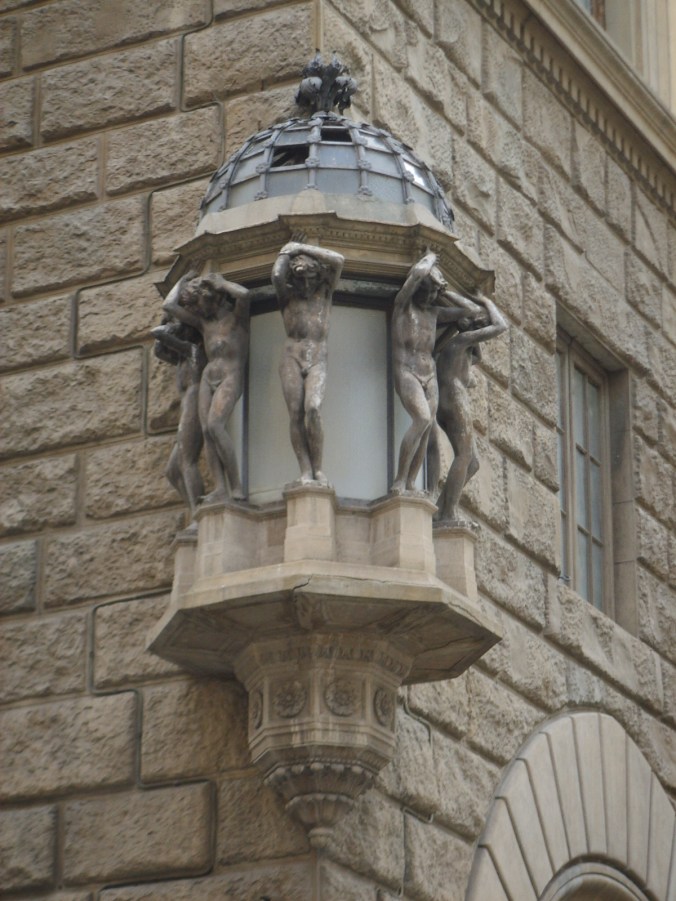
At the same time, two of the palace’s facades were redesigned, and a circular temple-shaped lantern was placed on a corner with bronze nude efibici, by the sculptor Marescalchi. 

Palazzo_dello_strozzini,_edicola

Inside the cinema, the sculptor Giovanni Gronchi created the lacunars and stucco plaques, and sculptor Antonio Maraini designed the three Muses in gilded and polychromed wood on the boccascena.  Other specialized artists and firms created the elaborate decorative interior.

800px-Cinema_odeon_firenze_00


red_cinema_odeon_france_firenze

The theatre was later re-named Cinema Teatro Odeon, and it is now operated by the Cinehall Group. It remains a first-run single screen cinema. Many films are shown in their original language version (with Italian sub-titles).

The Odeon has long been a preferred meeting point for members of Florentine cultural and artistic life.  Guests such as Louis Armstrong and Ella Fitzgerald visited the theatre, as have directors and actors of Italian neorealist cinema, as well as contemporary artists such as Isabelle Adjani, Angelica Houston, Bernando Bertolucci, Kenneth Branagh, Roberto Benigni, Nanni Moretti and Paolo Sorrentino.

The prestigious and elegant spaces of the Cinema Odeon Theater include  a large open room, with a stage holding the movie screen, and has a total capacity of 594 seats, divided into the large stall (with 334 seats) and stylish balcony (seats 260).

Fortunately for us, the Odeon still maintains the harmony and beauty of its original art deco/nouveau style; its tapestries, statues, and colored glass skylight are admired by its many visitors.

The original furnishings of the grand room were red velvet; the furnishings were renewed in 1987 and replaced with yellow gold velvet. Theoriginal wooden chairs remain in the balconies. 
On Via dei Sassetti a plaque reads: "Built in the MCMXXII on behal of S.A. Toscano Immobiliare Sindacato - Restored in the MCMXXXVIII".

The Odeon Cinema is a vibrant cultural centre, often hosting cinema
festivals. One of the leading is “50 Giorni di Cinema Internazionale”, which takes place in winter, showcasing movies and directors from
diverse cultures.

In addition to the entertainment venues and offices of the German Management, the building houses the Departmental Department of Tobacco Growth and the Department of Economic Development of the City of Florence, and in the basement a historic disco, the Yab.

Back to Rome for a hot minute: Triumphs and Laments

William Kentridge: Triumphs and Laments, Rome

20_William-Kentridge-Triumphs-and-Laments-Detail_Photo-by-Giulia-Carpignoli-23

Last month I had the great pleasure of staying in Rome for a few weeks.  I’ve lived in Rome in years past and, like so many others, have a great affection for the Eternal City.  The city has had its ups and downs, but still has great capacity to beguile.

As is well-known, Rome is suffering under mammoth financial and organizational problems; what is less well known but, quite interesting and inspiring, is how some non-profit organizations have stepped in with armies of volunteers to make a difference in the city.

One instantly noticed area of neglect has always been the banks of the Tiber. While for decades city officials have promised to clean up the river’s banks, little to nothing has been done over the years.  That’s until some volunteers stepped in.


As a result of their work, one of the best new things in Rome is the street art, or I guess I should say the river art, along sections of the Tiber: Kentridge’s Triumphs and Laments. Great stretches of the riverfront walkways that abut the high travertine embankments built after disastrous flooding in 1870 have been covered with images from local–and thereby world–history.


images-2

As Rome’s largest contemporary art work, it was unveiled last year with great festivities. Launched by a local non-profit organization, the Tevereterno Onlus, the mission of Tevereterno is to reactivate the Tiber in the heart of Rome. It’s a multidisciplinary cultural organization, dedicated to the site-specific contemporary art on Rome’s urban riverfront, called Piazza Tevere. Overcoming years of administrative opposition and bureaucratic hurdles, the Italian culture minister and others finally gave the green light to the project.


Along a 500-yard stretch of the river’s embankment now appear an incongruous procession of historical characters depicting a series of “Triumphs and Laments,” culled from Rome’s history.

The figures were created using gigantic stencils and power-washing to erase layers of smog, soot and biological patina on the embankment — a process sometimes known as reverse graffiti — to produce beauty from grime.

Un-test-per-la-realizzazione-di-Triumphs-and-Laments

The ancient statesman Cicero, St. Peter and the she-wolf who nurtured Romulus and Remus are among the dozens of figures, drawn from iconic sculptures, photographs and monuments, along with Bernini’s statue of St. Teresa in ecstasy.

There are celebrities: Anita Ekberg and Marcello Mastroianni from “Dolce Vita” days. And then there are the unknown and anonymous: three women who are the nameless widows of countless migrants who have drowned trying to cross the Mediterranean into Italy.

The artist, William Kentridge, discussed his work: “There’s no specific narrative, except that everyone’s triumphs and glories is someone else’s laments and shamefulness.”


images

You can read about Kentridge, a South African political artist, here:  http://nymag.com/arts/art/profiles/15946/

You can view the project fully here: https://vimeo.com/204544946

And you can read more about it here: https://www.nytimes.com/2016/04/27/world/europe/tiber-river-rome-cleanup.html?action=click&contentCollection=Europe&module=RelatedCoverage&region=EndOfArticle&pgtype=article

Palazzo Strozzi: an incredible, historic building now repurposed as a superb exhibition space

The Palazzo Strozzi is a superb example of Renaissance civil noble residential architecture in the historic center of Florence.  And it has been repurposed to delightful service of the modern world.

220px-Palazzo_Strozzi_2


Today the palace is used for temporary international expositions, like the one I viewed yesterday, devoted to Bill Viola.


banner-pg2-ing


Before looking at the exhibition, let’s discuss the incredible building:

Filippo Strozzi the Elder (1428 – 1491), the banker and statesman, commissioned the structure after his return to Florence in November of 1466.

Stile_di_niccolò_fiorentino,_filippo_strozzi_(1426-91),_1489,_recto

As a major Medici rival, Strozzi wanted to build the most magnificent home in the city to assert his family’s prominence.  The palace may as well have been intended as a political statement of his own status.  Based on the wishes of Strozzi himself, the palazzo would be built to look like a small fortress in the heart of the city.

The palace was begun in 1489 and designed by Benedetto da Maiano.

250px-Palazzo_Strozzi_03

The Strozzi palace was clearly inspired by the Palazzo Medici, with its rusticated stone exterior, but it is much larger and has more harmonious proportions than its predecessor.  Whereas the Palazzo Medici was sited on a corner lot and thus has only two main sides, the Stozzi is surrounded on all four sides by streets. The Strozzi palace faces the historical  and fashionable Via de’ Tornabuoni, as well as the Piazza Strozzi and on Via Strozzi. The building thus required three imposing entranceways, each flanked by rectangular windows. The Strozzi family’s coat of arms is found in the upper floors.

The siting of the Strozzi in the center major streets provided the challenge of how to integrate a cross-axis in keeping with the Renaissance desire for strict internal symmetry.  As a result, the ground plan of Palazzo Strozzi is rigorously symmetrical on its two axes.

The Strozzi family acquired a great number of buildings in this area were acquired during the 70s and demolished them all to to provide enough space for his new home.

The original architect, Benedetto da Maiano, died in 1497; Simone del Pollaiolo (il Cronaca) took over and was responsible for the completion of the palace. Pollaiolo died in Florence in 1508, but is credited with the design and finish of the central courtyard or cortile, surrounded by an arcade inspired by Michelozzo.

The external facade is adnorned with splendid torch holders, flag holders and rings to tie horses made by Niccolò di Nofri, an iron-worker known as il Caparra.

Unfortunately, Filippo Strozzi died in 1491, long before the construction’s completion in 1538.  Strozzi’s children were the first to live in the palazzo, moving in around 1505.  Ironically, Duke Cosimo I de’ Medici confiscated the palazzo in the same year, not returning it to the Strozzi family until thirty years later.

The palazzo remained the seat of the Strozzi family. Although the family lived in Rome for centuries, the palazzo was returned to its original splendour in the mid-1800s with the Princess Antonietta, and then with Prince Piero, who, from 1886 to 1889, had the building renovated by architect Pietro Berti.  In 1937 the family sold the building to the Istituto Nazionale delle Assicurazioni, and many changes were made to the edifice.  It was later given to the city of Florence in 1999. It is now home to the Institute of Humanist Studies and to the Fondazione Palazzo Strozzi.

Since July 2006, the Fondazione Palazzo Strozzi has been able to create a rich and innovative calendar of events and exhibits, in these areas of the building: Piano Nobile, la Strozzina and Il Cortile.

The Gabinetto G.P. Viesseux and the Renaissance Studies Institute both have also occupied the building since 1940.  Here also is the seat of the Istituto Nazionale del Rinascimento and the noted Gabinetto Vieusseux, with a library and reading room.

Today the palace is used for temporary international expositions like the now-annual antique show, founded as the Biennale dell’Antiquariato in 1959, fashion shows and other cultural and artistic events.


Allora, on to Bill Viola and his video art.

In the exhibition “Electric Renaissance,” Viola seems to have taken certain Renaissance masterpieces and created video dialogues with them.  I would say he is tremendously fortunate to have been able to borrow the original Italian artworks and, even if you don’t love Viola’s work, you will be rewarded with a small, select group of historic masterworks.  For example:

Here’s his dialogue between his video of 3 contemporary women greeting each other, in relationship to Pontormo’s

IMG_3759


IMG_3758  IMG_3757


Other installations stand on their own.  This screen is about 200 feet long by 15 feet high.

IMG_3761


IMG_3766IMG_3767IMG_3768IMG_3769IMG_3770IMG_3771