The Ara Pacis, Rome

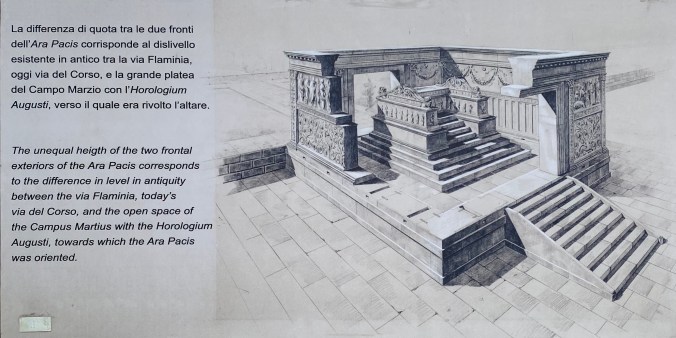
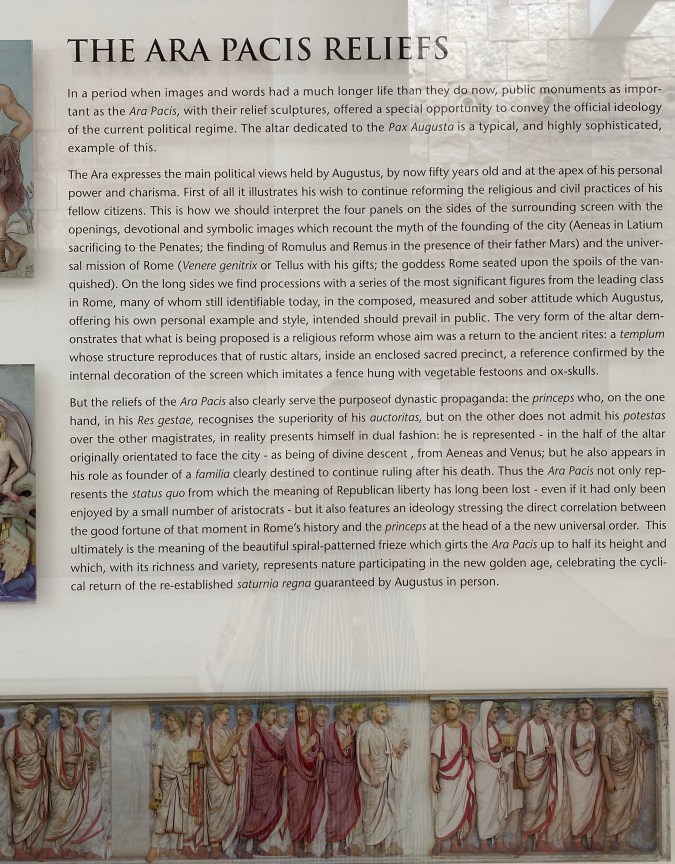
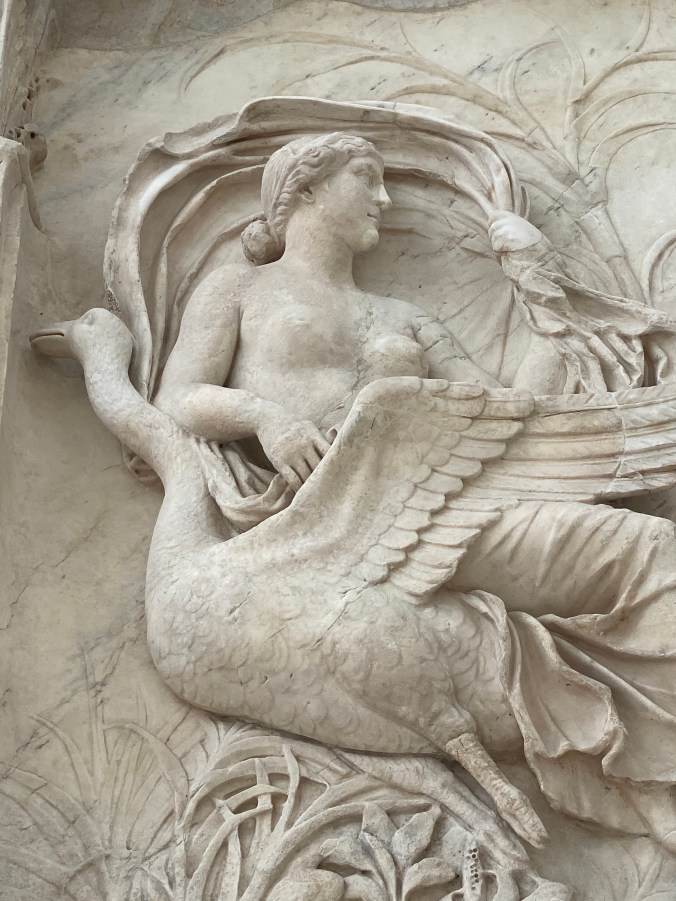
One of the loveliest, and smallest, museums I like to visit in Rome is the Ara Pacis. On my recent visit to Rome, I enjoyed this almost empty museum.

EbB3BkQBSoSToFwIjDQ

fullsizeoutput_3b14


fullsizeoutput_3b18


fullsizeoutput_3b16


fullsizeoutput_3b12


HdguuR5RRr+hS0n80mfeJw


7zr+CCv7SiO0Z+jHYnhWVA


95LtdBBzQm+yNsSpJ8QXWg


My video below captures the interior of the monument, just before a guard told me I couldn’t make a video.


zLTMisltTRO4I6Eh4Uozqw


fullsizeoutput_3b10


fullsizeoutput_3b0e


RSbUne8mR6mGHlJrqC0P3w


P4l5xRVeQ9m7PPiH4SYE9Q


fullsizeoutput_3b15


2V63mx3YQLOvbkqw35v3fg


RZTV0rX3RCOmAcgw7cihgg


nrgW3eCoSDqaImpyM6eKjQ


VQZRPkEEQ1qPve7SwE0brQ


XONI6+xNQGuYe8JGjOmDvg


IPjm4rjcQyKcxH8fRw94Yw


1NYgUb+VRv2CHP%6iuVWTw


wLdfXkYbSe+1R7U7+Nfj9w


fullsizeoutput_3b1a


fullsizeoutput_3b19


Wolves in Florence

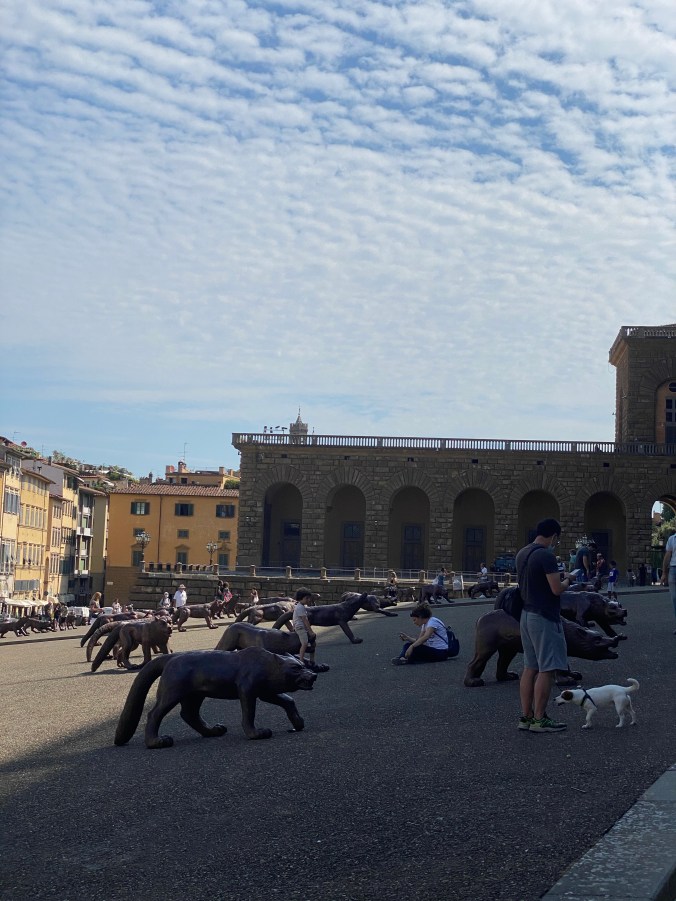
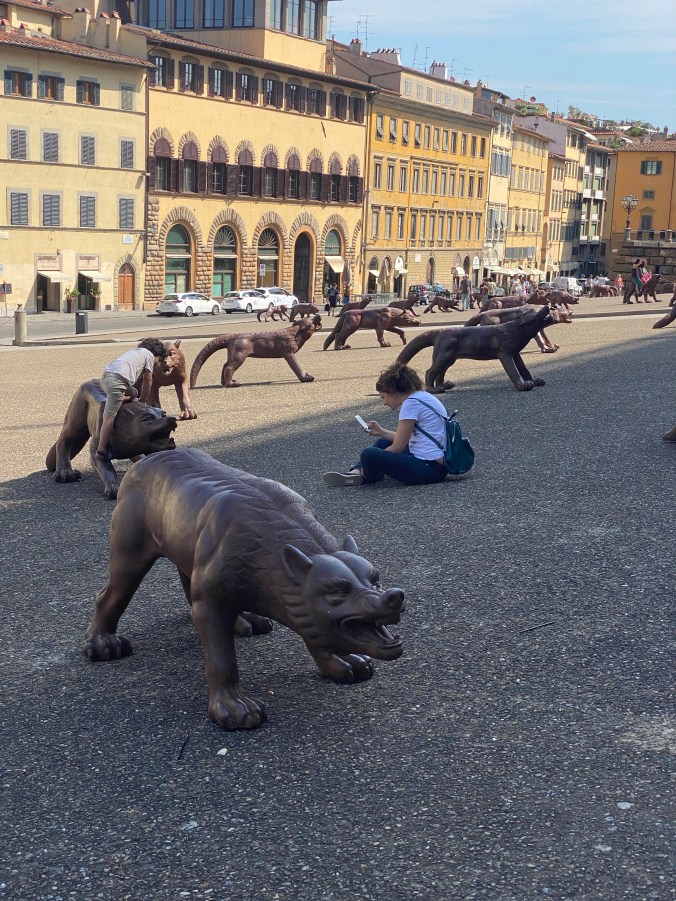
Artist Liu Ruowang has a new installation in Florence, as seen below in the Piazza del Palazzo Pitti.

6ryLrQfuSJys3H+c+%Swow


FBBI4PrrSeWUVz2PdU+5Gw


hy7oyiMvTe+fXtQrfFJW4g


B44NQpcYTD+NPGnAGikjOQ


YHjTQHtqRYmxa6JEba%1pg

These metal wolves are meant “to protect” both Piazza Pitti and Santissima Annunziata. The monumental installation, named “The wolves on the way,” is possible thanks to the collaboration between the Municipality of Florence and the Uffizi Galleries and will be on view from 13 July and until 2 November. The work reflects on the excesses of progress in contemporary society, and are on view in Florence, symbol of the Renaissance, in dialogue with two masterpieces of urban architecture, Palazzo Pitti and the Spedale degli Innocenti.

Liu Ruowang’s wants you to reflect on man’s predatory attitude towards nature. The threatening pack of wolves composed of a hundred iron castings, each weighing 280 kg, which seems to attack an unseen warrior. It is an allegory of nature’s response to the ravages and predatory behavior of man towards the environment. And it is, at the same time, a reflection on the values ​​of civilization, on the great uncertainty in which we live today – made even more evident by the dramatic effects of covid-19 – and on the actual risks of an irreversible annihilation of the environment.

Organized thanks to Matteo Lorenzelli, owner of the Milanese Lorenzelli Arte gallery, the exhibition aims to establish a physical, intellectual and even playful link with citizenship, stimulating curiosity and participation, so as to bring a wider audience than those who usually attend exhibitions and museums.

The project was conceived on the occasion of the celebrations of 50 years of diplomatic relations between the Italian Republic and the People’s Republic of China – the latter represented by Consul General Weng Wengang – and made possible by the collaboration between Eike Schmidt, Director of the Uffizi Galleries and Tommaso Sacchi, Councilor for Culture of the Municipality of Florence, who have made available two of the most symbolic spaces in Florence. Incoming Wolves interact freely with the city’s architecture, with its inhabitants or with those who are just passing through, thus responding to a specific intention of the author, who claims that “to teach love and respect for art to new generations , the best method is to bring art into everyday life, making museums increasingly accessible and beyond. My sculptures, for example, are placed in the squares: thus art also creates a link with public spaces.

It is important to build a culture of the common good .” Before arriving in Florence, Liu Ruowang’s wolves had “invaded” Naples, where they had been positioned in Piazza del Municipio. The installation in the Tuscan capital marks an ideal relationship between the mayors Luigi De Magistris and Dario Nardella, who have shown that they believe in the powerful message of the great work of the Chinese artist.

The director of the Uffizi Galleries Eike Schmidt says: “In Piazza Pitti, the pack of wolves that is about to enter the palace through the central door immediately reminds us of the dark counterattack of nature in the classic ‘The birds’ by Alfred Hitchcock, but calls to our mind also the recent experience of many wild species that returned to our city during the recent lockdown.

It is the metaphor of the relationship between man and nature. With the presence of Liu Ruowang’s wolves in our squares – elegant wolves, with a chiseled crown as in the ancient Chinese bronzes – we will have many months to think about how to contribute to respecting the balance of the planet. ”

Liu Ruowang (1977) is one of the major contemporary Chinese artists. Sculptor and painter, his is an original path placed in the wake of the Chinese tradition, and which amalgamates transversal elements with peculiar aspects of his tradition. Starting from the consideration that the history of man is also the history of his relationship with nature, the Chinese artist draws, on the one hand, from the culture of his country and on the other to the western one, and through references to globalization, represents the multiplication of the various real and virtual identities. The philosophical dimension of Liu Ruowang is also a real denunciation of the risks caused by the loss of human values, mortified by the oppressive system of contemporary life, theater of pain and violence.

“The upcoming Lupi installation is the result of the production of the last decade which must be considered fully the artistic maturity of Liu Ruowang. Behind the monumentality of the installation, moreover, there is an aspect dear to the East as to the West, the central pivot of all Liu Ruowang’s production, namely the ability to polarize the environment and space through a simple and sublime, which adapts the epic tones of the myth to today’s civilization, dominated by scientific and technological progress, increasingly in conflict with the natural order. ”


Santa Maria Vittoria, Rome

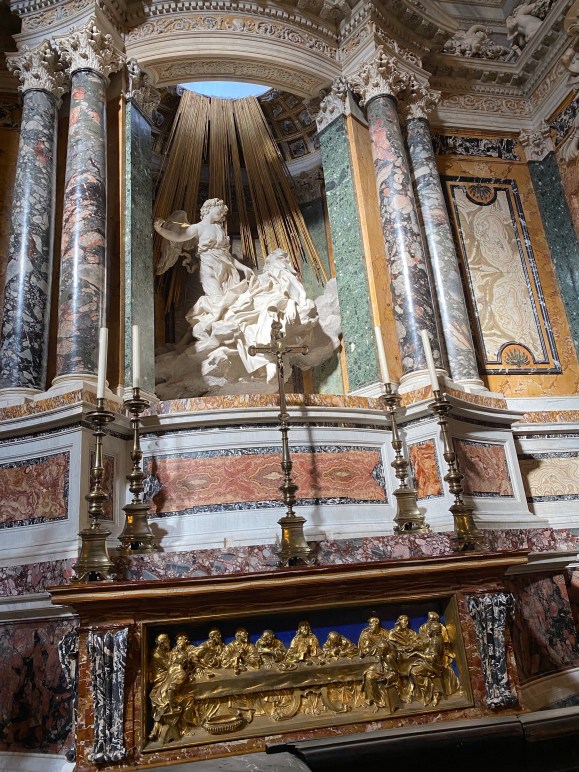
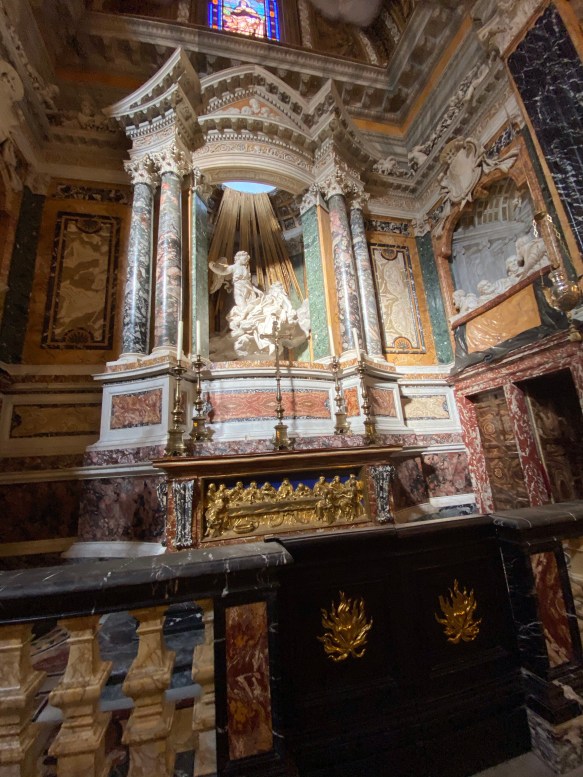
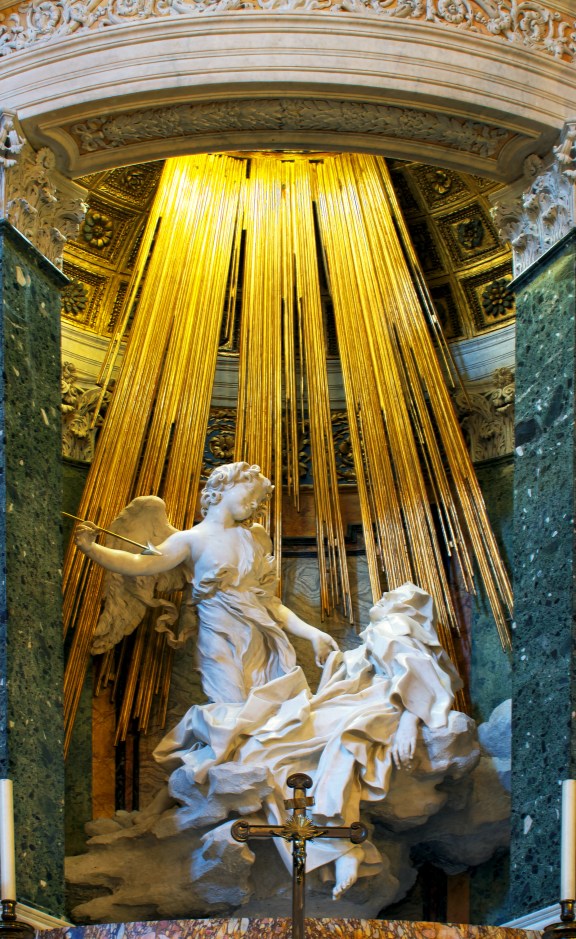
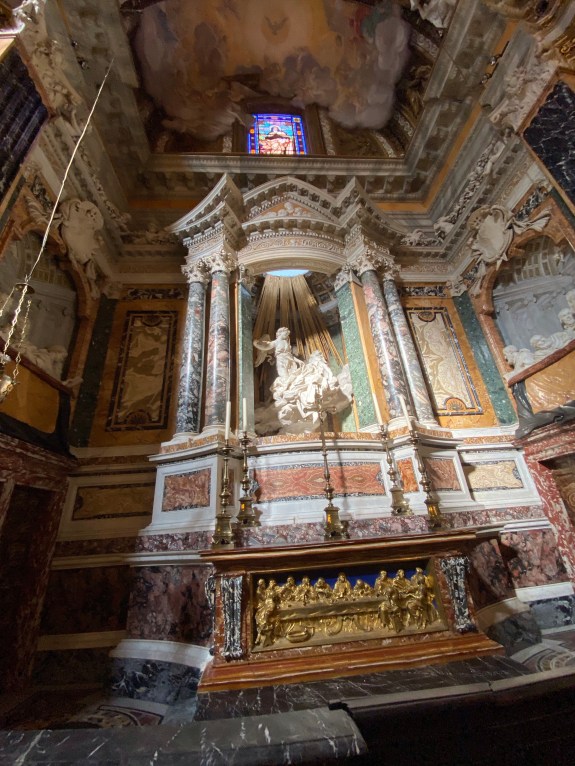
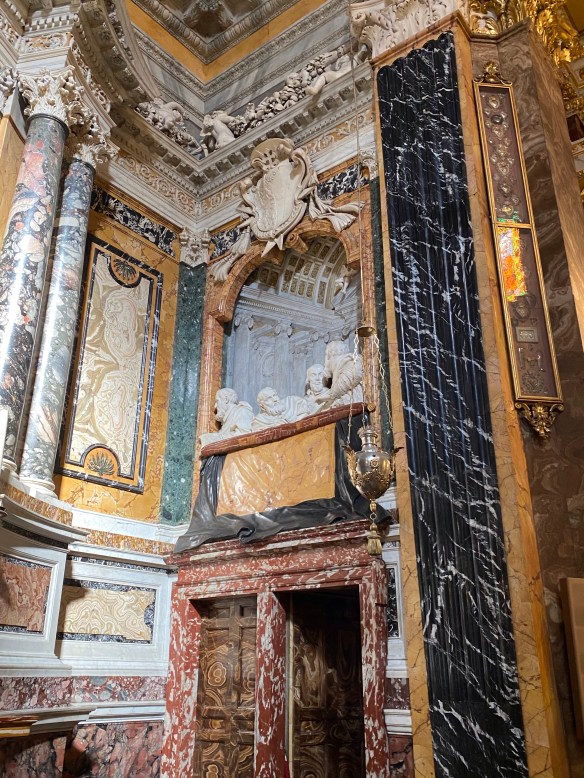
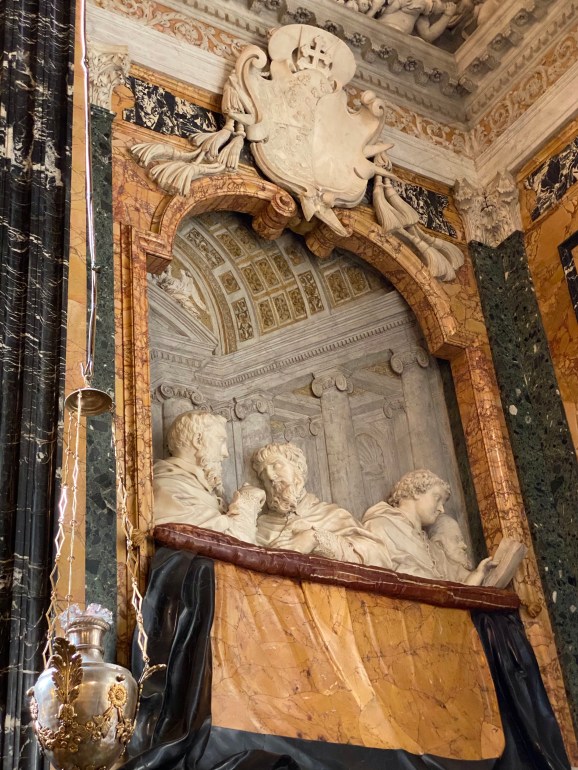
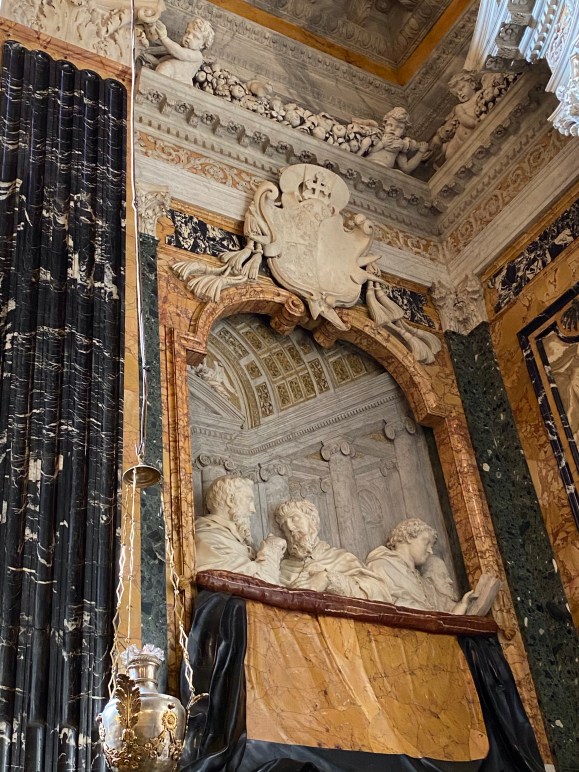
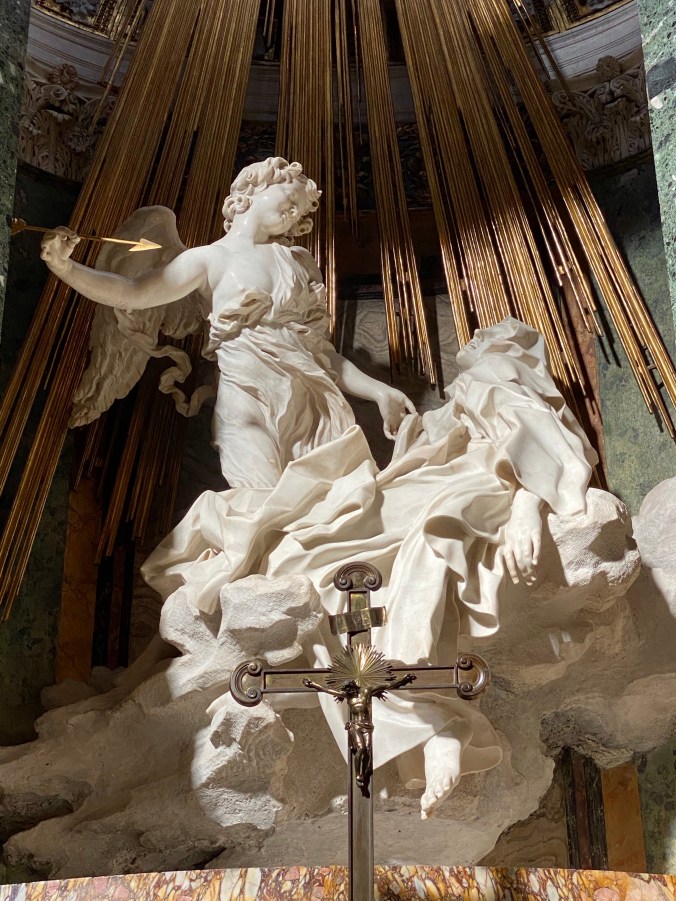
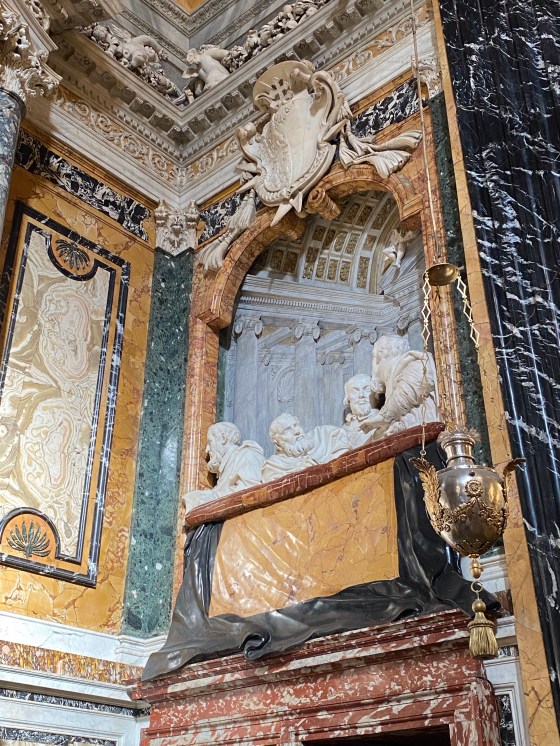
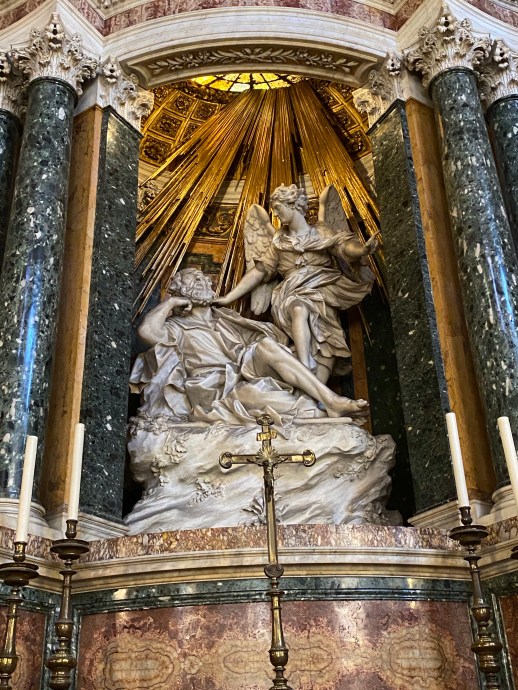
No visit to Rome would be complete without a stop at this august church to admire, among many things, the sculpture of Bernini.

fullsizeoutput_3b50

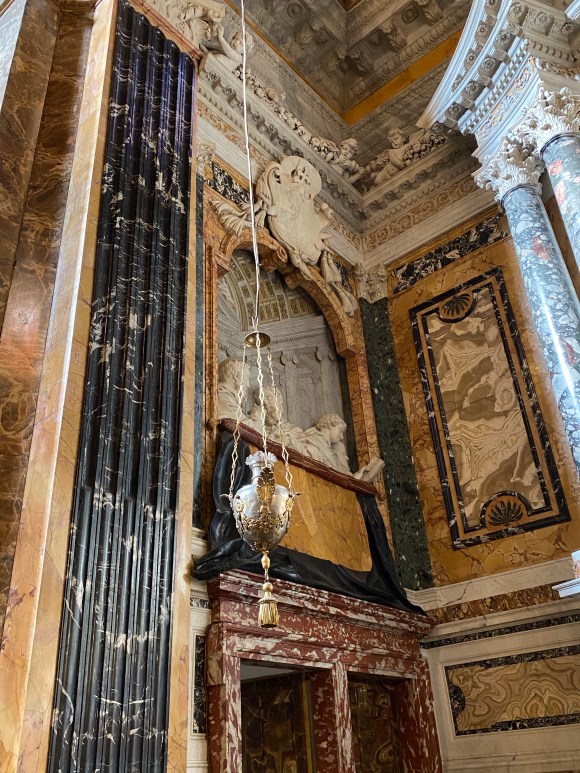
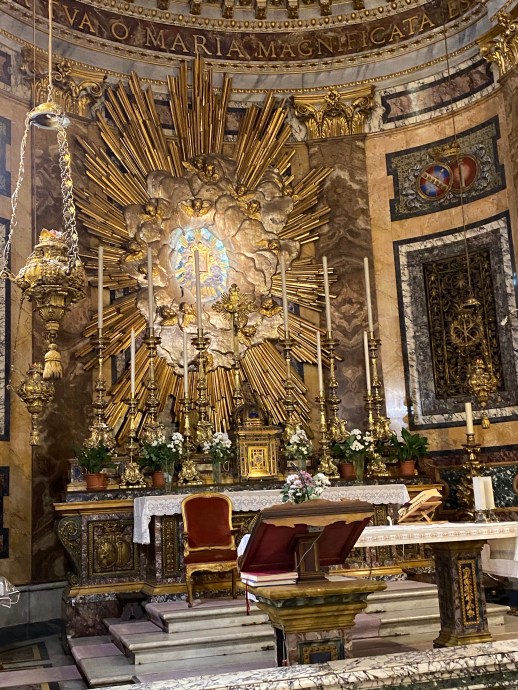
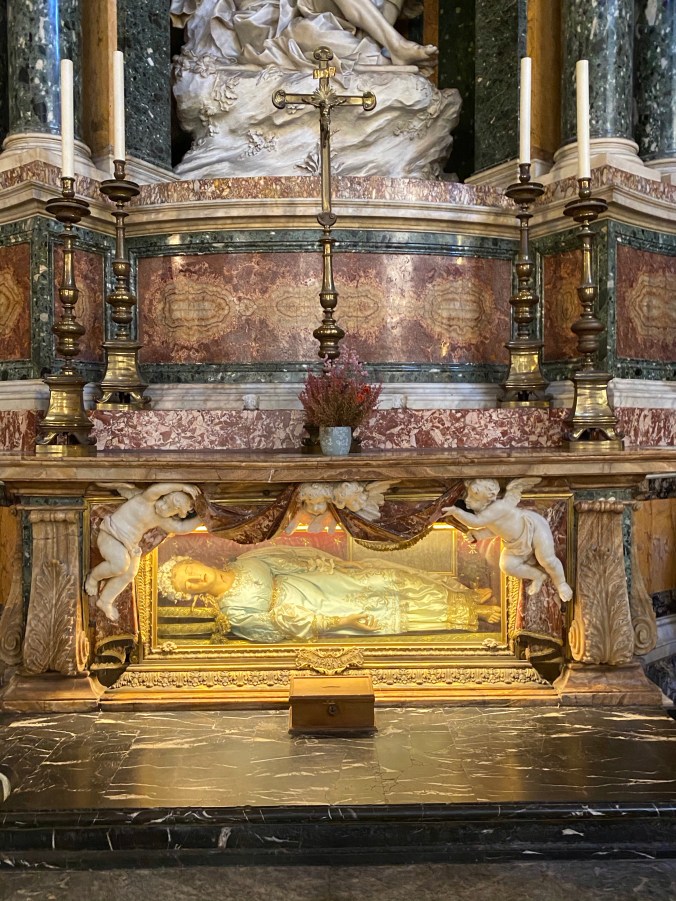
I happened upon this favorite church on my recent visit just as mass was wrapping up and I had to surreptitiously take some of these pictures, which accounts for their poor framing. Luckily, my iPhone camera takes good pictures, in terms of color and sharpness, no matter how bad the aim.

img_7009


img_7011


Ecstasy_of_St._Teresa_HDR.jpg


img_7012


What I had not realized on earlier trips is how the artist arranged this chapel as a theater box.  You must remember I spent most of my art history career studying American art, so I hope I can be forgiving for not knowing a lot of details of this great Italian Baroque period.  I am an avid student of the Baroque now, so I am filling in the gaps in my understanding, work by work.

img_7013


img_7014


img_7015


img_7016


img_7017


img_7018


The high altar of the church was later made to imitate Bernini’s spectacular sculptural group.

img_7019


And, on the other side of the church, directly opposite to Bernini’s chapel, is this companion sculptural arrangement.  Bernini is a tough act to follow.

img_7020


img_7021


img_7022


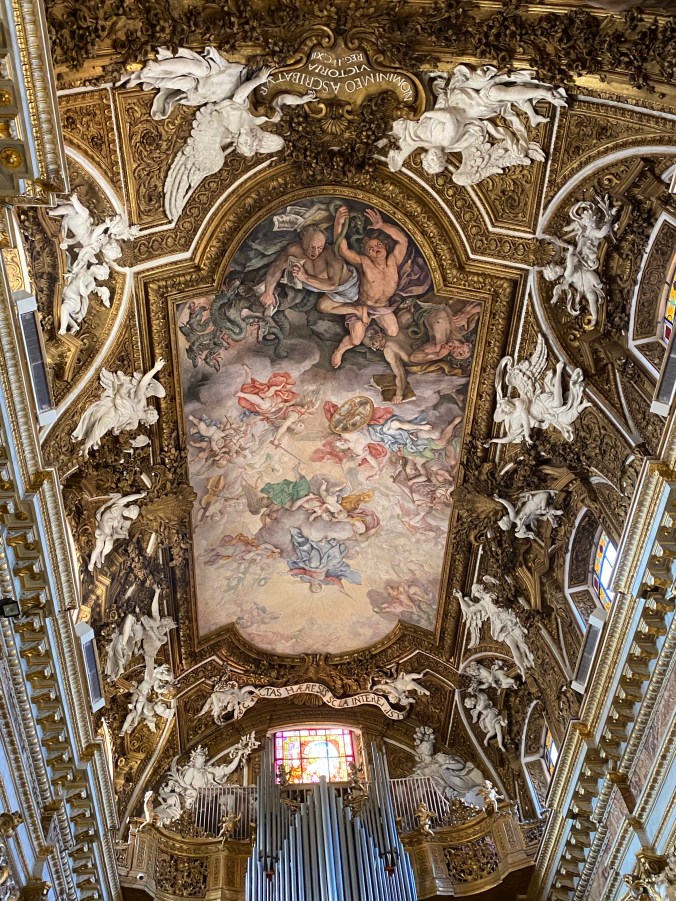
Before departing, I had a last long look at the amazing ceiling of this lovely church.

img_7023

Chiesa di Sant’ Ignazio, Rome

With the plethora of churches in Rome, you might think it would be hard to have a favorite.  But, for me, The Church of St. Ignatius of Loyola at Campus Martius is my favorite.

It is a Roman Catholic titular church dedicated to Ignatius of Loyola, the founder of the Society of Jesus.

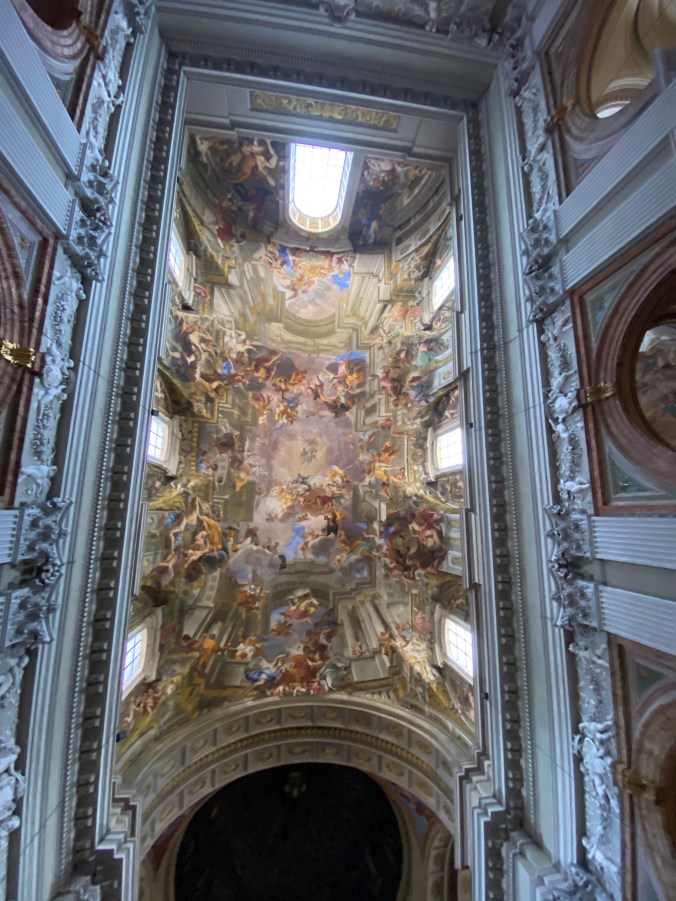
What I love about it is the ceiling fresco:

Andrea_pozzo,_gloria_di_sant'ignazio,_1685-94,_02


img_6989

The story of this incredible building and its surroundings begins with the gift, in 1560, from Vittoria della Tolfa, the Marchesa della Valle. She donated her family isola, which was an entire city block and its existing buildings, to the Society of Jesus in memory of her late husband the Marchese della Guardia Camillo Orsini. This was also the founding the Collegio Romano and the beginning of the building of a church with a different name from the one that is discussed in this post.

Although the Jesuits received the marchesa’s land, they did not get any funds from her for completing the church. They were able to build a church, but it would later be dismantled so that this current church could be built on the site and was used by the Collegio Romano. Over time, the old church became insufficient for over 2,000 students of many nations who were attending the College at the beginning of the 17th century.

Pope Gregory XV, who was a former student of the Collegio Romano, was strongly therefore attached to the church. Following the canonization of Ignatius of Loyola in 1622, he suggested to his nephew, Cardinal Ludovico Ludovisi, that a new church dedicated to the founder of the Jesuits should be erected at this site.

The young cardinal accepted the idea, asked several architects to draw plans, among them Carlo Maderno. Cardinal Ludovisi finally chose the plans drawn up by the Jesuit mathematician, Orazio Grassi, professor at the Collegio Romano itself.

The foundation stone was laid on August 2, 1626, four years later, a delay which was caused by the fact that a section of the buildings belonging to the Roman College had to be dismantled. The old church was eventually demolished in 1650 to make way for the massive Church of St. Ignatius of Loyola, which was begun in 1626 and finished only at the end of the century. In striking contrast to the earlier Church of the Annunciation, which occupied only a small section of the Collegio Romano, the Church of St. Ignatius of Loyola took up a quarter of the entire block when it was completed.

The church was opened for public worship only in 1650, at the occasion of the Jubilee of 1650. The final solemn consecration of the church was celebrated only in 1722 by Cardinal Antonfelice Zondadari. The church’s entrance faces the Rococo Place of San Ignazio was planned by the architect Filippo Raguzzini.

img_6990

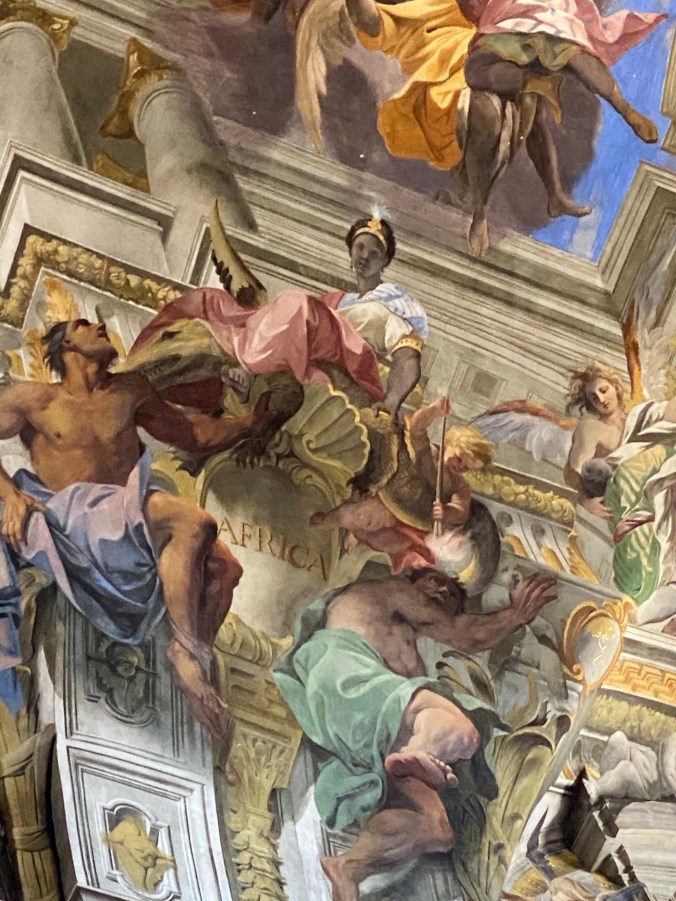
Andrea Pozzo, a Jesuit lay brother, painted the grandiose fresco that stretches across the nave ceiling (after 1685). The fresco celebrates the work of Saint Ignatius and the Society of Jesus in the world, presenting the saint welcomed into paradise by Christ and the Virgin Mary and surrounded by allegorical representations of all four continents.

Pozzo’s work seems to visually dissolve the actual surface of the nave’s barrel vault, arranging a perspectival projection to make an observer see a huge and lofty sky filled with floating figures.

A marble disk set into the middle of the nave floor marks the ideal spot from which observers might fully experience the illusion.

A second marker in the nave floor further east provides the ideal vantage point for the trompe l’oeil painting on canvas that covers the crossing and depicts a tall, ribbed and coffered dome. The cupola one expects to see here was never built and in its place, in 1685, Andrea Pozzo supplied a painting on canvas with a perspectival projection of a cupola. Destroyed in 1891, the painting was subsequently replaced.

Pozzo also frescoed the pendentives in the crossing with Old Testament figures: Judith, David, Samson, and Jaele.

Pozzo also painted the frescoes in the eastern apse depicting the life and apotheosis of St Ignatius. Pozzo is also responsible for the fresco in the conch depicting St. Ignatius Healing the Pestilent.

img_6991

It is, of course, the depiction of the American continent that delights me the most. I never tire of craning my neck to look up at this masterpiece.

img_6992


img_6993


img_6994


img_6995


img_6996


img_6997


img_6998


img_6999


img_7001


img_7002


img_7003


img_7004


img_7005


img_7006


img_7007

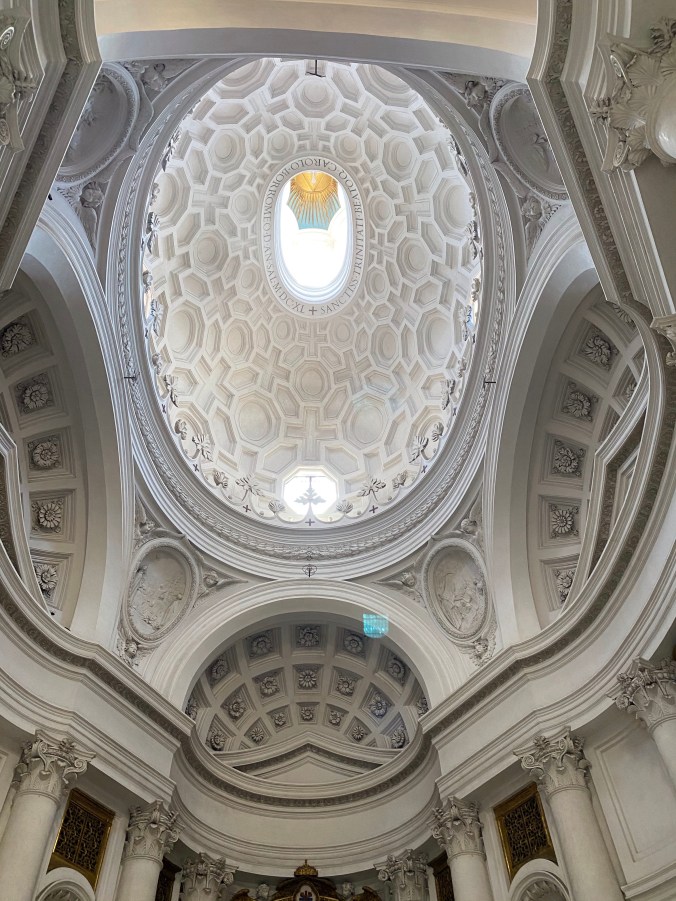
Borromini’s Chiesa of San Carlo

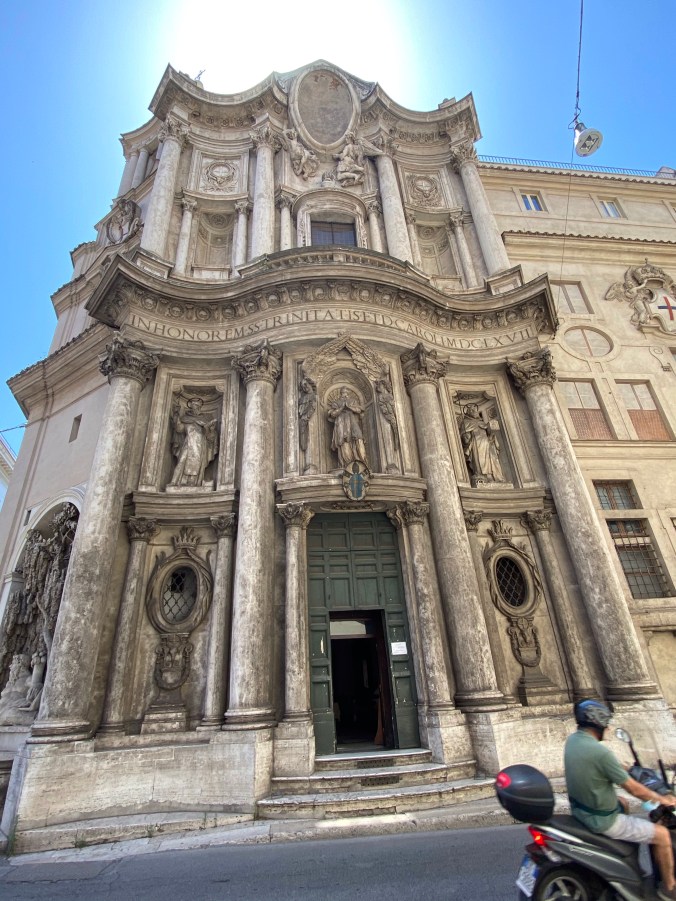
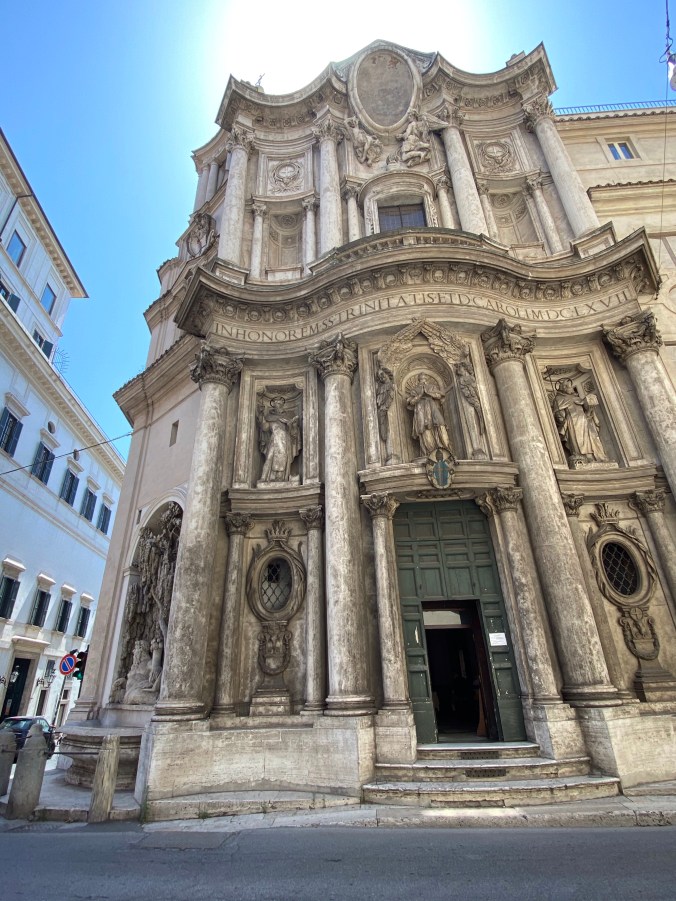
I love the Baroque church of San Carlo alle Quattro Fontane, by Francesco Borromini, which is located next to the fountain ensemble of the same name: Quattro Fontane.  I always try to make a drive by visit to this lovely, calm interior on any trip to Rome.  Here is evidence of my last drive by (walk by, in fact).


img_6951-1

The church was designed by the architect Francesco Borromini and it was his first independent commission. It is an iconic masterpiece of Baroque architecture, built as part of a complex of monastic buildings on the Quirinal Hill for the Spanish Trinitarians, an order dedicated to the freeing of Christian slaves.

Borromini received the commission in 1634, under the patronage of Cardinal Francesco Barberini, whose palace was across the road. However, this financial backing did not last and subsequently the building project suffered various financial difficulties.

It is one of at least three churches in Rome dedicated to San Carlo, including San Carlo ai Catinari and San Carlo al Corso.

img_6952-1img_6953-1img_6955-1