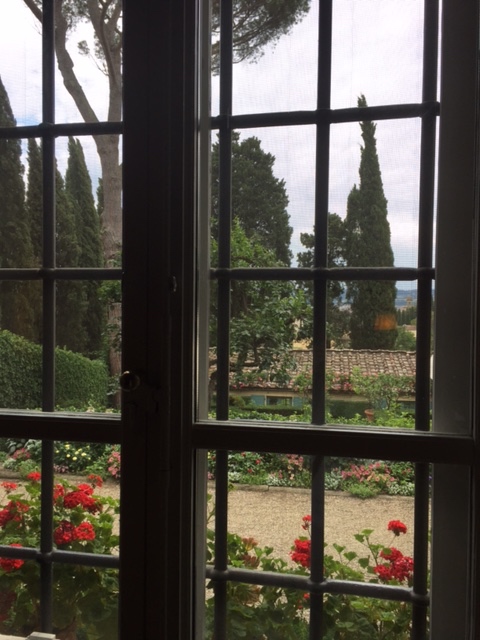
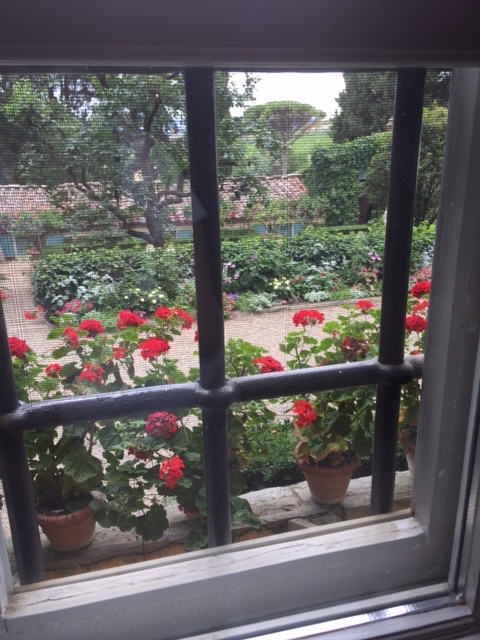
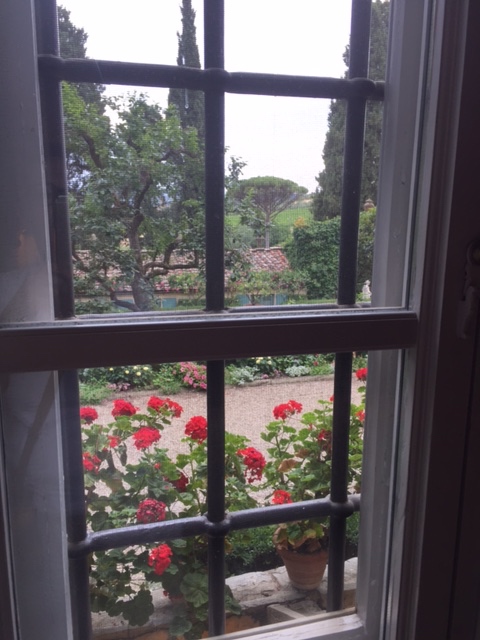
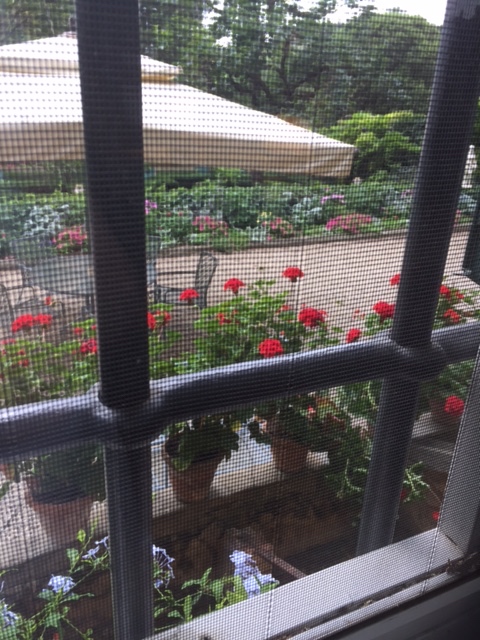
Let’s start with a picture that summarizes Italian summer to me:
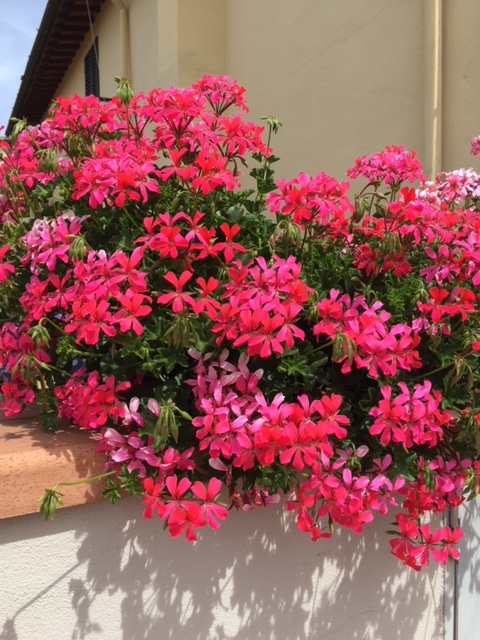
I love Italian geraniums!
But, I digressed!

Okay, so today a friend and I took a beautiful little jaunt through warm and very green Chianti, just outside of Florence to the little village of Impruneta. Impruneta is famed for its proprietorial production of what may well be the world’s finest quality terre cotte. To me, it is just that.
And the most beautiful.

It is said that the world’s finest terracotta planters come from Impruneta, this small village nestled in the Tuscan hills a few kilometers from Florence, Italy. Blessed with land that is naturally rich in iron, copper, calcium, and aluminum, the town has been well known for its exceptional quality terracotta and craftsmanship for centuries. Hard gray earth is mined from the surrounding hills, ground to a powder, and mixed with water to make this coarse bodied clay. It develops its renowned pale, terracotta color after the firing process and is able to withstand extreme temperatures. Terracotta from Impruneta is frost resistant to -22°F. This, along with the hand of a skilled artisan makes the Impruneta collection the absolute best available.

Classic Impruneta Italian terra cotta planters have held their aesthetic value for generations and aren’t showing any signs of slowing down.
 If the term terracotta conjures up images of stacks of dusty orange common clay nursery pots, you’ve probably never experienced the subdued beauty of Italian terracotta from the regions of Impruneta or Siena.
The rich earth in these beautiful Italian towns near Florence boasts an extremely high mineral content which is exceptionally high in iron, calcium, aluminum and copper. The Impruneta clay is so revered that only seven potters are licensed by the Italian government to use the name on their wares.
The first factor is the type of clay that is used. Impruneta clay is found only by the river Arno near Florence and has been use d to make pottery for at least the last ten centuries.
In addition to the minerals, this gray clay contains particles of sandstone which give it a special strength and texture. This robust mixture makes the resulting pottery incredibly strong in the same way that adding gravel to a concrete mix binds it together to create a more durable finished product.
The pottery is then fired at over 1000 degrees for 36 hours and cooled in the kiln for another 70 hours (terra cotta = cooked earth). The result is a beautiful soft rosy color not found anywhere else in the world.
The second factor is how the Impruneta pots are created. There are several techniques employed, all of them labor-intensive. One method is to hand-apply the clay, pounding it over an inverted form which shapes the clay to the desired form and size. This is then smoothed and decorated.
Another method is to hand-pack the clay into plaster cases, a technique perfected hundreds of years ago.
Even larger pots are often made free-form entirely by hand. After the bowl or basin of the pot is created, the rim is applied by hand.
It’s easy to tell a handmade pot–when you run your ha nd under the rim there is a deep relief where you can fit your fingers. Machine-made or cast-formed pots have a flat, less dimensional rim with no overhang.
When the artist is satisfied with the
appearance of the pot, it is then fired as previously mentioned. This results in an extremely strong pot with great structural integrity. Designs are actually molded into the pot and become an integral part of the structure instead of being “applied” as an afterthought.
Another great way to identify one of these Tuscan masterpieces is by giving it a sharp rap with your knuckles. The resulting clear, sharp peal of a bell signifies that you indeed are in the presence of one of these amazing pots – high fired with no cracks.
Impruneta terracotta ornaments have classic good looks that serve as the perfect counterpoint to a wide variety of flowers and foliage. Florentine gardens are replete with Imprunetta pottery, as is the Vatican. In the USA, the Biltmore Estate has several large Impruneta pots that have graced their gardens since the 1800s.
Imagine how tough it was to import these from Italy more than 200 years ago. These are some rugged beauties that were able to survive that journey.
Another spot in the US in which you may have seen Impruneta terracotta is at the New York Botanical Gardens. They chose large classic rolled rim pots to showcase their gorgeous specimens of lemon trees.
These planters will last more than a lifetime with proper care. They’re extremely hardy and can be left outside to weather in areas where frost is expected (but nothing lower) without fear, but it is imperative to make sure the pot is lifted off the ground and that the drainage hole is unobstructed so water has the ability to drain freely.
 The use of clay to produce both models and finished sculpture has been important to Italian artists such as Donatello and Luca della Robbia since the early 15th century. They took advantage of the special clay found in the area and consequently helped make Florence an important center for Italian art. Still today you occasionally find beautiful, classical statues with graceful figures and lovely faces sculpted in the distinctive rose pink clay of Impruneta.

Before I talk about the two pottery businesses I visited today, let me note the use of terra cotta in Impruneta. It’s everywhere! House number plates are terra cotta. Mail boxes are terra cotta. Door bells are surrounded by terra cotta plates. Local altars are terra cotta.
s


Of course window gardens, even those of cactus, are in terra cotta containers.

Many homes enjoy a terra cotta lion guarding the gate.

Sidewalks, stair treads, balustrades are all of terra cotta.
Close to the center of the sweet little village are two businesses within a easy walk. The first we visited was Corsiani Impruneta Terrecotte srcs on Via di Cappello. You can visit this business virtually on their websites: www.terrecottecorsiani.it and www.imprunetaterrecotte.it .

The proprietor could not have been nicer or more welcoming to us, showing us a large hand-formed vessel he was making as well as the furnace in which the pots are fired.
Here’s a look at Corsiani’s vast array of products.


We next walked to another pottery: Antica Furnace Mariani M.I.T.A.L., sas, which you can also visit virtually at www.terrecottemital.it .

Another vast yard, full of terra cotta treasures, awaits your visit! But first, a hydrangea growing in a large vessel.


The containers produced by this pottery seem infinite, though of course I exaggerate. I think you can get a sense of why: as a gardener and an art historian, I was almost hyperventilating from the choices available here!

In addition to garden vessels, this pottery also makes fabulous terra cotta reproductions of some famous art works.


A likeness of Cosimo I among the oleander blossoms.


There is literally something for everyone at this pottery.
My favorite items were some reproductions of famous artworks in nearby Florence:
Dontatello’s David:

Luca della Robbia:


Desiderio di Settignano:

And other Florentine notables:


And then there was the kitch! The human-sized Eiffel Tower!


The human-sized Leaning Tower of Pisa:


Venice’s Rialto Bridge:

And, if you are going to do a bridge, you’ve got to do the Ponte Vecchio! Certo!

Tremendously practical items were made of terra cotta, as in this downspout:

And unusual decorative items such as a fireplace surround, in terra cotta of course:
We had time to return to the center of the sweet, small piazza where we had a nice pranzo while gazing at the town’s main church.









.jpg)
_-_Chapiteaux.JPG)
 get back, lauretta!
You must be logged in to post a comment.