Sophie Robinson is obviously fun.

Her fashion sense is pretty unique. I usually like it, except for her shoe/tights combinations.

Here’s a fun video capturing some of her aesthetic:
http://www.bbc.co.uk/programmes/p03l94fq
Sophie Robinson is obviously fun.
Her fashion sense is pretty unique. I usually like it, except for her shoe/tights combinations.
Here’s a fun video capturing some of her aesthetic:
http://www.bbc.co.uk/programmes/p03l94fq
OMG! Who knew?!!

Having never lived on the British coastline, I had no idea that these so-called huts even existed. Built in the 1920s, these darling little buildings make an appearance on that tv obsession I currently have, The Great Interior Design Challenge, on BBC Two.
You can watch the episode on Youtube: https://youtu.be/dn0OtnufTC0

Aren’t they sweet?
So, here are some of the interiors. I want one.


Want to join me?
Here’s a little more into on the place they inhabit:
https://en.wikipedia.org/wiki/Canford_Cliffs
This is considered to be Britain’s best beach hut:

Read about it here: http://www.gazette-news.co.uk/news/13609885.Mersea_Island___s_Betty_is_Britain___s_best_beach_hut/
BBC’s “The Great Interior Design Challenge.” For me, this is binge watching at its finest!


Per che no?

An interesting new exhibition at the NSU Art Museum in Ft. Lauderdale traces Italian high fashion from 1945 to 1968. Check out the link below to feast your eyes on the show’s photo gallery. Some stunning stuff is included.
BELLISSIMA: ITALY AND HIGH FASHION 1945-1968
FEBRUARY 7 – JUNE 5, 2016
The show was recently written up in the New York Times, which you can find here.
Here is a little Bulgari number to make your heart race until you can get to the included links!

Bellisima indeed!
but I need a little beauty to begin the weekend. American politics have me shaking my head in disbelief and I need a shot of good design to clear my head.
So, here it is:

And here’s another one:

Emilio Pucci to the rescue, grazie a dio! I feel better already. Amazing what art and beauty can do.
Have a chill weekend everybody!
That’s my boy standing in front of Peale’s portrait of GW. We were visiting the Crystal Bridges American Art Museum in Arkansas, which is a pretty place if you ever get the chance.
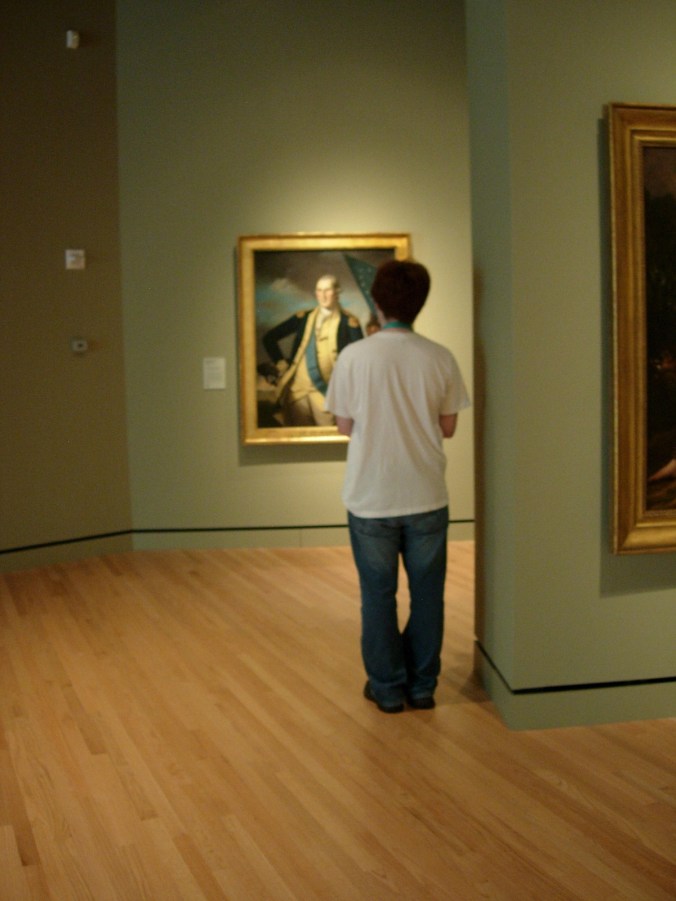 Title: George Washington
Artist: Charles Willson Peale, 1741 – 1827
Date: ca. 1780-1782
Medium: Oil on canvas
Dimensions: 50 x 40 in. (127 x 101.6 cm) Framed: 57 3/4 × 48 1/4 × 3 1/4 in.
Credit Line: Crystal Bridges Museum of American Art, Bentonville, Arkansas, 2010.70
Label Text: George Washington posed for Peale an unparalleled seven times. The artist had been an officer in the Continental Army under Washington and crossed the Delaware River with him during the New Jersey campaigns in the winter of 1777-78. Peale portrays Washington as a relaxed yet powerful military leader wearing the blue sash of commander-in-chief of the Continental Army. Although Washington leans against a cannon, at momentary rest, his body fills the foreground and he looks out at the viewer with a commanding gaze. The left background depicts Yorktown, Virginia, where Washington defeated the British in one of the last major battles of the American Revolution. The original owner of this painting, François-Jean de Beauvoir, the Chevalier de Chastellux, was part of the French military force that helped Washington achieve victory in Virginia.
I recently watched the 2015 Nicole Kidman film, Queen of the Desert. The movie chronicles the life of a fascinating Brit, Gertrude Bell. It’s a beautifully produced film and features some interior shots of the world-famous hotel in Marrakech, La Maoumania. One thing always leads to another, and thanks to the internet, we can make a quick trip to Marrakech.
I highly recommend the film, as well as Morocco. I was lucky enough to spend a month there a few years ago and I loved it.


In 1951 a talented American photographer, Ruth Orkin, shot this iconic picture in Florence. She called it “American girl in Italy.”

The background of the photo is the corner where the Via Roma meets the Piazza della Repubblica, the location of the Belle Epoche Cafe Gilli in Florence that I mentioned recently. In the fabulous black and white photograph, a single, young, very attractive woman passes through a typical group of Florentine men, from young to old, who often gather at such intersections. Remember that this was shortly after WWII, and unemployment was high.
Any American woman who has traveled in Italy alone will recognize the moment captured in the photo. You can almost hear the “ciao, bella!” that always accompanies such interactions. Italian men simply cannot stop themselves from appreciating a lovely female. It just goes with the territory. As they lean against the wall of the café or sit on a Lambretta motor scooter, the men just cannot not look at the girl. Let’s be honest, it’s a part of what we all love about Italy!
On the day the picture was created, Orkin noted in her diary: “Shot Jinx in morn in color—at Arno & Piazza Signoria, then got idea for pic story. Satire on Am. girl alone in Europe.”
When Orkin said “Jinx” she was using the nickname of Ninalee Craig who was 23 years old and six foot tall. Jinx had caught Orkin’s eye on the morning of August 21, 1951 at the Hotel Berchielli, located near the Arno River in Florence. Not only was Jinx strikingly tall–much taller than the average Italian man of the period–but Orkin described Jinx as “luminescent.” She certainly appears that way in these photos.
Jinx had recently graduated from Sarah Lawrence College in Yonkers, NY and had gone to Italy to study art and be “carefree.” Something that earlier generations of American women would not have had the opportunity to do.
In 1951, Craig was a carefree college graduate who had quit her job in New York and bought a third-class ticket on a ship bound for Europe. She spent more than six months making her way through France, Spain and Italy all by herself — something no woman did in the years before World War II. It was rare indeed for a single woman to tour Europe alone after the war.
Jinx traveled as inexpensively as she could, and when she found a hotel on the Arno where she could stay for $1 per night, she checked in. As luck would have it, there she met another brave solo female traveler: 29 year old professional photographer Ruth Orkin, who had traveled to Italy after completing an professional assignment during two months in Israel.
Orkin, a freelance photographer, was herself a fearless young woman. When she was just 17, Orkin journeyed alone from her home in Los Angeles to New York City; she did the whole trip on bike and by hitch-hiking. This was not your typical female experience by any stretch of the imagination.
When they met in Florence, Jinx and Ruth, both traveling on budgets, compared notes about traveling solo. They agreed that it was great fun to see Europe on their own, with only a few minor difficulties.
During their conversation in Florence, the two young women came up with an idea: they would wander around Florence the following morning and capture on film what it felt like for a single woman to do the normal tourist activities in fabulous Florence.
As agreed, the following day they set out about 10 a.m. and shot pictures near the Arno, on the Piazza della Signoria, at the straw market (which I wrote about here), and so on. Jinx Allen wore separates of a top and a belted gathered skirt; this was a trendy outfit, named “The New Look” when it was introduced by Christian Dior in 1947. She accessorized her outfit with a white pendant on a chain around her neck and an orange Mexican rebozo or shawl over her shoulder.
Orkin was on the lookout for great moments to capture with her Contax camera. When she saw the reaction of the 15 men near the Cafe Gilli, she snapped the iconic picture. She is said to have then asked Allen to retrace her steps and clicked again. Both Orkin and Jinx later said that there was no staging or prearranging. Jinx herself would later say that “The men were not arranged or told how to look…That is how they were in August 1951.”
Several of Orkin’s photos were published for the first time in the September 1952 issue of Cosmopolitan magazine, as part of a story offering travel tips to young women traveling solo. Again, this was something the mothers and grandmothers of Jinx and Orkin would never have been allowed to do. It just was not done. Even adventurous women never traveled alone.

Jinx bargains for straw bags at the straw market.

Jinx walks out of a shop that has the usual beaded curtains used as a screen to keep insects out.

Jinx is perhaps interrupted (while putting on lipstick?) by a young Italian admirer who has been drinking a Coca Cola and reading the International Herald Tribune.

Jinx photographed as if she is reading a letter from home which she has just collected from the Florence American Express office. Back in the day, before cellphones and the internet, this is how people communicated.

A very tired looking Jinx sitting with her guidebook (?) and sunglasses near a famous Florentine fountain. I think Jinx was play-acting the tired part. I love the detail of her obviously Italian leather sandals. This is a beautiful version of the flat sandals one could buy and can still buy in Florence or Capri.

Jinx rides a bicycle around Florence and stops with her tourist map to ask for directions from a uniformed officer. You can see similar scenes as this in Florence today.


Jinx wearing head gear for motoring around Florence with a guy.

Jinx wandering through crazy traffic that was already a nuisance in Italy.
Many years later, in 2011, Jinx Allen was living in Toronto when an exhibition of Orkin’s photographs was held there. Jinx was then known as Ninalee Craig, her real first name and her married last name, and she vividly recalled the day of the shooting. “We were literally horsing around,” she said and, at age 84, she was photographed in standing next to the iconic Orkin photo. Reminiscing about the day itself as well as the bright orange shawl she wore that day, Mrs. Craig wore the shawl she had kept all those years.


“Men who see the picture always ask me: Was I frightened? Did I need to be protected? Was I upset?” Craig said. “They always have a manly concern for me. Women, on the other hand, look at that picture, and the ones who have become my friends will laugh and say, ‘Isn’t it wonderful? Aren’t the Italians wonderful? … They make you feel appreciated!’”
“At no time was I unhappy or harassed in Europe,” says Craig. Her expression in the photo is not one of distress, she says; rather, she was imagining herself as the noble, admired Beatrice from Dante’s Divine Comedy. To this day she keeps a “tacky” postcard she bought in Italy that year—a Henry Holiday painting depicting Beatrice walking along the Arno—that reminds her “of how happy I was.”
Mrs. Craig further related that although none of Orkin’s pictures of her made it into the Herald Tribune, the American Girl in Italy was published as part of a feature entitled “Don’t Be Afraid To Travel Alone” in 1952 in Cosmopolitan magazine, “by which time I was back in New York. It was also blown up in Grand Central Station, used as part of a promotion by Kodak, which horrified my father. He had no idea I was walking around Italy in that way.”

Of the many photos Orkin took that happy Florentine day in 1951, my favorite is this one of Jinx going crazy for the sculpture of the Rape of the Sabine Women by Giambologna. in the Loggia dei Lanzi, just off the Piazza della Signoria, seen here.

You can read more about this lovely intersection between art and serendipity, between Orkin and Jinx, between the new and old ways available for women, on these sites:
Orkin/Engel Film and Photo Archive
Ciao, bella!

There’s a small shop in Florence, not far from il Duomo, known as Paolo Penko Bottega Orafa. Paolo Penko himself is a prestigious jeweler who has many famous clients, including the Pope. He’s had this shop since 1980 and his grandfather was a merchant of fine goods out of the same building before him.

What I love about Signor Penko’s work is his inspiration. He has combed Florence’s famous museums and buildings looking for inspiration for his incredible pendants, brooches, etc. He has designed, for example, his Primavera pendant after a necklace worn by one of the 3 graces in Botticelli’s painting of the same title, complete with gems and pearls.


But the goldsmith also has a youthful, playful side: he was cited by Vogue Jewelry as the most innovative jeweler for a video art pendant, a custom made piece with a 30-60 second video loop that he creates.

What most fascinates me, however, is Mr. Penko’s production of il Fiorino, or the Florin. The florin, of course, was the gold currency that was once Europe’s strongest trade value. Mr. Penko makes gold florins in his shop, as they are a traditional birth gift.
The Florin has St. John the Baptist on one side and the Florentine Lily (or iris? I’ve heard it called both) on the other.

Below is a short film showcasing Penko’s workmanship–and a little magic besides including fire–in producing the beautiful 18 karat gold coin.
The video is as artistic in itself as any opera! I hope you enjoy it!
Ciao, ciao.
 get back, lauretta!
You must be logged in to post a comment.